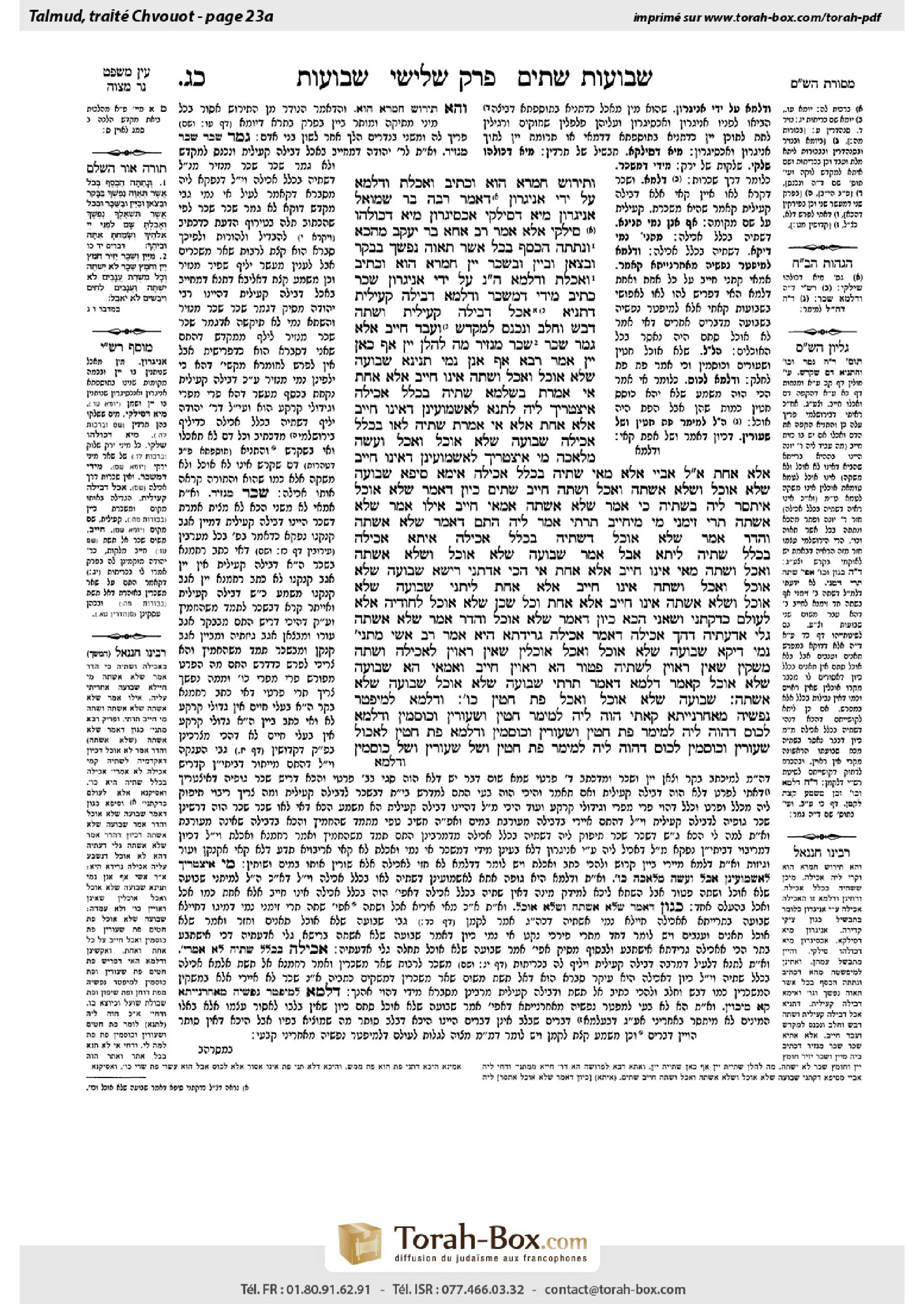
Shevuot 23a: Talmud study for Daf Yomi
Daf Yomi is the daily study of one Talmud folio. Explore 37 tractates with scans, Hebrew text, Sefaria English and AI-generated French translations where annotated.
Passage selection and English or AI-generated French translation are available where the scan has annotations. Daf Study is independent of Torah-Box and Sefaria.
Browse Shevuot · שבועות · All tractatesShevuot 23a text and translations
This page of Shevuot includes the Aramaic text, an English translation and an AI-generated French translation, alongside the scan above.
שבועות כ״ג א · Aramaic and Hebrew text
וְתִירוֹשׁ חַמְרָא הוּא, וּכְתִיב: ״וְאָכַלְתָּ״.
וְדִלְמָא עַל יְדֵי אֲנִיגְרוֹן? דְּאָמַר רַבָּה בַּר שְׁמוּאֵל: אֲנִיגְרוֹן – מַיָּא דְּסִילְקֵי, אַכְּסִיגְרוֹן – מַיָּא דְּכוּלְּהוּ סִילְקִי.
אֶלָּא אָמַר רַב אַחָא בַּר יַעֲקֹב, מֵהָכָא: ״וְנָתַתָּה הַכֶּסֶף בְּכֹל אֲשֶׁר תְּאַוֶּה נַפְשְׁךָ, בַּבָּקָר וּבַצֹּאן וּבַיַּיִן וּבַשֵּׁכָר״; יַיִן חַמְרָא הוּא, וּכְתִיב: ״וְאָכַלְתָּ״.
וְדִלְמָא הָכָא נָמֵי עַל יְדֵי אֲנִיגְרוֹן?
״שֵׁכָר״ כְּתִיב, מִידֵּי דִּמְשַׁכַּר.
וְדִלְמָא דְּבֵילָה קְעִילִית? דְּתַנְיָא: אָכַל דְּבֵילָה קְעִילִית וְשָׁתָה דְּבַשׁ וְחָלָב, וְנִכְנַס לַמִּקְדָּשׁ וְעָבַד – חַיָּיב.
אֶלָּא גָּמַר ״שֵׁכָר״–״שֵׁכָר״ מִנָּזִיר; מָה לְהַלָּן יַיִן, אַף כָּאן יַיִן.
אָמַר רָבָא, אַף אֲנַן נָמֵי תְּנֵינָא: ״שְׁבוּעָה שֶׁלֹּא אוֹכַל״, וְאָכַל וְשָׁתָה – אֵינוֹ חַיָּיב אֶלָּא אַחַת. אִי אָמְרַתְּ בִּשְׁלָמָא שְׁתִיָּה בִּכְלַל אֲכִילָה, אִיצְטְרִיךְ לֵיהּ לְתַנָּא לְאַשְׁמוֹעִינַן דְּאֵינוֹ חַיָּיב אֶלָּא אַחַת. אֶלָּא אִי אָמְרַתְּ שְׁתִיָּה לָאו בִּכְלַל אֲכִילָה, ״שְׁבוּעָה שֶׁלֹּא אוֹכַל״, וְאָכַל וְעָשָׂה מְלָאכָה – מִי אִיצְטְרִיךְ לְאַשְׁמוֹעִינַן דְּאֵינוֹ חַיָּיב אֶלָּא אַחַת?!
אֲמַר לֵיהּ אַבָּיֵי: אֶלָּא מַאי, שְׁתִיָּה בִּכְלַל אֲכִילָה?! אֵימָא סֵיפָא: ״שְׁבוּעָה שֶׁלֹּא אוֹכַל וְשֶׁלֹּא אֶשְׁתֶּה״, וְאָכַל וְשָׁתָה – חַיָּיב שְׁתַּיִם. כֵּיוָן דְּאָמַר ״שֶׁלֹּא אוֹכַל״ – אִיתְּסַר לֵיהּ בִּשְׁתִיָּה; כִּי אָמַר ״שֶׁלֹּא אֶשְׁתֶּה״ – אַמַּאי חַיָּיב? אִילּוּ אָמַר ״שֶׁלֹּא אֶשְׁתֶּה״ תְּרֵי זִימְנֵי, מִי מִיחַיַּיב תַּרְתֵּי?!
אֲמַר לֵיהּ: הָתָם דְּאָמַר ״שֶׁלֹּא אֶשְׁתֶּה״, וַהֲדַר אָמַר ״שֶׁלֹּא אוֹכַל״; דִּשְׁתִיָּה בִּכְלַל אֲכִילָה אִיתַהּ, אֲכִילָה בִּכְלָל שְׁתִיָּה לֵיתַהּ.
אֲבָל אָמַר שְׁבוּעָה ״שֶׁלֹּא אוֹכַל וְשֶׁלֹּא אֶשְׁתֶּה״, וְאָכַל וְשָׁתָה, מַאי – אֵינוֹ חַיָּיב אֶלָּא אַחַת? אִי הָכִי, אַדְּתָנֵי רֵישָׁא: ״שְׁבוּעָה שֶׁלֹּא אוֹכַל״ וְאָכַל וְשָׁתָה אֵינוֹ חַיָּיב אֶלָּא אַחַת; לִיתְנֵי: ״שְׁבוּעָה שֶׁלֹּא אוֹכַל וְשֶׁלֹּא אֶשְׁתֶּה״ אֵינוֹ חַיָּיב אֶלָּא אַחַת – וְכׇל שֶׁכֵּן ״שֶׁלֹּא אוֹכַל״ לְחוֹדֵיהּ!
אֶלָּא לְעוֹלָם כִּדְקָתָנֵי; וְשָׁאנֵי הָכָא, כֵּיוָן דְּאָמַר ״שֶׁלֹּא אוֹכַל״ וַהֲדַר אָמַר ״שֶׁלֹּא אֶשְׁתֶּה״ – גַּלִּי אַדַּעְתֵּיהּ דְּהָךְ אֲכִילָה דְּאָמַר, אֲכִילָה גְּרֵידְתָּא הִיא.
אָמַר רַב אָשֵׁי, מַתְנִיתִין נָמֵי דַּיְקָא: ״שְׁבוּעָה שֶׁלֹּא אוֹכַל״, וְאָכַל אֳוכָלִין שֶׁאֵין רְאוּיִן לַאֲכִילָה, וְשָׁתָה מַשְׁקִין שֶׁאֵין רְאוּיִן לִשְׁתִיָּה – פָּטוּר. הָא רְאוּיִן – חַיָּיב; וְאַמַּאי? הָא ״שְׁבוּעָה שֶׁלֹּא אוֹכַל״ קָאָמַר!
דִּלְמָא דְּאָמַר תַּרְתֵּי: ״שְׁבוּעָה שֶׁלֹּא אוֹכַל״, ״שְׁבוּעָה שֶׁלֹּא אֶשְׁתֶּה״.
שְׁבוּעָה שֶׁלֹּא אוֹכַל, וְאָכַל פַּת חִטִּין כּוּ׳. וְדִלְמָא לְמִיפְטַר נַפְשֵׁיהּ מֵאַחְרָנְיָיתָא קָאָתֵי?
הֲוָה לֵיהּ לְמֵימַר ״חִטִּין וּשְׂעוֹרִין וְכוּסְּמִין״. וְדִלְמָא לָכוֹס?
דַּהֲוָה לֵיהּ לְמֵימַר ״פַּת חִטִּין וּשְׂעוֹרִין וְכוּסְּמִין״. וְדִלְמָא ״פַּת חִטִּין״ – לֶאֱכוֹל, ״שְׂעוֹרִין וְכוּסְּמִין״ – לָכוֹס?
דַּהֲוָה לֵיהּ לְמֵימַר ״פַּת חִטִּין וְשֶׁל שְׂעוֹרִין וְשֶׁל כּוּסְּמִין״.
Shevuot 23a · English translation
And since the Hebrew word tirosh mentioned in the verse is wine, and it is written with regard to it: “And you shall eat,” this indicates that drinking is an activity included in eating.
The Gemara challenges: But perhaps the verse is referring to consuming wine by means of an anigeron, as Rabba bar Shmuel says: Anigeron is a stew of beet greens and wine, and aksigeron is a stew of all types of cooked vegetables. If so, the wine in the verse is not drunk but eaten.
Rather, Rav Aḥa bar Ya’akov said: Cite from here, a verse written with regard to money with which one has redeemed second tithe: “And you shall bestow the money for whatsoever your soul desires, for oxen, or for sheep, or for wine [uvayyayin], or for strong drink, or for whatsoever your soul asks of you; and you shall eat there before the Lord your God, and you shall rejoice, you and your household” (Deuteronomy 14:26). The Hebrew word yayin mentioned in the verse is wine, and it is written: “And you shall eat.”
The Gemara challenges: But perhaps here this verse is also referring to consuming wine by means of an anigeron.
The Gemara rejects this: “Strong drink” is written in the verse, referring to something intoxicating, and wine mixed into a stew is not intoxicating.
The Gemara challenges: But perhaps the intoxicating substance referred to in the verse is pressed figs from Ke’ila, as it is taught in a baraita: A priest who ate pressed figs from Ke’ila or drank honey or milk and then entered the Temple and performed the sacrificial rites is liable for violating the prohibition against conducting the Temple service while intoxicated.
Rather, one derives the meaning of “strong drink” in this verse by means of a verbal analogy from the verse about a nazirite: “He shall abstain from wine and strong drink: He shall drink no vinegar of wine, or vinegar of strong drink, neither shall he drink any liquor of grapes, nor eat fresh grapes or dried” (Numbers 6:3). Just as there, the strong drink that is forbidden to the nazirite is referring to a type of wine, so too here, the verse is referring to wine.
§ Rava said: We learn in the mishna as well that drinking is included in eating. The mishna teaches: If one said: On my oath I will not eat, and then he ate and drank, he is liable to bring only one offering. Granted, if you say that drinking is included in eating, that is why it was necessary for the tanna to teach us that he is liable to bring only one offering. But if you say that drinking is not included in eating, there is no reason for the tanna to teach that it is only one violation. If one says: On my oath I will not eat, and he ate and performed some kind of labor, would it be necessary to teach us that the person is liable to bring only one offering? He never took an oath prohibiting labor.
Abaye said to him: What, rather, is your conclusion; that drinking is included in eating? Say the latter clause of the mishna: If he said: On my oath I will not eat and I will not drink, and then he ate and drank, he is liable to bring two offerings. According to you, Rava, once he said: I will not eat, drinking became forbidden to him, so when he said: I will not drink, why is he rendered liable to bring a separate offering? If he had said: I will not drink, two times, would he be liable to bring two offerings?
Rava said to him: There, in the mishna, it is actually a case where he said: I will not drink, and then said: I will not eat. Although it is so that drinking is included in eating, it is not so that eating is included in drinking, and the oath not to drink went into effect independently of the oath not to eat. Therefore, he is liable to bring two offerings.
The Gemara asks: But according to this, if he said: On my oath I will not eat and I will not drink, and he then ate and drank, what is the halakha? Is it that he is liable to bring only one offering? If that is so, rather than teaching in the first clause of the mishna that one who said: On my oath I will not eat, and then ate and drank, is liable to bring only one offering, let the tanna teach the following: If one says: On my oath I will not eat and I will not drink, and he ate and drank, he is liable to bring only one offering. From that ruling it could be concluded that when one takes an oath: I will not eat, alone, all the more so is he liable to bring only one offering.
Rather, the mishna actually is as it is taught, that one who took an oath not to eat and drink, and then ate and drank, is liable to bring two offerings, even though drinking is included in eating. And here it is different. Since he said: I will not eat, and then said: I will not drink, he revealed his intention that the eating that he stated first is eating alone and does not include drinking.
Rav Ashi said: The mishna is also precisely formulated in accordance with the opinion of Shmuel that drinking is included in eating. It teaches: If he said: On my oath I will not eat, and he ate foods that are inedible or drank liquids that are not potable, he is exempt. But if those liquids were fit for consumption, he would be liable. And why? The mishna teaches that he took an oath saying: On my oath I will not eat, without mentioning drinking, which indicates that drinking is included in eating.
The Gemara rejects this: Perhaps the mishna is referring to a case where he said both: On my oath I will not eat and: On my oath I will not drink. The mishna did not spell out the second oath because its primary interest was in teaching that eating or drinking that which is inedible or not potable is not considered eating or drinking.
§ The mishna teaches that if one said: On my oath I will not eat, and then he ate wheat bread and barley bread and spelt bread, he is liable to bring only one offering. If he said: On my oath I will not eat wheat bread or barley bread or spelt bread, and then he ate all of them, he is liable to bring an offering for each one. The Gemara challenges: But perhaps when he details each type of bread it comes to ensure that he exempts himself from having other foods included in the oath, not to indicate that each type of bread is a separate oath.
The Gemara answers: If that was his intention, then he could have just said: Wheat, barley, and spelt, without mentioning bread each time. From the fact that he mentioned bread each time, it can be understood that his intention was that each be considered a separate oath. The Gemara rejects this: But if he did not mention bread, perhaps his oath could be interpreted to prohibit chewing [lakhos] whole kernels of these grains, and he consequently mentioned bread to limit the oath to bread.
The Gemara suggests: If his intention was to ensure that his oath does not extend to other foods, he could have just said: Bread made from wheat, or barley, or spelt, and in that way his oath would be limited to just bread. The Gemara rejects this: If he had said it that way, perhaps his oath could be interpreted to prohibit him from eating wheat bread and from chewing whole kernels of barley or spelt.
The Gemara suggests: If his intention was to ensure that his oath does not extend to other foods, he could have just said: Bread made from wheat, and from barley, and from spelt, thereby limiting his oath to types of bread.
Shevuot 23a · Traduction française (IA)
Puisque le mot hébreu tirosh mentionné dans le verset désigne le vin, et qu’il est écrit à son sujet : « Et tu mangeras », cela indique que boire est compris dans le fait de manger.
La Guemara objecte : Mais peut-être le verset parle-t-il de consommer du vin avec un anigeron, comme le dit Rabba bar Shmuel : un anigeron est un ragoût de feuilles de betterave et de vin, tandis qu’un aksigeron est un ragoût de toutes sortes de légumes cuits. Dans ce cas, le vin mentionné dans le verset n’est pas bu, mais mangé.
Rav Aḥa bar Ya’akov dit plutôt : Citez ce verset, qui concerne l’argent avec lequel on a racheté la seconde dîme : « Tu dépenseras l’argent pour tout ce que ton âme désire, pour des bovins, des ovins, du vin [uvayyayin], ou des boissons fortes, ou pour tout ce que ton âme te demandera ; et tu mangeras là, devant le Seigneur ton Dieu, et tu te réjouiras, toi et ta maison » (Deutéronome 14, 26). Le mot hébreu yayin mentionné dans le verset désigne le vin, et il est écrit : « Et tu mangeras. »
La Guemara objecte : Mais peut-être ce verset parle-t-il lui aussi de consommer du vin avec un anigeron.
La Guemara écarte cette possibilité : le verset mentionne une « boisson forte », qui désigne une substance enivrante, et le vin mélangé à un ragoût n’est pas enivrant.
La Guemara objecte : Mais peut-être la substance enivrante dont parle le verset est-elle des figues pressées de Ke’ila, comme l’enseigne une baraïta : un prêtre qui a mangé des figues pressées de Ke’ila ou bu du miel ou du lait, puis est entré dans le Temple et a accompli le service sacrificiel, est passible pour avoir transgressé l’interdiction d’accomplir le service du Temple en état d’ivresse.
On déduit plutôt le sens de « boisson forte » dans ce verset par une analogie verbale avec le verset concernant le nazir : « Il s’abstiendra de vin et de boisson forte ; il ne boira ni vinaigre de vin ni vinaigre de boisson forte, et il ne boira aucune liqueur de raisin, et ne mangera ni raisins frais ni raisins secs » (Nombres 6, 3). De même que là, la boisson forte interdite au nazir désigne une sorte de vin, de même ici, le verset parle de vin.
§ Rava dit : Nous apprenons également de la Michna que boire est compris dans le fait de manger. La Michna enseigne : Si quelqu’un a dit : « Par serment, je ne mangerai pas », puis a mangé et bu, il n’est passible que d’un seul sacrifice. Il est logique que si l’on affirme que boire est compris dans le fait de manger, le tanna ait dû nous enseigner qu’il n’est passible que d’un seul sacrifice. Mais si l’on affirme que boire n’est pas compris dans le fait de manger, le tanna n’a aucune raison de nous enseigner qu’il s’agit d’une seule transgression. Serait-il nécessaire de nous enseigner que si quelqu’un dit : « Par serment, je ne mangerai pas », puis mange et accomplit une sorte de travail, il n’est passible que d’un seul sacrifice ? Il n’a jamais prêté serment pour interdire le travail.
Abaye lui dit : Quelle est donc, selon toi, la conclusion ? Que boire est compris dans le fait de manger ? Examine alors la dernière partie de la Michna : S’il a dit : « Par serment, je ne mangerai pas et je ne boirai pas », puis a mangé et bu, il est passible de deux sacrifices. Selon toi, Rava, dès qu’il a dit : « Je ne mangerai pas », boire lui est devenu interdit. Alors, lorsqu’il a dit : « Je ne boirai pas », pourquoi est-il passible d’un sacrifice distinct ? S’il avait dit deux fois : « Je ne boirai pas », aurait-il été passible de deux sacrifices ?
Rava lui dit : Dans ce passage de la Michna, il s’agit en réalité d’un cas où il a dit : « Je ne boirai pas », puis : « Je ne mangerai pas ». Bien qu’il soit vrai que boire est compris dans le fait de manger, l’inverse n’est pas vrai : manger n’est pas compris dans le fait de boire. Le serment de ne pas boire a donc pris effet indépendamment du serment de ne pas manger. Il est par conséquent passible de deux sacrifices.
La Guemara demande : Mais, selon cela, quelle est la halakha s’il a dit : « Par serment, je ne mangerai pas et je ne boirai pas », puis a mangé et bu ? N’est-il passible que d’un seul sacrifice ? Si tel est le cas, au lieu d’enseigner dans la première partie de la Michna que celui qui a dit : « Par serment, je ne mangerai pas », puis a mangé et bu, n’est passible que d’un seul sacrifice, le tanna devrait enseigner le cas suivant : si quelqu’un dit : « Par serment, je ne mangerai pas et je ne boirai pas », puis mange et boit, il n’est passible que d’un seul sacrifice. De cette règle, on pourrait conclure que lorsqu’on prête seulement le serment : « Je ne mangerai pas », à plus forte raison n’est-on passible que d’un seul sacrifice.
La Michna est plutôt bien telle qu’elle est enseignée : celui qui a prêté serment de ne pas manger et de ne pas boire, puis a mangé et bu, est passible de deux sacrifices, même si boire est compris dans le fait de manger. Mais le cas présent est différent : puisqu’il a dit « Je ne mangerai pas », puis « Je ne boirai pas », il a révélé son intention : le fait de manger qu’il a mentionné en premier désigne uniquement le fait de manger et ne comprend pas le fait de boire.
Rav Ashi dit : La Michna est également formulée avec précision selon l’opinion de Shmuel, selon laquelle boire est compris dans le fait de manger. Elle enseigne : s’il a dit « Par serment, je ne mangerai pas », puis a mangé des aliments impropres à la consommation ou bu des liquides non potables, il est exempt. Mais si ces liquides avaient été propres à la consommation, il aurait été passible. Pourquoi ? La Michna enseigne qu’il a prêté serment en disant : « Par serment, je ne mangerai pas », sans mentionner le fait de boire, ce qui indique que boire est compris dans le fait de manger.
La Guemara rejette cette interprétation : peut-être la Michna parle-t-elle d’un cas où il a dit à la fois : « Par serment, je ne mangerai pas » et « Par serment, je ne boirai pas ». La Michna n’a pas explicité le second serment, car son propos principal était d’enseigner que manger ou boire ce qui est impropre à la consommation ou non potable n’est pas considéré comme manger ou boire.
§ La Michna enseigne que si quelqu’un a dit : « Par serment, je ne mangerai pas », puis a mangé du pain de blé, du pain d’orge et du pain d’épeautre, il n’est passible que d’un seul sacrifice. S’il a dit : « Par serment, je ne mangerai pas de pain de blé, ni de pain d’orge, ni de pain d’épeautre », puis a mangé les trois, il est passible d’un sacrifice pour chacun. La Guemara objecte : Mais peut-être énumère-t-il chaque sorte de pain afin de s’assurer que d’autres aliments ne soient pas compris dans le serment, et non pour indiquer que chaque sorte de pain fait l’objet d’un serment distinct.
La Guemara répond : S’il avait eu cette intention, il aurait pu simplement dire : « Blé, orge et épeautre », sans mentionner « pain » chaque fois. Le fait qu’il ait mentionné « pain » chaque fois permet de comprendre qu’il avait l’intention que chaque sorte fasse l’objet d’un serment distinct. La Guemara rejette cette réponse : Mais s’il n’avait pas mentionné « pain », son serment aurait peut-être pu être interprété comme interdisant de mâcher [lakhos] des grains entiers de ces céréales ; il a donc mentionné le pain pour limiter le serment au pain.
La Guemara suggère : S’il avait eu l’intention de s’assurer que son serment ne s’étende pas à d’autres aliments, il aurait pu simplement dire : « Du pain fait de blé, ou d’orge, ou d’épeautre », limitant ainsi son serment au seul pain. La Guemara rejette cette réponse : S’il l’avait formulé ainsi, son serment aurait peut-être pu être interprété comme lui interdisant de manger du pain de blé et de mâcher des grains entiers d’orge ou d’épeautre.
La Guemara suggère : S’il avait eu l’intention de s’assurer que son serment ne s’étende pas à d’autres aliments, il aurait pu simplement dire : « Du pain fait de blé, d’orge et d’épeautre », limitant ainsi son serment aux sortes de pain.
Traduction française générée par IA à partir de l’édition anglaise de Sefaria. Vérifie toujours un passage avec le texte source.
Text from Sefaria: William Davidson Edition - Vocalized Aramaic (CC BY NC); William Davidson Edition - English (CC BY NC).