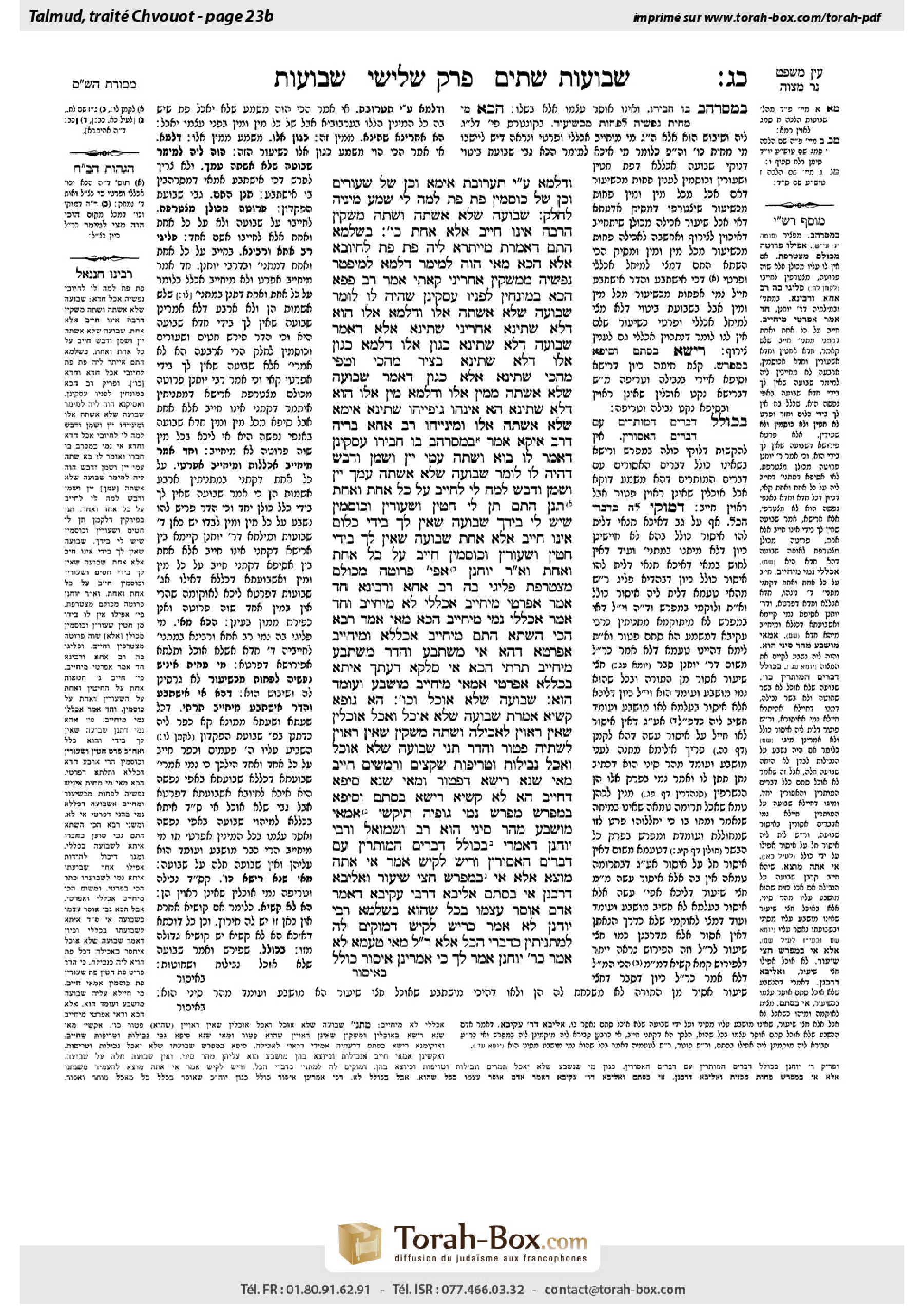
Shevuot 23b: Talmud study for Daf Yomi
Daf Yomi is the daily study of one Talmud folio. Explore 37 tractates with scans, Hebrew text, Sefaria English and AI-generated French translations where annotated.
Passage selection and English or AI-generated French translation are available where the scan has annotations. Daf Study is independent of Torah-Box and Sefaria.
Browse Shevuot · שבועות · All tractatesShevuot 23b text and translations
This page of Shevuot includes the Aramaic text, an English translation and an AI-generated French translation, alongside the scan above.
שבועות כ״ג ב · Aramaic and Hebrew text
וְדִלְמָא עַל יְדֵי תַּעֲרוֹבֶת?
אֵימָא ״וְכֵן שֶׁל שְׂעוֹרִים וְכֵן שֶׁל כּוּסְּמִין״; ״פַּת״ ״פַּת״ לְמָה לִי? שְׁמַע מִינַּהּ לְחַלֵּק.
״שְׁבוּעָה שֶׁלֹּא אֶשְׁתֶּה״ וְשָׁתָה מַשְׁקִין הַרְבֵּה, אֵינוֹ חַיָּיב אֶלָּא אַחַת כּוּ׳. בִּשְׁלָמָא הָתָם, דְּאָמְרַתְּ מְיַיתְּרָא לֵיהּ ״פַּת״ ״פַּת״ לְחִיּוּבָא; אֶלָּא הָכָא, מַאי הֲוָה לְמֵימַר? דִּלְמָא לְמִיפְטַר נַפְשֵׁיהּ מִמַּשְׁקִין אַחֲרִינֵי קָאָתֵי!
אָמַר רַב פָּפָּא: הָכָא בְּמוּנָּחִין לְפָנָיו עָסְקִינַן, שֶׁהָיָה לוֹ לוֹמַר ״שְׁבוּעָה שֶׁלֹּא אֶשְׁתֶּה אֵלּוּ״. וְדִלְמָא אֵלּוּ הוּא דְּלָא שָׁתֵינָא, אַחֲרִינֵי שָׁתֵינָא?
אֶלָּא דְּאָמַר ״שְׁבוּעָה דְּלָא שָׁתֵינָא כְּגוֹן אֵלּוּ״. דִּלְמָא כְּגוֹן אֵלּוּ דְּלָא שָׁתֵינָא; בְּצִיר מֵהָכִי וּטְפֵי מֵהָכִי שָׁתֵינָא?
אֶלָּא כְּגוֹן דְּאָמַר: ״שְׁבוּעָה שֶׁלֹּא אֶשְׁתֶּה מִמִּין אֵלּוּ״. וְדִלְמָא מִין אֵלּוּ הוּא דְּלָא שָׁתֵינָא, הָא אִינְהוּ גּוּפַיְיהוּ שָׁתֵינָא?
אֵימָא ״שֶׁלֹּא אֶשְׁתֶּה אֵלּוּ וּמִינַּיְיהוּ״.
רַב אַחָא בְּרֵיהּ דְּרַב אִיקָא אָמַר: בִּמְסַרְהֵב בּוֹ חֲבֵירוֹ עָסְקִינַן, דְּאָמַר לוֹ: ״בּוֹא וּשְׁתֵה עִמִּי יַיִן וְשֶׁמֶן וּדְבַשׁ״. דְּהָיָה לוֹ לוֹמַר: ״שְׁבוּעָה שֶׁלֹּא אֶשְׁתֶּה עִמְּךָ״, ״יַיִן וְשֶׁמֶן וּדְבַשׁ״ לְמָה לִי? לְחַיֵּיב עַל כׇּל אַחַת וְאַחַת.
תְּנַן הָתָם: ״תֵּן לִי חִטִּין וּשְׂעוֹרִין וְכוּסְּמִין שֶׁיֵּשׁ לִי בְּיָדְךָ״, ״שְׁבוּעָה שֶׁאֵין לְךָ בְּיָדִי כְּלוּם״ – אֵינוֹ חַיָּיב אֶלָּא אַחַת. ״שְׁבוּעָה שֶׁאֵין לְךָ בְּיָדִי חִטִּין וּשְׂעוֹרִין וְכוּסְּמִין״ – חַיָּיב עַל כׇּל אַחַת וְאַחַת.
וְאָמַר רַבִּי יוֹחָנָן: אֲפִילּוּ פְּרוּטָה מִכּוּלָּם מִצְטָרֶפֶת.
פְּלִיגִי בַּהּ רַב אַחָא וְרָבִינָא; חַד אָמַר: אַפְּרָטֵי מִיחַיַּיב, אַכְּלָלֵי לָא מִיחַיַּיב; וְחַד אָמַר: אַכְּלָלֵי נָמֵי מִיחַיַּיב.
הָכָא מַאי?
אָמַר רָבָא: הָכִי הַשְׁתָּא?! הָתָם מִיחַיַּיב אַכְּלָלָא וּמִיחַיַּיב אַפְּרָטָא, דְּהָא אִי מִשְׁתְּבַע וַהֲדַר מִשְׁתְּבַע – מִיחַיַּיב תַּרְתֵּי. הָכָא, אִי סָלְקָא דַעְתָּךְ אִיתָא בִּכְלָלָא, אַפְּרָטֵי אַמַּאי מִיחַיַּיב? מוּשְׁבָּע וְעוֹמֵד הוּא!
שְׁבוּעָה שֶׁלֹּא אוֹכַל וְכוּ׳. הָא גוּפַאּ קַשְׁיָא – אָמְרַתְּ: ״שְׁבוּעָה שֶׁלֹּא אוֹכַל״, וְאָכַל אֳוכָלִין שֶׁאֵין רְאוּיִן לַאֲכִילָה וְשָׁתָה מַשְׁקִין שֶׁאֵין רְאוּיִן לִשְׁתִיָּה – פָּטוּר; וַהֲדַר תָּנֵי: ״שְׁבוּעָה שֶׁלֹּא אוֹכַל״, וְאָכַל נְבֵילוֹת וּטְרֵיפוֹת, שְׁקָצִים וּרְמָשִׂים – חַיָּיב; מַאי שְׁנָא רֵישָׁא דְּפָטוּר, וּמַאי שְׁנָא סֵיפָא דְּחַיָּיב?
הָא לָא קַשְׁיָא; רֵישָׁא בִּסְתָם, וְסֵיפָא בִּמְפָרֵשׁ.
מְפָרֵשׁ נָמֵי גּוּפֵיהּ תִּיקְשֵׁי – אַמַּאי מוּשְׁבָּע מֵהַר סִינַי הוּא?
רַב וּשְׁמוּאֵל וְרַבִּי יוֹחָנָן דְּאָמְרִי: בְּכוֹלֵל דְּבָרִים הַמּוּתָּרִין עִם דְּבָרִים הָאֲסוּרִין.
וְרֵישׁ לָקִישׁ אָמַר: אִי אַתָּה מוֹצֵא אֶלָּא אִי בִּמְפָרֵשׁ חֲצִי שִׁיעוּר – וְאַלִּיבָּא דְרַבָּנַן; אִי בִּסְתָם – אַלִּיבָּא דְּרַבִּי עֲקִיבָא, דְּאָמַר: אָדָם אוֹסֵר עַצְמוֹ בְּכׇל שֶׁהוּא.
בִּשְׁלָמָא רַבִּי יוֹחָנָן לָא אָמַר כְּרֵישׁ לָקִישׁ – דְּמוֹקֵים לָהּ לְמַתְנִיתִין כְּדִבְרֵי הַכֹּל; אֶלָּא רֵישׁ לָקִישׁ, מַאי טַעְמָא לָא אָמַר כְּרַבִּי יוֹחָנָן?
אָמַר לְךָ: כִּי אָמְרִינַן אִיסּוּר כּוֹלֵל –
Shevuot 23b · English translation
The Gemara rejects this: But if he had said it that way, perhaps his oath could be interpreted to prohibit only bread made from a mixture of all these grains.
The Gemara suggests: If the specification in the mishna serves merely to ensure that his oath does not extend to other foods, have him say: Bread made from wheat and so from barley and so from spelt. Why do I need to repeat: Bread, bread, each time? Conclude from it that the point of repeating the word bread each time is to individuate each statement as a separate oath.
§ The mishna teaches: If he said: On my oath I will not drink, and then he drank several kinds of liquids, he is liable to bring only one offering. If he says: On my oath I will not drink wine, or oil, or honey, and he drank all of them, he is liable to bring an offering for each and every one. The Gemara asks: Granted, there, in the case of the bread, the ruling of the mishna is understood, as you said that the word bread before barley, and the word bread before spelt are superfluous and serve to extend his liability so that each is considered an independent oath. But here, where there is no superfluous language, what was there to say? Perhaps the oath comes to ensure that he exempts himself so that the oath does not extend to other liquids. Since that is a possibility, he should not be liable for breaking three separate oaths when he drank all three liquids.
Rav Pappa said: We are dealing here with a situation where all three liquids are placed before him. Under the circumstances, if he merely wished to indicate that his oath is limited to these liquids, he could have said: On my oath I will not drink these. Since he instead specified the liquids in the oath, it was in order to indicate that each should be considered as a separate oath. The Gemara challenges: But had he said: I will not drink these, perhaps his oath would be interpreted as meaning: It is these liquids, which are before me right now, that I will not drink, but I will drink other wine, oil, and honey.
The Gemara answers: Rather, if he merely wished to indicate that his oath is limited to these types of liquids, it would be a case where he said: On my oath I will not drink liquids such as these. The Gemara challenges: Had he said it that way, perhaps it could be interpreted as referring to the volume of the liquids: I will not drink liquids such as these, but I will drink less than this or more than this.
The Gemara answers: Rather, if he merely wished to indicate that his oath is limited to these types of liquids, it is a case where he said: On my oath I will not drink from these types of liquids. The Gemara challenges: But had he said it that way, perhaps his oath would be interpreted to mean: I will not drink these types of liquids in general, but I will drink these particular liquids in front of me.
The Gemara suggests: If the point of the specification of the liquids in the mishna was merely to ensure that his oath does not extend to other liquids, have him say: On my oath I will not drink these and liquids of their types. Since he instead specified: Wine, oil, and honey, one may conclude that his intention was to individuate each liquid as a separate oath.
Rav Aḥa, son of Rav Ika, said: We are dealing with a case in which another is importuning him to drink, as he said to him: Come, drink wine, and oil, and honey with me; if he wanted him to desist, he should have said: On my oath I will not drink with you. Under these circumstances, why do I need him to specify: Wine, and oil, and honey? The specification of the liquids serves to indicate his intention to render himself liable for each and every one.
§ We learned in a mishna elsewhere (36b) with regard to an oath concerning a deposit, that if one says to his bailee: Give me my wheat, barley, and spelt that are in your possession, and the bailee lies and says: On my oath nothing of yours is in my possession, he is liable to bring only one guilt-offering. But if the bailee says: On my oath I do not have in my possession any wheat, barley, or spelt that belong to you, he is liable to bring a separate offering for each and every one.
And Rabbi Yoḥanan says with regard to that mishna that he is liable even if the value of all three species combines to amount to as little as one peruta.
Rav Aḥa and Ravina disagree with regard to this. One said: When the bailee says: On my oath I do not have in my possession any wheat, barley, or spelt that belong to you, he is liable to bring a guilt-offering only for violating the specific oaths for individual types of grain, and he is not liable for violating a general oath that he does not have anything in his possession. Consequently, Rabbi Yoḥanan’s statement that the different types of grains can be combined to amount to one peruta is referring only to the oath in the first clause of the mishna where he did not specify the grains. And one said: He is also liable for violating a general oath, and in the latter clause of the mishna he is liable for violating four oaths: One general oath that he does not have anything in his possession and three specific oaths, one for each type of grain. Consequently, Rabbi Yoḥanan’s statement applies also to where he specifies the grains, and he is liable to bring one offering even when all three species combine to amount to only one peruta.
The Gemara asks: Here, in the case of one who takes an oath that he will not eat wheat bread, barley bread, or spelt bread, what is the halakha? Is there a dispute as to whether he is considered to have taken a general oath alongside the specific oaths?
Rava said: How can these cases be compared? There, in the case of an oath of a deposit, he is liable for the general oath and for the specific oath, since if a bailee takes an oath denying that he is in possession of a deposit and then takes another oath to the same effect, he is liable for taking two false oaths on a deposit. Here, with regard to an oath to prohibit oneself from eating, if it enters your mind that he is bound by a general oath, why would he be liable for the specific oaths? He is already under an oath due to the general oath, and an oath cannot take effect when the matter it prohibits is already forbidden by another oath.
§ The mishna teaches that if one said: On my oath I will not eat, and he ate foods that are inedible, he is exempt. If he said: On my oath I will not eat, and then he ate the meat of unslaughtered carcasses, he is liable. The Gemara asks: This mishna itself is difficult. You said that if one said: On my oath I will not eat, and he ate foods that are inedible, or drank liquids that are not potable, he is exempt. And then the mishna teaches that if one says: On my oath I will not eat, and then he ate the meat of unslaughtered carcasses or tereifot, repugnant creatures or creeping animals, he is liable. What is different about the first clause that he is exempt and what is different about the latter clause that he is liable? Non-kosher animals are also unfit to be eaten.
The Gemara answers: This is not difficult. The first clause is where he took an oath not to eat without specifying what is included in it. Presumably, his oath did not include items that are not ordinarily eaten. And the latter clause is a case where he specifies what it is he will not eat, e.g., unslaughtered carcasses, and nevertheless eats them.
The Gemara asks: You may also raise a difficulty with regard to the case where he specifies that he will not eat non-kosher items: Why? He is under oath from Mount Sinai, and an oath does not take effect to prohibit that which is already forbidden.
Rav and Shmuel and Rabbi Yoḥanan all say that this is a case where he incorporates into the oath that he will not eat some permitted items, along with the statement concerning the forbidden items. Since the oath takes effect with regard to the permitted items, it extends also to the forbidden ones.
And Reish Lakish says: You find that one is liable for eating non-kosher food as the result of an oath only if it is an oath where he specifies that it includes a half-measure, and in accordance with the opinion of the Rabbis that one is not liable for eating a half-measure unless it is specified in the oath. Since eating a half-measure is not prohibited by Torah law, the oath takes effect. Alternatively, you find that one is liable if he took the oath without specifying that the oath prohibits less than the usual measure, and in accordance with the opinion of Rabbi Akiva, who says that a person renders himself prohibited from eating any amount by taking an oath not to eat.
The Gemara asks: Granted, it is understood why Rabbi Yoḥanan did not say like Reish Lakish, as he interprets the mishna so that it is in accordance with the opinion of everyone; but what is the reason that Reish Lakish does not say like the opinion of Rabbi Yoḥanan?
The Gemara answers: Reish Lakish could say to you: When we say that a more inclusive prohibition, which adds additional aspects to the prohibition for the same individual, can take effect where there already is a prohibition in place,
Shevuot 23b · Traduction française (IA)
La Guemara rejette cette explication : mais s’il l’avait formulé ainsi, son serment aurait peut-être pu être compris comme n’interdisant que le pain fait d’un mélange de toutes ces céréales.
La Guemara propose : si la précision de la Michna sert seulement à empêcher que son serment s’étende à d’autres aliments, qu’il dise : « Du pain de blé, et de même pour l’orge, et de même pour l’épeautre. » Pourquoi répéter chaque fois le mot « pain » ? Déduis-en que cette répétition vise à faire de chaque énoncé un serment distinct.
§ La Michna enseigne : s’il a dit : « Par serment, je ne boirai pas », puis a bu plusieurs sortes de liquides, il n’est tenu d’apporter qu’un seul sacrifice. S’il a dit : « Par serment, je ne boirai ni vin, ni huile, ni miel », et qu’il en a bu de toutes ces sortes, il est tenu d’apporter un sacrifice pour chacune d’elles. La Guemara demande : Certes, dans le cas du pain, la décision de la Michna s’explique, puisque tu as dit que le mot « pain » avant « orge » et le mot « pain » avant « épeautre » sont superflus et servent à étendre sa responsabilité, de sorte que chacun soit considéré comme un serment indépendant. Mais ici, où aucun terme n’est superflu, qu’y avait-il à dire ? Peut-être le serment vise-t-il seulement à limiter sa portée, afin qu’il ne s’étende pas à d’autres liquides. Puisque c’est possible, il ne devrait pas être tenu pour avoir enfreint trois serments distincts en buvant les trois liquides.
Rav Pappa dit : nous sommes ici dans un cas où les trois liquides sont placés devant lui. Dans ces circonstances, s’il voulait seulement indiquer que son serment se limite à ces liquides, il aurait pu dire : « Par serment, je ne boirai pas ceux-ci. » Puisqu’il a plutôt nommé les liquides dans son serment, c’était pour indiquer que chacun devait être considéré comme un serment distinct. La Guemara objecte : mais s’il avait dit : « Je ne boirai pas ceux-ci », son serment aurait peut-être pu être compris ainsi : « Je ne boirai pas ces liquides qui sont devant moi en ce moment, mais je boirai d’autres vins, huiles et miels. »
La Guemara répond : s’il voulait seulement indiquer que son serment se limite à ces sortes de liquides, il aurait dit : « Par serment, je ne boirai pas de liquides comme ceux-ci. » La Guemara objecte : s’il l’avait formulé ainsi, cela aurait peut-être pu être compris comme faisant référence au volume des liquides : « Je ne boirai pas de liquides comme ceux-ci, mais j’en boirai une quantité moindre ou supérieure. »
La Guemara répond : s’il voulait seulement indiquer que son serment se limite à ces sortes de liquides, il aurait dit : « Par serment, je ne boirai pas de ces sortes de liquides. » La Guemara objecte : mais s’il l’avait formulé ainsi, son serment aurait peut-être pu être compris ainsi : « Je ne boirai pas de ces sortes de liquides en général, mais je boirai ces liquides particuliers qui sont devant moi. »
La Guemara propose : si la précision concernant les liquides dans la Michna visait seulement à empêcher que son serment s’étende à d’autres liquides, qu’il dise : « Par serment, je ne boirai pas ceux-ci ni des liquides de leur sorte. » Puisqu’il a plutôt précisé : « vin, huile et miel », on peut en conclure qu’il voulait faire de chaque liquide un serment distinct.
Rav Aḥa, fils de Rav Ika, dit : nous sommes dans un cas où quelqu’un le presse de boire, en lui disant : « Viens, bois du vin, de l’huile et du miel avec moi. » S’il voulait que l’autre cesse de le presser, il aurait dû dire : « Par serment, je ne boirai pas avec toi. » Dans ces circonstances, pourquoi préciser : « du vin, de l’huile et du miel » ? Cette précision indique qu’il avait l’intention de se rendre responsable pour chacun de ces liquides.
§ Nous avons appris dans une Michna ailleurs (36b), au sujet d’un serment relatif à un dépôt, que si quelqu’un dit à son dépositaire : « Rends-moi mon blé, mon orge et mon épeautre qui sont en ta possession », et que le dépositaire ment en disant : « Par serment, je n’ai rien qui t’appartienne en ma possession », il n’est tenu d’apporter qu’un seul sacrifice de culpabilité. Mais si le dépositaire dit : « Par serment, je n’ai en ma possession ni blé, ni orge, ni épeautre qui t’appartiennent », il est tenu d’apporter un sacrifice distinct pour chacune de ces espèces.
Et Rabbi Yoḥanan dit à propos de cette Michna qu’il est tenu d’apporter ce sacrifice même si la valeur des trois espèces réunies ne représente qu’une perouta.
Rav Aḥa et Ravina sont en désaccord à ce sujet. L’un dit : lorsque le dépositaire dit : « Par serment, je n’ai en ma possession ni blé, ni orge, ni épeautre qui t’appartiennent », il est tenu d’apporter un sacrifice de culpabilité uniquement pour avoir enfreint les serments précis portant sur chaque sorte de céréale, et non pour avoir enfreint un serment général selon lequel il n’a rien en sa possession. Par conséquent, la déclaration de Rabbi Yoḥanan, selon laquelle les différentes sortes de céréales peuvent être réunies pour atteindre la valeur d’une perouta, ne concerne que le serment de la première partie de la Michna, où il n’a pas précisé les céréales. L’autre dit : il est également tenu pour avoir enfreint un serment général ; dans la dernière partie de la Michna, il est donc tenu pour avoir enfreint quatre serments : un serment général selon lequel il n’a rien en sa possession et trois serments précis, un pour chaque sorte de céréale. Par conséquent, la déclaration de Rabbi Yoḥanan s’applique aussi au cas où il précise les céréales, et il est tenu d’apporter un seul sacrifice même lorsque les trois espèces réunies ne valent qu’une perouta.
La Guemara demande : ici, dans le cas de celui qui jure qu’il ne mangera ni pain de blé, ni pain d’orge, ni pain d’épeautre, quelle est la halakha ? Existe-t-il un désaccord sur le point de savoir si l’on considère qu’il a prêté un serment général en plus des serments précis ?
Rava dit : comment peut-on comparer ces cas ? Dans le cas d’un serment relatif à un dépôt, il est tenu pour avoir enfreint le serment général et les serments précis, car si un dépositaire jure qu’il ne détient pas un dépôt, puis prête un autre serment en ce sens, il est tenu pour avoir prêté deux faux serments concernant un dépôt. Ici, s’agissant d’un serment par lequel on s’interdit de manger, si tu pensais qu’il est lié par un serment général, pourquoi serait-il tenu pour avoir enfreint les serments précis ? Il est déjà lié par un serment en vertu du serment général, et un serment ne prend pas effet lorsque ce qu’il interdit est déjà interdit par un autre serment.
§ La Michna enseigne que si quelqu’un dit : « Par serment, je ne mangerai pas », puis mange des aliments impropres à la consommation, il est quitte. S’il dit : « Par serment, je ne mangerai pas », puis mange de la viande de carcasses d’animaux non abattus rituellement, il est tenu pour responsable. La Guemara demande : cette Michna elle-même est difficile. Tu as dit que si quelqu’un dit : « Par serment, je ne mangerai pas », puis mange des aliments impropres à la consommation ou boit des liquides qui ne sont pas potables, il est quitte. Ensuite, la Michna enseigne que si quelqu’un dit : « Par serment, je ne mangerai pas », puis mange de la viande de carcasses d’animaux non abattus rituellement ou de tereifot, des créatures répugnantes ou des reptiles, il est tenu pour responsable. En quoi le premier cas diffère-t-il pour qu’il soit quitte, et en quoi le dernier cas diffère-t-il pour qu’il soit tenu pour responsable ? Les animaux non cachères sont eux aussi impropres à la consommation.
La Guemara répond : il n’y a pas de difficulté. Le premier cas concerne celui qui a prêté serment de ne pas manger sans préciser ce que cela inclut. On présume que son serment n’incluait pas les aliments que l’on ne mange pas habituellement. Le dernier cas concerne celui qui précise ce qu’il ne mangera pas, par exemple des carcasses d’animaux non abattus rituellement, et qui les mange néanmoins.
La Guemara demande : on peut aussi soulever une difficulté à propos du cas où il précise qu’il ne mangera pas d’aliments non cachères : pourquoi ? Il est déjà lié par le serment du mont Sinaï, et un serment ne prend pas effet pour interdire ce qui est déjà interdit.
Rav, Shmuel et Rabbi Yoḥanan disent tous qu’il s’agit d’un cas où il inclut dans son serment certains aliments permis, en même temps qu’il mentionne les aliments interdits. Puisque le serment prend effet à l’égard des aliments permis, il s’étend également aux aliments interdits.
Et Reish Lakish dit : on ne trouve un cas où quelqu’un est tenu pour responsable d’avoir mangé un aliment non cachère à la suite d’un serment que si le serment précise qu’il inclut une demi-mesure, conformément à l’opinion des Rabbins selon laquelle on n’est pas tenu pour responsable d’avoir mangé une demi-mesure à moins que celle-ci soit précisée dans le serment. Puisque manger une demi-mesure n’est pas interdit par la Torah, le serment prend effet. Autre possibilité : on peut trouver qu’il est tenu pour responsable s’il a prêté serment sans préciser que le serment interdit une quantité inférieure à la mesure habituelle, conformément à l’opinion de Rabbi Akiva, qui dit qu’une personne s’interdit toute quantité en prêtant serment de ne pas manger.
La Guemara demande : certes, on comprend pourquoi Rabbi Yoḥanan ne soutient pas l’opinion de Reish Lakish, puisqu’il interprète la Michna de sorte qu’elle soit conforme à l’opinion de tous ; mais pourquoi Reish Lakish ne soutient-il pas l’opinion de Rabbi Yoḥanan ?
La Guemara répond : Reish Lakish pourrait te dire : lorsque nous disons qu’une interdiction plus englobante, qui ajoute des aspects à l’interdiction pour une même personne, peut prendre effet alors qu’une interdiction est déjà en vigueur,
Traduction française générée par IA à partir de l’édition anglaise de Sefaria. Vérifie toujours un passage avec le texte source.
Text from Sefaria: William Davidson Edition - Vocalized Aramaic (CC BY NC); William Davidson Edition - English (CC BY NC).