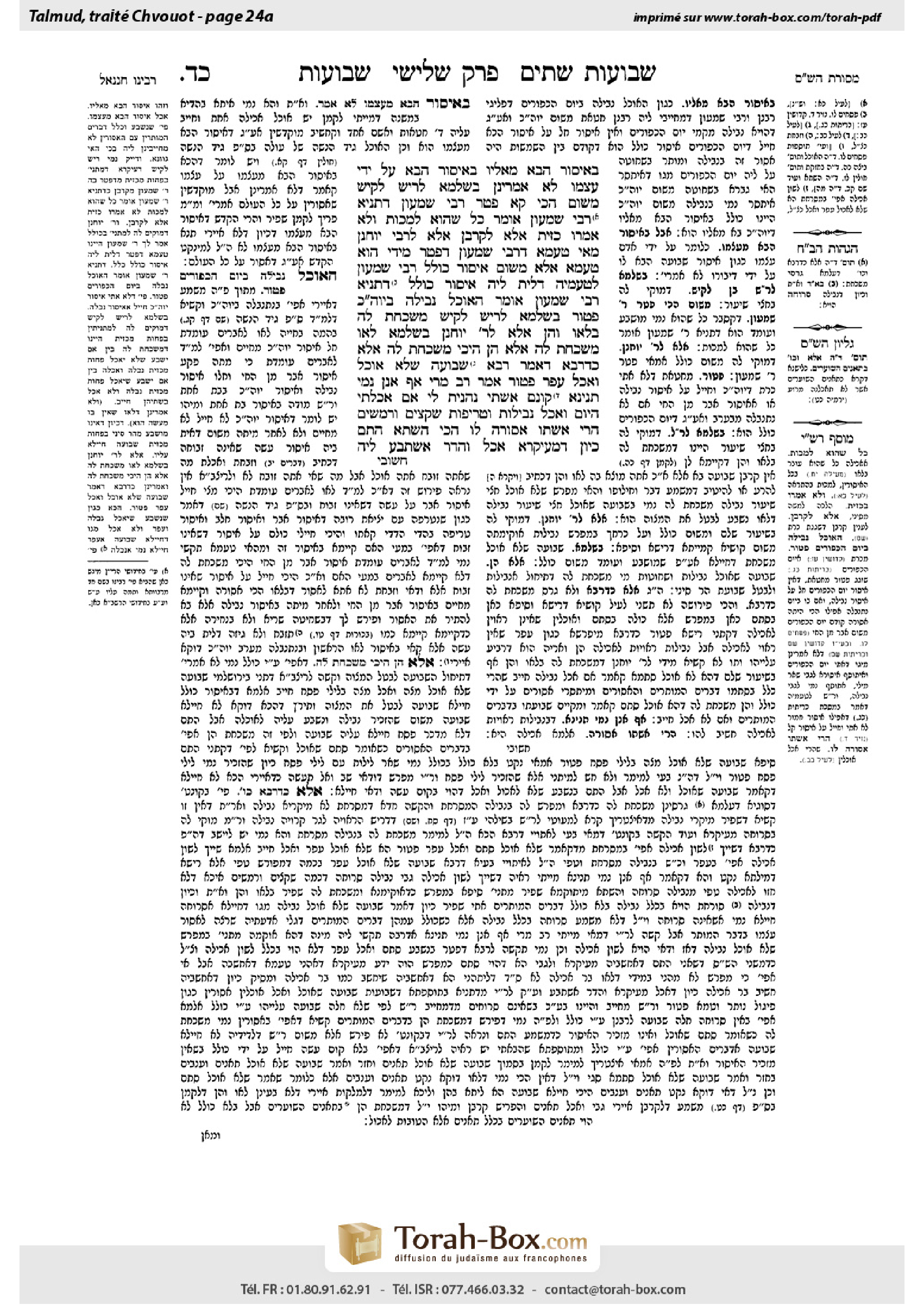
Shevuot 24a: Talmud study for Daf Yomi
Daf Yomi is the daily study of one Talmud folio. Explore 37 tractates with scans, Hebrew text, Sefaria English and AI-generated French translations where annotated.
Passage selection and English or AI-generated French translation are available where the scan has annotations. Daf Study is independent of Torah-Box and Sefaria.
Browse Shevuot · שבועות · All tractatesShevuot 24a text and translations
This page of Shevuot includes the Aramaic text, an English translation and an AI-generated French translation, alongside the scan above.
שבועות כ״ד א · Aramaic and Hebrew text
בְּאִיסּוּר הַבָּא מֵאֵלָיו; בְּאִיסּוּר הַבָּא עַל יְדֵי עַצְמוֹ לָא אָמְרִינַן.
בִּשְׁלָמָא לְרֵישׁ לָקִישׁ, מִשּׁוּם הָכִי קָא פָטַר רַבִּי שִׁמְעוֹן; דְּתַנְיָא, רַבִּי שִׁמְעוֹן אוֹמֵר: כׇּל שֶׁהוּא לְמַכּוֹת, וְלֹא אָמְרוּ כְּזַיִת אֶלָּא לְקׇרְבָּן. אֶלָּא לְרַבִּי יוֹחָנָן, מַאי טַעְמָא דְּרַבִּי שִׁמְעוֹן דְּפָטַר?
מִידֵּי הוּא טַעְמָא – אֶלָּא מִשּׁוּם אִיסּוּר כּוֹלֵל; רַבִּי שִׁמְעוֹן לְטַעְמֵיהּ דְּלֵית לֵיהּ אִיסּוּר כּוֹלֵל. דְּתַנְיָא, רַבִּי שִׁמְעוֹן אוֹמֵר: הָאוֹכֵל נְבֵילָה בְּיוֹם הַכִּפּוּרִים – פָּטוּר.
בִּשְׁלָמָא לְרֵישׁ לָקִישׁ, מַשְׁכַּחַתְּ לַהּ בְּלָאו וָהֵן; אֶלָּא לְרַבִּי יוֹחָנָן, בִּשְׁלָמָא לָאו – מַשְׁכַּחַתְּ לַהּ, אֶלָּא הֵן – הֵיכִי מַשְׁכַּחַתְּ לַהּ?
אֶלָּא כִּדְרָבָא, דְּאָמַר רָבָא: ״שְׁבוּעָה שֶׁלֹּא אוֹכַל״, וְאָכַל עָפָר – פָּטוּר.
אָמַר רַב מָרִי, אַף אֲנַן נָמֵי תְּנֵינָא: ״קוּנָּם אִשְׁתִּי נֶהֱנֵית לִי אִם אָכַלְתִּי הַיּוֹם״, וְאָכַל נְבֵילוֹת וּטְרֵיפוֹת, שְׁקָצִים וּרְמָשִׂים – הֲרֵי אִשְׁתּוֹ אֲסוּרָה לוֹ.
הָכִי הַשְׁתָּא?! הָתָם, כֵּיוָן דְּמֵעִיקָּרָא (אכל) [אַכְלֵיהּ] וַהֲדַר אִשְׁתְּבַע (ליה) [עֲלֵיהּ],
Shevuot 24a · English translation
it is with regard to a prohibition that occurs on its own, like the prohibition against eating on Yom Kippur, which is more inclusive than the prohibition against eating non-kosher food and therefore takes effect. But with regard to a prohibition that occurs by the act of a person himself, i.e., an oath or a vow, we do not say that because it is more inclusive it can take effect also with regard to items that are already forbidden by Torah law.
The Gemara asks: Granted, according to Reish Lakish, who understands the mishna to be dealing with the case of one who took an oath about less than a full measure, it is due to this reason that Rabbi Shimon deems exempt one who takes an oath prohibiting himself from eating non-kosher food, as it is taught in a baraita: Rabbi Shimon says: Any amount is sufficient to render one liable to receive lashes, and the Sages stated the measure of an olive-bulk to determine only liability to bring an offering. According to Reish Lakish, Rabbi Shimon holds that one is already under oath from Mount Sinai even with regard to less than a full measure, and for that reason the oath does not take effect. But according to Rabbi Yoḥanan, who understands the mishna to be referring to an oath that includes erstwhile permitted items, what is the reason that Rabbi Shimon deems one exempt from bringing an offering for breaking his oath not to eat non-kosher food?
The Gemara answers: Isn’t the reason that the first tanna holds that the individual is liable for violating his oath only due to the fact that the oath generates a more inclusive prohibition? In this matter Rabbi Shimon conforms to his standard line of reasoning in that he does not hold that a more inclusive prohibition takes effect where a preexisting prohibition is in place. This is in accordance with that which is taught in a baraita: Rabbi Shimon says: One who eats non-kosher meat on Yom Kippur is exempt from bringing an offering for eating on Yom Kippur, despite the fact that the prohibition against eating on Yom Kippur is a more inclusive prohibition than that of eating non-kosher meat, as on that day one may not eat anything.
From the verse: “Or if any one take an oath clearly with his lips to do evil, or to do good” (Leviticus 5:4), the Sages derived that one is liable to bring an offering for an oath on an utterance only when the oath is such that it could be inverted from the positive to the negative or vice versa. For example, one is liable for violating an oath to eat because one can also take an oath not to eat. The Gemara asks: Granted, according to the opinion of Reish Lakish, you find a case where the oath can be negative or positive. Therefore, one is liable according to the Rabbis when he takes an oath that he will eat any amount, since he could also take an oath that he will not eat any amount. But according to the opinion of Rabbi Yoḥanan, granted, that you can find a case of a negative oath, as the oath not to eat non-kosher animals takes effect when it includes other erstwhile permitted items. But how can you find a positive version of this oath? An oath to eat non-kosher animals cannot take effect, as eating non-kosher animals is prohibited by Torah law.
Rather, do not distinguish between the former and the latter clauses of the mishna based on whether he specifies what he is eating. In both cases he takes an oath not to eat, without specifying. In the case where he eats something inedible, he is exempt, in accordance with that which Rava says, as Rava says that if one said: On my oath I will not eat, and he ate dirt, he is exempt, since eating an inedible substance is not considered to be eating. Eating non-kosher meat is considered to be eating; for that reason, the latter clause of the mishna states that one is liable for doing so if he took an oath not to eat. The oath takes effect with regard to the non-kosher items because, as Rabbi Yoḥanan noted, it includes items that would otherwise be permitted.
Rav Mari said: We learn in the mishna (22b) as well that eating non-kosher food is considered eating, as if one said: It is konam for my wife to derive benefit from me if I ate today, and he had eaten carcasses or tereifot, repugnant creatures or creeping animals, his wife is prohibited from deriving benefit from him.
The Gemara asks: How can these cases be compared? There, since he initially ate the forbidden item and only then took an oath saying that he did not eat,
Shevuot 24a · Traduction française (IA)
Cela concerne une interdiction qui survient d’elle-même, comme l’interdiction de manger à Yom Kippour, qui est plus inclusive que l’interdiction de manger des aliments non cachères et qui, par conséquent, prend effet. Mais lorsqu’il s’agit d’une interdiction provoquée par l’acte de la personne elle-même, c’est-à-dire un serment ou un vœu, nous ne disons pas qu’elle peut prendre effet, du fait qu’elle est plus inclusive, même à l’égard d’éléments déjà interdits par la Torah.
La Guemara demande : Certes, selon Reish Lakish, qui comprend que la Michna traite du cas d’une personne ayant prêté serment au sujet d’une quantité inférieure à la mesure minimale, c’est pour cette raison que Rabbi Shimon déclare quitte celui qui jure de s’interdire de manger des aliments non cachères, comme l’enseigne une baraïta : Rabbi Shimon dit : Toute quantité suffit à rendre passible de coups ; les Sages ont fixé la mesure d’un volume d’olive uniquement pour déterminer l’obligation d’apporter un sacrifice. Selon Reish Lakish, Rabbi Shimon considère que l’on est déjà lié par un serment prêté au mont Sinaï, même pour une quantité inférieure à la mesure minimale, et c’est pourquoi le serment ne prend pas effet. Mais selon Rabbi Yoḥanan, qui comprend que la Michna parle d’un serment incluant des éléments auparavant permis, pour quelle raison Rabbi Shimon déclare-t-il quitte d’apporter un sacrifice celui qui enfreint son serment de ne pas manger d’aliments non cachères ?
La Guemara répond : N’est-ce pas uniquement parce que, selon le premier tanna, l’individu est passible pour avoir enfreint son serment du fait que celui-ci crée une interdiction plus inclusive ? Sur ce point, Rabbi Shimon suit sa position habituelle : il considère qu’une interdiction plus inclusive ne prend pas effet lorsqu’une interdiction préexistante est déjà en place. Cela correspond à ce qui est enseigné dans une baraïta : Rabbi Shimon dit : Celui qui mange de la viande non cachère à Yom Kippour est quitte d’apporter un sacrifice pour avoir mangé à Yom Kippour, bien que l’interdiction de manger à Yom Kippour soit plus inclusive que celle de manger de la viande non cachère, car ce jour-là, on ne peut rien manger.
À partir du verset : « Ou si quelqu’un jure clairement de ses lèvres de faire le mal ou le bien » (Lévitique 5, 4), les Sages ont déduit que l’on est tenu d’apporter un sacrifice pour un serment portant sur une parole uniquement lorsque le serment peut être inversé du positif au négatif, ou inversement. Par exemple, on est passible pour avoir enfreint un serment de manger, car on peut aussi jurer de ne pas manger. La Guemara demande : Certes, selon l’opinion de Reish Lakish, on trouve un cas où le serment peut être négatif ou positif. Ainsi, selon les Rabbins, on est passible lorsqu’on jure de manger une quantité quelconque, puisqu’on pourrait aussi jurer de ne manger aucune quantité. Mais selon l’opinion de Rabbi Yoḥanan, certes, on peut trouver un cas de serment négatif, puisque le serment de ne pas manger d’animaux non cachères prend effet lorsqu’il inclut d’autres éléments auparavant permis. Mais comment trouver la version positive de ce serment ? Un serment de manger des animaux non cachères ne peut pas prendre effet, puisque la Torah interdit de manger ces animaux.
Au contraire, ne distinguons pas les clauses antérieure et postérieure de la Michna selon qu’il précise ou non ce qu’il mange. Dans les deux cas, il jure de ne pas manger, sans autre précision. S’il mange quelque chose d’inedible, il est quitte, conformément à ce que dit Rava : si quelqu’un a dit : « Je jure que je ne mangerai pas », puis a mangé de la terre, il est quitte, car manger une substance non comestible n’est pas considéré comme manger. Manger de la viande non cachère est considéré comme manger ; c’est pourquoi la clause postérieure de la Michna indique qu’il est passible s’il a juré de ne pas manger. Le serment prend effet à l’égard des aliments non cachères parce que, comme l’a fait remarquer Rabbi Yoḥanan, il inclut des éléments qui auraient autrement été permis.
Rav Mari a dit : Nous apprenons également dans la Michna (22b) que manger des aliments non cachères est considéré comme manger : si quelqu’un a dit : « Que ma femme ne puisse tirer aucun profit de moi si j’ai mangé aujourd’hui », et qu’il a mangé des carcasses ou des animaux tréfa, des créatures répugnantes ou des animaux rampants, sa femme n’a pas le droit de tirer profit de lui.
La Guemara demande : Comment comparer ces cas ? Là-bas, puisqu’il a d’abord mangé l’aliment interdit et n’a prêté serment qu’ensuite, en disant qu’il n’avait pas mangé,
Traduction française générée par IA à partir de l’édition anglaise de Sefaria. Vérifie toujours un passage avec le texte source.
Text from Sefaria: William Davidson Edition - Vocalized Aramaic (CC BY NC); William Davidson Edition - English (CC BY NC).