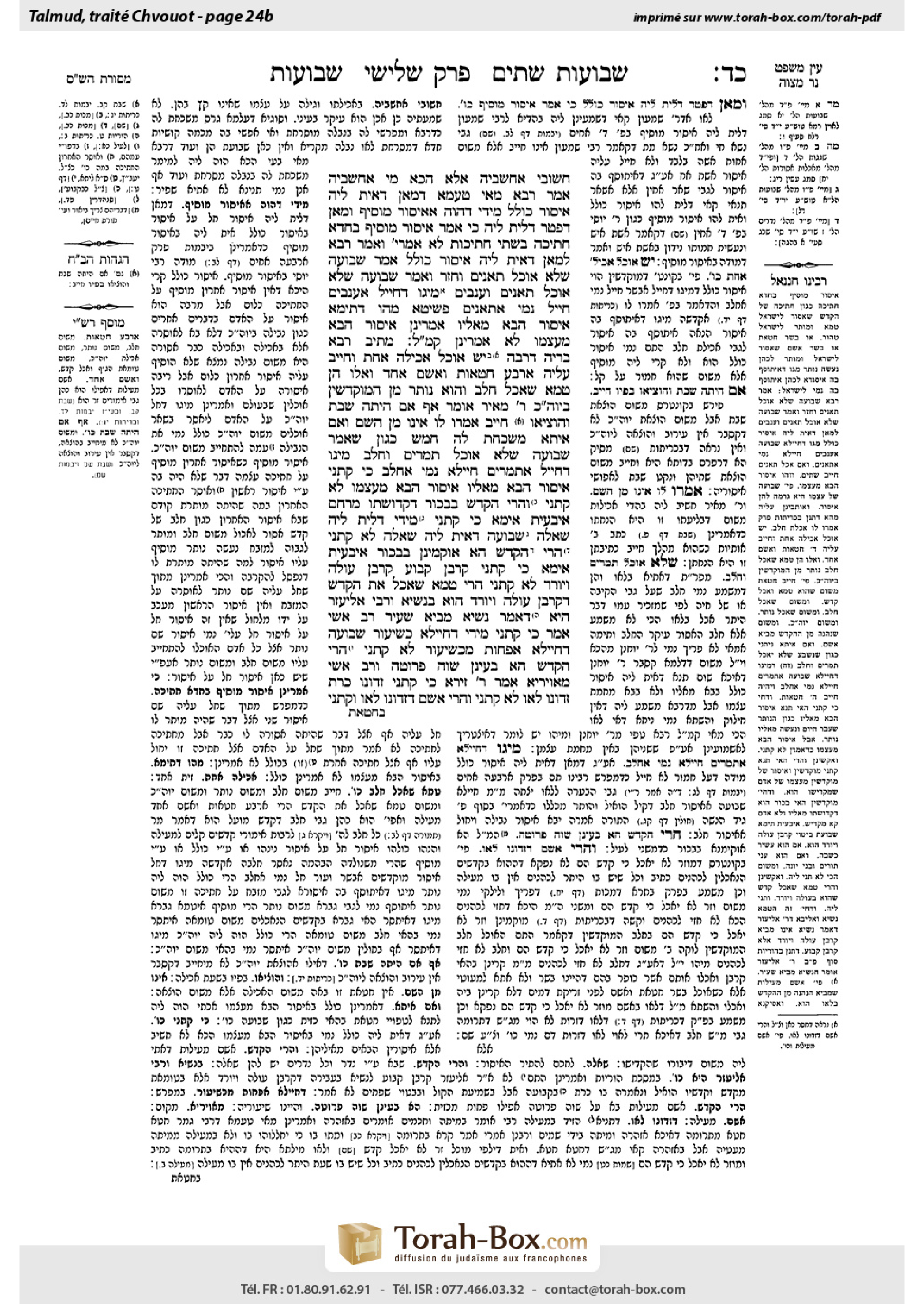
Shevuot 24b: Talmud study for Daf Yomi
Daf Yomi is the daily study of one Talmud folio. Explore 37 tractates with scans, Hebrew text, Sefaria English and AI-generated French translations where annotated.
Passage selection and English or AI-generated French translation are available where the scan has annotations. Daf Study is independent of Torah-Box and Sefaria.
Browse Shevuot · שבועות · All tractatesShevuot 24b text and translations
This page of Shevuot includes the Aramaic text, an English translation and an AI-generated French translation, alongside the scan above.
שבועות כ״ד ב · Aramaic and Hebrew text
(חשובי) [אַחְשׁוֹבֵי]; אֶלָּא הָכָא מִי אַחְשְׁבֵיהּ?!
אָמַר רָבָא: מַאי טַעְמָא דְּמַאן דְּאִית לֵיהּ אִיסּוּר כּוֹלֵל?
מִידֵּי דְּהָוֵה אַאִיסּוּר מוֹסִיף.
וּמַאן דְּפָטַר, דְּלֵית לֵיהּ? כִּי אָמַר אִיסּוּר מוֹסִיף – בַּחֲדָא חֲתִיכָה, בִּשְׁתֵּי חֲתִיכוֹת לָא אָמְרִינַן.
וְאָמַר רָבָא: לְמַאן דְּאִית לֵיהּ אִיסּוּר כּוֹלֵל, אָמַר ״שְׁבוּעָה שֶׁלֹּא אוֹכַל תְּאֵנִים״, וְחָזַר וְאָמַר ״שְׁבוּעָה שֶׁלֹּא אוֹכַל תְּאֵנִים וַעֲנָבִים״ – מִיגּוֹ דְּחָיְילָא שְׁבוּעָה אַעֲנָבִים, חָיְילָא נָמֵי אַתְּאֵנִים.
פְּשִׁיטָא!
מַהוּ דְּתֵימָא: אִיסּוּר הַבָּא מֵאֵלָיו אָמְרִינַן, אִיסּוּר הַבָּא מֵעַצְמוֹ לָא אָמְרִינַן; קָא מַשְׁמַע לַן.
מֵתִיב רָבָא בְּרֵיהּ דְּרַבָּה: יֵשׁ אוֹכֵל אֲכִילָה אַחַת, וְחַיָּיב עָלֶיהָ אַרְבַּע חַטָּאוֹת וְאָשָׁם אֶחָד; וְאֵלּוּ הֵן: טָמֵא שֶׁאָכַל חֵלֶב, וְהוּא נוֹתָר, מִן הַמּוּקְדָּשִׁין, בְּיוֹם הַכִּפּוּרִים.
רַבִּי מֵאִיר אוֹמֵר: אַף אִם הָיְתָה שַׁבָּת וְהוֹצִיאוֹ – חַיָּיב. אָמְרוּ לוֹ: אֵינוֹ מִן הַשֵּׁם.
וְאִם אִיתָא, מַשְׁכַּחַתְּ לַהּ חָמֵשׁ – כְּגוֹן שֶׁאָמַר ״שְׁבוּעָה שֶׁלֹּא אוֹכַל תְּמָרִים וְחֵלֶב״, מִיגּוֹ דְּחָיְילָא שְׁבוּעָה אַתְּמָרִים, חָיְילָא נָמֵי אַחֵלֶב!
כִּי קָתָנֵי, אִיסּוּר הַבָּא מֵאֵלָיו; אִיסּוּר הַבָּא מֵעַצְמוֹ לָא קָתָנֵי.
וַהֲרֵי הֶקְדֵּשׁ!
בִּבְכוֹר, דִּקְדוּשָּׁתוֹ מֵרֶחֶם.
אִיבָּעֵית אֵימָא: כִּי קָתָנֵי, מִידֵּי דְּלֵית לֵיהּ שְׁאֵלָה; שְׁבוּעָה דְּאִית לֵיהּ שְׁאֵלָה לָא קָתָנֵי.
הֲרֵי הֶקְדֵּשׁ!
הָא אוֹקְמִינַן בִּבְכוֹר.
אִיבָּעֵית אֵימָא: כִּי קָתָנֵי, קׇרְבָּן קָבוּעַ; קׇרְבָּן עוֹלֶה וְיוֹרֵד לָא קָתָנֵי.
הֲרֵי טָמֵא שֶׁאָכַל אֶת הַקֹּדֶשׁ – דְּקׇרְבָּן עוֹלֶה וְיוֹרֵד הוּא!
בְּנָשִׂיא, וְרַבִּי אֱלִיעֶזֶר הִיא דְּאָמַר: נָשִׂיא מֵבִיא שָׂעִיר.
רַב אָשֵׁי אָמַר: כִּי קָתָנֵי, מִידֵּי דְּבָעֵי שִׁיעוּר; שְׁבוּעָה דְּחָיְילָא אַפָּחוֹת מִכְּשִׁיעוּר, לָא קָתָנֵי.
הֲרֵי הֶקְדֵּשׁ!
הָא בָּעֵינַן שָׁוֶה פְּרוּטָה.
וְרַב אָשֵׁי מֵאַוֵּירְיָא אָמַר רַבִּי זֵירָא: כִּי קָתָנֵי, זְדוֹנוֹ כָּרֵת; זְדוֹנוֹ לָאו, לָא קָתָנֵי.
וַהֲרֵי אָשָׁם, דִּזְדוֹנוֹ לָאו, וְקָתָנֵי!
Shevuot 24b · English translation
in taking the oath, he granted significance to the non-kosher food, and that is why his eating forbidden items is considered to be eating. But here, where he took an oath not to eat and then ate non-kosher food, did he thereby give significance to it? For this reason, no conclusive proof can be cited from the last case in the mishna.
Rabbi Yoḥanan understands the mishna as referring to a case in which the oath takes effect because it is a more inclusive prohibition than the prohibition against eating non-kosher food, in that it adds additional prohibitions for the same individual. In this context, Rava says: What is the reasoning of the one who holds that a more inclusive prohibition takes effect where there already is a prohibition in place?
Rava answers his own question: It is just as it is in the case of an expanded prohibition, which incorporates additional people into the list of those for whom the original item is forbidden. An expanded prohibition also takes effect despite the fact that there is already a prohibition in place.
And with regard to the one who exempts another from liability in the case of a more inclusive prohibition, as he does not hold that it takes effect, why does he hold that an expanded prohibition does take effect? When he says that an expanded prohibition takes effect, that is with regard to a single piece, i.e., that the number of people who are prohibited from eating the same piece of meat is expanded. With regard to two distinct pieces, i.e., a case where the new prohibition expands the scope of prohibited items, as in an inclusive prohibition, we do not say that it takes effect.
§ And Rava says: According to the one who holds that a more inclusive prohibition takes effect where another prohibition is already in place, the halakha should be as follows: When a person says: On my oath I will not eat figs, and then says: On my oath I will not eat figs and grapes, since the last oath takes effect with regard to the grapes, it also takes effect with regard to the figs, even though they were already forbidden by his previous oath.
The Gemara asks: Isn’t that obvious?
The Gemara answers: Lest you say that we say that a more inclusive prohibition takes effect only with regard to a prohibition that occurs on its own, like the prohibition against eating non-kosher food, but with regard to a prohibition that occurs by the act of a person himself we do not say that the more inclusive prohibition takes effect, Rava teaches us that there is no difference.
Rava, son of Rabba, raises an objection from a mishna (Karetot 13b): It is possible for a person to perform one act of eating for which he is liable to bring four sin-offerings and one guilt-offering. And these are the prohibitions one can violate in this manner: A ritually impure person who ate forbidden fat that is the leftover from one of the sacrificial animals on Yom Kippur. If he did this and was unaware of the relevant prohibitions he is liable to bring four sin-offerings, as well as a guilt-offering for deriving benefit from the misuse of consecrated property.
Rabbi Meir says: Also, if it was Shabbat and he transferred the item from one domain to another in his mouth, he is liable to bring a sin-offering for performing labor on Shabbat as well. The Rabbis said to him: This is not a prohibition of the same type, since in the case of Rabbi Meir’s additional prohibition he does not violate it by eating.
Rava, son of Rabba, explains the objection that arises from the mishna: And if it is so that a more inclusive prohibition takes effect, then you find a case where one is liable for the violation of five prohibitions in one act of eating, such as where one says in the aforementioned situation: On my oath I will not eat dates and forbidden fat. Since the oath takes effect with regard to the dates, it also takes effect with regard to the forbidden fat. The fact that the mishna fails to mention such an oath indicates that a more inclusive prohibition does not take effect where another prohibition is already in place.
The Gemara answers: The absence of an oath with a more inclusive prohibition in the mishna does not indicate anything. When the tanna teaches the scenario above, he lists only the potential prohibitions that occur on their own in one act of eating, but he does not teach prohibitions that occur by the act of the person himself.
The Gemara asks: But doesn’t the mishna include in its list the prohibition against deriving benefit from consecrated property, which does not occur on its own but only when an item is consecrated?
The Gemara answers: The case in the mishna is that of a first-born animal, whose sanctity is from the womb, i.e., begins automatically at birth.
If you wish, say instead, in response to the question, that when the tanna of the mishna teaches it, he includes only matters to which presenting a request for dissolution do not apply. An oath, to which a request for dissolution applies, is not taught.
The Gemara asks: Doesn’t the mishna include in its list the prohibition against deriving benefit from consecrated property? Consecration can be dissolved by a Sage.
The Gemara answers: Didn’t we already establish that the case in the mishna is that of a firstborn animal, whose sanctity cannot be dissolved?
If you wish, say instead that when he teaches that case, he lists only those prohibitions for which one is liable to bring a fixed sin-offering. If one breaks his oath he is liable to bring a sliding-scale offering, and the tanna of the mishna does not teach about the liability to bring other offerings.
The Gemara asks: Doesn’t the mishna list the transgression of an impure person who ate consecrated items, i.e., the sacrificial animals mentioned in the mishna, which is a prohibition for which one brings a sliding-scale offering?
The Gemara answers: The mishna is referring to a king who eats the leftover of a sacrificial animal while impure, and the mishna is in accordance with the opinion of Rabbi Eliezer, who says: A ritually impure king who ate consecrated items brings a male goat as a sin-offering, rather than the sliding-scale offering brought by a commoner.
Rav Ashi said there is a different answer: When the tanna teaches this case, he lists only matters that apply when one eats the measure of an olive-bulk, whereas the case of an oath, which applies to eating even less than the standard measure, is not taught in the mishna.
The Gemara asks: Doesn’t the mishna include in its list the prohibition against deriving benefit from the misuse of consecrated property, which applies to eating even less than an olive-bulk?
The Gemara answers: We require that one derive the value of one peruta of benefit in order to be liable, so that is also a prohibition to which standard measures apply.
And Rav Ashi of Avireya said that Rabbi Zeira said: When the tanna teaches this case, he lists only prohibitions for which intentional violation of them renders one liable to receive karet, and he does not teach prohibitions for which intentional violation of them renders one liable to receive lashes.
The Gemara asks: But isn’t the guilt-offering for the misuse of consecrated property, which is listed in the mishna, a prohibition for which intentional violation of it renders one liable to receive only lashes, not karet? And nevertheless the tanna of the mishna teaches it.
Shevuot 24b · Traduction française (IA)
En prêtant serment, il a conféré une importance à l’aliment non casher ; c’est pourquoi manger des aliments interdits est considéré comme une véritable consommation. Mais ici, où il a juré de ne pas manger, puis a consommé un aliment non casher, lui a-t-il pour autant conféré de l’importance ? On ne peut donc tirer aucune preuve concluante du dernier cas de la Michna.
Rabbi Yoḥanan comprend que la Michna parle d’un cas où le serment prend effet parce qu’il constitue une interdiction plus englobante que l’interdiction de manger des aliments non casher, en ce qu’il ajoute d’autres interdictions pour la même personne. Dans ce contexte, Rava demande : Quel est le raisonnement de celui qui soutient qu’une interdiction plus englobante prend effet alors qu’une autre interdiction est déjà en vigueur ?
Rava répond à sa propre question : c’est comme dans le cas d’une interdiction étendue, qui ajoute d’autres personnes à la liste de celles auxquelles l’objet initial est interdit. Une interdiction étendue prend elle aussi effet, bien qu’une interdiction soit déjà en vigueur.
Et quant à celui qui exonère de responsabilité dans le cas d’une interdiction plus englobante, puisqu’il ne soutient pas qu’elle prend effet, pourquoi soutient-il qu’une interdiction étendue prend effet ? Lorsqu’il dit qu’une interdiction étendue prend effet, il s’agit d’un seul morceau : le nombre de personnes auxquelles il est interdit de manger le même morceau de viande s’élargit. Mais lorsqu’il s’agit de deux morceaux distincts, c’est-à-dire d’un cas où la nouvelle interdiction étend le champ des objets interdits, comme dans le cas d’une interdiction plus englobante, nous ne disons pas qu’elle prend effet.
§ Rava dit : Selon celui qui soutient qu’une interdiction plus englobante prend effet alors qu’une autre interdiction est déjà en vigueur, la halakha est la suivante : si quelqu’un dit : « Par serment, je ne mangerai pas de figues », puis dit : « Par serment, je ne mangerai ni figues ni raisins », le dernier serment, puisqu’il prend effet à l’égard des raisins, prend également effet à l’égard des figues, bien qu’elles aient déjà été interdites par son serment précédent.
La Guemara demande : N’est-ce pas évident ?
La Guemara répond : De peur que tu ne dises que nous considérons qu’une interdiction plus englobante prend effet uniquement lorsqu’il s’agit d’une interdiction qui survient d’elle-même, comme l’interdiction de manger des aliments non casher, mais pas lorsqu’il s’agit d’une interdiction résultant de l’acte de la personne elle-même, Rava nous enseigne qu’il n’y a pas de différence.
Rava, fils de Rabba, soulève une objection à partir d’une Michna (Karetot 13b) : il est possible qu’une personne accomplisse un seul acte de consommation qui l’oblige à apporter quatre sacrifices expiatoires et un sacrifice de culpabilité. Voici les interdictions que l’on peut transgresser de cette manière : une personne en état d’impureté rituelle qui mange du suif interdit provenant des restes d’un animal sacrificiel, à Yom Kippour. Si elle agit ainsi sans avoir connaissance des interdictions concernées, elle doit apporter quatre sacrifices expiatoires, ainsi qu’un sacrifice de culpabilité pour avoir tiré profit de l’usage illicite d’un bien consacré.
Rabbi Meïr dit : De plus, si c’était Chabbat et qu’il avait transporté l’objet d’un domaine à un autre dans sa bouche, il devrait également apporter un sacrifice expiatoire pour avoir accompli un travail interdit le Chabbat. Les Sages lui dirent : Ce n’est pas une interdiction du même type, car, dans le cas de l’interdiction supplémentaire de Rabbi Meïr, on ne la transgresse pas en mangeant.
Rava, fils de Rabba, expose l’objection que l’on peut tirer de la Michna : si tel était le cas, on trouverait une situation où un seul acte de consommation engagerait la responsabilité pour la transgression de cinq interdictions. Ce serait le cas, par exemple, si quelqu’un disait, dans la situation susmentionnée : « Par serment, je ne mangerai ni dattes ni suif interdit. » Puisque le serment prend effet à l’égard des dattes, il prend également effet à l’égard du suif interdit. Le fait que la Michna ne mentionne pas un tel serment indique qu’une interdiction plus englobante ne prend pas effet lorsqu’une autre interdiction est déjà en vigueur.
La Guemara répond : L’absence, dans la Michna, d’un serment comportant une interdiction plus englobante n’indique rien. Lorsque le tanna présente le scénario ci-dessus, il énumère uniquement les interdictions potentielles qui surviennent d’elles-mêmes lors d’un seul acte de consommation ; il ne mentionne pas les interdictions qui résultent de l’acte de la personne elle-même.
La Guemara demande : Mais la Michna n’inclut-elle pas dans sa liste l’interdiction de tirer profit d’un bien consacré, qui ne survient pas d’elle-même, mais seulement lorsqu’un objet est consacré ?
La Guemara répond : La Michna parle d’un animal premier-né, dont la sainteté vient du ventre maternel, c’est-à-dire qu’elle prend effet automatiquement à la naissance.
Si tu le souhaites, on peut répondre autrement à la question : lorsque le tanna de la Michna expose ce cas, il ne mentionne que les choses auxquelles ne s’applique pas une demande de dissolution. Le serment, auquel une demande de dissolution s’applique, n’est pas mentionné.
La Guemara demande : Mais la Michna n’inclut-elle pas dans sa liste l’interdiction de tirer profit d’un bien consacré ? La consécration peut être annulée par un Sage.
La Guemara répond : N’avons-nous pas déjà établi que la Michna parle d’un animal premier-né, dont la sainteté ne peut être annulée ?
Si tu le souhaites, on peut répondre autrement : lorsqu’il expose ce cas, le tanna énumère uniquement les interdictions pour lesquelles on doit apporter un sacrifice expiatoire fixe. Si quelqu’un enfreint son serment, il doit apporter un sacrifice à offrande variable, et le tanna de la Michna ne traite pas de l’obligation d’apporter d’autres offrandes.
La Guemara demande : Mais la Michna ne mentionne-t-elle pas la transgression commise par une personne en état d’impureté qui mange des aliments consacrés, c’est-à-dire les animaux sacrificiels mentionnés dans la Michna, infraction pour laquelle on apporte un sacrifice à offrande variable ?
La Guemara répond : La Michna parle d’un roi qui mange les restes d’un animal sacrificiel alors qu’il est en état d’impureté, et elle suit l’opinion de Rabbi Eliezer, qui dit : un roi en état d’impureté rituelle qui a mangé des aliments consacrés apporte un bouc comme sacrifice expiatoire, plutôt que le sacrifice à offrande variable qu’apporte un particulier.
Rav Ashi donne une autre réponse : lorsque le tanna expose ce cas, il n’énumère que les interdictions qui s’appliquent à la consommation d’une quantité équivalant au volume d’une olive. Le cas du serment, qui s’applique même à une consommation inférieure à la mesure standard, n’est donc pas mentionné dans la Michna.
La Guemara demande : Mais la Michna n’inclut-elle pas dans sa liste l’interdiction de tirer profit de l’usage illicite d’un bien consacré, qui s’applique même à une consommation inférieure au volume d’une olive ?
La Guemara répond : Pour être passible, il faut avoir tiré un profit d’une valeur d’une perouta ; cette interdiction relève donc elle aussi d’une mesure minimale.
Et Rav Ashi d’Avireya rapporte au nom de Rabbi Zeira : lorsque le tanna expose ce cas, il énumère uniquement les interdictions dont la transgression intentionnelle rend passible de karet ; il ne mentionne pas celles dont la transgression intentionnelle rend passible de flagellation.
La Guemara demande : Mais le sacrifice de culpabilité pour l’usage illicite d’un bien consacré, qui figure dans la Michna, n’est-il pas lié à une interdiction dont la transgression intentionnelle rend passible uniquement de flagellation, et non de karet ? Pourtant, le tanna de la Michna le mentionne.
Traduction française générée par IA à partir de l’édition anglaise de Sefaria. Vérifie toujours un passage avec le texte source.
Text from Sefaria: William Davidson Edition - Vocalized Aramaic (CC BY NC); William Davidson Edition - English (CC BY NC).