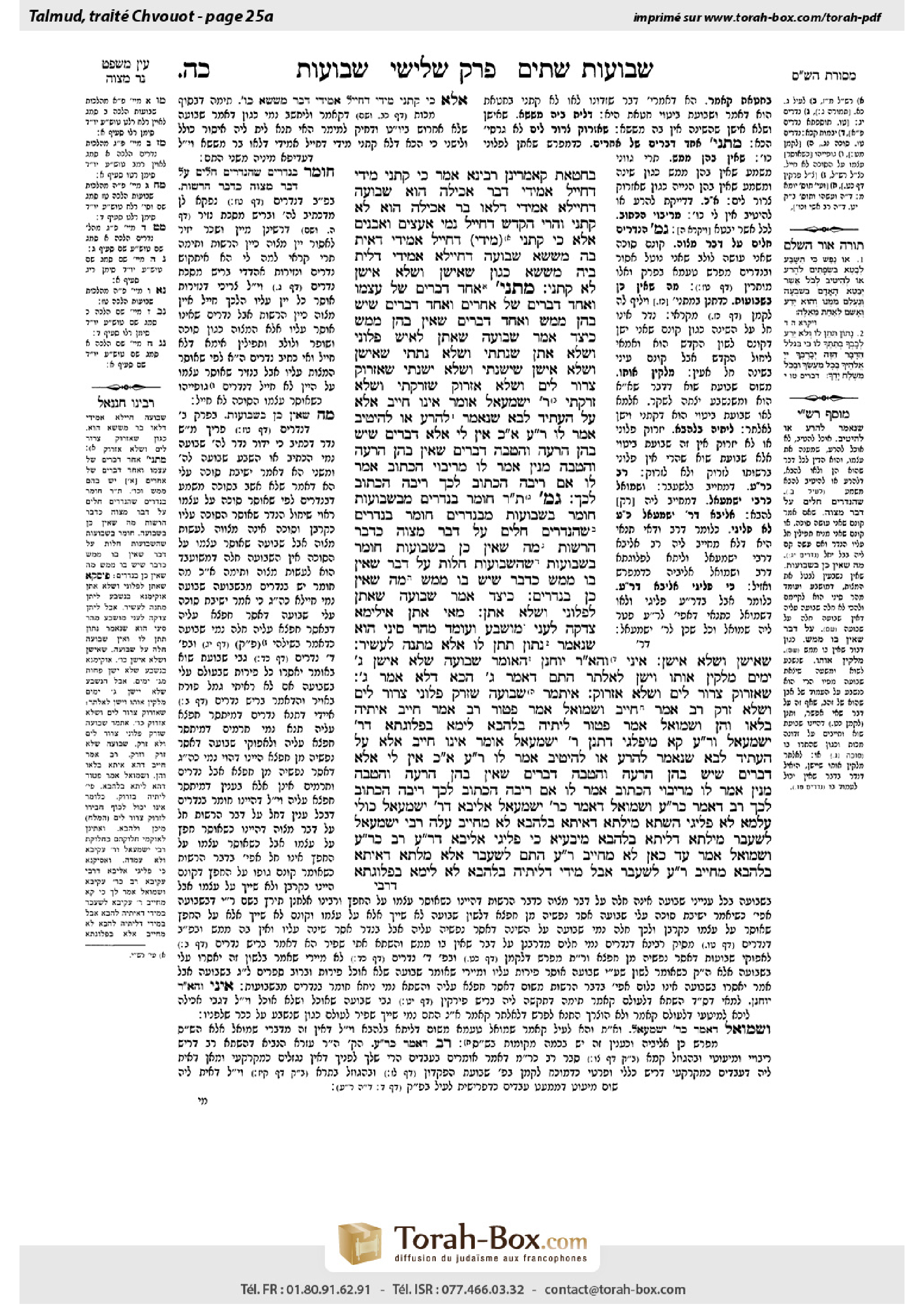
Shevuot 25a: Talmud study for Daf Yomi
Daf Yomi is the daily study of one Talmud folio. Explore 37 tractates with scans, Hebrew text, Sefaria English and AI-generated French translations where annotated.
Passage selection and English or AI-generated French translation are available where the scan has annotations. Daf Study is independent of Torah-Box and Sefaria.
Browse Shevuot · שבועות · All tractatesShevuot 25a text and translations
This page of Shevuot includes the Aramaic text, an English translation and an AI-generated French translation, alongside the scan above.
שבועות כ״ה א · Aramaic and Hebrew text
בְּחַטָּאת קָאָמְרִינַן.
רָבִינָא אָמַר: כִּי קָתָנֵי, מִידֵּי דְּחָיֵיל אַמִּידֵּי דְּבַר אֲכִילָה הוּא; שְׁבוּעָה דְּחָיְילָא אַמִּידֵּי דְּלָאו בַּר אֲכִילָה הוּא, לָא קָתָנֵי.
וַהֲרֵי הֶקְדֵּשׁ – דְּחָיֵיל נָמֵי אַעֵצִים וַאֲבָנִים!
אֶלָּא כִּי קָתָנֵי, מִידֵּי דְּחָיֵיל אַמִּידֵּי דְּאִית בֵּהּ מְשָׁשָׁא; שְׁבוּעָה דְּחָיְילָא אַמִּידֵּי דְּלֵית בֵּיהּ מְשָׁשָׁא, כְּגוֹן ״שֶׁאִישַׁן״ וְ״שֶׁלֹּא אִישַׁן״ – לָא קָתָנֵי.
מַתְנִי׳ אֶחָד דְּבָרִים שֶׁל עַצְמוֹ וְאֶחָד דְּבָרִים שֶׁל אֲחֵרִים, וְאֶחָד דְּבָרִים שֶׁיֵּשׁ בָּהֶן מַמָּשׁ וְאֶחָד דְּבָרִים שֶׁאֵין בָּהֶן מַמָּשׁ.
כֵּיצַד? אָמַר ״שְׁבוּעָה שֶׁאֶתֵּן לְאִישׁ פְּלוֹנִי״ וְ״שֶׁלֹּא אֶתֵּן״; ״שֶׁנָּתַתִּי״ וְ״שֶׁלֹּא נָתַתִּי״;
״שֶׁאִישַׁן״ וְ״שֶׁלֹּא אִישַׁן״; ״שֶׁיָּשַׁנְתִּי״ וְ״שֶׁלֹּא יָשַׁנְתִּי״; ״שֶׁאֶזְרוֹק צְרוֹר לַיָּם״ וְ״שֶׁלֹּא אֶזְרוֹק״; ״שֶׁזָּרַקְתִּי״ וְ״שֶׁלֹּא זָרַקְתִּי״.
רַבִּי יִשְׁמָעֵאל אוֹמֵר: אֵינוֹ חַיָּיב אֶלָּא עַל הֶעָתִיד לָבֹא, שֶׁנֶּאֱמַר: ״לְהָרַע אוֹ לְהֵיטִיב״.
אָמַר לוֹ רַבִּי עֲקִיבָא: אִם כֵּן, אֵין לִי אֶלָּא דְּבָרִים שֶׁיֵּשׁ בָּהֶן הֲרָעָה וַהֲטָבָה; דְּבָרִים שֶׁאֵין בָּהֶן הֲרָעָה וַהֲטָבָה מִנַּיִן?
אָמַר לוֹ: מֵרִיבּוּי הַכָּתוּב. אָמַר לוֹ: אִם רִיבָּה הַכָּתוּב לְכָךְ, רִיבָּה הַכָּתוּב לְכָךְ!
גְּמָ׳ תָּנוּ רַבָּנַן: חוֹמֶר בַּנְּדָרִים מִבַּשְּׁבוּעוֹת, חוֹמֶר בַּשְּׁבוּעוֹת מִבַּנְּדָרִים. חוֹמֶר בַּנְּדָרִים – שֶׁהַנְּדָרִים חָלִים עַל דְּבַר מִצְוָה כִּדְבַר הָרְשׁוּת, מַה שֶּׁאֵין כֵּן בַּשְּׁבוּעוֹת.
חוֹמֶר בַּשְּׁבוּעוֹת – שֶׁהַשְּׁבוּעוֹת חָלוֹת עַל דָּבָר שֶׁאֵין בּוֹ מַמָּשׁ כְּדָבָר שֶׁיֵּשׁ בּוֹ מַמָּשׁ, מַה שֶּׁאֵין כֵּן בַּנְּדָרִים.
כֵּיצַד? אָמַר ״שְׁבוּעָה שֶׁאֶתֵּן לִפְלוֹנִי״ וְ״שֶׁלֹּא אֶתֵּן״. מַאי ״אֶתֵּן״? אִילֵּימָא צְדָקָה לְעָנִי, מוּשְׁבָּע וְעוֹמֵד מֵהַר סִינַי הוּא – שֶׁנֶּאֱמַר: ״נָתוֹן תִּתֵּן לוֹ״!
אֶלָּא מַתָּנָה לְעָשִׁיר.
״שֶׁאִישַׁן״ וְ״שֶׁלֹּא אִישַׁן״ – אִינִי?! וְהָאָמַר רַבִּי יוֹחָנָן: הָאוֹמֵר ״שְׁבוּעָה שֶׁלֹּא אִישַׁן שְׁלֹשָׁה יָמִים״ – מַלְקִין אוֹתוֹ וְיָשֵׁן לְאַלְתַּר!
הָתָם דְּאָמַר ״שְׁלֹשָׁה״, הָכָא דְּלָא אָמַר ״שְׁלֹשָׁה״.
״שֶׁאֶזְרוֹק צְרוֹר לַיָּם״ וְ״שֶׁלֹּא אֶזְרוֹק״. אִיתְּמַר: ״שְׁבוּעָה שֶׁזָּרַק פְּלוֹנִי צְרוֹר לַיָּם״ וְ״שֶׁלֹּא זָרַק״, רַב אָמַר חַיָּיב, וּשְׁמוּאֵל אָמַר פָּטוּר.
רַב אָמַר חַיָּיב – אִיתֵיהּ בְּלָאו וְהֵן. וּשְׁמוּאֵל אָמַר פָּטוּר – לֵיתֵיהּ בִּלְהַבָּא.
לֵימָא בִּפְלוּגְתָּא דְּרַבִּי יִשְׁמָעֵאל וְרַבִּי עֲקִיבָא קָא מִיפַּלְגִי? דִּתְנַן, רַבִּי יִשְׁמָעֵאל אוֹמֵר: אֵינוֹ חַיָּיב אֶלָּא עַל הֶעָתִיד לָבֹא, שֶׁנֶּאֱמַר: ״לְהָרַע אוֹ לְהֵיטִיב״. אָמַר לוֹ רַבִּי עֲקִיבָא: אִם כֵּן, אֵין לִי אֶלָּא דְּבָרִים שֶׁיֵּשׁ בָּהֶן הֲרָעָה וַהֲטָבָה, דְּבָרִים שֶׁאֵין בָּהֶן הֲרָעָה וַהֲטָבָה מִנַּיִן?
אָמַר לוֹ: מֵרִיבּוּי הַכָּתוּב. אָמַר לוֹ: אִם רִיבָּה הַכָּתוּב לְכָךְ, רִיבָּה הַכָּתוּב לְכָךְ!
רַב דְּאָמַר כְּרַבִּי עֲקִיבָא, וּשְׁמוּאֵל דְּאָמַר כְּרַבִּי יִשְׁמָעֵאל?
אַלִּיבָּא דְּרַבִּי יִשְׁמָעֵאל – כּוּלֵּי עָלְמָא לָא פְּלִיגִי; הַשְׁתָּא מִילְּתָא דְּאִיתַהּ בִּלְהַבָּא לָא מְחַיַּיב עֲלַהּ רַבִּי יִשְׁמָעֵאל לְשֶׁעָבַר, מִילְּתָא דְּלֵיתַהּ בִּלְהַבָּא מִיבַּעְיָא?!
כִּי פְּלִיגִי – אַלִּיבָּא דְּרַבִּי עֲקִיבָא. רַב – כְּרַבִּי עֲקִיבָא; וּשְׁמוּאֵל אָמַר: עַד כָּאן לָא מְחַיֵּיב רַבִּי עֲקִיבָא הָתָם לְשֶׁעָבַר, אֶלָּא מִלְּתָא דְּאִיתַהּ בִּלְהַבָּא – מְחַיֵּיב רַבִּי עֲקִיבָא לְשֶׁעָבַר; אֲבָל מִידֵּי דְּלֵיתֵיהּ בִּלְהַבָּא – לָא.
לֵימָא בִּפְלוּגְתָּא
Shevuot 25a · English translation
The Gemara answers: We are speaking of sin-offerings when we assert that that mishna lists only prohibitions for which one is liable to receive karet for their intentional violation.
Ravina offered a different answer. He said: When the tanna teaches this case, he lists only those prohibitions that apply specifically to items that are edible. With regard to an oath, it is a matter that applies also to items that are not edible, and he does not teach it in that mishna.
The Gemara asks: But doesn’t that mishna include in its list the prohibition against deriving benefit from the misuse of consecrated property, which applies even to consecrated wood and stones?
The Gemara answers: Rather, when the tanna teaches this case, he lists those prohibitions that apply to tangible matters. With regard to an oath, it is something that also applies to intangible matters, such as: I will sleep, or: I will not sleep, and the tanna does not teach it in that mishna.
MISHNA: If one unwittingly takes a false oath about the past or breaks an oath he made about the future, both if it is an oath that addresses matters that concern oneself and if it is an oath that addresses matters that concern others, he is liable to bring a sliding-scale offering for an oath on an utterance. And likewise, an oath on an utterance may address both tangible matters and intangible matters.
How so? Examples of oaths about future actions that concern others are if one said: On my oath I will give so-and-so a particular item, or: On my oath I will not give it to him. Examples of such oaths about the past are if one said: On my oath I gave another a particular item, or: On my oath I did not give it to him.
Examples of oaths about the future that address intangible matters are where one said: On my oath I will sleep, or: On my oath I will not sleep. Examples of such oaths about the past are where one said: On my oath I slept, or: On my oath I did not sleep. Other examples of oaths about intangible matters are when one takes an oath, saying: I will throw a stone into the sea, or: I will not throw it, or: I threw it, or: I did not throw it.
Rabbi Yishmael says: One is liable only for an oath on an utterance taken about the future, as it is stated: “Or if anyone take an oath clearly with his lips to do evil, or to do good, whatsoever it be that a man shall utter clearly with an oath” (Leviticus 5:4). The Torah refers explicitly only to oaths about what one will do in the future.
Rabbi Akiva said to him: If so, and one is liable only for oaths explicitly mentioned in the verse, then I have derived only that one is liable for an oath on an utterance with regard to matters to which doing evil and doing good apply. From where do I derive that one is liable for an oath on an utterance with regard to matters to which doing evil and doing good do not apply?
Rabbi Yishmael said to him: The halakha in these cases is derived by amplification of the meaning of the verse. Rabbi Akiva said to him: If the verse is amplified for this, i.e., to extend the halakha of an oath on an utterance to matters that do not involve doing evil or good, the verse is amplified for that, i.e., oaths about the past.
GEMARA: With regard to oaths about intangible matters, the Sages taught: There is a stringency that applies to vows and not to oaths, and there is a stringency that applies to oaths and not to vows. The stringency that applies to vows is that vows take effect with regard to a matter involving a mitzva, like they take effect with regard to an optional matter, which is not the case with regard to oaths. An oath not to perform a mitzva does not take effect at all.
The stringency that applies to oaths is that oaths take effect with regard to an intangible matter like they do with regard to a tangible matter, which is not the case with regard to vows.
§ The mishna teaches: How so? Examples are if one said: On my oath I will give so-and-so some item, or: On my oath I will not give it to him. What is the case of an oath in which he says: I will give? If we say that he takes an oath that he will give charity to a poor person, that is not an oath that takes effect, since he is under oath from Mount Sinai to give charity, as it is stated with regard to a poor person: “You shall give him” (Deuteronomy 15:10).
Rather, the case is where he said he would give a gift to a rich person. The oath takes effect, as there is no mitzva to do so.
§ The mishna teaches that if one takes an oath, saying: I will sleep, or: I will not sleep, the oath takes effect and he is liable to bring an offering if he fails to fulfill the terms of his oath. The Gemara asks: Is that so? But doesn’t Rabbi Yoḥanan say that in the case of one who says: On my oath I will not sleep for three days, the court flogs him immediately and he may sleep. Since it is impossible for one not to sleep for three days, his oath is regarded as an oath taken in vain from the outset. How could someone who took an oath never to sleep be liable to bring an offering for an oath on an utterance if he slept unwittingly?
The Gemara answers: There, Rabbi Yoḥanan is referring to a case where he said explicitly that he will not sleep for three days. Here, the mishna is referring to a case where he did not say three days, and his oath extends only for the amount of time it is possible not to sleep.
§ The mishna teaches that an example of an oath on an utterance is where one took an oath, saying: I will throw a stone into the sea, or: I will not throw it. It was stated: With regard to one who says: On my oath so-and-so threw a stone into the sea, or: On my oath he did not throw it, Rav says: If it was later discovered that what he said was false, he is liable to bring an offering for his oath. And Shmuel says: He is exempt.
The Gemara explains the opinions: Rav says that he is liable, as the oath can be positive or negative. The Sages derived from the verse: “Or if anyone take an oath clearly with his lips to do evil, or to do good” (Leviticus 5:4), that one is liable to bring an offering for an oath on an utterance only when the oath is such that it could be inverted from the positive to the negative and vice versa. Since he can take an oath either that he threw the stone or that he did not, he is liable. And Shmuel says he is exempt, because the oath cannot be stated with regard to the future; he cannot control what so-and-so will do in the future. Consequently, it is an oath taken in vain, rather than an oath on an utterance.
The Gemara asks: Shall we say that they disagree with regard to the issue that is the subject of the dispute between Rabbi Yishmael and Rabbi Akiva? As we learned in the mishna: Rabbi Yishmael says: One is liable only for an oath on an utterance taken about the future, as it is stated: “Or if anyone take an oath clearly with his lips to do evil, or to do good, whatsoever it be that a man shall utter clearly with an oath” (Leviticus 5:4). Rabbi Akiva said to him: If so, and one is liable only for oaths explicitly mentioned in the verse, then I have derived only that one is liable for an oath on an utterance with regard to matters to which doing evil and doing good apply. From where do I derive that one is liable for an oath on an utterance with regard to matters to which doing evil and doing good do not apply?
Rabbi Yishmael said to him: The halakha in these cases is derived by amplification of the verse. Rabbi Akiva said to him: If the verse is amplified for this, i.e., to extend the halakha of an oath on an utterance to matters that do not involve doing evil or good, the verse is amplified for that, i.e., oaths about the past.
Say that Rav, who ruled that one who took an oath that so-and-so threw a stone into the sea is liable, states his opinion in accordance with the opinion of Rabbi Akiva, that one can be liable for oaths about the past. And say that Shmuel states his opinion in accordance with the opinion of Rabbi Yishmael, that one is exempt from liability for taking an oath about the past.
The Gemara rejects this suggestion: Everyone agrees that according to the opinion of Rabbi Yishmael one is exempt from liability for taking an oath that so-and-so threw an item. Now, with regard to a statement, i.e., an oath, that could be a valid oath referring to the future, e.g., I will throw an item, Rabbi Yishmael does not deem one liable for it when it refers to the past. Is it necessary to say that one is not liable for a statement, i.e., an oath, that so-and-so threw a particular item, that cannot be a valid oath when adjusted to be referring to someone else’s actions in the future, since it is not under the oath taker’s control?
When they disagree, it is with regard to how to understand the halakha according to the opinion of Rabbi Akiva. The opinion of Rav is in accordance with the opinion of Rabbi Akiva without any qualification of it. And Shmuel says: Rabbi Akiva deems one liable only there, in the case of an oath that refers to the past, when it is a statement, i.e., an oath, that could be a valid oath referring to the future; in such a case Rabbi Akiva deems one liable also if the oath was taken referring to the past, like an oath where one says: I threw a stone. But with regard to statements that cannot be valid oaths if adjusted to the future, like an oath about another’s action, he does not deem one liable when they are made about the past.
The Gemara suggests: Shall we say that the dispute
Shevuot 25a · Traduction française (IA)
La Guemara répond : Nous parlons des sacrifices expiatoires lorsque nous affirmons que cette Michna ne mentionne que les interdits dont la transgression intentionnelle rend passible du retranchement.
Ravina proposa une autre réponse. Il dit : Lorsque le tanna enseigne ce cas, il ne mentionne que les interdits qui s’appliquent spécifiquement à des choses comestibles. Un serment, quant à lui, concerne aussi des choses qui ne sont pas comestibles, et le tanna ne le mentionne donc pas dans cette Michna.
La Guemara demande : Mais cette Michna ne comprend-elle pas dans sa liste l’interdit de tirer profit de l’usage abusif de biens consacrés, qui s’applique même au bois et aux pierres consacrés ?
La Guemara répond : En réalité, lorsque le tanna enseigne ce cas, il mentionne les interdits qui s’appliquent à des choses tangibles. Un serment, quant à lui, concerne aussi des choses intangibles, par exemple : « Je dormirai » ou « Je ne dormirai pas », et le tanna ne le mentionne donc pas dans cette Michna.
MICHNA : Si quelqu’un prête par inadvertance un faux serment au sujet du passé, ou enfreint un serment qu’il a prêté au sujet de l’avenir, qu’il s’agisse d’un serment portant sur des choses qui le concernent lui-même ou sur des choses qui concernent autrui, il est passible d’apporter une offrande à valeur variable pour un serment d’expression. De même, un serment d’expression peut porter aussi bien sur des choses tangibles que sur des choses intangibles.
Dans quel cas ? Parmi les exemples de serments au sujet d’actions futures qui concernent autrui, on trouve celui qui dit : « Je jure que je donnerai tel objet à untel », ou : « Je jure que je ne le lui donnerai pas ». Parmi les exemples de tels serments portant sur le passé, on trouve celui qui dit : « Je jure que j’ai donné tel objet à quelqu’un », ou : « Je jure que je ne le lui ai pas donné ».
Parmi les exemples de serments au sujet de l’avenir portant sur des choses intangibles, on trouve celui qui dit : « Je jure que je dormirai » ou « Je jure que je ne dormirai pas ». Parmi les exemples de tels serments portant sur le passé, on trouve celui qui dit : « Je jure que j’ai dormi » ou « Je jure que je n’ai pas dormi ». D’autres exemples de serments portant sur des choses intangibles sont ceux où l’on prête serment en disant : « Je jetterai une pierre dans la mer », « Je ne la jetterai pas », « Je l’ai jetée » ou « Je ne l’ai pas jetée ».
Rabbi Yishmaël dit : On n’est passible que pour un serment d’expression portant sur l’avenir, comme il est dit : « Si quelqu’un jure clairement de ses lèvres de faire le mal ou le bien, quel que soit ce qu’un homme prononce clairement sous serment » (Lévitique 5,4). La Torah écrite ne fait explicitement référence qu’aux serments portant sur ce que l’on fera à l’avenir.
Rabbi Akiva lui dit : Dans ce cas, si l’on n’est passible que pour les serments explicitement mentionnés dans le verset, je n’ai déduit que l’obligation encourue pour un serment d’expression portant sur des choses auxquelles s’appliquent le fait de faire le mal et celui de faire le bien. D’où déduis-je qu’on est passible pour un serment d’expression portant sur des choses auxquelles ne s’appliquent ni le fait de faire le mal ni celui de faire le bien ?
Rabbi Yishmaël lui dit : La halakha dans ces cas se déduit de l’extension du sens du verset. Rabbi Akiva lui dit : Si le verset est étendu à cet effet, c’est-à-dire pour étendre la halakha du serment d’expression aux choses qui n’impliquent ni le mal ni le bien, il est étendu à cet autre effet, c’est-à-dire aux serments portant sur le passé.
GUEMARA : À propos des serments portant sur des choses intangibles, les Sages ont enseigné : Il existe une rigueur qui s’applique aux vœux et non aux serments, et une rigueur qui s’applique aux serments et non aux vœux. La rigueur propre aux vœux est qu’ils prennent effet lorsqu’ils portent sur une chose impliquant une mitsva, tout comme lorsqu’ils portent sur une chose facultative, contrairement aux serments. Un serment de ne pas accomplir une mitsva ne prend pas du tout effet.
La rigueur propre aux serments est qu’ils prennent effet lorsqu’ils portent sur une chose intangible, tout comme lorsqu’ils portent sur une chose tangible, contrairement aux vœux.
§ La Michna enseigne : Dans quel cas ? Parmi les exemples, on trouve celui qui dit : « Je jure que je donnerai tel objet à untel », ou : « Je jure que je ne le lui donnerai pas ». Quel est le cas où il dit sous serment : « Je donnerai » ? Si l’on suppose qu’il jure qu’il donnera la charité à un pauvre, le serment ne prend pas effet, puisqu’il est déjà tenu par le serment prononcé au mont Sinaï de donner la charité, comme il est dit au sujet d’un pauvre : « Tu lui donneras » (Deutéronome 15,10).
Il s’agit plutôt du cas où il dit qu’il fera un cadeau à un riche. Le serment prend effet, car il n’y a aucune mitsva de le faire.
§ La Michna enseigne que si quelqu’un prête serment en disant : « Je dormirai » ou « Je ne dormirai pas », le serment prend effet et il est passible d’apporter une offrande s’il ne respecte pas les termes de son serment. La Guemara demande : Est-ce vraiment le cas ? Rabbi Yoḥanan ne dit-il pas que, dans le cas de celui qui dit : « Je jure que je ne dormirai pas pendant trois jours », le tribunal le flagelle immédiatement et il peut dormir ? Puisqu’il est impossible de ne pas dormir pendant trois jours, son serment est considéré d’emblée comme un serment vain. Comment celui qui a juré de ne pas dormir pourrait-il être passible d’apporter une offrande pour un serment d’expression s’il a dormi par inadvertance ?
La Guemara répond : Là-bas, Rabbi Yoḥanan parle d’un cas où il a explicitement dit qu’il ne dormirait pas pendant trois jours. Ici, la Michna parle d’un cas où il n’a pas précisé de durée : son serment ne vaut que pendant le laps de temps où il est possible de ne pas dormir.
§ La Michna enseigne qu’un exemple de serment d’expression est celui où quelqu’un prête serment en disant : « Je jetterai une pierre dans la mer » ou « Je ne la jetterai pas ». Il a été rapporté au sujet de celui qui dit : « Je jure qu’untel a jeté une pierre dans la mer » ou « Je jure qu’il ne l’a pas jetée » que Rav dit : S’il s’avère ensuite que ses paroles étaient fausses, il est passible d’apporter une offrande pour son serment. Shmuel dit : Il en est exempt.
La Guemara explique les avis : Rav dit qu’il en est passible, car le serment peut être formulé à l’affirmative ou à la négative. Les Sages ont déduit du verset : « Si quelqu’un jure clairement de ses lèvres de faire le mal ou le bien » (Lévitique 5,4), qu’on n’est passible d’apporter une offrande pour un serment d’expression que si le serment peut être inversé de l’affirmative au négatif, et inversement. Puisqu’il peut prêter serment qu’il a jeté la pierre ou qu’il ne l’a pas jetée, il en est passible. Shmuel dit qu’il en est exempt, car le serment ne peut pas être formulé au sujet de l’avenir : il ne peut pas contrôler ce qu’untel fera à l’avenir. Par conséquent, il s’agit d’un serment vain, et non d’un serment d’expression.
La Guemara demande : Peut-on donc dire qu’ils sont en désaccord sur la question qui fait l’objet du différend entre Rabbi Yishmaël et Rabbi Akiva ? Car nous avons appris dans la Michna : Rabbi Yishmaël dit : On n’est passible que pour un serment d’expression portant sur l’avenir, comme il est dit : « Si quelqu’un jure clairement de ses lèvres de faire le mal ou le bien, quel que soit ce qu’un homme prononce clairement sous serment » (Lévitique 5,4). Rabbi Akiva lui dit : Dans ce cas, si l’on n’est passible que pour les serments explicitement mentionnés dans le verset, je n’ai déduit que l’obligation encourue pour un serment d’expression portant sur des choses auxquelles s’appliquent le fait de faire le mal et celui de faire le bien. D’où déduis-je qu’on est passible pour un serment d’expression portant sur des choses auxquelles ne s’appliquent ni le fait de faire le mal ni celui de faire le bien ?
Rabbi Yishmaël lui dit : La halakha dans ces cas se déduit de l’extension du verset. Rabbi Akiva lui dit : Si le verset est étendu à cet effet, c’est-à-dire pour étendre la halakha du serment d’expression aux choses qui n’impliquent ni le mal ni le bien, il est étendu à cet autre effet, c’est-à-dire aux serments portant sur le passé.
Disons que Rav, qui a tranché que celui qui a juré qu’untel avait jeté une pierre dans la mer en est passible, exprime son avis conformément à celui de Rabbi Akiva, selon lequel on peut être passible pour des serments portant sur le passé. Et disons que Shmuel exprime son avis conformément à celui de Rabbi Yishmaël, selon lequel on n’est pas passible pour un serment portant sur le passé.
La Guemara rejette cette proposition : Tout le monde convient que, selon Rabbi Yishmaël, on est exempt d’avoir juré qu’untel a jeté un objet. En effet, s’agissant d’une déclaration, c’est-à-dire d’un serment, qui pourrait constituer un serment valable portant sur l’avenir, par exemple : « Je jetterai un objet », Rabbi Yishmaël ne juge pas qu’on en est passible lorsqu’elle porte sur le passé. Faut-il donc préciser qu’on n’est pas passible pour une déclaration, c’est-à-dire un serment, selon laquelle untel a jeté un objet précis, qui ne pourrait pas constituer un serment valable si on la transposait aux actions futures d’une autre personne, puisqu’elles échappent au contrôle de celui qui prête serment ?
Le désaccord porte sur la manière de comprendre la halakha selon l’avis de Rabbi Akiva. L’avis de Rav suit celui de Rabbi Akiva sans aucune réserve. Shmuel, lui, dit : Rabbi Akiva ne juge passible que dans ce cas-là, celui d’un serment portant sur le passé, lorsque la déclaration, c’est-à-dire le serment, pourrait constituer un serment valable portant sur l’avenir. Dans un tel cas, Rabbi Akiva juge également passible celui qui a prêté serment au sujet du passé, comme lorsqu’il dit : « J’ai jeté une pierre ». Mais, pour les déclarations qui ne pourraient pas constituer des serments valables si on les transposait à l’avenir, comme un serment portant sur l’action d’une autre personne, il ne juge pas passible celui qui les prononce au sujet du passé.
La Guemara suggère : Peut-on donc dire que le différend
Traduction française générée par IA à partir de l’édition anglaise de Sefaria. Vérifie toujours un passage avec le texte source.
Text from Sefaria: William Davidson Edition - Vocalized Aramaic (CC BY NC); William Davidson Edition - English (CC BY NC).