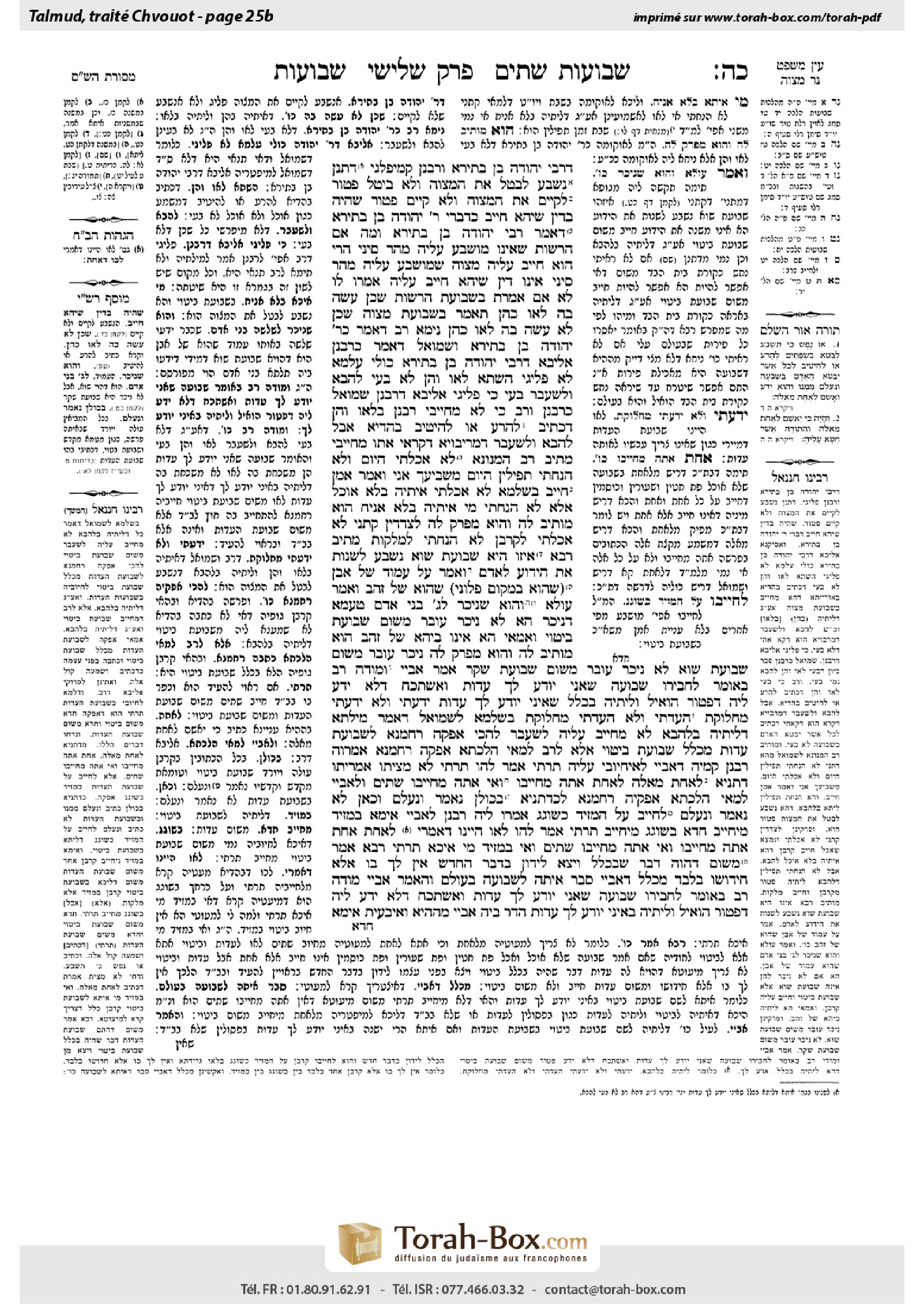
Shevuot 25b: Talmud study for Daf Yomi
Daf Yomi is the daily study of one Talmud folio. Explore 37 tractates with scans, Hebrew text, Sefaria English and AI-generated French translations where annotated.
Passage selection and English or AI-generated French translation are available where the scan has annotations. Daf Study is independent of Torah-Box and Sefaria.
Browse Shevuot · שבועות · All tractatesShevuot 25b text and translations
This page of Shevuot includes the Aramaic text, an English translation and an AI-generated French translation, alongside the scan above.
שבועות כ״ה ב · Aramaic and Hebrew text
דְּרַבִּי יְהוּדָה בֶּן בְּתֵירָא וְרַבָּנַן קָמִיפַּלְגִי? דִּתְנַן: נִשְׁבַּע לְבַטֵּל אֶת הַמִּצְוָה וְלֹא בִּיטֵּל – פָּטוּר. לְקַיֵּים אֶת הַמִּצְוָה וְלֹא קִיֵּים – פָּטוּר. שֶׁהָיָה בַּדִּין שֶׁיְּהֵא חַיָּיב, כְּדִבְרֵי רַבִּי יְהוּדָה בֶּן בְּתִירָא; דְּאָמַר רַבִּי יְהוּדָה בֶּן בְּתִירָא: וּמָה אִם הָרְשׁוּת, שֶׁאֵינוֹ מוּשְׁבָּע עָלֶיהָ מֵהַר סִינַי – הֲרֵי הוּא חַיָּיב עָלֶיהָ; מִצְוָה, שֶׁמּוּשְׁבָּע עָלֶיהָ מֵהַר סִינַי – אֵינוֹ דִּין שֶׁיְּהֵא חַיָּיב עָלֶיהָ?
אָמְרוּ לוֹ: לֹא; אִם אָמַרְתָּ בִּשְׁבוּעַת הָרְשׁוּת – שֶׁכֵּן עָשָׂה בָּהּ לָאו כְּהֵן; תֹּאמַר בִּשְׁבוּעַת מִצְוָה – שֶׁכֵּן לֹא עָשָׂה בָּהּ לָאו כְּהֵן?!
נֵימָא רַב דְּאָמַר כְּרַבִּי יְהוּדָה בֶּן בְּתִירָא, וּשְׁמוּאֵל דְּאָמַר כְּרַבָּנַן?
אַלִּיבָּא דְּרַבִּי יְהוּדָה בֶּן בְּתִירָא – כּוּלֵּי עָלְמָא לָא פְּלִיגִי; הַשְׁתָּא לָאו וָהֵן לָא בָּעֵי, לְהַבָּא וּלְשֶׁעָבַר בָּעֵי?!
כִּי פְּלִיגִי – אַלִּיבָּא דְּרַבָּנַן. שְׁמוּאֵל – כְּרַבָּנַן; וְרַב – כִּי לָא מְחַיְּיבִי רַבָּנַן בְּלָאו וָהֵן, דִּכְתִיב ״לְהָרַע אוֹ לְהֵיטִיב״ בְּהֶדְיָא; אֲבָל לְהַבָּא וּלְשֶׁעָבַר, דְּמֵרִיבּוּיָא דִּקְרָאֵי אָתוּ – מְחַיְּיבִי.
מֵתִיב רַב הַמְנוּנָא: ״לֹא אָכַלְתִּי הַיּוֹם״ וְ״לֹא הִנַּחְתִּי תְּפִילִּין הַיּוֹם״; ״מַשְׁבִּיעֲךָ אֲנִי״, וְאָמַר ״אָמֵן״ – חַיָּיב. בִּשְׁלָמָא ״לֹא אָכַלְתִּי״ – אִיתֵיהּ בְּ״לֹא אוֹכַל״; אֶלָּא ״לֹא הִנַּחְתִּי״ – מִי אִיתֵיהּ בְּ״לֹא אַנִּיחַ״?!
הוּא מוֹתֵיב לַהּ וְהוּא מְפָרֵק לַהּ – לִצְדָדִין קָתָנֵי: ״לֹא אָכַלְתִּי״ – לְקׇרְבָּן, ״לֹא הִנַּחְתִּי״ – לְמַלְקוֹת.
מֵתִיב רָבָא: אֵיזוֹ הִיא שְׁבוּעַת שָׁוְא? נִשְׁבַּע לְשַׁנּוֹת אֶת הַיָּדוּעַ לָאָדָם – וְאָמַר עַל עַמּוּד שֶׁל אֶבֶן שֶׁהוּא בְּמָקוֹם פְּלוֹנִי, שֶׁהוּא שֶׁל זָהָב. וְאָמַר עוּלָּא: וְהוּא שֶׁנִּיכָּר לִשְׁלֹשָׁה בְּנֵי אָדָם. טַעְמָא דְּנִיכָּר; הָא לֹא נִיכָּר – עוֹבֵר מִשּׁוּם שְׁבוּעַת בִּיטּוּי. וְאַמַּאי? הָא אֵינוֹ בִּ״יהֵא שֶׁל זָהָב״!
הוּא מוֹתֵיב לַהּ וְהוּא מְפָרֵק לַהּ: נִיכָּר – עוֹבֵר מִשּׁוּם שְׁבוּעַת שָׁוְא, לֹא נִיכָּר – עוֹבֵר מִשּׁוּם שְׁבוּעַת שֶׁקֶר.
אָמַר אַבָּיֵי: וּמוֹדֶה רַב בְּאוֹמֵר לַחֲבֵירוֹ ״שְׁבוּעָה שֶׁאֲנִי יוֹדֵעַ לְךָ עֵדוּת״, וְאִשְׁתְּכַח דְּלָא יְדַע לֵיהּ – דְּפָטוּר, הוֹאִיל וְלֵיתֵיהּ בִּכְלַל ״שֶׁאֵינִי יוֹדֵעַ לְךָ עֵדוּת״.
״יָדַעְתִּי״ וְ״לֹא יָדַעְתִּי״ – מַחְלוֹקֶת. ״הֵעַדְתִּי״ וְ״לֹא הֵעַדְתִּי״ – מַחְלוֹקֶת.
בִּשְׁלָמָא לִשְׁמוּאֵל, דְּאָמַר: מִילְּתָא דְּלֵיתֵיהּ בִּלְהַבָּא לָא מְחַיֵּיב עֲלֵיהּ לְשֶׁעָבַר; לְהָכִי אַפְּקַהּ רַחֲמָנָא לִשְׁבוּעַת עֵדוּת מִכְּלַל שְׁבוּעַת בִּיטּוּי. אֶלָּא לְרַב, לְמַאי הִלְכְתָא אַפְּקַהּ רַחֲמָנָא?
אַמְרוּהָ רַבָּנַן קַמֵּיהּ דְּאַבָּיֵי: לְאִיחַיּוֹבֵי עֲלַיהּ תַּרְתֵּי.
אֲמַר לְהוּ: תַּרְתֵּי לָא מָצִיתוּ אָמְרִיתוּ, דְּתַנְיָא: לְאַחַת מֵאֵלֶּה – לְאַחַת אַתָּה מְחַיְּיבוֹ, וְאִי אַתָּה מְחַיְּיבוֹ שְׁתַּיִם!
וּלְאַבָּיֵי, לְמַאי הִלְכְתָא אַפְּקָיהּ רַחֲמָנָא?
לְכִדְתַנְיָא: בְּכוּלָּן נֶאֱמַר ״וְנֶעֱלַם״, וְכָאן לֹא נֶאֱמַר ״וְנֶעְלַם״; לְחַיֵּיב עַל הַמֵּזִיד כַּשּׁוֹגֵג.
אֲמַרוּ לֵיהּ רַבָּנַן לְאַבָּיֵי: אֵימָא בְּמֵזִיד מִיחַיַּיב חֲדָא, בְּשׁוֹגֵג מִיחַיַּיב תַּרְתֵּי!
אֲמַר לְהוּ: לָאו הַיְינוּ דַּאֲמַרִי – ״לְאַחַת״, אַחַת אַתָּה מְחַיְּיבוֹ וְאִי אַתָּה מְחַיְּיבוֹ שְׁתַּיִם; וְאִי בְּמֵזִיד, מִי אִיכָּא תַּרְתֵּי?
רָבָא אָמַר: מִשּׁוּם דְּהָוֵה דָּבָר שֶׁבַּכְּלָל וְיָצָא לִידּוֹן בְּדָבָר הֶחָדָשׁ – אֵין לְךָ בּוֹ אֶלָּא חִידּוּשׁוֹ בִּלְבַד.
מִכְּלַל דְּאַבָּיֵי סָבַר: אִיתַהּ לִשְׁבוּעָה בָּעוֹלָם?!
וְהָאָמַר אַבָּיֵי: מוֹדֶה רַב בְּאוֹמֵר לַחֲבֵירוֹ ״שְׁבוּעָה שֶׁאֲנִי יוֹדֵעַ לָךְ עֵדוּת״, וְאִשְׁתְּכַח דְּלָא יְדַע לֵיהּ – דְּפָטוּר, הוֹאִיל וְלֵיתֵיהּ בְּאֵינִי יוֹדֵעַ לָךְ עֵדוּת!
הֲדַר בֵּיהּ אַבָּיֵי מֵהַהִיא. וְאִיבָּעֵית אֵימָא:
Shevuot 25b · English translation
between these amora’im parallels the disagreement between Rabbi Yehuda ben Beteira and the Rabbis? As we learned in a mishna (27a): If one took an oath to refrain from performing a mitzva and he did not refrain, he is exempt from bringing an offering for an oath on an utterance. If one took an oath to perform a mitzva and he did not perform it, he is also exempt, though it would have been fitting to argue that he is liable to bring the offering, in accordance with the statement of Rabbi Yehuda ben Beteira. As Rabbi Yehuda ben Beteira said: What? If, with regard to an oath concerning an optional matter, for which one is not under oath from Mount Sinai, he is liable for breaking it, then with regard to an oath about a mitzva, for which he is under oath from Mount Sinai, is it not logical that he would be liable for it?
The Rabbis said to him: No, if you said that one is liable for breaking an oath concerning an optional action, where the Torah rendered one liable for a negative oath not to perform it like for a positive oath to perform it, shall you also say one is liable for breaking an oath concerning a mitzva, where the Torah did not render one liable for a negative oath like for a positive oath? If one takes an oath to refrain from performing a mitzva and he did not refrain, he is exempt.
The Gemara asks: Shall we say that Rav states his opinion in accordance with that of Rabbi Yehuda ben Beteira, who holds that one can be liable for an oath that cannot be inverted, and Shmuel states his opinion in accordance with that of the Rabbis, who hold that one can be liable only if the oath can be inverted?
The Gemara rejects this: Everyone, i.e., both Rav and Shmuel, agrees with regard to the opinion of Rabbi Yehuda ben Beteira that one is liable if he took an oath that so-and-so performed an action that he did not in fact perform. The Gemara explains: Now, given that Rabbi Yehuda ben Beteira does not require that it be possible to invert a negative oath to a positive oath, does he require that it be possible for an oath to refer to the future as well as to the past? Shmuel explained that the reason one is not liable for an oath that so-and-so threw a stone into the sea is that it cannot be inverted to address the future, in other words: So-and-so will throw a stone into the sea, as that is not under the oath taker’s control.
When they disagree it is with regard to the opinion of the Rabbis: Shmuel holds like the Rabbis, that one is exempt in the case of an oath that cannot be inverted. Accordingly, Shmuel ruled that one who takes an oath that so-and-so threw an item is exempt from bringing an offering if it is found that the statement was false. And Rav holds that the Rabbis do not deem one liable in the case of an oath that cannot be inverted from negative to positive or vice versa, as it is written explicitly: “Or if anyone take an oath clearly with his lips to do evil, or to do good” (Leviticus 5:4). But with regard to the requirement that it be possible to invert an oath referring to the future to refer to the past or vice versa, which is derived from an amplification of the meaning of the verses, the Rabbis deem one liable, as they do not accept the derivation.
Rav Hamnuna raises an objection to Shmuel’s opinion from a mishna (29b): If one said: I did not eat today, or: I did not don phylacteries today, and another said to him: I administer an oath to you that your statement is true, and the original speaker said: Amen, he is liable for breaking an oath on an utterance if his statement was false, as responding amen to an oath administered to oneself is equivalent to stating the oath explicitly. Granted, he is liable in the case where he said: I did not eat, since it also would have been possible for him to take an oath saying: I will not eat, but in the case where he said: I did not don phylacteries, would it have been possible for him to take an oath saying: I will not don phylacteries, and in doing so abrogate a positive mitzva?
He, Rav Hamnuna, raises the objection and he resolves it: The tanna teaches this mishna disjunctively, referring to two different cases. When he teaches that one is liable for taking the oath: I did not eat, it refers to one’s liability to bring an offering. When he teaches liability for the oath: I did not don phylacteries, it refers to one’s liability to receive lashes for taking a false oath. This liability does not require that it be possible to invert the oath to refer to the future.
Rava also raises an objection to Shmuel’s opinion from a mishna (see 29a): Which oath is an oath taken in vain? It is when one takes an oath to deny that which is known to people to be true, and, for example, says about a stone column that is in such and such a place that it is made of gold. And Ulla says that the phrase: Known to people, in the mishna is referring to when it is a fact that is known to three people. The Gemara explains the objection to Shmuel’s opinion: The reason he is liable for taking an oath in vain is due to the fact that his oath contradicted a fact known to three people. But if it is not known, he violates the prohibition of taking a false oath on an utterance. Given Shmuel’s opinion, why should he be liable? Isn’t it impossible to invert the oath to make it about the future, saying: That column will be of gold?
He raises the objection and he resolves it. When the fact is known to three people, the one who takes an oath denying it violates the prohibition of taking an oath in vain. If it is not known, then he violates the prohibition of taking a false oath, for which he receives lashes if he did so intentionally. Nevertheless, he is not liable to bring an offering for falsely taking an oath on an utterance, since this oath cannot be inverted to be about the future.
§ Abaye said: And Rav, who holds one liable for an oath on an utterance even if it cannot be inverted to refer to the future, concedes in a case where one says to another: On my oath I know testimony that is relevant to you, and it is found afterward that he did not know testimony that was relevant to him, that in that case he is exempt from bringing an offering for an oath on an utterance. The reason is that it is not in the category of an oath that could be inverted to the negative oath of: I do not know testimony that is relevant to you, as that oath would be an oath of testimony, rather than an oath on an utterance. The Torah states: “And if anyone sin, in that he hears the voice of adjuration, he being a witness, whether he has seen or known, if he do not utter it, then he shall bear his iniquity” (Leviticus 5:1). One is liable to bring an offering for an oath of testimony if he takes an oath falsely denying that he has knowledge of testimony in a monetary matter.
But if he takes an oath saying: I knew testimony that is relevant to you, or: I did not know testimony that is relevant to you, the halakha is subject to the dispute between Rav and Shmuel. Similarly, if he took an oath saying: I testified, or: I did not testify, whether or not he is liable to bring an offering for an oath on an utterance depends on the dispute between Rav and Shmuel. In these cases, the oaths cannot be inverted from the past to the future and are also not oaths of testimony, since they do not involve the refusal to testify.
The Gemara says: Granted, according to the opinion of Shmuel, who says that an oath about a matter that cannot be inverted to refer to the future is one for which one is not liable when it refers to the past, it is for that reason the Merciful One removed an oath of testimony, which cannot be inverted, from the category of an oath on an utterance and legislated it in a separate verse (see Leviticus 5:1). But according to the opinion of Rav, for what halakha did the Merciful One remove it from the category of an oath on an utterance and relate to it as a distinct category? Every oath of testimony is a case of an oath on an utterance and there is no need to relate to it as a special case.
The Sages said before Abaye: An oath of testimony is singled out, according to Rav, in order to render one who takes it falsely liable to bring two sliding-scale offerings for it, one for a false oath on an utterance and one for a false oath of testimony.
Abaye said to them: You cannot say that one who takes a false oath of testimony is liable to bring two offerings, as it is taught in a baraita with regard to the sliding-scale offering that is brought for both an oath of testimony and an oath on an utterance: The verse states: “And it shall be, when he shall be guilty in one of these things” (Leviticus 5:5). By inference, for one of the sins that render one liable to bring a sliding-scale offering you may deem him liable, but you may not deem him liable for two.
The Gemara asks: And if this is so, then according to Abaye’s understanding of the opinion of Rav, for what halakha did the Merciful One remove an oath of testimony from the category of an oath on an utterance and relate to it as a distinct category?
The Gemara answers: An oath of testimony is singled out, as it is taught in a baraita: For every other one of the prohibitions for which one is liable to bring a sliding-scale offering, it is stated in the verse: “And it is hidden from him” (see Leviticus 5:2–4), and here, with regard to the oath of testimony, the phrase: And it is hidden from him, is not stated. This serves to render one liable to bring an offering for taking a false oath of testimony intentionally like one who is liable for doing so unwittingly.
The Sages said to Abaye: Say that the oath of testimony was singled out for a different reason: When he takes a false oath of testimony intentionally he is liable to bring only one offering but when he does so unwittingly, he is liable to bring two, one for an oath of testimony and one for an oath on an utterance.
Abaye said to them in response: Is this not what they said in a baraita with regard to the verse about the sliding-scale offering: “When he shall be guilty in one of these things” (Leviticus 5:5)? By inference, for one of the sins that render one liable to bring a sliding-scale offering you may deem him liable, but you may not deem him liable for two? And since one does not bring an offering for an intentional false oath on an utterance, if the verse is referring to a case where he intentionally took a false oath of testimony, how could there be a case where one is liable to bring two offerings such that this case needs to be excluded? Consequently, the verse must be referring to a case where he took the oath unwittingly, and it teaches that nevertheless, one brings only one offering for each violation.
Rava said in response to the question posed by the Sages: There is no need to derive from a verse that one is liable to bring only one offering for a false oath of testimony. Since an oath of testimony is a matter that was included in a generalization, i.e., the general principle of an oath on an utterance, and it was singled out to teach a new matter with regard to it, you have only the new matter alone to consider. Since an oath of testimony is singled out in that it applies only to potential witnesses in the context of a court, a case of an oath of testimony ceases to be included under the rubric of an oath on an utterance.
The Gemara asks: Should one understand by inference that Abaye holds that in cases of an oath of testimony, the oath on an utterance still exists in principle? One does not bring two offerings because of the halakha derived from the verse, but if for some reason the oath of testimony does not take effect, one may still be liable for an oath on an utterance.
But didn’t Abaye say that Rav concedes that one is exempt from bringing an offering for an oath on an utterance in a case where one says to another: On my oath I know testimony that is relevant to you, and it was found that he did not know testimony that was relevant to him? In that case he is exempt from bringing an offering for an oath on utterance, since it is not an oath that could be inverted to the negative oath: I do not know testimony that is relevant to you, as that oath would be an oath of testimony rather than an oath on an utterance.
The Gemara answers: Abaye retracted that opinion. And if you wish, say instead that
Shevuot 25b · Traduction française (IA)
Le désaccord entre ces amoraïm correspond-il à celui qui oppose Rabbi Yehouda ben Beteira aux Sages ? Nous avons en effet appris dans une Michna (27a) : Si quelqu’un prête serment de s’abstenir d’accomplir une mitsva et qu’il ne s’en abstient pas, il est exempt d’apporter un sacrifice pour un serment prononcé. Si quelqu’un prête serment d’accomplir une mitsva et ne l’accomplit pas, il est également exempt, bien qu’il aurait été logique de soutenir qu’il est tenu d’apporter le sacrifice, conformément à l’opinion de Rabbi Yehouda ben Beteira. Car Rabbi Yehouda ben Beteira a dit : « Quoi donc ? Si, pour un serment portant sur une affaire facultative, à propos de laquelle on n’est pas déjà lié par un serment prêté au mont Sinaï, on est passible lorsqu’on le transgresse, alors, pour un serment portant sur une mitsva, à propos de laquelle on est déjà lié par un serment prêté au mont Sinaï, n’est-il pas logique qu’on en soit passible ? »
Les Sages lui répondirent : Non. Si tu dis qu’on est passible lorsqu’on transgresse un serment portant sur une action facultative, car la Torah a rendu passible celui qui prête un serment négatif de ne pas l’accomplir, tout comme celui qui prête un serment positif de l’accomplir, diras-tu également qu’on est passible lorsqu’on transgresse un serment portant sur une mitsva, alors que la Torah n’a pas rendu passible celui qui prête un serment négatif comme celui qui prête un serment positif ? Si quelqu’un prête serment de s’abstenir d’accomplir une mitsva et qu’il ne s’en abstient pas, il est exempt.
La Guemara demande : Faut-il donc dire que Rav exprime une opinion conforme à celle de Rabbi Yehouda ben Beteira, qui considère qu’on peut être passible pour un serment qui ne peut être inversé, tandis que Chmouel exprime une opinion conforme à celle des Sages, qui considèrent qu’on ne peut être passible que si le serment peut être inversé ?
La Guemara rejette cette interprétation : Tous, c’est-à-dire Rav et Chmouel, sont d’accord avec l’opinion de Rabbi Yehouda ben Beteira : on est passible si l’on a prêté serment qu’untel avait accompli un acte qu’il n’a en réalité pas accompli. La Guemara explique : Puisque Rabbi Yehouda ben Beteira n’exige pas qu’un serment négatif puisse être inversé en serment positif, exigerait-il qu’un serment puisse porter aussi bien sur l’avenir que sur le passé ? Chmouel a expliqué que si l’on n’est pas passible pour un serment affirmant qu’untel a jeté une pierre dans la mer, c’est parce qu’il ne peut être inversé pour porter sur l’avenir, autrement dit : « Untel jettera une pierre dans la mer », puisque cela ne dépend pas de la personne qui prête serment.
Le désaccord porte sur l’opinion des Sages. Chmouel adopte l’opinion des Sages selon laquelle on est exempt dans le cas d’un serment qui ne peut être inversé. Chmouel a donc statué que celui qui prête serment qu’untel a jeté un objet est exempt d’apporter un sacrifice si l’on découvre que sa déclaration était fausse. Rav, lui, considère que les Sages ne rendent pas passible dans le cas d’un serment qui ne peut être inversé du négatif au positif, ou inversement, comme il est écrit explicitement : « Ou si quelqu’un prête serment clairement de ses lèvres, pour faire le mal ou le bien » (Lévitique 5,4). En revanche, s’agissant de l’exigence qu’un serment portant sur l’avenir puisse être inversé pour porter sur le passé, ou inversement, exigence déduite d’une interprétation extensive des versets, Rav considère que les Sages rendent passible, car ils n’acceptent pas cette déduction.
Rav Hamnouna soulève une objection contre l’opinion de Chmouel à partir d’une Michna (29b) : Si quelqu’un dit : « Je n’ai pas mangé aujourd’hui » ou « Je n’ai pas mis les téfilines aujourd’hui », et qu’un autre lui dit : « Je t’adjure que ta déclaration est vraie », puis que le premier répond : « Amen », il est passible pour avoir transgressé un serment prononcé si sa déclaration était fausse, car répondre « amen » à un serment qui lui est adressé équivaut à énoncer explicitement le serment. Il est compréhensible qu’il soit passible dans le cas où il a dit : « Je n’ai pas mangé », puisqu’il aurait aussi pu prêter serment en disant : « Je ne mangerai pas ». Mais, dans le cas où il a dit : « Je n’ai pas mis les téfilines », aurait-il pu prêter serment en disant : « Je ne mettrai pas les téfilines », et ainsi annuler une mitsva positive ?
Rav Hamnouna soulève l’objection, puis la résout : le tanna enseigne cette Michna en distinguant deux cas. Lorsqu’il enseigne qu’on est passible pour avoir prêté le serment « Je n’ai pas mangé », il s’agit de l’obligation d’apporter un sacrifice. Lorsqu’il enseigne qu’on est passible pour le serment « Je n’ai pas mis les téfilines », il s’agit de l’obligation de recevoir des coups pour avoir prêté un faux serment. Cette peine n’exige pas que le serment puisse être inversé pour porter sur l’avenir.
Rava soulève lui aussi une objection contre l’opinion de Chmouel à partir d’une Michna (voir 29a) : Quel serment est un serment vain ? Celui par lequel on jure contre une chose dont la vérité est connue des gens, en disant par exemple, au sujet d’une colonne de pierre située à tel endroit, qu’elle est en or. Oulla dit que, dans la Michna, l’expression « connue des gens » désigne un fait connu de trois personnes. La Guemara explique l’objection contre l’opinion de Chmouel : S’il est passible d’avoir prêté un serment vain, c’est parce que son serment contredisait un fait connu de trois personnes. Mais si ce fait n’est pas connu, il transgresse l’interdiction de prêter un faux serment prononcé. Selon l’opinion de Chmouel, pourquoi serait-il passible ? Ne lui est-il pas impossible d’inverser le serment pour le faire porter sur l’avenir, en disant : « Cette colonne sera en or » ?
Il soulève l’objection, puis la résout. Lorsque le fait est connu de trois personnes, celui qui prête un serment le niant transgresse l’interdiction de prêter un serment vain. Si le fait n’est pas connu, il transgresse l’interdiction de prêter un faux serment, ce qui est passible de coups s’il l’a fait intentionnellement. Il n’est néanmoins pas tenu d’apporter un sacrifice pour avoir prêté un faux serment prononcé, puisque ce serment ne peut être inversé pour porter sur l’avenir.
§ Abayé a dit : Rav, qui considère qu’on est passible pour un serment prononcé même s’il ne peut être inversé pour porter sur l’avenir, reconnaît que, si quelqu’un dit à un autre : « Je jure que je connais un témoignage qui te concerne », et qu’on découvre ensuite qu’il ne connaissait aucun témoignage le concernant, il est exempt d’apporter un sacrifice pour un serment prononcé. En effet, ce cas ne relève pas d’un serment pouvant être inversé en serment négatif : « Je ne connais pas de témoignage qui te concerne », car un tel serment serait un serment de témoignage, et non un serment prononcé. La Torah dit : « Si quelqu’un pèche en entendant une adjuration, étant témoin, qu’il ait vu ou appris, et qu’il ne le déclare pas, il portera son iniquité » (Lévitique 5,1). On est tenu d’apporter un sacrifice pour un serment de témoignage si l’on prête un serment mensonger en niant connaître un témoignage dans une affaire d’argent.
Mais si quelqu’un prête serment en disant : « Je connaissais un témoignage qui te concerne » ou « Je ne connaissais pas de témoignage qui te concerne », la halakha dépend du désaccord entre Rav et Chmouel. De même, s’il prête serment en disant : « J’ai témoigné » ou « Je n’ai pas témoigné », le fait qu’il soit ou non tenu d’apporter un sacrifice pour un serment prononcé dépend du désaccord entre Rav et Chmouel. Dans ces cas, les serments ne peuvent pas être inversés du passé vers l’avenir et ne sont pas non plus des serments de témoignage, puisqu’ils n’impliquent pas un refus de témoigner.
La Guemara dit : Il est compréhensible que, selon l’opinion de Chmouel, qui dit qu’on n’est pas passible pour un serment portant sur une affaire qui ne peut être inversé pour porter sur l’avenir lorsqu’il se rapporte au passé, le Miséricordieux ait retiré de la catégorie du serment prononcé un serment de témoignage, qui ne peut être inversé, et l’ait institué dans un verset distinct (voir Lévitique 5,1). Mais, selon l’opinion de Rav, dans quel but le Miséricordieux l’a-t-il retiré de la catégorie du serment prononcé et traité comme une catégorie distincte ? Tout serment de témoignage est un serment prononcé ; il n’est donc pas nécessaire de le traiter comme un cas particulier.
Les Sages dirent à Abayé : Selon Rav, le serment de témoignage est distingué afin de rendre celui qui le prête mensongèrement passible de deux sacrifices à échelle mobile : l’un pour un faux serment prononcé, l’autre pour un faux serment de témoignage.
Abayé leur dit : On ne peut pas dire que celui qui prête un faux serment de témoignage soit tenu d’apporter deux sacrifices, car une baraïta enseigne au sujet du sacrifice à échelle mobile apporté pour un serment de témoignage aussi bien que pour un serment prononcé : le verset dit : « Et il arrivera, lorsqu’il sera coupable de l’une de ces choses » (Lévitique 5,5). Il en découle qu’on peut le déclarer passible pour l’un des péchés entraînant l’obligation d’apporter un sacrifice à échelle mobile, mais non pour deux.
La Guemara demande : Si tel est le cas, selon l’interprétation qu’Abayé donne de l’opinion de Rav, dans quel but le Miséricordieux a-t-il retiré un serment de témoignage de la catégorie du serment prononcé et l’a-t-il traité comme une catégorie distincte ?
La Guemara répond : Le serment de témoignage est distingué, comme l’enseigne une baraïta : pour chacune des autres interdictions entraînant l’obligation d’apporter un sacrifice à échelle mobile, le verset dit : « Et cela lui a été caché » (voir Lévitique 5,2-4). Or, ici, à propos du serment de témoignage, l’expression « et cela lui a été caché » n’est pas énoncée. Cela sert à rendre passible d’apporter un sacrifice celui qui prête intentionnellement un faux serment de témoignage, au même titre que celui qui le fait par inadvertance.
Les Sages dirent à Abayé : Dis plutôt que le serment de témoignage a été distingué pour une autre raison : lorsqu’on prête intentionnellement un faux serment de témoignage, on n’est passible que d’un seul sacrifice, mais lorsqu’on le fait par inadvertance, on est passible de deux sacrifices, l’un pour un serment de témoignage et l’autre pour un serment prononcé.
Abayé leur répondit : N’est-ce pas ce qu’enseigne une baraïta à propos du verset relatif au sacrifice à échelle mobile : « Lorsqu’il sera coupable de l’une de ces choses » (Lévitique 5,5) ? Il en découle qu’on peut le déclarer passible pour l’un des péchés entraînant l’obligation d’apporter un sacrifice à échelle mobile, mais non pour deux. Et puisqu’on n’apporte pas de sacrifice pour un faux serment prononcé prêté intentionnellement, si le verset parle d’un cas où il a intentionnellement prêté un faux serment de témoignage, comment pourrait-il exister un cas où l’on serait passible de deux sacrifices, au point qu’il faille exclure ce cas ? Par conséquent, le verset doit parler d’un cas où il a prêté le serment par inadvertance ; il enseigne que, malgré cela, on n’apporte qu’un seul sacrifice pour chaque transgression.
Rava répondit à la question posée par les Sages : Il n’est pas nécessaire de déduire d’un verset qu’on n’est passible que d’un seul sacrifice pour un faux serment de témoignage. Puisqu’un serment de témoignage était inclus dans une règle générale, à savoir le principe général du serment prononcé, et qu’il a été distingué pour enseigner une nouvelle règle à son sujet, seule cette nouvelle règle doit être prise en considération. Le serment de témoignage étant distingué parce qu’il ne s’applique qu’aux témoins potentiels dans le cadre d’un tribunal, le cas du serment de témoignage cesse d’être inclus dans la catégorie du serment prononcé.
La Guemara demande : Faut-il en déduire qu’Abayé considère que, dans les cas de serment de témoignage, le serment prononcé demeure en principe applicable ? On n’apporte pas deux sacrifices en raison de la halakha déduite du verset ; mais si, pour une raison quelconque, le serment de témoignage ne prend pas effet, on pourrait tout de même être passible pour un serment prononcé.
Mais Abayé n’a-t-il pas dit que Rav reconnaît qu’on est exempt d’apporter un sacrifice pour un serment prononcé si quelqu’un dit à un autre : « Je jure que je connais un témoignage qui te concerne », et qu’on découvre qu’il ne connaissait aucun témoignage le concernant ? Dans ce cas, il est exempt d’apporter un sacrifice pour un serment prononcé, puisqu’il ne s’agit pas d’un serment pouvant être inversé en serment négatif : « Je ne connais pas de témoignage qui te concerne », car un tel serment serait un serment de témoignage, et non un serment prononcé.
La Guemara répond : Abayé est revenu sur cette opinion. Et si tu le souhaites, dis plutôt que
Traduction française générée par IA à partir de l’édition anglaise de Sefaria. Vérifie toujours un passage avec le texte source.
Text from Sefaria: William Davidson Edition - Vocalized Aramaic (CC BY NC); William Davidson Edition - English (CC BY NC).