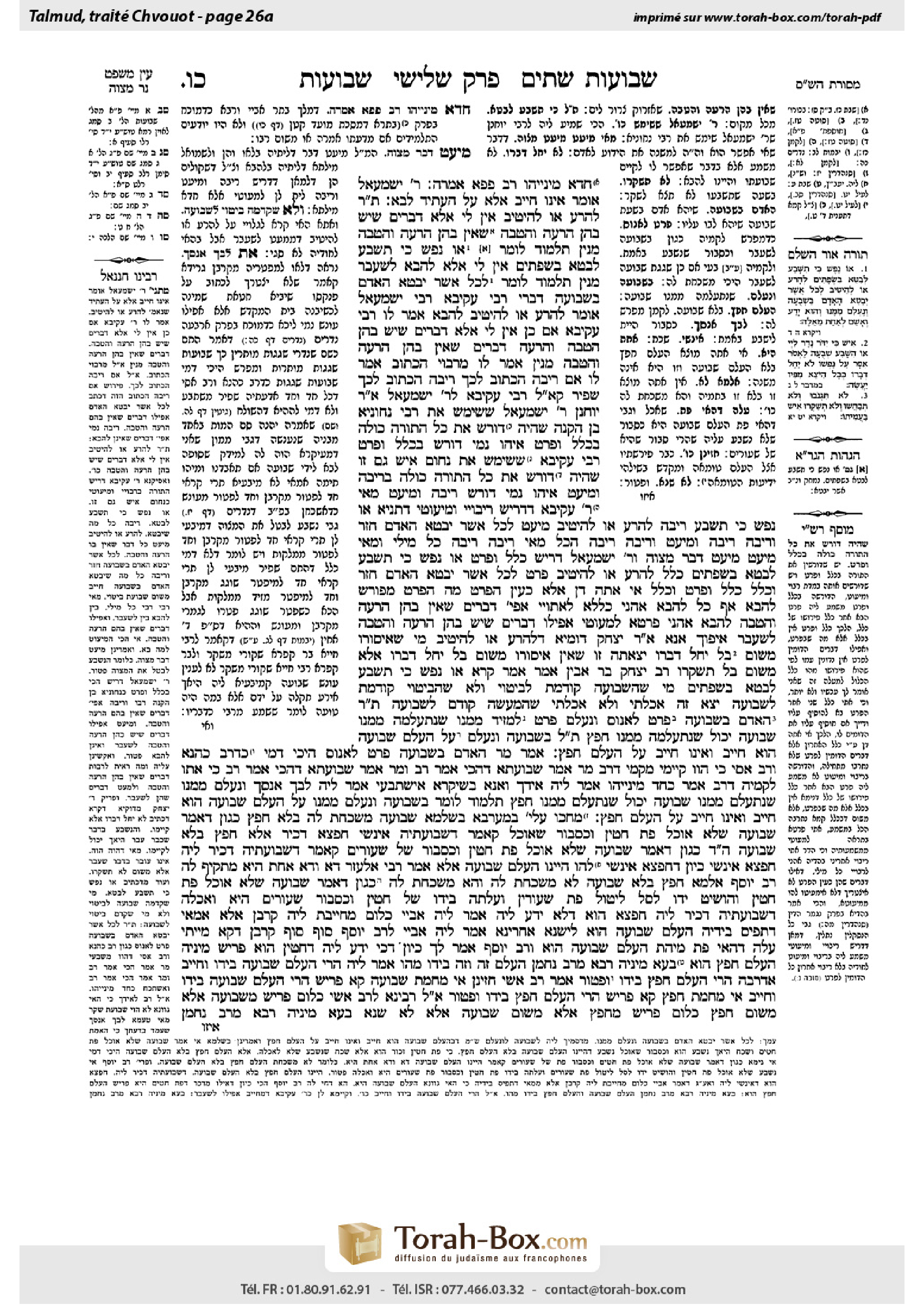
Shevuot 26a: Talmud study for Daf Yomi
Daf Yomi is the daily study of one Talmud folio. Explore 37 tractates with scans, Hebrew text, Sefaria English and AI-generated French translations where annotated.
Passage selection and English or AI-generated French translation are available where the scan has annotations. Daf Study is independent of Torah-Box and Sefaria.
Browse Shevuot · שבועות · All tractatesShevuot 26a text and translations
This page of Shevuot includes the Aramaic text, an English translation and an AI-generated French translation, alongside the scan above.
שבועות כ״ו א · Aramaic and Hebrew text
חֲדָא מִינַּיְיהוּ רַב פָּפָּא אַמְרַהּ.
רַבִּי יִשְׁמָעֵאל אוֹמֵר: אֵינוֹ חַיָּיב אֶלָּא עַל הֶעָתִיד לָבֹא. תָּנוּ רַבָּנַן: ״לְהָרַע אוֹ לְהֵיטִיב״ – אֵין לִי אֶלָּא דְּבָרִים שֶׁיֵּשׁ בָּהֶן הֲרָעָה וַהֲטָבָה; שֶׁאֵין בָּהֶן הֲרָעָה וַהֲטָבָה מִנַּיִן? תַּלְמוּד לוֹמַר: ״אוֹ נֶפֶשׁ כִּי תִשָּׁבַע לְבַטֵּא בִשְׂפָתַיִם״.
אֵין לִי אֶלָּא לְהַבָּא, לְשֶׁעָבַר מִנַּיִן? תַּלְמוּד לוֹמַר: ״לְכֹל אֲשֶׁר יְבַטֵּא הָאָדָם בִּשְׁבֻעָה״. דִּבְרֵי רַבִּי עֲקִיבָא. רַבִּי יִשְׁמָעֵאל אוֹמֵר: ״לְהָרַע אוֹ לְהֵיטִיב״ – לְהַבָּא.
אָמַר לוֹ רַבִּי עֲקִיבָא: אִם כֵּן, אֵין לִי אֶלָּא דְּבָרִים שֶׁיֵּשׁ בָּהֶן הֲטָבָה וְהָרָעָה, דְּבָרִים שֶׁאֵין בָּהֶן הֲרָעָה וַהֲטָבָה מִנַּיִן? אָמַר לוֹ: מֵרִבּוּי הַכָּתוּב. אָמַר לוֹ: אִם רִיבָּה הַכָּתוּב לְכָךְ, רִיבָּה הַכָּתוּב לְכָךְ!
שַׁפִּיר קָא אָמַר לֵיהּ רַבִּי עֲקִיבָא לְרַבִּי יִשְׁמָעֵאל!
אָמַר רַבִּי יוֹחָנָן: רַבִּי יִשְׁמָעֵאל – שֶׁשִּׁימֵּשׁ אֶת רַבִּי נְחוּנְיָא בֶּן הַקָּנָה, שֶׁהָיָה דּוֹרֵשׁ אֶת כָּל הַתּוֹרָה כּוּלָּהּ בִּכְלָל וּפְרָט – אִיהוּ נָמֵי דּוֹרֵשׁ בִּכְלָל וּפְרָט. רַבִּי עֲקִיבָא – שֶׁשִּׁימֵּשׁ אֶת נַחוּם אִישׁ גַּם זוֹ, שֶׁהָיָה דּוֹרֵשׁ אֶת כָּל הַתּוֹרָה כּוּלָּהּ בְּרִיבָּה וּמִיעֵט – אִיהוּ נָמֵי דּוֹרֵשׁ רִיבָּה וּמִיעֵט.
מַאי רַבִּי עֲקִיבָא דְּדָרֵישׁ רִיבּוּיֵי וּמִיעוּטֵי? דְּתַנְיָא: ״אוֹ נֶפֶשׁ כִּי תִשָּׁבַע״ – רִיבָּה, ״לְהָרַע אוֹ לְהֵיטִיב״ – מִיעֵט, ״לְכֹל אֲשֶׁר יְבַטֵּא הָאָדָם״ – חָזַר וְרִיבָּה; רִיבָּה וּמִיעֵט וְרִיבָּה – רִיבָּה הַכֹּל.
מַאי רִיבָּה? רִיבָּה כֹּל מִילֵּי, וּמַאי מִיעֵט? מִיעֵט דְּבַר מִצְוָה.
וְרַבִּי יִשְׁמָעֵאל דָּרֵישׁ כְּלָל וּפְרָט: ״אוֹ נֶפֶשׁ כִּי תִשָּׁבַע לְבַטֵּא בִשְׂפָתַיִם״ – כְּלָל, ״לְהָרַע אוֹ לְהֵיטִיב״ – פְּרָט, ״לְכֹל אֲשֶׁר יְבַטֵּא הָאָדָם״ – חָזַר וְכָלַל; כְּלָל וּפְרָט וּכְלָל – אִי אַתָּה דָן אֶלָּא כְעֵין הַפְּרָט; מָה הַפְּרָט מְפוֹרָשׁ – לְהַבָּא, אַף כֹּל לְהַבָּא.
אַהֲנִי כְּלָלָא, לְאֵתוֹיֵי אֲפִילּוּ דְּבָרִים שֶׁאֵין בָּהֶן הֲרָעָה וַהֲטָבָה לְהַבָּא; אַהֲנִי פְּרָטָא, לְמַעוֹטֵי אֲפִילּוּ דְּבָרִים שֶׁיֵּשׁ בָּהֶן הֲרָעָה וַהֲטָבָה לְשֶׁעָבַר.
אֵיפוֹךְ אֲנָא!
אָמַר רַבִּי יִצְחָק: דּוּמְיָא דִּ״לְהָרַע אוֹ לְהֵיטִיב״ – מִי שֶׁאִיסּוּרוֹ מִשּׁוּם ״בַּל יַחֵל דְּבָרוֹ״; יָצָאתָה זוֹ, שֶׁאֵין אִיסּוּרוֹ מִשּׁוּם ״בַּל יַחֵל דְּבָרוֹ״, אֶלָּא מִשּׁוּם ״בַּל תְּשַׁקְּרוּ״.
רַב יִצְחָק בַּר אָבִין אָמַר, אָמַר קְרָא: ״אוֹ נֶפֶשׁ כִּי תִשָּׁבַע לְבַטֵּא בִשְׂפָתַיִם״ – מִי שֶׁהַשְּׁבוּעָה קוֹדֶמֶת לַבִּיטּוּי, וְלֹא שֶׁהַבִּיטּוּי קוֹדֶמֶת לַשְּׁבוּעָה; יָצָא זֶה ״אָכַלְתִּי״ וְ״לֹא אָכַלְתִּי״, שֶׁהַמַּעֲשֶׂה קוֹדֵם לַשְּׁבוּעָה.
תָּנוּ רַבָּנַן: ״הָאָדָם בִּשְׁבוּעָה״ – פְּרָט לְאָנוּס. ״וְנֶעְלַם״ – פְּרָט לְמֵזִיד.
״מִמֶּנּוּ״ – שֶׁנִּתְעַלְּמָה מִמֶּנּוּ שְׁבוּעָה. יָכוֹל שֶׁנִּתְעַלְּמָה מִמֶּנּוּ חֵפֶץ? תַּלְמוּד לוֹמַר: ״בִּשְׁבוּעָה וְנֶעְלַם״ – עַל הֶעְלֵם שְׁבוּעָה הוּא חַיָּיב, וְאֵינוֹ חַיָּיב עַל הֶעְלֵם חֵפֶץ.
אָמַר מָר: ״הָאָדָם בִּשְׁבוּעָה״ – פְּרָט לְאָנוּס. הֵיכִי דָּמֵי?
כִּדְרַב כָּהֲנָא וְרַב אַסִּי, כִּי הֲווֹ קָיְימִי מִקַּמֵּי דְּרַב, מָר אֲמַר: שְׁבוּעֲתָא דְּהָכִי אֲמַר רַב, וּמָר אָמַר: שְׁבוּעֲתָא דְּהָכִי אֲמַר רַב. כִּי אֲתוֹ לְקַמֵּיהּ דְּרַב, אֲמַר כְּחַד מִינַּיְיהוּ. אֲמַר לֵיהּ אִידַּךְ: וַאֲנָא בְּשִׁיקְרָא אִישְׁתְּבַעִי?!
אֲמַר לֵיהּ: לִבָּךְ אֲנָסָךְ.
״וְנֶעְלַם מִמֶּנּוּ״ – שֶׁנִּתְעַלֵּם מִמֶּנּוּ שְׁבוּעָה. יָכוֹל שֶׁנִּתְעַלֵּם מִמֶּנּוּ חֵפֶץ? תַּלְמוּד לוֹמַר: ״בִּשְׁבוּעָה וְנֶעְלַם מִמֶּנּוּ״ – עַל הֶעְלֵם שְׁבוּעָה הוּא חַיָּיב, וְאֵינוֹ חַיָּיב עַל הֶעְלֵם חֵפֶץ.
מַחֲכוּ עֲלֵיהּ בְּמַעְרְבָא: בִּשְׁלָמָא שְׁבוּעָה – מַשְׁכַּחַתְּ לַהּ בְּלָא חֵפֶץ, כְּגוֹן דְּאָמַר: ״שְׁבוּעָה שֶׁלֹּא אוֹכַל פַּת חִטִּין״, וּכְסָבוּר ״שֶׁאוֹכַל״ קָאָמַר – דִּשְׁבוּעֲתֵיהּ אִינְּשִׁי, חֶפְצָא דְּכִיר; אֶלָּא חֵפֶץ בְּלֹא שְׁבוּעָה, הֵיכִי דָּמֵי?
כְּגוֹן דְּאָמַר: ״שְׁבוּעָה שֶׁלֹּא אוֹכַל פַּת חִטִּין״, וּכְסָבוּר ״שֶׁל שְׂעוֹרִים״ קָאָמַר – דִּשְׁבוּעֲתֵיהּ דְּכִיר לֵיהּ, חֶפְצָא אִינְּשִׁי. כֵּיוָן דְּחֶפְצָא אִינְּשִׁי לְהוּ, הַיְינוּ הֶעְלֵם שְׁבוּעָה!
אֶלָּא אָמַר רַבִּי אֶלְעָזָר: דָּא וְדָא אַחַת הִיא.
מַתְקֵיף לַהּ רַב יוֹסֵף: אַלְמָא חֵפֶץ בְּלֹא שְׁבוּעָה לָא מַשְׁכַּחַתְּ לַהּ? וְהָא מַשְׁכַּחַתְּ לַהּ – כְּגוֹן דְּאָמַר ״שְׁבוּעָה שֶׁלֹּא אוֹכַל פַּת חִטִּין״, וְהוֹשִׁיט יָדוֹ לַסַּל לִיטּוֹל פַּת שְׂעוֹרִין; וְעָלְתָה בְּיָדוֹ שֶׁל חִטִּין, וּכְסָבוּר שְׂעוֹרִים הִיא וַאֲכָלָהּ; דִּשְׁבוּעֲתֵיהּ דְּכִיר לֵיהּ, חֶפְצָא הוּא דְּלָא יָדַע לֵיהּ!
אֲמַר לֵיהּ אַבָּיֵי: כְּלוּם מְחַיְּיבַתְּ לֵיהּ קׇרְבָּן – אֶלָּא אַמַּאי דִּתְפִיס בִּידֵיהּ; הֶעְלֵם שְׁבוּעָה הוּא!
לִישָּׁנָא אַחֲרִינָא – אֲמַר לֵיהּ אַבָּיֵי לְרַב יוֹסֵף: סוֹף סוֹף, קׇרְבָּן דְּקָא מַיְיתֵי עֲלַהּ דְּהַאי פַּת מִיהַת, הֶעְלֵם שְׁבוּעָה הוּא!
וְרַב יוֹסֵף אָמַר לָךְ: כֵּיוָן דְּכִי יָדַע לֵיהּ דְּחִטִּין הוּא – פָּרֵישׁ מִינֵּיהּ, הֶעְלֵם חֵפֶץ הוּא.
בְּעָא מִינֵּיהּ רָבָא מֵרַב נַחְמָן: הֶעְלֵם זֶה וְזֶה בְּיָדוֹ, מַהוּ? אֲמַר לֵיהּ: הֲרֵי הֶעְלֵם שְׁבוּעָה בְּיָדוֹ, וְחַיָּיב. אַדְּרַבָּה, הֲרֵי הֶעְלֵם חֵפֶץ בְּיָדוֹ, וּפָטוּר!
אָמַר רַב אָשֵׁי: חָזֵינַן; אִי מֵחֲמַת שְׁבוּעָה קָא פָרֵישׁ – הֲרֵי הֶעְלֵם שְׁבוּעָה בְּיָדוֹ, וְחַיָּיב; אִי מֵחֲמַת חֵפֶץ קָא פָרֵישׁ – הֲרֵי הֶעְלֵם חֵפֶץ בְּיָדוֹ, וּפָטוּר.
אֲמַר לֵיהּ רָבִינָא לְרַב אָשֵׁי: כְּלוּם פָּרֵישׁ מִשְּׁבוּעָה – אֶלָּא מִשּׁוּם חֵפֶץ! כְּלוּם פָּרֵישׁ מֵחֵפֶץ – אֶלָּא מִשּׁוּם שְׁבוּעָה! אֶלָּא לָא שְׁנָא.
בְּעָא מִינֵּיהּ רָבָא מֵרַב נַחְמָן:
Shevuot 26a · English translation
Rav Pappa said one of those statements, not Abaye.
§ The mishna teaches that Rabbi Yishmael says: One is liable only for an oath on an utterance taken about the future. The Sages taught in a baraita with regard to an oath on an utterance: From the verse: “Or if anyone take an oath clearly with his lips to do evil, or to do good” (Leviticus 5:4), I have derived only that one is liable for an oath on an utterance with regard to matters to which doing evil and doing good apply. From where do I derive that one is liable for an oath on an utterance with regard to matters to which doing evil and doing good do not apply? The verse states: “Or if anyone take an oath clearly with his lips,” which includes other matters.
I have derived only that one is liable for oaths referring to the future. From where do I derive that one is liable for oaths referring to the past? The verse subsequently states: “Whatsoever it be that a man shall utter clearly with an oath” (Leviticus 5:4); this is the statement of Rabbi Akiva. Rabbi Yishmael says: The verse states: “To do evil, or to do good,” referring exclusively to oaths about the future.
The baraita continues: Rabbi Akiva said to him: If so, then I have derived only that one is liable for an oath on an utterance with regard to matters to which doing evil and doing good apply. From where do I derive that one is liable for an oath on an utterance with regard to matters to which doing evil and doing good do not apply? Rabbi Yishmael said to Rabbi Akiva in response: It is derived from an amplification of the meaning of the verse. Rabbi Akiva said to him: If the verse is amplified for this, i.e., to extend the halakha of an oath on an utterance to matters that do not involve doing evil or good, the verse is amplified for that, i.e., oaths about the past.
The Gemara questions: Rabbi Akiva said well his critique of the opinion of Rabbi Yishmael. Why does Rabbi Yishmael disagree?
Rabbi Yoḥanan said: It is because Rabbi Yishmael was the one who served as a disciple of Rabbi Neḥunya ben HaKana, who would interpret the entire Torah with the hermeneutical principle of a generalization and a detail. Therefore, Rabbi Yishmael also interprets the Torah with the method of a generalization and a detail. Rabbi Akiva was one who served as a disciple of Naḥum of Gam Zo, who would interpret the entire Torah with the hermeneutical principle of amplification and restriction. Therefore, Rabbi Akiva also interprets the Torah by amplification and restriction.
What is the specific instance in this context where one finds that Rabbi Akiva interprets with amplifications and restrictions? It is as it is taught in a baraita that when the verse states: “Or if anyone take an oath clearly with his lips” (Leviticus 5:4), it amplifies the range of possible oaths for which one could be liable to bring an offering for an oath on an utterance. When the verse continues: “To do evil, or to do good,” it restricts that range. When it further continues: “Whatsoever it be that a man shall utter clearly with an oath,” it then amplifies again. According to the hermeneutical principle that when a verse amplified, and then restricted, and then amplified, it amplified the relevant category to include everything except for the specific matter that was excluded by the restriction.
What was included when the verse amplified the range of liability? It amplified it to include all matters about which one might take an oath. And in what way did it restrict it when it continued: “To do evil, or to do good”? It restricted the range of liability for an oath on an utterance to exclude an oath that is a matter involving a mitzva, i.e., an oath to refrain from performing a mitzva.
And Rabbi Yishmael interprets the verse following the hermeneutical principle of a generalization and a detail: “Or if anyone take an oath clearly with his lips” (Leviticus 5:4), is a generalization; “to do evil, or to do good,” is a detail; “whatsoever it be that a man shall utter clearly with an oath,” the verse then further generalized. There is a hermeneutical principle that when a verse contains a generalization, and a detail, and another generalization, you may deduce that the verse is referring only to items similar to the detail. Just as the detail in the verse is explicitly an oath referring to the future, so too, all the oaths for which one is liable must be referring to the future.
The generalization serves to include even those matters that do not concern doing evil or doing good when they refer to the future; the detail serves to exclude even matters that concern doing evil or doing good when they refer to the past.
The Gemara challenges: I will reverse it and say that the generalization serves to include oaths concerning the past, and the detail serves to exclude matters that do not involve doing evil or doing good. Why is that not an equally legitimate interpretation of the verse?
Rabbi Yitzḥak said that Rabbi Yishmael understands that liability is extended to one whose oath is similar to an oath “to do evil, or to do good” (Leviticus 5:4). He whose prohibition is due to the verse: “He shall not break his word” (Numbers 30:3), is liable, as liability for an oath about the future entails breaking one’s word. Excluded is that oath whose prohibition is not due to the verse: “He shall not break his word”; rather, it is due to the verse: “You shall not lie” (Leviticus 19:11), since liability for an oath about the past applies when the oath itself was a lie.
Rav Yitzḥak bar Avin says that there is a different explanation of Rabbi Yishmael’s opinion: The verse states: “Or if anyone take an oath clearly with his lips to do evil, or to do good,” referring to one whose oath precedes its clarification, i.e., the action that breaks it, and not to one who takes an oath where the clarification, i.e., the action prohibited in the oath, precedes the oath. Excluded is that oath where one said, for example: I ate, or: I did not eat, where the action precedes the oath.
§ The Sages taught in a baraita: The verse states: “Or if anyone take an oath clearly with his lips to do evil, or to do good, whatsoever it be that a man shall utter clearly with an oath, and it is hidden from him; and, when he knows of it, be guilty in one of these things” (Leviticus 5:4). The phrase “a man…with an oath” serves to exclude a victim of circumstances beyond his control from liability to bring an offering. The term “and it is hidden” serves to exclude from liability one who broke his oath intentionally, as he does not deserve to be able to achieve atonement through bringing an offering.
The baraita continues: The term “from him” teaches that one who was unaware of his oath, i.e., forgot it, and subsequently broke it, is liable to bring an offering. One might have thought that an oath taker is also liable when he broke an oath because he was unaware that a particular item is forbidden as the object of his oath; therefore, the verse states: “With an oath, and it is hidden from him.” He is liable for lack of awareness of the oath but he is not liable for lack of awareness of the object of the oath.
The Master says above in the baraita: The phrase “a man…with an oath” serves to exclude a victim of circumstances beyond his control. The Gemara asks: What are such circumstances?
The Gemara answers: It is as it was with Rav Kahana and Rav Asi, who, when they were standing up in the presence of Rav, their teacher, at the conclusion of a lesson, disagreed with regard to exactly what he said. One Sage said: On my oath Rav said like this, and the other Sage said: On my oath Rav said like that. When they came before Rav to clarify what he had said, he stated his opinion in accordance with what one of them had said. The other said to Rav: Did I then take a false oath?
Rav said to him: Your heart compelled you. It is not regarded as a false oath, since at the time that you took the oath you were certain that you were telling the truth.
§ The baraita teaches: The phrase “and it is hidden from him” teaches that one who was unaware of his oath, i.e., forgot it, and subsequently broke it, is liable to bring an offering. One might have thought that the oath taker is also liable when he broke the oath because he was unaware that a particular item is forbidden as the object of his oath; therefore, the verse states: “With an oath, and it is hidden from him.” He is liable for lack of awareness of the oath, but he is not liable for lack of awareness of the object of the oath.
They laughed at this in the West, Eretz Yisrael, and said: Granted, you find lack of awareness of one’s oath without there being lack of awareness of the object of the oath, as in a case where one said: On my oath I will not eat wheat bread, and he thought he had said: I will eat wheat bread, as in that case his oath is forgotten and the object of it is remembered. But under what circumstances is there a case of lack of awareness of the object of the oath without lack of awareness of the oath itself?
The Gemara suggests: It can be found in a case where he said: On my oath I will not eat wheat bread, and he thought he had said: On my oath I will not eat barley bread, as in that case his oath is remembered by him and the object of it is forgotten. The Gemara rejects this suggestion: Once the object of the oath is forgotten by him, that is a case of lack of awareness of his oath.
Rather, Rabbi Elazar said: The distinction made in the baraita between lack of awareness of one’s oath and lack of awareness of the object of one’s oath is not valid, and both this and that are one and the same.
Rav Yosef objects to this. Is it really the case that you do not find a case of lack of awareness of the object of an oath without lack of awareness of the oath? But you find it in a case where he said: On my oath I will not eat wheat bread, and he extended his hand to the basket to take barley bread, and wheat bread came up in his hand, and he thought it was barley bread and ate it. That is a case where his oath is remembered by him, and it is the object of the oath of which he is unaware.
Abaye said to him: Don’t you deem him liable to bring an offering for breaking his oath only for that which he holds in his hand and eats? When he eats the bread, that is lack of awareness of the oath, since he thinks that the item in his hand is permitted.
The Gemara presents another formulation of this statement. Abaye said to Rav Yosef: Ultimately, the offering he brings for this bread is in any event due to lack of awareness of the oath, as he thinks that the item in his hand is permitted.
And Rav Yosef could say to you: Since were he to know of it that it is wheat bread he would refrain from eating it, this should be regarded as a case of lack of awareness of the object.
Rava asked of Rav Naḥman: In a case where one has a lack of awareness of this, the oath, and that, its object, what is the halakha? Rav Naḥman said to him: He breaks the oath while having a lack of awareness of the oath and is therefore liable. Rava replied: On the contrary, he has a lack of awareness of the object of the oath and should therefore be exempt.
Rav Ashi said: We see: If he refrains from eating due to the oath, i.e., when he is reminded that he took an oath, he had a lack of awareness of the oath and is liable. If he refrains due to the object of the oath, i.e., when he is reminded what it is he is about to eat, he had a lack of awareness due to the object, and is exempt.
Ravina said to Rav Ashi: Doesn’t he refrain from breaking the oath due to his recognition of the object? Doesn’t he refrain from the object due only to the oath? In either case, he needs to remember both the oath and its object, and the manner in which he was reminded does not serve to indicate anything. Rather, there is no difference between the two.
Rava asked of Rav Naḥman:
Shevuot 26a · Traduction française (IA)
Rav Pappa a énoncé l’une de ces affirmations, et non Abaye.
§ La Michna enseigne que Rabbi Yishmael dit : On n’est passible que pour un serment d’expression portant sur l’avenir. Les Sages ont enseigné dans une baraïta au sujet du serment d’expression : Du verset « Ou si quelqu’un prononce clairement de ses lèvres un serment de faire le mal ou le bien » (Lévitique 5, 4), j’ai appris qu’on n’est passible que pour un serment d’expression portant sur des choses auxquelles s’applique le fait de faire le mal ou le bien. D’où apprend-on qu’on est passible pour un serment d’expression portant sur des choses auxquelles ne s’applique pas le fait de faire le mal ou le bien ? Le verset dit : « Ou si quelqu’un prononce clairement de ses lèvres », ce qui inclut d’autres choses.
J’ai appris qu’on n’est passible que pour des serments portant sur l’avenir. D’où apprend-on qu’on est passible pour des serments portant sur le passé ? Le verset dit ensuite : « Quelle que soit la chose qu’un homme prononce clairement par un serment » (Lévitique 5, 4). Telle est l’opinion de Rabbi Akiva. Rabbi Yishmael dit : Le verset dit : « De faire le mal ou le bien », ce qui se rapporte exclusivement aux serments portant sur l’avenir.
La baraïta poursuit : Rabbi Akiva lui dit : Si tel est le cas, j’ai seulement appris qu’on est passible pour un serment d’expression portant sur des choses auxquelles s’applique le fait de faire le mal ou le bien. D’où apprend-on qu’on est passible pour un serment d’expression portant sur des choses auxquelles ne s’applique pas le fait de faire le mal ou le bien ? Rabbi Yishmael répondit à Rabbi Akiva : Cela se déduit d’une extension du sens du verset. Rabbi Akiva lui dit : Si le verset est étendu à cette fin, c’est-à-dire pour étendre la halakha du serment d’expression aux choses qui n’impliquent ni le mal ni le bien, il est aussi étendu à cette autre fin, c’est-à-dire aux serments portant sur le passé.
La Guemara objecte : Rabbi Akiva a bien formulé sa critique de l’opinion de Rabbi Yishmael. Pourquoi Rabbi Yishmael n’est-il pas d’accord ?
Rabbi Yoḥanan dit : C’est parce que Rabbi Yishmael fut le disciple de Rabbi Neḥunya ben HaKana, qui interprétait toute la Torah selon le principe herméneutique de la généralité et de la particularité. Rabbi Yishmael interprète donc lui aussi la Torah selon cette méthode. Rabbi Akiva fut le disciple de Naḥum de Gam Zo, qui interprétait toute la Torah selon le principe herméneutique de l’amplification et de la restriction. Rabbi Akiva interprète donc lui aussi la Torah par l’amplification et la restriction.
Quel est, dans ce contexte, le cas précis où l’on voit que Rabbi Akiva interprète par amplifications et restrictions ? C’est ce qu’enseigne une baraïta : lorsque le verset dit « Ou si quelqu’un prononce clairement de ses lèvres un serment » (Lévitique 5, 4), il amplifie l’éventail des serments pour lesquels on peut être passible d’apporter une offrande pour un serment d’expression. Lorsque le verset poursuit : « De faire le mal ou le bien », il restreint cet éventail. Puis, lorsqu’il poursuit : « Quelle que soit la chose qu’un homme prononce clairement par un serment », il l’amplifie de nouveau. Selon le principe herméneutique, lorsqu’un verset amplifie, puis restreint, puis amplifie de nouveau, il élargit la catégorie concernée afin d’inclure tout, à l’exception de la chose précise exclue par la restriction.
Qu’a-t-on inclus lorsque le verset a amplifié le champ de la responsabilité ? On a inclus toutes les choses au sujet desquelles on peut prêter serment. Et de quelle manière l’a-t-il restreint en poursuivant : « De faire le mal ou le bien » ? Il a restreint le champ de la responsabilité pour un serment d’expression afin d’exclure un serment portant sur une mitsva, c’est-à-dire un serment de s’abstenir d’accomplir une mitsva.
Rabbi Yishmael interprète le verset selon le principe herméneutique de la généralité et de la particularité : « Ou si quelqu’un prononce clairement de ses lèvres » (Lévitique 5, 4) est une généralité ; « de faire le mal ou le bien » est une particularité ; puis le verset énonce une autre généralité : « Quelle que soit la chose qu’un homme prononce clairement par un serment ». Selon un principe herméneutique, lorsqu’un verset contient une généralité, une particularité, puis une autre généralité, on en déduit qu’il ne concerne que les éléments semblables à la particularité. De même que la particularité du verset est explicitement un serment portant sur l’avenir, de même tous les serments pour lesquels on est passible doivent porter sur l’avenir.
La généralité sert à inclure même les choses qui ne concernent pas le fait de faire le mal ou le bien, lorsqu’elles portent sur l’avenir ; la particularité sert à exclure même les choses qui concernent le fait de faire le mal ou le bien, lorsqu’elles portent sur le passé.
La Guemara objecte : Je pourrais inverser les choses et dire que la généralité sert à inclure les serments portant sur le passé, tandis que la particularité sert à exclure les choses qui n’impliquent pas de faire le mal ou le bien. Pourquoi cette interprétation du verset ne serait-elle pas tout aussi légitime ?
Rabbi Yitzḥak dit que, selon Rabbi Yishmael, la responsabilité s’étend à celui dont le serment est semblable à un serment « de faire le mal ou le bien » (Lévitique 5, 4). Celui qui enfreint l’interdiction découlant du verset « Il ne violera pas sa parole » (Nombres 30, 3) est passible, puisque la responsabilité pour un serment portant sur l’avenir implique de violer sa parole. Est exclu le serment dont l’interdiction ne découle pas du verset « Il ne violera pas sa parole », mais plutôt du verset « Vous ne mentirez pas » (Lévitique 19, 11), car la responsabilité pour un serment portant sur le passé s’applique lorsque le serment lui-même était mensonger.
Rav Yitzḥak bar Avin donne une autre explication de l’opinion de Rabbi Yishmael : Le verset dit « Ou si quelqu’un prononce clairement de ses lèvres un serment de faire le mal ou le bien », ce qui se rapporte à celui dont le serment précède sa réalisation, c’est-à-dire l’acte qui le rompt, et non à celui qui prête serment alors que sa réalisation, c’est-à-dire l’acte interdit par le serment, a déjà eu lieu. Est exclu le serment dans lequel on a dit, par exemple : « J’ai mangé » ou « Je n’ai pas mangé », car l’acte précède le serment.
§ Les Sages ont enseigné dans une baraïta : Le verset dit : « Ou si quelqu’un prononce clairement de ses lèvres un serment de faire le mal ou le bien, quelle que soit la chose qu’un homme prononce clairement par un serment, et que cela lui soit caché ; quand il en prend connaissance, il sera coupable dans l’un de ces cas » (Lévitique 5, 4). L’expression « un homme… par un serment » sert à exclure de l’obligation d’apporter une offrande celui qui est victime de circonstances indépendantes de sa volonté. Le terme « et que cela lui soit caché » sert à exclure de toute responsabilité celui qui a rompu son serment intentionnellement, car il ne mérite pas de pouvoir obtenir l’expiation en apportant une offrande.
La baraïta poursuit : Le terme « de lui » enseigne que celui qui ignorait son serment, c’est-à-dire qui l’avait oublié, et qui l’a ensuite rompu, est tenu d’apporter une offrande. On aurait pu penser que celui qui a prêté serment est également passible lorsqu’il l’a rompu parce qu’il ignorait qu’un objet particulier était interdit par son serment ; le verset dit donc : « Par un serment, et que cela lui soit caché ». Il est passible s’il ignorait son serment, mais il ne l’est pas s’il ignorait l’objet du serment.
Le Maître dit plus haut dans la baraïta : L’expression « un homme… par un serment » sert à exclure celui qui est victime de circonstances indépendantes de sa volonté. La Guemara demande : De quelles circonstances s’agit-il ?
La Guemara répond : C’est ce qui arriva à Rav Kahana et Rav Asi qui, alors qu’ils se tenaient debout en présence de Rav, leur maître, à la fin d’un cours, ne s’accordèrent pas sur ce qu’il avait exactement dit. L’un des Sages dit : « Par mon serment, Rav a dit ceci », et l’autre Sage dit : « Par mon serment, Rav a dit cela ». Lorsqu’ils vinrent auprès de Rav pour vérifier ce qu’il avait dit, celui-ci exprima son opinion conformément à ce qu’avait dit l’un d’eux. L’autre dit à Rav : « Aurais-je donc prêté un faux serment ? »
Rav lui dit : « Ton cœur t’y a poussé. » Cela n’est pas considéré comme un faux serment, puisque, au moment où tu as prêté serment, tu étais certain de dire la vérité.
§ La baraïta enseigne : L’expression « et que cela lui soit caché » enseigne que celui qui ignorait son serment, c’est-à-dire qui l’avait oublié, et qui l’a ensuite rompu, est tenu d’apporter une offrande. On aurait pu penser que celui qui a prêté serment est également passible lorsqu’il l’a rompu parce qu’il ignorait qu’un objet particulier était interdit par son serment ; le verset dit donc : « Par un serment, et que cela lui soit caché ». Il est passible s’il ignorait son serment, mais il ne l’est pas s’il ignorait l’objet du serment.
En Occident, c’est-à-dire en terre d’Israël, on rit de cela et on dit : Certes, on peut trouver un cas où quelqu’un ignore son serment sans ignorer l’objet du serment, comme lorsqu’il a dit : « Par mon serment, je ne mangerai pas de pain de blé », et qu’il croit avoir dit : « Je mangerai du pain de blé » ; dans ce cas, il a oublié son serment, mais se souvient de son objet. Mais dans quelles circonstances peut-on trouver un cas où quelqu’un ignore l’objet du serment sans ignorer le serment lui-même ?
La Guemara propose : Cela peut se produire dans le cas où il a dit : « Par mon serment, je ne mangerai pas de pain de blé », et qu’il croit avoir dit : « Par mon serment, je ne mangerai pas de pain d’orge » ; dans ce cas, il se souvient de son serment, mais en a oublié l’objet. La Guemara rejette cette proposition : Dès lors qu’il a oublié l’objet du serment, il s’agit d’un cas où il ignore son serment.
Rabbi Elazar dit plutôt : La distinction faite dans la baraïta entre le fait d’ignorer son serment et le fait d’ignorer l’objet de son serment n’est pas valable ; ces deux cas sont identiques.
Rav Yosef objecte : Est-il vraiment impossible de trouver un cas où quelqu’un ignore l’objet de son serment sans ignorer le serment ? On en trouve pourtant un : il a dit « Par mon serment, je ne mangerai pas de pain de blé », puis a tendu la main vers le panier pour prendre du pain d’orge ; du pain de blé s’est retrouvé dans sa main, mais il a cru que c’était du pain d’orge et l’a mangé. Dans ce cas, il se souvient de son serment, mais ignore l’objet du serment.
Abaye lui dit : N’estimes-tu pas qu’il n’est passible d’apporter une offrande pour avoir rompu son serment qu’à raison de ce qu’il tient dans sa main et mange ? Lorsqu’il mange le pain, il ignore son serment, puisqu’il croit que l’objet qu’il tient dans sa main est permis.
La Guemara présente une autre formulation de cet échange. Abaye dit à Rav Yosef : En définitive, l’offrande qu’il apporte pour ce pain est, dans tous les cas, due au fait qu’il ignorait son serment, puisqu’il croit que l’objet qu’il tient dans sa main est permis.
Rav Yosef pourrait te répondre : Puisque, s’il savait qu’il s’agit de pain de blé, il s’abstiendrait d’en manger, il faut considérer qu’il ignore l’objet.
Rava demanda à Rav Naḥman : Dans le cas où quelqu’un ignore à la fois ceci, le serment, et cela, son objet, quelle est la halakha ? Rav Naḥman lui dit : Il rompt le serment tout en ignorant celui-ci, et il est donc passible. Rava répondit : Au contraire, il ignore l’objet du serment et devrait donc être exempté.
Rav Ashi dit : Voyons : S’il s’abstient de manger à cause du serment, c’est-à-dire que, lorsqu’on lui rappelle qu’il a prêté serment, il s’avère qu’il ignorait son serment et qu’il est passible. S’il s’abstient à cause de l’objet du serment, c’est-à-dire que, lorsqu’on lui rappelle ce qu’il s’apprête à manger, il s’avère qu’il ignorait l’objet et qu’il est exempté.
Ravina dit à Rav Ashi : Ne s’abstient-il pas de rompre le serment parce qu’il reconnaît l’objet ? Et ne s’abstient-il pas de consommer cet objet uniquement à cause du serment ? Dans les deux cas, il doit se souvenir à la fois du serment et de son objet, et la manière dont on le lui rappelle ne permet de rien conclure. Il n’y a donc aucune différence entre les deux cas.
Rava demanda à Rav Naḥman :
Traduction française générée par IA à partir de l’édition anglaise de Sefaria. Vérifie toujours un passage avec le texte source.
Text from Sefaria: William Davidson Edition - Vocalized Aramaic (CC BY NC); William Davidson Edition - English (CC BY NC).