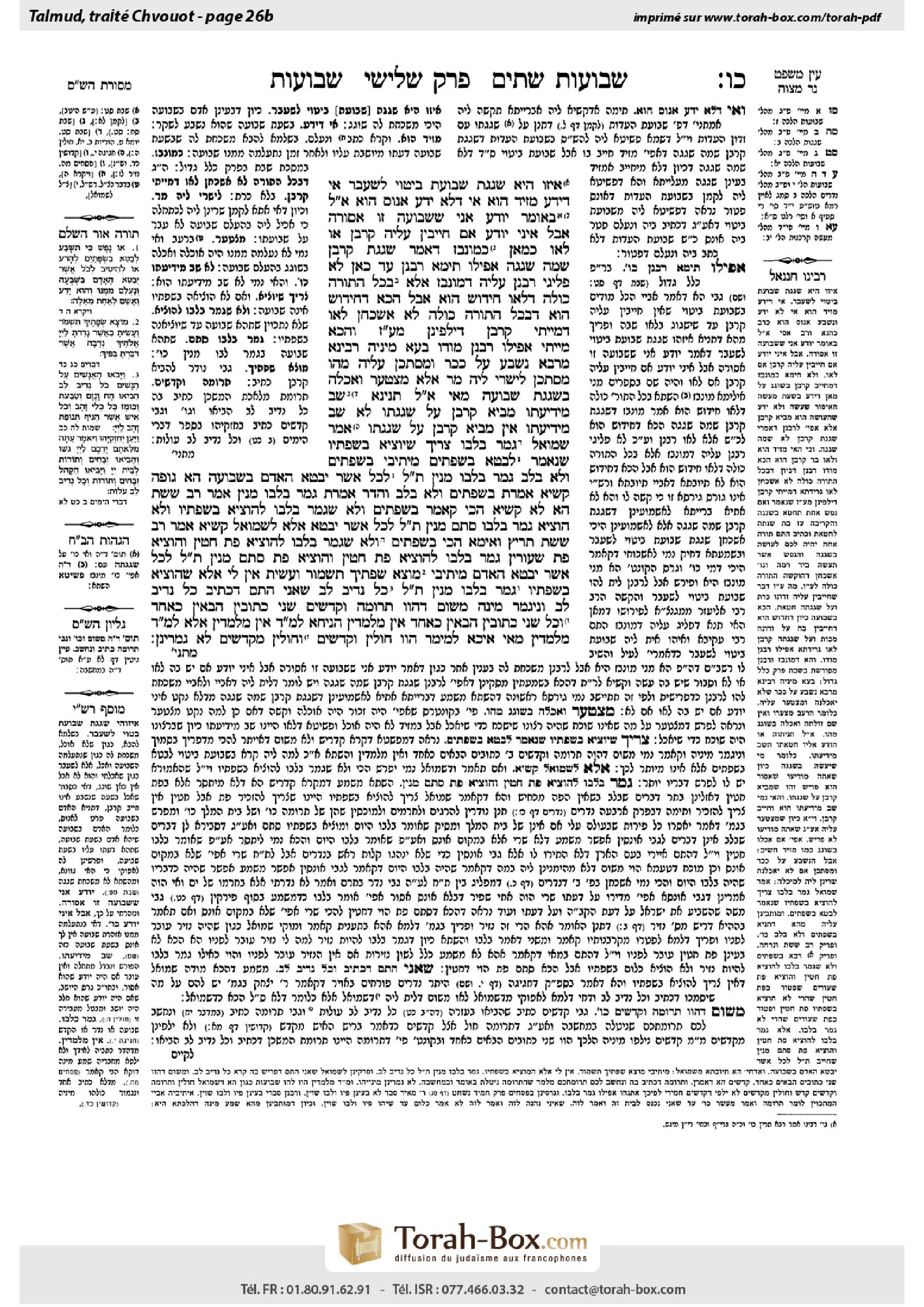
Shevuot 26b: Talmud study for Daf Yomi
Daf Yomi is the daily study of one Talmud folio. Explore 37 tractates with scans, Hebrew text, Sefaria English and AI-generated French translations where annotated.
Passage selection and English or AI-generated French translation are available where the scan has annotations. Daf Study is independent of Torah-Box and Sefaria.
Browse Shevuot · שבועות · All tractatesShevuot 26b text and translations
This page of Shevuot includes the Aramaic text, an English translation and an AI-generated French translation, alongside the scan above.
שבועות כ״ו ב · Aramaic and Hebrew text
אֵיזוֹ הִיא שִׁגְגַת שְׁבוּעַת בִּיטּוּי לְשֶׁעָבַר? אִי דְּיָדַע – מֵזִיד הוּא! אִי דְּלָא יָדַע – אָנוּס הוּא!
אֲמַר לֵיהּ, בְּאוֹמֵר: ״יוֹדֵעַ אֲנִי שֶׁשְּׁבוּעָה זוֹ אֲסוּרָה, אֲבָל אֵינִי יוֹדֵעַ אִם חַיָּיבִין עָלֶיהָ קׇרְבָּן אוֹ לָאו״.
כְּמַאן – כְּמוֹנְבַּז, דְּאָמַר: שִׁגְגַת קׇרְבָּן שְׁמָהּ שְׁגָגָה?
אֲפִילּוּ תֵּימָא רַבָּנַן, עַד כָּאן לָא פְּלִיגִי רַבָּנַן עֲלֵיהּ דְּמוֹנְבַּז – אֶלָּא בְּכׇל הַתּוֹרָה כּוּלָּהּ, דְּלָאו חִידּוּשׁ הוּא; אֲבָל הָכָא, דְּחִידּוּשׁ הוּא – דִּבְכָל הַתּוֹרָה כּוּלָּהּ לָא אַשְׁכְּחַן לָאו דְּמַיְיתֵי קׇרְבָּן,
דְּיָלְפִינַן מֵעֲבוֹדָה זָרָה; וְהָכָא מַיְיתֵי – אֲפִילּוּ רַבָּנַן מוֹדוּ.
בְּעָא מִינֵּיהּ רָבִינָא מֵרָבָא: נִשְׁבַּע עַל כִּכָּר וּמִסְתַּכֵּן עָלֶיהָ, מַהוּ?
מִסְתַּכֵּן – לִישְׁרֵי לֵיהּ מָר! אֶלָּא מִצְטַעֵר, וַאֲכָלָהּ בְּשִׁגְגַת שְׁבוּעָה – מַאי?
אֲמַר לֵיהּ, תְּנֵינָא: שָׁב מִידִיעָתוֹ – מֵבִיא קׇרְבָּן עַל שִׁגְגָתוֹ; לֹא שָׁב מִידִיעָתוֹ – אֵין מֵבִיא קׇרְבָּן עַל שִׁגְגָתוֹ.
אָמַר שְׁמוּאֵל: גָּמַר בְּלִבּוֹ – צָרִיךְ שֶׁיּוֹצִיא בִּשְׂפָתָיו; שֶׁנֶּאֱמַר: ״לְבַטֵּא בִּשְׂפָתַיִם״.
מֵיתִיבִי: ״בִּשְׂפָתַיִם״ – וְלֹא בַּלֵּב; גָּמַר בְּלִבּוֹ מִנַּיִן? תַּלְמוּד לוֹמַר: ״לְכֹל אֲשֶׁר יְבַטֵּא הָאָדָם בִּשְׁבוּעָה״.
הָא גּוּפַהּ קַשְׁיָא – אָמְרַתְּ ״בִּשְׂפָתַיִם״ וְלֹא בַּלֵּב, וַהֲדַר אָמְרַתְּ ״גָּמַר בְּלִבּוֹ מִנַּיִן״?!
אָמַר רַב שֵׁשֶׁת: הָא לָא קַשְׁיָא; הָכִי קָאָמַר: ״בִּשְׂפָתַיִם״ – וְלֹא שֶׁגָּמַר בְּלִבּוֹ לְהוֹצִיא בִּשְׂפָתָיו וְלֹא הוֹצִיא; גָּמַר בְּלִבּוֹ סְתָם מִנַּיִן? תַּלְמוּד לוֹמַר: ״לְכֹל אֲשֶׁר יְבַטֵּא״.
אֶלָּא לִשְׁמוּאֵל קַשְׁיָא!
אָמַר רַב שֵׁשֶׁת, תָּרֵיץ וְאֵימָא הָכִי: ״בִּשְׂפָתַיִם״ – וְלֹא שֶׁגָּמַר בְּלִבּוֹ לְהוֹצִיא ״פַּת חִטִּין״ וְהוֹצִיא ״פַּת שְׂעוֹרִין״; גָּמַר בְּלִבּוֹ לְהוֹצִיא ״פַּת חִטִּין״ וְהוֹצִיא ״פַּת״ סְתָם, מִנַּיִן? תַּלְמוּד לוֹמַר: ״לְכֹל אֲשֶׁר יְבַטֵּא הָאָדָם״.
מֵיתִיבִי: ״מוֹצָא שְׂפָתֶיךָ תִּשְׁמוֹר וְעָשִׂיתָ״ – אֵין לִי אֶלָּא שֶׁהוֹצִיא בִּשְׂפָתָיו; גָּמַר בְּלִבּוֹ מִנַּיִן? תַּלְמוּד לוֹמַר: ״כׇּל נְדִיב לֵב״!
שָׁאנֵי הָתָם, דִּכְתִיב ״כׇּל נְדִיב לֵב״.
וְנִיגְמַר מִינַּהּ!
מִשּׁוּם דְּהָווּ תְּרוּמָה וְקָדָשִׁים שְׁנֵי כְּתוּבִין הַבָּאִין כְּאֶחָד, וְכׇל שְׁנֵי כְּתוּבִין הַבָּאִין כְּאֶחָד אֵין מְלַמְּדִין.
הָנִיחָא לְמַאן דְּאָמַר אֵין מְלַמְּדִין, אֶלָּא לְמַאן דְּאָמַר מְלַמְּדִין – מַאי אִיכָּא לְמֵימַר?
הָווּ חוּלִּין וְקָדָשִׁים, וְחוּלִּין מִקֳּדָשִׁים לָא גָּמְרִינַן.
Shevuot 26b · English translation
What is the case of an unwitting oath on an utterance referring to the past, for which one is liable to bring an offering? If it is a case where he knows when he takes the oath that it is not true, then he is an intentional taker of a false oath and may not bring an offering. If it is a case where he did not know at the time of taking the oath that what he was saying is not true, then he is a victim of circumstances beyond his control, and is exempt from bringing an offering.
Rav Naḥman said to him in answer to his question: It is a case where the one taking the oath says: I know that taking this oath is prohibited, but I do not know if one is liable to bring an offering for it or not. Since he does not know the full implications of his action, it is regarded as unwitting, and he may still bring an offering to atone for it.
Rava asked Rav Naḥman further: In accordance with whose opinion do you answer in this way? Is it in accordance with the opinion of Munbaz, who says: Lack of intention with regard to the offering, i.e., ignorance as to whether one’s action renders one liable to bring an offering, is regarded as lack of intention? There is a dispute between Munbaz and the Rabbis in tractate Shabbat (69a–b) with regard to one who knows that a particular action desecrates Shabbat but does not know that it renders one liable to bring a sin-offering. Munbaz holds that even one who is merely ignorant of the liability to bring an offering is deemed an unwitting sinner who brings a sin-offering to atone. The Rabbis disagree and deem him unwitting only if he is unaware that the action is prohibited.
Rav Naḥman explains: You may even say that this explanation accords with the opinion of the Rabbis. The Rabbis disagree with the opinion of Munbaz only with regard to all typical cases in the entire Torah for which one is liable to bring a sin-offering, where that liability is not a novelty. But here, with regard to oaths, it could be said that bringing a sin-offering is a novelty, since there is a principle that we do not find in the entire Torah another example of a simple prohibition for which one brings an offering for its unwitting violation.
Rav Naḥman continues: The reason for this principle is that we derive for which prohibitions one brings a sin-offering from the prohibition of idol worship, where one is liable to receive karet for an intentional violation and one is liable to bring a sin-offering for an unwitting violation. And yet here, in the case of the oath, one brings a sin-offering even though intentional violation of the prohibition is not punishable by karet. Given the novelty of the offering for an oath on an utterance, even the Rabbis would agree that ignorance of the fact that one is performing an action for which the Torah legislates an offering is sufficient for one to be regarded as unwitting and liable to bring a sliding-scale offering.
Ravina asked Rava: If one took an oath concerning a certain loaf, rendering himself prohibited from eating it, and later his life is in danger due to his not eating it, what is the halakha? Is he liable to bring an offering in atonement for eating it?
Rava responded: If his life is in danger, let the Master permit him to eat, as saving his life overrides the prohibition; he is considered a victim of circumstances beyond his control and does not need to atone at all. Ravina said: Rather, the question is this: With regard to one who is suffering from hunger and who ate it unwittingly, i.e., he forgot the prohibition generated by the oath, although had he known, he would still have eaten this loaf of bread intentionally due to his hunger, what is the halakha?
Rava said to him: We learn in a baraita: One who, had he known that his action was prohibited, would have withdrawn from sinning due to his knowledge, brings an offering for his unwitting sin; but one who would not have withdrawn from sinning due to his knowledge does not bring an offering for his unwitting sin. Since he would have eaten anyway, he does not bring an offering.
§ Shmuel says: Even after one decided to take an oath, he needs to express it with his lips for it to take effect, as it is stated in the verse: “Or if anyone take an oath clearly with his lips to do evil, or to do good” (Leviticus 5:4).
The Gemara raises an objection from a baraita: The verse states that one takes an oath “with his lips,” but not with his heart. From where is it derived that one who decided in his heart to take an oath is liable to bring an offering for an oath on an utterance? The verse states: “Whatsoever it be that a man shall express with an oath” (Leviticus 5:4).
The Gemara points out: This baraita is difficult in itself. You said: “With his lips,” but not with his heart, and then you said: From where is it derived that one who decided in his heart to take an oath is liable? There seems to be a contradiction within the baraita concerning the halakha where one did not express the oath.
Rav Sheshet said: This is not difficult; this is what the baraita is saying: One takes an oath “with his lips” and does not take an oath when he merely decided in his heart to express with his lips but has not yet actually expressed the oath verbally. From where is it derived that one who simply decided in his heart to take an oath without the intention of stating it with his lips is liable? The verse states: “Whatsoever it be that a man shall express with an oath” (Leviticus 5:4).
The Gemara challenges: But according to the opinion of Shmuel, this baraita nevertheless poses a difficulty, as it indicates that an oath that was not expressed verbally takes effect.
Rav Sheshet said: Resolve the difficulty and say the baraita like this: One takes an oath “with his lips,” but does not take an oath where he decided in his heart to express an oath prohibiting wheat bread and he instead expressed an oath about barley bread. From where is it derived that he is liable where he decided in his heart to express an oath about wheat bread and expressed his oath about bread without specifying? The verse states: “Whatsoever it be that a man shall express with an oath.”
The Gemara raises an objection to the opinion of Shmuel from a baraita: The verse states: “That which is gone out of your lips you shall observe and do; according as you have vowed freely to the Lord your God, even that which you have promised with your mouth” (Deuteronomy 23:24). From here I have derived only a case in which he expresses with his lips. From where do I derive a case where he decided only in his heart? The verse states in the context of the contributions to the building of the Tabernacle: “And they came, both men and women, as many as were willinghearted, and brought nose rings, and earrings, and signet rings, and girdles, all jewels of gold” (Exodus 35:22). The fact that the verse describes those who contributed as willinghearted indicates that one becomes liable via a non-verbal decision.
The Gemara answers: The case there, of contributions to the Tabernacle, is different, as it is written: “As many as were willinghearted.” This halakha is stated only in the context of contributions to the Tabernacle, not in the context of oaths.
The Gemara suggests: And let us learn from it that in general, oaths can be taken via a non-verbal decision.
The Gemara rejects this: One cannot extrapolate from the fact that the non-verbal consecrations to the Tabernacle were effective, because teruma, which can be separated non-verbally, and donating consecrated items are two verses that come as one, i.e., they are both instances where a non-verbal commitment is sufficient, and any two verses that come as one do not teach their common element to apply to other cases.
The Gemara asks: This works out well according to the one who says that two verses that come as one do not teach their common element, but according to the one who says that they do teach their common element, what can be said?
The Gemara answers: The two contexts here are non-sacred items, i.e., oaths, and consecrated items, donations to the Tabernacle and teruma, and we do not derive halakhot concerning non-sacred items from halakhot concerning consecrated items.
Shevuot 26b · Traduction française (IA)
Quel est le cas d’un serment prononcé par inadvertance concernant une déclaration portant sur le passé, pour lequel on est tenu d’apporter un sacrifice ? Si, au moment de prêter serment, il sait que ce qu’il affirme est faux, il prête alors intentionnellement un faux serment et ne peut pas apporter de sacrifice. S’il ne savait pas, au moment de prêter serment, que ce qu’il affirmait était faux, il est alors victime de circonstances indépendantes de sa volonté et est dispensé d’apporter un sacrifice.
Rav Naḥman lui répondit : Il s’agit d’un cas où celui qui prête serment dit : « Je sais qu’il est interdit de prêter ce serment, mais je ne sais pas si l’on est tenu d’apporter un sacrifice à cause de lui ou non. » Puisqu’il ignore toutes les implications de son acte, celui-ci est considéré comme accompli par inadvertance, et il peut encore apporter un sacrifice pour expier sa faute.
Rava demanda encore à Rav Naḥman : Selon l’avis de qui réponds-tu ainsi ? Est-ce selon l’avis de Munbaz, qui dit que l’ignorance concernant le sacrifice, c’est-à-dire le fait d’ignorer que son acte le rend passible d’apporter un sacrifice, est considérée comme une inadvertance ? Il existe une controverse entre Munbaz et les Sages, dans le traité Chabbat (69a–b), au sujet de celui qui sait qu’un acte particulier profane Chabbat, mais ignore qu’il le rend passible d’apporter un sacrifice expiatoire. Selon Munbaz, même celui qui ignore seulement qu’il est passible d’apporter un sacrifice est considéré comme ayant péché par inadvertance et apporte un sacrifice expiatoire pour expier sa faute. Les Sages ne sont pas d’accord et ne le considèrent comme ayant péché par inadvertance que s’il ignore que l’acte est interdit.
Rav Naḥman explique : Tu peux même dire que cette explication est conforme à l’avis des Sages. Les Sages ne sont en désaccord avec Munbaz que pour les cas habituels de la Torah entière où l’on est passible d’un sacrifice expiatoire, car cette obligation n’a rien d’exceptionnel. Mais ici, au sujet des serments, on pourrait dire que l’obligation d’apporter un sacrifice expiatoire est une nouveauté, puisqu’il existe un principe selon lequel on ne trouve nulle part ailleurs dans toute la Torah un simple interdit dont la transgression involontaire entraîne l’apport d’un sacrifice.
Rav Naḥman poursuit : Ce principe s’explique par le fait que nous déduisons les interdits pour lesquels on apporte un sacrifice expiatoire de l’interdit de l’idolâtrie, dont la transgression intentionnelle entraîne le retranchement et dont la transgression involontaire entraîne l’apport d’un sacrifice expiatoire. Pourtant, ici, dans le cas du serment, on apporte un sacrifice expiatoire alors que la transgression intentionnelle de l’interdit n’est pas punie par le retranchement. Étant donné que le sacrifice lié à un serment portant sur une déclaration constitue une nouveauté, même les Sages conviendraient qu’ignorer que l’on accomplit un acte pour lequel la Torah prescrit un sacrifice suffit pour être considéré comme ayant agi par inadvertance et être tenu d’apporter un sacrifice à échelle mobile.
Ravina demanda à Rava : Si quelqu’un a prêté serment au sujet d’un certain pain, s’interdisant ainsi de le manger, puis que sa vie est en danger parce qu’il ne le mange pas, quelle est la halakha ? Est-il tenu d’apporter un sacrifice pour expier le fait de l’avoir mangé ?
Rava lui répondit : Si sa vie est en danger, que le Maître lui permette de manger, car sauver sa vie l’emporte sur l’interdit ; il est considéré comme victime de circonstances indépendantes de sa volonté et n’a aucunement besoin d’expier. Ravina dit : La question est plutôt la suivante : quelle est la halakha concernant celui qui souffre de la faim et qui a mangé ce pain par inadvertance, c’est-à-dire qu’il a oublié l’interdit résultant du serment, alors que, même s’il s’en était souvenu, il aurait tout de même mangé ce pain intentionnellement à cause de sa faim ?
Rava lui dit : Nous apprenons dans une baraïta : Celui qui, s’il avait su que son acte était interdit, aurait renoncé à pécher en raison de cette connaissance, apporte un sacrifice pour sa faute commise par inadvertance ; mais celui qui n’aurait pas renoncé à pécher même s’il avait su ne doit pas apporter de sacrifice pour sa faute commise par inadvertance. Puisqu’il aurait mangé ce pain de toute façon, il n’apporte pas de sacrifice.
§ Chmouel dit : Même après avoir décidé de prêter serment, il faut l’exprimer de ses lèvres pour qu’il prenne effet, ainsi qu’il est dit dans le verset : « Ou si quelqu’un prononce clairement de ses lèvres un serment pour faire le mal ou le bien » (Lévitique 5:4).
La Guemara soulève une objection à partir d’une baraïta : Le verset dit qu’on prête serment « de ses lèvres », mais non dans son cœur. D’où déduit-on que celui qui a décidé dans son cœur de prêter serment est tenu d’apporter un sacrifice pour un serment portant sur une déclaration ? Le verset dit : « Quelle que soit la chose qu’un homme exprime par un serment » (Lévitique 5:4).
La Guemara relève que cette baraïta est en elle-même difficile. Tu as dit : « De ses lèvres », mais non dans son cœur, puis tu as demandé : D’où déduit-on que celui qui a décidé dans son cœur de prêter serment est passible ? Il semble y avoir une contradiction au sein de la baraïta concernant la halakha dans le cas où le serment n’a pas été prononcé.
Rav Chéchet dit : Il n’y a pas de difficulté ; voici ce que dit la baraïta : On prête serment « de ses lèvres », mais on ne prête pas serment lorsqu’on a seulement décidé dans son cœur de l’exprimer de ses lèvres, sans avoir encore effectivement prononcé le serment. D’où déduit-on que celui qui a simplement décidé dans son cœur de prêter serment, sans avoir l’intention de le prononcer de ses lèvres, est passible ? Le verset dit : « Quelle que soit la chose qu’un homme exprime par un serment » (Lévitique 5:4).
La Guemara objecte : Mais selon l’avis de Chmouel, cette baraïta pose malgré tout une difficulté, puisqu’elle indique qu’un serment qui n’a pas été prononcé prend effet.
Rav Chéchet dit : Résous la difficulté en formulant ainsi la baraïta : On prête serment « de ses lèvres », mais on ne prête pas serment lorsqu’on a décidé dans son cœur de prononcer un serment interdisant le pain de blé et qu’on a prononcé à la place un serment concernant le pain d’orge. D’où déduit-on qu’il est passible lorsqu’il a décidé dans son cœur de prononcer un serment au sujet du pain de blé, mais qu’il a prononcé un serment au sujet du pain sans préciser lequel ? Le verset dit : « Quelle que soit la chose qu’un homme exprime par un serment. »
La Guemara soulève une objection à l’avis de Chmouel à partir d’une baraïta : Le verset dit : « Tu observeras et tu accompliras ce qui est sorti de tes lèvres, selon le vœu que tu as fait librement à l’Éternel ton Dieu, ce que tu as promis de ta bouche » (Deutéronome 23:24). De là, je n’ai déduit que le cas où il s’exprime de ses lèvres. D’où déduis-je le cas où il a seulement décidé dans son cœur ? Le verset dit, à propos des offrandes pour la construction du Tabernacle : « Les hommes et les femmes, tous ceux que leur cœur portait, vinrent apporter des boucles, des anneaux, des bagues, des colliers et toutes sortes d’objets en or » (Exode 35:22). Le fait que le verset qualifie de personnes au cœur généreux ceux qui apportèrent leurs offrandes indique qu’on devient passible à la suite d’une décision non verbale.
La Guemara répond : Le cas des offrandes pour le Tabernacle est différent, car il est écrit : « Tous ceux que leur cœur portait. » Cette halakha n’est énoncée que dans le contexte des offrandes pour le Tabernacle, et non dans celui des serments.
La Guemara propose : Déduisons-en que, de manière générale, on peut prêter serment par une décision non verbale.
La Guemara rejette cette proposition : On ne peut pas déduire du fait que les consécrations non verbales au Tabernacle étaient valides, car la terouma, qui peut être prélevée sans paroles, et le don d’objets consacrés sont deux versets qui viennent enseigner une même chose, c’est-à-dire qu’ils sont deux cas où un engagement non verbal suffit ; or, deux versets qui viennent enseigner une même chose ne transmettent pas leur point commun à d’autres cas.
La Guemara demande : Cela s’accorde bien avec l’avis de celui qui dit que deux versets qui viennent enseigner une même chose ne transmettent pas leur point commun ; mais selon celui qui dit qu’ils le transmettent, que peut-on répondre ?
La Guemara répond : Les deux domaines concernés ici sont les biens profanes, c’est-à-dire les serments, et les biens consacrés, c’est-à-dire les offrandes pour le Tabernacle et la terouma ; or, nous ne déduisons pas les halakhot concernant les biens profanes des halakhot concernant les biens consacrés.
Traduction française générée par IA à partir de l’édition anglaise de Sefaria. Vérifie toujours un passage avec le texte source.
Text from Sefaria: William Davidson Edition - Vocalized Aramaic (CC BY NC); William Davidson Edition - English (CC BY NC).