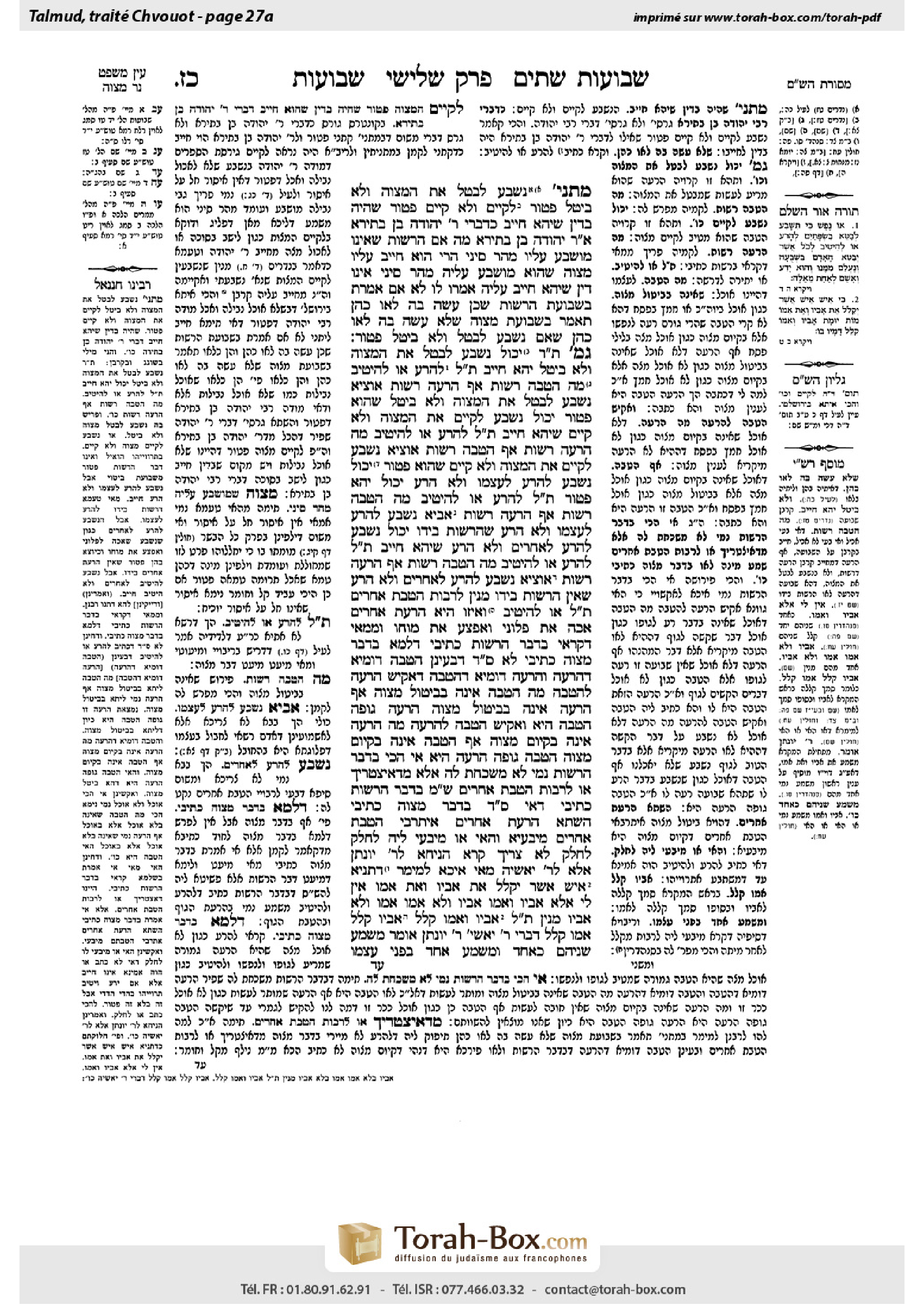
Shevuot 27a: Talmud study for Daf Yomi
Daf Yomi is the daily study of one Talmud folio. Explore 37 tractates with scans, Hebrew text, Sefaria English and AI-generated French translations where annotated.
Passage selection and English or AI-generated French translation are available where the scan has annotations. Daf Study is independent of Torah-Box and Sefaria.
Browse Shevuot · שבועות · All tractatesShevuot 27a text and translations
This page of Shevuot includes the Aramaic text, an English translation and an AI-generated French translation, alongside the scan above.
שבועות כ״ז א · Aramaic and Hebrew text
מַתְנִי׳ נִשְׁבַּע לְבַטֵּל אֶת הַמִּצְוָה וְלֹא בִּיטֵּל – פָּטוּר. לְקַיֵּים וְלֹא קִיֵּים – פָּטוּר; שֶׁהָיָה בַּדִּין שֶׁיְּהֵא חַיָּיב, כְּדִבְרֵי רַבִּי יְהוּדָה בֶּן בְּתֵירָא.
אָמַר רַבִּי יְהוּדָה בֶּן בְּתֵירָא: מָה אִם הָרְשׁוּת, שֶׁאֵינוֹ מוּשְׁבָּע עָלָיו מֵהַר סִינַי – הֲרֵי הוּא חַיָּיב עָלָיו; מִצְוָה, שֶׁהוּא מוּשְׁבָּע עָלֶיהָ מֵהַר סִינַי – אֵינוֹ דִּין שֶׁיְּהֵא חַיָּיב עָלֶיהָ?!
אָמְרוּ לוֹ: לֹא אִם אָמַרְתָּ בִּשְׁבוּעַת הָרְשׁוּת – שֶׁכֵּן עָשָׂה בָּהּ לָאו כְּהֵן, תֹּאמַר בִּשְׁבוּעַת מִצְוָה – שֶׁלֹּא עָשָׂה בָּהּ לָאו כְּהֵן; שֶׁאִם נִשְׁבַּע לְבַטֵּל וְלֹא בִּיטֵּל – פָּטוּר.
גְּמָ׳ תָּנוּ רַבָּנַן: יָכוֹל נִשְׁבַּע לְבַטֵּל אֶת הַמִּצְוָה וְלֹא בִּיטֵּל, יְהֵא חַיָּיב? תַּלְמוּד לוֹמַר: ״לְהָרַע אוֹ לְהֵיטִיב״ – מָה הֲטָבָה רְשׁוּת, אַף הֲרָעָה רְשׁוּת; אוֹצִיא נִשְׁבַּע לְבַטֵּל אֶת הַמִּצְוָה וְלֹא בִּיטֵּל, שֶׁהוּא פָּטוּר.
יָכוֹל נִשְׁבַּע לְקַיֵּים אֶת הַמִּצְוָה וְלֹא קִיֵּים, שֶׁיְּהֵא חַיָּיב? תַּלְמוּד לוֹמַר: ״לְהָרַע אוֹ לְהֵיטִיב״ – מָה הֲרָעָה רְשׁוּת, אַף הֲטָבָה רְשׁוּת; אוֹצִיא נִשְׁבַּע לְקַיֵּים אֶת הַמִּצְוָה וְלֹא קִיֵּים, שֶׁהוּא פָּטוּר.
יָכוֹל נִשְׁבַּע לְהָרַע לְעַצְמוֹ וְלֹא הָרַע – יָכוֹל יְהֵא פָּטוּר? תַּלְמוּד לוֹמַר: ״לְהָרַע אוֹ לְהֵיטִיב״ – מָה הֲטָבָה רְשׁוּת, אַף הֲרָעָה רְשׁוּת; אָבִיא נִשְׁבַּע לְהָרַע לְעַצְמוֹ וְלֹא הֵרַע, שֶׁהָרְשׁוּת בְּיָדוֹ.
יָכוֹל נִשְׁבַּע לְהָרַע לַאֲחֵרִים וְלֹא הֵרַע, שֶׁיְּהֵא חַיָּיב? תַּלְמוּד לוֹמַר: ״לְהָרַע אוֹ לְהֵיטִיב״ – מָה הֲטָבָה רְשׁוּת, אַף הֲרָעָה רְשׁוּת; אוֹצִיא נִשְׁבַּע לְהָרַע לַאֲחֵרִים וְלֹא הֵרַע, שֶׁאֵין הָרְשׁוּת בְּיָדוֹ. מִנַּיִן לְרַבּוֹת הֲטָבַת אֲחֵרִים? תַּלְמוּד לוֹמַר: ״אוֹ לְהֵיטִיב״. וְאֵיזוֹ הִיא הֲרָעַת אֲחֵרִים? ״אַכֶּה אֶת פְּלוֹנִי וַאֲפַצֵּעַ אֶת מוֹחוֹ״.
וּמִמַּאי דִּקְרָאֵי בִּדְבַר הָרְשׁוּת כְּתִיבִי? דִּלְמָא בִּדְבַר מִצְוָה כְּתִיבִי!
לָא סָלְקָא דַּעְתָּךְ; דְּבָעֵינַן הֲטָבָה דּוּמְיָא דַּהֲרָעָה, וַהֲרָעָה דּוּמְיָא דַּהֲטָבָה; דְּאַקֵּישׁ הֲרָעָה לַהֲטָבָה – מָה הֲטָבָה אֵינָהּ בְּבִיטּוּל מִצְוָה, אַף הֲרָעָה אֵינָהּ בְּבִיטּוּל מִצְוָה. הֲרָעָה גּוּפָהּ – הֲטָבָה הִיא.
וְאַקֵּישׁ הֲטָבָה לַהֲרָעָה – מָה הֲרָעָה אֵינָהּ בְּקִיּוּם מִצְוָה, אַף הֲטָבָה אֵינָהּ בְּקִיּוּם מִצְוָה. הֲטָבָה גּוּפַהּ – הֲרָעָה הִיא.
אִי הָכִי, בִּדְבַר הָרְשׁוּת נָמֵי לָא מַשְׁכַּחַתְּ לַהּ!
אֶלָּא מִדְּאִיצְטְרִיךְ ״אוֹ״ לְרַבּוֹת הֲטָבַת אֲחֵרִים – שְׁמַע מִינַּהּ בִּדְבַר הָרְשׁוּת כְּתִיבִי. דְּאִי סָלְקָא דַעְתָּךְ בִּדְבַר מִצְוָה כְּתִיבִי; הַשְׁתָּא הֲרָעַת אֲחֵרִים אִיתְרַבַּי, הֲטָבַת אֲחֵרִים מִיבַּעְיָא?!
וְהַאי ״אוֹ״ – מִיבְּעֵי לֵיהּ לְחַלֵּק! לְחַלֵּק לָא צְרִיךְ קְרָא.
הָנִיחָא לְרַבִּי יוֹנָתָן, אֶלָּא לְרַבִּי יֹאשִׁיָּה מַאי אִיכָּא לְמֵימַר?
דְּתַנְיָא: ״אִישׁ אֲשֶׁר יְקַלֵּל אֶת אָבִיו וְאֶת אִמּוֹ״ – אֵין לִי אֶלָּא אָבִיו וְאִמּוֹ; אָבִיו וְלֹא אִמּוֹ, אִמּוֹ וְלֹא אָבִיו – מִנַּיִן? תַּלְמוּד לוֹמַר: ״אָבִיו וְאִמּוֹ קִלֵּל״ – אָבִיו קִלֵּל, אִמּוֹ קִלֵּל. דִּבְרֵי רַבִּי יֹאשִׁיָּה.
רַבִּי יוֹנָתָן אוֹמֵר: מַשְׁמָע שְׁנֵיהֶם כְּאֶחָד וּמַשְׁמָע אֶחָד בִּפְנֵי עַצְמוֹ,
Shevuot 27a · English translation
MISHNA: If one takes an oath to refrain from performing a mitzva and he does not refrain, he is exempt from bringing an offering for an oath on an utterance. If he takes an oath to perform a mitzva and he does not perform it, he is also exempt, though it would have been fitting to claim that he is liable to bring the offering, in accordance with the statement of Rabbi Yehuda ben Beteira.
The mishna explains: Rabbi Yehuda ben Beteira said: What? If, with regard to an oath concerning an optional matter, for which one is not under oath from Mount Sinai, he is liable for breaking it, then with regard to an oath about a mitzva, for which he is under oath from Mount Sinai, is it not logical that he would be liable for breaking it?
The Rabbis said to him: No, if you said that one is liable for breaking an oath concerning an optional action, where the Torah rendered one liable for a negative oath not to perform it like for a positive oath to perform it, shall you also say one is liable with regard to breaking an oath concerning a mitzva, where the Torah did not render one liable for a negative oath like for a positive oath, since if one takes an oath to refrain from performing a mitzva and did not refrain, he is exempt.
GEMARA: The Sages taught in a baraita: One might have thought that when one takes an oath to refrain from performing a mitzva and he does not refrain, he would be liable to bring an offering for an oath on an utterance. To counter this, the verse states: “To do evil, or to do good” (Leviticus 5:4). Just as doing good is referring to an oath about an optional action, so too, doing evil is referring to an oath about an optional action. I will therefore exclude from liability one who takes an oath to refrain from performing a mitzva and does not refrain, so that he is exempt from bringing the offering.
The baraita continues: One might have thought that when one takes an oath to perform a mitzva and does not perform it, that he would be liable. To counter this, the verse states: “To do evil, or to do good.” Just as doing evil is referring to an oath about an optional action, so too, doing good is referring to an oath about an optional action. I will therefore exclude from liability one who takes an oath to perform a mitzva and does not perform it, so that he is exempt from bringing the offering.
One might have thought that when one takes an oath to harm himself and he does not harm himself, that he could be exempt from liability. The verse states: “To do evil, or to do good.” Just as doing good is referring to an oath about an optional action, so too, doing evil is referring to an oath about an optional action. I include as liable one who takes an oath to harm himself and does not harm himself, since it is his prerogative to harm himself or not.
One might have thought that when one takes an oath to harm others and does not harm them, that he would be liable. To counter this, the verse states: “To do evil, or to do good.” Just as doing good is referring to an oath about an optional action, so too, doing evil is referring to an oath about an optional action. I will therefore exclude from liability one who takes an oath to harm others and he does not harm them, since it is not his prerogative to do so. From where is it derived that taking an oath that concerns doing good to others is included among the oaths for which one may be liable? The verse states: “Or to do good.” And what is harming others? An example is when one takes an oath saying: I will strike so-and-so and injure his brain.
The baraita assumes throughout that “to do evil, or to do good” is referring to optional actions. The Gemara asks: But from where do we know that these verses are written referring to optional matters? Perhaps they are written referring to matters involving a mitzva.
The Gemara rejects this: This should not enter your mind, since we require that doing good be similar to doing evil, and doing evil be similar to doing good, as doing evil is juxtaposed to doing good in the verse. If one stipulates that the verse is referring to matters involving a mitzva, then just as doing good does not involve refraining from performing a mitzva, but must involve performing a mitzva, e.g., an oath to eat matza on Passover, so too, doing evil does not involve refraining from performing a mitzva, e.g., an oath not to eat leavened bread on Passover. The result of this reasoning is that doing evil in the verse is itself doing good, in that it will always involve taking oaths to keep mitzvot.
And likewise, doing good is juxtaposed to doing evil; just as doing evil does not involve performing a mitzva, as it would then not be doing evil, so too, doing good does not involve performing a mitzva. Doing good in the verse is itself doing evil, in that it does not involve the fulfillment of mitzvot.
The Gemara asks: If that is so, that doing evil and doing good are compared in this manner, you do not find that the verse can be interpreted even with regard to optional matters, as the same sort of contradiction could be generated.
Rather, one may derive that the verse is referring to optional matters from the fact that it was necessary for the verse to write “or to do good,” in order to include liability for oaths that involve doing good to others. Conclude from it that these verses are written referring to optional matters. As, if it should enter your mind that the verses are written referring to matters involving a mitzva, there is a difficulty: Now that doing evil to others has been included, i.e., when one takes an oath to refrain from performing a mitzva, is it necessary to mention doing good to others?
The Gemara challenges: But this “or” is necessary in order to separate them, i.e., to indicate that one can be liable for either type of oath. Had the verse said: To do evil and to do good, one might assume that one is liable only for oaths that involve both. The Gemara answers: A verse is unnecessary in order to separate, as it is clear that either sort of oath is included.
The Gemara asks: This works out well according to Rabbi Yonatan’s opinion concerning the interpretation of conjunctions, but according to Rabbi Yoshiya’s opinion, what can be said?
The Gemara explains: As it is taught in a baraita: From the verse: “A man who curses his father and his mother shall die” (Leviticus 20:9), I have derived only that one is liable if he curses both his father and his mother. From where do I derive that if one curses his father but not his mother, or his mother but not his father, he is liable? The continuation of the verse states: “His father and his mother he has cursed; his blood is upon him.” In the first part of the verse, the word “curses” is in proximity to “his father,” and in the last part of the verse, “cursed” is in proximity to “his mother.” This teaches that the verse is referring to both a case where he cursed only his father and a case where he cursed only his mother; this is the statement of Rabbi Yoshiya. Rabbi Yoshiya maintains that conjunctions are interpreted strictly unless the verse indicates otherwise.
Rabbi Yonatan says: There is no need for this derivation, because the phrase “his father and his mother” indicates that one is liable if he curses both of them together, and it also indicates that he is liable if he curses either one of them on their own,
Shevuot 27a · Traduction française (IA)
MICHNA : Si quelqu’un jure de ne pas accomplir une mitsva et ne s’en abstient pas, il est exempt d’apporter un sacrifice pour un serment vain. S’il jure d’accomplir une mitsva et ne l’accomplit pas, il est également exempt, bien qu’il aurait été possible de soutenir qu’il est tenu d’apporter le sacrifice, conformément à l’opinion de Rabbi Yehouda ben Beteira.
La Michna explique : Rabbi Yehouda ben Beteira a dit : Quoi ? Si, pour un serment portant sur une action facultative, à laquelle on n’est pas tenu par un serment prononcé au mont Sinaï, on est passible lorsqu’on le transgresse, alors, pour un serment portant sur une mitsva, à laquelle on est tenu par un serment prononcé au mont Sinaï, n’est-il pas logique qu’on soit passible lorsqu’on le transgresse ?
Les Sages lui dirent : Non. Si tu dis qu’on est passible lorsqu’on transgresse un serment portant sur une action facultative, domaine dans lequel la Torah a rendu passible de la même manière celui qui prête un serment négatif de ne pas l’accomplir et celui qui prête un serment positif de l’accomplir, diras-tu aussi qu’on est passible lorsqu’on transgresse un serment portant sur une mitsva, domaine dans lequel la Torah n’a pas rendu passibles de la même manière celui qui prête un serment négatif et celui qui prête un serment positif ? En effet, si quelqu’un jure de ne pas accomplir une mitsva et ne s’en abstient pas, il est exempt.
GUEMARA : Les Sages ont enseigné dans une baraïta : On aurait pu penser que si quelqu’un jure de ne pas accomplir une mitsva et ne s’en abstient pas, il serait tenu d’apporter un sacrifice pour un serment vain. Pour écarter cette possibilité, le verset dit : « Pour faire le mal ou le bien » (Lévitique 5:4). De même que « faire le bien » désigne un serment portant sur une action facultative, de même « faire le mal » désigne un serment portant sur une action facultative. J’exclus donc de cette obligation celui qui jure de ne pas accomplir une mitsva et ne s’en abstient pas : il est exempt d’apporter le sacrifice.
La baraïta poursuit : On aurait pu penser que si quelqu’un jure d’accomplir une mitsva et ne l’accomplit pas, il serait passible. Pour écarter cette possibilité, le verset dit : « Pour faire le mal ou le bien. » De même que « faire le mal » désigne un serment portant sur une action facultative, de même « faire le bien » désigne un serment portant sur une action facultative. J’exclus donc de cette obligation celui qui jure d’accomplir une mitsva et ne l’accomplit pas : il est exempt d’apporter le sacrifice.
On aurait pu penser que si quelqu’un jure de se faire du mal et ne s’en fait pas, il pourrait être exempt de toute responsabilité. Le verset dit : « Pour faire le mal ou le bien. » De même que « faire le bien » désigne un serment portant sur une action facultative, de même « faire le mal » désigne un serment portant sur une action facultative. J’inclus donc parmi les cas où l’on est passible celui où quelqu’un jure de se faire du mal et ne s’en fait pas, puisqu’il lui appartient de décider de se faire du mal ou non.
On aurait pu penser que si quelqu’un jure de faire du mal à autrui et ne lui en fait pas, il serait passible. Pour écarter cette possibilité, le verset dit : « Pour faire le mal ou le bien. » De même que « faire le bien » désigne un serment portant sur une action facultative, de même « faire le mal » désigne un serment portant sur une action facultative. J’exclus donc de cette obligation celui qui jure de faire du mal à autrui et ne lui en fait pas, puisque ce n’est pas à lui d’en décider. D’où déduit-on que les serments portant sur le fait de faire du bien à autrui sont inclus parmi ceux pour lesquels on peut être passible ? Le verset dit : « Ou le bien. » Et en quoi consiste le fait de faire du mal à autrui ? Par exemple, quelqu’un jure en disant : « Je frapperai untel et lui blesserai le cerveau. »
La baraïta présuppose tout au long de son raisonnement que « pour faire le mal ou le bien » désigne des actions facultatives. La Guemara demande : Mais d’où savons-nous que ces versets concernent des choses facultatives ? Peut-être concernent-ils des choses relevant d’une mitsva.
La Guemara rejette cette possibilité : Cela ne doit pas te venir à l’esprit, car nous exigeons que « faire le bien » soit semblable à « faire le mal », et que « faire le mal » soit semblable à « faire le bien », puisque « faire le mal » est juxtaposé à « faire le bien » dans le verset. Si l’on pose que le verset concerne des choses relevant d’une mitsva, alors, de même que « faire le bien » ne peut pas désigner le fait de s’abstenir d’accomplir une mitsva, mais doit désigner l’accomplissement d’une mitsva — par exemple, jurer de manger de la matsa à Pessa’h —, de même, « faire le mal » ne peut pas désigner le fait de s’abstenir d’accomplir une mitsva, par exemple en jurant de ne pas manger de pain levé à Pessa’h. Il s’ensuit que, dans le verset, « faire le mal » revient en fait à « faire le bien », puisqu’il s’agirait toujours de serments visant à observer des mitsvot.
De même, « faire le bien » est juxtaposé à « faire le mal » : de même que « faire le mal » ne désigne pas l’accomplissement d’une mitsva, car il ne s’agirait alors pas de « faire le mal », de même, « faire le bien » ne désigne pas l’accomplissement d’une mitsva. Dans le verset, « faire le bien » revient en fait à « faire le mal », puisqu’il ne s’agirait pas de l’accomplissement de mitsvot.
La Guemara demande : Si tel est le cas, si « faire le mal » et « faire le bien » sont comparés de cette manière, on ne peut même pas interpréter le verset comme portant sur des choses facultatives, car on pourrait susciter la même contradiction.
Au contraire, on peut déduire que le verset concerne des choses facultatives du fait qu’il était nécessaire d’écrire « ou le bien », afin d’inclure parmi les cas de responsabilité les serments portant sur le fait de faire du bien à autrui. Déduis-en que ces versets concernent des choses facultatives. En effet, si l’on devait penser que les versets concernent des choses relevant d’une mitsva, une difficulté se poserait : maintenant que le fait de faire du mal à autrui a été inclus, c’est-à-dire le cas où quelqu’un jure de s’abstenir d’accomplir une mitsva, était-il nécessaire de mentionner le fait de faire du bien à autrui ?
La Guemara objecte : Mais le mot « ou » est nécessaire pour distinguer les deux cas, c’est-à-dire pour indiquer qu’on peut être passible pour chacun des deux types de serment. Si le verset avait dit : « faire le mal et faire le bien », on aurait pu penser qu’on n’est passible que pour les serments qui impliquent les deux. La Guemara répond : Il n’est pas nécessaire d’avoir un verset pour les distinguer, car il est évident que chacun des deux types de serment est inclus.
La Guemara demande : Cela fonctionne bien selon l’opinion de Rabbi Yonatan concernant l’interprétation des conjonctions, mais que peut-on dire selon l’opinion de Rabbi Yoshiya ?
La Guemara explique : Comme il est enseigné dans une baraïta : Du verset « L’homme qui maudit son père et sa mère sera mis à mort » (Lévitique 20:9), j’ai seulement déduit qu’on est passible si l’on maudit à la fois son père et sa mère. D’où déduis-je que si quelqu’un maudit son père mais pas sa mère, ou sa mère mais pas son père, il est passible ? La suite du verset dit : « Son père et sa mère, il les a maudits ; son sang est sur lui. » Dans la première partie du verset, le mot « maudit » est rapproché de « son père » et, dans la dernière partie, le mot « maudits » est rapproché de « sa mère ». Cela enseigne que le verset concerne aussi bien le cas où il a maudit seulement son père que celui où il a maudit seulement sa mère. Telle est l’opinion de Rabbi Yoshiya. Rabbi Yoshiya soutient que les conjonctions sont interprétées strictement, sauf indication contraire du verset.
Rabbi Yonatan dit : Cette déduction n’est pas nécessaire, car l’expression « son père et sa mère » indique qu’on est passible si l’on maudit les deux ensemble, et également si l’on maudit l’un ou l’autre séparément.
Traduction française générée par IA à partir de l’édition anglaise de Sefaria. Vérifie toujours un passage avec le texte source.
Text from Sefaria: William Davidson Edition - Vocalized Aramaic (CC BY NC); William Davidson Edition - English (CC BY NC).