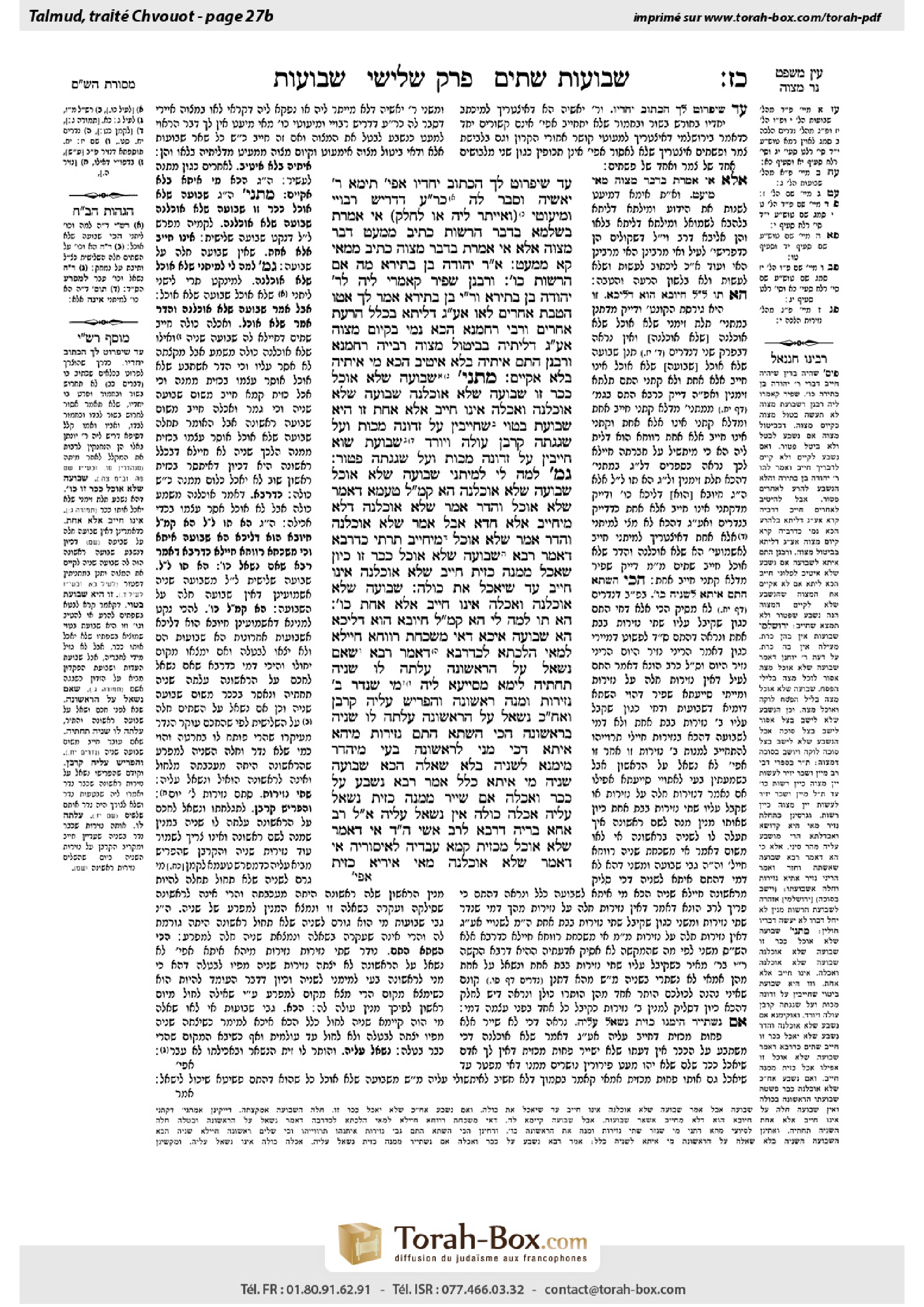
Shevuot 27b: Talmud study for Daf Yomi
Daf Yomi is the daily study of one Talmud folio. Explore 37 tractates with scans, Hebrew text, Sefaria English and AI-generated French translations where annotated.
Passage selection and English or AI-generated French translation are available where the scan has annotations. Daf Study is independent of Torah-Box and Sefaria.
Browse Shevuot · שבועות · All tractatesShevuot 27b text and translations
This page of Shevuot includes the Aramaic text, an English translation and an AI-generated French translation, alongside the scan above.
שבועות כ״ז ב · Aramaic and Hebrew text
עַד שֶׁיִּפְרוֹט לְךָ הַכָּתוּב ״יַחְדָּיו״.
אֲפִילּוּ תֵּימָא רַבִּי יֹאשִׁיָּה; וְסָבַר לַהּ כְּרַבִּי עֲקִיבָא דְּדָרֵישׁ רִבּוּיֵי וּמִיעוּטֵי, וְאִיַּיתַּר לֵיהּ ״אוֹ״ לְחַלֵּק.
אִי אָמְרַתְּ בִּשְׁלָמָא בִּדְבַר הָרְשׁוּת כְּתִיב, מְמַעֵט דְּבַר מִצְוָה; אֶלָּא אִי אָמְרַתְּ בִּדְבַר מִצְוָה כְּתִיב, מִמַּאי קָא מְמַעֵט?
אָמַר רַבִּי יְהוּדָה בֶּן בְּתֵירָא: מָה אִם הָרְשׁוּת כּוּ׳. וְרַבָּנַן – שַׁפִּיר קָאָמְרִי לֵיהּ לְרַבִּי יְהוּדָה בֶּן בְּתֵירָא!
וְרַבִּי יְהוּדָה בֶּן בְּתֵירָא אָמַר לָךְ: אַטּוּ הֲטָבַת אֲחֵרִים – לָאו אַף עַל גַּב דְּלֵיתַהּ בִּכְלַל הֲרָעַת אֲחֵרִים, וְרַבִּי רַחֲמָנָא? הָכָא נָמֵי בְּקִיּוּם מִצְוָה – אַף עַל גַּב דְּלֵיתֵיהּ בְּבִיטּוּל מִצְוָה, רַבְּיֵיהּ רַחֲמָנָא.
וְרַבָּנַן – הָתָם, אִיתֵיהּ בְּ״לֹא אֵיטִיב״; הָכָא מִי אִיתֵיהּ בְּ״לֹא אֲקַיֵּים״?!
מַתְנִי׳ ״שְׁבוּעָה שֶׁלֹּא אוֹכַל כִּכָּר זוֹ״; ״שְׁבוּעָה שֶׁלֹּא אוֹכְלֶנָּה״; ״שְׁבוּעָה שֶׁלֹּא אוֹכְלֶנָּה״; וַאֲכָלָהּ – אֵינוֹ חַיָּיב אֶלָּא אַחַת.
זוֹ הִיא שְׁבוּעַת בִּטּוּי – שֶׁחַיָּיבִין עַל זְדוֹנָהּ מַכּוֹת, וְעַל שִׁגְגָתָהּ קׇרְבָּן עוֹלֶה וְיוֹרֵד.
שְׁבוּעַת שָׁוְא – חַיָּיבִין עַל זְדוֹנָהּ מַכּוֹת, וְעַל שִׁגְגָתָהּ פָּטוּר.
גְּמָ׳ לְמָה לִי לְמִיתְנֵי ״שְׁבוּעָה שֶׁלֹּא אוֹכַל״, ״שְׁבוּעָה שֶׁלֹּא אוֹכְלֶנָּה״?
הָא קָא מַשְׁמַע לַן: טַעְמָא דְּאָמַר ״שֶׁלֹּא אוֹכַל״ וַהֲדַר אָמַר ״שֶׁלֹּא אוֹכְלֶנָּה״ – דְּלָא מִיחַיַּיב אֶלָּא חֲדָא; אֲבָל אָמַר ״שֶׁלֹּא אוֹכְלֶנָּה״ וַהֲדַר אָמַר ״שֶׁלֹּא אוֹכַל״ – מִיחַיַּיב תַּרְתֵּי.
כִּדְרָבָא – דְּאָמַר רָבָא: ״שְׁבוּעָה שֶׁלֹּא אוֹכַל כִּכָּר זוֹ״, כֵּיוָן שֶׁאָכַל מִמֶּנָּה כְּזַיִת – חַיָּיב. ״שֶׁלֹּא אוֹכְלֶנָּה״ – אֵינוֹ חַיָּיב עַד שֶׁיֹּאכַל אֶת כּוּלָּהּ.
״שְׁבוּעָה שֶׁלֹּא אוֹכְלֶנָּה״, וַאֲכָלָהּ – אֵינוֹ חַיָּיב אֶלָּא אַחַת כּוּ׳. הָא תּוּ לְמָה לִי?
הָא קָא מַשְׁמַע לַן: חִיּוּבָא הוּא דְּלֵיכָּא – הָא שְׁבוּעָה אִיכָּא; דְּאִי מַשְׁכַּחַת רַוְוחָא – חָיְילָא.
לְמַאי הִלְכְתָא? לְכִדְרָבָא – דְּאָמַר רָבָא: שֶׁאִם נִשְׁאַל עַל הָרִאשׁוֹנָה – עָלְתָה לוֹ שְׁנִיָּה תַּחְתֶּיהָ.
לֵימָא מְסַיְּיעָא לֵיהּ: מִי שֶׁנָּדַר שְׁתֵּי נְזִירוֹת, וּמָנָה רִאשׁוֹנָה וְהִפְרִישׁ עָלֶיהָ קׇרְבָּן, וְאַחַר כָּךְ נִשְׁאַל עַל הָרִאשׁוֹנָה – עָלְתָה לוֹ שְׁנִיָּה בָּרִאשׁוֹנָה.
הָכִי הַשְׁתָּא?! הָתָם נְזִירוּת מִיהָא אִיתַאּ, דְּכִי מָנֵי לְרִאשׁוֹנָה, בָּעֵי מִיהְדָּר מִימְנָא לִשְׁנִיָּה בְּלָא שְׁאֵלָה. הָכָא, שְׁבוּעָה שְׁנִיָּה מִי אִיתַאּ כְּלָל?!
אָמַר רָבָא: נִשְׁבַּע עַל כִּכָּר וַאֲכָלָהּ – אִם שִׁיֵּיר מִמֶּנָּה כְּזַיִת, נִשְׁאַל עָלֶיהָ; אֲכָלָהּ כּוּלָּהּ, אֵין נִשְׁאָל עָלֶיהָ.
אֲמַר לֵיהּ רַב אַחָא בְּרֵיהּ דְּרָבָא לְרַב אָשֵׁי: הֵיכִי דָמֵי? אִי דְּאָמַר ״שֶׁלֹּא אוֹכַל״ – מִכְּזַיִת קַמָּא עַבְדֵּיהּ לְאִיסּוּרֵיהּ! אִי דְּאָמַר ״שֶׁלֹּא אוֹכְלֶנָּה״ – מַאי אִירְיָא כְּזַיִת?
Shevuot 27b · English translation
unless the verse specifies that one is liable only if he curses both together. An example of a verse where the Torah specifies that the halakha applies only to the two elements in conjunction is: “You shall not plow with an ox and a donkey together” (Deuteronomy 22:10).
The Gemara continues: You may even say that the verse is referring to optional matters according to the opinion of Rabbi Yoshiya. He holds in accordance with the opinion of Rabbi Akiva, who interprets the Torah using the hermeneutical principle of amplifications and restrictions (see 26a), and the word “or” is superfluous and is used to separate “to do evil” from “to do good.”
The Gemara explains how one derives that the oaths referred to in the verse are oaths about optional matters in accordance with Rabbi Yoshiya, who interprets the verse in accordance with the principle of amplifications and restrictions: Granted, if you say that the verse about an oath on an utterance is written with regard to optional matters, the words “to do evil, or to do good” serve to restrict the meaning of the verse and exclude the application of an oath on an utterance to a matter involving a mitzva. The Gemara asks rhetorically: But if you say that the verse is written referring to a matter involving a mitzva, what do the words “to do evil, or to do good” serve to restrict?
§ The mishna teaches: Rabbi Yehuda ben Beteira said: What? If, with regard to an oath concerning an optional matter, for which one is not under oath from Mount Sinai, he is liable for breaking it, then with regard to an oath about a mitzva, for which he is under oath from Mount Sinai, is it not logical that he would be liable for breaking it? The Rabbis then asked him why he thinks one should be liable for an oath about a mitzva, since one would be exempt if it were inverted from positive to negative, rendering it an oath to refrain from performing a mitzva, which does not take effect. The Gemara comments: The Rabbis’ objection to the opinion of Rabbi Yehuda ben Beteira is well stated.
The Gemara responds: And Rabbi Yehuda ben Beteira could say to you: Isn’t there the case of an oath involving doing good to others, even though it does not include the possibility of being inverted to include liability for an oath concerning harming others, but nevertheless the Merciful One has amplified the halakha to include it? Here also, with regard to an oath to perform a mitzva, even though it does not include the possibility of being inverted to include liability for an oath concerning refraining from performing a mitzva, the Merciful One has amplified the halakha to include it.
And how could the Rabbis respond? They could say that there, with regard to an oath to do good to others, there is the possibility of inverting the oath to: I will not do good. Here, with regard to an oath to perform a mitzva, is there any possibility of a valid oath: I will not perform a mitzva?
MISHNA: If one says: On my oath I will not eat this loaf, and he then says again: On my oath I will not eat it, and again: On my oath I will not eat it, and he then ate it, he is liable only once. Once the first oath had taken effect, the subsequent oaths could not, as a prohibition cannot take effect where another prohibition is already in place.
This is an oath on an utterance, for which one is liable to receive lashes for intentionally breaking it, and for unwittingly breaking it one is liable to bring a sliding-scale offering.
For an oath taken in vain, one is liable to receive lashes when it is taken intentionally, and one is exempt when it is taken unwittingly.
GEMARA: The Gemara asks: Why do I need to teach the mishna such that the wording of the first oath is: On my oath I will not eat this loaf, and then the wording of the second oath is: On my oath I will not eat it?
The Gemara answers: This teaches us that the reason that he is liable only once is that he said: I will not eat this loaf, and then said: I will not eat it. But if he had said: I will not eat it, and then had said: I will not eat this loaf, he would be liable twice.
This is in accordance with the opinion of Rava, as Rava says: If one says: On my oath I will not eat this loaf, once he has eaten an olive-bulk of it he is liable, as this oath is understood to mean that it is prohibited for him to eat any of the loaf. If he says: On my oath I will not eat it, he is not liable unless he eats the whole loaf. The words: I will not eat it, indicate that his oath applies only to eating the entire loaf. Accordingly, when the first oath is: I will not eat it, and the second oath is: I will not eat this loaf, the second oath can take effect, as it generates a new prohibition that applies to each and every olive-bulk of the loaf.
§ The mishna teaches: If one says: On my oath I will not eat this loaf, and he then says again: On my oath I will not eat it, and again: On my oath I will not eat it, and he then ate it, he is liable only once. The Gemara asks: Why do I need the mishna to mention this additional, third, oath: I will not eat it?
The Gemara answers: This teaches us that there is no liability where one states redundant oaths, but there is an oath; the final oath is not completely discounted, so that if you find room, i.e., an application, for the additional oath, it goes into effect.
For what matter is this halakha relevant? It is relevant for the statement of Rava, as Rava says that if one requested of a halakhic authority to dissolve the first oath, and he did so, the second one counts for him in its place unless it, too, was dissolved.
The Gemara suggests: Let us say that the following baraita supports his opinion: With regard to one who took two vows of naziriteship, and counted the first term of naziriteship and separated an offering for it, and afterward requested and received dissolution of the first vow from a halakhic authority, the second term was counted for him in the observance of the first term, and he is not required to be a nazirite further. This indicates that the second vow went into effect retroactively once the first was dissolved, and the same would be true in the case of two oaths.
The Gemara rejects this: How can these cases be compared? There, the second naziriteship is there in any event, as once he counts the first term, he needs to return and count the second if there is no request for dissolution. Here, if he does not request dissolution of the first oath, is there a second oath at all? Therefore one cannot find support for Rava’s opinion from the baraita.
§ Rava says: If one took an oath about a loaf and then ate it, if he left an olive-bulk of it, he may request that his oath about the loaf be dissolved. If he ate the whole loaf, he may no longer request that his oath about it be dissolved.
Rav Aḥa, son of Rava, said to Rav Ashi: What are the circumstances? If one took an oath where he said: I will not eat this loaf, which Rava, as cited above, understands as rendering it prohibited for him to eat any part of the loaf, then with the first olive-bulk that he ate he already committed his transgression. If he took an oath where he said: I will not eat it, which Rava understands as rendering it prohibited for him to eat only the whole loaf, why does Rava mention specifically that he left over an olive-bulk?
Shevuot 27b · Traduction française (IA)
à moins que le verset ne précise qu’il n’est passible que s’il maudit les deux ensemble. Un exemple de verset où la Torah précise que la halakha ne s’applique qu’aux deux éléments conjointement est : « Tu ne laboureras pas avec un bœuf et un âne ensemble » (Deutéronome 22:10).
La Guemara poursuit : On peut même dire que, selon Rabbi Yoshiya, le verset parle de choses facultatives. Il suit l’opinion de Rabbi Akiva, qui interprète la Torah au moyen du principe herméneutique des amplifications et des restrictions (voir 26a) ; le mot « ou » est superflu et sert à séparer « faire le mal » de « faire le bien ».
La Guemara explique comment on déduit que, selon Rabbi Yoshiya, qui interprète le verset selon le principe des amplifications et des restrictions, les serments dont parle le verset portent sur des choses facultatives : il est entendu que si l’on dit que le verset relatif au serment portant sur une parole concerne des choses facultatives, les mots « faire le mal ou faire le bien » servent à restreindre le sens du verset et à exclure l’application d’un serment portant sur une parole à une question relevant d’une mitsva. La Guemara demande de façon rhétorique : mais si l’on dit que le verset concerne une question relevant d’une mitsva, que servent à restreindre les mots « faire le mal ou faire le bien » ?
§ La Michna enseigne : Rabbi Yehuda ben Beteira a dit : Quoi donc ? Si, pour un serment portant sur une question facultative, qui n’est pas couvert par un serment prononcé au mont Sinaï, on est passible lorsqu’on le transgresse, n’est-il pas logique que l’on soit passible lorsqu’on transgresse un serment portant sur une mitsva, qui est couvert par un serment prononcé au mont Sinaï ? Les Sages lui demandèrent alors pourquoi il pensait qu’on devrait être passible pour un serment portant sur une mitsva, puisqu’on serait exempt si on l’inversait, en passant du positif au négatif, pour en faire un serment de s’abstenir d’accomplir une mitsva, lequel ne prend pas effet. La Guemara commente : L’objection des Sages à l’opinion de Rabbi Yehuda ben Beteira est bien fondée.
La Guemara répond : Rabbi Yehuda ben Beteira pourrait te dire : Le cas d’un serment visant à faire du bien à autrui n’existe-t-il pas, même s’il ne peut pas être inversé de manière à inclure la responsabilité pour un serment visant à faire du mal à autrui ? Pourtant, le Miséricordieux a élargi la halakha pour l’inclure. De même ici, s’agissant d’un serment d’accomplir une mitsva, même s’il ne peut pas être inversé de manière à inclure la responsabilité pour un serment de s’abstenir d’accomplir une mitsva, le Miséricordieux a élargi la halakha pour l’inclure.
Et que pourraient répondre les Sages ? Ils pourraient dire que, dans le cas d’un serment visant à faire du bien à autrui, le serment peut être inversé ainsi : « Je ne ferai pas de bien. » Ici, s’agissant d’un serment d’accomplir une mitsva, existe-t-il la moindre possibilité d’un serment valide disant : « Je n’accomplirai pas de mitsva » ?
MICHNA : Si quelqu’un dit : « Par serment, je ne mangerai pas cette miche », puis répète : « Par serment, je ne la mangerai pas », et encore : « Par serment, je ne la mangerai pas », puis la mange, il n’est passible qu’une seule fois. Dès que le premier serment a pris effet, les serments suivants ne pouvaient pas prendre effet, car une interdiction ne peut prendre effet là où une autre interdiction est déjà en vigueur.
Il s’agit d’un serment portant sur une parole : celui qui le transgresse intentionnellement est passible de flagellation, et celui qui le transgresse par inadvertance est tenu d’apporter un sacrifice à valeur variable.
Pour un serment vain, celui qui le prononce intentionnellement est passible de flagellation, tandis que celui qui le prononce par inadvertance est exempt.
GUEMARA : La Guemara demande : Pourquoi la Michna doit-elle présenter le cas avec la formulation suivante pour le premier serment : « Par serment, je ne mangerai pas cette miche », puis celle-ci pour le deuxième : « Par serment, je ne la mangerai pas » ?
La Guemara répond : Cela nous enseigne qu’il n’est passible qu’une seule fois parce qu’il a dit : « Je ne mangerai pas cette miche », puis : « Je ne la mangerai pas ». Mais s’il avait dit : « Je ne la mangerai pas », puis : « Je ne mangerai pas cette miche », il aurait été passible deux fois.
Cela est conforme à l’opinion de Rava, car Rava dit : Si quelqu’un dit : « Par serment, je ne mangerai pas cette miche », dès qu’il en a mangé l’équivalent du volume d’une olive, il est passible, car ce serment signifie qu’il lui est interdit de manger quoi que ce soit de cette miche. S’il dit : « Par serment, je ne la mangerai pas », il n’est passible que s’il mange la miche entière. Les mots « je ne la mangerai pas » indiquent que son serment ne porte que sur le fait de manger la miche entière. Ainsi, lorsque le premier serment est : « Je ne la mangerai pas » et que le second est : « Je ne mangerai pas cette miche », le second serment peut prendre effet, car il crée une nouvelle interdiction qui s’applique à chaque équivalent du volume d’une olive de la miche.
§ La Michna enseigne : Si quelqu’un dit : « Par serment, je ne mangerai pas cette miche », puis répète : « Par serment, je ne la mangerai pas », et encore : « Par serment, je ne la mangerai pas », puis la mange, il n’est passible qu’une seule fois. La Guemara demande : Pourquoi la Michna doit-elle mentionner ce serment supplémentaire, le troisième : « Je ne la mangerai pas » ?
La Guemara répond : Cela nous enseigne qu’on n’est pas passible pour des serments redondants, mais qu’il s’agit bien d’un serment ; le dernier serment n’est pas entièrement écarté, de sorte que si l’on trouve une place, c’est-à-dire un champ d’application, pour le serment supplémentaire, celui-ci prend effet.
À quelle question cette halakha est-elle pertinente ? Elle est pertinente pour l’enseignement de Rava : Rava dit que si quelqu’un demande à une autorité halakhique de délier le premier serment et que celle-ci le fait, le second serment compte à sa place, à moins qu’il ne soit lui aussi délié.
La Guemara propose : Disons que la baraïta suivante appuie son opinion : Celui qui a prononcé deux vœux de naziréat, a compté la première période de naziréat et a mis une offrande de côté pour celle-ci, puis a demandé à une autorité halakhique la dissolution du premier vœu et l’a obtenue, compte la seconde période comme la première, et n’a pas à poursuivre son naziréat. Cela indique que le second vœu a pris effet rétroactivement une fois le premier dissous ; il en serait de même dans le cas de deux serments.
La Guemara rejette cette comparaison : Comment peut-on comparer ces cas ? Là, la seconde période de naziréat subsiste de toute façon, car, une fois qu’il a compté la première période, il doit revenir et compter la seconde s’il ne demande pas la dissolution. Ici, s’il ne demande pas la dissolution du premier serment, existe-t-il seulement un second serment ? On ne peut donc pas tirer de la baraïta un appui à l’opinion de Rava.
§ Rava dit : Si quelqu’un a prêté serment au sujet d’une miche, puis l’a mangée, et qu’il en a laissé l’équivalent du volume d’une olive, il peut demander la dissolution de son serment au sujet de la miche. S’il a mangé toute la miche, il ne peut plus demander la dissolution de son serment à son sujet.
Rav Aḥa, fils de Rava, dit à Rav Ashi : Quelles sont les circonstances ? Si quelqu’un a prêté serment en disant : « Je ne mangerai pas cette miche », ce que Rava, comme cela a été expliqué plus haut, comprend comme lui interdisant de manger n’importe quelle partie de la miche, alors, dès qu’il a mangé le premier équivalent du volume d’une olive, il a déjà commis sa transgression. S’il a prêté serment en disant : « Je ne la mangerai pas », ce que Rava comprend comme lui interdisant de manger la miche entière, pourquoi Rava mentionne-t-il spécifiquement qu’il en a laissé l’équivalent du volume d’une olive ?
Traduction française générée par IA à partir de l’édition anglaise de Sefaria. Vérifie toujours un passage avec le texte source.
Text from Sefaria: William Davidson Edition - Vocalized Aramaic (CC BY NC); William Davidson Edition - English (CC BY NC).