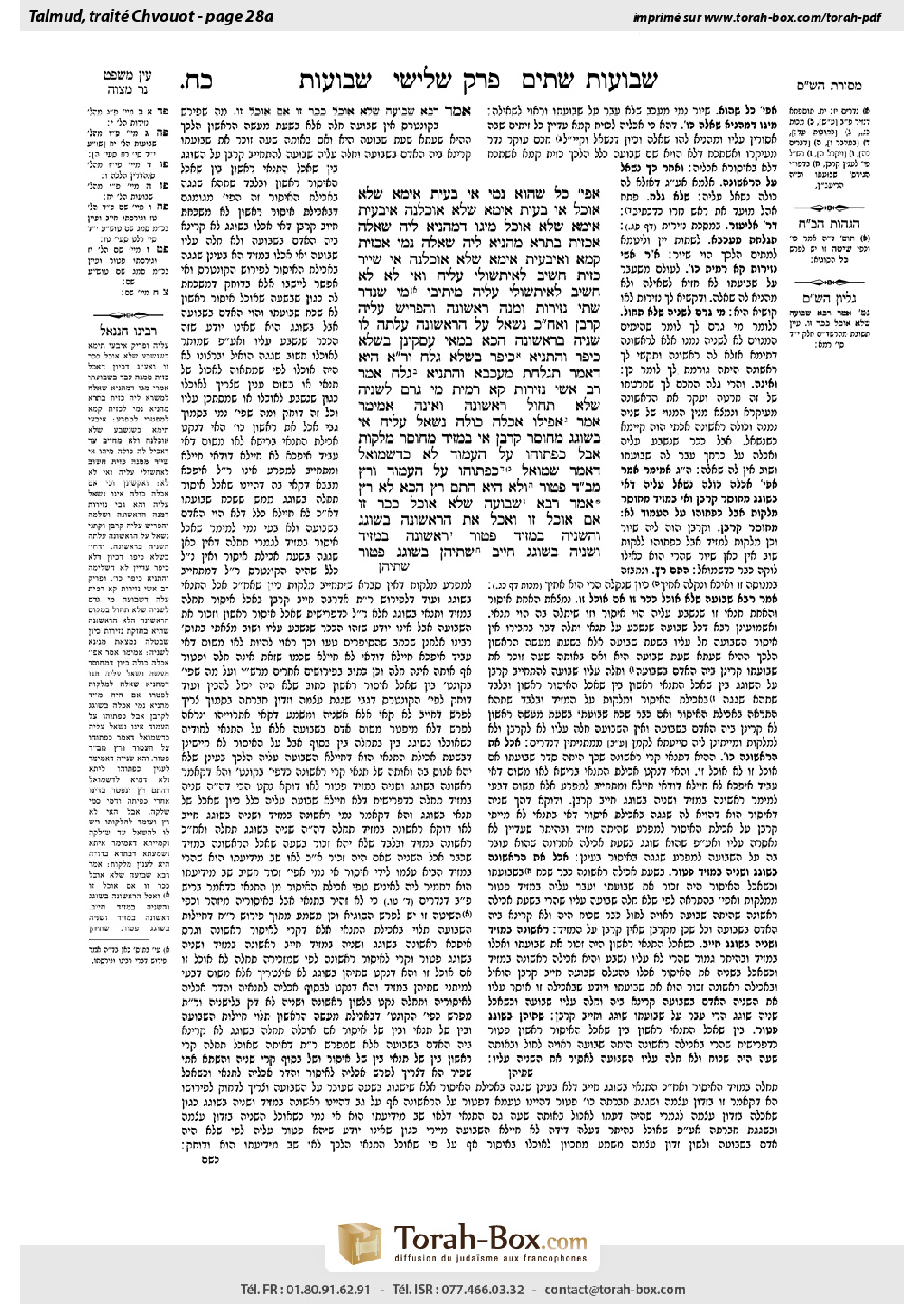
Shevuot 28a: Talmud study for Daf Yomi
Daf Yomi is the daily study of one Talmud folio. Explore 37 tractates with scans, Hebrew text, Sefaria English and AI-generated French translations where annotated.
Passage selection and English or AI-generated French translation are available where the scan has annotations. Daf Study is independent of Torah-Box and Sefaria.
Browse Shevuot · שבועות · All tractatesShevuot 28a text and translations
This page of Shevuot includes the Aramaic text, an English translation and an AI-generated French translation, alongside the scan above.
שבועות כ״ח א · Aramaic and Hebrew text
אֲפִילּוּ כָּל שֶׁהוּא נָמֵי!
אִי בָּעֵית אֵימָא ״שֶׁלֹּא אוֹכַל״, אִי בָּעֵית אֵימָא ״שֶׁלֹּא אוֹכְלֶנָּה״. אִיבָּעֵית אֵימָא ״שֶׁלֹּא אוֹכַל״ – מִיגּוֹ דְּמַהְנְיָא לֵיהּ שְׁאֵלָה אַכְּזַיִת בָּתְרָא, מַהְנְיָא לֵיהּ שְׁאֵלָה נָמֵי אַכְּזַיִת קַמָּא.
וְאִיבָּעֵית אֵימָא ״שֶׁלֹּא אוֹכְלֶנָּה״ – אִי שַׁיַּיר כְּזַיִת, חֲשִׁיב לְאִיתְּשׁוֹלֵי עֲלֵיהּ; וְאִי לָא, לָא חֲשִׁיב לְאִיתְּשׁוֹלֵי עֲלֵיהּ.
מֵיתִיבִי: מִי שֶׁנָּדַר שְׁתֵּי נְזִירוֹת, וּמָנָה רִאשׁוֹנָה וְהִפְרִישׁ עָלֶיהָ קׇרְבָּן, וְאַחַר כָּךְ נִשְׁאַל עַל הָרִאשׁוֹנָה – עָלְתָה לוֹ שְׁנִיָּה בָּרִאשׁוֹנָה!
הָכָא בְּמַאי עָסְקִינַן – בְּשֶׁלֹּא כִּיפֵּר.
וְהָתַנְיָא: כִּיפֵּר! בְּשֶׁלֹּא גִּלַּח – וְרַבִּי אֱלִיעֶזֶר הִיא, דְּאָמַר תִּגְלַחַת מְעַכְּבָא.
וְהָתַנְיָא: גִּלַּח! אָמַר רַב אָשֵׁי: נְזִירוֹת קָא רָמֵית? מִי גָּרַם לַשְּׁנִיָּה שֶׁלֹּא תָּחוּל – רִאשׁוֹנָה; וְאֵינָהּ.
אַמֵּימָר אָמַר: אֲפִילּוּ אֲכָלָהּ כּוּלָּהּ, נִשְׁאָל עָלֶיהָ; אִי בְּשׁוֹגֵג – מְחוּסָּר קׇרְבָּן, אִי בְּמֵזִיד – מְחוּסָּר מַלְקוֹת. אֲבָל כְּפָתוּהוּ עַל הָעַמּוּד – לָא; כְּדִשְׁמוּאֵל, דְּאָמַר שְׁמוּאֵל: כְּפָתוּהוּ עַל הָעַמּוּד וְרָץ מִבֵּית דִּין – פָּטוּר.
וְלָא הִיא; הָתָם רָץ, הָכָא לָא רָץ.
אָמַר רָבָא: ״שְׁבוּעָה שֶׁלֹּא אוֹכַל כִּכָּר זוֹ אִם אוֹכַל זוֹ״, וְאָכַל אֶת הָרִאשׁוֹנָה בְּשׁוֹגֵג וְהַשְּׁנִיָּה בְּמֵזִיד – פָּטוּר. רִאשׁוֹנָה בְּמֵזִיד וּשְׁנִיָּה בְּשׁוֹגֵג – חַיָּיב. שְׁתֵּיהֶן בְּשׁוֹגֵג – פָּטוּר.
Shevuot 28a · English translation
Even if he had left any amount it would also be possible for him to dissolve the oath, as he had not yet broken his oath.
Rav Ashi answers: If you wish, say that the halakha stated by Rava is referring to a case where he took an oath, saying: I will not eat this loaf, and if you wish, say that it is referring to a case where he took an oath, saying: I will not eat it. The Gemara elaborates: If you wish, say that the halakha stated by Rava is referring to a case where he took an oath, saying: I will not eat this loaf. Since a request for dissolution is still effective even for the last olive-bulk of the loaf, it is effective also for the first olive-bulk.
And if you wish, say that the halakha stated by Rava is referring to a case where he took an oath, saying: I will not eat it. If he left an olive-bulk, that is a sufficiently significant quantity for which to request dissolution of the oath. But if he did not leave that much, it is not a sufficiently significant quantity for which to request dissolution of the oath.
Rava assumes that once one has eaten the entire loaf, it is no longer possible to dissolve the oath. The Gemara raises an objection to this from a baraita: With regard to one who took two vows of naziriteship, and counted the first term and separated an offering for it, and afterward requested and received dissolution of the first vow from a halakhic authority, the second term was counted for him in the observance of the first term and he is not required to be a nazirite further. Although the first term of naziriteship was entirely finished, a halakhic authority could still dissolve the vow.
The Gemara answers: What are we dealing with here? We are dealing with a case where he has not yet atoned, i.e., he has not yet brought the offerings that one brings at the conclusion of naziriteship.
The Gemara asks: But isn’t it taught in a baraita that one can still dissolve his vow of naziriteship after he has atoned? The Gemara answers: It is a case where he has brought the offerings but has not yet shaved his hair, and this is in accordance with the opinion of Rabbi Eliezer, who says: Shaving is indispensable to the completion of naziriteship.
The Gemara asks: But isn’t it taught in a baraita that one can still dissolve his vow of naziriteship after he has shaved? Rav Ashi said: Are you comparing naziriteship to oaths? What caused the second naziriteship to not take effect until now? It was the first naziriteship, and once it has been dissolved, it is no longer a factor. Since the observance of the naziriteship term is the same whether it is counted for the second or the first, the first term of naziriteship can be regarded as not yet having started and that is why it can be dissolved. By contrast, in the case of the oath, once he ate the loaf, his oath is no longer extant at all.
Ameimar said, in contrast to the opinion of Rava: Even if he ate the entire loaf he may still request dissolution of the oath. If he ate it unwittingly, i.e., he forgot the oath, it is a situation where he has not yet brought the offering he is liable to bring. If he ate it intentionally, it is a situation where he has not yet received lashes. But if he was already tied to the stake in order to receive lashes, he can no longer request that his oath be dissolved, in accordance with the opinion of Shmuel. As Shmuel says: If one had already been tied to the stake in order to receive lashes, and he ran away from the court and escaped, he is exempt from receiving lashes, as being tied to the stake is regarded as the beginning of receiving the lashes; once he has escaped, he is treated as though he were already flogged.
The Gemara rejects this: And that is not so. Even if he was tied to the stake he can still have his oath dissolved. There, with regard to his exemption from receiving lashes after he ran away, the original flogging is over and there is no need to initiate a new one. Here, with regard to dissolving the oath, he did not run, and since he is still subject to lashes, he can still have his oath dissolved.
§ Rava says: If one says: On my oath I will not eat that loaf if I eat this one, and then he ate the first one, i.e., the loaf whose consumption was the condition for the oath taking effect, unwittingly, and ate the second intentionally, he is exempt. Since he fulfilled the condition unintentionally, the oath does not take effect, as it was without full intent. But if he ate the first intentionally, knowing that if he eats it it will be prohibited for him to eat the other loaf, and he then ate the second unwittingly, he is liable to bring an offering for breaking his oath unwittingly. If he ate them both unwittingly he is exempt, as the oath does not take effect when he fulfills the condition unwittingly.
Shevuot 28a · Traduction française (IA)
Même s’il avait laissé une quantité quelconque, il aurait également été possible de délier le serment, puisqu’il ne l’avait pas encore enfreint.
Rav Ashi répond : Si tu veux, dis que la halakha énoncée par Rava concerne un cas où il a prêté serment en disant : « Je ne mangerai pas cette miche », et si tu veux, dis qu’elle concerne un cas où il a prêté serment en disant : « Je ne la mangerai pas. » La Guemara développe : Si tu veux, dis que la halakha énoncée par Rava concerne un cas où il a prêté serment en disant : « Je ne mangerai pas cette miche. » Puisqu’une demande de dissolution est encore recevable même pour le dernier volume d’olive de la miche, elle l’est également pour le premier volume d’olive.
Et si tu veux, dis que la halakha énoncée par Rava concerne un cas où il a prêté serment en disant : « Je ne la mangerai pas. » S’il a laissé un volume d’olive, c’est une quantité suffisamment importante pour demander la dissolution du serment. Mais s’il n’en a pas laissé autant, ce n’est pas une quantité suffisamment importante pour demander la dissolution du serment.
Rava suppose qu’une fois que l’on a mangé toute la miche, il n’est plus possible de délier le serment. La Guemara soulève une objection à cette affirmation à partir d’une baraïta : celui qui a prononcé deux vœux de naziréat, accompli le premier terme et mis à part une offrande pour celui-ci, puis demandé et obtenu d’une autorité halakhique la dissolution du premier vœu, voit le second terme compté comme observance du premier terme et n’a pas à poursuivre son naziréat. Bien que le premier terme de naziréat ait été entièrement achevé, une autorité halakhique pouvait encore délier le vœu.
La Guemara répond : De quoi s’agit-il ici ? D’un cas où il n’a pas encore expié, c’est-à-dire qu’il n’a pas encore apporté les offrandes que l’on apporte à la fin du naziréat.
La Guemara demande : Mais n’est-il pas enseigné dans une baraïta que l’on peut encore délier son vœu de naziréat après avoir expié ? La Guemara répond : Il s’agit d’un cas où il a apporté les offrandes, mais ne s’est pas encore rasé les cheveux, et cela correspond à l’opinion de Rabbi Eliezer, qui dit que le rasage est indispensable à l’achèvement du naziréat.
La Guemara demande : Mais n’est-il pas enseigné dans une baraïta que l’on peut encore délier son vœu de naziréat après s’être rasé ? Rav Ashi dit : Compare-t-on le naziréat aux serments ? Qu’est-ce qui a empêché le second naziréat de prendre effet jusqu’à présent ? C’est le premier naziréat ; une fois celui-ci dissous, il ne constitue plus un obstacle. Puisque le terme de naziréat est observé de la même manière, qu’il soit compté pour le second ou pour le premier, on peut considérer que le premier terme de naziréat n’a pas encore commencé, et c’est pourquoi le vœu peut être dissous. En revanche, dans le cas du serment, une fois qu’il a mangé la miche, son serment n’existe plus du tout.
Ameimar dit, à l’encontre de l’opinion de Rava : Même s’il a mangé toute la miche, il peut encore demander la dissolution du serment. S’il l’a mangée par inadvertance, c’est-à-dire qu’il a oublié le serment, il n’a pas encore apporté le sacrifice dont il est redevable. S’il l’a mangée intentionnellement, il n’a pas encore reçu les coups de flagellation. Mais s’il était déjà attaché au poteau en vue d’être flagellé, il ne peut plus demander la dissolution de son serment, conformément à l’opinion de Shmuel. Car Shmuel dit : Si quelqu’un avait déjà été attaché au poteau en vue d’être flagellé, puis s’était enfui du tribunal et avait échappé à la justice, il est exempt de flagellation, car le fait d’être attaché au poteau est considéré comme le début de la flagellation ; une fois qu’il s’est enfui, il est traité comme s’il avait déjà été flagellé.
La Guemara rejette cette affirmation : Il n’en est pas ainsi. Même s’il a été attaché au poteau, son serment peut encore être dissous. Là, concernant son exemption de flagellation après sa fuite, la flagellation initiale est terminée et il n’est pas nécessaire d’en commencer une nouvelle. Ici, concernant la dissolution du serment, il ne s’est pas enfui et, puisqu’il reste passible de flagellation, son serment peut encore être dissous.
§ Rava dit : Si quelqu’un dit : « Par serment, je ne mangerai pas cette miche si je mange celle-ci », puis mange par inadvertance la première miche, c’est-à-dire celle dont la consommation devait rendre le serment applicable, et mange intentionnellement la seconde, il est exempt. Puisqu’il a rempli la condition par inadvertance, le serment ne prend pas effet, car il n’y a pas eu pleine intention. Mais s’il a mangé intentionnellement la première, sachant qu’en la mangeant il lui serait interdit de manger l’autre miche, puis a mangé la seconde par inadvertance, il est redevable d’un sacrifice pour avoir enfreint son serment par inadvertance. S’il les a mangées toutes deux par inadvertance, il est exempt, car le serment ne prend pas effet lorsqu’il remplit la condition par inadvertance.
Traduction française générée par IA à partir de l’édition anglaise de Sefaria. Vérifie toujours un passage avec le texte source.
Text from Sefaria: William Davidson Edition - Vocalized Aramaic (CC BY NC); William Davidson Edition - English (CC BY NC).