Shevuot 28b: Talmud study for Daf Yomi
Daf Yomi is the daily study of one Talmud folio. Explore 37 tractates with scans, Hebrew text, Sefaria English and AI-generated French translations where annotated.
Passage selection and English or AI-generated French translation are available where the scan has annotations. Daf Study is independent of Torah-Box and Sefaria.
Browse Shevuot · שבועות · All tractatesShevuot 28b text and translations
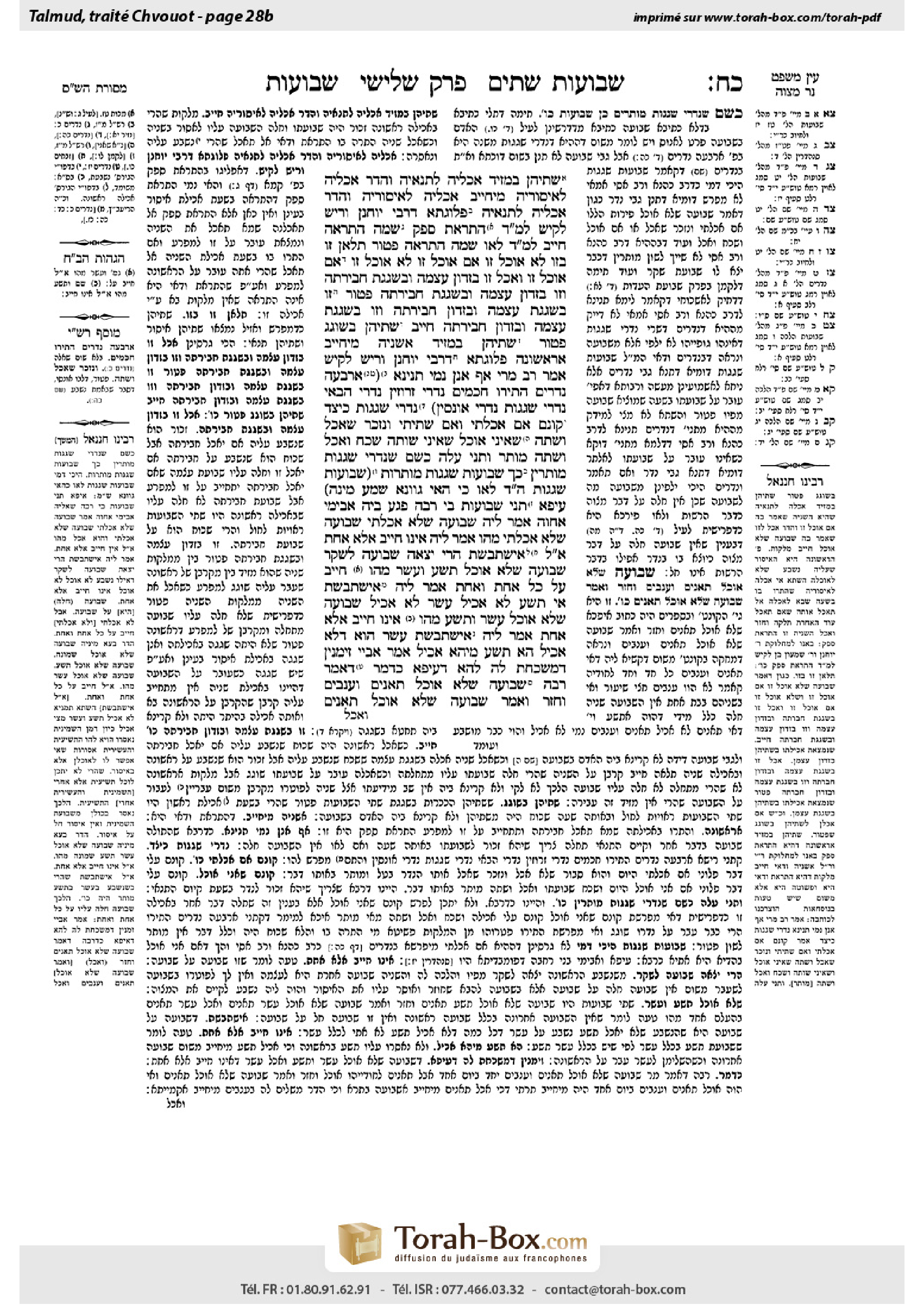
This page of Shevuot includes the Aramaic text, an English translation and an AI-generated French translation, alongside the scan above.
שבועות כ״ח ב · Aramaic and Hebrew text
שְׁתֵּיהֶן בְּמֵזִיד – אַכְלֵיהּ לִתְנָאֵיהּ וַהֲדַר אַכְלֵיהּ לְאִיסּוּרֵיהּ, מִיחַיַּיב; אַכְלֵיהּ לְאִיסּוּרֵיהּ וַהֲדַר אַכְלֵיהּ לִתְנָאֵיהּ, פְּלוּגְתָּא דְּרַבִּי יוֹחָנָן וְרֵישׁ לָקִישׁ – לְמַאן דְּאָמַר הַתְרָאַת סָפֵק שְׁמָהּ הַתְרָאָה, חַיָּיב; לְמַאן דְּאָמַר לָאו שְׁמָהּ הַתְרָאָה, פָּטוּר.
תְּלָאָן זוֹ בָּזוֹ – ״לֹא אוֹכַל זוֹ אִם אוֹכַל זוֹ״, ״לֹא אוֹכַל זוֹ אִם אוֹכַל זוֹ״; וְאָכַל זוֹ בִּזְדוֹן עַצְמָהּ וּבְשִׁגְגַת חֲבֶירְתָּהּ, וְזוֹ בִּזְדוֹן עַצְמָהּ וּבְשִׁגְגַת חֲבֶירְתָּהּ – פָּטוּר.
זוֹ בְּשִׁגְגַת עַצְמָהּ וּבְזָדוֹן חֲבֶירְתָּהּ, וְזוֹ בְּשִׁגְגַת עַצְמָהּ וּבִזְדוֹן חֲבֶירְתָּהּ – חַיָּיב.
שְׁתֵּיהֶן בְּשׁוֹגֵג – פָּטוּר.
שְׁתֵּיהֶן בְּמֵזִיד – אַשְּׁנִיָּה מִיחַיַּיב, אַרִאשׁוֹנָה פְּלוּגְתָּא דְּרַבִּי יוֹחָנָן וְרֵישׁ לָקִישׁ.
אָמַר רַב מָרִי, אַף אֲנַן נָמֵי תְּנֵינָא: אַרְבָּעָה נְדָרִים הִתִּירוּ חֲכָמִים – נִדְרֵי זֵרוּזִין, נִדְרֵי הֲבַאי, נִדְרֵי שְׁגָגוֹת, נִדְרֵי אֳונָסִין.
נִדְרֵי שְׁגָגוֹת כֵּיצַד? ״קוּנָּם אִם אָכַלְתִּי וְאִם שָׁתִיתִי״, וְנִזְכַּר שֶׁאָכַל וְשָׁתָה; ״שֶׁאֵינִי אוֹכֵל שֶׁאֵינִי שׁוֹתֶה״, שָׁכַח וְאָכַל וְשָׁתָה – מוּתָּר. וְתָנֵי עֲלַהּ: כְּשֵׁם שֶׁנִּדְרֵי שְׁגָגוֹת מוּתָּרִין, כָּךְ שְׁבוּעוֹת שְׁגָגוֹת מוּתָּרוֹת.
שְׁבוּעוֹת שְׁגָגוֹת הֵיכִי דָּמֵי – לָאו כִּי הַאי גַּוְונָא? שְׁמַע מִינַּהּ.
עֵיפָא תָּנֵי שְׁבוּעוֹת בֵּי רַבָּה. פְּגַע בֵּיהּ אֲבִימִי אֲחוּהּ, אֲמַר לֵיהּ: ״שְׁבוּעָה שֶׁלֹּא אָכַלְתִּי״ ״שְׁבוּעָה שֶׁלֹּא אָכַלְתִּי״, מַהוּ? אֲמַר לֵיהּ: אֵינוֹ חַיָּיב אֶלָּא אַחַת. אֲמַר לֵיהּ: אִישְׁתַּבַּשְׁתְּ, הֲרֵי יָצְאָה שְׁבוּעָה לַשֶּׁקֶר!
״שְׁבוּעָה שֶׁלֹּא אוֹכַל תֵּשַׁע וְעֶשֶׂר״, מַהוּ? חַיָּיב עַל כׇּל אַחַת וְאַחַת. אֲמַר לֵיהּ: אִישְׁתַּבַּשְׁתְּ, אִי תֵּשַׁע לָא אָכֵיל, עֶשֶׂר לָא אָכֵיל!
״שְׁבוּעָה שֶׁלֹּא אוֹכַל עֶשֶׂר וָתֵשַׁע״, מַהוּ? אֵינוֹ חַיָּיב אֶלָּא אַחַת. אֲמַר לֵיהּ: אִישְׁתַּבַּשְׁתְּ, עֶשֶׂר הוּא דְּלָא אָכֵיל, הָא תֵּשַׁע מִיהָא אָכֵיל!
אָמַר אַבָּיֵי: זִימְנִין דְּמַשְׁכַּחַתְּ לַהּ לְהָא דְּעֵיפָא, כִּדְמָר. דְּאָמַר רַבָּה: ״שְׁבוּעָה שֶׁלֹּא אוֹכַל תְּאֵנִים וַעֲנָבִים״, וְחָזַר וְאָמַר: ״שְׁבוּעָה שֶׁלֹּא אוֹכַל תְּאֵנִים״;
Shevuot 28b · English translation
In a case where he ate both of them intentionally, if he ate the loaf whose consumption was his condition and then ate the forbidden loaf, he is liable to receive lashes. If he ate the forbidden loaf and then ate the loaf whose consumption was his condition, his liability is the subject of a dispute between Rabbi Yoḥanan and Reish Lakish. According to the one who says that an uncertain forewarning is deemed a valid forewarning, he is liable to receive lashes. According to the one who says that an uncertain forewarning is not deemed a valid forewarning, he is exempt. Since when he was forewarned for eating the forbidden loaf it was uncertain whether it would actually become forbidden, that forewarning is not sufficient for him to be liable to receive lashes.
If one took an oath with regard to two loaves such that he rendered them interdependent, this one on that one, saying: I will not eat that if I eat this, and: I will not eat this if I eat that, and he ate this one intentionally with regard to itself, i.e., at the time he ate it he was aware that he had taken an oath that would render it forbidden if he ate the other, but unwittingly with regard to the other, i.e., he did not remember that in eating it he rendered the second one forbidden, and then he ate that one intentionally with regard to itself but unwittingly with regard to the other, he is exempt, as both conditions were fulfilled only unintentionally.
If he ate this one unwittingly with regard to itself, having forgotten that it would be forbidden if he ate the other, but intentionally with regard to the other, understanding that with his action he rendered the other forbidden, and that one unwittingly with regard to itself but intentionally with regard to the other, he is liable to bring offerings for unwittingly breaking his oaths, as the conditions were fulfilled intentionally and the oaths took effect.
If he ate both of them unwittingly he is exempt, as both conditions were fulfilled only unintentionally.
If he ate both of them intentionally, he is liable to receive lashes for eating the second loaf, while for the first loaf his status depends on the dispute between Rabbi Yoḥanan and Reish Lakish with regard to an uncertain forewarning.
Rav Mari said: We learn in the mishna (Nedarim 20b) as well that if one takes an oath with a condition but then fulfills the condition only unwittingly, he is exempt: The Sages dissolved four types of vows without the requirement of a request to a halakhic authority: Vows of exhortation, vows of exaggeration, unwitting vows, and vows whose fulfillment is impeded by circumstances beyond one’s control.
The mishna elaborates (see Nedarim 25b): Unwitting vows, how so? If one says: A certain item is forbidden to me like an offering [konam] if I ate or if I drank, and he then remembers that he ate or drank, or if one says: This loaf is konam for me if I will eat or if I will drink, and he then forgets and eats or drinks, the item is permitted. And it is taught in a baraita with regard to that mishna: Just as unwitting vows are dissolved, so are unwitting oaths dissolved, since he fulfilled the condition while lacking awareness that he was doing so.
The Gemara clarifies: What are the circumstances of unwitting oaths? Is it not a case like this, where he takes an oath with a condition and then fulfills the condition of the oath unwittingly? Conclude from that mishna that there is support for Rava’s opinion.
§ It is related that the Sage Eifa learned tractate Shevuot in the academy of Rabba. His brother Avimi met him and tested him concerning the halakhot of oaths. Avimi said to him: If one says: On my oath I did not eat, and then again: On my oath I did not eat, what is the halakha? Eifa said to him: He is liable only once if he ate. Avimi said to him: You have confused the issue. Since the oaths are about the past, it is not a question of whether the second oath takes effect. Each time, a false oath was issued, and each was a separate transgression.
Avimi asked him further: If one said: On my oath I will not eat nine pieces and on my oath I will not eat ten, what is the halakha? Eifa replied: He is liable for each and every one of the oaths, as the scope of the second oath is broader than that of the first. Avimi said to him: You have confused the issue: If he may not eat nine, he may not eat ten. The oath not to eat ten cannot take effect, since it is an action already prohibited by the oath not to eat nine.
Avimi asked him further: If one said: On my oath I will not eat ten and on my oath I will not eat nine, what is the halakha? Eifa replied: He is liable for only one oath. Avimi said to him: You have confused the issue. According to the first oath, it is ten that he may not eat, but he may still eat nine, so the second oath takes effect, in that it prohibits him from eating nine.
Abaye said: There are times when you find that the ruling of Eifa with regard to an oath not to eat ten followed by an oath not to eat nine applies, as in the case mentioned by the Master. As Rabba says: In the case of one who says: On my oath I will not eat figs and grapes together, and then says: On my oath I will not eat figs,
Shevuot 28b · Traduction française (IA)
Dans le cas où il a mangé les deux intentionnellement, s’il a d’abord mangé le pain dont la consommation constituait sa condition, puis le pain interdit, il est passible de flagellation. S’il a d’abord mangé le pain interdit, puis le pain dont la consommation constituait sa condition, sa responsabilité fait l’objet d’une controverse entre Rabbi Yoḥanan et Reish Lakish. Selon celui qui considère qu’un avertissement incertain est un avertissement valable, il est passible de flagellation. Selon celui qui considère qu’un avertissement incertain n’est pas un avertissement valable, il est exempt. En effet, lorsqu’il a été averti au sujet de la consommation du pain interdit, on ne savait pas encore si celui-ci deviendrait effectivement interdit ; cet avertissement ne suffit donc pas à le rendre passible de flagellation.
Si quelqu’un a prêté serment au sujet de deux pains de manière à les rendre interdépendants, l’un de l’autre, en disant : « Je ne mangerai pas celui-là si je mange celui-ci », et : « Je ne mangerai pas celui-ci si je mange celui-là », et qu’il a mangé celui-ci intentionnellement en ce qui le concerne — c’est-à-dire qu’au moment de le manger, il se souvenait avoir prêté un serment qui le rendrait interdit s’il mangeait l’autre —, mais sans en avoir conscience en ce qui concerne l’autre — c’est-à-dire qu’il ne se souvenait pas qu’en le mangeant, il rendait le second interdit —, puis qu’il a mangé celui-là intentionnellement en ce qui le concerne, mais sans en avoir conscience en ce qui concerne l’autre, il est exempt, car les deux conditions n’ont été remplies que par inadvertance.
S’il a mangé celui-ci par inadvertance en ce qui le concerne, ayant oublié qu’il serait interdit s’il mangeait l’autre, mais intentionnellement en ce qui concerne l’autre, sachant que son acte rendait l’autre interdit, puis qu’il a mangé celui-là par inadvertance en ce qui le concerne, mais intentionnellement en ce qui concerne l’autre, il est tenu d’apporter des sacrifices pour avoir enfreint ses serments par inadvertance, car les conditions ont été remplies intentionnellement et les serments ont pris effet.
S’il a mangé les deux par inadvertance, il est exempt, car les deux conditions n’ont été remplies que par inadvertance.
S’il a mangé les deux intentionnellement, il est passible de flagellation pour avoir mangé le second pain ; quant au premier, son statut dépend de la controverse entre Rabbi Yoḥanan et Reish Lakish au sujet d’un avertissement incertain.
Rav Mari a dit : Nous apprenons également dans la Michna (Nedarim 20b) que si quelqu’un prête serment sous condition, mais ne remplit cette condition que par inadvertance, il est exempt : les Sages ont dissous quatre types de vœux sans qu’il soit nécessaire de s’adresser à une autorité halakhique : les vœux d’exhortation, les vœux d’exagération, les vœux prononcés par inadvertance et les vœux dont l’accomplissement est empêché par des circonstances indépendantes de la volonté de la personne.
La Michna précise (voir Nedarim 25b) : Que sont les vœux prononcés par inadvertance ? Si quelqu’un dit : « Tel objet m’est interdit comme une offrande [konam] si j’ai mangé ou si j’ai bu », puis se souvient qu’il a mangé ou bu ; ou s’il dit : « Ce pain m’est interdit comme konam si je mange ou si je bois », puis oublie et mange ou boit, l’objet est permis. Et une baraïta enseigne à propos de cette Michna : de même que les vœux prononcés par inadvertance sont dissous, les serments prononcés par inadvertance le sont aussi, puisqu’il a rempli la condition sans avoir conscience de le faire.
La Guemara précise : En quoi consistent les serments prononcés par inadvertance ? Ne s’agit-il pas d’un cas comme celui-ci, où il prête serment sous condition, puis remplit par inadvertance la condition de son serment ? Conclus de cette Michna qu’elle étaye l’opinion de Rava.
§ On rapporte que le Sage Eifa étudia le traité Shevuot à l’académie de Rabba. Son frère Avimi le rencontra et l’interrogea sur les halakhot des serments. Avimi lui dit : Si quelqu’un dit : « Par serment, je n’ai pas mangé », puis répète : « Par serment, je n’ai pas mangé », quelle est la halakha ? Eifa lui répondit : S’il a mangé, il n’est passible que d’une seule peine. Avimi lui dit : Tu as embrouillé la question. Puisque les serments portent sur le passé, il ne s’agit pas de savoir si le second serment prend effet. Chaque fois, un faux serment a été prononcé, et chacun constitue une transgression distincte.
Avimi lui demanda encore : Si quelqu’un dit : « Par serment, je ne mangerai pas neuf morceaux », puis : « Par serment, je ne mangerai pas dix morceaux », quelle est la halakha ? Eifa répondit : Il est passible pour chacun des serments, puisque le second a une portée plus large que le premier. Avimi lui dit : Tu as embrouillé la question : s’il ne peut pas manger neuf morceaux, il ne peut pas en manger dix. Le serment de ne pas en manger dix ne peut pas prendre effet, puisque l’acte est déjà interdit par le serment de ne pas en manger neuf.
Avimi lui demanda encore : Si quelqu’un dit : « Par serment, je ne mangerai pas dix morceaux », puis : « Par serment, je ne mangerai pas neuf morceaux », quelle est la halakha ? Eifa répondit : Il n’est passible que pour un seul serment. Avimi lui dit : Tu as embrouillé la question. Selon le premier serment, il lui est interdit de manger dix morceaux, mais il peut encore en manger neuf ; le second serment prend donc effet et lui interdit d’en manger neuf.
Abaye a dit : Il arrive que la décision d’Eifa concernant un serment de ne pas manger dix morceaux suivi d’un serment de ne pas en manger neuf s’applique, comme dans le cas mentionné par le Maître. En effet, Rabba dit : Dans le cas de quelqu’un qui dit : « Par serment, je ne mangerai pas de figues et de raisins ensemble », puis dit : « Par serment, je ne mangerai pas de figues »,
Traduction française générée par IA à partir de l’édition anglaise de Sefaria. Vérifie toujours un passage avec le texte source.
Text from Sefaria: William Davidson Edition - Vocalized Aramaic (CC BY NC); William Davidson Edition - English (CC BY NC).