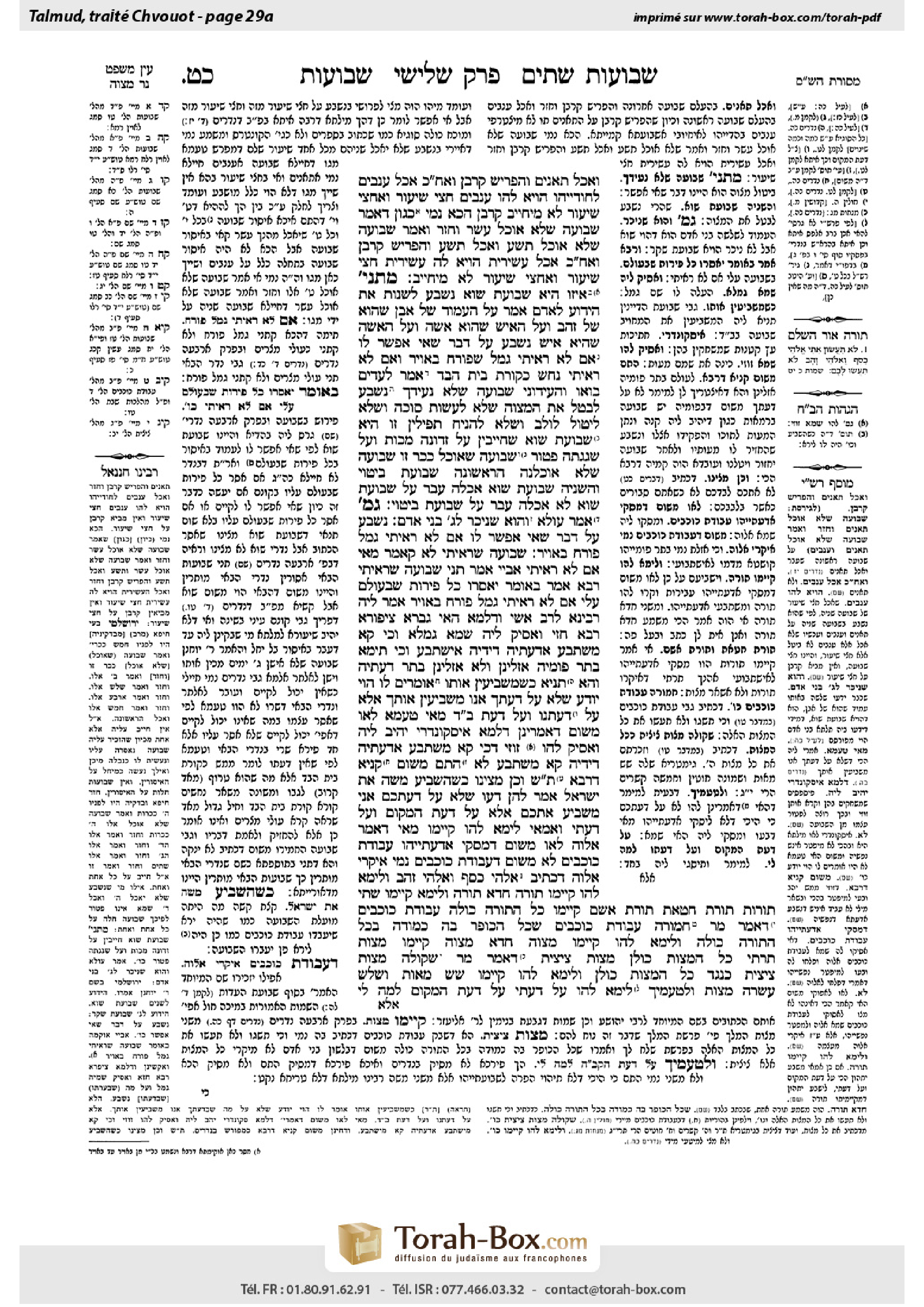
Shevuot 29a: Talmud study for Daf Yomi
Daf Yomi is the daily study of one Talmud folio. Explore 37 tractates with scans, Hebrew text, Sefaria English and AI-generated French translations where annotated.
Passage selection and English or AI-generated French translation are available where the scan has annotations. Daf Study is independent of Torah-Box and Sefaria.
Browse Shevuot · שבועות · All tractatesShevuot 29a text and translations
This page of Shevuot includes the Aramaic text, an English translation and an AI-generated French translation, alongside the scan above.
שבועות כ״ט א · Aramaic and Hebrew text
וְאָכַל תְּאֵנִים וְהִפְרִישׁ קׇרְבָּן, וְאַחַר כָּךְ אָכַל עֲנָבִים לְחוֹדַיְיהוּ – הָוְיָא לְהוּ עֲנָבִים חֲצִי שִׁיעוּר, וְאַחֲצִי שִׁיעוּר לָא מִיחַיַּיב קׇרְבָּן. הָכָא נָמֵי, כְּגוֹן דְּאָמַר: ״שְׁבוּעָה שֶׁלֹּא אוֹכַל עֶשֶׂר״, וְחָזַר וְאָמַר: ״שְׁבוּעָה שֶׁלֹּא אוֹכַל תֵּשַׁע״, וְאָכַל תֵּשַׁע וְהִפְרִישׁ קׇרְבָּן, וְאַחַר כָּךְ אָכַל עֲשִׂירִית; הָוְיָא לַהּ עֲשִׂירִית חֲצִי שִׁיעוּר, וְאַחֲצִי שִׁיעוּר לָא מִיחַיַּיב.
מַתְנִי׳ אֵיזוֹ הִיא שְׁבוּעַת שָׁוְא? נִשְׁבַּע לְשַׁנּוֹת אֶת הַיָּדוּעַ לָאָדָם – אָמַר עַל הָעַמּוּד שֶׁל אֶבֶן שֶׁהוּא שֶׁל זָהָב, וְעַל הָאִישׁ שֶׁהוּא אִשָּׁה, וְעַל הָאִשָּׁה שֶׁהִיא אִישׁ;
נִשְׁבַּע עַל דָּבָר שֶׁאִי אֶפְשָׁר לוֹ – ״אִם לֹא רָאִיתִי גָּמָל שֶׁפּוֹרֵחַ בָּאֲוִיר״ וְ״אִם לֹא רָאִיתִי נָחָשׁ כְּקוֹרַת בֵּית הַבַּד״;
אָמַר לְעֵדִים: ״בּוֹאוּ וְהַעִידוּנִי״, ״שְׁבוּעָה שֶׁלֹּא נְעִידֶךָ״; נִשְׁבַּע לְבַטֵּל אֶת הַמִּצְוָה – שֶׁלֹּא לַעֲשׂוֹת סוּכָּה וְשֶׁלֹּא לִיטּוֹל לוּלָב וְשֶׁלֹּא לְהַנִּיחַ תְּפִילִּין; זוֹ הִיא שְׁבוּעַת שָׁוְא, שֶׁחַיָּיבִין עַל זְדוֹנָהּ מַכּוֹת וְעַל שִׁגְגָתָהּ פָּטוּר.
״שְׁבוּעָה שֶׁאוֹכַל כִּכָּר זוֹ״, ״שְׁבוּעָה שֶׁלֹּא אוֹכְלֶנָּה״ – הָרִאשׁוֹנָה שְׁבוּעַת בִּיטּוּי, וְהַשְּׁנִיָּה שְׁבוּעַת שָׁוְא.
אֲכָלָהּ – עָבַר עַל שְׁבוּעַת שָׁוְא. לֹא אֲכָלָהּ – עָבַר עַל שְׁבוּעַת בִּיטּוּי.
גְּמָ׳ אָמַר עוּלָּא: וְהוּא שֶׁנִּיכָּר לִשְׁלֹשָׁה בְּנֵי אָדָם.
נִשְׁבַּע עַל דָּבָר שֶׁאִי אֶפְשָׁר לוֹ – ״אִם לֹא רָאִיתִי גָּמָל פּוֹרֵחַ בָּאֲוִיר״. ״שְׁבוּעָה שֶׁרָאִיתִי״ לָא קָאָמַר, מַאי ״אִם לֹא רָאִיתִי״? אַבָּיֵי אָמַר: תָּנֵי ״שְׁבוּעָה שֶׁרָאִיתִי״. רָבָא אָמַר: בְּאוֹמֵר ״יֵאָסְרוּ כׇּל פֵּירוֹת שֶׁבְּעוֹלָם עָלַי, אִם לֹא רָאִיתִי גָּמָל פּוֹרֵחַ בָּאֲוִיר״.
אֲמַר לֵיהּ רָבִינָא לְרַב אָשֵׁי: וְדִלְמָא הַאי גַּבְרָא צִיפּוֹרָא רַבָּא חֲזִי, וְאַסֵּיק לֵיהּ שְׁמָא ״גַּמְלָא״, וְכִי קָא מִשְׁתְּבַע – אַדַּעְתֵּיהּ דִּידֵיהּ אִישְׁתְּבַע?
וְכִי תֵּימָא: בָּתַר פּוּמֵּיהּ אָזְלִינַן, וְלָא אָזְלִינַן בָּתַר דַּעְתֵּיהּ – וְהָא תַּנְיָא: כְּשֶׁמַּשְׁבִּיעִין אוֹתוֹ אוֹמְרִים לוֹ: ״הֱוֵי יוֹדֵעַ, שֶׁלֹּא עַל דַּעְתְּךָ אָנוּ מַשְׁבִּיעִין אוֹתְךָ, אֶלָּא עַל דַּעְתֵּנוּ וְעַל דַּעַת בֵּית דִּין״. מַאי טַעְמָא? לָאו מִשּׁוּם דְּאָמְרִינַן: דִּלְמָא אִיסְקוּנְדְּרֵי יְהַיב לֵיהּ וְאַסֵּיק לְהוּ ״זוּזֵי״, דְּכִי קָא מִשְׁתְּבַע – אַדַּעְתֵּיהּ דִּידֵיהּ קָא מִשְׁתְּבַע?
לָא, הָתָם מִשּׁוּם קַנְיָא דְּרָבָא.
תָּא שְׁמַע: וְכֵן מָצִינוּ כְּשֶׁהִשְׁבִּיעַ מֹשֶׁה אֶת יִשְׂרָאֵל, אָמַר לָהֶן: ״דְּעוּ שֶׁלֹּא עַל דַּעְתְּכֶם אֲנִי מַשְׁבִּיעַ אֶתְכֶם, אֶלָּא עַל דַּעַת הַמָּקוֹם וְעַל דַּעְתִּי״. וְאַמַּאי? לֵימָא לְהוּ: ״קַיִּימוּ מַאי דַּאֲמַר אֱלוֹהַּ״! לָאו מִשּׁוּם דְּמַסְּקִי אַדַּעְתַּיְיהוּ עֲבוֹדָה זָרָה?
לָא; מִשּׁוּם דַּעֲבוֹדָה זָרָה נָמֵי אִיקְּרִי ״אֱלוֹהַּ״, דִּכְתִיב: ״אֱלֹהֵי כֶסֶף וֵאלֹהֵי זָהָב״.
וְלֵימָא לְהוּ: ״קַיִּימוּ תּוֹרָה״! חֲדָא תּוֹרָה. וְלֵימָא: ״קַיִּימוּ שְׁתֵּי תּוֹרוֹת״! ״תּוֹרַת חַטָּאת״ ״תּוֹרַת אָשָׁם״. ״קַיִּימוּ כׇּל הַתּוֹרָה כּוּלָּהּ״! עֲבוֹדָה זָרָה, דְּאָמַר מָר: חֲמוּרָה עֲבוֹדָה זָרָה, שֶׁכׇּל הַכּוֹפֵר בָּהּ כְּמוֹדֶה בְּכׇל הַתּוֹרָה כּוּלָּהּ.
וְלֵימָא לְהוּ: ״קַיִּימוּ מִצְוָה״! חֲדָא מִצְוָה. ״קַיִּימוּ מִצְוֹת!״ תַּרְתֵּי. ״כׇּל הַמִּצְוֹת כּוּלָּן״! מִצְוַת צִיצִית, דְּאָמַר מָר: שְׁקוּלָה מִצְוַת צִיצִית כְּנֶגֶד כׇּל הַמִּצְוֹת כּוּלָּן.
וְלֵימָא לְהוּ: ״קַיִּימוּ שֵׁשׁ מֵאוֹת וּשְׁלֹשׁ עֶשְׂרֵה מִצְוֹת״! וּלְטַעֲמֵיךְ, לֵימָא לְהוּ: ״עַל דַּעְתִּי״; ״עַל דַּעַת הַמָּקוֹם״ לְמָה לִי?
Shevuot 29a · English translation
and he unwittingly ate figs and set aside an offering for breaking the second oath, and afterward he unwittingly ate grapes alone, he is exempt from liability for breaking the first oath. The grapes are tantamount to a half-measure of his first oath, which was not to eat figs and grapes together, and one is not liable to bring an offering for a half-measure. Here also, where he said: On my oath I will not eat ten, and then said: On my oath I will not eat nine, and he ate nine and set aside an offering for breaking his second oath, and later he ate the tenth, this tenth is tantamount to a half-measure of his first oath, and one is not liable to bring an offering for a half-measure.
MISHNA: Which oath is an oath taken in vain, mentioned in the previous mishna (27b)? It is when one takes an oath to deny that which is known to people to be true, for example, one says about a stone column that it is made of gold, or about a man that he is a woman, or about a woman that she is a man.
Another type of oath taken in vain is when one takes an oath about a matter that is impossible, e.g., if he says: If I did not see a camel flying through the air, or: If I did not see a snake as large as the beam of the olive press.
In the case of one who said to witnesses: Come and testify for me, and they replied: On our oath we will not testify for you, that is an oath taken in vain, because it involves taking an oath to refrain from performing a mitzva. Other examples of this include an oath not to build a sukka, or not to take a lulav, or not to don phylacteries. This type of oath is an oath taken in vain, for which one is liable to receive lashes if he takes the oath intentionally, and for which he is exempt if he takes it unwittingly.
If one said: On my oath I will eat this loaf, and later said: On my oath I will not eat it, the first oath is an oath on an utterance, and the second is an oath taken in vain, as he took an oath to perform an action that would violate his previous oath.
If he ate it, he violated the prohibition against taking an oath in vain. If he did not eat it, he violated the prohibition against breaking an oath on an utterance.
GEMARA: With regard to an oath taken in vain that denies that which is known to people, Ulla says: It is considered known to people when it is a fact that is known to three people.
§ The mishna describes an oath taken in vain where one takes an oath about a matter that is impossible, e.g., where one says: If I did not see a camel flying through the air. The Gemara points out: The tanna of the mishna did not say: On my oath I saw. What is the meaning of: If I did not see? Abaye said: Emend the language of the mishna and teach: On my oath I saw. Rava said: This is part of a larger statement where one says: Let all the produce in the world be prohibited for me if I did not see a camel flying through the air.
With regard to the oath: If I did not see a camel flying through the air, Ravina said to Rav Ashi: Perhaps this man who took this oath saw a great bird and named it for himself: Camel, and when he took the oath, he took the oath according to his own understanding.
And if you would say that we follow his mouth, i.e., the generally accepted meaning of what one says, and we do not follow his understanding, i.e., his own private meaning, but isn’t it taught otherwise in a baraita: When they administer an oath to him in court, the judges say to him: Know that it is not according to your own understanding that we administer this oath to you, but according to our understanding and according to the understanding of the court? What is the reason they say this? Is it not because we say: Perhaps he gave tokens [iskunderei] to his creditor but he calls them for himself: Dinars, so that when he takes the oath, it is according to his own understanding that he takes the oath. Since, in principle, it is possible for him to take an oath according to his private meaning of the words, the court insists that the oath it administers is to be understood according to the words’ generally accepted meaning.
Rav Ashi replies: No, the reason the court admonishes the oath taker is not that the oath can be interpreted according to a private meaning. There, when the court administers an oath, they explain that it is according to their meaning due to deceptions like that of the reed in Rava’s court. In that incident, someone handed his creditor a hollow reed, which he had secretly filled with coins, to hold for him, and proceeded to take an oath that he had given him the money owed to him, whereupon he took back the reed, as the creditor was unaware of its contents. The court admonishes oath takers so that they do not think that they have fulfilled their obligation to take an oath if they engage in such chicanery.
The Gemara suggests: Come and hear a baraita: And so we found that when Moses administered an oath to Israel that they would keep the Torah (see Deuteronomy 29:9–12), he said to them: Know that I am not administering this oath according to your understanding but according to the understanding of the Omnipresent and according to my understanding. And why not let him simply say to them: Keep that which God said? Is it not that he insisted on admonishing them because he was concerned lest they direct the oath in their minds to idolatry, saying that they are taking an oath of loyalty to God but privately intending the oath to be for idolatry? This indicates that the content of an oath can be affected by an oath taker’s private meaning.
The Gemara rejects this: No, Moses explicitly indicated that the oath was according to God’s and his own understanding because idolatry is also referred to with the word: God, as it is written: “You shall not make with Me gods of silver or gods of gold” (Exodus 20:20). Therefore, the generally accepted meaning of the oath is ambiguous.
The Gemara suggests: If private meanings do not affect the content of an oath, let Moses merely say to them: Keep the Torah. The Gemara explains: They could then have taken an oath to keep only one Torah, either the Written or the Oral Torah. The Gemara suggests: And let him say: Keep two Torahs. The Gemara explains: The word: Torah, also has a narrower meaning of a set of halakhic procedures. The Jewish people could then have limited the oath to the law of [torat] the sin-offering or the law of [torat] the guilt-offering. The Gemara suggests: Let Moses administer an oath to keep the entire Torah. The Gemara replies: That could have been understood as referring only to the prohibition of idolatry, as the Master says: The prohibition of idolatry is so severe that with regard to one who denies idol worship, it is as if he affirms the entire Torah.
The Gemara suggests: And let him say to them: Keep the mitzva, i.e., that which you are commanded. The Gemara replies: That could have been understood as referring to only one mitzva. The Gemara suggests: Let him say: Keep mitzvot, i.e., in the plural. The Gemara replies: That could be understood as referring to only two mitzvot. The Gemara suggests: Let him say: All the mitzvot in their entirety. The Gemara replies: That could be understood as referring to the mitzva of ritual fringes, as the Master says: The mitzva of ritual fringes is equivalent to all the other mitzvot.
The Gemara suggests: And let him say to them: Keep 613 mitzvot. The Gemara replies: And according to your reasoning, let him simply say: Take the oath according to my understanding. Why do I need for him to say: According to the understanding of the Omnipresent?
Shevuot 29a · Traduction française (IA)
et il mangea par inadvertance des figues et mit de côté une offrande pour avoir enfreint le second serment, puis il mangea ensuite par inadvertance uniquement des raisins, il est quitte de toute responsabilité pour avoir enfreint le premier serment. Les raisins équivalent à une demi-mesure au regard de son premier serment, qui était de ne pas manger ensemble des figues et des raisins, et l’on n’est pas tenu d’apporter une offrande pour une demi-mesure. De même ici, lorsqu’il dit : « Par serment, je n’en mangerai pas dix », puis : « Par serment, je n’en mangerai pas neuf », qu’il en mange neuf et mette de côté une offrande pour avoir enfreint son second serment, puis qu’il mange ensuite le dixième, celui-ci équivaut à une demi-mesure au regard de son premier serment, et l’on n’est pas tenu d’apporter une offrande pour une demi-mesure.
MICHNA : Quel est le serment vain mentionné dans la Michna précédente (27b) ? C’est le cas où quelqu’un jure le contraire d’un fait connu de tous, par exemple, en affirmant qu’une colonne de pierre est en or, qu’un homme est une femme ou qu’une femme est un homme.
Un autre type de serment vain est celui où quelqu’un jure au sujet d’une chose impossible, par exemple en disant : « Si je n’ai pas vu un chameau voler dans les airs », ou : « Si je n’ai pas vu un serpent aussi grand que la poutre du pressoir à olives. »
Dans le cas de quelqu’un qui dit à des témoins : « Venez témoigner pour moi », et à qui ils répondent : « Par serment, nous ne témoignerons pas pour toi », il s’agit d’un serment vain, car cela revient à jurer de s’abstenir d’accomplir une mitsva. Parmi les autres exemples figurent le serment de ne pas construire de soukka, de ne pas prendre de loulav ou de ne pas mettre les téfilines. Ce type de serment est un serment vain : celui qui le prononce intentionnellement est passible de flagellation, tandis que celui qui le prononce par inadvertance est quitte.
Si quelqu’un dit : « Par serment, je mangerai ce pain », puis dit ensuite : « Par serment, je ne le mangerai pas », le premier serment est un serment portant sur une expression, et le second est un serment vain, puisqu’il a juré d’accomplir un acte qui violerait son serment précédent.
S’il le mange, il transgresse l’interdiction de prononcer un serment vain. S’il ne le mange pas, il transgresse l’interdiction de violer un serment portant sur une expression.
GUEMARA : À propos d’un serment vain qui nie un fait connu de tous, Oula dit : Un fait est considéré comme connu de tous lorsqu’il est connu de trois personnes.
§ La Michna décrit un serment vain portant sur une chose impossible, par exemple lorsque quelqu’un dit : « Si je n’ai pas vu un chameau voler dans les airs. » La Guemara relève : Le tanna de la Michna n’a pas dit : « Par serment, j’ai vu. » Que signifie donc : « Si je n’ai pas vu » ? Abayé dit : Corrige le texte de la Michna et enseigne : « Par serment, j’ai vu. » Rava dit : Cette phrase fait partie d’une déclaration plus longue, dans laquelle quelqu’un dit : « Que tous les produits du monde me soient interdits si je n’ai pas vu un chameau voler dans les airs. »
À propos du serment : « Si je n’ai pas vu un chameau voler dans les airs », Ravina dit à Rav Achi : Peut-être cet homme qui a prononcé ce serment a-t-il vu un grand oiseau et l’a-t-il appelé « chameau » ; lorsqu’il a juré, il l’a fait selon sa propre interprétation.
Et si tu dis que nous nous en tenons à ses paroles, c’est-à-dire à leur sens généralement admis, et non à son interprétation, c’est-à-dire au sens particulier qu’il leur donne, n’est-il pas pourtant enseigné le contraire dans une baraïta : lorsqu’on lui fait prêter serment au tribunal, les juges lui disent : « Sache que nous te faisons prêter serment non selon ton interprétation, mais selon la nôtre et celle du tribunal. » Pourquoi disent-ils cela ? N’est-ce pas parce que nous disons : Peut-être a-t-il remis à son créancier des jetons [iskunderei], mais les appelle-t-il « dinars » ; lorsqu’il jure, il le fait donc selon sa propre interprétation. Puisqu’il est en principe possible de prêter serment selon le sens particulier qu’on donne aux mots, le tribunal insiste pour que le serment qu’il fait prêter soit compris selon le sens généralement admis des mots.
Rav Achi répond : Non, le tribunal avertit la personne qui prête serment non pas parce que le serment pourrait être interprété selon un sens particulier. Dans ce cas, lorsqu’on fait prêter serment au tribunal, les juges précisent qu’il doit être compris selon leur interprétation en raison de tromperies comme celle du roseau au tribunal de Rava. Dans cet épisode, quelqu’un remit à son créancier un roseau creux qu’il avait secrètement rempli de pièces, afin que celui-ci le garde pour lui, puis jura qu’il lui avait remis l’argent qu’il lui devait ; après quoi il reprit le roseau, le créancier ignorant ce qu’il contenait. Le tribunal avertit ceux qui prêtent serment afin qu’ils ne pensent pas s’être acquittés de leur obligation de prêter serment en recourant à de telles manœuvres.
La Guemara propose : Écoute une baraïta : Nous trouvons ainsi que, lorsque Moïse fit jurer Israël de respecter la Torah (voir Deutéronome 29, 9-12), il leur dit : « Sachez que je ne vous fais pas prêter serment selon votre interprétation, mais selon celle du Tout-Puissant et la mienne. » Pourquoi ne leur a-t-il pas simplement dit : « Respectez ce que Dieu a dit » ? N’est-ce pas parce qu’il tenait à les avertir, de peur qu’ils ne dirigent mentalement le serment vers l’idolâtrie, disant qu’ils jurent fidélité à Dieu tout en ayant secrètement l’intention de jurer en faveur de l’idolâtrie ? Cela indique que le contenu d’un serment peut être influencé par le sens particulier que lui donne celui qui le prononce.
La Guemara rejette cette explication : Non, Moïse précisa explicitement que le serment devait être compris selon l’interprétation de Dieu et la sienne, car l’idolâtrie est elle aussi désignée par le mot « dieu », comme il est écrit : « Tu ne te feras pas de dieux d’argent ni de dieux d’or » (Exode 20, 20). Le sens généralement admis du serment était donc ambigu.
La Guemara propose : Si les interprétations particulières ne modifient pas le contenu d’un serment, que Moïse leur dise simplement : « Respectez la Torah. » La Guemara explique : Ils auraient alors pu comprendre qu’il s’agissait d’une seule Torah, soit la Torah écrite, soit la Torah orale. La Guemara propose : Qu’il leur dise : « Respectez deux Torahs. » La Guemara explique : Le mot « Torah » désigne aussi, dans un sens plus restreint, un ensemble de règles de halakha. Les enfants d’Israël auraient alors pu limiter le serment à la loi du [torat] sacrifice expiatoire ou à celle du [torat] sacrifice de culpabilité. La Guemara propose : Que Moïse leur fasse jurer de respecter toute la Torah. La Guemara répond : Cela aurait pu être compris comme ne visant que l’interdiction de l’idolâtrie, car le Maître dit : L’interdiction de l’idolâtrie est si grave que celui qui renie le culte des idoles est considéré comme ayant affirmé toute la Torah.
La Guemara propose : Qu’il leur dise : « Respectez la mitsva », c’est-à-dire ce qui vous est ordonné. La Guemara répond : Ils auraient alors pu comprendre qu’il ne s’agissait que d’une seule mitsva. La Guemara propose : Qu’il leur dise : « Respectez les mitsvot », au pluriel. La Guemara répond : Ils auraient alors pu comprendre qu’il ne s’agissait que de deux mitsvot. La Guemara propose : Qu’il leur dise : « Respectez toutes les mitsvot dans leur intégralité. » La Guemara répond : Ils auraient alors pu comprendre qu’il s’agissait de la mitsva des franges rituelles, car le Maître dit : La mitsva des franges rituelles équivaut à toutes les autres mitsvot.
La Guemara propose : Qu’il leur dise : « Respectez les 613 mitsvot. » La Guemara répond : Mais, selon ton raisonnement, qu’il leur dise simplement : « Prêtez serment selon mon interprétation. » Pourquoi faut-il qu’il dise : « Selon l’interprétation du Tout-Puissant » ?
Traduction française générée par IA à partir de l’édition anglaise de Sefaria. Vérifie toujours un passage avec le texte source.
Text from Sefaria: William Davidson Edition - Vocalized Aramaic (CC BY NC); William Davidson Edition - English (CC BY NC).