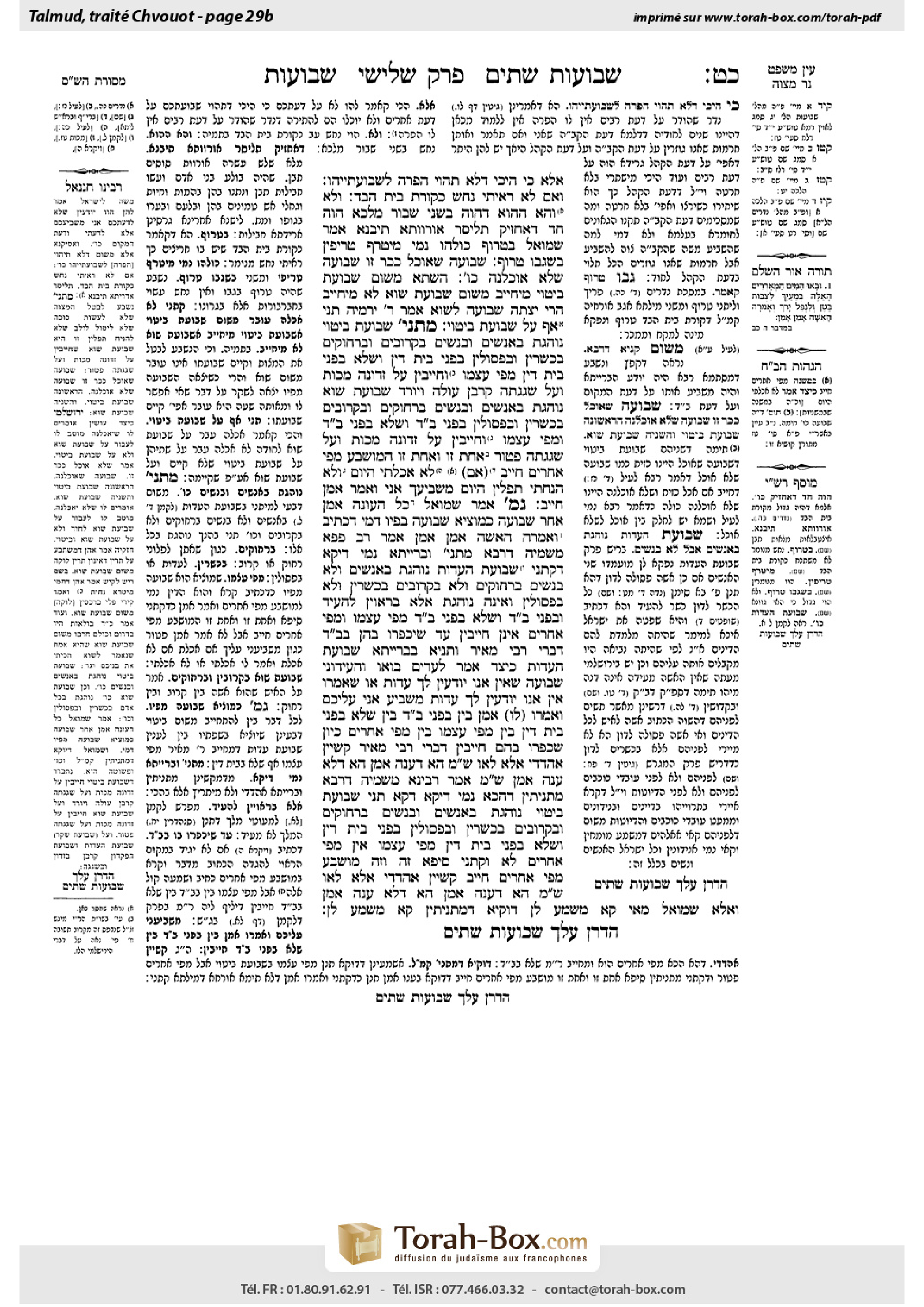
Shevuot 29b: Talmud study for Daf Yomi
Daf Yomi is the daily study of one Talmud folio. Explore 37 tractates with scans, Hebrew text, Sefaria English and AI-generated French translations where annotated.
Passage selection and English or AI-generated French translation are available where the scan has annotations. Daf Study is independent of Torah-Box and Sefaria.
Browse Shevuot · שבועות · All tractatesShevuot 29b text and translations
This page of Shevuot includes the Aramaic text, an English translation and an AI-generated French translation, alongside the scan above.
שבועות כ״ט ב · Aramaic and Hebrew text
אֶלָּא כִּי הֵיכִי דְּלָא תִּהְוֵי הֲפָרָה לִשְׁבוּעֲתַיְיהוּ.
וְ״אִם לֹא רָאִיתִי נָחָשׁ כְּקוֹרַת בֵּית הַבַּד״. וְלָא?! וְהָא הַהוּא דַּהֲוָה בִּשְׁנֵי שַׁבּוּר מַלְכָּא, הֲוָה חַד דְּאַחְזֵיק תְּלֵיסַר אוּרָוָותָא תִּיבְנָא!
אָמַר שְׁמוּאֵל: בְּטָרוּף. כּוּלְּהוּ נָמֵי מִיטְרָף טְרִיפִין! בְּשֶׁגַּבּוֹ טָרוּף.
״שְׁבוּעָה שֶׁאוֹכַל כִּכָּר זוֹ״, ״שְׁבוּעָה שֶׁלֹּא אוֹכְלֶנָּה״ כּוּ׳. הַשְׁתָּא מִשּׁוּם שְׁבוּעַת בִּיטּוּי מִיחַיַּיב, מִשּׁוּם שְׁבוּעַת שָׁוְא לָא מִיחַיַּיב?! הֲרֵי יָצְתָה שְׁבוּעָה לַשָּׁוְא!
אָמַר רַבִּי יִרְמְיָה, תָּנֵי: אַף עַל שְׁבוּעַת בִּיטּוּי.
מַתְנִי׳ שְׁבוּעַת בִּיטּוּי נוֹהֶגֶת בַּאֲנָשִׁים וּבְנָשִׁים, בִּקְרוֹבִים וּבִרְחוֹקִים, בִּכְשֵׁרִין וּבִפְסוּלִין, בִּפְנֵי בֵּית דִּין וְשֶׁלֹּא בִּפְנֵי בֵּית דִּין – מִפִּי עַצְמוֹ. וְחַיָּיבִין עַל זְדוֹנָהּ מַכּוֹת, וְעַל שִׁגְגָתָהּ קׇרְבָּן עוֹלֶה וְיוֹרֵד.
שְׁבוּעַת שָׁוְא נוֹהֶגֶת בַּאֲנָשִׁים וּבְנָשִׁים, בִּרְחוֹקִים וּבִקְרוֹבִים, בִּכְשֵׁרִין וּבִפְסוּלִין, בִּפְנֵי בֵּית דִּין וְשֶׁלֹּא בִּפְנֵי בֵּית דִּין – וּמִפִּי עַצְמוֹ. וְחַיָּיבִין עַל זְדוֹנָהּ מַכּוֹת, וְעַל שִׁגְגָתָהּ פָּטוּר.
אַחַת זוֹ וְאַחַת זוֹ, הַמּוּשְׁבָּע מִפִּי אֲחֵרִים חַיָּיב – ״אִם לֹא אָכַלְתִּי הַיּוֹם״ וְ״לֹא הִנַּחְתִּי תְּפִלִּין הַיּוֹם״; ״מַשְׁבִּיעֲךָ אֲנִי״, וְאָמַר ״אָמֵן״ – חַיָּיב.
גְּמָ׳ אָמַר שְׁמוּאֵל: כׇּל הָעוֹנֶה ״אָמֵן״ אַחַר שְׁבוּעָה – כְּמוֹצִיא שְׁבוּעָה בְּפִיו דָּמֵי, דִּכְתִיב: ״וְאָמְרָה הָאִשָּׁה אָמֵן אָמֵן״.
אָמַר רַב פָּפָּא מִשְּׁמֵיהּ דְּרָבָא: מַתְנִיתִין וּבָרָיְיתָא נָמֵי דַּיְקָא, דְּקָתָנֵי: שְׁבוּעַת הָעֵדוּת נוֹהֶגֶת בַּאֲנָשִׁים וְלֹא בְּנָשִׁים, בִּרְחוֹקִים וְלֹא בִּקְרוֹבִים, בִּכְשֵׁרִין וְלֹא בִּפְסוּלִין; וְאֵינָהּ נוֹהֶגֶת אֶלָּא בִּרְאוּיִן לְהָעִיד, וּבִפְנֵי בֵּית דִּין וְשֶׁלֹּא בִּפְנֵי בֵּית דִּין – מִפִּי עַצְמוֹ; וּמִפִּי אֲחֵרִים אֵינָן חַיָּיבִין, עַד שֶׁיִּכְפְּרוּ בָּהֶן בְּבֵית דִּין. דִּבְרֵי רַבִּי מֵאִיר.
וְתַנְיָא בְּבָרַיְיתָא: שְׁבוּעַת הָעֵדוּת כֵּיצַד? אָמַר לְעֵדִים: ״בּוֹאוּ וְהַעִידוּנִי״; ״שְׁבוּעָה שֶׁאֵין אָנוּ יוֹדְעִין לְךָ עֵדוּת״, אוֹ שֶׁאָמְרוּ: ״אֵין אָנוּ יוֹדְעִין לָךְ עֵדוּת״; ״מַשְׁבִּיעַ אֲנִי עֲלֵיכֶם״, וְאָמְרוּ (לוֹ) ״אָמֵן״ – בֵּין בִּפְנֵי בֵּית דִּין בֵּין שֶׁלֹּא בִּפְנֵי בֵּית דִּין, בֵּין מִפִּי עַצְמוֹ בֵּין מִפִּי אֲחֵרִים, כֵּיוָן שֶׁכָּפְרוּ בָּהֶם – חַיָּיבִין. דִּבְרֵי רַבִּי מֵאִיר.
קַשְׁיָין אַהֲדָדֵי! אֶלָּא לָאו שְׁמַע מִינַּהּ: הָא דְּעָנָה ״אָמֵן״, הָא דְּלָא עָנָה ״אָמֵן״? שְׁמַע מִינַּהּ.
אָמַר רָבִינָא מִשְּׁמֵיהּ דְּרָבָא: מַתְנִיתִין דְּהָכָא נָמֵי דַּיְקָא – דְּקָא תָּנֵי: ״שְׁבוּעַת בִּיטּוּי נוֹהֶגֶת בַּאֲנָשִׁים וּבְנָשִׁים, בִּרְחוֹקִים וּבִקְרוֹבִים, בִּכְשֵׁרִין וּבִפְסוּלִין, בִּפְנֵי בֵּית דִּין וְשֶׁלֹּא בִּפְנֵי בֵּית דִּין – מִפִּי עַצְמוֹ אִין, מִפִּי אֲחֵרִים לָא; וְקָתָנֵי סֵיפָא: ״זֶה וָזֶה מוּשְׁבָּע מִפִּי אֲחֵרִים – חַיָּיב״.
קַשְׁיָין אַהֲדָדֵי! אֶלָּא לָאו שְׁמַע מִינַּהּ: הָא דְּעָנָה ״אָמֵן״, הָא דְּלָא עָנָה ״אָמֵן״?
וְאֶלָּא שְׁמוּאֵל – מַאי קָא מַשְׁמַע לַן? דּוּקְיָא דְּמַתְנִיתִין קָא מַשְׁמַע לַן.
הֲדַרַן עֲלָךְ שְׁבוּעוֹת שְׁתַּיִם
Shevuot 29b · English translation
Rather, Moses administered the oath in this manner so that there would not be any possibility of the nullification of their oath. An oath taken with public consent cannot be dissolved. In this case, Moses and God constitute the public that gives its consent to the oath administered to the people. This was the reason for Moses’ insistence that the oath was taken according to his and God’s awareness; it was not because there was a possibility that the people could take the oath according to a private meaning.
§ The mishna teaches with regard to an oath about a matter that is impossible, e.g., If I did not see a camel flying through the air, or: If I did not see a snake as large as the beam of the olive press. The Gemara asks: And are there no snakes that large? But wasn’t there a certain snake during the years of the reign of King Shapur, one snake that could contain, i.e., swallow, thirteen stables of straw?
Shmuel said: The size of the snake is not the subject of the analogy. The oath is referring to a snake that was flat [taruf ] like the beam of an olive press. The Gemara asks: Aren’t they all flat? The Gemara explains: Snakes’ undersides are flat. This oath is referring to a snake whose back is flat.
§ The mishna teaches: If one said: On my oath I will eat this loaf, and later said: On my oath I will not eat it, the first oath is an oath on an utterance, and the second is an oath taken in vain. If he ate the loaf, he violated the prohibition against taking an oath in vain. If he did not eat it, he violated the prohibition against breaking an oath on an utterance. The Gemara asks: Now, if he did not eat it, he is liable because he violated his oath on an utterance. Is he not also liable for an oath taken in vain? An oath was issued in vain when he took the oath not to eat the loaf, as this required a violation of the oath he had taken to eat it.
Rabbi Yirmeya said: Teach the mishna with this emendation: If he did not eat it, he also violated the prohibition against breaking an oath on an utterance.
MISHNA: As opposed to the halakhot of an oath of testimony, which will be discussed in the following chapter, the halakhot of an oath on an utterance apply to men and to women, to relatives and to non-relatives, to those who are fit to testify and to those who are disqualified, whether the oath is taken in the presence of a court or not in the presence of a court, i.e., when one takes an oath on his own, at his own initiative. And for violating an oath intentionally one is liable to receive lashes, and for doing so unwittingly he is liable to bring a sliding-scale offering.
Liability for an oath taken in vain applies to men and to women, to relatives and to non-relatives, to those who are fit to bear witness and to those who are disqualified, whether the oath is taken in the presence of a court or not in the presence of a court, and also when one takes an oath on his own. And for violating an oath intentionally one is liable to receive lashes, and for doing so unwittingly he is exempt.
With regard to both this, an oath on an utterance, and that, an oath taken in vain, even if he is administered the oath by others, he is liable. For example, if one said: If I did not eat today, or: I did not don phylacteries today, and another said to him: I administer an oath to you that your statement is true, and the former said: Amen, he is liable if the statement was false.
GEMARA: Shmuel says: Anyone who answers amen after being administered an oath is like one who expresses an oath with his own mouth, as it is written in the context of the oath administered to a sota, a woman suspected by her husband of having been unfaithful: “And the woman shall say: Amen, amen” (Numbers 5:22).
Rav Pappa said in the name of Rava: An inference from the mishna and a baraita also support this when they are read precisely, as it is taught in the mishna (30a): The oath of testimony is practiced with regard to men but not with regard to women; with regard to non-relatives of the litigants, but not with regard to relatives; with regard to those fit to testify but not with regard to those unfit to testify due to a transgression that they performed. And the oath of testimony is practiced only with regard to those fit to testify. And this oath applies both in the presence of a court and not in the presence of a court, i.e., when the witness takes the oath on his own that he has no knowledge of the matter. But if an oath is administered to the witnesses by others, they are not liable until they deny knowledge of the matter in court and take an oath to that effect; this is the statement of Rabbi Meir.
Before stating the inference from the mishna, Rav Pappa cites the baraita. And it is taught in a baraita: With regard to an oath of testimony, how is one liable to bring a sliding-scale offering? A person said to witnesses: Come and testify for me. They replied: On our oath we do not know any testimony that concerns you, i.e., we have no knowledge of the matter. Alternatively, they said: We do not know any testimony that concerns you, and he said to them: I administer an oath to you, and they said to him: Amen. Whether this oath was taken in the presence of a court or whether it was not in the presence of a court, whether it was taken by each witness by himself or whether it was administered by others, once they denied knowing testimony that they in fact knew, they are liable; this is the statement of Rabbi Meir.
Rav Pappa asks: Aren’t the mishna and the baraita difficult, as they contradict each other? According to the mishna one is liable when the oath is administered by others only if it takes place in the presence of a court, while according to the baraita one is liable even not in the presence of a court. Rather, isn’t it correct to conclude from it that this statement in the baraita, where he is liable even not in the presence of a court, is referring to one who answered amen to the administered oath. That statement in the mishna is referring to one who did not answer amen and is therefore liable only in the presence of a court? The Gemara affirms: Conclude from it that it is so.
Ravina said in the name of Rava: The mishna that is here (29b) also may be read precisely to support this point. As it is taught in the mishna: The halakhot of an oath on an utterance apply to men and to women, to relatives and to non-relatives, to those who are fit to testify and to those who are disqualified, whether the oath is taken in the presence of a court or not in the presence of a court, i.e., when one takes an oath on his own, at his own initiative. Ravina states his inference: On his own, yes, but administered by others, no. And it is taught in the last clause of the mishna: With regard to this, an oath on an utterance, and that, an oath taken in vain, even if he is administered the oath by others, he is liable.
These statements in the mishna are difficult, as they contradict each other. Rather, isn’t it correct to conclude from it that this latter clause of the mishna is referring to one who answered amen to the administered oath. That former clause is referring to one who did not answer amen and is therefore liable only in the presence of a court.
The Gemara asks: But since his statement can be derived from tannaitic sources, what is Shmuel teaching us? The Gemara answers: He is teaching us the precise reading of the mishna. Since that halakha is not stated explicitly in the mishna, Shmuel saw fit to state it.
Shevuot 29b · Traduction française (IA)
Au contraire, Moïse fit prêter le serment de cette manière afin qu’il ne puisse en aucun cas être annulé. Un serment prêté avec le consentement du public ne peut être dissous. En l’occurrence, Moïse et Dieu constituent le public qui donne son consentement au serment fait prêter au peuple. C’est pourquoi Moïse insista pour que le serment soit prêté avec sa connaissance et celle de Dieu ; ce n’était pas parce qu’il était possible que le peuple prête serment en lui attribuant un sens privé.
§ La Michna enseigne qu’il s’agit d’un serment portant sur une chose impossible, par exemple : « Si je n’ai pas vu un chameau voler dans les airs », ou : « Si je n’ai pas vu un serpent aussi grand que la poutre d’un pressoir à olives ». La Guemara demande : N’existe-t-il donc pas de serpents aussi grands ? Pourtant, au temps du roi Shapour, il y eut un serpent qui pouvait contenir, c’est-à-dire avaler, treize granges de paille.
Chmouel dit : La comparaison ne porte pas sur la taille du serpent. Le serment évoque un serpent aplati [taruf] comme la poutre d’un pressoir à olives. La Guemara demande : Ne sont-ils pas tous aplatis ? La Guemara explique : Le ventre des serpents est plat. Ce serment évoque un serpent dont le dos est plat.
§ La Michna enseigne : Si quelqu’un dit : « Par serment, je mangerai ce pain », puis dit ensuite : « Par serment, je ne le mangerai pas », le premier serment est un serment portant sur une déclaration, et le second est un serment prononcé en vain. S’il mange le pain, il transgresse l’interdiction de prononcer un serment en vain. S’il ne le mange pas, il transgresse l’interdiction de violer un serment portant sur une déclaration. La Guemara demande : Or, s’il ne le mange pas, il est passible parce qu’il a violé son serment portant sur une déclaration. N’est-il pas également passible pour avoir prononcé un serment en vain ? Le serment était vain dès lors qu’il a juré de ne pas manger le pain, car cela exigeait qu’il viole le serment qu’il avait prêté de le manger.
Rabbi Yirmeya dit : Corrige la Michna ainsi : s’il ne l’a pas mangé, il a également transgressé l’interdiction de violer un serment portant sur une déclaration.
MICHNA : Contrairement aux halakhot du serment de témoignage, qui seront examinées au chapitre suivant, les halakhot du serment portant sur une déclaration s’appliquent aux hommes et aux femmes, aux parents et aux non-parents, à ceux qui sont aptes à témoigner et à ceux qui en sont inaptes, que le serment soit prêté devant un tribunal ou non, c’est-à-dire lorsqu’une personne le prête de son propre chef, de sa propre initiative. Celui qui le transgresse intentionnellement est passible de flagellation ; celui qui le fait involontairement est tenu d’apporter un sacrifice à valeur variable.
La responsabilité pour un serment prononcé en vain s’applique aux hommes et aux femmes, aux parents et aux non-parents, à ceux qui sont aptes à témoigner et à ceux qui en sont inaptes, que le serment soit prêté devant un tribunal ou non, y compris lorsqu’une personne le prête de son propre chef. Celui qui le transgresse intentionnellement est passible de flagellation ; celui qui le fait involontairement est exempt.
Dans les deux cas, celui du serment portant sur une déclaration et celui du serment prononcé en vain, la personne est passible même si le serment lui est fait prêter par autrui. Par exemple, si quelqu’un dit : « Si je n’ai pas mangé aujourd’hui » ou : « Je n’ai pas mis les téfilines aujourd’hui », et qu’un autre lui dit : « Je te fais prêter serment que ta déclaration est vraie », puis que le premier répond : « Amen », il est passible si sa déclaration était fausse.
GUEMARA : Chmouel dit : Quiconque répond amen après qu’on lui a fait prêter serment équivaut à quelqu’un qui prononce lui-même un serment, comme il est écrit au sujet du serment fait prêter à une sota, une femme que son mari soupçonne d’infidélité : « Et la femme dira : Amen, amen » (Nombres 5:22).
Rav Pappa dit au nom de Rava : Une déduction tirée de la Michna et d’une baraïta confirme également ce principe, lorsqu’on les lit avec précision. En effet, la Michna enseigne (30a) : Le serment de témoignage s’applique aux hommes, mais non aux femmes ; aux personnes qui ne sont pas parentes des plaideurs, mais non à leurs parents ; à ceux qui sont aptes à témoigner, mais non à ceux qui en sont inaptes en raison d’une transgression qu’ils ont commise. Le serment de témoignage ne s’applique qu’à ceux qui sont aptes à témoigner. Ce serment s’applique aussi bien devant un tribunal qu’en dehors d’un tribunal, c’est-à-dire lorsqu’un témoin jure de son propre chef qu’il n’a pas connaissance de l’affaire. Mais si le serment est fait prêter aux témoins par autrui, ils ne sont passibles qu’après avoir nié devant le tribunal avoir connaissance de l’affaire et avoir prêté serment en ce sens ; telle est la déclaration de Rabbi Meïr.
Avant d’énoncer la déduction tirée de la Michna, Rav Pappa cite la baraïta. Une baraïta enseigne : En quoi consiste le cas où l’on est tenu d’apporter un sacrifice à valeur variable pour un serment de témoignage ? Une personne dit à des témoins : « Venez témoigner pour moi. » Ils répondent : « Par serment, nous ne connaissons aucun témoignage qui vous concerne », c’est-à-dire que nous n’avons pas connaissance de l’affaire. Autre possibilité : ils disent : « Nous ne connaissons aucun témoignage qui vous concerne », et cette personne leur dit : « Je vous fais prêter serment », puis ils lui répondent : « Amen ». Que le serment soit prêté devant un tribunal ou non, qu’il soit prêté individuellement par chaque témoin ou qu’il leur soit fait prêter par autrui, dès lors qu’ils ont nié connaître un témoignage dont ils avaient effectivement connaissance, ils sont passibles ; telle est la déclaration de Rabbi Meïr.
Rav Pappa demande : La Michna et la baraïta ne présentent-elles pas une difficulté, puisqu’elles se contredisent ? Selon la Michna, on n’est passible que si le serment fait prêter par autrui a lieu devant un tribunal, tandis que selon la baraïta, on est passible même si le serment n’est pas prêté devant un tribunal. Au contraire, ne faut-il pas en conclure que la déclaration de la baraïta, selon laquelle on est passible même en dehors d’un tribunal, concerne celui qui a répondu amen au serment qu’on lui a fait prêter ? La déclaration de la Michna, quant à elle, concerne celui qui n’a pas répondu amen et qui n’est donc passible que devant un tribunal. La Guemara confirme : Il faut en conclure ainsi.
Ravina dit au nom de Rava : La Michna qui figure ici (29b) peut également être lue avec précision pour étayer ce principe. Elle enseigne : Les halakhot du serment portant sur une déclaration s’appliquent aux hommes et aux femmes, aux parents et aux non-parents, à ceux qui sont aptes à témoigner et à ceux qui en sont inaptes, que le serment soit prêté devant un tribunal ou non, c’est-à-dire lorsqu’une personne le prête de son propre chef, de sa propre initiative. Ravina en déduit : De son propre chef, oui, mais si le serment lui est fait prêter par autrui, non. Or, la Michna enseigne dans sa dernière clause : Dans les deux cas, celui du serment portant sur une déclaration et celui du serment prononcé en vain, la personne est passible même si le serment lui est fait prêter par autrui.
Ces déclarations de la Michna présentent une difficulté, car elles se contredisent. Au contraire, ne faut-il pas en conclure que cette dernière clause de la Michna concerne celui qui a répondu amen au serment qu’on lui a fait prêter ? La première clause concerne celui qui n’a pas répondu amen et qui n’est donc passible que devant un tribunal.
La Guemara demande : Mais puisque sa déclaration peut être déduite de sources tannaïtiques, que nous enseigne Chmouel ? La Guemara répond : Il nous enseigne à lire la Michna avec précision. Puisque cette halakha n’est pas énoncée explicitement dans la Michna, Chmouel a jugé bon de l’énoncer.
Traduction française générée par IA à partir de l’édition anglaise de Sefaria. Vérifie toujours un passage avec le texte source.
Text from Sefaria: William Davidson Edition - Vocalized Aramaic (CC BY NC); William Davidson Edition - English (CC BY NC).