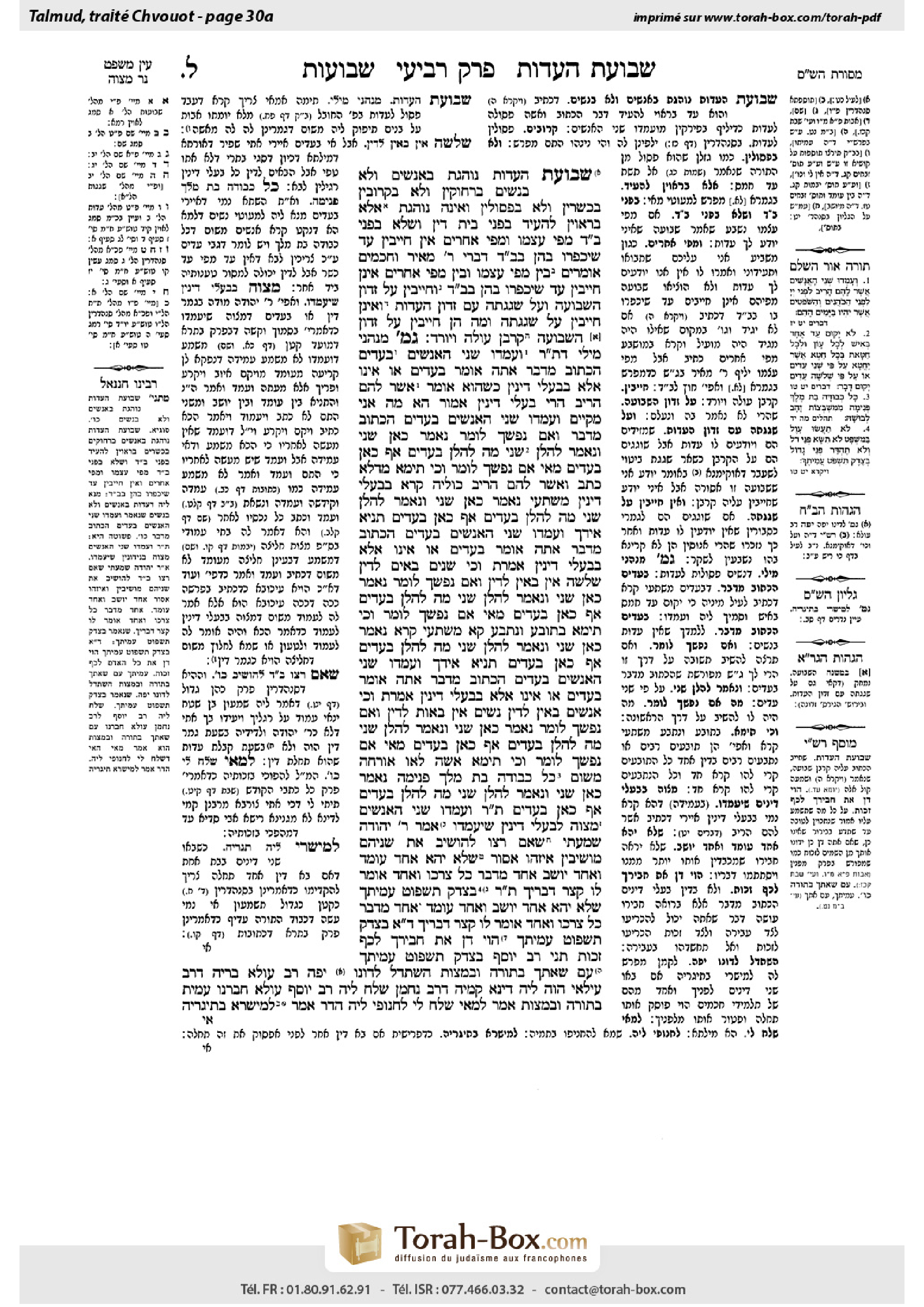
Shevuot 30a: Talmud study for Daf Yomi
Daf Yomi is the daily study of one Talmud folio. Explore 37 tractates with scans, Hebrew text, Sefaria English and AI-generated French translations where annotated.
Passage selection and English or AI-generated French translation are available where the scan has annotations. Daf Study is independent of Torah-Box and Sefaria.
Browse Shevuot · שבועות · All tractatesShevuot 30a text and translations
This page of Shevuot includes the Aramaic text, an English translation and an AI-generated French translation, alongside the scan above.
שבועות ל׳ א · Aramaic and Hebrew text
מַתְנִי׳ שְׁבוּעַת הָעֵדוּת נוֹהֶגֶת בַּאֲנָשִׁים וְלֹא בְּנָשִׁים, בִּרְחוֹקִין וְלֹא בִּקְרוֹבִין, בִּכְשֵׁרִין וְלֹא בִּפְסוּלִין; וְאֵינָהּ נוֹהֶגֶת אֶלָּא בִּרְאוּיִן לְהָעִיד.
בִּפְנֵי בֵּית דִּין וְשֶׁלֹּא בִּפְנֵי בֵּית דִּין – מִפִּי עַצְמוֹ, וּמִפִּי אֲחֵרִים אֵין חַיָּיבִין עַד שֶׁיִּכְפְּרוּ בָּהֶן בְּבֵית דִּין. דִּבְרֵי רַבִּי מֵאִיר. וַחֲכָמִים אוֹמְרִים: בֵּין מִפִּי עַצְמוֹ וּבֵין מִפִּי אֲחֵרִים – אֵינָן חַיָּיבִין עַד שֶׁיִּכְפְּרוּ בָּהֶן בְּבֵית דִּין.
וְחַיָּיבִין עַל זְדוֹן הַשְּׁבוּעָה, וְעַל שִׁגְגָתָהּ עִם זְדוֹן הָעֵדוּת, וְאֵינָן חַיָּיבִין עַל שִׁגְגָתָהּ. וּמָה הֵן חַיָּיבִין עַל זְדוֹן הַשְּׁבוּעָה? קׇרְבַּן עוֹלֶה וְיוֹרֵד.
גְּמָ׳ מְנָהָנֵי מִילֵּי? דְּתָנוּ רַבָּנַן: ״וְעָמְדוּ שְׁנֵי הָאֲנָשִׁים״ – בְּעֵדִים הַכָּתוּב מְדַבֵּר.
אַתָּה אוֹמֵר בְּעֵדִים, אוֹ אֵינוֹ אֶלָּא בְּבַעֲלֵי דִינִין? כְּשֶׁהוּא אוֹמֵר ״אֲשֶׁר לָהֶם הָרִיב״ – הֲרֵי בַּעֲלֵי דִינִין אָמוּר; הָא מָה אֲנִי מְקַיֵּים ״וְעָמְדוּ שְׁנֵי הָאֲנָשִׁים״? בְּעֵדִים הַכָּתוּב מְדַבֵּר. וְאִם נַפְשְׁךָ לוֹמַר: נֶאֱמַר כָּאן ״שְׁנֵי״ וְנֶאֱמַר לְהַלָּן ״שְׁנֵי״; מָה לְהַלָּן בְּעֵדִים, אַף כָּאן בְּעֵדִים.
מַאי ״אִם נַפְשְׁךָ לוֹמַר״? וְכִי תֵּימָא: מִדְּלָא כְּתִב ״וַאֲשֶׁר לָהֶם הָרִיב״– כּוּלֵּיהּ קְרָא בְּבַעֲלֵי דִינִין מִשְׁתַּעֵי; נֶאֱמַר כָּאן ״שְׁנֵי״ וְנֶאֱמַר לְהַלָּן ״שְׁנֵי״, מָה לְהַלָּן בְּעֵדִים אַף כָּאן בְּעֵדִים.
תַּנְיָא אִידַּךְ: ״וְעָמְדוּ שְׁנֵי הָאֲנָשִׁים״ – בְּעֵדִים הַכָּתוּב מְדַבֵּר. אַתָּה אוֹמֵר בְּעֵדִים, אוֹ אֵינוֹ אֶלָּא בְּבַעֲלֵי דִינִין? אָמְרַתְּ: וְכִי שְׁנַיִם בָּאִים לְדִין, שְׁלֹשָׁה אֵין בָּאִין לָדִין?! וְאִם נַפְשְׁךָ לוֹמַר: נֶאֱמַר כָּאן ״שְׁנֵי״ וְנֶאֱמַר לְהַלָּן ״שְׁנֵי״, מָה לְהַלָּן בְּעֵדִים, אַף כָּאן בְּעֵדִים.
מַאי ״אִם נַפְשְׁךָ לוֹמַר״? וְכִי תֵּימָא: בְּתוֹבֵעַ וְנִתְבָּע קָא מִשְׁתַּעֵי קְרָא; נֶאֱמַר כָּאן ״שְׁנֵי״ וְנֶאֱמַר לְהַלָּן ״שְׁנֵי״, מָה לְהַלָּן בְּעֵדִים אַף כָּאן בְּעֵדִים.
תַּנְיָא אִידַּךְ: ״וְעָמְדוּ שְׁנֵי הָאֲנָשִׁים״ – בְּעֵדִים הַכָּתוּב מְדַבֵּר. אַתָּה אוֹמֵר בְּעֵדִים, אוֹ אֵינוֹ אֶלָּא בְּבַעֲלֵי דִינִין? אָמְרַתְּ: וְכִי אֲנָשִׁים בָּאִין לַדִּין, נָשִׁים אֵין בָּאוֹת לַדִּין?! וְאִם נַפְשְׁךָ לוֹמַר: נֶאֱמַר כָּאן ״שְׁנֵי״ וְנֶאֱמַר לְהַלָּן ״שְׁנֵי״, מָה לְהַלָּן בְּעֵדִים אַף כָּאן בְּעֵדִים.
מַאי ״אִם נַפְשְׁךָ לוֹמַר״? וְכִי תֵּימָא: אִשָּׁה לָאו אוֹרְחַהּ, מִשּׁוּם ״כׇּל כְּבוּדָּה בַת מֶלֶךְ פְּנִימָה״; נֶאֱמַר כָּאן ״שְׁנֵי״ וְנֶאֱמַר לְהַלָּן ״שְׁנֵי״, מָה לְהַלָּן בְּעֵדִים אַף כָּאן בְּעֵדִים.
תָּנוּ רַבָּנַן: ״וְעָמְדוּ שְׁנֵי הָאֲנָשִׁים״ – מִצְוָה לְבַעֲלֵי דִינִין שֶׁיַּעַמְדוּ. אָמַר רַבִּי יְהוּדָה: שָׁמַעְתִּי שֶׁאִם רָצוּ לְהוֹשִׁיב אֶת שְׁנֵיהֶם – מוֹשִׁיבִין; אֵיזֶהוּ אָסוּר? שֶׁלֹּא יְהֵא אֶחָד עוֹמֵד וְאֶחָד יוֹשֵׁב, אֶחָד מְדַבֵּר כׇּל צָרְכּוֹ וְאֶחָד אוֹמֵר לוֹ ״קַצֵּר דְּבָרֶיךָ״.
תָּנוּ רַבָּנַן: ״בְּצֶדֶק תִּשְׁפֹּט עֲמִיתֶךָ״ – שֶׁלֹּא יְהֵא אֶחָד יוֹשֵׁב וְאֶחָד עוֹמֵד, אֶחָד מְדַבֵּר כׇּל צָרְכּוֹ וְאֶחָד אוֹמֵר לוֹ: ״קַצֵּר דְּבָרֶיךָ״. דָּבָר אַחֵר: ״בְּצֶדֶק תִּשְׁפֹּט עֲמִיתֶךָ״ – הֱוֵי דָּן אֶת חֲבֵירְךָ לְכַף זְכוּת.
תָּנֵי רַב יוֹסֵף: ״בְּצֶדֶק תִּשְׁפֹּט עֲמִיתֶךָ״ – עִם שֶׁאִתְּךָ בְּתוֹרָה וּבְמִצְוֹת, הִשְׁתַּדֵּל לְדוּנוֹ יָפֶה.
רַב עוּלָּא בְּרֵיהּ דְּרַב עִילַּאי הֲוָה לֵיהּ דִּינָא קַמֵּיהּ דְּרַב נַחְמָן. שְׁלַח לֵיהּ רַב יוֹסֵף: עוּלָּא חֲבֵרֵנוּ עָמִית בְּתוֹרָה וּבְמִצְוֹת. אָמַר: לְמַאי שְׁלַח לִי? לְחַנּוֹפֵי לֵיהּ?! הֲדַר אָמַר: לְמִישְׁרֵא בְּתִיגְרֵיהּ,
Shevuot 30a · English translation
MISHNA: The oath of testimony is practiced with regard to men but not with regard to women, with regard to non-relatives of the litigants but not with regard to relatives, with regard to those fit to testify but not with regard to those unfit to testify due to a transgression that they performed. And the oath of testimony is practiced only with regard to those fit to testify.
The oath of testimony is practiced both in the presence of a court and not in the presence of a court, when the potential witness takes the oath on his own. But if the oath is administered by others and those denying that they witnessed the incident in question neither take an oath nor answer amen to the administered oath, they are not liable until they deny any knowledge of the incident in question in court. This is the statement of Rabbi Meir. And the Rabbis say: Whether one of the witnesses takes the oath on his own or whether the oath is administered by others, the witnesses are not liable until they deny any knowledge of the incident in question before the litigants in court.
And one is liable for the act of taking a false oath with intent and for an unwitting act of taking a false oath, i.e., he is unaware of the liability for taking a false oath, provided that he takes the oath with intent in terms of the testimony, i.e., he takes an oath that he has no knowledge of the matter even though he knows that he witnessed the incident. But witnesses are not liable for taking the oath if they were unwitting in terms of the testimony, i.e., they believe that they have no knowledge of the matter. And what are they liable for by taking a false oath with intent? They are liable to bring a sliding-scale offering.
GEMARA: The mishna teaches that the oath of testimony is not practiced with regard to women because they are unfit to testify. The Gemara asks: From where is this matter, that women do not testify, derived? The Gemara answers: It is as the Sages taught in a baraita: When the verse states: “If an unrighteous witness rises up against any man…then the two men shall stand” (Deuteronomy 19:16–17), it is with regard to witnesses that the verse is speaking. Apparently, men, not women, may testify.
The baraita continues: Do you say that it is with regard to witnesses, or perhaps it is only with regard to litigants that the verse is speaking? When it states: “Between whom the controversy is” (Deuteronomy 19:17), the litigants are already stated in the verse. How do I realize the meaning of the phrase “then the two men shall stand”? Apparently, it is with regard to witnesses that the verse is speaking. And if it is your wish to say that this is not a proof, another proof may be cited. It is stated here: “The two men,” and it is stated there: “On the basis of two witnesses” (Deuteronomy 19:15); just as there, it is with regard to witnesses that the verse speaks, so too here, it is with regard to witnesses that the verse speaks.
The Gemara asks: What is the meaning of the statement of the baraita: And if it is your wish to say? Why is the initial proof inadequate? The Gemara answers: And if you would say that from the fact that the verse did not write: Then the two men and those between whom the controversy is shall stand, which would indicate that the verse changes its focus from the witnesses to the litigants, perhaps throughout the entire verse it is with regard to litigants that it is speaking. Therefore, the tanna cites an additional proof. It is stated here: “The two men,” and it is stated there: “On the basis of two witnesses”; just as there, it is with regard to witnesses that the verse speaks, so too here, it is with regard to witnesses that the verse speaks.
It is taught in another baraita: When the verse states: “Then the two men shall stand,” it is with regard to witnesses that the verse is speaking. The baraita continues: Do you say that it is with regard to witnesses, or perhaps it is only with regard to litigants that the verse is speaking? The tanna asks: Did you say that? If the reference is to litigants, why does the verse mention two? Do two people come to court for judgment but three people do not come to court for judgment? And if it is your wish to say that this is not a proof, another proof may be cited. It is stated here: “The two men,” and it is stated there: “On the basis of two witnesses”; just as there, it is with regard to witnesses that the verse speaks, so too here, it is with regard to witnesses that the verse speaks.
The Gemara asks: What is the meaning of: And if it is your wish to say? Why is the initial proof inadequate? The Gemara answers: And if you would say that even though there are cases where there are more than two litigants, it is with regard to a plaintiff and a defendant that the verse is speaking. Therefore, the tanna cites an additional proof. It is stated here: “The two men,” and it is stated there: “On the basis of two witnesses”; just as there, it is with regard to witnesses that the verse speaks, so too here, it is with regard to witnesses that the verse speaks.
It is taught in another baraita: When the verse states: “Then the two men shall stand,” it is with regard to witnesses that the verse is speaking. The baraita continues: Do you say that it is with regard to witnesses, or perhaps it is only with regard to litigants that the verse is speaking? The tanna asks: Did you say that? If the reference is to litigants, why does the verse mention men? Do men come to court for judgment but women do not come to court for judgment? And if it is your wish to say that this is not a proof, another proof may be cited. It is stated here: “The two men,” and it is stated there: “On the basis of two witnesses”; just as there, it is with regard to witnesses that the verse speaks, so too here, it is with regard to witnesses that the verse speaks.
The Gemara asks: What is the meaning of: And if it is your wish to say? Why is the initial proof inadequate? The Gemara answers that it means: And if you would say that with regard to a woman, it is not typical conduct for her to appear in court due to the verse that is stated with regard to women: “All the glory of the king’s daughter is within” (Psalms 45:14), and that is why the verse addressed a situation that is prevalent, i.e., a case where the litigants are men, and there is no proof that women are unfit for testimony. Therefore, the tanna cites an additional proof. It is stated here: “The two men,” and it is stated there: “On the basis of two witnesses”; just as there, it is with regard to witnesses that the verse speaks, so too here, it is with regard to witnesses that the verse speaks.
§ The Gemara cites another interpretation of the verse. The Sages taught: “Then the two men shall stand”; this indicates that there is a mitzva for the litigants to stand during the court proceedings. Rabbi Yehuda said: I heard that if the judges wished to seat both of the litigants, they may seat them. What, then, is prohibited for the judges? They must ensure that there will not be a situation where one litigant is standing and one litigant is sitting, or a situation where one litigant says everything that he needs to say to present his case and one litigant, the judge says to him: Curtail your statement.
The Sages taught: The verse states: “But in righteousness shall you judge your colleague” (Leviticus 19:15), from which it is derived: The court must ensure that there will not be a situation where one litigant is sitting and one litigant is standing, or a situation where one litigant says everything that he needs to say to present his case and one litigant, the judge says to him: Curtail your statement. Alternatively, it is derived from the verse: “But in righteousness shall you judge your colleague,” that you should judge another favorably, and seek to find justification for his actions, even if when interpreted differently his actions could be judged unfavorably.
Rav Yosef teaches that from the verse: “But in righteousness shall you judge your colleague [amitekha],” it is derived: With regard to one who is with you [im she’itekha] in observance of Torah and in fulfillment of mitzvot, try to judge him favorably, in the manner that the Gemara will now explain.
The Gemara relates: Rav Ulla, son of Rav Ilai, had a trial pending before Rav Naḥman. Rav Yosef sent a message to Rav Naḥman: Ulla our friend is a colleague in Torah and mitzvot, with regard to whom the verse states that you should judge him favorably. Rav Naḥman said: For what purpose did he send this message to me? Does he expect me to grant him preferential treatment? Every judgment must be undertaken with righteousness. Rav Naḥman then said: Rav Yosef sent me the message to ensure I would open with Rav Ulla’s dispute in the event that other cases come before me for judgment, in deference to the Torah because he is a Torah scholar.
Shevuot 30a · Traduction française (IA)
Michna : Le serment de témoignage s’applique aux hommes, mais non aux femmes ; aux personnes qui ne sont pas parentes des plaideurs, mais non à leurs parentes ; à ceux qui sont aptes à témoigner, mais non à ceux qui en sont inaptes en raison d’une transgression qu’ils ont commise. Le serment de témoignage ne s’applique qu’à ceux qui sont aptes à témoigner.
Le serment de témoignage s’applique aussi bien en présence d’un tribunal qu’en son absence, lorsque le témoin potentiel prête serment de son propre chef. Mais si d’autres lui font prêter serment et que ceux qui nient avoir été témoins de l’incident en question ne prêtent pas serment et ne répondent pas « amen » au serment qu’on leur fait prêter, ils ne sont passibles que s’ils nient devant le tribunal toute connaissance de l’incident en question. Telle est l’opinion de Rabbi Meïr. Les Sages disent : que l’un des témoins prête serment de son propre chef ou que d’autres lui fassent prêter serment, les témoins ne sont passibles que s’ils nient devant les plaideurs, au tribunal, toute connaissance de l’incident en question.
On est passible aussi bien si l’on prête intentionnellement un faux serment que si on le fait par inadvertance, c’est-à-dire sans savoir qu’on est passible pour avoir prêté un faux serment, à condition de prêter serment intentionnellement quant au témoignage : autrement dit, on jure ne rien savoir de l’affaire alors qu’on sait avoir été témoin de l’incident. Mais les témoins ne sont pas passibles d’avoir prêté serment s’ils se sont mépris quant au témoignage, c’est-à-dire s’ils croyaient ne rien savoir de l’affaire. Et de quoi sont-ils passibles lorsqu’ils prêtent intentionnellement un faux serment ? Ils doivent apporter une offrande à valeur variable.
Guemara : La Michna enseigne que le serment de témoignage ne s’applique pas aux femmes, car elles sont inaptes à témoigner. La Guemara demande : D’où déduit-on que les femmes ne témoignent pas ? La Guemara répond : C’est ce que les Sages ont enseigné dans une baraïta : lorsque le verset dit : « Si un témoin injuste se lève contre un homme… alors les deux hommes se tiendront » (Deutéronome 19, 16-17), il parle de témoins. Il en ressort que les hommes, et non les femmes, peuvent témoigner.
La baraïta poursuit : Peut-on dire que le verset parle de témoins, ou peut-être parle-t-il seulement des plaideurs ? Lorsque le verset dit : « Entre lesquels il y a une contestation » (Deutéronome 19, 17), les plaideurs sont déjà mentionnés. Comment comprendre alors l’expression « alors les deux hommes se tiendront » ? Il en ressort que le verset parle de témoins. Et si tu veux dire que cela ne constitue pas une preuve, on peut en apporter une autre. Il est dit ici : « les deux hommes », et il est dit là : « sur la déposition de deux témoins » (Deutéronome 19, 15). De même que là, le verset parle de témoins, de même ici, il parle de témoins.
La Guemara demande : Que signifie la formule de la baraïta : « Et si tu veux dire » ? Pourquoi la première preuve n’est-elle pas suffisante ? La Guemara répond : Et si tu disais que, puisque le verset ne dit pas : « Alors les deux hommes et ceux entre lesquels il y a une contestation se tiendront », ce qui aurait indiqué que le verset passe des témoins aux plaideurs, il est possible que, dans tout le verset, il soit question de plaideurs. Le tanna apporte donc une preuve supplémentaire. Il est dit ici : « les deux hommes », et il est dit là : « sur la déposition de deux témoins » ; de même que là, le verset parle de témoins, de même ici, il parle de témoins.
Il est enseigné dans une autre baraïta : lorsque le verset dit : « Alors les deux hommes se tiendront », il parle de témoins. La baraïta poursuit : Peut-on dire que le verset parle de témoins, ou peut-être parle-t-il seulement des plaideurs ? Le tanna demande : As-tu dit cela ? Si le verset se réfère aux plaideurs, pourquoi en mentionne-t-il deux ? Deux personnes viennent-elles au tribunal pour être jugées, mais pas trois ? Et si tu veux dire que cela ne constitue pas une preuve, on peut en apporter une autre. Il est dit ici : « les deux hommes », et il est dit là : « sur la déposition de deux témoins » ; de même que là, le verset parle de témoins, de même ici, il parle de témoins.
La Guemara demande : Que signifie la formule « Et si tu veux dire » ? Pourquoi la première preuve n’est-elle pas suffisante ? La Guemara répond : Et si tu disais que, même s’il existe des cas où il y a plus de deux plaideurs, le verset parle d’un demandeur et d’un défendeur. Le tanna apporte donc une preuve supplémentaire. Il est dit ici : « les deux hommes », et il est dit là : « sur la déposition de deux témoins » ; de même que là, le verset parle de témoins, de même ici, il parle de témoins.
Il est enseigné dans une autre baraïta : lorsque le verset dit : « Alors les deux hommes se tiendront », il parle de témoins. La baraïta poursuit : Peut-on dire que le verset parle de témoins, ou peut-être parle-t-il seulement des plaideurs ? Le tanna demande : As-tu dit cela ? Si le verset se réfère aux plaideurs, pourquoi mentionne-t-il des hommes ? Les hommes viennent-ils au tribunal pour être jugés, mais pas les femmes ? Et si tu veux dire que cela ne constitue pas une preuve, on peut en apporter une autre. Il est dit ici : « les deux hommes », et il est dit là : « sur la déposition de deux témoins » ; de même que là, le verset parle de témoins, de même ici, il parle de témoins.
La Guemara demande : Que signifie la formule « Et si tu veux dire » ? Pourquoi la première preuve n’est-elle pas suffisante ? La Guemara répond que cela signifie : Et si tu disais que, pour une femme, il n’est pas habituel de se présenter au tribunal, en raison du verset qui est énoncé à propos des femmes : « Toute la gloire de la fille du roi est à l’intérieur » (Psaumes 45, 14), et que c’est pourquoi le verset traite d’une situation courante, à savoir celle où les plaideurs sont des hommes, sans qu’on puisse en conclure que les femmes sont inaptes à témoigner. Le tanna apporte donc une preuve supplémentaire. Il est dit ici : « les deux hommes », et il est dit là : « sur la déposition de deux témoins » ; de même que là, le verset parle de témoins, de même ici, il parle de témoins.
§ La Guemara cite une autre interprétation du verset. Les Sages ont enseigné : « Alors les deux hommes se tiendront » indique qu’il y a une mitsva pour les plaideurs de se tenir debout pendant la procédure judiciaire. Rabbi Yehouda a dit : J’ai entendu que, si les juges souhaitent faire asseoir les deux plaideurs, ils le peuvent. Qu’est-ce donc qui est interdit aux juges ? Ils doivent veiller à ce qu’un plaideur ne soit pas debout tandis que l’autre est assis, et à ce qu’un plaideur ne puisse pas dire tout ce qu’il a à dire pour exposer sa cause tandis que le juge dit à l’autre : « Abrège ton propos. »
Les Sages ont enseigné : Le verset dit : « Mais tu jugeras ton prochain avec justice » (Lévitique 19, 15), d’où l’on déduit que le tribunal doit veiller à ce qu’un plaideur ne soit pas assis tandis que l’autre est debout, et à ce qu’un plaideur ne puisse pas dire tout ce qu’il a à dire pour exposer sa cause tandis que le juge dit à l’autre : « Abrège ton propos. » On peut aussi déduire du verset « Mais tu jugeras ton prochain avec justice » que tu dois juger autrui favorablement et chercher à justifier ses actes, même si, interprétés autrement, ils pourraient être jugés défavorablement.
Rav Yossef enseigne que du verset « Mais tu jugeras ton prochain [amitekha] avec justice », on déduit : à l’égard de celui qui est avec toi [im she’itekha] dans l’observance de la Torah et l’accomplissement des mitsvot, efforce-toi de le juger favorablement, comme la Guemara va maintenant l’expliquer.
La Guemara rapporte : Rav Oula, fils de Rav Ilaï, avait une affaire en instance devant Rav Naḥman. Rav Yossef envoya un message à Rav Naḥman : Oula, notre ami, est un compagnon dans l’étude de la Torah et l’accomplissement des mitsvot ; le verset dit de le juger favorablement. Rav Naḥman dit : Dans quel but m’a-t-il envoyé ce message ? Attend-il de moi que je lui accorde un traitement de faveur ? Tout jugement doit être rendu avec justice. Rav Naḥman dit alors : Rav Yossef m’a envoyé ce message pour que, si d’autres affaires m’étaient présentées, je commence par le litige d’Oula, par égard pour la Torah, puisqu’il est un érudit en Torah.
Traduction française générée par IA à partir de l’édition anglaise de Sefaria. Vérifie toujours un passage avec le texte source.
Text from Sefaria: William Davidson Edition - Vocalized Aramaic (CC BY NC); William Davidson Edition - English (CC BY NC).