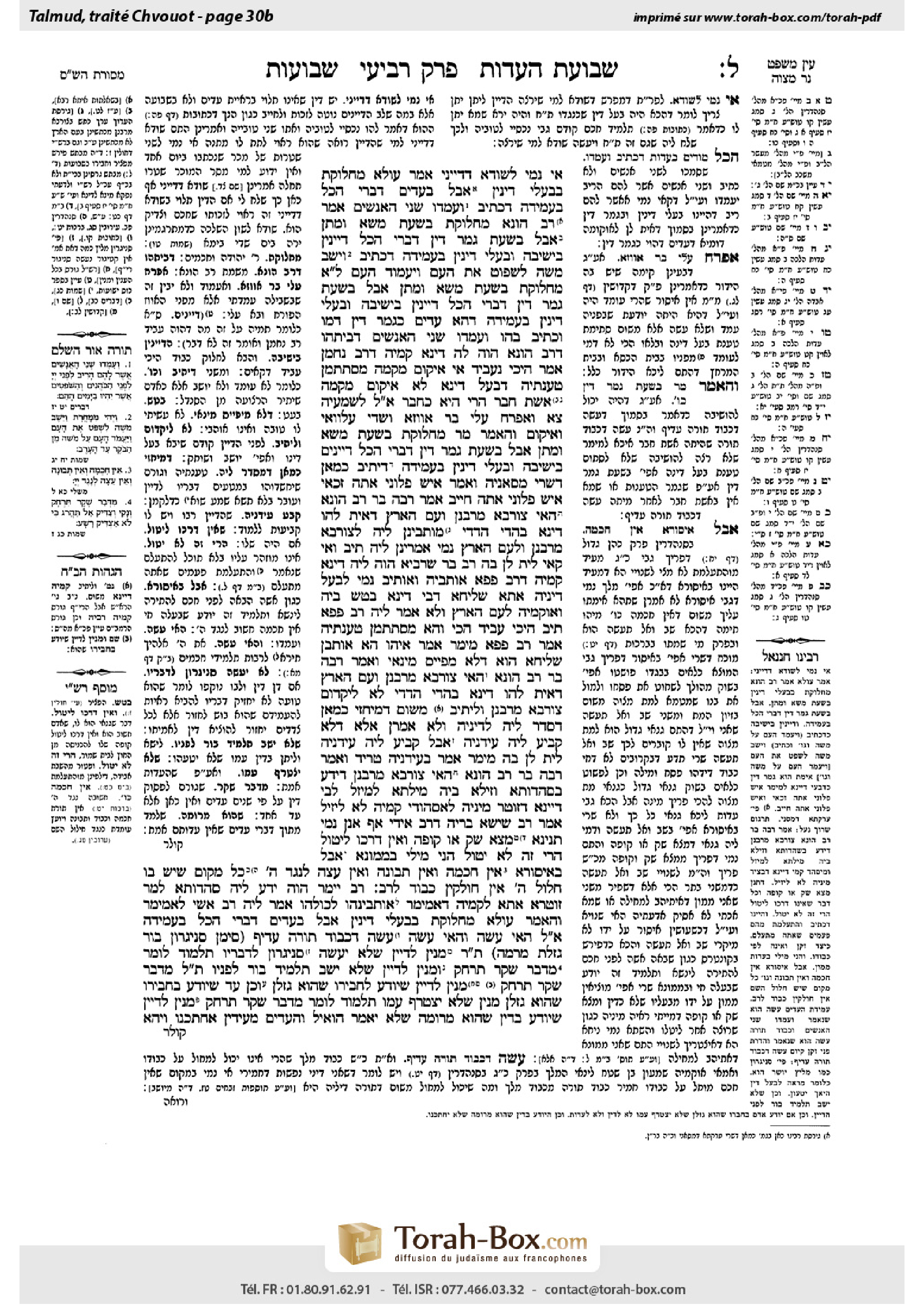
Shevuot 30b: Talmud study for Daf Yomi
Daf Yomi is the daily study of one Talmud folio. Explore 37 tractates with scans, Hebrew text, Sefaria English and AI-generated French translations where annotated.
Passage selection and English or AI-generated French translation are available where the scan has annotations. Daf Study is independent of Torah-Box and Sefaria.
Browse Shevuot · שבועות · All tractatesShevuot 30b text and translations
This page of Shevuot includes the Aramaic text, an English translation and an AI-generated French translation, alongside the scan above.
שבועות ל׳ ב · Aramaic and Hebrew text
אִי נָמֵי לְשׁוּדָא דְּדַיָּינֵי.
אָמַר עוּלָּא: מַחְלוֹקֶת בְּבַעֲלֵי דִינִין; אֲבָל בְּעֵדִים – דִּבְרֵי הַכֹּל בַּעֲמִידָה, דִּכְתִיב: ״וְעָמְדוּ שְׁנֵי הָאֲנָשִׁים״. אָמַר רַב הוּנָא: מַחְלוֹקֶת בִּשְׁעַת מַשָּׂא וּמַתָּן; אֲבָל בִּשְׁעַת גְּמַר דִּין – דִּבְרֵי הַכֹּל דַּיָּינִין בִּישִׁיבָה וּבַעֲלֵי דִינִין בַּעֲמִידָה, דִּכְתִיב: ״וַיָּשֶׁב מֹשֶׁה לִשְׁפֹּט אֶת הָעָם וַיַּעֲמֹד הָעָם״.
לִישָּׁנָא אַחֲרִינָא: מַחְלוֹקֶת בִּשְׁעַת מַשָּׂא וּמַתָּן, אֲבָל בִּשְׁעַת גְּמַר דִּין – דִּבְרֵי הַכֹּל דַּיָּינִין בִּישִׁיבָה וּבַעֲלֵי דִינִין בַּעֲמִידָה; דְּהָא עֵדִים כִּגְמַר דִּין דָּמוּ, וּכְתִיב בְּהוּ: ״וְעָמְדוּ שְׁנֵי הָאֲנָשִׁים״.
דְּבֵיתְהוּ דְּרַב הוּנָא הֲוָה לַהּ דִּינָא קַמֵּיהּ דְּרַב נַחְמָן, אֲמַר: הֵיכִי נַעֲבֵיד? אִי אֵיקוּם מִקַּמַּהּ – מִסְתַּתְּמָן טַעֲנָתֵיהּ דְּבַעַל דִּינָא. לָא אֵיקוּם מִקַּמַּהּ – אֵשֶׁת חָבֵר הֲרֵי הִיא כְּחָבֵר. אֲמַר לֵיהּ לְשַׁמָּעֵיהּ: צֵא וְאַפְרַח עֲלַי בַּר אֲוָוזָא וּשְׁדִי עִלָּוַואי, וְאֵיקוּם.
וְהָאָמַר מָר: מַחְלוֹקֶת בִּשְׁעַת מַשָּׂא וּמַתָּן, אֲבָל בִּשְׁעַת גְּמַר דִּין – דִּבְרֵי הַכֹּל דַּיָּינִים בִּישִׁיבָה וּבַעֲלֵי דִינִין בַּעֲמִידָה! דְּיָתֵיב כְּמַאן דְּשָׁרֵי מְסָאנֵיהּ, וְאָמַר: ״אִישׁ פְּלוֹנִי אַתָּה זַכַּאי״, ״אִישׁ פְּלוֹנִי אַתָּה חַיָּיב״.
אָמַר רַבָּה בַּר רַב הוּנָא: הַאי צוּרְבָּא מֵרַבָּנַן וְעַם הָאָרֶץ דְּאִית לְהוּ דִּינָא בַּהֲדֵי הֲדָדֵי – מוֹתְבִינַן לֵיהּ לְצוּרְבָּא מֵרַבָּנַן, וּלְעַם הָאָרֶץ נָמֵי אָמְרִינַן לֵיהּ ״תִּיב״; וְאִי קָאֵי – לֵית לַן בַּהּ.
רַב בַּר שֵׁרֵבְיָא הֲוָה לֵיהּ דִּינָא קַמֵּיהּ דְּרַב פָּפָּא, אוֹתְבֵיהּ וְאוֹתֵיב נָמֵי לְבַעַל דִּינֵיהּ. אֲתָא שְׁלִיחָא דְּבֵי דִינָא, בְּטַשׁ בֵּיהּ וְאוֹקְמֵיהּ לְעַם הָאָרֶץ, וְלָא אֲמַר לֵיהּ רַב פָּפָּא ״תִּיב״. הֵיכִי עָבֵיד הָכִי? וְהָא מִסְתַּתְּמָן טַעֲנָתֵיהּ! אָמַר רַב פָּפָּא: מֵימָר אָמַר, אִיהוּ הָא אוֹתְבַן, שְׁלִיחָא הוּא דְּלָא מִפַּיַּיס מִינַּאי.
וְאָמַר רַבָּה בַּר רַב הוּנָא: הַאי צוּרְבָּא מֵרַבָּנַן וְעַם הָאָרֶץ דְּאִית לְהוּ דִּינָא בַּהֲדֵי הֲדָדֵי, לָא לִיקְדּוֹם צוּרְבָּא מֵרַבָּנַן וְלִיתֵּיב, מִשּׁוּם דְּמִיחֲזֵי כְּמַאן דְּסָדַר לֵיהּ לְדִינֵיהּ. וְלָא אֲמַרַן אֶלָּא דְּלָא קְבִיעַ לֵיהּ עִידָּנֵיהּ, אֲבָל קְבִיעַ לֵיהּ עִידָּנֵיהּ – לֵית לַן בַּהּ; מֵימָר אָמַר: בְּעִידָּנֵיהּ טְרִיד.
וְאָמַר רַבָּה בַּר רַב הוּנָא: הַאי צוּרְבָּא מֵרַבָּנַן דְּיָדַע בְּסָהֲדוּתָא, וְזִילָא בֵּיהּ מִילְּתָא לְמֵיזַל לְבֵי דַיָּינָא דְּזוּטַר מִינֵּיהּ לְאַסְהוֹדֵי קַמֵּיהּ – לָא לֵיזִיל. אָמַר רַב שִׁישָׁא בְּרֵיהּ דְּרַב אִידִי, אַף אֲנַן נָמֵי תְּנֵינָא: מָצָא שַׂק אוֹ קוּפָּה וְאֵין דַּרְכּוֹ לִיטּוֹל – הֲרֵי זֶה לֹא יִטּוֹל.
הָנֵי מִילֵּי בְּמָמוֹנָא, אֲבָל בְּאִיסּוּרָא – ״אֵין חׇכְמָה וְאֵין תְּבוּנָה וְאֵין עֵצָה לְנֶגֶד ה׳״; כׇּל מָקוֹם שֶׁיֵּשׁ בּוֹ חִלּוּל ה׳ – אֵין חוֹלְקִין כָּבוֹד לְרַב.
רַב יֵימַר הֲוָה יָדַע לֵיהּ סָהֲדוּתָא לְמָר זוּטְרָא. אֲתָא לְקַמֵּיהּ דְּאַמֵּימָר, אוֹתְבִינְהוּ לְכוּלְּהוּ. אֲמַר לֵיהּ רַב אָשֵׁי לְאַמֵּימָר, וְהָאָמַר עוּלָּא: מַחְלוֹקֶת בְּבַעֲלֵי דִינִין, אֲבָל בְּעֵדִים – דִּבְרֵי הַכֹּל בַּעֲמִידָה! אֲמַר לֵיהּ: הַאי עֲשֵׂה וְהַאי עֲשֵׂה, וַעֲשֵׂה דִּכְבוֹד תּוֹרָה עָדִיף.
(סִימָן: סָנֵיגָרוֹן, בּוּר, גְּזֵלַת, מִרְמָה)
תָּנוּ רַבָּנַן: מִנַּיִן לַדַּיָּין שֶׁלֹּא יַעֲשֶׂה סָנִיגָרוֹן לִדְבָרָיו? תַּלְמוּד לוֹמַר: ״מִדְּבַר שֶׁקֶר תִּרְחָק״. וּמִנַּיִן לַדַּיָּין שֶׁלֹּא יֵשֵׁב תַּלְמִיד בּוּר לְפָנָיו? תַּלְמוּד לוֹמַר: ״מִדְּבַר שֶׁקֶר תִּרְחָק״.
מִנַּיִן לַדַּיָּין שֶׁיּוֹדֵעַ לַחֲבֵירוֹ שֶׁהוּא גַּזְלָן, וְכֵן עֵד שֶׁיּוֹדֵעַ בַּחֲבֵירוֹ שֶׁהוּא גַּזְלָן – מִנַּיִן שֶׁלֹּא יִצְטָרֵף עִמּוֹ? תַּלְמוּד לוֹמַר: ״מִדְּבַר שֶׁקֶר תִּרְחָק״.
מִנַּיִן לַדַּיָּין שֶׁיּוֹדֵעַ בַּדִּין שֶׁהוּא מְרוּמֶּה, שֶׁלֹּא יֹאמַר: הוֹאִיל וְהָעֵדִים מְעִידִין – אֶחְתְּכֶנּוּ, וִיהֵא
Shevuot 30b · English translation
Alternatively, Rav Yosef informed me that Rav Ulla is a Torah scholar with regard to circumstances where the ruling is not clear-cut and the decision is rendered based on the discretion of the judges, that is, when the court is unable to rule solely based on the testimony presented in court and the judges arrive at their ruling based on their sense of the matter. Rav Yosef informed Rav Naḥman that if the case is decided based on judicial discretion, Rav Ulla is worthy of having the decision ruled in his favor.
§ Ulla says: The dispute between the Rabbis and Rabbi Yehuda with regard to the obligation to stand in court is only with regard to the litigants; but with regard to the witnesses, everyone agrees that they testify while standing, as it is written: “Then the two men shall stand” (Deuteronomy 19:17). Rav Huna says: The dispute whether the litigants are required to stand is only at the time of the deliberation, but at the time of the verdict, everyone agrees that the judges issue the verdict while sitting and the litigants receive the verdict while standing, as it is written: “And Moses sat to judge the people and the people stood” (Exodus 18:13).
The Gemara presents an alternative version of the statement of Rav Huna: The dispute whether the litigants are required to stand is only at the time of the deliberation, but at the time of the verdict, everyone agrees that the judges issue the verdict while sitting and the litigants receive the verdict while standing, as concerning the witnesses, the status of the stage of their testimony is like that of the stage of the verdict, and it is written concerning them: “Then the two men shall stand.”
The Gemara relates: The wife of Rav Huna had a trial pending before Rav Naḥman. Rav Naḥman said: What should we do? If I will arise before her in deference to her status as the wife of a Torah scholar, the claims of the other litigant will be suppressed, as it will be mistaken as a display of preference for the wife of Rav Huna, since not everyone is aware that one is required to show deference to the wife of a Torah scholar. If I will not arise before her, that would run counter to the principle that in terms of deference, the status of the wife of a ḥaver is like that of a ḥaver, who is devoted to the meticulous observance of mitzvot. Rav Naḥman said to his attendant: Go outside and cause a duck to fly and cast it onto me, and in that way I will be forced to arise in a manner that will fulfill the obligation to rise, without intimidating the other litigant.
The Gemara asks: But doesn’t the Master, Rav Huna, say: The dispute between Rabbi Yehuda and the Rabbis whether the litigants are required to stand is only at the time of the deliberation, but at the time of the verdict, everyone agrees that the judges issue the verdict while sitting and the litigants receive the verdict while standing? How, then, can Rav Naḥman rise? The Gemara responds: One may fulfill both requirements in a case where he sits like one who unties his shoe, neither completely standing nor completely sitting, and says his verdict: So-and-so, you are innocent, and so-and-so, you are guilty.
§ Rabba bar Rav Huna says: In this situation where a Torah scholar [tzurva merabbanan] and an am ha’aretz have a court case with one another, we seat the Torah scholar, and to the am ha’aretz we also say: Sit. And if he chooses to stand due to deference, we have no problem with it.
The Gemara relates: Rav bar Sherevya had a trial pending before Rav Pappa. Rav Pappa seated him and also seated his litigant counterpart, who was an am ha’aretz. An agent of the court came and kicked and stood the am ha’aretz on his feet to show deference to the Torah scholars there, and Rav Pappa did not say to him: Sit. The Gemara asks: How did Rav Pappa act in that manner by not instructing the am ha’aretz to sit again? But aren’t the claims of the am ha’aretz suppressed by Rav Pappa’s perceived preferential treatment of Rav bar Sherevya? The Gemara responds: Rav Pappa said to himself that the litigant will not perceive bias, as he says: The judge seated me; it is the agent of the court who is displeased with me and compelled me to stand.
And Rabba bar Rav Huna says: In this situation where a Torah scholar and an am ha’aretz have a court case with one another, let the Torah scholar not come to court early and sit with the judge in order to learn from him, due to the fact that by doing so he appears as one who is consulting the judge to arrange his legal claims, and that is prohibited. And we said this only in a case where there is not a fixed time for the Torah scholar to study with the judge at that hour; but if there is a fixed time for him to study with the judge at that hour, we have no problem with it, as the other litigant will say: He is occupied with his fixed study time, and the fact that he sat before the judge is unrelated to the case.
§ And Rabba bar Rav Huna says: In the case of a certain Torah scholar who knows testimony relevant to a certain individual, but it is a demeaning matter for him to go to the court consisting of a judge who is less prominent than he in order to testify before him, let him not go and testify. Rav Sheisha, son of Rav Idi, said: We learn that halakha in a mishna (Bava Metzia 29b) as well: If one found a sack or a basket, and it is not his typical manner to take it, he shall not take it in order to return it to its owner. Evidently, a Torah scholar may refrain from performing the mitzva to return a lost item (see Deuteronomy 22:1–3) if it is not in keeping with his stature.
The Gemara notes: This matter applies only with regard to cases involving monetary matters; but in cases involving ritual matters, the dignity of the Torah scholar is not a consideration, as it is written: “There is neither wisdom nor understanding nor counsel against the Lord” (Proverbs 21:30), from which it is derived: Wherever there is desecration of the name of the Lord, one does not show deference to the teacher. Rather, the Torah scholar forgoes the honor due him in order to avoid violation of any prohibition that would desecrate the name of God.
The Gemara relates: Rav Yeimar knew testimony relevant to the case of Mar Zutra. He came before Ameimar, who seated all the witnesses in deference to Rav Yeimar. Rav Ashi said to Ameimar: But doesn’t Ulla say that the dispute between the Rabbis and Rabbi Yehuda with regard to the obligation to stand in court is only with regard to the litigants, but with regard to the witnesses, everyone agrees that they testify while standing? Ameimar said to him: This, i.e., witnesses standing during testimony, is a positive mitzva, and that, i.e., treating Torah scholars with deference and allowing Rav Yeimar to sit, is a positive mitzva, and the positive mitzva of deference to the Torah takes precedence. Ameimar seated Rav Yeimar in deference to the Torah. In order to prevent a miscarriage of justice, he seated all the witnesses.
§ The Gemara provides a mnemonic for the ensuing discussion: Advocacy, ignoramus, robbery, fraud.
The Sages taught: From where is it derived that a judge should not engage in advocacy [saneigeron] for his own statements and devise various pretexts to justify his erroneous rulings? It is derived as the verse states: “Distance yourself from a false matter” (Exodus 23:7). And from where is it derived with regard to a judge that a student who is an ignoramus should not sit before him to discuss the proceedings? It is derived as the verse states: “Distance yourself from a false matter.” When an ignorant student engages in the proceedings, he is apt to cause the judge to err in judgment.
From where is it derived that a judge who knows that another judge is a robber and is disqualified from serving as a judge; and likewise, a witness who knows that another witness is a robber and is disqualified from serving as a witness; from where is it derived that he should not join him in judgment or testimony? It is derived as the verse states: “Distance yourself from a false matter.”
From where is it derived that in a case where a judge who knows that the witnesses testifying before him are lying even though he is unable to prove it through their cross-examination and with regard to the verdict the result will be that it is fraudulent, that he should not say: Since the witnesses are testifying and I cannot prove their deceit, I will decide the case based on their testimony, and let
Shevuot 30b · Traduction française (IA)
Autre explication : Rav Yossef m’a appris que Rav Oula est un érudit de la Torah dans les cas où la décision n’est pas évidente et doit être rendue selon le discernement des juges, c’est-à-dire lorsque le tribunal ne peut pas statuer uniquement sur la base des témoignages présentés devant lui et que les juges tranchent selon leur appréciation de l’affaire. Rav Yossef fit savoir à Rav Naḥman que, si l’affaire était tranchée selon le discernement des juges, Rav Oula méritait que la décision soit rendue en sa faveur.
§ Oula dit : La controverse entre les Rabbins et Rabbi Yehouda au sujet de l’obligation de se tenir debout au tribunal ne concerne que les plaideurs ; mais, pour les témoins, tous conviennent qu’ils déposent debout, comme il est écrit : « Alors les deux hommes se tiendront debout » (Deutéronome 19:17). Rav Houna dit : La controverse sur l’obligation des plaideurs de se tenir debout ne concerne que le moment des délibérations ; au moment du prononcé du jugement, en revanche, tous conviennent que les juges rendent leur décision assis et que les plaideurs la reçoivent debout, comme il est écrit : « Moïse s’assit pour juger le peuple, et le peuple se tenait debout » (Exode 18:13).
La Guemara présente une autre version de la déclaration de Rav Houna : La controverse sur l’obligation des plaideurs de se tenir debout ne concerne que le moment des délibérations ; au moment du prononcé du jugement, en revanche, tous conviennent que les juges rendent leur décision assis et que les plaideurs la reçoivent debout. En effet, le stade du témoignage des témoins est comparable à celui du prononcé du jugement, et il est écrit à leur sujet : « Alors les deux hommes se tiendront debout. »
La Guemara rapporte : L’épouse de Rav Houna avait une affaire en instance devant Rav Naḥman. Rav Naḥman dit : Que faire ? Si je me lève devant elle par égard pour son statut d’épouse d’un érudit de la Torah, les arguments de l’autre plaideur seront étouffés, car on pourrait prendre cela pour une marque de faveur envers l’épouse de Rav Houna, puisque tout le monde ne sait pas qu’il faut témoigner de la déférence à l’épouse d’un érudit de la Torah. Si je ne me lève pas devant elle, j’agirai à l’encontre du principe selon lequel, en matière de déférence, l’épouse d’un ḥaver a le même statut qu’un ḥaver, qui s’attache à observer les mitsvot avec minutie. Rav Naḥman dit à son serviteur : Va dehors, fais s’envoler un canard et jette-le sur moi ; ainsi, je serai contraint de me lever de façon à m’acquitter de l’obligation de me lever, sans intimider l’autre plaideur.
La Guemara demande : Mais le Maître, Rav Houna, ne dit-il pas que la controverse entre Rabbi Yehouda et les Rabbins sur l’obligation des plaideurs de se tenir debout ne concerne que le moment des délibérations, tandis qu’au moment du prononcé du jugement, tous conviennent que les juges rendent leur décision assis et que les plaideurs la reçoivent debout ? Comment Rav Naḥman peut-il donc se lever ? La Guemara répond : Il est possible de satisfaire aux deux exigences dans un cas où le juge s’assied comme quelqu’un qui délace sa chaussure, ni tout à fait debout ni tout à fait assis, et prononce son verdict : « Untel, tu es innocent, et untel, tu es coupable. »
§ Rabba bar Rav Houna dit : Dans le cas où un érudit de la Torah [tzurva merabbanan] et un am ha’aretz ont une affaire l’un contre l’autre au tribunal, on fait asseoir l’érudit de la Torah et l’on dit également à l’am ha’aretz : « Assieds-toi. » S’il choisit de rester debout par déférence, cela ne pose aucun problème.
La Guemara rapporte : Rav bar Sherevya avait une affaire en instance devant Rav Pappa. Rav Pappa le fit asseoir, ainsi que son adversaire, qui était un am ha’aretz. Un agent du tribunal vint, donna un coup de pied à l’am ha’aretz et le fit se lever, afin de témoigner de la déférence aux érudits de la Torah présents ; Rav Pappa ne lui dit pas de se rasseoir. La Guemara demande : Comment Rav Pappa a-t-il pu agir ainsi sans donner à nouveau à l’am ha’aretz l’ordre de s’asseoir ? Les arguments de l’am ha’aretz ne sont-ils pas étouffés par le traitement apparemment préférentiel que Rav Pappa réserve à Rav bar Sherevya ? La Guemara répond : Rav Pappa se dit que le plaideur ne soupçonnerait pas de partialité, car il se dirait : « Le juge m’a fait asseoir ; c’est l’agent du tribunal qui est mécontent de moi et m’a contraint à me lever. »
Rabba bar Rav Houna dit également : Lorsqu’un érudit de la Torah et un am ha’aretz ont une affaire l’un contre l’autre au tribunal, que l’érudit de la Torah ne se présente pas tôt au tribunal pour s’asseoir auprès du juge et apprendre de lui, car il donnerait ainsi l’impression de consulter le juge afin de préparer ses arguments juridiques, ce qui est interdit. Cela ne s’applique que s’il n’a pas d’horaire fixe pour étudier avec le juge à cette heure-là ; mais s’il a un horaire fixe pour étudier avec le juge à cette heure-là, cela ne pose aucun problème, car l’autre plaideur se dira : « Il est occupé par son étude habituelle », et le fait qu’il soit assis auprès du juge n’a aucun rapport avec l’affaire.
§ Rabba bar Rav Houna dit également : Dans le cas d’un érudit de la Torah qui connaît un témoignage pertinent pour une personne donnée, mais qui trouverait dégradant de se présenter devant un tribunal présidé par un juge moins éminent que lui pour témoigner, qu’il ne s’y rende pas pour déposer. Rav Sheisha, fils de Rav Idi, dit : Nous apprenons aussi cette halakha dans une Michna (Bava Metzia 29b) : si quelqu’un trouve un sac ou un panier, mais que ce n’est pas son usage de le prendre, qu’il ne le prenne pas pour le rendre à son propriétaire. Il ressort de là qu’un érudit de la Torah peut s’abstenir d’accomplir la mitsva de restituer un objet perdu (voir Deutéronome 22:1–3) si cela n’est pas conforme à son rang.
La Guemara précise : Cette règle ne s’applique qu’aux affaires pécuniaires ; dans les affaires rituelles, en revanche, la dignité de l’érudit de la Torah n’entre pas en considération, comme il est écrit : « Il n’y a ni sagesse, ni intelligence, ni conseil contre le Seigneur » (Proverbes 21:30). On en déduit que, partout où le nom du Seigneur est profané, on ne témoigne pas de déférence au maître. L’érudit de la Torah renonce plutôt à l’honneur qui lui est dû afin d’éviter toute transgression d’une interdiction qui profanerait le nom de Dieu.
La Guemara rapporte : Rav Yeimar connaissait un témoignage pertinent pour l’affaire de Mar Zutra. Il se présenta devant Ameimar, qui fit asseoir tous les témoins par égard pour Rav Yeimar. Rav Ashi dit à Ameimar : Mais Oula ne dit-il pas que la controverse entre les Rabbins et Rabbi Yehouda au sujet de l’obligation de se tenir debout au tribunal ne concerne que les plaideurs, tandis que, pour les témoins, tous conviennent qu’ils déposent debout ? Ameimar lui répondit : Ceci, c’est-à-dire le fait que les témoins se tiennent debout pendant leur déposition, est une mitsva positive ; cela, c’est-à-dire traiter les érudits de la Torah avec déférence et permettre à Rav Yeimar de s’asseoir, est également une mitsva positive ; or la mitsva positive de déférence envers la Torah a priorité. Ameimar fit asseoir Rav Yeimar par déférence pour la Torah. Afin d’éviter une erreur judiciaire, il fit asseoir tous les témoins.
§ La Guemara donne un moyen mnémotechnique pour la discussion qui suit : plaidoirie, ignorant, vol, fraude.
Les Sages ont enseigné : D’où déduit-on qu’un juge ne doit pas plaider [saneigeron] en faveur de ses propres déclarations et inventer divers prétextes pour justifier ses décisions erronées ? On le déduit du verset : « Tiens-toi éloigné d’une affaire mensongère » (Exode 23:7). Et d’où déduit-on qu’un élève ignorant ne doit pas siéger devant un juge pour discuter de la procédure ? On le déduit du verset : « Tiens-toi éloigné d’une affaire mensongère. » Lorsqu’un élève ignorant intervient dans la procédure, il risque d’induire le juge en erreur.
D’où déduit-on qu’un juge qui sait qu’un autre juge est un voleur et, par conséquent, inapte à exercer comme juge, ou qu’un témoin qui sait qu’un autre témoin est un voleur et, par conséquent, inapte à témoigner, ne doit pas s’associer à lui pour rendre un jugement ou témoigner ? On le déduit du verset : « Tiens-toi éloigné d’une affaire mensongère. »
D’où déduit-on que, dans le cas où un juge sait que les témoins qui déposent devant lui mentent, bien qu’il ne puisse pas le prouver par leur contre-interrogatoire et que le verdict qui en résulterait serait frauduleux, il ne doit pas se dire : « Puisque les témoins déposent et que je ne peux pas prouver leur mensonge, je trancherai l’affaire sur la base de leur témoignage, et que… »
Traduction française générée par IA à partir de l’édition anglaise de Sefaria. Vérifie toujours un passage avec le texte source.
Text from Sefaria: William Davidson Edition - Vocalized Aramaic (CC BY NC); William Davidson Edition - English (CC BY NC).