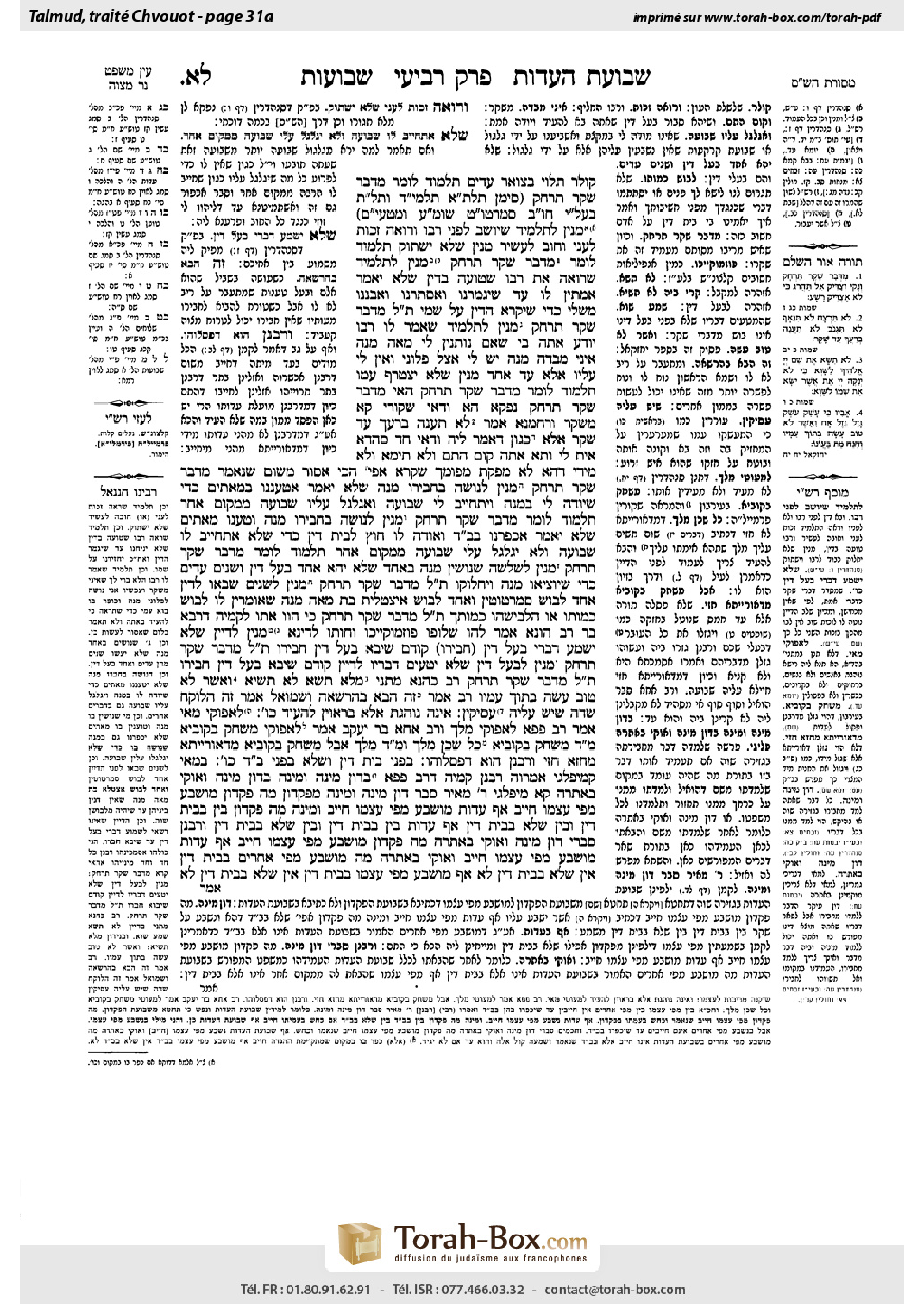
Shevuot 31a: Talmud study for Daf Yomi
Daf Yomi is the daily study of one Talmud folio. Explore 37 tractates with scans, Hebrew text, Sefaria English and AI-generated French translations where annotated.
Passage selection and English or AI-generated French translation are available where the scan has annotations. Daf Study is independent of Torah-Box and Sefaria.
Browse Shevuot · שבועות · All tractatesShevuot 31a text and translations
This page of Shevuot includes the Aramaic text, an English translation and an AI-generated French translation, alongside the scan above.
שבועות ל״א א · Aramaic and Hebrew text
קוֹלָר תָּלוּי בְּצַוַּאר עֵדִים? תַּלְמוּד לוֹמַר: ״מִדְּבַר שֶׁקֶר תִּרְחַק״.
(סִימָן: תְּלָתָא תַּלְמִיד, וּתְלָת בַּעֲלֵי חוֹב, סְמַרְטוּט שׁוֹמֵעַ וּמַטְעִים)
מִנַּיִן לְתַלְמִיד שֶׁיּוֹשֵׁב לִפְנֵי רַבּוֹ וְרוֹאֶה זְכוּת לֶעָנִי וְחוֹב לֶעָשִׁיר – מִנַּיִן שֶׁלֹּא יִשְׁתּוֹק? תַּלְמוּד לוֹמַר: ״מִדְּבַר שֶׁקֶר תִּרְחָק״.
מִנַּיִן לְתַלְמִיד שֶׁרוֹאֶה אֶת רַבּוֹ שֶׁטּוֹעֶה בַּדִּין, שֶׁלֹּא יֹאמַר: אַמְתִּין לוֹ עַד שֶׁיִּגְמְרֶנּוּ; וְאֶסְתְּרֶנּוּ וְאֶבְנֶנּוּ מִשֶּׁלִּי, כְּדֵי שֶׁיִּקָּרֵא הַדִּין עַל שְׁמִי? תַּלְמוּד לוֹמַר: ״מִדְּבַר שֶׁקֶר תִּרְחָק״.
מִנַּיִן לְתַלְמִיד שֶׁאָמַר לוֹ רַבּוֹ: יוֹדֵעַ אַתָּה בִּי שֶׁאִם נוֹתְנִין לִי מֵאָה מָנֶה אֵינִי מְבַדֶּה; מָנֶה יֵשׁ לִי אֵצֶל פְּלוֹנִי, וְאֵין לִי עָלָיו אֶלָּא עֵד אֶחָד – מִנַּיִן שֶׁלֹּא יִצְטָרֵף עִמּוֹ? תַּלְמוּד לוֹמַר: ״מִדְּבַר שֶׁקֶר תִּרְחָק״.
הַאי מִ״דְּבַר שֶׁקֶר תִּרְחָק״ נָפְקָא?! הָא וַדַּאי שַׁקּוֹרֵי קָא מְשַׁקֵּר, וְרַחֲמָנָא אָמַר: ״לֹא תַעֲנֶה בְרֵעֲךָ עֵד שָׁקֶר״! אֶלָּא כְּגוֹן דַּאֲמַר לֵיהּ: וַדַּאי חַד סָהֲדָא אִית לִי, וְתָא אַתָּה קוּם הָתָם וְלָא תֵּימָא וְלָא מִידֵּי, דְּהָא לָא מַפְּקַתְּ מִפּוּמָּךְ שִׁקְרָא – אֲפִילּוּ הָכִי אָסוּר, מִשּׁוּם שֶׁנֶּאֱמַר: ״מִדְּבַר שֶׁקֶר תִּרְחָק״.
מִנַּיִן לַנּוֹשֶׁה בַּחֲבֵירוֹ מָנֶה, שֶׁלֹּא יֹאמַר: אֶטְעָנֶנּוּ בְּמָאתַיִם – כְּדֵי שֶׁיּוֹדֶה לִי בְּמָנֶה, וְיִתְחַיֵּיב לִי שְׁבוּעָה, וַאֲגַלְגֵּל עָלָיו שְׁבוּעָה מִמָּקוֹם אַחֵר? תַּלְמוּד לוֹמַר: ״מִדְּבַר שֶׁקֶר תִּרְחָק״.
מִנַּיִן לַנּוֹשֶׁה בַּחֲבֵירוֹ מָנֶה וּטְעָנוֹ מָאתַיִם, שֶׁלֹּא יֹאמַר: אֶכְפְּרֶנּוּ בְּבֵית דִּין וְאוֹדֶה לוֹ חוּץ לְבֵית דִּין, כְּדֵי שֶׁלֹּא אֶתְחַיֵּיב לוֹ שְׁבוּעָה וְלֹא יְגַלְגֵּל עָלַי שְׁבוּעָה מִמָּקוֹם אַחֵר? תַּלְמוּד לוֹמַר: ״מִדְּבַר שֶׁקֶר תִּרְחָק״.
מִנַּיִן לִשְׁלֹשָׁה שֶׁנּוֹשִׁין מָנֶה בְּאֶחָד, שֶׁלֹּא יְהֵא אֶחָד בַּעַל דִּין וּשְׁנַיִם עֵדִים, כְּדֵי שֶׁיּוֹצִיאוּ מָנֶה וְיַחְלוֹקוּ? תַּלְמוּד לוֹמַר: ״מִדְּבַר שֶׁקֶר תִּרְחָק״.
מִנַּיִן לִשְׁנַיִם שֶׁבָּאוּ לַדִּין, אֶחָד לָבוּשׁ סְמַרְטוּטִין וְאֶחָד לָבוּשׁ אִיצְטְלִית בַּת מֵאָה מָנֶה, שֶׁאוֹמְרִין לוֹ: לְבוֹשׁ כְּמוֹתוֹ אוֹ הַלְבִּישֵׁהוּ כְּמוֹתְךָ? תַּלְמוּד לוֹמַר: ״מִדְּבַר שֶׁקֶר תִּרְחָק״. כִּי הֲווֹ אָתוּ לְקַמֵּיהּ דְּרָבָא בַּר רַב הוּנָא, אֲמַר לְהוּ: שְׁלוּפוּ פּוּזְמוּקַיְיכוּ וְחוּתוּ לְדִינָא.
מִנַּיִן לְדַיָּין שֶׁלֹּא יִשְׁמַע דִּבְרֵי בַּעַל דִּין (חֲבֵירוֹ) קוֹדֶם שֶׁיָּבֹא בַּעַל דִּין חֲבֵירוֹ? תַּלְמוּד לוֹמַר: ״מִדְּבַר שֶׁקֶר תִּרְחָק״.
מִנַּיִן לְבַעַל דִּין שֶׁלֹּא יַטְעִים דְּבָרָיו לַדַּיָּין קוֹדֶם שֶׁיָּבֹא בַּעַל דִּין חֲבֵירוֹ? תַּלְמוּד לוֹמַר: ״מִדְּבַר שֶׁקֶר תִּרְחָק״. רַב כָּהֲנָא מַתְנֵי מִ״לֹּא תִשָּׂא״ – ״לֹא תַשִּׂיא״.
״וַאֲשֶׁר לֹא טוֹב עָשָׂה בְּתוֹךְ עַמָּיו״ – רַב אָמַר: זֶה הַבָּא בְּהַרְשָׁאָה, וּשְׁמוּאֵל אָמַר: זֶה הַלּוֹקֵחַ שָׂדֶה שֶׁיֵּשׁ עָלֶיהָ עֲסִיקִין.
אֵינָהּ נוֹהֶגֶת אֶלָּא בִּרְאוּיִן לְהָעִיד כּוּ׳. לְאַפּוֹקֵי מַאי? אָמַר רַב פָּפָּא: לְאַפּוֹקֵי מֶלֶךְ. וְרַב אַחָא בַּר יַעֲקֹב אָמַר: לְאַפּוֹקֵי מְשַׂחֵק בְּקוּבְיָא.
מַאן דְּאָמַר מְשַׂחֵק בְּקוּבְיָא – כׇּל שֶׁכֵּן מֶלֶךְ; וּמַאן דְּאָמַר מֶלֶךְ – אֲבָל מְשַׂחֵק בְּקוּבְיָא, מִדְּאוֹרָיְיתָא מִחְזָא חֲזֵי, וְרַבָּנַן הוּא דְּפַסְלוּהוּ.
בִּפְנֵי בֵּית דִּין וְשֶׁלֹּא בִּפְנֵי בֵּית דִּין כּוּ׳. בְּמַאי קָמִיפַּלְגִי?
אַמְרוּהָ רַבָּנַן קַמֵּיהּ דְּרַב פָּפָּא: בְּדוּן מִינַּהּ וּמִינַּהּ – בְּדוּן מִינַּהּ וְאוֹקֵי בְאַתְרַהּ קָא מִיפַּלְגִי.
רַבִּי מֵאִיר סָבַר: דּוּן מִינַּהּ וּמִינַּהּ מִפִּקָּדוֹן; מָה פִּקָּדוֹן – מוּשְׁבָּע מִפִּי עַצְמוֹ חַיָּיב, אַף עֵדוּת – מוּשְׁבָּע מִפִּי עַצְמוֹ חַיָּיב, וּמִינַּהּ, מָה פִּקָּדוֹן – בֵּין בְּבֵית דִּין וּבֵין שֶׁלֹּא בְּבֵית דִּין, אַף עֵדוּת – בֵּין בְּבֵית דִּין וּבֵין שֶׁלֹּא בְּבֵית דִּין.
וְרַבָּנַן סָבְרִי: דּוּן מִינַּהּ וְאוֹקֵי בְּאַתְרַהּ; מָה פִּקָּדוֹן – מוּשְׁבָּע מִפִּי עַצְמוֹ חַיָּיב, אַף עֵדוּת – מוּשְׁבָּע מִפִּי עַצְמוֹ חַיָּיב. וְאוֹקֵי בְּאַתְרַהּ: מָה מוּשְׁבָּע מִפִּי אֲחֵרִים – בְּבֵית דִּין אִין, שֶׁלֹּא בְּבֵית דִּין לָא; אַף מוּשְׁבָּע מִפִּי עַצְמוֹ – בְּבֵית דִּין אִין, שֶׁלֹּא בְּבֵית דִּין לָא.
Shevuot 31a · English translation
the chain [kolar] of culpability for the miscarriage of justice be placed around the neck of the false witnesses? It is derived as the verse states: “Distance yourself from a false matter.”
The Gemara provides a mnemonic for additional halakhot derived from the verse: “Distance yourself from a false matter.” Three relating to a student; and three relating to creditors; and three relating to a judge: Rags, hears, and explain.
From where is it derived with regard to a student who is sitting before his teacher and sees a claim that provides advantage for a poor person and disadvantage for a wealthy person that he shall not remain silent? It is derived as the verse states: “Distance yourself from a false matter.”
From where is it derived with regard to a student who sees his teacher who is erring in judgment that he shall not say: I will wait for my teacher until he concludes the trial and then I will contradict him and construct a ruling of my own so that the verdict will be attributed to my name? It is derived as the verse states: “Distance yourself from a false matter.”
From where is it derived with regard to a student whose teacher said to him: You know concerning me that even if one were to give me one hundred times one hundred dinars, I would not fabricate a claim. Now, I have one hundred dinars in the possession of so-and-so, to whom I lent money, but I have only one witness of the two required to testify about the loan and enable me to collect payment; from where is it derived that the student shall not join with the other witness and testify? It is derived as the verse states: “Distance yourself from a false matter” (Exodus 23:7).
The Gemara asks: Is it from the verse “Distance yourself from a false matter” that this matter is derived? But isn’t he certainly lying in that case, and this is already stated, as the Merciful One states: “You shall not bear false witness against your neighbor” (Exodus 20:13)? Rather, the reference is to a case where the teacher said to him: It is certain that I have one witness, and you come and stand there beside him and do not say anything, as in that manner you do not express a lie from your mouth. Your silent presence will create the impression that I have two witnesses and lead the debtor to admit his debt. Even so, it is prohibited to do this, due to that which is stated: “Distance yourself from a false matter.”
There are three halakhot with regard to a creditor: From where is it derived with regard to one who is seeking repayment from another of a debt of one hundred dinars, and there are no witnesses to that effect, that he shall not say: I will claim that he owes me two hundred dinars so that he will admit that he owes me one hundred dinars, and he will become liable to take an oath to me, the oath of one who admits to part of a claim, and on that basis I will extend the oath and compel him to take an oath with regard to a debt that he owes me from another place? It is derived as the verse states: “Distance yourself from a false matter.”
From where is it derived with regard to one who is seeking repayment from another of a debt of one hundred dinars and claims that the debtor owes him two hundred dinars, that the debtor shall not say: I will completely deny his claim in court, and I will admit to him outside court so that I will not become liable to take an oath to him and he will not extend the oath and compel me to take an oath with regard to a debt that I owe him from another place? It is derived as the verse states: “Distance yourself from a false matter.”
From where is it derived with regard to three who are seeking repayment from one individual for a total of one hundred dinars, that one of the three should not assume the role of a sole litigant and claim one hundred dinars, and the other two will assume the role of witnesses so that they will exact payment of one hundred dinars from the debtor and divide it among them? It is derived as the verse states: “Distance yourself from a false matter.”
There are three halakhot with regard to a judge: From where is it derived with regard to two individuals who came to judgment, one dressed in rags and one dressed in a garment worth one hundred times one hundred dinars, that the judges say to the wealthy person: Dress like the poor person or dress the poor person in a garment like yours? It is derived as the verse states: “Distance yourself from a false matter.” The Gemara relates: When individuals would come before Rava bar Rav Huna for judgment he would say to them: Remove your fine shoes [puzmukaikhu] and descend for judgment, so you will not appear more distinguished than the other litigant.
From where is it derived that a judge should not hear the statement of one litigant before the other litigant comes to court? It is derived as the verse states: “Distance yourself from a false matter.”
From where is it derived that a litigant shall not explain the rationale behind his statements to the judge before the other litigant comes to court? It is derived as the verse states: “Distance yourself from a false matter.” Rav Kahana teaches that this halakha is derived from that which is written: “You shall not accept [lo tissa] a false report” (Exodus 23:1), which he interprets as though it is written: You shall not cause others [lo tassi] to accept a false report.
The verse states: “And did that which is not good among his people” (Ezekiel 18:18). Rav says: This is referring to one who comes to court with authorization to present claims on behalf of another. And Shmuel says: This is referring to one who purchases a field concerning which there are those who contest ownership of it, as in that way, he involves himself in the disputes of others.
§ The mishna teaches that the oath of testimony is practiced only with regard to those fit to testify. The Gemara asks: This statement serves to exclude what person not allowed to testify who was not mentioned explicitly in the mishna? Rav Pappa said: It serves to exclude a king who, although he is neither a relative nor otherwise disqualified from testifying, does not testify in court. And Rav Aḥa bar Ya’akov said: It serves to exclude one who plays with dice, who is disqualified as a witness by rabbinic law.
The Gemara notes: According to the one who says that the mishna excludes one who plays with dice from the oath of testimony, all the more so should a king be excluded, as he does not testify by Torah law. And according to the one who says that the mishna excludes a king from the oath of testimony, it may exclude only a king, but perhaps one who plays with dice is not excluded, as by Torah law he is fit to testify and it is the Sages who disqualified him. Therefore, he is not excluded from the oath of testimony, which is by Torah law.
§ The mishna teaches: The oath of testimony is practiced both in the presence of the court and not in the presence of the court, when the potential witness takes the oath on his own. And if the oath is administered by others he is liable only when he denies, in court, any knowledge of the incident in question. This is the statement of Rabbi Meir. And the Rabbis say: Whether the witness takes the oath on his own or whether the oath is administered by others, he is liable only when he denies, in court, any knowledge of the incident in question. The Gemara asks: With regard to what do they disagree?
The Sages said the explanation before Rav Pappa: They disagree with regard to the method of derivation by means of a verbal analogy. Is the method to infer the halakha from the source of the verbal analogy and derive the details from that source as well, or is the method to infer the halakha from it but interpret the halakha according to its own place?
The Gemara elaborates: Rabbi Meir holds: Infer from it and derive the details from it. The halakha of the oath of testimony is derived from the halakha of an oath on a deposit: Just as in the case of the oath on a deposit, one who takes the oath on his own is liable, so too in the case of the oath of testimony, one who takes the oath on his own is liable. And derive the details from it: Just as in the case of the oath on a deposit one is liable whether he took the oath in court or he took the oath not in court, so too in the case of the oath of testimony, one is liable whether he took the oath in court or he took the oath not in court.
And the Rabbis hold: Infer the halakha from it but interpret the halakha according to its own place. The halakha of the oath of testimony is derived from the halakha of an oath on a deposit: Just as in the case of the oath on a deposit, one who takes the oath on his own is liable, so too in the case of the oath of testimony, one who takes the oath on his own is liable. But interpret the halakha according to its own place and derive the details of the halakha from the halakhot of the oath of testimony: Just as in the case of one who was administered an oath by others, if he denies knowledge of the matter in court, yes, he is liable, and if his denial does not take place in court, no, he is not liable; so too, one who took the oath on his own, if he did so in court, yes, he is liable, and if he did not take the oath in court, no, he is not liable.
Shevuot 31a · Traduction française (IA)
que la chaîne [kolar] de culpabilité pour cette erreur judiciaire soit passée au cou des faux témoins ? Cela se déduit du verset : « Éloigne-toi d’une parole mensongère. »
La Guemara fournit un moyen mnémotechnique pour les halakhot supplémentaires déduites du verset : « Éloigne-toi d’une parole mensongère. » Trois concernent un élève, trois des créanciers et trois un juge : guenilles, écoute et explication.
D’où déduit-on qu’un élève assis devant son maître, qui voit une prétention avantageant un pauvre et désavantageant un riche, ne doit pas garder le silence ? Cela se déduit du verset : « Éloigne-toi d’une parole mensongère. »
D’où déduit-on qu’un élève qui voit son maître commettre une erreur de jugement ne doit pas se dire : « J’attendrai que mon maître termine le procès, puis je le contredirai et formulerai ma propre décision, afin que le verdict soit attribué à mon nom » ? Cela se déduit du verset : « Éloigne-toi d’une parole mensongère. »
D’où déduit-on qu’un élève dont le maître lui a dit : « Tu sais que, même si l’on me donnait cent fois cent dinars, je n’inventerais pas une prétention. Or, untel détient cent dinars que je lui ai prêtés, mais je n’ai qu’un seul des deux témoins requis pour témoigner au sujet du prêt et me permettre d’en obtenir le remboursement », ne doit pas se joindre à l’autre témoin et témoigner ? Cela se déduit du verset : « Éloigne-toi d’une parole mensongère » (Exode 23, 7).
La Guemara demande : Cette règle se déduit-elle du verset « Éloigne-toi d’une parole mensongère » ? Mais dans ce cas, il ment certainement, et cela est déjà énoncé, puisque le Miséricordieux dit : « Tu ne porteras pas de faux témoignage contre ton prochain » (Exode 20, 13). Il s’agit plutôt d’un cas où le maître lui dit : « J’ai certainement un témoin ; viens te tenir à côté de lui sans rien dire », car ainsi tu ne profères aucun mensonge. Ta présence silencieuse donnera l’impression que j’ai deux témoins et conduira le débiteur à reconnaître sa dette. Même ainsi, il est interdit d’agir de la sorte, en vertu de ce qui est écrit : « Éloigne-toi d’une parole mensongère. »
Il y a trois halakhot concernant un créancier. D’où déduit-on que celui qui réclame à autrui le remboursement d’une dette de cent dinars, sans avoir de témoins à ce sujet, ne doit pas dire : « Je prétendrai qu’il me doit deux cents dinars, afin qu’il reconnaisse m’en devoir cent et soit tenu de prêter serment devant moi, du serment de celui qui reconnaît une partie de la prétention. Je pourrai alors prolonger le serment et le contraindre à prêter serment au sujet d’une autre dette qu’il me doit » ? Cela se déduit du verset : « Éloigne-toi d’une parole mensongère. »
D’où déduit-on que celui qui réclame à autrui le remboursement d’une dette de cent dinars et prétend que le débiteur lui en doit deux cents ne doit pas dire : « Je nierai entièrement sa prétention au tribunal, puis je la reconnaîtrai hors du tribunal, afin de ne pas être tenu de prêter serment devant lui et qu’il ne prolonge pas le serment pour me contraindre à prêter serment au sujet d’une autre dette que je lui dois » ? Cela se déduit du verset : « Éloigne-toi d’une parole mensongère. »
D’où déduit-on que, lorsque trois personnes réclament à un même individu un total de cent dinars, l’une d’elles ne doit pas se présenter comme seul demandeur et réclamer cent dinars, tandis que les deux autres se présenteraient comme témoins, afin qu’ils obtiennent du débiteur le paiement de cent dinars et se le partagent ? Cela se déduit du verset : « Éloigne-toi d’une parole mensongère. »
Il y a trois halakhot concernant un juge. D’où déduit-on que, lorsque deux personnes comparaissent en justice, l’une vêtue de haillons et l’autre d’un vêtement valant cent fois cent dinars, les juges doivent dire au riche : « Habille-toi comme le pauvre ou donne au pauvre un vêtement semblable au tien » ? Cela se déduit du verset : « Éloigne-toi d’une parole mensongère. » La Guemara rapporte : Lorsque des personnes comparaissaient devant Rava bar Rav Houna pour être jugées, il leur disait : « Enlevez vos belles chaussures [puzmukaikhu] et descendez pour le jugement », afin que vous ne paraissiez pas plus distingués que l’autre plaideur.
D’où déduit-on qu’un juge ne doit pas entendre les propos de l’un des plaideurs avant que l’autre ne se présente au tribunal ? Cela se déduit du verset : « Éloigne-toi d’une parole mensongère. »
D’où déduit-on qu’un plaideur ne doit pas exposer au juge le raisonnement qui sous-tend ses propos avant que l’autre plaideur ne se présente au tribunal ? Cela se déduit du verset : « Éloigne-toi d’une parole mensongère. » Rav Kahana enseigne que cette halakha se déduit de ce qui est écrit : « Tu n’accueilleras pas [lo tissa] un faux rapport » (Exode 23, 1), qu’il interprète comme s’il était écrit : « Tu ne feras pas accueillir [lo tassi] aux autres un faux rapport. »
Le verset dit : « Et il a fait ce qui n’est pas bien au milieu de son peuple » (Ézéchiel 18, 18). Rav dit : Cela désigne celui qui se présente au tribunal avec l’autorisation de faire valoir des prétentions au nom d’autrui. Et Chmouel dit : Cela désigne celui qui achète un champ dont la propriété est contestée, car il se mêle ainsi aux différends d’autrui.
§ La Michna enseigne que le serment du témoignage ne s’applique qu’à ceux qui sont aptes à témoigner. La Guemara demande : Quelle personne inapte à témoigner, qui n’est pas explicitement mentionnée dans la Michna, cette affirmation vient-elle exclure ? Rav Pappa dit : Elle vient exclure un roi qui, bien qu’il ne soit ni un parent ni autrement disqualifié pour témoigner, ne témoigne pas au tribunal. Et Rav Aḥa bar Ya’akov dit : Elle vient exclure celui qui joue aux dés, disqualifié comme témoin par décret rabbinique.
La Guemara fait remarquer : Selon celui qui dit que la Michna exclut du serment du témoignage celui qui joue aux dés, un roi doit à plus forte raison en être exclu, puisqu’il ne témoigne pas selon la Torah. Et selon celui qui dit que la Michna exclut un roi du serment du témoignage, elle peut n’exclure que le roi ; peut-être celui qui joue aux dés n’est-il pas exclu, puisqu’il est apte à témoigner selon la Torah et que ce sont les Sages qui l’ont disqualifié. Il n’est donc pas exclu du serment du témoignage, qui relève de la Torah.
§ La Michna enseigne : Le serment du témoignage s’applique aussi bien en présence du tribunal qu’en son absence, lorsque le témoin potentiel prête serment de sa propre initiative. Si d’autres lui font prêter serment, il n’est passible que s’il nie au tribunal avoir connaissance de l’incident en question. Telle est la déclaration de Rabbi Meïr. Les Sages disent : que le témoin prête serment de sa propre initiative ou que d’autres lui fassent prêter serment, il n’est passible que s’il nie au tribunal avoir connaissance de l’incident en question. La Guemara demande : Sur quoi porte leur désaccord ?
Les Sages exposèrent cette explication devant Rav Pappa : Ils sont en désaccord au sujet de la méthode de déduction par analogie verbale. Faut-il déduire la halakha de la source de l’analogie verbale et en tirer également les détails, ou faut-il en déduire la halakha, mais l’interpréter selon son contexte propre ?
La Guemara développe : Rabbi Meïr estime qu’il faut déduire la halakha de cette source et en tirer les détails. La halakha du serment du témoignage est déduite de celle du serment sur un dépôt : de même que, dans le cas du serment sur un dépôt, celui qui prête serment de sa propre initiative est passible, de même, dans le cas du serment du témoignage, celui qui prête serment de sa propre initiative est passible. Il faut également en tirer les détails : de même que, dans le cas du serment sur un dépôt, on est passible qu’on ait prêté serment au tribunal ou hors du tribunal, de même, dans le cas du serment du témoignage, on est passible qu’on ait prêté serment au tribunal ou hors du tribunal.
Les Sages estiment qu’il faut déduire la halakha de cette source, mais l’interpréter selon son contexte propre. La halakha du serment du témoignage est déduite de celle du serment sur un dépôt : de même que, dans le cas du serment sur un dépôt, celui qui prête serment de sa propre initiative est passible, de même, dans le cas du serment du témoignage, celui qui prête serment de sa propre initiative est passible. Mais il faut interpréter la halakha selon son contexte propre et en tirer les détails des règles du serment du témoignage : de même que celui à qui d’autres ont fait prêter serment est passible s’il nie au tribunal avoir connaissance de l’affaire, mais ne l’est pas si sa dénégation n’a pas lieu au tribunal, de même celui qui a prêté serment de sa propre initiative est passible s’il l’a fait au tribunal, mais ne l’est pas s’il ne l’a pas fait au tribunal.
Traduction française générée par IA à partir de l’édition anglaise de Sefaria. Vérifie toujours un passage avec le texte source.
Text from Sefaria: William Davidson Edition - Vocalized Aramaic (CC BY NC); William Davidson Edition - English (CC BY NC).