Shevuot 31b: Talmud study for Daf Yomi
Daf Yomi is the daily study of one Talmud folio. Explore 37 tractates with scans, Hebrew text, Sefaria English and AI-generated French translations where annotated.
Passage selection and English or AI-generated French translation are available where the scan has annotations. Daf Study is independent of Torah-Box and Sefaria.
Browse Shevuot · שבועות · All tractatesShevuot 31b text and translations
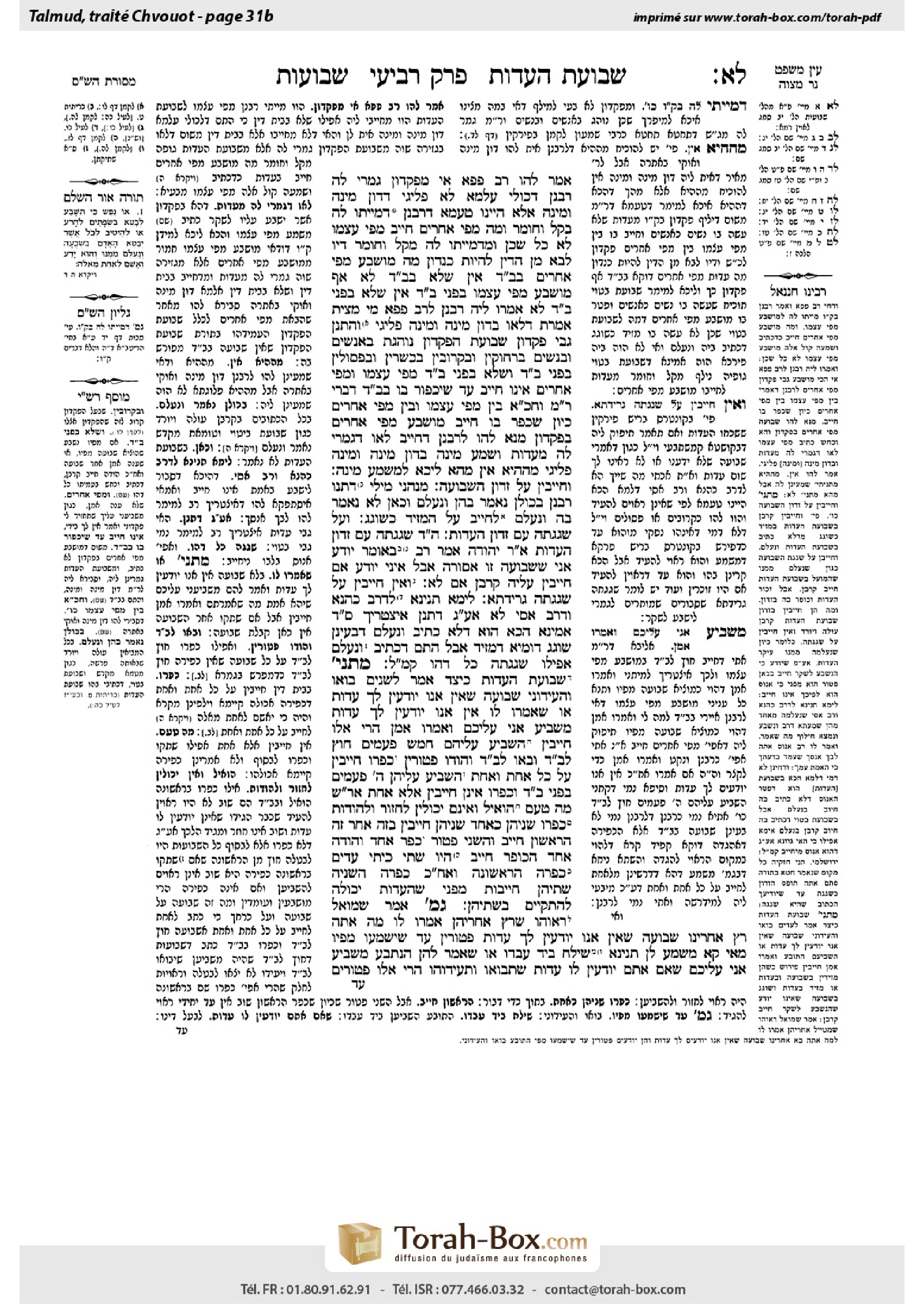
This page of Shevuot includes the Aramaic text, an English translation and an AI-generated French translation, alongside the scan above.
שבועות ל״א ב · Aramaic and Hebrew text
אֲמַר לְהוּ רַב פָּפָּא: אִי מִפִּקָּדוֹן גָּמְרִי לַהּ רַבָּנַן, דְּכוּלֵּי עָלְמָא לָא פְּלִיגִי דְּדוּן מִינַּהּ וּמִינַּהּ.
אֶלָּא הַיְינוּ טַעְמָא דְּרַבָּנַן – דְּמַיְיתוּ לַהּ בְּקַל וָחוֹמֶר: וּמָה מִפִּי אֲחֵרִים חַיָּיב, מִפִּי עַצְמוֹ לֹא כׇּל שֶׁכֵּן?!
וּמִדְּמַיְיתוּ לַהּ מִקַּל וָחוֹמֶר – דַּיּוֹ לַבָּא מִן הַדִּין לִהְיוֹת כַּנִּדּוֹן: מָה מוּשְׁבָּע מִפִּי אֲחֵרִים – בְּבֵית דִּין אִין, שֶׁלֹּא בְּבֵית דִּין לָא; אַף מוּשְׁבָּע מִפִּי עַצְמוֹ – בִּפְנֵי בֵּית דִּין אִין, שֶׁלֹּא בִּפְנֵי בֵּית דִּין לָא.
אֲמַרוּ לֵיהּ רַבָּנַן לְרַב פָּפָּא: מִי מָצֵית אָמְרַתְּ דְּלָאו בְּדוּן מִינַּהּ וּמִינַּהּ פְּלִיגִי?! וְהָתְנַן גַּבֵּי פִּקָּדוֹן: שְׁבוּעַת הַפִּקָּדוֹן נוֹהֶגֶת בַּאֲנָשִׁים וּבְנָשִׁים, בִּרְחוֹקִין וּבִקְרוֹבִין, בִּכְשֵׁרִין וּבִפְסוּלִין, בִּפְנֵי בֵּית דִּין וְשֶׁלֹּא בִּפְנֵי בֵּית דִּין – מִפִּי עַצְמוֹ; וּמִפִּי אֲחֵרִים אֵינוֹ חַיָּיב עַד שֶׁיִּכְפּוֹר בּוֹ בְּבֵית דִּין. דִּבְרֵי רַבִּי מֵאִיר. וַחֲכָמִים אוֹמְרִים: בֵּין מִפִּי עַצְמוֹ וּבֵין מִפִּי אֲחֵרִים – כֵּיוָן שֶׁכָּפַר בּוֹ חַיָּיב.
מוּשְׁבָּע מִפִּי אֲחֵרִים בְּפִקָּדוֹן מְנָא לְהוּ לְרַבָּנַן דְּחַיָּיב? לָאו דְּגָמְרִי לַהּ מֵעֵדוּת – וּשְׁמַע מִינַּהּ בְּדוּן מִינַּהּ וּמִינַּהּ פְּלִיגִי?
מֵהַהִיא – אִין; מֵהָא – לֵיכָּא לְמִשְׁמַע מִינַּהּ.
וְחַיָּיבִין עַל זְדוֹן הַשְּׁבוּעָה. מְנָהָנֵי מִילֵּי? דְּתָנוּ רַבָּנַן: בְּכוּלָּן נֶאֱמַר בָּהֶן ״וְנֶעְלַם״, וְכָאן לֹא נֶאֱמַר בָּהּ ״וְנֶעְלַם״; לְחַיֵּיב עַל הַמֵּזִיד כַּשּׁוֹגֵג.
וְעַל שִׁגְגָתָהּ עִם זְדוֹן הָעֵדוּת. הֵיכִי דָּמֵי שִׁגְגָתָהּ עִם זְדוֹן הָעֵדוּת? אָמַר רַב יְהוּדָה אָמַר רַב: בְּאוֹמֵר ״יוֹדֵעַ אֲנִי שֶׁשְּׁבוּעָה זוֹ אֲסוּרָה, אֲבָל אֵינִי יוֹדֵעַ אִם חַיָּיבִין עָלֶיהָ קׇרְבָּן אִם לֹא״.
וְאֵין חַיָּיבִין עַל שִׁגְגָתָהּ גְּרֵידְתָּא. לֵימָא תְּנֵינָא לִדְרַב כָּהֲנָא וּדְרַב אַסִּי?
לָא; אַף עַל גַּב דִּתְנַן, אִיצְטְרִיךְ; סָלְקָא דַּעְתָּךְ אָמֵינָא: הָכָא הוּא דְּלָא כְּתִיב ״וְנֶעְלַם״ דְּבָעֵינַן שׁוֹגֵג דּוּמְיָא דְּמֵזִיד; אֲבָל הָתָם דִּכְתִיב ״וְנֶעְלַם״, אֲפִילּוּ שִׁגְגָתָהּ כֹּל דְּהוּ; קָא מַשְׁמַע לַן.
מַתְנִי׳ שְׁבוּעַת הָעֵדוּת כֵּיצַד? אָמַר לִשְׁנַיִם: ״בּוֹאוּ וְהַעִידוּנִי״; ״שְׁבוּעָה שֶׁאֵין אָנוּ יוֹדְעִין לְךָ עֵדוּת״, אוֹ שֶׁאָמְרוּ לוֹ ״אֵין אָנוּ יוֹדְעִין לְךָ עֵדוּת״; ״מַשְׁבִּיעַ אֲנִי עֲלֵיכֶם״, וְאָמְרוּ: ״אָמֵן״ – הֲרֵי אֵלּוּ חַיָּיבִין.
הִשְׁבִּיעַ עֲלֵיהֶם חָמֵשׁ פְּעָמִים חוּץ לְבֵית דִּין, וּבָאוּ לְבֵית דִּין וְהוֹדוּ – פְּטוּרִין. כָּפְרוּ – חַיָּיבִין עַל כׇּל אַחַת וְאַחַת. הִשְׁבִּיעַ עֲלֵיהֶן חָמֵשׁ פְּעָמִים בִּפְנֵי בֵּית דִּין וְכָפְרוּ – אֵינָן חַיָּיבִין אֶלָּא אַחַת. אָמַר רַבִּי שִׁמְעוֹן: מָה טַעַם? הוֹאִיל וְאֵינָם יְכוֹלִין לַחְזוֹר וּלְהוֹדוֹת.
כָּפְרוּ שְׁנֵיהֶן כְּאֶחָד – שְׁנֵיהֶן חַיָּיבִין. בְּזֶה אַחַר זֶה – הָרִאשׁוֹן חַיָּיב וְהַשֵּׁנִי פָּטוּר. כָּפַר אֶחָד וְהוֹדָה אֶחָד – הַכּוֹפֵר חַיָּיב.
הָיוּ שְׁתֵּי כִּיתֵּי עֵדִים, כָּפְרָה הָרִאשׁוֹנָה וְאַחַר כָּךְ כָּפְרָה הַשְּׁנִיָּה – שְׁתֵּיהֶן חַיָּיבוֹת, מִפְּנֵי שֶׁהָעֵדוּת יְכוֹלָה לְהִתְקַיֵּים בִּשְׁתֵּיהֶן.
גְּמָ׳ אָמַר שְׁמוּאֵל: רָאוּהוּ שֶׁרָץ אַחֲרֵיהֶן, אָמְרוּ לוֹ: ״מָה אַתָּה רָץ אַחֲרֵינוּ? שְׁבוּעָה שֶׁאֵין אָנוּ יוֹדְעִין לָךְ עֵדוּת״ – פְּטוּרִין, עַד שֶׁיִּשְׁמְעוּ מִפִּיו. מַאי קָא מַשְׁמַע לַן? תְּנֵינָא: שִׁילַּח בְּיַד עַבְדּוֹ, אוֹ שֶׁאָמַר לָהֶן הַנִּתְבָּע: ״מַשְׁבִּיעַ אֲנִי עֲלֵיכֶם, שֶׁאִם אַתֶּם יוֹדְעִין לוֹ עֵדוּת – שֶׁתָּבוֹאוּ וּתְעִידוּהוּ״ – הֲרֵי אֵלּוּ פְּטוּרִים,
Shevuot 31b · English translation
Rav Pappa said to the Rabbis: If the Rabbis derive liability for one who takes a false oath of testimony on his own by means of a verbal analogy from the oath on a deposit, then everyone agrees: Infer from it and derive the details from it, and even the Rabbis would concede that all of the halakhot of the oath of testimony are derived from the oath on a deposit; therefore, one is liable for an oath taken on one’s own even outside the court.
Rather, this is the reason that the Rabbis hold that there is no liability for the oath of testimony taken on one’s own outside the court: They derive it by means of an a fortiori inference from the halakhot of the oath of testimony itself, as follows: And if one who was administered an oath by others is liable, when one takes the oath on his own, is he not all the more so liable?
And from the fact that they derived the halakha by means of an a fortiori inference, one is bound by the limitations that restrict that derivation: It is sufficient for the conclusion that emerges from an a fortiori inference to be like its source. Therefore, just as one who is administered an oath by others, if the oath is administered in court, yes, he is liable, and if it is not administered in court, no, he is not liable, so too, one who took the oath on his own, before a court, yes, he is liable, and if it is not before a court, no, he is not liable.
The Rabbis said to Rav Pappa: How can you say that it is not with regard to the matter of: Infer from it and derive the details from it, that they disagree? But didn’t we learn in the mishna with regard to the oath on a deposit: The oath on a deposit is practiced with regard to men and with regard to women, with regard to non-relatives and with regard to relatives, with regard to those fit to testify and with regard to those unfit to testify. The oath on a deposit is practiced both in the presence of the court and not in the presence of the court, when the bailee takes the oath on his own. And if the oath is administered by others, he is not liable until he denies responsibility for the deposit in court. This is the statement of Rabbi Meir. And the Rabbis say: Whether the bailee takes the oath on his own or whether the oath is administered by others, once he denied the claim concerning the deposit he is liable.
The question arises: From where do the Rabbis derive that one who is administered an oath on a deposit by others is liable, given that an oath of that kind is not mentioned in the Torah in the context of an oath on a deposit? Is it not that they derive it from the halakhot of the oath of testimony? And conclude from it that it is with regard to the matter of: Infer from it and derive the details from it, that they disagree? The Rabbis hold: Infer the halakha from it but interpret the halakha according to its own place. The fact that one is liable for an oath on a deposit that is administered by others is derived from the oath of testimony, but one does not derive that one is liable only if that oath is administered in the presence of a court. Rather, the oath on a deposit administered by others is derived from an oath on a deposit taken on one’s own; one is liable in both cases for an oath taken not in the presence of the court.
Rav Pappa said to the Rabbis: From that mishna, yes, it is evident that the Rabbis and Rabbi Meir disagree with regard to the matter of: Infer from it and derive the details from it. However, no inference is to be learned from this mishna taught with regard to the oath of testimony, as perhaps the Rabbis derived their opinion by means of an a fortiori inference.
§ The mishna teaches: And one is liable for the act of taking a false oath with intent. The Gemara asks: From where is this matter derived that one is liable to bring a sliding-scale offering for taking a false oath of testimony with intent? It is derived as the Sages taught: In all of the other cases where one is liable to bring a sliding-scale offering (see Leviticus 5:2–4), i.e., the defiling of the Temple or its sacrificial foods, and violating an oath on an utterance, it is stated: “And it is hidden”; but here, with regard to the oath of testimony, it is not stated: And it is hidden, which serves to render one liable for taking the oath intentionally just as he is liable for taking the oath unwittingly.
§ The mishna teaches: And one is liable for an unwitting act of taking a false oath provided that he takes the oath with intent in terms of the testimony. The Gemara asks: What are the circumstances of the case of an unwitting act of taking a false oath with intent in terms of the testimony? Rav Yehuda says that Rav says that this is in the case of one who says: I know that taking this false oath that I do not know the relevant information is prohibited, but I do not know whether or not one is liable to bring an offering for taking that oath.
The mishna teaches: But they are not liable for taking the oath if they were unwitting in terms of the testimony alone. If one actually forgot that he knows about the matter, he is exempt from bringing an offering. The Gemara asks: Shall we say that we learn in the mishna that which Rav said in response to the dispute of Rav Kahana and Rav Asi? The Gemara (26a) cited a dispute between Rav Kahana and Rav Asi with regard to a certain statement of Rav, and each took an oath that his version was accurate. Rav told them that although the version of one of the amora’im was not accurate, he is not liable for taking a false oath, as each amora was convinced that his oath was true. This is not an unwitting oath; rather, it is an oath taken unaware.
The Gemara responds: No, even though we learned this halakha in the mishna, Rav’s statement that the one who did not cite Rav’s statement accurately is exempt was necessary. It may enter your mind to say: It is only here, with regard to the oath of testimony, that one is exempt for unwittingly taking a false oath, as: And it is hidden, is not written concerning it, indicating that in order to be liable, we require that the halakhic status of the unwitting oath is similar to that of an intentional oath, i.e., he knows that he is taking a false oath, but he does not know that he is liable to bring an offering for doing so. Therefore, one who is unaware that it is a false oath is exempt. But there, in the case of Rav Kahana and Rav Asi, where each took an oath on an utterance, where it is written: “And it is hidden,” even if it is entirely unwitting, i.e., they were totally unaware that the oath was false, one might say that he is liable. Therefore, Rav teaches us that even in the case of an oath on an utterance, one who is unwitting to that extent is exempt.
MISHNA: Liability to bring a sliding-scale offering for taking a false oath of testimony, how so? In a case where the plaintiff said to two individuals: Come and testify on my behalf, and they replied: On our oath we do not know any testimony on your behalf, i.e., we do not have any knowledge of the matter you speak of, or in a case where they said to him: We do not know any testimony on your behalf, and he said to them: I administer an oath to you, and they said: Amen; if it was determined that they lied, these two witnesses are liable.
If he administered an oath to them five times outside the court, and they came to court and admitted that they had knowledge of the incident in question and testified, they are exempt. But if they denied knowledge of the incident in court as well, they are liable for each and every one of the oaths administered to them outside the court. If he administered an oath to them five times before the court, and they denied knowledge of the incident, they are liable for taking only one false oath. Rabbi Shimon said: What is the reason for this ruling? Since once they denied that they had any knowledge of the incident they can no longer retract that denial and admit that they have knowledge of the matter. Therefore, there was only one oath of testimony, and there is no liability for the remaining oaths.
If both of the witnesses denied knowledge of the incident together, both of them are liable. If they denied knowledge one after the other, the first who denied knowledge is liable, and the second is exempt, as once the first witness denies knowledge of the incident, the second is an individual witness, whose testimony is not decisive. If one of the two witnesses denied knowledge of the incident, and the other one admitted that he had knowledge and proceeded to testify, the one who denies knowledge of the incident is liable.
If there were two sets of witnesses that took the oath of testimony, and the first set denied knowledge of the matter and then the second set denied knowledge of the matter, both of the sets are liable, because the testimony can exist with either of them, as even after the first set denies knowledge of the incident, the second remains capable of providing decisive testimony.
GEMARA: Shmuel says: If the witnesses saw the plaintiff pursuing them, and they said to him: For what reason are you pursuing us? On our oath we do not know any testimony on your behalf, they are exempt, until they will hear a demand to testify directly from his mouth. The Gemara asks: What is Shmuel teaching us? We learn this in a mishna (35a): If the plaintiff sent a request for testimony with his servant, or if the respondent said to the potential witnesses: I administer an oath to you that if you know any testimony on behalf of the plaintiff, i.e., my opponent in the litigation, you will come and testify on his behalf, and they took a false oath that they have no knowledge of the incident, they are exempt,
Shevuot 31b · Traduction française (IA)
Rav Pappa dit aux Rabbins : Si les Rabbins déduisent, par une analogie verbale avec le serment portant sur un dépôt, la responsabilité de celui qui prête de son propre chef un faux serment de témoignage, alors tous sont d’accord : on déduit de ce cas et on en tire les détails. Même les Rabbins reconnaîtraient donc que toutes les halakhot du serment de témoignage se déduisent du serment portant sur un dépôt. Par conséquent, on est responsable d’un serment prêté de son propre chef, même hors du tribunal.
En réalité, voici pourquoi les Rabbins estiment qu’on n’est pas responsable d’un serment de témoignage prêté de son propre chef hors du tribunal : ils le déduisent par un raisonnement a fortiori à partir des halakhot du serment de témoignage lui-même, comme suit : si celui à qui d’autres ont fait prêter serment est responsable, celui qui prête serment de son propre chef ne l’est-il pas à plus forte raison ?
Et puisqu’ils ont déduit cette halakha par un raisonnement a fortiori, ils sont soumis aux limites qui encadrent une telle déduction : la conclusion d’un raisonnement a fortiori ne peut pas aller au-delà de son point de départ. Par conséquent, de même que celui à qui d’autres font prêter serment n’est responsable que si le serment a été prêté devant le tribunal, et non s’il ne l’a pas été, de même celui qui prête serment de son propre chef n’est responsable que si cela se passe devant le tribunal, et non dans le cas contraire.
Les Rabbins dirent à Rav Pappa : Comment peux-tu dire qu’ils ne sont pas en désaccord sur la question de savoir s’il faut déduire de ce cas et en tirer les détails ? N’avons-nous pas appris dans la Michna, à propos du serment portant sur un dépôt : le serment portant sur un dépôt s’applique aux hommes comme aux femmes, aux personnes sans lien de parenté comme aux proches, aux personnes aptes à témoigner comme à celles qui ne le sont pas. Le serment portant sur un dépôt s’applique aussi bien en présence du tribunal qu’en son absence, lorsque le dépositaire prête serment de son propre chef. Si d’autres lui font prêter serment, il n’est responsable que s’il nie devant le tribunal être responsable du dépôt. Telle est la déclaration de Rabbi Meïr. Les Rabbins disent : que le dépositaire prête serment de son propre chef ou que d’autres lui fassent prêter serment, dès lors qu’il a nié la réclamation concernant le dépôt, il est responsable.
La question se pose : d’où les Rabbins déduisent-ils que celui à qui d’autres font prêter serment au sujet d’un dépôt est responsable, alors qu’un serment de ce type n’est pas mentionné dans la Torah dans le contexte du serment portant sur un dépôt ? Ne le déduisent-ils pas des halakhot du serment de témoignage ? Il faut donc en conclure qu’ils sont en désaccord sur la question de savoir s’il faut déduire de ce cas et en tirer les détails. Les Rabbins estiment qu’on en déduit la halakha, mais qu’on l’interprète selon son propre contexte. La responsabilité pour un serment portant sur un dépôt que d’autres font prêter se déduit du serment de témoignage, mais on n’en déduit pas qu’on n’est responsable que si ce serment est prêté en présence du tribunal. Au contraire, le serment portant sur un dépôt que d’autres font prêter se déduit du serment portant sur un dépôt prêté de son propre chef : dans les deux cas, on est responsable d’un serment prêté en l’absence du tribunal.
Rav Pappa dit aux Rabbins : Il ressort effectivement de cette Michna que les Rabbins et Rabbi Meïr sont en désaccord sur la question de savoir s’il faut déduire de ce cas et en tirer les détails. Toutefois, on ne peut tirer aucune conclusion de cette Michna, enseignée à propos du serment de témoignage, car il se peut que les Rabbins aient déduit leur opinion par un raisonnement a fortiori.
§ La Michna enseigne : On est responsable d’avoir prêté intentionnellement un faux serment. La Guemara demande : d’où déduit-on qu’on est tenu d’apporter un sacrifice à valeur variable pour avoir prêté intentionnellement un faux serment de témoignage ? Cela se déduit de ce que les Sages ont enseigné : dans tous les autres cas où l’on est tenu d’apporter un sacrifice à valeur variable (voir Lévitique 5, 2–4), c’est-à-dire la souillure du Temple ou de ses aliments sacrificiels, et la transgression d’un serment portant sur une déclaration, il est écrit : « Et il lui est caché » ; mais ici, à propos du serment de témoignage, ces mots ne sont pas écrits. Cela rend responsable celui qui prête serment intentionnellement, tout comme celui qui le prête par inadvertance.
§ La Michna enseigne : On est responsable d’avoir prêté un faux serment par inadvertance, à condition d’avoir eu conscience des faits concernant le témoignage. La Guemara demande : Dans quelles circonstances prête-t-on par inadvertance un faux serment tout en ayant conscience des faits concernant le témoignage ? Rav Yehouda dit au nom de Rav : c’est le cas de celui qui dit : « Je sais qu’il est interdit de prêter ce faux serment en affirmant que j’ignore les informations en question, mais je ne sais pas si l’on est tenu ou non d’apporter un sacrifice pour avoir prêté ce serment. »
La Michna enseigne : Mais ils ne sont pas responsables s’ils ont prêté serment par inadvertance au sujet du témoignage seulement. Si quelqu’un a réellement oublié qu’il connaissait l’affaire, il est dispensé d’apporter un sacrifice. La Guemara demande : Faut-il dire que nous apprenons dans la Michna ce que Rav a dit en réponse à la controverse entre Rav Kahana et Rav Assi ? La Guemara (26a) rapportait une controverse entre Rav Kahana et Rav Assi à propos d’une déclaration de Rav ; chacun jura que sa version était exacte. Rav leur dit que, bien que la version de l’un des amoraïm ne fût pas exacte, celui-ci n’était pas responsable d’avoir prêté un faux serment, car chacun des amoraïm était convaincu que son serment était vrai. Il ne s’agit pas d’un serment prêté par inadvertance, mais d’un serment prêté sans en avoir conscience.
La Guemara répond : Non. Bien que nous ayons appris cette halakha dans la Michna, la déclaration de Rav selon laquelle celui qui n’avait pas rapporté correctement les paroles de Rav était dispensé était nécessaire. On aurait pu penser que ce n’est qu’ici, à propos du serment de témoignage, qu’on est dispensé lorsqu’on prête par inadvertance un faux serment, car les mots « Et il lui est caché » ne sont pas écrits à son sujet. Cela indique que, pour être responsable, le statut halakhique du serment prêté par inadvertance doit être semblable à celui d’un serment intentionnel : il sait qu’il prête un faux serment, mais il ignore qu’il est tenu d’apporter un sacrifice pour cela. Par conséquent, celui qui ignore que son serment est faux est dispensé. Mais là, dans le cas de Rav Kahana et Rav Assi, où chacun a prêté un serment portant sur une déclaration et où les mots « Et il lui est caché » sont écrits, on pourrait dire qu’il est responsable même si le serment a été prêté par inadvertance totale, c’est-à-dire s’ils ignoraient complètement que leur serment était faux. Rav nous enseigne donc que même dans le cas d’un serment portant sur une déclaration, celui qui est dans une telle inadvertance est dispensé.
MICHNA : Dans quels cas est-on tenu d’apporter un sacrifice à valeur variable pour avoir prêté un faux serment de témoignage ? Si le demandeur dit à deux personnes : « Venez témoigner en ma faveur », et qu’elles répondent : « Nous jurons que nous n’avons connaissance d’aucun témoignage en votre faveur », c’est-à-dire que nous ne connaissons rien de l’affaire dont vous parlez ; ou si elles lui disent : « Nous n’avons connaissance d’aucun témoignage en votre faveur », qu’il leur fait prêter serment et qu’elles répondent : « Amen ». Si l’on établit qu’elles ont menti, ces deux témoins sont responsables.
S’il leur a fait prêter serment cinq fois hors du tribunal, puis qu’elles sont venues au tribunal, ont reconnu avoir eu connaissance de l’incident en question et ont témoigné, elles sont dispensées. Mais si elles ont également nié au tribunal avoir eu connaissance de l’incident, elles sont responsables pour chacun des serments qu’il leur a fait prêter hors du tribunal. S’il leur a fait prêter serment cinq fois devant le tribunal et qu’elles ont nié avoir eu connaissance de l’incident, elles ne sont responsables que d’un seul faux serment. Rabbi Shimon dit : Quelle est la raison de cette règle ? Dès lors qu’elles ont nié avoir eu connaissance de l’incident, elles ne peuvent plus revenir sur ce démenti et reconnaître qu’elles connaissent l’affaire. Il n’y a donc eu qu’un seul serment de témoignage, et elles ne sont pas responsables des serments suivants.
Si les deux témoins ont nié ensemble avoir eu connaissance de l’incident, ils sont tous deux responsables. S’ils ont nié l’un après l’autre, le premier à avoir nié est responsable et le second est dispensé, car dès que le premier témoin nie avoir connaissance de l’incident, le second devient un témoin isolé, dont le témoignage ne suffit pas à trancher l’affaire. Si l’un des deux témoins a nié avoir eu connaissance de l’incident et que l’autre a reconnu en avoir eu connaissance et a témoigné, celui qui a nié avoir connaissance de l’incident est responsable.
Si deux groupes de témoins ont prêté le serment de témoignage, que le premier groupe a nié avoir connaissance de l’affaire, puis que le second groupe a également nié en avoir connaissance, les deux groupes sont responsables, car le témoignage peut être apporté par l’un ou l’autre : même après que le premier groupe a nié avoir connaissance de l’incident, le second reste en mesure de fournir un témoignage décisif.
GUEMARA : Shmuel dit : Si les témoins ont vu le demandeur les poursuivre et lui ont dit : « Pourquoi nous poursuivez-vous ? Nous jurons que nous n’avons connaissance d’aucun témoignage en votre faveur », ils sont dispensés tant qu’ils n’ont pas entendu de sa bouche une demande directe de témoigner. La Guemara demande : Que nous enseigne Shmuel ? Nous l’apprenons dans une Michna (35a) : si le demandeur a envoyé son serviteur leur demander de témoigner, ou si le défendeur a dit aux témoins potentiels : « Je vous fais prêter serment : si vous connaissez un témoignage en faveur du demandeur, c’est-à-dire de mon adversaire dans le litige, venez témoigner en sa faveur », et qu’ils ont prêté un faux serment en affirmant ne rien savoir de l’incident, ils sont dispensés,
Traduction française générée par IA à partir de l’édition anglaise de Sefaria. Vérifie toujours un passage avec le texte source.
Text from Sefaria: William Davidson Edition - Vocalized Aramaic (CC BY NC); William Davidson Edition - English (CC BY NC).