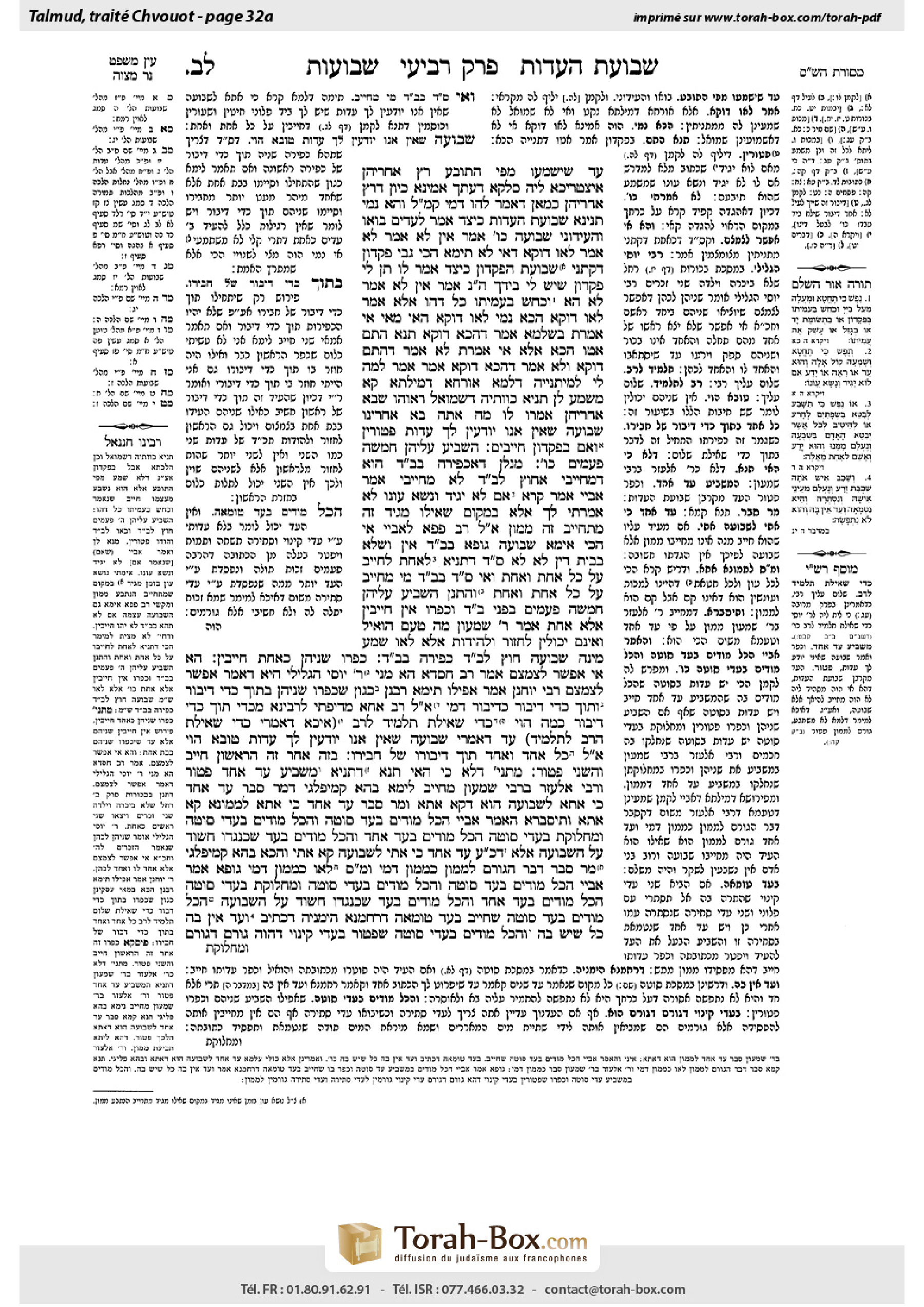
Shevuot 32a: Talmud study for Daf Yomi
Daf Yomi is the daily study of one Talmud folio. Explore 37 tractates with scans, Hebrew text, Sefaria English and AI-generated French translations where annotated.
Passage selection and English or AI-generated French translation are available where the scan has annotations. Daf Study is independent of Torah-Box and Sefaria.
Browse Shevuot · שבועות · All tractatesShevuot 32a text and translations
This page of Shevuot includes the Aramaic text, an English translation and an AI-generated French translation, alongside the scan above.
שבועות ל״ב א · Aramaic and Hebrew text
עַד שֶׁיִּשְׁמְעוּ מִפִּי הַתּוֹבֵעַ!
רָץ אַחֲרֵיהֶן אִיצְטְרִיכָא לֵיהּ; סָלְקָא דַּעְתָּךְ אָמֵינָא: כֵּיוָן דְּרָץ אַחֲרֵיהֶן – כְּמַאן דְּאָמַר לְהוּ דָּמֵי; קָא מַשְׁמַע לַן.
וְהָא נָמֵי תְּנֵינָא: שְׁבוּעַת הָעֵדוּת כֵּיצַד? אָמַר לְעֵדִים ״בּוֹאוּ וְהַעִידוּנִי״, ״שְׁבוּעָה״ כּוּ׳ – אָמַר אִין, לָא אָמַר לָא!
״אָמַר״ לָאו דַּוְקָא.
דְּאִי לָא תֵּימָא הָכִי, גַּבֵּי פִּקָּדוֹן דְּקָתָנֵי: שְׁבוּעַת הַפִּקָּדוֹן כֵּיצַד? אָמַר לוֹ: ״תֵּן לִי פִּקָּדוֹן שֶׁיֵּשׁ לִי בְּיָדְךָ״ ; הָכָא נָמֵי – אָמַר אִין, לָא אָמַר לָא?! הָא ״וְכִחֶשׁ בַּעֲמִיתוֹ״ כֹּל דְּהוּ!
אֶלָּא ״אָמַר״ לָאו דַּוְקָא; הָכָא נָמֵי לָאו דַּוְקָא.
הַאי מַאי? אִי אָמְרַתְּ בִּשְׁלָמָא ״אָמַר״ דְּהָכָא דַּוְקָא – תְּנָא הָתָם אַטּוּ הָכָא. אֶלָּא אִי אָמְרַתְּ לָא ״אָמַר״ דְּהָתָם דַּוְקָא וְלָא ״אָמַר״ דְּהָכָא דַּוְקָא – ״אָמַר״ ״אָמַר״ לְמָה לִי לְמִיתְנְיַיהּ?
דִּלְמָא אוֹרְחָא דְּמִילְּתָא קָא מַשְׁמַע לַן.
תַּנְיָא כְּוָותֵיהּ דִּשְׁמוּאֵל: רָאוּהוּ שֶׁבָּא אַחֲרֵיהֶן, אָמְרוּ לוֹ: ״מָה אַתָּה בָּא אַחֲרֵינוּ? שְׁבוּעָה שֶׁאֵין אָנוּ יוֹדְעִין לָךְ עֵדוּת״ – פְּטוּרִין. וְאִם בְּפִקָּדוֹן – חַיָּיבִים.
הִשְׁבִּיעַ עֲלֵיהֶן חֲמִשָּׁה פְּעָמִים כּוּ׳.
מְנָלַן דְּאַכְּפִירָה בְּבֵית דִּין הוּא דִּמְחַיְּיבִי, אַחוּץ לְבֵית דִּין לָא מִחַיְּיבִי?
אָמַר אַבָּיֵי, אָמַר קְרָא: ״אִם לוֹא יַגִּיד וְנָשָׂא עֲוֹנוֹ״ – לֹא אָמַרְתִּי לְךָ אֶלָּא בִּמְקוֹם שֶׁאִילּוּ מַגִּיד זֶה, מִתְחַיֵּיב זֶה מָמוֹן.
אֲמַר לֵיהּ רַב פָּפָּא לְאַבָּיֵי: אִי הָכִי, אֵימָא שְׁבוּעָה גּוּפַאּ – בְּבֵית דִּין אֵין, וְשֶׁלֹּא בְּבֵית דִּין לָא!
לָא סָלְקָא דַּעְתָּךְ, דְּתַנְיָא: ״לְאַחַת״ – לְחַיֵּיב עַל כׇּל אַחַת וְאַחַת. וְאִי סָלְקָא דַעְתָּךְ בְּבֵית דִּין, מִי מְחַיֵּיב עַל כׇּל אַחַת וְאַחַת?! וְהָתְנַן: הִשְׁבִּיעַ עֲלֵיהֶן חֲמִשָּׁה פְּעָמִים בִּפְנֵי בֵּית דִּין וְכָפְרוּ – אֵין חַיָּיבִין אֶלָּא אַחַת. אָמַר רַבִּי שִׁמְעוֹן: מָה טַעַם? הוֹאִיל וְאֵינָם יְכוֹלִין לַחְזוֹר וּלְהוֹדוֹת. אֶלָּא לָאו שְׁמַע מִינַּהּ: שְׁבוּעָה – חוּץ לְבֵית דִּין, כְּפִירָה – בְּבֵית דִּין?
כָּפְרוּ שְׁנֵיהֶן כְּאַחַת – חַיָּיבִין. הָא אִי אֶפְשָׁר לְצַמְצֵם?
אָמַר רַב חִסְדָּא: הָא מַנִּי – רַבִּי יוֹסֵי הַגְּלִילִי הִיא, דְּאָמַר אֶפְשָׁר לְצַמְצֵם.
רַבִּי יוֹחָנָן אָמַר: אֲפִילּוּ תֵּימָא רַבָּנַן, כְּגוֹן שֶׁכָּפְרוּ שְׁנֵיהֶן בְּתוֹךְ כְּדֵי דִיבּוּר – וְתוֹךְ כְּדֵי דִיבּוּר כְּדִיבּוּר דָּמֵי.
אֲמַר לֵיהּ רַב אַחָא מִדִּיפְתִּי לְרָבִינָא: מִכְּדִי תּוֹךְ כְּדֵי דִיבּוּר כַּמָּה הָוֵי – כְּדֵי שְׁאֵילַת תַּלְמִיד לָרַב, אִיכָּא דְּאָמְרִי: כְּדֵי שְׁאֵילַת הָרַב לַתַּלְמִיד; עַד דְּאָמְרִי ״שְׁבוּעָה שֶׁאֵין אָנוּ יוֹדְעִין לָךְ עֵדוּת״, טוּבָא הָוֵי! אֲמַר לֵיהּ: כׇּל אֶחָד וְאֶחָד תּוֹךְ דִּיבּוּרוֹ שֶׁל חֲבֵירוֹ.
בְּזֶה אַחַר זֶה – הָרִאשׁוֹן חַיָּיב וְהַשֵּׁנִי פָּטוּר. מַתְנִיתִין דְּלָא כִּי הַאי תַּנָּא – דְּתַנְיָא: מַשְׁבִּיעַ עֵד אֶחָד – פָּטוּר, וְרַבִּי אֶלְעָזָר בְּרַבִּי שִׁמְעוֹן מְחַיֵּיב.
לֵימָא בְּהָא קָמִיפַּלְגִי – דְּמָר סָבַר: עֵד אֶחָד כִּי אָתֵא – לִשְׁבוּעָה הוּא דְּקָא אָתֵא; וּמָר סָבַר: עֵד אֶחָד כִּי אֲתָא – לְמָמוֹנָא קָא אָתֵא?
וְתִיסְבְּרָא?! הָאָמַר אַבָּיֵי: הַכֹּל מוֹדִים בְּעֵד סוֹטָה, וְהַכֹּל מוֹדִים בְּעֵדֵי סוֹטָה, וּמַחְלוֹקֶת בְּעֵדֵי סוֹטָה; הַכֹּל מוֹדִים בְּעֵד אֶחָד, וְהַכֹּל מוֹדִים בְּעֵד שֶׁכְּנֶגְדּוֹ חָשׁוּד עַל הַשְּׁבוּעָה.
אֶלָּא דְּכוּלֵּי עָלְמָא עֵד אֶחָד כִּי אָתֵי – לִשְׁבוּעָה קָא אָתֵי; וְהָכָא בְּהָא קָמִיפַּלְגִי: מָר סָבַר דָּבָר הַגּוֹרֵם לְמָמוֹן – כְּמָמוֹן דָּמֵי, וּמָר סָבַר לָאו כְּמָמוֹן דָּמֵי.
גּוּפָא – אָמַר אַבָּיֵי: הַכֹּל מוֹדִים בְּעֵד סוֹטָה, וְהַכֹּל מוֹדִים בְּעֵדֵי סוֹטָה, וּמַחְלוֹקֶת בְּעֵדֵי סוֹטָה; הַכֹּל מוֹדִים בְּעֵד אֶחָד, וְהַכֹּל מוֹדִים בְּעֵד שֶׁכְּנֶגְדּוֹ חָשׁוּד עַל הַשְּׁבוּעָה.
הַכֹּל מוֹדִים בְּעֵד סוֹטָה – שֶׁחַיָּיב, בְּעֵד טוּמְאָה; דְּרַחֲמָנָא הֵימְנֵיהּ, דִּכְתִיב ״וְעֵד אֵין בָּהּ״ – כֹּל שֶׁיֵּשׁ בָּהּ.
וְהַכֹּל מוֹדִים בְּעֵדֵי סוֹטָה – שֶׁפָּטוּר, בְּעֵדֵי קִינּוּי; דְּהָוֵה גּוֹרֵם דְּגוֹרֵם.
Shevuot 32a · English translation
until they hear a demand to testify directly from the mouth of the plaintiff.
The Gemara answers: Mentioning the case of the plaintiff pursuing them was necessary for Shmuel, as otherwise it could enter your mind to say: Since the plaintiff is pursuing them, it is like the case of one who says to them directly to testify. Therefore, Shmuel teaches us that although the intent of the plaintiff is for them to testify, the witnesses are liable only if he tells them so explicitly.
The Gemara asks: But this too, we learn in the mishna: Liability to bring a sliding-scale offering for taking a false oath of testimony, how so? In a case where the plaintiff said to two witnesses: Come and testify on my behalf, and they replied: On our oath, etc., from which it can be inferred that if the plaintiff said this to the witnesses, yes, they are liable, and if he did not say this to the witnesses, no, they are not liable.
The Gemara rejects this: No proof may be cited from the mishna, as perhaps when the tanna states: In a case where the plaintiff said, he did not mean that this is the halakha only in a case where he specifically verbalized his demand that they testify; rather, the same would be true even if he conveyed his intent in a non-verbal manner.
As, if you do not say so and assert that the language of the mishna is precise and one is liable only if the oath was in response to a verbal demand, then as for the mishna (36b), which teaches with regard to a deposit: Liability to bring a guilt-offering for taking a false oath on a deposit, how so? In a case where the owner said to the bailee: Give me the deposit that belongs to me and is in your possession, would you say there, also, that if the owner said this to the bailee, yes, he is liable, and if he did not say this to the bailee, no, he is not liable? But doesn’t the verse “And deals falsely with his colleague in a matter of deposit” (Leviticus 5:21) indicate that the bailee is liable for any denial of the deposit at all, unrelated to the nature of the claim raised by the owner of the item?
Rather, it must be that when the tanna says with regard to the oath on a deposit: In a case where the owner said to the bailee, he did not mean that this is the halakha only in a case where he specifically verbalized his demand. Here too, with regard to the oath of testimony, the tanna did not mean that this is the halakha only in a case where the plaintiff specifically verbalized his demand.
The Gemara asks: What is this comparison? Granted, if you say that here, when the tanna says in the mishna with regard to the oath of testimony: In a case where the plaintiff said to two individuals, it is specifically in a case where the plaintiff verbalized his demand, one could explain that the tanna taught there, with regard to the oath on a deposit: In a case where the owner said, due to the fact that he employed that formulation here in the mishna. Tanna’im frequently employ uniform language in different cases, even though there are halakhic differences between them. But if you say that neither there with regard to the oath on a deposit is it specifically in a case where the owner verbally said, nor here with regard to the oath of testimony is it specifically in a case where the plaintiff verbally said, why do I need to teach: Said, said, in both instances?
The Gemara answers: Perhaps the tanna is teaching us the matter in the manner in which it typically occurs, as both a plaintiff and the owner of a deposit typically articulate their claims verbally. It may still be that if the demand was conveyed non-verbally, the witness is liable. Since there is no proof from the mishna, the statement of Shmuel is necessary to teach that if the demand is not articulated verbally, the witness is not liable for taking a false oath.
The Gemara notes that it is taught in a baraita in accordance with the opinion of Shmuel: In a case where the witnesses saw that the plaintiff was pursuing them, and they said to him: For what reason are you pursuing us; on our oath we do not know testimony on your behalf, they are exempt. And if it is with regard to an oath on a deposit, in a case where the owner is pursuing the bailee and he denies that the deposit is in his possession, the bailees are liable, as they are liable for any denial of the deposit at all, irrespective of the nature of the claim raised by the owner of the item.
§ The mishna teaches: If he administered an oath to them five times and they came to court and admitted that they had knowledge of the incident and testified, they are exempt. But if they denied knowledge of the incident in court as well, they are liable for each and every one of the oaths administered to them outside the court.
The Gemara asks: From where do we derive that it is specifically for denial in court that they are liable, and they are not liable for denial outside court?
Abaye said: It is derived as the verse states with regard to the oath of testimony: “If he does not utter it, he shall bear his iniquity” (Leviticus 5:1), from which it is derived: I said this halakha to you only in a place where, were this witness to utter his testimony, that other individual becomes liable to make a monetary payment, i.e., in court. He is not liable for denial in a place where his testimony would not render one liable to pay.
Rav Pappa said to Abaye: If so, say that it is not the denial but the oath itself; if it is taken in court, yes, he is liable, and if it is that which is not taken in court, no, he is not liable.
Abaye said to Rav Pappa: That should not enter your mind, as it is taught in a baraita that the verse: “And it will be when he is guilty of any one of these” (Leviticus 5:5), serves to render one liable to bring an offering for each and every instance when one repeatedly performs the transgressions for which one is liable to bring a sliding-scale offering. And if it enters your mind that one is liable only for an oath taken in court, is one liable for each and every oath? But didn’t we learn in the mishna: If he administered an oath to them five times before the court, and they denied knowledge of any testimony relating to the incident, they are liable for taking only one false oath. Rabbi Shimon said: What is the reason for this ruling? Since once they denied that they had any knowledge of the matter they can no longer retract that denial and admit that they have knowledge of the matter. Abaye explains: Rather, must one not conclude from it that one is liable for each and every oath taken outside court; but one is liable only if the denial is in court?
§ The mishna teaches: If both of the witnesses denied knowledge of the incident together, both of them are liable. The Gemara asks: But isn’t it impossible for two events to coincide precisely? By necessity, one denial must have preceded the other.
Rav Ḥisda said: In accordance with whose opinion is this mishna? It is in accordance with the opinion of Rabbi Yosei HaGelili, who says: It is possible for two events to coincide precisely.
Rabbi Yoḥanan said: Even if you say that the mishna is in accordance with the opinion of the Rabbis who disagree with Rabbi Yosei HaGelili, the mishna can be interpreted in a case where both of them denied knowledge of relevant testimony within the time required for speaking a short phrase, and the halakhic status of a pause or retraction within the time required for speaking a short phrase is like that of continuous speech. Although the two statements did not coincide precisely, their halakhic status is as if they did.
Rav Aḥa of Difti said to Ravina: After all, how long is the duration of: Within the time required for speaking a short phrase? It is an interval equivalent to the duration of the three-word greeting of a student to his teacher: Shalom alekha rabbi. Some say that it is a briefer interval, equivalent to the duration of the two-word greeting of a teacher to his student: Shalom alekha. According to either opinion, in the time that elapses until the two of them say: On my oath we do not know any testimony for you, it is an interval greater than the time required to utter those words. How, then, can the mishna be interpreted as referring to a case where they stated their denials within the time required for speaking those words? Ravina said to Rav Aḥa of Difti: The case in the mishna is one where each and every potential witness will issue his denial within the time required for speaking, starting from the end of the statement of the other.
§ The mishna teaches: If they denied knowledge one after the other, the first one who denied knowledge is liable, and the second one is exempt, as once the first witness denies knowledge of the incident, the second is an individual witness, whose testimony is not decisive, and he is exempt from the oath of testimony. The Gemara notes: The mishna is not in accordance with the opinion of this tanna, as it is taught in a baraita: In the case of one who administers an oath to one witness, the witness is exempt from bringing an offering for taking a false oath of testimony; and Rabbi Elazar, son of Rabbi Shimon, deems the witness liable to bring an offering. In his opinion, the second witness in the case in the mishna would be liable, not exempt.
The Gemara suggests: Let us say that they disagree about this: One Sage, the first tanna, holds: When one witness comes to testify, it is to render the one against whom he is testifying liable to take an oath, and that is the reason that he is coming, as one witness cannot render him liable to make a monetary payment. And one Sage, Rabbi Elazar, son of Rabbi Shimon, holds: When one witness comes to testify, it is to render the one against whom he is testifying liable to make a monetary payment, and that is the reason that he is coming. The tanna’im disagree whether denial by one witness constitutes a denial with regard to monetary matters.
The Gemara rejects this: And how can you understand their dispute in that way? Doesn’t Abaye say: All concede with regard to a witness in the case of a sota that he is liable for taking a false oath of testimony; and all concede with regard to witnesses in the case of a sota; and there is a dispute with regard to witnesses in the case of a sota. All concede with regard to one witness that he is not liable for taking a false oath of testimony because he cannot render another liable to make a monetary payment; and all concede with regard to a witness testifying on behalf of the claimant when his counterpart, the defendant, is suspect about the oath.
The Gemara suggests: Rather, all concede that when one witness comes to testify, it is to render the one against whom he is testifying liable to take an oath, and that is the reason he is coming. And here they disagree about this: One Sage, Rabbi Elazar, son of Rabbi Shimon, holds: A matter that causes financial loss is considered to have monetary value. Although the testimony of one witness does not render one liable for monetary payment, occasionally the party against whom he testified will prefer to pay rather than take the oath that the witness rendered him liable to take. In those cases, the testimony of one witness does in fact cause money to be paid. And one Sage, the first tanna, holds: A matter that causes financial loss is not considered to have monetary value.
§ With regard to the matter itself, Abaye says: All concede with regard to a witness in the case of a sota that he is liable for taking a false oath of testimony; and all concede with regard to witnesses in the case of a sota; and there is a dispute with regard to witnesses in the case of a sota. All concede with regard to one witness, and all concede with regard to a witness testifying on behalf of the claimant when his counterpart is suspect about the oath.
The Gemara elaborates: All concede with regard to a witness in the case of a sota that he is liable for taking a false oath of testimony in the case of a witness of impurity. This is referring to a case where the husband issues a warning to his wife in the presence of two witnesses that she may not enter into seclusion with a certain man and witnesses testify that she entered into seclusion with him, and one witness testifies that she engaged in intercourse with that man, as in that case the Merciful One accorded credibility to the witness, as it is written with regard to a sota: “And there is no witness against her” (Numbers 5:13), that she engaged in intercourse. From that verse it is derived that any witness that there is against her is sufficient to render her forbidden to her husband and enable him to divorce her without paying the sum stipulated in the marriage contract. Therefore, the witness who testified that she engaged in intercourse with that man is for all intents and purposes a witness to a monetary matter.
And all concede with regard to witnesses in the case of a sota that each witness is exempt from liability due to a false oath of testimony. This is referring to the case of witnesses of warning, who testify that the jealous husband warned his wife not to enter into seclusion with a certain man, as each witness is the cause of a cause of financial loss, not a direct cause of that loss. In order to lose payment of her marriage contract, in addition to the witnesses of warning, witnesses of seclusion would also be required, after which either a witness would testify that she engaged in intercourse or she would be required to drink the bitter water of a sota, either of which would confirm that she engaged in an adulterous relationship.
Shevuot 32a · Traduction française (IA)
jusqu’à ce qu’ils entendent le plaignant leur demander directement de témoigner.
La Guemara répond : Il était nécessaire de mentionner le cas où le plaignant les poursuit pour expliquer l’enseignement de Shmuel ; autrement, on aurait pu penser que, puisque le plaignant les poursuit, c’est comme s’il leur avait directement demandé de témoigner. Shmuel nous enseigne donc que, même si le plaignant a l’intention qu’ils témoignent, les témoins ne sont passibles que s’il le leur dit explicitement.
La Guemara demande : Mais cela aussi, nous l’apprenons dans la Michna : comment se présente l’obligation d’apporter une offrande à montant variable pour avoir prêté un faux serment de témoignage ? Dans le cas où le plaignant a dit à deux témoins : « Venez témoigner en ma faveur », et où ils ont répondu : « Par notre serment, etc. » On peut en déduire que si le plaignant a dit cela aux témoins, ils sont passibles, et que s’il ne le leur a pas dit, ils ne sont pas passibles.
La Guemara rejette cette déduction : on ne peut tirer de preuve de la Michna, car peut-être, lorsque le tanna dit : « Dans le cas où le plaignant a dit », il ne veut pas dire que cette halakha ne s’applique que lorsqu’il a formulé expressément sa demande pour qu’ils témoignent ; la même halakha s’appliquerait également s’il avait exprimé son intention de manière non verbale.
En effet, si tu n’admets pas cela et affirmes que le texte de la Michna est précis et qu’on n’est passible que si le serment répond à une demande verbale, que dirais-tu alors de la Michna (36b), qui enseigne au sujet d’un dépôt : comment se présente l’obligation d’apporter un sacrifice de culpabilité pour avoir prêté un faux serment concernant un dépôt ? Dans le cas où le propriétaire a dit au dépositaire : « Rends-moi le dépôt qui m’appartient et qui se trouve en ta possession. » Dirais-tu là aussi que si le propriétaire a dit cela au dépositaire, celui-ci est passible, et que s’il ne le lui a pas dit, il ne l’est pas ? Pourtant, le verset « et qu’il ait agi faussement envers son prochain au sujet d’un dépôt » (Lévitique 5, 21) indique que le dépositaire est passible pour tout déni du dépôt, quelle que soit la nature de la réclamation du propriétaire de l’objet.
Il faut plutôt dire que, lorsque le tanna enseigne au sujet du serment concernant un dépôt : « Dans le cas où le propriétaire a dit au dépositaire », il ne veut pas dire que cette halakha ne s’applique que lorsque le propriétaire a formulé expressément sa demande. De même ici, au sujet du serment de témoignage, le tanna ne veut pas dire que cette halakha ne s’applique que lorsque le plaignant a formulé expressément sa demande.
La Guemara demande : Quelle est la pertinence de cette comparaison ? Certes, si tu dis qu’ici, lorsque le tanna enseigne dans la Michna au sujet du serment de témoignage : « Dans le cas où le plaignant a dit à deux personnes », il s’agit précisément d’un cas où le plaignant a formulé sa demande, on peut expliquer que le tanna a enseigné là, au sujet du serment concernant un dépôt : « Dans le cas où le propriétaire a dit », parce qu’il a employé cette formulation ici, dans la Michna. Les tannaïm emploient souvent une formulation uniforme dans différents cas, même lorsqu’il existe entre eux des différences halakhiques. Mais si tu dis que ni là, au sujet du serment concernant un dépôt, il ne s’agit précisément d’un cas où le propriétaire s’est exprimé verbalement, ni ici, au sujet du serment de témoignage, d’un cas où le plaignant s’est exprimé verbalement, pourquoi enseigner « a dit » dans les deux cas ?
La Guemara répond : Peut-être le tanna nous enseigne-t-il les choses selon leur déroulement habituel, car le plaignant comme le propriétaire d’un dépôt formulent habituellement leurs demandes verbalement. Il se peut néanmoins que le témoin soit passible même si la demande a été communiquée de façon non verbale. Puisque la Michna ne fournit pas de preuve, la déclaration de Shmuel est nécessaire pour enseigner que si la demande n’est pas formulée verbalement, le témoin n’est pas passible pour avoir prêté un faux serment.
La Guemara relève qu’une baraïta est enseignée conformément à l’opinion de Shmuel : dans le cas où les témoins ont vu que le plaignant les poursuivait et lui ont dit : « Pourquoi nous poursuis-tu ? Par notre serment, nous ne connaissons aucun témoignage en ta faveur », ils sont quittes. En revanche, s’il s’agit d’un serment concernant un dépôt, dans le cas où le propriétaire poursuit le dépositaire et que celui-ci nie que le dépôt se trouve en sa possession, les dépositaires sont passibles, car ils le sont pour tout déni du dépôt, quelle que soit la nature de la réclamation du propriétaire de l’objet.
§ La Michna enseigne : S’il leur a fait prêter serment cinq fois, puis qu’ils sont venus au tribunal, ont reconnu avoir eu connaissance de l’incident et ont témoigné, ils sont quittes. Mais s’ils ont également nié au tribunal avoir eu connaissance de l’incident, ils sont passibles pour chacun des serments qu’on leur a fait prêter hors du tribunal.
La Guemara demande : D’où déduisons-nous qu’ils ne sont passibles que pour un déni au tribunal, et qu’ils ne le sont pas pour un déni hors du tribunal ?
Abayé dit : Cela se déduit du verset qui concerne le serment de témoignage : « S’il ne le déclare pas, il portera sa faute » (Lévitique 5, 1). On en déduit : Je vous ai enseigné cette halakha uniquement dans un lieu où, si ce témoin déposait, l’autre personne serait tenue de verser une somme d’argent, c’est-à-dire au tribunal. Il n’est pas passible pour un déni dans un lieu où son témoignage n’obligerait personne à payer.
Rav Pappa dit à Abayé : Dans ce cas, dis que ce n’est pas le déni qui compte, mais le serment lui-même : s’il est prêté au tribunal, le témoin est passible ; s’il n’est pas prêté au tribunal, il ne l’est pas.
Abayé dit à Rav Pappa : Ne va pas le penser, car une baraïta enseigne que le verset « Et lorsqu’il sera coupable de l’un de ces cas » (Lévitique 5, 5) rend quelqu’un passible d’apporter une offrande pour chaque fois qu’il répète l’une des transgressions entraînant l’obligation d’apporter une offrande à montant variable. Or, si tu penses qu’on n’est passible que pour un serment prêté au tribunal, est-on passible pour chacun des serments ? Pourtant, nous avons appris dans la Michna : S’il leur a fait prêter serment cinq fois devant le tribunal et qu’ils ont nié avoir connaissance d’un quelconque témoignage relatif à l’incident, ils ne sont passibles que pour un seul faux serment. Rabbi Shimon a dit : Quelle est la raison de cette règle ? Dès qu’ils ont nié avoir connaissance de l’affaire, ils ne peuvent plus revenir sur ce déni et reconnaître qu’ils en ont connaissance. Abayé explique : Ne faut-il pas plutôt en conclure qu’on est passible pour chaque serment prêté hors du tribunal, mais uniquement si le déni a lieu au tribunal ?
§ La Michna enseigne : Si les deux témoins ont nié ensemble avoir eu connaissance de l’incident, ils sont tous deux passibles. La Guemara demande : Mais deux événements ne peuvent-ils pas coïncider exactement ? Nécessairement, l’un des dénis a précédé l’autre.
Rav Ḥisda dit : Selon l’opinion de qui cette Michna a-t-elle été enseignée ? Selon celle de Rabbi Yosei HaGelili, qui dit qu’il est possible que deux événements coïncident exactement.
Rabbi Yoḥanan dit : Même si tu dis que la Michna suit l’opinion des Rabbins qui sont en désaccord avec Rabbi Yosei HaGelili, on peut interpréter la Michna comme portant sur un cas où les deux ont nié avoir connaissance d’un témoignage pertinent dans le délai nécessaire pour prononcer une courte phrase, le statut halakhique d’une pause ou d’une rétractation dans ce délai étant celui d’une parole continue. Bien que leurs déclarations n’aient pas coïncidé exactement, elles ont le même statut halakhique que si elles avaient coïncidé.
Rav Aḥa de Difti dit à Ravina : Après tout, quelle est la durée du délai nécessaire pour prononcer une courte phrase ? C’est l’intervalle correspondant au temps qu’il faut à un élève pour saluer son maître en trois mots : « Shalom alekha rabbi ». Selon certains, cet intervalle est plus court et correspond au temps qu’il faut à un maître pour saluer son élève en deux mots : « Shalom alekha ». Selon l’une ou l’autre opinion, le temps qui s’écoule jusqu’à ce que tous deux disent : « Par notre serment, nous ne connaissons aucun témoignage en ta faveur », dépasse le temps nécessaire pour prononcer ces mots. Comment, dès lors, la Michna peut-elle être interprétée comme portant sur un cas où ils ont formulé leurs dénis dans le délai nécessaire pour prononcer ces mots ? Ravina dit à Rav Aḥa de Difti : Le cas de la Michna est celui où chacun des témoins potentiels formule son déni dans le délai nécessaire pour prononcer une courte phrase, à compter de la fin de la déclaration de l’autre.
§ La Michna enseigne : S’ils ont nié l’un après l’autre avoir eu connaissance de l’incident, le premier qui a nié est passible et le second est quitte, car, dès que le premier témoin nie avoir connaissance de l’incident, le second est un témoin isolé, dont le témoignage n’est pas décisif, et il est exempt du serment de témoignage. La Guemara relève : La Michna ne suit pas l’opinion de ce tanna, car une baraïta enseigne : Dans le cas où quelqu’un fait prêter serment à un témoin isolé, celui-ci est quitte de l’obligation d’apporter une offrande pour avoir prêté un faux serment de témoignage ; Rabbi Elazar, fils de Rabbi Shimon, estime que le témoin est passible d’apporter une offrande. Selon son opinion, le second témoin dans le cas de la Michna serait passible, et non quitte.
La Guemara propose : Disons qu’ils sont en désaccord sur ce point : un Sage, le premier tanna, estime que lorsqu’un témoin vient déposer, c’est pour obliger la personne contre laquelle il témoigne à prêter serment, et que c’est pour cela qu’il vient, puisqu’un seul témoin ne peut pas l’obliger à verser une somme d’argent. Un autre Sage, Rabbi Elazar, fils de Rabbi Shimon, estime que lorsqu’un témoin vient déposer, c’est pour obliger la personne contre laquelle il témoigne à verser une somme d’argent, et que c’est pour cela qu’il vient. Les tannaïm sont en désaccord sur la question de savoir si le déni d’un seul témoin constitue un déni en matière pécuniaire.
La Guemara rejette cette proposition : Comment peux-tu comprendre leur désaccord de cette façon ? Abayé ne dit-il pas : Tous reconnaissent qu’un témoin dans le cas d’une sota est passible pour avoir prêté un faux serment de témoignage ; tous reconnaissent le cas de témoins dans le cas d’une sota ; et il existe un désaccord au sujet des témoins dans le cas d’une sota. Tous reconnaissent qu’un témoin isolé n’est pas passible pour avoir prêté un faux serment de témoignage, car il ne peut pas obliger une autre personne à verser une somme d’argent ; et tous reconnaissent le cas d’un témoin qui dépose en faveur du demandeur lorsque son adversaire, le défendeur, est suspect quant au serment.
La Guemara propose : Tous reconnaissent plutôt que lorsqu’un témoin vient déposer, c’est pour obliger la personne contre laquelle il témoigne à prêter serment, et que c’est pour cela qu’il vient. Ici, ils sont en désaccord sur ce point : un Sage, Rabbi Elazar, fils de Rabbi Shimon, estime qu’une chose qui entraîne une perte financière est considérée comme ayant une valeur pécuniaire. Bien que le témoignage d’un seul témoin n’oblige personne à verser une somme d’argent, il arrive que la partie contre laquelle il témoigne préfère payer plutôt que de prêter le serment auquel le témoin l’a obligée. Dans ces cas, le témoignage d’un seul témoin entraîne effectivement un paiement. Un autre Sage, le premier tanna, estime qu’une chose qui entraîne une perte financière n’est pas considérée comme ayant une valeur pécuniaire.
§ À propos de la question elle-même, Abayé dit : Tous reconnaissent qu’un témoin dans le cas d’une sota est passible pour avoir prêté un faux serment de témoignage ; tous reconnaissent le cas de témoins dans le cas d’une sota ; et il existe un désaccord au sujet des témoins dans le cas d’une sota. Tous reconnaissent le cas d’un témoin isolé, et tous reconnaissent le cas d’un témoin qui dépose en faveur du demandeur lorsque son adversaire est suspect quant au serment.
La Guemara développe : Tous reconnaissent qu’un témoin dans le cas d’une sota est passible pour avoir prêté un faux serment de témoignage lorsqu’il s’agit d’un témoin d’impureté. Il s’agit d’un cas où le mari a averti sa femme, en présence de deux témoins, qu’elle ne devait pas s’isoler avec un homme déterminé ; des témoins attestent qu’elle s’est isolée avec lui, tandis qu’un témoin atteste qu’elle a eu des relations sexuelles avec cet homme. En effet, le Miséricordieux a accordé foi à ce témoin, comme il est écrit au sujet d’une sota : « Et il n’y a pas de témoin contre elle » (Nombres 5, 13), c’est-à-dire qu’elle a eu des relations sexuelles. On déduit de ce verset que tout témoin qui témoigne contre elle suffit à la rendre interdite à son mari et à permettre à celui-ci de la répudier sans lui verser la somme stipulée dans le contrat de mariage. Par conséquent, le témoin qui a attesté qu’elle a eu des relations sexuelles avec cet homme est, à toutes fins utiles, un témoin en matière pécuniaire.
Tous reconnaissent également que les témoins dans le cas d’une sota ne sont pas passibles individuellement pour un faux serment de témoignage. Il s’agit du cas des témoins de l’avertissement, qui attestent que le mari jaloux a averti sa femme de ne pas s’isoler avec un homme déterminé, car chacun de ces témoins n’est qu’une cause indirecte d’une perte financière, et non une cause directe de cette perte. Pour qu’elle perde le droit au paiement de son contrat de mariage, outre les témoins de l’avertissement, il faut aussi des témoins de l’isolement ; ensuite, soit un témoin doit attester qu’elle a eu des relations sexuelles, soit elle doit boire l’eau amère de la sota, l’une ou l’autre de ces éventualités confirmant qu’elle a entretenu une relation adultère.
Traduction française générée par IA à partir de l’édition anglaise de Sefaria. Vérifie toujours un passage avec le texte source.
Text from Sefaria: William Davidson Edition - Vocalized Aramaic (CC BY NC); William Davidson Edition - English (CC BY NC).