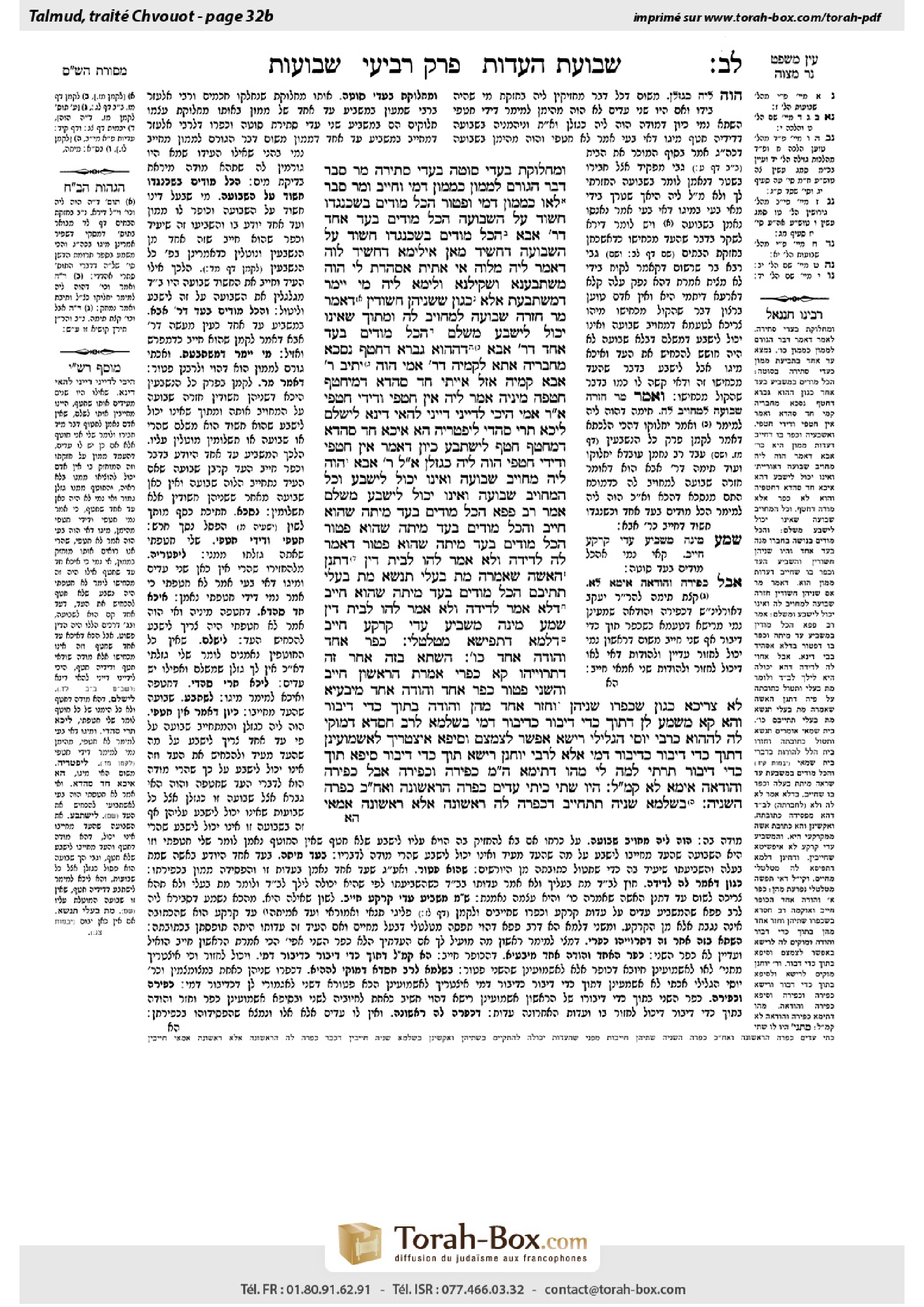
Shevuot 32b: Talmud study for Daf Yomi
Daf Yomi is the daily study of one Talmud folio. Explore 37 tractates with scans, Hebrew text, Sefaria English and AI-generated French translations where annotated.
Passage selection and English or AI-generated French translation are available where the scan has annotations. Daf Study is independent of Torah-Box and Sefaria.
Browse Shevuot · שבועות · All tractatesShevuot 32b text and translations
This page of Shevuot includes the Aramaic text, an English translation and an AI-generated French translation, alongside the scan above.
שבועות ל״ב ב · Aramaic and Hebrew text
וּמַחְלוֹקֶת בְּעֵדֵי סוֹטָה – בְּעֵדֵי סְתִירָה; מָר סָבַר: דָּבָר הַגּוֹרֵם לְמָמוֹן כְּמָמוֹן דָּמֵי – וְחַיָּיב, וּמָר סָבַר: לָאו כְּמָמוֹן דָּמֵי – וּפָטוּר.
הַכֹּל מוֹדִים בְּשֶׁכְּנֶגְדּוֹ חָשׁוּד עַל הַשְּׁבוּעָה, הַכֹּל מוֹדִים בְּעֵד אֶחָד דְּרַבִּי אַבָּא.
הַכֹּל מוֹדִים בְּשֶׁכְּנֶגְדּוֹ חָשׁוּד עַל הַשְּׁבוּעָה – דַּחֲשִׁיד מַאן? אִילֵימָא דַּחֲשִׁיד לֹוֶה, דְּאָמַר לֵיהּ מַלְוֶה: אִי אֲתֵית אַסְהֵדְתְּ לִי, הֲוָה מִשְׁתְּבַעְנָא וְשָׁקֵילְנָא; וְלֵימָא לֵיהּ: מִי יֵימַר דְּמִשְׁתְּבַעְתְּ?
אֶלָּא כְּגוֹן שֶׁשְּׁנֵיהֶן חֲשׁוּדֵין, דְּאָמַר מָר: חָזְרָה שְׁבוּעָה לַמְחוּיָּב לָהּ, וּמִתּוֹךְ שֶׁאֵינוֹ יָכוֹל לִישָּׁבַע – מְשַׁלֵּם.
הַכֹּל מוֹדִים בְּעֵד אֶחָד דְּרַבִּי אַבָּא – דְּהָהוּא גַּבְרָא דַּחֲטַף נְסָכָא מֵחַבְרֵיהּ. אֲתָא לְקַמֵּיהּ דְּרַבִּי אַמֵּי, הֲוָה יָתֵיב רַבִּי אַבָּא קַמֵּיהּ; אֲזַל אַיְיתִי חַד סָהֲדָא דְּמִיחְטָף חַטְפַהּ מִינֵּיהּ. אֲמַר לֵיהּ: ״אִין, חֲטַפִי – וְדִידִי חֲטַפִי״.
אָמַר רַבִּי אַמֵּי: הֵיכִי (לִדַיְּינֵי) [לִידַיְּינוּהּ] דַּיָּינֵי לְהַאי דִּינָא? לִישַׁלֵּם – לֵיכָּא תְּרֵי סָהֲדִי! לִיפְטְרֵיהּ – הָא אִיכָּא חַד סָהֲדָא דְּמִחְטָף חֲטַף! לִישְׁתְּבַע – כֵּיוָן דְּאָמַר ״אֵין, חֲטַפִי – וְדִידִי חֲטַפִי״, הָוֵה לֵיהּ כְּגַזְלָן! אֲמַר לֵיהּ רַבִּי אַבָּא: הָוֵה לֵיהּ מְחוּיָּב שְׁבוּעָה וְאֵינוֹ יָכוֹל לִישָּׁבַע, וְכׇל הַמְחוּיָּב שְׁבוּעָה וְאֵינוֹ יָכוֹל לִישָּׁבַע – מְשַׁלֵּם.
אָמַר רַב פָּפָּא: הַכֹּל מוֹדִים בְּעֵד מִיתָה שֶׁהוּא חַיָּיב, וְהַכֹּל מוֹדִים בְּעֵד מִיתָה שֶׁהוּא פָּטוּר.
הַכֹּל מוֹדִים בְּעֵד מִיתָה שֶׁהוּא פָּטוּר – דַּאֲמַר לַהּ לְדִידַהּ וְלָא אֲמַר לְהוּ לְבֵית דִּין, דִּתְנַן: הָאִשָּׁה שֶׁאָמְרָה ״מֵת בַּעְלִי״ – תִּנָּשֵׂא, ״מֵת בַּעְלִי״ – תִּתְיַבֵּם.
הַכֹּל מוֹדִים בְּעֵד מִיתָה שֶׁהוּא חַיָּיב – דְּלָא אָמַר לְדִידַהּ וְלָא אֲמַר לְהוּ לְבֵית דִּין.
שְׁמַע מִינַּהּ: מַשְׁבִּיעַ עֵדֵי קַרְקַע חַיָּיב? דִּלְמָא דִּתְפִישָׂא מִטַּלְטְלֵי.
כָּפַר אֶחָד וְהוֹדָה אֶחָד כּוּ׳. הַשְׁתָּא בְּזֶה אַחַר זֶה, דְּתַרְוַיְיהוּ קָא כָפְרִי – אָמְרַתְּ הָרִאשׁוֹן חַיָּיב וְהַשֵּׁנִי פָּטוּר; כָּפַר אֶחָד וְהוֹדָה אֶחָד מִיבַּעְיָא?!
לָא צְרִיכָא, כְּגוֹן שֶׁכָּפְרוּ שְׁנֵיהֶן, וְחָזַר אֶחָד מֵהֶן וְהוֹדָה בְּתוֹךְ כְּדֵי דִיבּוּר; וְהָא קָא מַשְׁמַע לַן – דְּתוֹךְ כְּדֵי דִיבּוּר כְּדִיבּוּר דָּמֵי.
בִּשְׁלָמָא לְרַב חִסְדָּא, דְּמוֹקֵי לַהּ לְהָהוּא כְּרַבִּי יוֹסֵי הַגְּלִילִי – רֵישָׁא אֶפְשָׁר לְצַמְצֵם, וְסֵיפָא אִיצְטְרִיךְ לְאַשְׁמוֹעִינַן דְּתוֹךְ כְּדֵי דִיבּוּר כְּדִיבּוּר דָּמֵי. אֶלָּא לְרַבִּי יוֹחָנָן – רֵישָׁא תּוֹךְ כְּדֵי דִיבּוּר, סֵיפָא תּוֹךְ כְּדֵי דִיבּוּר! תַּרְתֵּי לְמָה לִי?
מַהוּ דְּתֵימָא: הָנֵי מִילֵּי כְּפִירָה וּכְפִירָה, אֲבָל כְּפִירָה וְהוֹדָאָה – אֵימָא לָא; קָא מַשְׁמַע לַן.
הָיוּ שְׁתֵּי כִּיתֵּי עֵדִים, כָּפְרָה הָרִאשׁוֹנָה וְאַחַר כָּךְ כָּפְרָה הַשְּׁנִיָּה. בִּשְׁלָמָא שְׁנִיָּה תִּתְחַיֵּיב – דְּכָפְרָה לַהּ רִאשׁוֹנָה; אֶלָּא רִאשׁוֹנָה אַמַּאי?
Shevuot 32b · English translation
And there is a dispute with regard to witnesses in the case of a sota; this is referring to witnesses of seclusion who testify that the woman who was warned by her husband in fact entered into seclusion with the man in question. One Sage, Rabbi Elazar, son of Rabbi Shimon, holds that a matter that causes financial loss is considered to have monetary value, and each witness is liable for taking a false oath of testimony, as had they testified the woman would lose her marriage contract. And one Sage, the Rabbis, hold that a matter that causes financial loss is not considered to have monetary value, and he is exempt.
§ It is stated above further: All concede with regard to a witness testifying on behalf of the claimant when his counterpart is suspect about the oath. All concede in the case of one witness, as in the incident with Rabbi Abba.
The Gemara elaborates: All concede with regard to a witness testifying on behalf of the claimant when his counterpart is suspect about the oath. The testimony of one witness renders the borrower liable to take an oath that he does not owe money. The Gemara asks: In a case where who is suspect? If we say that the borrower who is denying the debt is suspect, and it is a case where the lender says to the witness: If you came and testified on my behalf I would have taken an oath and taken the sum owed me from the borrower, since he is suspect with regard to oaths, why would the witness be liable for taking a false oath of testimony? Let the witness say to the lender: Who could say that you would have taken an oath? Since there is no certainty that he would have taken the oath, the witness is merely the cause of a cause of financial loss.
Rather, it is a case where both the borrower and the lender are suspect, as the Master says: Since both are suspect, the oath reverts to the one who is initially obligated to take it, i.e., the borrower, and since he is unable to take the oath because he is suspect, he pays the entire claim to the lender. One witness rendered the borrower liable to pay the debt.
Abaye said: All concede in the case of one witness, as in the incident with Rabbi Abba. What are the circumstances? As there was a certain man who snatched a silver ingot from another. The one from whom it was taken came before Rabbi Ami while Rabbi Abba was sitting before him, and he went and brought one witness who testified that the defendant indeed snatched it from him. The one who snatched it said to him: Yes, it is true that I snatched it, but I merely snatched that which was mine.
Rabbi Ami said: How shall judges rule in this case? Let the judges require him to pay. But there are not two witnesses who witnessed the robbery. Let the judges rule to exempt him from payment. But there is one witness that he snatched the ingot. Based on the testimony of that witness, let the alleged robber take an oath that he did not snatch the ingot. But once he said: Yes, I snatched it, but I merely snatched that which was mine, his halakhic status is like that of a robber, who is disqualified from taking an oath. Rabbi Abba said to him: He is one who is obligated to take an oath but is unable to take an oath, and anyone who is obligated to take an oath but is unable to take an oath is liable to pay. In that case, were that witness to take a false oath and deny knowledge of the matter, he would be liable.
§ Rav Pappa says: All concede with regard to the witness of a death that he is liable for taking an oath of testimony if he took a false oath and denied knowledge of the incident, and all concede with regard to the witness of a death that he is exempt in that case.
The Gemara elaborates: All concede with regard to the witness of a death that he is exempt where he said to the wife herself that her husband is dead, but he did not tell it to the court, and now he denies his earlier statement, as we learned in a mishna (Eduyyot 1:12): The woman who said: My husband died, shall remarry on the basis of her own testimony. Likewise, if she says: My husband died, she shall enter into levirate marriage with her brother-in-law on the basis of her own testimony. The fact that the witness subsequently denied knowledge of the matter does not cause her to lose her marriage contract, since she can come to the court and testify based on the statement of the witness and collect her marriage contract.
All concede with regard to the witness of a death that he is liable in a case where he did not say that the husband is dead to the wife herself nor did he say it to the court. In that case, his denial of knowledge of the matter causes the wife to lose payment of her marriage contract.
The Gemara asks: Shall we conclude from here that according to Rav Pappa, in the case of one who administers an oath to witnesses with regard to land, the witnesses are liable for taking a false oath of testimony, given that the marriage contract here is collected from land belonging to the husband? This matter is subject to a dispute between the Sages (37b). The Gemara answers: No proof may be cited from here, as perhaps Rav Pappa is referring to a case where she seizes her husband’s movable property as payment for her marriage contract. Therefore, this is not considered testimony with regard to land.
§ The mishna teaches: If one of the two witnesses denied knowledge of the incident, and the other one admitted that he had knowledge and proceeded to testify, the one who denies knowledge of the incident is liable. The Gemara asks: Why was it necessary to teach this halakha in the mishna? Now that in the previous case, where the potential witnesses both denied knowledge of the matter one after the other, you said: The first is liable and the second is exempt, in a case where one denied knowledge and one admitted that he had knowledge and proceeded to testify, is it necessary to mention that the one who denied knowledge is liable?
The Gemara answers: No, it is necessary to state this halakha in a case where both of them denied knowledge of the matter, and one of them retracted his denial and admitted to knowledge of the matter within the time required for speaking a short phrase. And this teaches us that the halakhic status of a pause or retraction within the time required for speaking a short phrase is like that of continuous speech.
The Gemara asks: Granted, according to Rav Ḥisda, who interprets the previous case in the mishna in which the two witnesses denied knowledge of the incident as one, and they are liable in accordance with the opinion of Rabbi Yosei HaGelili, a different halakha may be learned from each clause in the mishna. It is learned from the first clause that it is possible for two events to coincide precisely, and the latter clause was necessary to teach us that the halakhic status of a pause or retraction within the time required for speaking a short phrase is like that of continuous speech. But according to Rabbi Yoḥanan, the halakha of: Within the time required for speaking a short phrase, is learned from the first clause, and the halakha of: Within the time required for speaking a short phrase, is learned from the latter clause. Why do I need two clauses to teach the same halakha?
The Gemara answers: Even according to Rabbi Yoḥanan, both clauses are necessary. Lest you say that this statement: The halakhic status of a pause or retraction within the time required for speaking a short phrase is like that of continuous speech, applies only in a case where the first statement is a denial and the second statement is a denial; but in a case where the first statement is a denial and the second statement is an admission, say that no, its halakhic status is not like that of continuous speech and one cannot admit knowledge after having denied it. Therefore, the tanna teaches us that even in a case where he retracts the denial and admits his knowledge, its halakhic status is not like that of continuous speech.
§ The mishna teaches: If there were two sets of witnesses that took the oath of testimony, and the first set denied knowledge of the matter and thereafter, the second set denied knowledge of the matter, both sets of witnesses are liable. The Gemara asks: Granted, the second set will be held liable, as since the first set denied knowledge of the matter, the ability of the plaintiff to collect his monetary claim is dependent exclusively on the second set, and their denial caused his loss. But why is the first set liable?
Shevuot 32b · Traduction française (IA)
Et il existe une controverse au sujet des témoins dans le cas d’une sota ; il s’agit de témoins de l’isolement, qui attestent que la femme avertie par son mari s’est effectivement isolée avec l’homme en question. Rabbi Elazar, fils de Rabbi Shimon, estime qu’une affaire entraînant une perte financière est considérée comme ayant une valeur monétaire ; chaque témoin est donc passible pour avoir prêté un faux serment de témoignage, car, s’ils avaient témoigné, la femme aurait perdu sa ketouba. Les Rabbins, quant à eux, estiment qu’une affaire entraînant une perte financière n’est pas considérée comme ayant une valeur monétaire ; le témoin est donc exempt.
§ Il est enseigné plus haut : Tous sont d’accord au sujet d’un témoin qui témoigne en faveur du demandeur lorsque son adversaire est suspect en matière de serment. Tous sont d’accord dans le cas d’un témoin unique, comme dans l’épisode de Rabbi Abba.
La Guemara développe : Tous sont d’accord au sujet d’un témoin qui témoigne en faveur du demandeur lorsque son adversaire est suspect en matière de serment. Le témoignage d’un témoin unique oblige l’emprunteur à prêter serment qu’il ne doit pas d’argent. La Guemara demande : De qui s’agit-il, lorsqu’on dit qu’il est suspect ? Si l’on dit qu’il s’agit de l’emprunteur qui nie la dette, et que le prêteur dit au témoin : « Si tu étais venu témoigner en ma faveur, j’aurais prêté serment et recouvré auprès de l’emprunteur la somme qui m’est due », puisque l’emprunteur est suspect en matière de serment, pourquoi le témoin serait-il passible pour avoir prêté un faux serment de témoignage ? Que le témoin dise au prêteur : « Qui peut affirmer que tu aurais prêté serment ? » Puisqu’il n’est pas certain que le prêteur aurait prêté serment, le témoin n’est que la cause d’une cause de perte financière.
Il s’agit plutôt d’un cas où l’emprunteur et le prêteur sont tous deux suspects, car le Maître enseigne : Puisqu’ils sont tous deux suspects, le serment revient à celui qui en était initialement tenu, c’est-à-dire l’emprunteur ; comme celui-ci ne peut prêter serment parce qu’il est suspect, il paie au prêteur la totalité de la somme réclamée. Le témoignage d’un témoin unique a donc rendu l’emprunteur passible de payer la dette.
Abayé a dit : Tous sont d’accord dans le cas d’un témoin unique, comme dans l’épisode de Rabbi Abba. Quelles sont les circonstances ? Un homme avait arraché un lingot d’argent à un autre. Celui à qui le lingot avait été pris se présenta devant Rabbi Ami, tandis que Rabbi Abba siégeait devant lui. Il alla chercher un témoin unique, qui attesta que l’accusé lui avait effectivement arraché le lingot. Celui qui l’avait arraché lui dit : « Oui, il est vrai que je l’ai arraché, mais je n’ai pris que ce qui m’appartenait. »
Rabbi Ami dit : « Comment les juges doivent-ils statuer dans ce cas ? Qu’ils lui ordonnent de payer. Mais il n’y a pas deux témoins qui aient vu le vol. Qu’ils statuent qu’il est exempt de paiement. Mais il y a un témoin qui atteste qu’il a arraché le lingot. Sur la base du témoignage de ce témoin, qu’ils obligent le prétendu voleur à prêter serment qu’il n’a pas arraché le lingot. Mais puisqu’il a dit : “Oui, je l’ai arraché, mais je n’ai pris que ce qui m’appartenait”, son statut halakhique est celui d’un voleur, qui est disqualifié pour prêter serment. » Rabbi Abba lui dit : « Il est tenu de prêter serment, mais incapable de le faire ; or quiconque est tenu de prêter serment mais incapable de le faire est passible de payer. » Dans ce cas, si ce témoin avait prêté un faux serment en niant avoir connaissance de l’affaire, il aurait été passible.
§ Rav Pappa dit : Tous sont d’accord qu’un témoin d’un décès est passible pour avoir prêté un faux serment de témoignage en niant avoir connaissance de l’événement ; et tous sont d’accord qu’un témoin d’un décès est exempt dans ce cas.
La Guemara développe : Tous sont d’accord qu’un témoin d’un décès est exempt lorsqu’il a dit à l’épouse elle-même que son mari était mort, sans le dire au tribunal, et qu’il nie maintenant avoir fait cette déclaration antérieure, comme nous l’avons appris dans une Michna (Eduyyot 1:12) : La femme qui dit : « Mon mari est mort » peut se remarier sur la base de son propre témoignage. De même, si elle dit : « Mon mari est mort », elle peut entrer en lévirat avec son beau-frère sur la base de son propre témoignage. Le fait que le témoin nie par la suite avoir connaissance de l’affaire ne lui fait pas perdre sa ketouba, puisqu’elle peut se présenter au tribunal et témoigner en se fondant sur la déclaration du témoin, puis recouvrer sa ketouba.
Tous sont d’accord qu’un témoin d’un décès est passible dans le cas où il n’a dit ni à l’épouse elle-même ni au tribunal que son mari était mort. Dans ce cas, en niant avoir connaissance de l’affaire, il fait perdre à l’épouse le paiement de sa ketouba.
La Guemara demande : Faut-il en conclure que, selon Rav Pappa, dans le cas où quelqu’un fait prêter serment à des témoins au sujet d’un terrain, les témoins sont passibles pour avoir prêté un faux serment de témoignage, puisque la ketouba est ici recouvrée sur les biens fonciers du mari ? Cette question fait l’objet d’une controverse entre les Sages (37b). La Guemara répond : On ne peut pas en tirer de preuve, car Rav Pappa fait peut-être référence à un cas où elle saisit des biens mobiliers de son mari en paiement de sa ketouba. Il ne s’agit donc pas d’un témoignage au sujet d’un terrain.
§ La Michna enseigne : Si l’un des deux témoins nie avoir connaissance de l’événement et que l’autre reconnaît en avoir connaissance et vient témoigner, celui qui nie avoir connaissance de l’événement est passible. La Guemara demande : Pourquoi était-il nécessaire d’enseigner cette halakha dans la Michna ? Puisque, dans le cas précédent, où les deux témoins potentiels ont nié l’un après l’autre avoir connaissance de l’affaire, tu as dit que le premier est passible et le second exempt, était-il nécessaire de préciser que, dans un cas où l’un nie avoir connaissance de l’affaire tandis que l’autre reconnaît en avoir connaissance et vient témoigner, celui qui a nié est passible ?
La Guemara répond : Il était nécessaire d’énoncer cette halakha dans un cas où tous deux ont nié avoir connaissance de l’affaire, puis où l’un d’eux est revenu sur son démenti et a reconnu en avoir connaissance dans le délai nécessaire pour prononcer une brève formule. Cela nous enseigne qu’une pause ou une rétractation survenant dans ce délai a, du point de vue halakhique, le statut d’une parole continue.
La Guemara demande : Certes, selon Rav Ḥisda, qui interprète le cas précédent de la Michna — où les deux témoins ont nié avoir connaissance de l’événement — comme un seul cas, et qui estime qu’ils sont passibles conformément à l’opinion de Rabbi Yosei HaGelili, on peut tirer une halakha différente de chacune des propositions de la Michna. La première proposition enseigne qu’il est possible que deux événements coïncident exactement, et la dernière était nécessaire pour nous enseigner qu’une pause ou une rétractation survenant dans le délai nécessaire pour prononcer une brève formule a, du point de vue halakhique, le statut d’une parole continue. Mais selon Rabbi Yoḥanan, la halakha du « délai nécessaire pour prononcer une brève formule » est enseignée dans la première proposition, et cette même halakha est enseignée dans la dernière. Pourquoi faut-il deux propositions pour enseigner la même halakha ?
La Guemara répond : Même selon Rabbi Yoḥanan, les deux propositions sont nécessaires. De peur que tu ne dises que cette règle — selon laquelle une pause ou une rétractation survenant dans le délai nécessaire pour prononcer une brève formule a, du point de vue halakhique, le statut d’une parole continue — ne s’applique que lorsque la première déclaration est un démenti et la seconde également un démenti ; mais que, lorsque la première déclaration est un démenti et la seconde un aveu, elle n’a pas le statut d’une parole continue et qu’on ne peut reconnaître avoir connaissance de l’affaire après l’avoir niée. Le tanna nous enseigne donc que même lorsqu’il revient sur son démenti et reconnaît avoir connaissance de l’affaire, sa déclaration n’a pas le statut d’une parole continue.
§ La Michna enseigne : Si deux groupes de témoins ont prêté le serment de témoignage, que le premier groupe a nié avoir connaissance de l’affaire, puis que le second groupe a nié à son tour avoir connaissance de l’affaire, les deux groupes de témoins sont passibles. La Guemara demande : Certes, le second groupe sera déclaré passible, car, puisque le premier groupe a nié avoir connaissance de l’affaire, la possibilité pour le demandeur de recouvrer sa créance dépend exclusivement du second groupe, et leur dénégation lui a causé une perte. Mais pourquoi le premier groupe est-il passible ?
Traduction française générée par IA à partir de l’édition anglaise de Sefaria. Vérifie toujours un passage avec le texte source.
Text from Sefaria: William Davidson Edition - Vocalized Aramaic (CC BY NC); William Davidson Edition - English (CC BY NC).