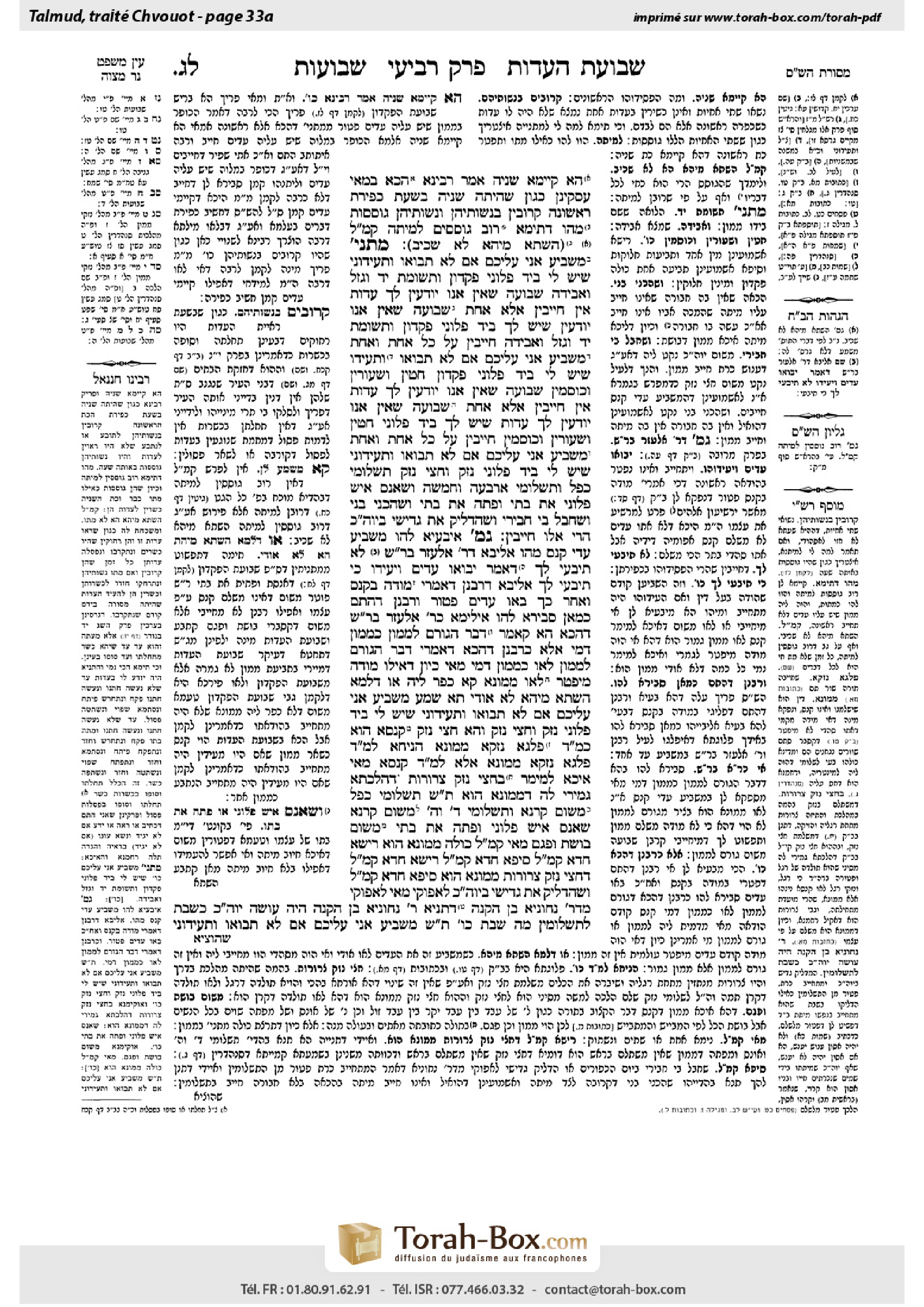
Shevuot 33a: Talmud study for Daf Yomi
Daf Yomi is the daily study of one Talmud folio. Explore 37 tractates with scans, Hebrew text, Sefaria English and AI-generated French translations where annotated.
Passage selection and English or AI-generated French translation are available where the scan has annotations. Daf Study is independent of Torah-Box and Sefaria.
Browse Shevuot · שבועות · All tractatesShevuot 33a text and translations
This page of Shevuot includes the Aramaic text, an English translation and an AI-generated French translation, alongside the scan above.
שבועות ל״ג א · Aramaic and Hebrew text
הָא קָיְימָא שְׁנִיָּה!
אָמַר רָבִינָא: הָכָא בְּמַאי עָסְקִינַן – כְּגוֹן שֶׁהָיְתָה שְׁנִיָּה בִּשְׁעַת כְּפִירַת רִאשׁוֹנָה קְרוֹבִין בִּנְשׁוֹתֵיהֶן, וּנְשׁוֹתֵיהֶן גּוֹסְסוֹת; מַהוּ דְּתֵימָא: רוֹב גּוֹסְסִים לְמִיתָה, קָא מַשְׁמַע לַן: הַשְׁתָּא מִיהָא לָא שְׁכֵיב.
מַתְנִי׳ ״מַשְׁבִּיעַ אֲנִי עֲלֵיכֶם, אִם לֹא תָבוֹאוּ וּתְעִידוּנִי שֶׁיֵּשׁ לִי בְּיַד פְּלוֹנִי פִּקָּדוֹן וּתְשׂוּמֶת יָד וְגָזֵל וַאֲבֵידָה״; ״שְׁבוּעָה שֶׁאֵין אָנוּ יוֹדְעִין לָךְ עֵדוּת״ – אֵין חַיָּיבִין אֶלָּא אַחַת.
״שְׁבוּעָה שֶׁאֵין אָנוּ יוֹדְעִין שֶׁיֵּשׁ לְךָ בְּיַד פְּלוֹנִי פִּקָּדוֹן וּתְשׂוּמֶת יָד וְגָזֵל וַאֲבֵידָה״ – חַיָּיבִין עַל כׇּל אַחַת וְאַחַת.
״מַשְׁבִּיעַ אֲנִי עֲלֵיכֶם, אִם לֹא תָבוֹאוּ וְתָעִידוּ שֶׁיֵּשׁ לִי בְּיַד פְּלוֹנִי פִּקָּדוֹן חִטִּין וּשְׂעוֹרִין וְכוּסְּמִין״; ״שְׁבוּעָה שֶׁאֵין אָנוּ יוֹדְעִין לְךָ עֵדוּת״ – אֵין חַיָּיבִין אֶלָּא אַחַת.
״שְׁבוּעָה שֶׁאֵין אָנוּ יוֹדְעִין לְךָ עֵדוּת שֶׁיֵּשׁ לְךָ בְּיַד פְּלוֹנִי חִטִּין וּשְׂעוֹרִין וְכוּסְּמִין״ – חַיָּיבִין עַל כׇּל אַחַת וְאַחַת.
״מַשְׁבִּיעַ אֲנִי עֲלֵיכֶם, אִם לֹא תָבוֹאוּ וּתְעִידוּנִי שֶׁיֵּשׁ לִי בְּיַד פְּלוֹנִי נֶזֶק, וַחֲצִי נֶזֶק, תַּשְׁלוּמֵי כֶּפֶל, וְתַשְׁלוּמֵי אַרְבָּעָה וַחֲמִשָּׁה, וְשֶׁאָנַס אִישׁ פְּלוֹנִי אֶת בִּתִּי, וּפִתָּה אֶת בִּתִּי, וְשֶׁהִכַּנִי בְּנִי, וְשֶׁחָבַל בִּי חֲבֵירִי, וְשֶׁהִדְלִיק אֶת גְּדִישִׁי בְּיוֹם הַכִּפּוּרִים״ – הֲרֵי אֵלּוּ חַיָּיבִין.
גְּמָ׳ אִיבַּעְיָא לְהוּ: מַשְׁבִּיעַ עֵדֵי קְנָס, מַהוּ?
אַלִּיבָּא דְּרַבִּי אֶלְעָזָר בְּרַבִּי שִׁמְעוֹן – לָא תִּיבְּעֵי לָךְ, דְּאָמַר: יָבוֹאוּ עֵדִים וְיָעִידוּ.
כִּי תִּיבְּעֵי לָךְ – אַלִּיבָּא דְּרַבָּנַן, דְּאָמְרִי: מוֹדֶה בִּקְנָס וְאַחַר כָּךְ בָּאוּ עֵדִים – פָּטוּר.
וְרַבָּנַן דְּהָתָם, כְּמַאן סְבִירָא לְהוּ? אִילֵּימָא כְּרַבִּי אֶלְעָזָר בְּרַבִּי שִׁמְעוֹן דְּהָכָא, הָא קָאָמַר: דָּבָר הַגּוֹרֵם לְמָמוֹן כְּמָמוֹן דָּמֵי!
אֶלָּא כְּרַבָּנַן דְּהָכָא, דְּאָמְרִי: דָּבָר הַגּוֹרֵם לְמָמוֹן לָאו כְּמָמוֹן דָּמֵי. מַאי? כֵּיוָן דְּאִילּוּ מוֹדֶה מִיפְּטַר – לָאו מָמוֹנָא קָא כָפַר לֵיהּ; אוֹ דִלְמָא, הַשְׁתָּא מִיהָא לָא אוֹדִי?
תָּא שְׁמַע: ״מַשְׁבִּיעַ אֲנִי עֲלֵיכֶם, אִם לֹא תָבוֹאוּ וּתְעִידוּנִי שֶׁיֵּשׁ לִי בְּיַד פְּלוֹנִי נֶזֶק וַחֲצִי נֶזֶק״. וְהָא חֲצִי נֶזֶק קְנָסָא הוּא! כְּמַאן דְּאָמַר פַּלְגָא נִזְקָא מָמוֹנָא.
הָנִיחָא לְמַאן דְּאָמַר פַּלְגָא נִזְקָא מָמוֹנָא; אֶלָּא לְמַאן דְּאָמַר קְנָסָא, מַאי אִיכָּא לְמֵימַר? בַּחֲצִי נֶזֶק צְרוֹרוֹת, דְּהִלְכְתָא גְּמִירִי לַהּ דְּמָמוֹנָא הוּא.
תָּא שְׁמַע: ״תַּשְׁלוּמֵי כֶפֶל״! מִשּׁוּם קַרְנָא.
״וְתַשְׁלוּמֵי אַרְבָּעָה וַחֲמִשָּׁה״! מִשּׁוּם קַרְנָא.
״שֶׁאָנַס אִישׁ פְּלוֹנִי וּפִתָּה אֶת בִּתִּי״! מִשּׁוּם בּוֹשֶׁת וּפְגָם.
מַאי קָא מַשְׁמַע לַן? כּוּלַּהּ מָמוֹנָא הוּא! רֵישָׁא חֲדָא קָא מַשְׁמַע לַן, סֵיפָא חֲדָא קָא מַשְׁמַע לַן; רֵישָׁא חֲדָא קָא מַשְׁמַע לַן – דַּחֲצִי נֶזֶק צְרוֹרוֹת מָמוֹנָא הוּא.
סֵיפָא חֲדָא קָא מַשְׁמַע לַן – ״וְשֶׁהִדְלִיק אֶת גְּדִישִׁי בְּיוֹם הַכִּפּוּרִים״. לְאַפּוֹקֵי מַאי? לְאַפּוֹקֵי מִדְּרַבִּי נְחוּנְיָא בֶּן הַקָּנָה – דְּתַנְיָא: רַבִּי נְחוּנְיָא בֶּן הַקָּנָה הָיָה עוֹשֶׂה יוֹם הַכִּפּוּרִים כַּשַּׁבָּת לְתַשְׁלוּמִין, מָה שַׁבָּת כּוּ׳.
תָּא שְׁמַע: ״מַשְׁבִּיעַ אֲנִי עֲלֵיכֶם, אִם לֹא תָבוֹאוּ וּתְעִידוּנִי
Shevuot 33a · English translation
But the second set of witnesses still stands available to testify, so what loss did the first set cause the plaintiff when they denied knowledge of the matter?
Ravina said: What are we dealing with here? We are dealing with a case where the two witnesses in the second set were relatives through their wives at the time of the denial of the first set of witnesses. The two witnesses in the second set were married to two sisters, and brothers-in-law are unfit to serve as witnesses together. Therefore, the claim of the plaintiff is entirely dependent upon the testimony of the first set of witnesses. And the sisters who were wives of the witnesses in the second set were moribund. Lest you say that since, presumably, the majority of individuals who are moribund will actually die very soon, and therefore these two witnesses are fit to testify together, therefore, the tanna teaches us that since now in any event, the wives had not yet died, their husbands remain unfit to testify together.
MISHNA: In a case where the plaintiff said to the witnesses: I administer an oath to you concerning your refusal to testify if you do not come and testify on my behalf that I have in the possession of so-and-so a deposit, and an outstanding loan, and a stolen item, and a lost item, and they lied in reply: On our oath we do not know any testimony on your behalf, they are liable for taking only one false oath of testimony.
But if they lied in reply: On our oath we do not know that you have in the possession of so-and-so a deposit, and an outstanding loan, and a stolen item, and a lost item, they are liable for each and every one of the components of the claim. It is as though they took a separate oath with regard to each of the details of the claim.
In a case where the plaintiff said to the witnesses: I administer an oath to you concerning your refusal to testify if you do not come and testify that I have in the possession of so-and-so a deposit of wheat, and barley, and spelt, and they lied in reply: On our oath we do not know any testimony on your behalf, they are liable for taking only one false oath of testimony.
But if they lied in reply: On our oath we do not know any testimony on your behalf that you have in the possession of so-and-so wheat, and barley, and spelt, they are liable for each and every one of the components of the claim.
In a case where the plaintiff said to the witnesses: I administer an oath to you concerning your refusal to testify if you do not come and testify on my behalf that I have in the possession of so-and-so an outstanding payment for damage; or an outstanding payment for half the damage, which the owner pays for damage caused by his innocuous ox goring another animal; or with regard to an outstanding payment of double the principal that a thief must pay the owner of the stolen item; or with regard to an outstanding payment of four or five times the principal that a thief pays when he stole a sheep or an ox, respectively, and then slaughtered or sold it; or in a case where the plaintiff said: I administer an oath to you concerning your refusal to testify if you do not come and testify that so-and-so raped my daughter; or, he seduced my daughter; or, that my son struck me; or, that another injured me; or, that he set my stack of grain on fire on Yom Kippur; if in any of these cases the witnesses took an oath falsely denying any knowledge of the matter on behalf of the plaintiff, these witnesses are liable for taking a false oath of testimony.
GEMARA: A dilemma was raised before the Sages: In a case where one administers an oath to witnesses concerning a fine if they do not come and testify that one performed an action that renders him liable to pay a sum fixed by the Torah as penalty for that action, what is the halakha? Is it like any other case of an oath administered to witnesses in monetary matters or not?
The Gemara refines the dilemma: According to the opinion of Rabbi Elazar, son of Rabbi Shimon, do not raise the dilemma, as he says in a case where one performed an action in the presence of witnesses for which he is liable to pay a fine, and before the witnesses testified, he admitted his liability, even though the principle is: One who admits that he is liable to pay a fine is exempt from paying the fine, the witnesses shall come and testify and render the one who performed the action liable to pay the fine. In his opinion, payment of the fine is dependent upon their testimony, and therefore if they lie, they are liable for taking a false oath of testimony.
When should you raise the dilemma? Raise it according to the opinion of the Rabbis who disagree with Rabbi Elazar, son of Rabbi Shimon, as they say: One who admits he is liable to pay a fine is exempt, even if afterward witnesses came and testified to his liability. The case in the mishna is one where the plaintiff demanded that the witnesses testify on his behalf before the defendant admitted knowledge of the fine.
The Gemara seeks to clarify: And the Rabbis, who expressed their opinion there that one who admits he is liable to pay a fine is exempt, even if afterward witnesses come, in accordance with whose opinion do they hold? If we say that they hold in accordance with the opinion of Rabbi Elazar, son of Rabbi Shimon, cited here (32a), doesn’t he say: A matter that causes financial loss is considered to have monetary value with regard to the oath of testimony? Witnesses who testify concerning a fine also cause financial loss, as, if the individual does not admit his liability, he will be liable to pay the fine based on their testimony.
Rather, apparently, the Rabbis there hold in accordance with the opinion of the Rabbis here, who say: A matter that causes financial loss is not considered to have monetary value. It is according to that opinion that the dilemma is raised: What is the halakha in the case of witnesses to a fine? Does one say: Since if the one liable to pay the fine admits his liability, he is exempt from paying the fine, the witness taking the oath denying knowledge of the matter is not denying a monetary claim, and therefore, he is not liable for taking a false oath of testimony? Or perhaps since now, in any event, he has not yet admitted liability, payment of the fine is dependent upon the testimony of these witnesses and it is considered a monetary matter for which they are liable for taking a false oath of testimony.
The Gemara suggests: Come and hear proof from the mishna to resolve the dilemma: I administer an oath to you concerning your refusal to testify if you do not come and testify on my behalf that I have in the possession of so-and-so an unpaid payment for damage; and likewise, an unpaid payment for half the damage. In those cases the witnesses can be held liable for the oath of testimony. But isn’t payment for half the damage payment of a fine? The Gemara rejects this proof: This mishna is in accordance with the opinion of the one who says that payment of half the damage is monetary restitution and not a fine.
The Gemara asks: This works out well according to the one who says that payment of half the damage is monetary restitution. But according to the one who says that payment of half the damage is payment of a fine, what can be said? The Gemara answers: In his opinion, the mishna is referring to a case where the plaintiff demands that the witnesses testify with regard to liability to pay for half the damage caused by pebbles inadvertently propelled by the foot of a walking animal, as they learned this halakha through tradition transmitted to Moses from Sinai that payment of half the damage in that case is monetary restitution, not a fine. Therefore, no proof may be cited from the mishna with regard to liability for taking a false oath of testimony concerning a fine.
The Gemara suggests: Come and hear proof from the mishna to resolve the dilemma: I administer an oath to you concerning your refusal to testify if you do not come and testify that I have in the possession of so-and-so an unpaid payment of double the principal, for which the witnesses are also liable for taking a false oath of testimony. But isn’t that payment of a fine? The Gemara responds: The liability for taking a false oath of testimony in that case is not due to their denial of knowledge of the matter with regard to the fine; rather, the liability is due to their denial of knowledge of the matter with regard to the principal, which is a full-fledged monetary payment.
The Gemara cites another proof from the mishna: I administer an oath to you concerning your refusal to testify if you do not come and testify that I have in the possession of so-and-so payment of four or five times the principal, which is a fine. The Gemara answers: There too, the liability is due to their denial of knowledge of the matter with regard to the principal, not due to the fine.
The Gemara cites another proof from the continuation of the mishna: I administer an oath to you concerning your refusal to testify if you do not come and testify that so-and-so raped my daughter; or, he seduced my daughter. Isn’t the payment for rape and seduction a fine of 50 sela? The Gemara rejects this: There, the liability of the witnesses is due to their denial of knowledge of the matter with regard to payment for humiliation and compensation for degradation of the value of the young woman resulting from the rape or the seduction. Those are categorized as monetary restitution, not as fines.
The Gemara asks: According to this understanding, what is the tanna teaching us with the multiplicity of cases in the mishna? All the cases in the mishna are of monetary restitution. The Gemara answers: In the first clause, the tanna teaches us one novel element, and in the latter clause, the tanna teaches us one novel element. In the first clause, the tanna teaches us one novel element, that liability to pay for half the damage caused by pebbles is monetary restitution, not a fine.
In the latter clause, the tanna teaches us one novel element: I administer an oath to you concerning your refusal to testify if you do not come and testify that he set my stack of grain on fire on Yom Kippur. What does this halakha serve to exclude? It serves to exclude the opinion of Rabbi Neḥunya ben HaKana, as it is taught in a baraita: Rabbi Neḥunya ben HaKana would deem Yom Kippur like Shabbat with regard to payment of damages. Just as in the case of one who intentionally desecrates Shabbat, he is liable to receive the death penalty and is therefore exempt from liability for payment for damage that is caused while desecrating Shabbat, so too, in the case of one who intentionally desecrates Yom Kippur, he is liable to receive the death penalty and is therefore exempt from liability for payment for damage that is caused while desecrating Yom Kippur. The tanna of the mishna disagrees.
The Gemara suggests: Come and hear proof from a baraita to resolve the dilemma: I administer an oath to you concerning your refusal to testify if you do not come and testify on my behalf
Shevuot 33a · Traduction française (IA)
Mais les témoins du second groupe sont toujours disponibles pour témoigner. Quel préjudice le premier groupe a-t-il donc causé au demandeur en niant connaître l’affaire ?
Ravina dit : De quoi s’agit-il ici ? D’un cas où les deux témoins du second groupe étaient apparentés par alliance au moment où les témoins du premier groupe ont nié connaître l’affaire. Les deux témoins du second groupe étaient mariés à deux sœurs, et des beaux-frères ne peuvent pas témoigner ensemble. La demande du plaignant dépend donc entièrement du témoignage des témoins du premier groupe. Or, les sœurs, épouses des témoins du second groupe, étaient mourantes. Ne pourrait-on pas dire que, puisque la plupart des personnes mourantes vont effectivement mourir très bientôt, ces deux témoins sont aptes à témoigner ensemble ? Le tanna nous enseigne donc que, puisque leurs épouses ne sont pas encore mortes, leurs maris restent inaptes à témoigner ensemble.
MICHNA : Si le plaignant dit aux témoins : « Je vous fais prêter serment au sujet de votre refus de témoigner si vous ne venez pas témoigner en ma faveur que je détiens chez untel un dépôt, une créance impayée, un objet volé et un objet perdu », et qu’ils répondent mensongèrement : « Par notre serment, nous ne connaissons aucun témoignage en votre faveur », ils ne sont passibles que d’un seul serment de témoignage mensonger.
Mais s’ils répondent mensongèrement : « Par notre serment, nous ne savons pas que vous détenez chez untel un dépôt, une créance impayée, un objet volé et un objet perdu », ils sont passibles d’une sanction pour chacun des éléments de la demande. C’est comme s’ils avaient prêté un serment distinct au sujet de chacun de ces éléments.
Si le plaignant dit aux témoins : « Je vous fais prêter serment au sujet de votre refus de témoigner si vous ne venez pas témoigner que je détiens chez untel du blé, de l’orge et de l’épeautre », et qu’ils répondent mensongèrement : « Par notre serment, nous ne connaissons aucun témoignage en votre faveur », ils ne sont passibles que d’un seul serment de témoignage mensonger.
Mais s’ils répondent mensongèrement : « Par notre serment, nous ne connaissons aucun témoignage en votre faveur attestant que vous détenez chez untel du blé, de l’orge et de l’épeautre », ils sont passibles d’une sanction pour chacun des éléments de la demande.
Si le plaignant dit aux témoins : « Je vous fais prêter serment au sujet de votre refus de témoigner si vous ne venez pas témoigner en ma faveur que je détiens chez untel une créance impayée pour des dommages ; ou une créance impayée correspondant à la moitié des dommages, somme que le propriétaire paie pour les dommages causés lorsqu’un bœuf inoffensif en encorne un autre animal ; ou une créance impayée correspondant au double du principal qu’un voleur doit verser au propriétaire de l’objet volé ; ou une créance impayée correspondant à quatre ou cinq fois le principal, somme que le voleur paie lorsqu’il a volé un mouton ou un bœuf, respectivement, puis l’a abattu ou vendu » ; ou si le plaignant dit : « Je vous fais prêter serment au sujet de votre refus de témoigner si vous ne venez pas témoigner qu’untel a violé ma fille ; ou qu’il l’a séduite ; ou que mon fils m’a frappé ; ou qu’un autre m’a blessé ; ou qu’il a incendié ma meule de grain à Yom Kippour », si, dans l’un de ces cas, les témoins prêtent un faux serment en niant connaître l’affaire en faveur du plaignant, ils sont passibles d’un serment de témoignage mensonger.
GUEMARA : Les Sages soulevèrent une question : si quelqu’un fait prêter serment à des témoins au sujet d’une amende, au cas où ils ne viendraient pas témoigner qu’une personne a commis un acte la rendant passible d’une somme fixée par la Torah à titre de sanction, quelle est la halakha ? Le cas est-il semblable à celui de tout autre serment imposé à des témoins en matière pécuniaire, ou non ?
La Guemara précise la question : selon l’opinion de Rabbi Elazar, fils de Rabbi Shimon, il n’y a pas lieu de la poser. En effet, il affirme que si une personne commet, devant des témoins, un acte qui la rend passible d’une amende, puis reconnaît sa responsabilité avant que les témoins n’aient témoigné, ceux-ci doivent venir témoigner et rendre cette personne passible de l’amende. Cela, bien que le principe soit le suivant : celui qui reconnaît être passible d’une amende en est exempté. Selon lui, le paiement de l’amende dépend de leur témoignage ; par conséquent, s’ils mentent, ils sont passibles d’un serment de témoignage mensonger.
Dans quel cas faut-il donc poser la question ? Selon l’opinion des Rabbins qui sont en désaccord avec Rabbi Elazar, fils de Rabbi Shimon, car ils disent que celui qui reconnaît être passible d’une amende en est exempté, même si des témoins viennent ensuite témoigner de sa responsabilité. Le cas de la Michna est celui où le plaignant a demandé aux témoins de déposer en sa faveur avant que le défendeur ne reconnaisse être passible de l’amende.
La Guemara cherche à préciser : les Rabbins qui ont exprimé là-bas l’opinion selon laquelle celui qui reconnaît être passible d’une amende en est exempté, même si des témoins viennent ensuite, de quelle opinion se réclament-ils ? S’ils se réclament de l’opinion de Rabbi Elazar, fils de Rabbi Shimon, citée ici (32a), ne dit-il pas qu’une affaire entraînant une perte financière est considérée comme ayant une valeur pécuniaire au regard du serment de témoignage ? Des témoins qui déposent au sujet d’une amende entraînent eux aussi une perte financière : si la personne ne reconnaît pas sa responsabilité, elle sera passible de l’amende sur la base de leur témoignage.
Il faut donc conclure que les Rabbins de là-bas se rangent à l’opinion des Rabbins d’ici, qui disent qu’une affaire entraînant une perte financière n’est pas considérée comme ayant une valeur pécuniaire. C’est selon cette opinion que la question est posée : quelle est la halakha dans le cas de témoins appelés à déposer au sujet d’une amende ? Doit-on dire que, puisque la personne passible de l’amende en est exemptée si elle reconnaît sa responsabilité, le témoin qui jure en niant connaître l’affaire ne nie pas une créance pécuniaire et n’est donc pas passible d’un serment de témoignage mensonger ? Ou peut-être que, puisqu’à présent la personne n’a pas encore reconnu sa responsabilité, le paiement de l’amende dépend du témoignage de ces témoins ; il s’agit donc d’une affaire pécuniaire et ils sont passibles d’un serment de témoignage mensonger.
La Guemara propose : Viens entendre un élément de preuve tiré de la Michna pour résoudre la question : « Je vous fais prêter serment au sujet de votre refus de témoigner si vous ne venez pas témoigner en ma faveur que je détiens chez untel une créance impayée pour des dommages ; et aussi une créance impayée correspondant à la moitié des dommages. » Dans ces cas, les témoins peuvent être passibles du serment de témoignage. Mais le paiement de la moitié des dommages n’est-il pas une amende ? La Guemara rejette cette preuve : cette Michna suit l’opinion de celui qui dit que le paiement de la moitié des dommages constitue une réparation pécuniaire et non une amende.
La Guemara demande : Cela convient selon celui qui dit que le paiement de la moitié des dommages constitue une réparation pécuniaire. Mais que peut-on répondre selon celui qui dit qu’il s’agit d’une amende ? La Guemara répond : selon lui, la Michna parle d’un cas où le plaignant demande aux témoins de déposer au sujet de l’obligation de payer la moitié des dommages causés par des cailloux projetés involontairement par le pied d’un animal en marche. En effet, ils ont appris par tradition, transmise à Moïse au Sinaï, que dans ce cas le paiement de la moitié des dommages constitue une réparation pécuniaire et non une amende. On ne peut donc tirer de la Michna aucune preuve concernant la responsabilité pour un serment de témoignage mensonger au sujet d’une amende.
La Guemara propose : Viens entendre un élément de preuve tiré de la Michna pour résoudre la question : « Je vous fais prêter serment au sujet de votre refus de témoigner si vous ne venez pas témoigner que je détiens chez untel une créance impayée correspondant au double du principal. » Dans ce cas également, les témoins sont passibles d’un serment de témoignage mensonger. Mais ce paiement n’est-il pas une amende ? La Guemara répond : dans ce cas, ils sont passibles non parce qu’ils ont nié connaître l’affaire concernant l’amende, mais parce qu’ils ont nié connaître l’affaire concernant le principal, qui constitue un véritable paiement pécuniaire.
La Guemara cite un autre élément de preuve tiré de la Michna : « Je vous fais prêter serment au sujet de votre refus de témoigner si vous ne venez pas témoigner que je détiens chez untel une créance impayée correspondant à quatre ou cinq fois le principal », ce qui constitue une amende. La Guemara répond : là aussi, ils sont passibles parce qu’ils ont nié connaître l’affaire concernant le principal, et non concernant l’amende.
La Guemara cite un autre élément de preuve tiré de la suite de la Michna : « Je vous fais prêter serment au sujet de votre refus de témoigner si vous ne venez pas témoigner qu’untel a violé ma fille ; ou qu’il l’a séduite. » Le paiement dû pour un viol ou une séduction n’est-il pas une amende de 50 sela ? La Guemara rejette cette preuve : dans ces cas, les témoins sont passibles parce qu’ils ont nié connaître l’affaire concernant le paiement pour l’humiliation et l’indemnisation de la dépréciation de la valeur de la jeune femme résultant du viol ou de la séduction. Ces paiements sont classés comme des réparations pécuniaires, et non comme des amendes.
La Guemara demande : Selon cette interprétation, que nous enseigne le tanna par la multiplicité des cas de la Michna ? Tous les cas de la Michna concernent des réparations pécuniaires. La Guemara répond : dans la première partie, le tanna nous enseigne un élément nouveau, et dans la dernière partie, il nous en enseigne un autre. Dans la première partie, il nous enseigne que l’obligation de payer la moitié des dommages causés par des cailloux constitue une réparation pécuniaire et non une amende.
Dans la dernière partie, le tanna nous enseigne un élément nouveau : « Je vous fais prêter serment au sujet de votre refus de témoigner si vous ne venez pas témoigner qu’il a incendié ma meule de grain à Yom Kippour. » Qu’est-ce que cette halakha vient exclure ? Elle vient exclure l’opinion de Rabbi Neḥunya ben HaKana, car il est enseigné dans une baraïta que Rabbi Neḥunya ben HaKana assimilait Yom Kippour à Chabbat concernant le paiement des dommages. De même que celui qui profane intentionnellement Chabbat est passible de la peine de mort et donc exempté de payer les dommages causés pendant la profanation de Chabbat, de même celui qui profane intentionnellement Yom Kippour est passible de la peine de mort et donc exempté de payer les dommages causés pendant la profanation de Yom Kippour. Le tanna de la Michna est en désaccord avec lui.
La Guemara propose : Viens entendre un élément de preuve tiré d’une baraïta pour résoudre la question : « Je vous fais prêter serment au sujet de votre refus de témoigner si vous ne venez pas témoigner en ma faveur ».
Traduction française générée par IA à partir de l’édition anglaise de Sefaria. Vérifie toujours un passage avec le texte source.
Text from Sefaria: William Davidson Edition - Vocalized Aramaic (CC BY NC); William Davidson Edition - English (CC BY NC).