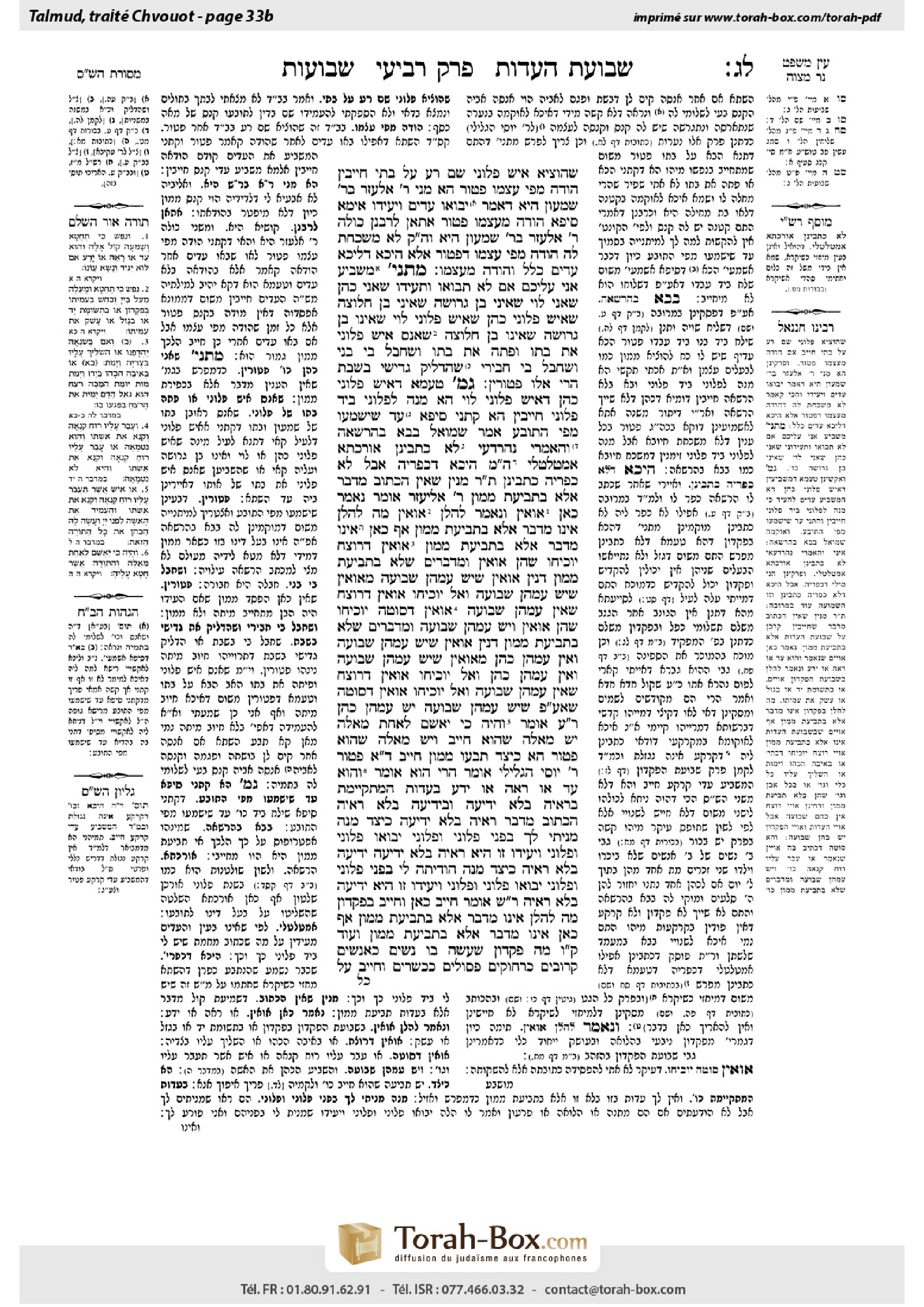
Shevuot 33b: Talmud study for Daf Yomi
Daf Yomi is the daily study of one Talmud folio. Explore 37 tractates with scans, Hebrew text, Sefaria English and AI-generated French translations where annotated.
Passage selection and English or AI-generated French translation are available where the scan has annotations. Daf Study is independent of Torah-Box and Sefaria.
Browse Shevuot · שבועות · All tractatesShevuot 33b text and translations
This page of Shevuot includes the Aramaic text, an English translation and an AI-generated French translation, alongside the scan above.
שבועות ל״ג ב · Aramaic and Hebrew text
שֶׁהוֹצִיא אִישׁ פְּלוֹנִי שֵׁם רַע עַל בִּתִּי״ – חַיָּיבִין. הוֹדָה מִפִּי עַצְמוֹ – פָּטוּר.
הָא מַנִּי – רַבִּי אֶלְעָזָר בְּרַבִּי שִׁמְעוֹן הִיא, דְּאָמַר: יָבוֹאוּ עֵדִים וְיָעִידוּ.
אֵימָא סֵיפָא: הוֹדָה מֵעַצְמוֹ – פָּטוּר, אֲתָאן לְרַבָּנַן!
כּוּלָּהּ רַבִּי אֶלְעָזָר בְּרַבִּי שִׁמְעוֹן הִיא, וְהָכִי קָאָמַר: לָא מַשְׁכַּחַתְּ לַהּ הוֹדָה מִפִּי עַצְמוֹ דְּפָטוּר, אֶלָּא הֵיכָא דְּלֵיכָּא עֵדִים כְּלָל וְהוֹדָה מֵעַצְמוֹ.
מַתְנִי׳ ״מַשְׁבִּיעַ אֲנִי עֲלֵיכֶם, אִם לֹא תָבוֹאוּ וְתָעִידוּ שֶׁאֲנִי כֹּהֵן, שֶׁאֲנִי לֵוִי, שֶׁאֵינִי בֶּן גְּרוּשָׁה, שֶׁאֵינִי בֶּן חֲלוּצָה, שֶׁאִישׁ פְּלוֹנִי כֹּהֵן, שֶׁאִישׁ פְּלוֹנִי לֵוִי, שֶׁאֵינוֹ בֶּן גְּרוּשָׁה, שֶׁאֵינוֹ בֶּן חֲלוּצָה,
שֶׁאָנַס אִישׁ פְּלוֹנִי אֶת בִּתּוֹ, וּפִתָּה אֶת בִּתּוֹ, וְשֶׁחָבַל בִּי בְּנִי, וְשֶׁחָבַל בִּי חֲבֵירִי, שֶׁהִדְלִיק גְּדִישִׁי בְּשַׁבָּת״ – הֲרֵי אֵלּוּ פְּטוּרִין.
גְּמָ׳ טַעְמָא דְּאִישׁ פְּלוֹנִי כֹּהֵן, דְּאִישׁ פְּלוֹנִי לֵוִי; הָא ״מָנֶה לִפְלוֹנִי בְּיַד פְּלוֹנִי״ – חַיָּיבִין; הָא קָתָנֵי סֵיפָא: עַד שֶׁיִּשְׁמְעוּ מִפִּי הַתּוֹבֵעַ!
אָמַר שְׁמוּאֵל: בְּבָא בְּהַרְשָׁאָה. וְהָאָמְרִי נְהַרְדָּעֵי: לָא כָּתְבִינַן אוֹרַכְתָּא אַמִּטַּלְטְלִי! הָנֵי מִילֵּי הֵיכָא דְּכַפְרֵיהּ, אֲבָל לָא כַּפְרֵיהּ – כָּתְבִינַן.
תָּנוּ רַבָּנַן: מִנַּיִן שֶׁאֵין הַכָּתוּב מְדַבֵּר אֶלָּא בִּתְבִיעַת מָמוֹן? רַבִּי אֱלִיעֶזֶר אוֹמֵר: נֶאֱמַר כָּאן ״אוֹאִין״, וְנֶאֱמַר לְהַלָּן ״אוֹאִין״; מָה לְהַלָּן אֵינוֹ מְדַבֵּר אֶלָּא בִּתְבִיעַת מָמוֹן, אַף כָּאן אֵינוֹ מְדַבֵּר אֶלָּא בִּתְבִיעַת מָמוֹן.
״אוֹאִין״ דְּרוֹצֵחַ יוֹכִיחוּ – שֶׁהֵן ״אוֹאִין״, וּמְדַבְּרִים שֶׁלֹּא בִּתְבִיעַת מָמוֹן!
דָּנִין ״אוֹאִין״ שֶׁיֵּשׁ עִמָּהֶן שְׁבוּעָה מֵ״אוֹאִין״ שֶׁיֵּשׁ עִמָּהֶן שְׁבוּעָה, וְאַל יוֹכִיחוּ ״אוֹאִין״ דְּרוֹצֵחַ – שֶׁאֵין עִמָּהֶן שְׁבוּעָה.
״אוֹאִין״ דְּסוֹטָה יוֹכִיחוּ – שֶׁהֵן ״אוֹאִין״, וְיֵשׁ עִמָּהֶן שְׁבוּעָה, וּמְדַבְּרִים שֶׁלֹּא בִּתְבִיעַת מָמוֹן!
דָּנִין ״אוֹאִין״ שֶׁיֵּשׁ עִמָּהֶן שְׁבוּעָה וְאֵין עִמָּהֶן כֹּהֵן, מֵ״אוֹאִין״ שֶׁיֵּשׁ עִמָּהֶן שְׁבוּעָה וְאֵין עִמָּהֶן כֹּהֵן; וְאַל יוֹכִיחוּ ״אוֹאִין״ דְּרוֹצֵחַ – שֶׁאֵין עִמָּהֶן שְׁבוּעָה; וְאַל יוֹכִיחוּ ״אוֹאִין״ דְּסוֹטָה – שֶׁאַף עַל פִּי שֶׁיֵּשׁ עִמָּהֶן שְׁבוּעָה, יֵשׁ עִמָּהֶן כֹּהֵן.
רַבִּי עֲקִיבָא אוֹמֵר: ״וְהָיָה כִּי יֶאְשַׁם לְאַחַת מֵאֵלֶּה״ – יֵשׁ מֵאֵלֶּה שֶׁהוּא חַיָּיב, וְיֵשׁ מֵאֵלֶּה שֶׁהוּא פָּטוּר. הָא כֵּיצַד? תְּבָעוֹ מָמוֹן – חַיָּיב, דָּבָר אַחֵר – פָּטוּר.
רַבִּי יוֹסֵי הַגְּלִילִי אוֹמֵר: הֲרֵי הוּא אוֹמֵר ״וְהוּא עֵד אוֹ רָאָה אוֹ יָדָע״ – בְּעֵדוּת הַמִּתְקַיֶּימֶת בִּרְאִיָּה בְּלֹא יְדִיעָה וּבִידִיעָה בְּלֹא רְאָיָה הַכָּתוּב מְדַבֵּר.
רְאִיָּה בְּלֹא יְדִיעָה – כֵּיצַד? ״מָנֶה מָנִיתִי לְךָ בִּפְנֵי פְּלוֹנִי וּפְלוֹנִי״, ״יָבוֹאוּ פְּלוֹנִי וּפְלוֹנִי וְיָעִידוּ״ – זוֹ הִיא רְאִיָּה בְּלֹא יְדִיעָה.
יְדִיעָה בְּלֹא רְאִיָּה – כֵּיצַד? ״מָנֶה הוֹדֵיתָה לִי בִּפְנֵי פְּלוֹנִי וּפְלוֹנִי״, ״יָבוֹאוּ פְּלוֹנִי וּפְלוֹנִי וְיָעִידוּ״ – זוֹ הִיא יְדִיעָה בְּלֹא רְאִיָּה.
רַבִּי שִׁמְעוֹן אוֹמֵר: חִיֵּיב כָּאן וְחִיֵּיב בְּפִקָּדוֹן; מָה לְהַלָּן אֵינוֹ מְדַבֵּר אֶלָּא בִּתְבִיעַת מָמוֹן, אַף כָּאן אֵינוֹ מְדַבֵּר אֶלָּא בִּתְבִיעַת מָמוֹן.
וְעוֹד – קַל וָחוֹמֶר: מָה פִּקָּדוֹן – שֶׁעָשָׂה בּוֹ נָשִׁים כַּאֲנָשִׁים, קְרוֹבִים כִּרְחוֹקִים, פְּסוּלִים כִּכְשֵׁרִים; וְחַיָּיב עַל
Shevuot 33b · English translation
that so-and-so slandered my daughter. In such a case, the witnesses are liable for taking a false oath of testimony. If the accused admitted on his own that he slandered the young woman, he is exempt from paying the fine. The only payment in the case of a husband who falsely accuses his bride of adultery is payment of a fine, and yet the baraita says that the witnesses are liable for taking a false oath of testimony.
The Gemara answers: In accordance with whose opinion is this baraita? It is in accordance with the opinion of Rabbi Elazar, son of Rabbi Shimon, who says: Even if the one who is liable to pay the fine admits his liability, the witnesses shall come and testify and render the one who performed the action liable to pay the fine.
The Gemara asks: Say the latter clause of the baraita: If that man admitted on his own that he slandered the young woman, he is exempt from paying the fine. Ostensibly, in this we arrive at the opinion of the Rabbis, who hold that if the one who is liable admits his liability before the witnesses testify, he is exempt from paying the fine, contrary to the opinion of Rabbi Elazar, son of Rabbi Shimon.
The Gemara explains: The baraita in its entirety is the opinion of Rabbi Elazar, son of Rabbi Shimon, and this is what the tanna is saying in the latter clause: You find a case of one who admitted liability on his own that he is exempt from paying the fine, only in a case where there are no witnesses at all and he admitted liability on his own. In a case where there are witnesses, he is liable to pay the fine on the basis of their testimony even if he admitted liability.
MISHNA: In a case where the plaintiff said to two witnesses: I administer an oath to you concerning your refusal to testify if you do not come and testify that I am a priest, or that I am a Levite, or that I am not the son of a priest and a divorced woman, or that I am not the son of a priest and a ḥalutza, or that so-and-so is a priest, or that so-and-so is a Levite, or that he is not the son of a priest and a divorced woman, or that he is not the son of a priest and a ḥalutza; in all these cases the witnesses are exempt from liability for taking a false oath of testimony, because these do not involve monetary claims.
Likewise, if the plaintiff said to them: I administer an oath to you concerning your refusal to testify if you do not come and testify that so-and-so raped his daughter, or that he seduced his daughter, or that my son injured me, or that another person wounded me on Shabbat, or that he set my stack of grain on fire on Shabbat; in all these cases these witnesses are exempt, as each case is punishable with the death penalty, and therefore they are cases that do not involve monetary payment.
GEMARA: The Gemara infers: The reason that the witnesses are exempt is that the plaintiff demanded that they testify that so-and-so is a priest or that so-and-so is a Levite, which are claims that do not involve monetary payment; but were the plaintiff to say: I administer an oath to you concerning your refusal to testify if you do not come and testify that one hundred dinars belonging to so-and-so are in the possession of another so-and-so, they would be liable. But isn’t it taught in the latter clause of the mishna (35a): The witnesses are exempt until they hear a demand to come and testify directly from the mouth of the plaintiff, and here the individual administering the oath is not the plaintiff.
Shmuel says: The reference here is to a case where the individual administering the oath comes with authorization to demand that the witnesses testify on his behalf. The Gemara asks: But didn’t the Sages of Neharde’a say: We do not write an authorization document concerning movable property? The Gemara answers: This statement that one does not write authorization for movable property applies only in a case where the respondent already denied the claim against him. But in a case where the respondent did not yet deny the claim against him, we write authorization even for movable property.
§ The Sages taught: From where is it derived that the verse with regard to an oath of testimony is speaking only about cases involving a monetary claim? Rabbi Eliezer says: Multiple instances of the term “or” are stated here, with regard to an oath of testimony: “And he hears the voice of an oath and he is a witness or he saw or he knew” (Leviticus 5:1), and multiple instances of the term “or” are stated there, with regard to an oath on a deposit: “And he deals falsely with his neighbor in a matter of deposit, or of an outstanding loan, or of robbery, or he exploited his colleague, or he found a lost item” (Leviticus 5:21–22); just as there, the verse is speaking only about cases involving a monetary claim, so too here, the verse is speaking only about cases involving a monetary claim.
The Gemara challenges: The multiple instances of the term “or” that are stated with regard to a murderer: “And if he shoved him with hatred or cast upon him any vessel without lying in wait or in enmity smote him with his hand” (Numbers 35:20–21), will prove that multiple instances of the term “or” are unrelated to limiting the application of the halakha to cases involving a monetary claim, as these are multiple instances of the term “or” in verses that are not speaking about cases involving a monetary claim.
The Gemara answers: One infers multiple instances of the term “or” with which there is an oath administered, i.e., an oath of testimony, from multiple instances of the term “or” with which there is an oath administered, i.e., an oath on a deposit, and the multiple instances of the term “or” that are stated with regard to a murderer will not prove anything to the contrary, as there is no oath in their context.
The Gemara challenges: The multiple instances of the term “or” that are stated with regard to a sota in the Torah: “Or if the spirit of jealousy came upon him…or a man upon whom a spirit of jealousy came” (Numbers 5:14, 30), will prove that multiple instances of the term are unrelated to a monetary claim, as these are multiple instances of the term “or,” and there is an oath administered by the priest to the sota in their context, and the verse is speaking about cases not involving a monetary claim.
The Gemara rejects this: One infers multiple instances of the term “or” with which there is an oath administered and with which there is no priest administering it, i.e., the case of an oath of testimony, from multiple instances of the term “or” with which there is an oath administered and with which there is no priest administering it, i.e., an oath on a deposit, and the multiple instances of the term “or” that are stated with regard to a murderer will not prove anything to the contrary, as there is no oath in their context, and the multiple instances of the term “or” that are stated with regard to a sota will not prove anything to the contrary, as even though there is an oath in their context, there is a priest administering the oath in their context. This is the source from which Rabbi Eliezer proves that liability for an oath of testimony is limited to cases involving a monetary claim.
Rabbi Akiva says that it is written with regard to an oath of testimony: “And it shall be when he will be guilty of one of these” (Leviticus 5:5). The term “of these” is a restrictive expression from which it is derived: There are some of these for which he is liable and there are some of these for which he is exempt. How so? If the plaintiff demanded testimony from the witness with regard to a monetary claim, the witness is liable for taking a false oath; if the plaintiff demanded testimony from the witness with regard to another matter, he is exempt.
Rabbi Yosei HaGelili cites a different proof and says: The verse states with regard to an oath of testimony: “And he is a witness or he saw or he knew” (Leviticus 5:1). It is with regard to testimony that is founded on sight, i.e., direct observation, without knowledge of the matter, or by means of indirect knowledge of the matter without sight that the verse is speaking.
Sight without knowledge, how so? It is a case where the creditor claims: I counted one hundred dinars for you before so-and-so and so-and-so, and the debtor responds: Let so-and-so and so-and-so come and testify. This is a case of sight without knowledge, as the witnesses do not know whether the money was counted as a loan, a deposit, or repayment of a loan.
Knowledge without sight, how so? It is a case where the creditor claims: You admitted to owing me one hundred dinars before so-and-so and so-and-so, and the debtor replied: Let so-and-so and so-and-so come and testify. This is a case of knowledge of the debt without sight of the loan taking place. Testimony based on sight without knowledge or based on knowledge without sight is possible only in cases involving a monetary claim.
Rabbi Shimon cites a different proof and says: The Torah rendered one liable if he takes a false oath here with regard to testimony, and the Torah rendered one liable if he takes a false oath with regard to a deposit; just as there, the verse is speaking of liability only in cases involving a monetary claim, so too here, the verse is speaking of liability only in cases involving a monetary claim.
And furthermore, one can infer this halakha by means of an a fortiori inference from the halakha of a deposit. If in the case of a deposit, with regard to which the Torah rendered the halakhic status of women like that of men, the halakhic status of relatives like that of non-relatives, and the halakhic status of unfit witnesses like that of those fit to testify, and he is liable for
Shevuot 33b · Traduction française (IA)
que tel homme a diffamé ma fille. Dans un tel cas, les témoins sont passibles pour avoir prêté un faux serment de témoignage. Si l’accusé reconnaît de lui-même qu’il a diffamé la jeune femme, il est exempté du paiement de l’amende. Dans le cas d’un mari qui accuse à tort son épouse d’adultère, le seul paiement est une amende ; pourtant, la baraïta dit que les témoins sont passibles pour avoir prêté un faux serment de témoignage.
La Guemara répond : Selon l’opinion de qui cette baraïta est-elle formulée ? Selon l’opinion de Rabbi Elazar, fils de Rabbi Shimon, qui dit : Même si celui qui est passible de l’amende reconnaît sa responsabilité, les témoins doivent venir témoigner et rendre passible de l’amende celui qui a commis l’acte.
La Guemara demande : Considérons la dernière clause de la baraïta : Si cet homme reconnaît de lui-même qu’il a diffamé la jeune femme, il est exempté du paiement de l’amende. Apparemment, nous retrouvons ici l’opinion des rabbins, qui soutiennent que si celui qui est passible de l’amende reconnaît sa responsabilité avant que les témoins ne témoignent, il est exempté de l’amende, contrairement à l’opinion de Rabbi Elazar, fils de Rabbi Shimon.
La Guemara explique : La baraïta dans son ensemble suit l’opinion de Rabbi Elazar, fils de Rabbi Shimon, et voici ce que le tanna dit dans la dernière clause : On ne trouve un cas où celui qui reconnaît de lui-même sa responsabilité est exempté du paiement de l’amende que lorsqu’il n’y a aucun témoin et qu’il reconnaît sa responsabilité de lui-même. S’il y a des témoins, il est passible de l’amende sur la base de leur témoignage, même s’il a reconnu sa responsabilité.
Michna : Dans le cas où le demandeur dit à deux témoins : « Je vous fais prêter serment au sujet de votre refus de témoigner si vous ne venez pas témoigner que je suis prêtre, ou que je suis lévite, ou que je ne suis pas le fils d’un prêtre et d’une femme divorcée, ou que je ne suis pas le fils d’un prêtre et d’une ḥaloutsa, ou que tel homme est prêtre, ou que tel homme est lévite, ou qu’il n’est pas le fils d’un prêtre et d’une femme divorcée, ou qu’il n’est pas le fils d’un prêtre et d’une ḥaloutsa » ; dans tous ces cas, les témoins sont exemptés de responsabilité pour avoir prêté un faux serment de témoignage, car il ne s’agit pas de revendications pécuniaires.
De même, si le demandeur leur dit : « Je vous fais prêter serment au sujet de votre refus de témoigner si vous ne venez pas témoigner que tel homme a violé sa fille, ou qu’il a séduit sa fille, ou que mon fils m’a blessé, ou qu’une autre personne m’a blessé pendant Chabbat, ou qu’il a mis le feu à ma meule de céréales pendant Chabbat » ; dans tous ces cas, les témoins sont exemptés, car chacun de ces actes est passible de la peine de mort et, par conséquent, il ne s’agit pas de cas entraînant un paiement pécuniaire.
Guemara : La Guemara déduit que si les témoins sont exemptés, c’est parce que le demandeur leur a demandé de témoigner que tel homme est prêtre ou que tel homme est lévite, des revendications qui ne portent pas sur un paiement pécuniaire. Mais si le demandeur leur disait : « Je vous fais prêter serment au sujet de votre refus de témoigner si vous ne venez pas témoigner que cent dinars appartenant à tel homme sont en possession de tel autre homme », ils seraient passibles. Mais n’est-il pas enseigné dans la dernière clause de la Michna (35a) : « Les témoins sont exemptés tant qu’ils n’ont pas entendu le demandeur lui-même leur demander de venir témoigner » ? Or, ici, celui qui fait prêter serment n’est pas le demandeur.
Shmuel dit : Il s’agit ici d’un cas où celui qui fait prêter serment est muni d’une autorisation lui permettant de demander aux témoins de témoigner en son nom. La Guemara demande : Mais les Sages de Neharde’a n’ont-ils pas dit : « Nous ne rédigeons pas de document d’autorisation concernant les biens meubles » ? La Guemara répond : Cette règle, selon laquelle on ne rédige pas d’autorisation pour les biens meubles, ne s’applique que dans un cas où le défendeur a déjà nié la revendication formulée contre lui. Mais si le défendeur n’a pas encore nié la revendication formulée contre lui, nous rédigeons une autorisation, même pour des biens meubles.
§ Les Sages ont enseigné : D’où déduit-on que le verset concernant le serment de témoignage ne parle que de cas portant sur une revendication pécuniaire ? Rabbi Eliezer dit : Plusieurs occurrences du terme « ou » figurent ici, à propos du serment de témoignage : « Il entend la voix d’un serment, il est témoin, ou il a vu, ou il en a connaissance » (Lévitique 5:1) ; et plusieurs occurrences du terme « ou » figurent là, à propos du serment relatif à un dépôt : « Il agit avec perfidie envers son prochain au sujet d’un dépôt, ou d’un prêt, ou d’un vol, ou s’il a extorqué quelque chose à son prochain, ou s’il a trouvé un objet perdu » (Lévitique 5:21–22). De même que là, le verset ne parle que de cas portant sur une revendication pécuniaire, de même ici, le verset ne parle que de cas portant sur une revendication pécuniaire.
La Guemara objecte : Les occurrences du terme « ou » qui figurent à propos d’un meurtrier — « S’il l’a poussé par haine, ou s’il a jeté sur lui un objet sans être à l’affût, ou s’il l’a frappé de sa main par inimitié » (Nombres 35:20–21) — prouvent que les occurrences multiples du terme « ou » ne servent pas à limiter l’application de la halakha aux cas portant sur une revendication pécuniaire, car elles figurent dans des versets qui ne parlent pas de revendications pécuniaires.
La Guemara répond : On déduit les occurrences multiples du terme « ou » dans un contexte où l’on fait prêter un serment, c’est-à-dire le serment de témoignage, des occurrences multiples du terme « ou » dans un contexte où l’on fait prêter un serment, c’est-à-dire le serment relatif à un dépôt. Les occurrences multiples du terme « ou » à propos d’un meurtrier ne prouvent rien en sens contraire, car il n’est pas question de serment dans leur contexte.
La Guemara objecte : Les occurrences multiples du terme « ou » qui figurent dans la Torah à propos d’une sota — « Ou si un esprit de jalousie s’empare de lui… ou si un homme est saisi d’un esprit de jalousie » (Nombres 5:14, 30) — prouvent que ces occurrences multiples ne sont pas liées à une revendication pécuniaire, car il s’agit bien d’occurrences multiples du terme « ou », et, dans leur contexte, le prêtre fait prêter serment à la sota ; pourtant, le verset parle de cas qui ne portent pas sur une revendication pécuniaire.
La Guemara écarte cette objection : On déduit les occurrences multiples du terme « ou » dans un contexte où l’on fait prêter un serment et où aucun prêtre ne le fait prêter, c’est-à-dire le cas du serment de témoignage, des occurrences multiples du terme « ou » dans un contexte où l’on fait prêter un serment et où aucun prêtre ne le fait prêter, c’est-à-dire le serment relatif à un dépôt. Les occurrences multiples du terme « ou » à propos d’un meurtrier ne prouvent rien en sens contraire, car il n’est pas question de serment dans leur contexte ; et les occurrences multiples du terme « ou » à propos d’une sota ne prouvent rien en sens contraire non plus, car, bien qu’il soit question d’un serment dans leur contexte, c’est un prêtre qui le fait prêter. Telle est la source à partir de laquelle Rabbi Eliezer déduit que la responsabilité pour un serment de témoignage se limite aux cas portant sur une revendication pécuniaire.
Rabbi Akiva dit qu’il est écrit à propos du serment de témoignage : « Et il sera coupable de l’une de ces choses » (Lévitique 5:5). L’expression « de ces choses » est une formule restrictive, dont on déduit : Pour certaines de ces choses, il est passible ; pour d’autres, il est exempté. Comment cela s’applique-t-il ? Si le demandeur a demandé au témoin de témoigner au sujet d’une revendication pécuniaire, le témoin est passible pour avoir prêté un faux serment ; si le demandeur lui a demandé de témoigner au sujet d’une autre question, il est exempté.
Rabbi Yossei HaGelili apporte une autre preuve et dit : Le verset énonce à propos du serment de témoignage : « Il est témoin, ou il a vu, ou il en a connaissance » (Lévitique 5:1). Le verset parle d’un témoignage fondé soit sur la vision, c’est-à-dire l’observation directe, sans connaissance de la nature de l’affaire, soit sur une connaissance indirecte de l’affaire, sans observation directe.
Une observation sans connaissance, comment cela se présente-t-il ? C’est le cas où le créancier affirme : « Je vous ai compté cent dinars en présence d’untel et d’untel », et le débiteur répond : « Que untel et untel viennent témoigner. » Il s’agit d’une observation sans connaissance, car les témoins ne savent pas si l’argent a été remis en prêt, en dépôt ou en remboursement d’un prêt.
Une connaissance sans observation, comment cela se présente-t-il ? C’est le cas où le créancier affirme : « Tu as reconnu me devoir cent dinars en présence d’untel et d’untel », et le débiteur répond : « Que untel et untel viennent témoigner. » Il s’agit d’une connaissance de la dette sans observation de l’octroi du prêt. Un témoignage fondé sur une observation sans connaissance, ou sur une connaissance sans observation, n’est possible que dans des cas portant sur une revendication pécuniaire.
Rabbi Shimon apporte une autre preuve et dit : La Torah a rendu quelqu’un passible ici, lorsqu’il prête un faux serment au sujet d’un témoignage, et la Torah a rendu quelqu’un passible lorsqu’il prête un faux serment au sujet d’un dépôt. De même que là, le verset ne parle de responsabilité que dans les cas portant sur une revendication pécuniaire, de même ici, le verset ne parle de responsabilité que dans les cas portant sur une revendication pécuniaire.
Et de plus, on peut déduire cette halakha par un raisonnement a fortiori à partir de la halakha relative à un dépôt. Si, dans le cas d’un dépôt, à propos duquel la Torah assimile le statut halakhique des femmes à celui des hommes, celui des proches à celui des personnes sans lien de parenté, et celui des témoins inaptes à celui des témoins aptes à témoigner, et que l’on est passible pour
Traduction française générée par IA à partir de l’édition anglaise de Sefaria. Vérifie toujours un passage avec le texte source.
Text from Sefaria: William Davidson Edition - Vocalized Aramaic (CC BY NC); William Davidson Edition - English (CC BY NC).