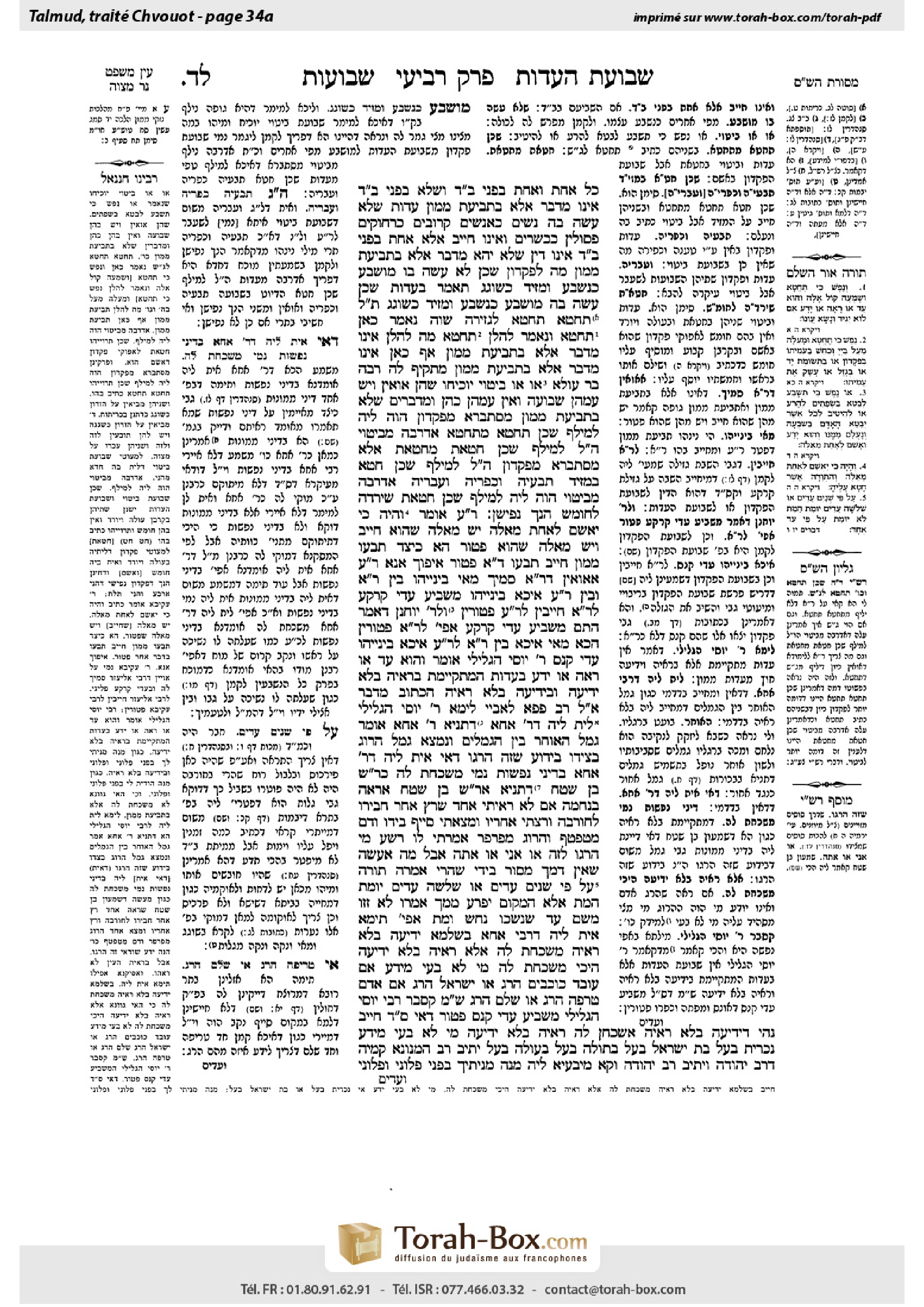
Shevuot 34a: Talmud study for Daf Yomi
Daf Yomi is the daily study of one Talmud folio. Explore 37 tractates with scans, Hebrew text, Sefaria English and AI-generated French translations where annotated.
Passage selection and English or AI-generated French translation are available where the scan has annotations. Daf Study is independent of Torah-Box and Sefaria.
Browse Shevuot · שבועות · All tractatesShevuot 34a text and translations
This page of Shevuot includes the Aramaic text, an English translation and an AI-generated French translation, alongside the scan above.
שבועות ל״ד א · Aramaic and Hebrew text
כׇּל אַחַת וְאַחַת, בִּפְנֵי בֵּית דִּין וְשֶׁלֹּא בִּפְנֵי בֵּית דִּין – אֵינוֹ מְדַבֵּר אֶלָּא בִּתְבִיעַת מָמוֹן; עֵדוּת שֶׁלֹּא עָשָׂה בָּהּ נָשִׁים כַּאֲנָשִׁים, קְרוֹבִים כִּרְחוֹקִים, פְּסוּלִין כִּכְשֵׁרִים; וְאֵינוֹ חַיָּיב אֶלָּא אַחַת בִּפְנֵי בֵּית דִּין – אֵינוֹ דִּין שֶׁלֹּא יְהֵא מְדַבֵּר אֶלָּא בִּתְבִיעַת מָמוֹן?!
מָה לְפִקָּדוֹן – שֶׁכֵּן לֹא עָשָׂה בּוֹ מוּשְׁבָּע כַּנִּשְׁבָּע וּמֵזִיד כַּשּׁוֹגֵג; תֹּאמַר בְּעֵדוּת – שֶׁכֵּן עָשָׂה בָּהּ מוּשְׁבָּע כַּנִּשְׁבָּע וּמֵזִיד כַּשּׁוֹגֵג?!
תַּלְמוּד לוֹמַר: ״תֶּחֱטָא״–״תֶּחֱטָא״ לִגְזֵירָה שָׁוָה – נֶאֱמַר כָּאן ״תֶּחֱטָא״, וְנֶאֱמַר לְהַלָּן ״תֶּחֱטָא״; מָה לְהַלָּן אֵינוֹ מְדַבֵּר אֶלָּא בִּתְבִיעַת מָמוֹן, אַף כָּאן אֵינוֹ מְדַבֵּר אֶלָּא בִּתְבִיעַת מָמוֹן.
מַתְקֵיף לַהּ רַבָּה בַּר עוּלָּא: ״אוֹ״ ״אוֹ״ בִּיטּוּי יוֹכִיחוּ – שֶׁהֵן ״אוֹאִין״, וְיֵשׁ עִמָּהֶן שְׁבוּעָה, וְאֵין עִמָּהֶן כֹּהֵן – וּמְדַבְּרִים שֶׁלֹּא בִּתְבִיעַת מָמוֹן!
מִסְתַּבְּרָא מִפִּקָּדוֹן הֲוָה לֵיהּ לְמֵילַף, שֶׁכֵּן ״תֶּחֱטָא״ מִ״תֶּחֱטָא״.
אַדְּרַבָּה – מִבִּיטּוּי הֲוָה לֵיהּ לְמֵילַף, שֶׁכֵּן חַטָּאת מֵחַטָּאת!
אֶלָּא מִסְתַּבְּרָא מִפִּקָּדוֹן הֲוָה לֵיהּ לְמֵילַף – שֶׁכֵּן חֵטְא; בְּמֵזִיד; תַּבְעֵיהּ וְכַפְרֵיהּ; וְעַבְרֵיהּ.
אַדְּרַבָּה, מִבִּיטּוּי הֲוָה לֵיהּ לְמֵילַף, שֶׁכֵּן חַטָּאת שֶׁיָּרְדָה לְחוֹמֶשׁ! הָנָךְ נְפִישָׁן.
רַבִּי עֲקִיבָא אוֹמֵר: ״וְהָיָה כִי יֶאְשַׁם לְאַחַת מֵאֵלֶּה״ – יֵשׁ מֵאֵלֶּה שֶׁהוּא חַיָּיב, וְיֵשׁ מֵאֵלֶּה שֶׁהוּא פָּטוּר. הָא כֵּיצַד? תְּבָעוֹ מָמוֹן – חַיָּיב, תְּבָעוֹ דָּבָר אַחֵר – פָּטוּר.
אֵיפוֹךְ אֲנָא!
רַבִּי עֲקִיבָא אַ״אוֹאִין״ דְּרַבִּי אֱלִיעֶזֶר סְמִיךְ.
מַאי בֵּינַיְיהוּ בֵּין רַבִּי אֱלִיעֶזֶר וּבֵין רַבִּי עֲקִיבָא?
אִיכָּא בֵּינַיְיהוּ מַשְׁבִּיעַ עֵדֵי קַרְקַע – לְרַבִּי אֱלִיעֶזֶר חַיָּיבִין, לְרַבִּי עֲקִיבָא פְּטוּרִין.
וּלְרַבִּי יוֹחָנָן, דְּאָמַר הָתָם: מַשְׁבִּיעַ עֵדֵי קַרְקַע אֲפִילּוּ לְרַבִּי אֱלִיעֶזֶר פְּטוּרִין – הָכָא מַאי אִיכָּא בֵּין רַבִּי אֱלִיעֶזֶר לְרַבִּי עֲקִיבָא?
אִיכָּא בֵּינַיְיהוּ עֵדֵי קְנָס.
רַבִּי יוֹסֵי הַגְּלִילִי אוֹמֵר: ״וְהוּא עֵד אוֹ רָאָה אוֹ יָדָע״ – בְּעֵדוּת הַמִּתְקַיֶּימֶת בִּרְאִיָּה בְּלֹא יְדִיעָה וּבִידִיעָה בְּלֹא רְאִיָּה הַכָּתוּב מְדַבֵּר.
אֲמַר לֵיהּ רַב פָּפָּא לְאַבָּיֵי: לֵימָא רַבִּי יוֹסֵי הַגְּלִילִי לֵית לֵיהּ דְּרַבִּי אַחָא? דְּתַנְיָא, רַבִּי אַחָא אוֹמֵר: גָּמָל הָאוֹחֵר בֵּין הַגְּמַלִּים וְנִמְצָא גָּמָל הָרוּג בְּצִידּוֹ – בְּיָדוּעַ שֶׁזֶּה הֲרָגוֹ. דְּאִי אִית לֵיהּ דְּרַבִּי אַחָא, בְּדִינֵי נְפָשׁוֹת נָמֵי מַשְׁכַּחַתְּ לַהּ – כְּרַבִּי שִׁמְעוֹן בֶּן שָׁטַח!
דְּתַנְיָא, אָמַר רַבִּי שִׁמְעוֹן בֶּן שָׁטַח: אֶרְאֶה בְּנֶחָמָה אִם לֹא רָאִיתִי אֶחָד שֶׁרָץ אַחַר חֲבֵירוֹ לְחוּרְבָּה, וְרַצְתִּי אַחֲרָיו, וּמָצָאתִי סַיִיף בְּיָדוֹ וְדָם מְטַפְטֵף וְהָרוּג מְפַרְפֵּר; אָמַרְתִּי לוֹ: רָשָׁע! מִי הֲרָגוֹ לָזֶה? אוֹ אֲנִי, אוֹ אַתָּה!
אֲבָל מָה אֶעֱשֶׂה, שֶׁאֵין דָּמְךָ מָסוּר בְּיָדִי, שֶׁהֲרֵי אָמְרָה תּוֹרָה: ״עַל פִּי שְׁנַיִם עֵדִים אוֹ שְׁלֹשָׁה עֵדִים יוּמַת הַמֵּת״. אֶלָּא הַמָּקוֹם יִפָּרַע מִמְּךָ. אָמְרוּ: לֹא זָזוּ מִשָּׁם עַד שֶׁנְּשָׁכוֹ נָחָשׁ וָמֵת.
אֲפִילּוּ תֵּימָא אִית לֵיהּ דְּרַבִּי אַחָא; בִּשְׁלָמָא יְדִיעָה בְּלֹא רְאִיָּה – מַשְׁכַּחַתְּ לַהּ; אֶלָּא רְאִיָּה בְּלֹא יְדִיעָה – הֵיכִי מַשְׁכַּחַתְּ לַהּ? מִי לָא בָּעֵי מִידָּע אִם גּוֹי הָרַג אוֹ יִשְׂרָאֵל הָרַג, אִם אָדָם טְרֵפָה הָרַג אוֹ שָׁלֵם הָרַג?
שְׁמַע מִינַּהּ, קָסָבַר רַבִּי יוֹסֵי הַגְּלִילִי: מַשְׁבִּיעַ עֵדֵי קְנָס – פָּטוּר; דְּאִי סָלְקָא דַעְתָּךְ חַיָּיב, נְהִי דִּידִיעָה בְּלֹא רְאִיָּה – אַשְׁכְּחַן לַהּ; רְאִיָּה בְּלֹא יְדִיעָה – מִי לָא בָּעֵי מִידָּע גּוֹיָה בָּעַל בַּת יִשְׂרָאֵל בָּעַל, בְּתוּלָה בָּעַל בְּעוּלָה בָּעַל?
יָתֵיב רַב הַמְנוּנָא קַמֵּיהּ דְּרַב יְהוּדָה, וְיָתֵיב רַב יְהוּדָה וְקָא מִיבַּעְיָא לֵיהּ: ״מָנֶה מְנִיתִיךְ בִּפְנֵי פְּלוֹנִי וּפְלוֹנִי״,
Shevuot 34a · English translation
each and every oath if the plaintiff administered several oaths to him and he denied having the deposit in his possession, whether he took the oath before a court or not before a court, and despite the broad application of the halakha, the verse is speaking of liability only in cases involving a monetary claim, then in the case of an oath of testimony with regard to which the Torah did not render the halakhic status of women like that of men, the status of relatives like that of non-relatives, and the status of unfit witnesses like that of those fit to testify, and he is liable to bring only one sliding-scale offering if the plaintiff administered several oaths to him and he falsely denied knowledge of the matter in the presence of a court, is it not right that the verse is speaking of liability only in cases involving a monetary claim?
The baraita rejects this inference: What is notable about the case of a deposit? It is notable in that with regard to a deposit the Torah did not render the halakhic status of one to whom an oath was administered by others like that of one who himself took an oath, as one to whom an oath was administered by others is exempt; and the Torah did not render the halakhic status of one who takes an intentional false oath like that of one who takes an unwitting false oath. Will you say that the same is true with regard to an oath of testimony, as in that case the Torah rendered the halakhic status of one to whom an oath was administered by others like that of one who himself took an oath; and it rendered the halakhic status of one who takes an intentional false oath like that of one who takes an unwitting false oath, and one is liable to bring an offering in both instances?
Therefore, the verse states the term “shall sin” with regard to an oath of testimony and states “shall sin” with regard to an oath on a deposit in order to derive a verbal analogy. Here, it is stated with regard to an oath of testimony: “Shall sin” (Leviticus 5:1), and there, it is stated with regard to an oath on a deposit: “Shall sin” (Leviticus 5:21). Just as there, concerning an oath on a deposit, the verse is speaking only with regard to a monetary claim, so too here, concerning an oath of testimony, the verse is speaking only with regard to a monetary claim.
§ After presenting the different proofs cited in the baraita, the Gemara proceeds to analyze the opinions cited therein, beginning with the opinion of Rabbi Eliezer that one derives that one is liable for an oath of testimony only if it involves a monetary claim from the case of an oath on a deposit based on multiple instances of the term “or” that appear in both contexts, and there is an oath with those multiple instances of the term “or” and there is no priest in their context. Rabba bar Ulla objects to this: The multiple instances of the term “or” in the verse: “Or if any one shall take an oath to clearly express with his lips to do evil or to do good” (Leviticus 5:4), which is written with regard to an oath on an utterance, will prove that one is liable even without a monetary claim, as they are multiple instances of the term “or,” and there is an oath in their context, and there is no priest in their context, and they are not speaking with regard to a monetary claim.
The Gemara rejects this: It stands to reason that he should have derived the halakha with regard to an oath of testimony from an oath on a deposit and not from an oath on an utterance due to the verbal analogy between the terms “shall sin” and “shall sin.”
The Gemara rejects this: On the contrary, he should have derived the halakha with regard to an oath of testimony from the halakha with regard to an oath on an utterance, as it is a derivation of one case for which one is liable to bring a sin-offering for taking a false oath from another case for which one is liable to bring a sin-offering for taking a false oath. This is in contrast to an oath on a deposit, for which one is liable to bring a guilt-offering for taking a false oath.
Rather, it stands to reason that he should have derived the halakha with regard to an oath of testimony from the halakha with regard to an oath on a deposit, as there are many elements common to both oaths, represented by the mnemonic: Sin, intentionally, claimed from him, denied his claim, and his past. There is a verbal analogy between them, as the term “shall sin” appears in both contexts. In both cases one is liable for taking a false oath intentionally. Additionally, in both cases there is a claim presented by one of the parties and denial of that claim by the one taking the oath. And both oaths relate to events that transpired in the past.
The Gemara asks: On the contrary, he should have derived the halakha with regard to an oath of testimony from the halakha with regard to an oath on an utterance, as there are many elements common to both oaths, represented by the mnemonic: Sin-offering, that descended, to one-fifth. In both cases one is liable to bring a sin-offering for a false oath, as opposed to a guilt-offering for a false oath on a deposit. In each case the offering is a sliding-scale offering, as opposed to the fixed offering in the case of an oath on a deposit. In both cases there is no payment of an additional one-fifth for taking a false oath. And in the case of a false oath on a deposit, there is payment of an additional one-fifth. The Gemara answers: These elements common to an oath of testimony and an oath on a deposit are more numerous than the elements common to an oath of testimony and an oath on an utterance.
§ Rabbi Akiva says that it is written with regard to an oath of testimony: “And it shall be when he will be guilty of one of these” (Leviticus 5:5). The term “of these” is a restrictive expression from which it is derived: There are some of these for which he is liable and there are some of these for which he is exempt. How so? If the plaintiff demanded testimony from the witness with regard to a monetary claim, the witness is liable for taking a false oath; if the plaintiff demanded testimony from the witness with regard to another matter, he is exempt.
The Gemara challenges: Since it is not clear from the verse for which claim one is liable and for which claim one is exempt, I will reverse it and say that one is liable only when the claim was with regard to another matter, not when it involves monetary matters.
The Gemara answers: Rabbi Akiva relies on the multiple instances of the term “or,” as cited by Rabbi Eliezer, to derive from an oath on a deposit that one is liable only for a false oath that involves a monetary claim. From the term “of these” Rabbi Akiva derives that there are some cases involving monetary claims for which one is not liable for taking a false oath of testimony.
The Gemara asks: What is the practical difference between the opinions of Rabbi Eliezer and Rabbi Akiva? With regard to which cases involving monetary claims does Rabbi Akiva hold that one is not liable for taking a false oath of testimony?
The Gemara answers: The practical difference between their opinions is in the case of one who administers an oath to witnesses with regard to testimony involving land. According to Rabbi Eliezer, they are liable if they take a false oath. According to Rabbi Akiva they are exempt in that case, as it is excluded by the term “of these.”
The Gemara asks: And according to Rabbi Yoḥanan, who says there with regard to an oath on a deposit and an oath of testimony that in the case of one who administers an oath to witnesses with regard to testimony involving land, the witnesses are exempt even according to Rabbi Eliezer, what difference is there between the opinions of Rabbi Eliezer and Rabbi Akiva?
The Gemara answers: The practical difference between their opinions is in the case where one administers an oath to witnesses with regard to testimony involving a fine. According to Rabbi Eliezer they are liable, and according to Rabbi Akiva they are exempt.
§ Rabbi Yosei HaGelili cites a different proof and says: The verse states with regard to an oath of testimony: “And he is a witness or he saw or he knew” (Leviticus 5:1). It is with regard to testimony that is founded on sight without knowledge of the matter, or by means of knowledge without sight, that the verse is speaking. The reference is to testimony involving monetary matters, as all other testimony requires both knowledge and sight.
Rav Pappa said to Abaye: Shall we say that Rabbi Yosei HaGelili does not accept the opinion of Rabbi Aḥa? As it is taught in a baraita (Tosefta, Bava Kamma 3:6) that Rabbi Aḥa says: If there is a rutting male camel [gamal haoḥer] that is rampaging among other camels and then a camel was found killed at its side, it is evident that this rampaging camel killed it, and the owner must pay for the damage. Rabbi Aḥa rules that cases of monetary law can be decided based on circumstantial evidence. As, if he is of the opinion that the ruling is in accordance with the opinion of Rabbi Aḥa that witnesses may testify on the basis of circumstantial evidence, in cases of capital law too, you find a case of knowledge without sight, as in the case discussed by Rabbi Shimon ben Shataḥ.
As it is taught in a baraita that Rabbi Shimon ben Shataḥ said in the form of an oath: I will not see the consolation of Israel if I did not see one who was running after another into a ruin, and I ran after him and found a sword in his hand and blood dripping from the sword, and the slain person convulsing. I said to him: Wicked one, who killed this person? It was either me or you, as there is no one else here.
But what can I do, as your blood is not given to my control and I have no jurisdiction to execute you, as the Torah says: “On the basis of two witnesses or three witnesses shall he that is to die be put to death” (Deuteronomy 17:6), and there are no witnesses here. Rather, the Omnipresent will exact retribution from you. The Sages said: They did not move from there until a snake came and bit the pursuer and he died. Rabbi Aḥa would hold in that case that the pursuer could be executed by the court based on circumstantial evidence. Ostensibly, Rabbi Yosei HaGelili disagrees, as he says that testimony based on knowledge without sight exists only in cases of monetary law.
The Gemara answers: Even if you say that Rabbi Yosei HaGelili is of the opinion that the ruling is in accordance with the opinion of Rabbi Aḥa that one may rely on circumstantial evidence even in cases of capital law, one may nevertheless distinguish between cases of monetary law and cases of capital law. Granted, even in cases of capital law you find testimony based on knowledge without sight, but how can you find a case of sight without knowledge? Don’t the witnesses need to know if the one whom he witnessed killing another killed a gentile or he killed a Jew, if he killed one who has a wound that would have caused him to die within twelve months [tereifa] or he killed one whose body is intact?
The Gemara notes: Conclude from it that Rabbi Yosei HaGelili holds that in a case where one administers an oath to witnesses with regard to testimony involving a fine, the witnesses are exempt from liability for taking a false oath of testimony. As if it enters your mind to say that the witnesses are liable, although you find testimony with regard to fines based on knowledge without sight, and witnesses may testify based on circumstantial evidence, in cases of sight without knowledge, when it comes to fines, don’t the witnesses need to know if the rapist engaged in intercourse with a gentile woman or if he engaged in intercourse with a Jewish woman, if he engaged in intercourse with a virgin or if he engaged in intercourse with a non-virgin? Rabbi Yosei HaGelili holds that witnesses are liable for taking a false oath of testimony only in cases where both testimony based on sight alone and testimony based on knowledge alone are accepted, which is not the case concerning testimony involving fines.
§ Apropos the matter of sight without knowledge in cases of monetary law, the Gemara relates: Rav Hamnuna was sitting before Rav Yehuda, and Rav Yehuda was sitting and he was raising a dilemma: If one demands payment from another and claims: I counted for you and gave you one hundred dinars in the presence of so-and-so and so-and-so,
Shevuot 34a · Traduction française (IA)
pour chaque serment, si le plaignant lui a fait prêter plusieurs serments et qu’il a nié avoir le dépôt en sa possession, qu’il ait prêté serment devant un tribunal ou non, et bien que la halakha ait une portée étendue, le verset ne rend responsable que dans les cas impliquant une réclamation pécuniaire. Alors, dans le cas d’un serment de témoignage, à propos duquel la Torah n’a pas assimilé le statut halakhique des femmes à celui des hommes, celui des proches à celui des personnes sans lien de parenté, ni celui des témoins inaptes à celui des témoins aptes, et où l’on n’est tenu d’apporter qu’un seul sacrifice à valeur graduée si le plaignant lui a fait prêter plusieurs serments et qu’il a faussement nié connaître les faits en présence d’un tribunal, n’est-il pas d’autant plus évident que le verset ne rend responsable que dans les cas impliquant une réclamation pécuniaire ?
La baraïta rejette cette déduction : Qu’est-ce qui distingue le cas d’un dépôt ? En ce qui concerne un dépôt, la Torah n’a pas assimilé le statut halakhique de celui à qui d’autres ont fait prêter serment à celui de celui qui a lui-même prêté serment, car celui à qui d’autres ont fait prêter serment est exempt. De plus, la Torah n’a pas assimilé le statut halakhique de celui qui prête intentionnellement un faux serment à celui de celui qui prête involontairement un faux serment. Peut-on dire qu’il en va de même pour un serment de témoignage ? Dans ce cas, la Torah a assimilé le statut halakhique de celui à qui d’autres ont fait prêter serment à celui de celui qui a lui-même prêté serment, et celui de celui qui prête intentionnellement un faux serment à celui de celui qui prête involontairement un faux serment ; dans les deux cas, on est tenu d’apporter un sacrifice.
Le verset emploie donc l’expression « il commettra une faute » à propos d’un serment de témoignage et l’expression « il commettra une faute » à propos d’un serment relatif à un dépôt, afin d’établir une analogie verbale. Ici, à propos d’un serment de témoignage, il est écrit : « il commettra une faute » (Lévitique 5:1) ; et là, à propos d’un serment relatif à un dépôt, il est écrit : « il commettra une faute » (Lévitique 5:21). De même que là, à propos d’un serment relatif à un dépôt, le verset ne concerne que les cas impliquant une réclamation pécuniaire, de même ici, à propos d’un serment de témoignage, le verset ne concerne que les cas impliquant une réclamation pécuniaire.
§ Après avoir présenté les différentes preuves citées dans la baraïta, la Guemara analyse les opinions qui y sont rapportées, en commençant par celle de Rabbi Eliezer : on déduit que l’on n’est responsable d’un serment de témoignage que s’il implique une réclamation pécuniaire à partir du cas d’un serment relatif à un dépôt, en raison des occurrences répétées du terme « ou » dans les deux contextes. Il s’agit d’un serment où figurent ces occurrences répétées du terme « ou » et dont le contexte ne mentionne aucun prêtre. Rabba bar Ulla objecte : Les occurrences répétées du terme « ou » dans le verset « Ou si quelqu’un prête serment, en exprimant clairement par ses lèvres de faire le mal ou de faire le bien » (Lévitique 5:4), qui concerne un serment sur une parole, prouvent que l’on est responsable même en l’absence d’une réclamation pécuniaire : le terme « ou » y apparaît plusieurs fois, un serment y est mentionné et aucun prêtre n’apparaît dans ce contexte, alors qu’il n’est pas question d’une réclamation pécuniaire.
La Guemara rejette cette objection : Il est logique qu’il ait déduit la halakha concernant un serment de témoignage d’un serment relatif à un dépôt, en raison de l’analogie verbale entre les expressions « il commettra une faute » et « il commettra une faute ».
La Guemara rejette cette réponse : Au contraire, il aurait dû déduire la halakha concernant un serment de témoignage de celle d’un serment sur une parole, car il s’agit de déduire le cas où l’on est tenu d’apporter un sacrifice expiatoire pour avoir prêté un faux serment à partir d’un autre cas où l’on est tenu d’apporter un sacrifice expiatoire pour avoir prêté un faux serment. Cela contraste avec le serment relatif à un dépôt, pour lequel on est tenu d’apporter un sacrifice de culpabilité pour avoir prêté un faux serment.
Il est plutôt logique qu’il ait déduit la halakha concernant un serment de témoignage de celle d’un serment relatif à un dépôt, car ces deux serments ont de nombreux éléments en commun, résumés par le moyen mnémotechnique : faute, intentionnellement, réclamé à lui, il a nié la réclamation, et passé. Il existe entre eux une analogie verbale, puisque l’expression « il commettra une faute » apparaît dans les deux contextes. Dans les deux cas, on est responsable d’avoir prêté intentionnellement un faux serment. De plus, dans les deux cas, l’une des parties présente une réclamation et celui qui prête serment la nie. Enfin, les deux serments concernent des événements qui se sont produits dans le passé.
La Guemara demande : Au contraire, il aurait dû déduire la halakha concernant un serment de témoignage de celle d’un serment sur une parole, car ces deux serments ont de nombreux éléments en commun, résumés par le moyen mnémotechnique : sacrifice expiatoire, descendu, au cinquième. Dans les deux cas, on est tenu d’apporter un sacrifice expiatoire pour un faux serment, par opposition au sacrifice de culpabilité dû pour un faux serment relatif à un dépôt. Dans les deux cas, il s’agit d’un sacrifice à valeur graduée, par opposition au sacrifice fixe prévu pour un serment relatif à un dépôt. Dans les deux cas, il n’y a pas de paiement d’un cinquième supplémentaire pour avoir prêté un faux serment. En revanche, dans le cas d’un faux serment relatif à un dépôt, un cinquième supplémentaire est payé. La Guemara répond : Les éléments communs au serment de témoignage et au serment relatif à un dépôt sont plus nombreux que ceux communs au serment de témoignage et au serment sur une parole.
§ Rabbi Akiva dit qu’il est écrit à propos d’un serment de témoignage : « Et il arrivera, lorsqu’il sera coupable de l’une de ces choses » (Lévitique 5:5). L’expression « de ces choses » est restrictive et l’on en déduit qu’il existe certains cas dans lesquels il est responsable et d’autres dans lesquels il est exempt. Comment cela ? Si le plaignant a demandé au témoin de témoigner au sujet d’une réclamation pécuniaire, le témoin est responsable d’avoir prêté un faux serment ; si le plaignant lui a demandé de témoigner au sujet d’une autre affaire, il est exempt.
La Guemara objecte : Puisque le verset ne précise pas pour quelle réclamation on est responsable et pour laquelle on est exempt, je pourrais inverser les choses et dire que l’on est responsable uniquement lorsque la réclamation concerne une autre affaire, et non lorsqu’elle porte sur une question pécuniaire.
La Guemara répond : Rabbi Akiva s’appuie sur les occurrences répétées du terme « ou », citées par Rabbi Eliezer, pour déduire, du cas d’un serment relatif à un dépôt, que l’on n’est responsable que d’un faux serment impliquant une réclamation pécuniaire. De l’expression « de ces choses », Rabbi Akiva déduit qu’il existe certains cas impliquant des réclamations pécuniaires dans lesquels on n’est pas responsable d’avoir prêté un faux serment de témoignage.
La Guemara demande : Quelle est la différence pratique entre les opinions de Rabbi Eliezer et de Rabbi Akiva ? Dans quels cas impliquant des réclamations pécuniaires Rabbi Akiva estime-t-il qu’on n’est pas responsable d’avoir prêté un faux serment de témoignage ?
La Guemara répond : La différence pratique entre leurs opinions concerne le cas où quelqu’un fait prêter serment à des témoins au sujet d’un témoignage portant sur un terrain. Selon Rabbi Eliezer, ils sont responsables s’ils prêtent un faux serment. Selon Rabbi Akiva, ils sont exempts dans ce cas, car l’expression « de ces choses » l’exclut.
La Guemara demande : Et selon Rabbi Yoḥanan, qui dit là, à propos d’un serment relatif à un dépôt et d’un serment de témoignage, que lorsque quelqu’un fait prêter serment à des témoins au sujet d’un témoignage portant sur un terrain, les témoins sont exempts même selon Rabbi Eliezer, quelle différence y a-t-il entre les opinions de Rabbi Eliezer et de Rabbi Akiva ?
La Guemara répond : La différence pratique entre leurs opinions concerne le cas où quelqu’un fait prêter serment à des témoins au sujet d’un témoignage portant sur une amende. Selon Rabbi Eliezer, ils sont responsables ; selon Rabbi Akiva, ils sont exempts.
§ Rabbi Yosei HaGelili apporte une autre preuve et dit : Le verset énonce à propos d’un serment de témoignage : « Et il est témoin, ou il a vu, ou il sait » (Lévitique 5:1). Le verset parle d’un témoignage fondé sur la vision sans connaissance des faits, ou sur la connaissance sans vision. Il s’agit d’un témoignage portant sur des questions pécuniaires, car tout autre témoignage exige à la fois la connaissance et la vision.
Rav Pappa dit à Abaye : Faut-il donc dire que Rabbi Yosei HaGelili n’accepte pas l’opinion de Rabbi Aḥa ? En effet, il est enseigné dans une baraïta (Tossefta, Baba Kamma 3:6) que Rabbi Aḥa dit : Si un chameau mâle en rut [gamal haoḥer] se déchaîne parmi d’autres chameaux et qu’on trouve ensuite un chameau tué à ses côtés, il est évident que ce chameau en furie l’a tué, et son propriétaire doit payer les dommages. Rabbi Aḥa statue que les affaires pécuniaires peuvent être tranchées sur la base d’indices circonstanciels. Car si Rabbi Yosei HaGelili estime que la halakha suit l’opinion de Rabbi Aḥa, selon laquelle des témoins peuvent témoigner sur la base d’indices circonstanciels, même dans les affaires criminelles, on trouve alors un cas de connaissance sans vision, comme dans l’affaire évoquée par Rabbi Shimon ben Shataḥ.
En effet, il est enseigné dans une baraïta que Rabbi Shimon ben Shataḥ déclara sous serment : « Puissé-je ne pas voir la consolation d’Israël si je n’ai pas vu un homme en poursuivre un autre jusque dans une ruine ; je l’ai poursuivi et j’ai trouvé une épée dans sa main, du sang dégoulinant de l’épée, et la victime convulsant. Je lui ai dit : “Méchant, qui a tué cet homme ? C’est soit moi, soit toi, car il n’y a personne d’autre ici.” »
« Mais que puis-je faire, puisque ton sang n’est pas remis entre mes mains et que je n’ai pas compétence pour te mettre à mort ? La Torah dit en effet : “Sur la déposition de deux ou de trois témoins, celui qui doit mourir sera mis à mort” (Deutéronome 17:6), et il n’y a pas de témoins ici. Le Lieu se vengera donc de toi. » Les Sages ont dit : Ils ne s’étaient pas éloignés de là qu’un serpent vint mordre le poursuivant, qui mourut. Dans ce cas, Rabbi Aḥa aurait estimé que le poursuivant pouvait être exécuté par le tribunal sur la base d’indices circonstanciels. Apparemment, Rabbi Yosei HaGelili est en désaccord, puisqu’il dit qu’un témoignage fondé sur la connaissance sans vision n’existe que dans les affaires pécuniaires.
La Guemara répond : Même si tu dis que Rabbi Yosei HaGelili estime que la halakha suit l’opinion de Rabbi Aḥa, selon laquelle on peut s’appuyer sur des indices circonstanciels même dans les affaires criminelles, il est néanmoins possible de distinguer les affaires pécuniaires des affaires criminelles. Admettons que l’on trouve aussi, dans les affaires criminelles, un témoignage fondé sur la connaissance sans vision ; mais comment peut-on trouver un cas de vision sans connaissance ? Les témoins ne doivent-ils pas savoir si la personne qu’ils ont vue en tuer une autre a tué un non-Juif ou un Juif, si elle a tué une personne atteinte d’une blessure qui l’aurait fait mourir dans les douze mois [tereifa] ou une personne dont le corps était intact ?
La Guemara relève : On peut en conclure que Rabbi Yosei HaGelili estime que, lorsqu’on fait prêter serment à des témoins au sujet d’un témoignage portant sur une amende, les témoins sont exempts de responsabilité pour avoir prêté un faux serment de témoignage. En effet, si tu envisages qu’ils soient responsables, bien qu’on puisse trouver un témoignage portant sur des amendes fondé sur la connaissance sans vision et que des témoins puissent témoigner sur la base d’indices circonstanciels, dans les cas de vision sans connaissance concernant les amendes, les témoins ne doivent-ils pas savoir si le violeur a eu des relations avec une non-Juive ou avec une Juive, s’il a eu des relations avec une vierge ou avec une femme qui ne l’était pas ? Rabbi Yosei HaGelili estime que les témoins ne sont responsables d’avoir prêté un faux serment de témoignage que dans les cas où sont admis à la fois les témoignages fondés uniquement sur la vision et ceux fondés uniquement sur la connaissance, ce qui n’est pas le cas des témoignages portant sur des amendes.
§ À propos de la question de la vision sans connaissance dans les affaires pécuniaires, la Guemara rapporte : Rav Hamnuna était assis devant Rav Yehuda, qui soulevait une question : Si quelqu’un réclame à un autre le paiement d’une somme et prétend : « J’ai compté pour toi et t’ai donné cent dinars en présence d’Untel et d’Untel »,
Traduction française générée par IA à partir de l’édition anglaise de Sefaria. Vérifie toujours un passage avec le texte source.
Text from Sefaria: William Davidson Edition - Vocalized Aramaic (CC BY NC); William Davidson Edition - English (CC BY NC).