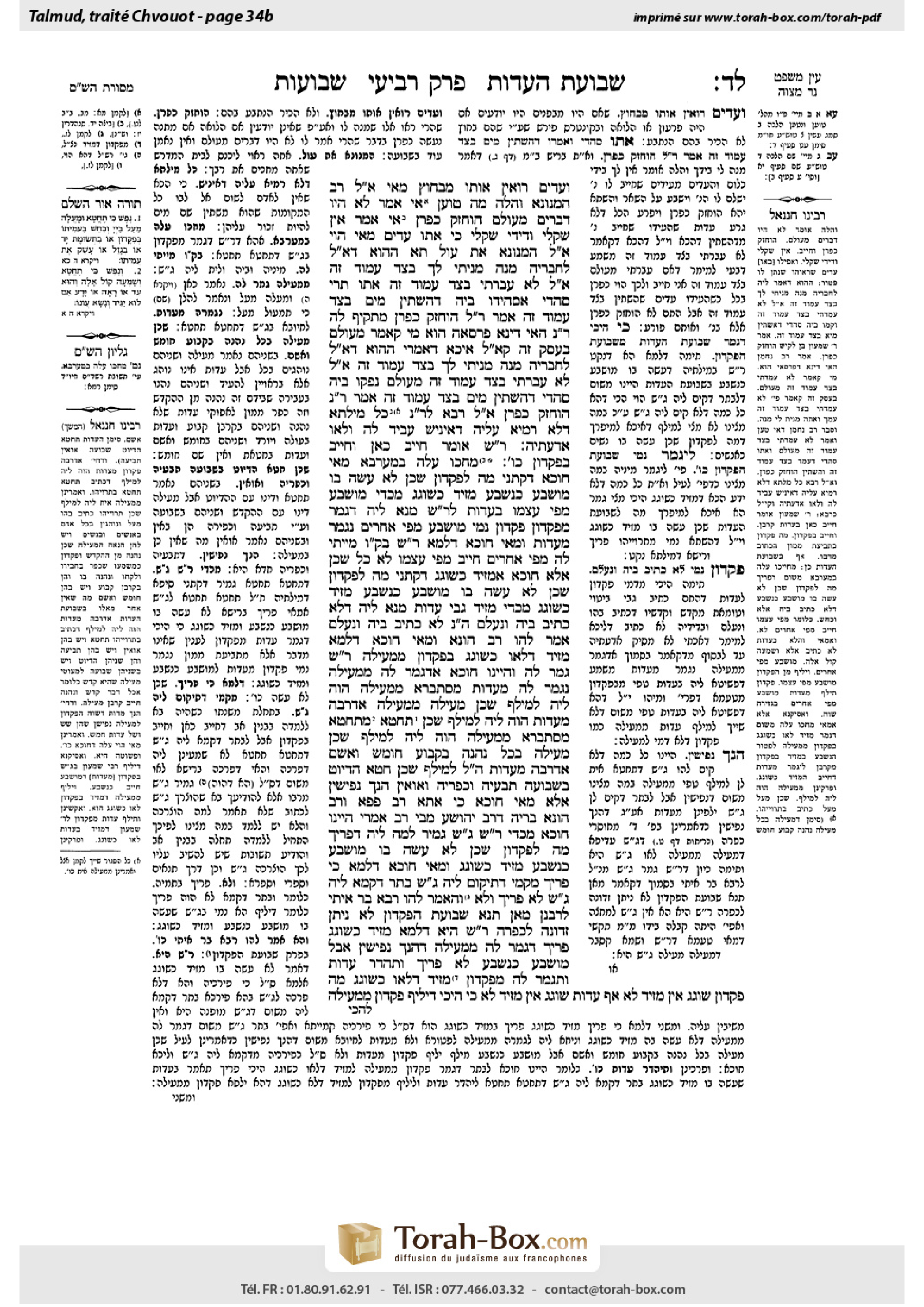
Shevuot 34b: Talmud study for Daf Yomi
Daf Yomi is the daily study of one Talmud folio. Explore 37 tractates with scans, Hebrew text, Sefaria English and AI-generated French translations where annotated.
Passage selection and English or AI-generated French translation are available where the scan has annotations. Daf Study is independent of Torah-Box and Sefaria.
Browse Shevuot · שבועות · All tractatesShevuot 34b text and translations
This page of Shevuot includes the Aramaic text, an English translation and an AI-generated French translation, alongside the scan above.
שבועות ל״ד ב · Aramaic and Hebrew text
וְעֵדִים רוֹאִין אוֹתוֹ מִבַּחוּץ, מַאי?
אֲמַר לֵיהּ רַב הַמְנוּנָא: וְהַלָּה מָה טוֹעֵן? אִי אָמַר: ״לֹא הָיוּ דְבָרִים מֵעוֹלָם״ – הוּחְזַק כַּפְרָן! אִי אָמַר: ״אִין, שְׁקַלִי – וְדִידִי שְׁקַלִי״ – כִּי אָתוּ עֵדִים מַאי הָוֵי? אֲמַר לֵיהּ: הַמְנוּנָא אַתְּ? עוּל תָּא.
הָהוּא דַּאֲמַר לֵיהּ לְחַבְרֵיהּ: ״מָנֶה מָנִיתִי לְךָ בְּצַד עַמּוּד זֶה״, אֲמַר לֵיהּ: ״לֹא עָבַרְתִּי בְּצַד עַמּוּד זֶה״. אֲתוֹ תְּרֵי סָהֲדִי, אַסְהִידוּ בֵּיהּ דְּהִשְׁתִּין מַיִם בְּצַד עַמּוּד זֶה. אָמַר רֵישׁ לָקִישׁ: הוּחְזַק כַּפְרָן.
מַתְקֵיף לַהּ רַב נַחְמָן: הַאי דִּינָא פָּרְסָאָה הוּא! מִי קָאָמַר ״מֵעוֹלָם״?! בְּעֵסֶק זֶה קָאָמַר לֵיהּ!
אִיכָּא דְּאָמְרִי, הָהוּא דַּאֲמַר לֵיהּ לְחַבְרֵיהּ: ״מָנֶה מָנִיתִי לְךָ בְּצַד עַמּוּד זֶה״, אֲמַר לֵיהּ: ״לֹא עָבַרְתִּי בְּצַד עַמּוּד זֶה מֵעוֹלָם״. נְפַקוּ בֵּיהּ סָהֲדִי דְּהִשְׁתִּין מַיִם בְּצַד עַמּוּד זֶה. אָמַר רַב נַחְמָן: הוּחְזַק כַּפְרָן.
אֲמַר לֵיהּ רָבָא לְרַב נַחְמָן: כֹּל מִילְּתָא דְּלָא רַמְיָא עֲלֵיהּ דְּאִינִישׁ, עָבֵיד לַהּ וְלָאו אַדַּעְתֵּיהּ.
רַבִּי שִׁמְעוֹן אוֹמֵר: חִיֵּיב כָּאן וְחִיֵּיב בְּפִקָּדוֹן כּוּ׳.
מַחֲכוּ עֲלַהּ בְּמַעְרְבָא. מַאי חוּכָא?
דְּקָתָנֵי: מָה לְפִקָּדוֹן, שֶׁכֵּן לֹא עָשָׂה בּוֹ מוּשְׁבָּע כַּנִּשְׁבָּע, מֵזִיד כַּשּׁוֹגֵג.
מִכְּדֵי מוּשְׁבָּע מִפִּי עַצְמוֹ בְּעֵדוּת, לְרַבִּי שִׁמְעוֹן מְנָא לֵיהּ – דִּגְמַר מִפִּקָּדוֹן; פִּקָּדוֹן נָמֵי – מוּשְׁבָּע מִפִּי אֲחֵרִים, נִגְמַר מֵעֵדוּת!
וּמַאי חוּכָא? דִּלְמָא רַבִּי שִׁמְעוֹן בְּקַל וָחוֹמֶר מַיְיתֵי לַהּ: מִפִּי אֲחֵרִים חַיָּיב – מִפִּי עַצְמוֹ לֹא כׇּל שֶׁכֵּן?!
אֶלָּא חוּכָא אַמֵּזִיד כַּשּׁוֹגֵג – דְּקָתָנֵי: מָה לְפִקָּדוֹן – שֶׁכֵּן לֹא עָשָׂה בּוֹ מוּשְׁבָּע כַּנִּשְׁבָּע, מֵזִיד כַּשּׁוֹגֵג.
מִכְּדֵי מֵזִיד גַּבֵּי עֵדוּת מְנָא לֵיהּ – דְּלָא כְּתִיב בֵּיהּ ״וְנֶעֱלַם״; הָכָא נָמֵי לָא כְּתִיב בֵּיהּ ״וְנֶעֱלַם״!
אֲמַר לְהוּ רַב הוּנָא: וּמַאי חוּכָא? דִּלְמָא מֵזִיד דְּלָאו כַּשּׁוֹגֵג בְּפִקָּדוֹן, מִמְּעִילָה רַבִּי שִׁמְעוֹן גָּמַר לַהּ!
וְהַיְינוּ חוּכָא – אַדְּגָמַר לַהּ מִמְּעִילָה, נִגְמַר לַהּ מֵעֵדוּת!
מִסְתַּבְּרָא מִמְּעִילָה הֲוָה לֵיהּ לְמֵילַף, שֶׁכֵּן מְעִילָה מִמְּעִילָה.
אַדְּרַבָּה – מֵעֵדוּת הֲוָה לֵיהּ לְמֵילַף, שֶׁכֵּן ״תֶּחֱטָא״ מִ״תֶּחֱטָא״!
מִסְתַּבְּרָא מִמְּעִילָה הֲוָה לֵיהּ לְמֵילַף, שֶׁכֵּן מְעִילָה; בַּכֹּל; נֶהֱנֶה; בְּקָבוּעַ; חוֹמֶשׁ; וְאָשָׁם.
אַדְּרַבָּה – מֵעֵדוּת הֲוָה לֵיהּ לְמֵילַף, שֶׁכֵּן חֵטְא; הֶדְיוֹט; בִּשְׁבוּעָה; תַּבְעֵיהּ וְכַפְרֵיהּ; וְ״אוֹאִין״! הָנָךְ נְפִישִׁין.
אֶלָּא מַאי חוּכָא?
כִּי אֲתָא רַב פָּפָּא וְרַב הוּנָא בְּרֵיהּ דְּרַב יְהוֹשֻׁעַ מִבֵּי רַב, אָמְרִי: הַיְינוּ חוּכָא – מִכְּדֵי רַבִּי שִׁמְעוֹן גְּזֵירָה שָׁוָה גְּמִיר, לְמָה לֵיהּ דְּפָרֵיךְ: מָה לְפִקָּדוֹן שֶׁכֵּן לֹא עָשָׂה בּוֹ מוּשְׁבָּע כַּנִּשְׁבָּע, מֵזִיד כַּשּׁוֹגֵג?
וּמַאי חוּכָא? דִּלְמָא כִּי פָּרֵיךְ – מִקַּמֵּי דְּתֵיקוּם לֵיהּ גְּזֵירָה שָׁוָה; בָּתַר דְּקָמָא לֵיהּ גְּזֵירָה שָׁוָה לָא פָּרֵיךְ!
וְלָא?! וְהָאָמַר לְהוּ רָבָא בַּר אִיתַּי לְרַבָּנַן: מַאן תָּנָא שְׁבוּעַת הַפִּקָּדוֹן לֹא נִיתַּן זְדוֹנָהּ לְכַפָּרָה – רַבִּי שִׁמְעוֹן הִיא!
דִּלְמָא מֵזִיד כַּשּׁוֹגֵג פָּרֵיךְ, דְּגָמַר לַהּ מִמְּעִילָה, דְּהָנָךְ נְפִישִׁין; אֲבָל מוּשְׁבָּע כַּנִּשְׁבָּע לָא פָּרֵיךְ.
וְתֶהְדַּר עֵדוּת וְתִגְמֵר לַהּ מִפִּקָּדוֹן, מֵזִיד דְּלָאו כַּשּׁוֹגֵג – מָה פִּקָּדוֹן, שׁוֹגֵג אִין מֵזִיד לָא; אַף עֵדוּת, שׁוֹגֵג אִין מֵזִיד לָא – כִּי הֵיכִי דְּיָלֵיף פִּקָּדוֹן מִמְּעִילָה!
Shevuot 34b · English translation
and witnesses see him counting the money from outside, what is the halakha? Is their testimony accepted?
Rav Hamnuna said to Rav Yehuda: And what does the other person claim in response to the demand for repayment? If he says: These matters never happened, he assumes the presumptive status of a denier of the truth, as the witnesses testify that they saw the claimant counting the money and giving it to him. If he says: Yes, I took money from him, but it is my money that I took, then when the witnesses come and testify that they saw the claimant counting the money and giving it to him, what of it? The testimony of the witnesses does not contradict his claim, as the witnesses do not know the circumstances under which the money changed hands. Rav Yehuda said to him: Are you Hamnuna? Enter and come into the study hall, as you make your teacher wiser.
The Gemara relates a similar incident: There was a certain individual who said to another: I counted for you and gave you one hundred dinars as a loan alongside this column. The other person said to him in response: I did not pass alongside this column. Two witnesses came and testified about him that they saw that he urinated alongside this column. Reish Lakish said: He assumes the presumptive status of a denier of the truth, as the testimony of witnesses proves that he passed alongside the column.
Rav Naḥman objects to this: That is a ruling characteristic of a Persian court, not a reasonable ruling characteristic of a Jewish court. Did the respondent say that he never passed alongside the column? It was that he did not pass alongside the column in the context of this matter that he said to him that he did not pass the column; therefore, the testimony of the witnesses does not contradict his statement.
There are those who say that the incident transpired a bit differently. There was a certain individual who said to another: I counted for you and gave you one hundred dinars as a loan alongside this column. The other person said to him in response: I never passed alongside this column. Witnesses emerged and testified concerning him that he urinated alongside this column. Rav Naḥman said: He assumes the presumptive status of a denier of the truth, as the witnesses contradicted his claim.
Rava said to Rav Naḥman: There is no proof from here that he assumes the presumptive status of a denier, as any matter that is not incumbent upon a person to remember, he performs it and it is not on his mind. Therefore, when he denied ever passing alongside the column, it was because there was never any reason for him to remember that he had been there.
§ The Gemara proceeds to cite the opinion cited last in the baraita explaining the source of the halakha that one is liable for taking a false oath of testimony only for a case involving monetary matters. Rabbi Shimon says: The Torah rendered one liable if he takes a false oath here, with regard to an oath of testimony, and the Torah rendered one liable if he takes a false oath with regard to an oath on a deposit; just as there, the verse is speaking of liability only in cases involving monetary claims, so too here, the verse is speaking of liability only in cases involving monetary claims.
They mocked this proof in the West, i.e., Eretz Yisrael. The Gemara asked: What is worthy of mockery in the statement of Rabbi Shimon?
The Gemara explains that they mocked that which the baraita teaches in the continuation, rejecting the a fortiori inference suggested by Rabbi Shimon: What is notable about the case of a deposit? It is notable in that with regard to a deposit the Torah did not render the halakhic status of one to whom an oath was administered by others like that of one who himself took an oath, as one to whom an oath was administered by others is exempt; and the Torah did not render the halakhic status of one who takes an intentional false oath like that of one who takes an unwitting false oath.
This rejection is difficult: Now, with regard to the fact that one who administered an oath to himself is liable in the case of an oath of testimony, from where is it derived according to Rabbi Shimon? Rabbi Shimon derives it by means of a verbal analogy from an oath on a deposit. If so, based on the same verbal analogy, in the case of an oath on a deposit too, let us derive from the case of an oath of testimony the fact that one is liable for a false oath that was administered by others.
The Gemara rejects this: And what is worthy of mockery in that statement? Perhaps Rabbi Shimon does not derive that one who takes a false oath of testimony on his own is liable by means of a verbal analogy from an oath on a deposit; rather, he derives it by means of an a fortiori inference: If one is liable for a false oath of testimony administered by others, is it not all the more so that he is liable for an oath that he takes on his own?
The Gemara answers: Rather, the mockery is with regard to the distinction between an oath on a deposit and an oath of testimony in the matter of whether the halakhic status of one who takes an intentional false oath is like that of one who takes an unwitting false oath, as it teaches in the baraita: What is notable about the case of a deposit? It is notable in that with regard to a deposit the Torah did not render the halakhic status of one to whom an oath was administered by others like that of one who himself took an oath, as one to whom an oath was administered by others is exempt; and the Torah did not render the halakhic status of one who takes an intentional false oath like that of one who takes an unwitting false oath.
Now, from where does he derive that one who takes an intentional false oath of testimony is liable? He derives it as it is not written in the context of an oath of testimony: And it is hidden. Here too, it is not written in the context of an oath on a deposit: And it is hidden. Therefore, there should be no distinction between intentional and unwitting with regard to an oath on a deposit either.
Rav Huna said to the Sages: And what is worthy of mockery in that statement? Perhaps the fact that the halakhic status of one who takes an intentional false oath is not like that of one who takes an unwitting false oath in the case of a deposit, and it is from the halakhot of misuse of consecrated property that Rabbi Shimon derived it. Just as one is liable to bring a guilt-offering for the misuse of consecrated property only if he did so unwittingly, one is liable to bring a guilt-offering for a false oath on a deposit only if he unwittingly took the false oath.
The Gemara answers: And that is what is worthy of mockery. Instead of deriving the lack of liability for an intentional false oath of deposit from the case of misuse of consecrated property, let him derive liability for an intentional false oath on a deposit from the case of an oath of testimony.
The Gemara rejects this: It stands to reason that he should have derived it from the case of misuse of consecrated property, as that is a derivation of misuse written with regard to an oath on a deposit: “If any one shall sin and commits an act of misuse and dealt falsely with his colleague in a matter of deposit” (Leviticus 5:21), which is derived from misuse written with regard to misuse of consecrated property: “If any one commits an act of misuse and sinned unwittingly from items consecrated to the Lord” (Leviticus 5:15).
The Gemara asks: On the contrary, he should have derived it from the case of an oath of testimony, as that is a derivation of “shall sin” written with regard to an oath on a deposit which is derived from “shall sin” written with regard to an oath of testimony: “And if any one shall sin and he hears the voice of an oath, and he is a witness” (Leviticus 5:1).
The Gemara rejects this: It stands to reason that it is from the case of misuse of consecrated property that he should have derived it, as there are many elements common to an oath on a deposit and misuse of consecrated property represented by the mnemonic: Misuse, with regard to all, derive benefit, with fixed, one-fifth, and guilt-offering. The term misuse is employed in both cases. Both cases are relevant with regard to all individuals and not only those fit to testify. Both involve one deriving benefit from property that is not his. In both cases, one is liable to bring a fixed guilt-offering, as opposed to one who takes a false oath of testimony, who is liable to bring a sliding-scale offering. In both cases, one adds one-fifth to the payment of the principal. In both cases, that is the offering with which one gains atonement.
The Gemara rejects this: On the contrary, he should have derived the halakha with regard to an oath on a deposit from the halakha of an oath of testimony, as there are many elements common to both oaths represented by the mnemonic: Sin, ordinary [hedyot], with an oath, claimed from him, denied his claim, and multiple instances of the term “or.” The term “shall sin” is written in both contexts. Both oaths relate to the property of ordinary individuals, not to consecrated property. In both cases there is a claim presented by one of the parties and denial of that claim by the one taking the oath. Multiple instances of the term “or” appear in both passages in the Torah. The Gemara responds: These elements common to an oath on a deposit and misuse of consecrated property are more numerous than the elements common to an oath on a deposit and an oath of testimony.
Rather, after resolving all the difficulties that were raised against the opinion of Rabbi Shimon, the question remains: What did the Sages of Eretz Yisrael find that is worthy of mockery in that baraita?
When Rav Pappa and Rav Huna, son of Rav Yehoshua, came from the study hall of their teacher, they said: This is what is worthy of mockery: Now, since ultimately Rabbi Shimon derives the halakha by means of a verbal analogy between the term “shall sin” written with regard to an oath on a deposit and the term “shall sin” written with regard to an oath of testimony, why is it that he refutes the parallel between them by saying: What is notable about the case of a deposit? It is notable in that with regard to a deposit the Torah did not render the halakhic status of one to whom an oath was administered by others like that of one who himself took an oath, as one to whom an oath was administered by others is exempt; and the Torah did not render the halakhic status of one who takes an intentional false oath like that of one who takes an unwitting false oath. Rabbi Shimon should have derived by means of the verbal analogy that all the halakhot of an oath of testimony and all the halakhot of an oath on a deposit are identical.
The Gemara rejects this: And what is worthy of mockery in that statement? Perhaps when Rabbi Shimon refuted the parallel between the two oaths, it was prior to the verbal analogy being established for him, and the derivation was by means of a paradigm. After the verbal analogy was established for him, he does not refute the parallel and holds that in the case of an oath on a deposit one is liable to bring a guilt-offering for false oaths administered by others as well as for intentional false oaths.
The Gemara asks: And does Rabbi Shimon not refute the parallel between the two oaths? But didn’t Rava bar Ittai say to the Sages: Who is the tanna who taught with regard to an oath on a deposit that atonement by means of an offering is not possible for one who takes an intentional false oath? It is Rabbi Shimon. Apparently, Rabbi Shimon concludes that there remains a distinction between intentional and unwitting in the case of an oath on a deposit.
The Gemara suggests: Perhaps with regard to the halakhic status of one who takes an intentional false oath being like that of one who takes an unwitting false oath, Rabbi Shimon refutes the parallel between the two oaths even after the verbal analogy is established for him, as he derives the halakha of an oath on a deposit from the halakha of misuse of consecrated property, where there is a distinction between intentional and unwitting, as those elements common to an oath on a deposit and the misuse of consecrated property are more numerous than the elements common to an oath on a deposit and an oath of testimony. But he does not refute the parallel between the two oaths with the claim that there is a distinction between them with regard to whether the halakhic status of one to whom an oath was administered by others is like that of one who himself took an oath. Once the verbal analogy was established for him, there is no longer a distinction between the two oaths in that regard.
The Gemara asks: If, according to Rabbi Shimon, based on the derivation from the misuse of consecrated property, one who intentionally takes a false oath on a deposit does not bring a guilt-offering like one who took the false oath unwittingly, let the discussion of the case of an oath of testimony return to the verbal analogy and derive it from the case of an oath on a deposit that the halakhic status of one who takes an intentional false oath is not like that of one who takes an unwitting false oath. Just as in the case of an oath on a deposit, one who takes an unwitting false oath, yes, he is liable to bring a guilt-offering, and one who takes an intentional false oath, no, he is not liable, so too, in the case of an oath of testimony, one who takes an unwitting false oath, yes, he is liable to bring a sin-offering, and one who takes an intentional false oath, no, he is not liable, just as he derives the case of an oath on a deposit from the case of misuse of consecrated property.
Shevuot 34b · Traduction française (IA)
et que des témoins le voient compter l’argent de l’extérieur, quelle est la halakha ? Leur témoignage est-il recevable ?
Rav Hamnouna dit à Rav Yehouda : Et que prétend l’autre en réponse à la demande de remboursement ? S’il dit : « Cela ne s’est jamais produit », il est présumé nier la vérité, puisque les témoins attestent l’avoir vu compter l’argent et le lui remettre. S’il dit : « Oui, j’ai reçu de l’argent de sa part, mais c’est mon propre argent que j’ai pris », alors, lorsque les témoins viennent attester qu’ils ont vu le demandeur compter l’argent et le lui remettre, qu’est-ce que cela prouve ? Le témoignage des témoins ne contredit pas sa prétention, puisqu’ils ignorent dans quelles circonstances l’argent a changé de mains. Rav Yehouda lui dit : « Est-ce toi, Hamnouna ? Entre donc dans la maison d’étude, car tu rends ton maître plus sage. »
La Guemara rapporte un incident similaire : un homme dit à un autre : « J’ai compté pour toi et je t’ai remis cent dinars en prêt près de cette colonne. » L’autre lui répondit : « Je ne suis pas passé près de cette colonne. » Deux témoins vinrent attester l’avoir vu uriner près de cette colonne. Rech Lakich dit : Il est présumé nier la vérité, car le témoignage des témoins prouve qu’il est passé près de la colonne.
Rav Naḥman objecte : Voilà une décision caractéristique d’un tribunal perse, et non d’un tribunal juif raisonnable. Le défendeur a-t-il dit qu’il n’était jamais passé près de la colonne ? Il disait qu’il n’était pas passé près de la colonne dans le cadre de cette affaire ; le témoignage des témoins ne contredit donc pas ses propos.
Certains disent que l’incident s’est déroulé un peu différemment. Un homme dit à un autre : « J’ai compté pour toi et je t’ai remis cent dinars en prêt près de cette colonne. » L’autre lui répondit : « Je ne suis jamais passé près de cette colonne. » Des témoins se présentèrent et attestèrent l’avoir vu uriner près de cette colonne. Rav Naḥman dit : Il est présumé nier la vérité, car les témoins ont contredit sa prétention.
Rava dit à Rav Naḥman : Cela ne prouve pas qu’il est présumé nier la vérité, car une personne n’a pas à se souvenir de tout ce qu’elle fait ; cela ne lui vient pas à l’esprit. Ainsi, s’il a nié être jamais passé près de la colonne, c’est parce qu’il n’avait aucune raison de se souvenir qu’il y était allé.
§ La Guemara poursuit en citant la dernière opinion mentionnée dans la baraïta, qui explique la source de la halakha selon laquelle on n’est passible que pour un faux serment de témoignage portant sur une affaire pécuniaire. Rabbi Chimon dit : La Torah rend passible celui qui prête ici un faux serment, dans le cas d’un serment de témoignage, et elle rend passible celui qui prête un faux serment dans le cas d’un serment sur un dépôt. De même que là, le verset ne parle de responsabilité que dans les cas de réclamations pécuniaires, de même ici, le verset ne parle de responsabilité que dans les cas de réclamations pécuniaires.
En Occident, c’est-à-dire en Eretz Israël, on se moqua de cette démonstration. La Guemara demande : Qu’y a-t-il de risible dans la déclaration de Rabbi Chimon ?
La Guemara explique que la moquerie visait ce que la baraïta enseigne ensuite, en rejetant l’inférence a fortiori suggérée par Rabbi Chimon : Qu’est-ce qui distingue le cas d’un dépôt ? Le fait que, dans le cas d’un dépôt, la Torah n’a pas assimilé le statut halakhique de celui à qui d’autres ont fait prêter serment à celui qui a prêté serment de lui-même, car celui à qui d’autres ont fait prêter serment est exempt ; et la Torah n’a pas assimilé le statut halakhique de celui qui prête intentionnellement un faux serment à celui qui en prête un par inadvertance.
Ce rejet soulève une difficulté : D’où Rabbi Chimon déduit-il que celui qui se fait prêter un serment à lui-même est passible dans le cas d’un serment de témoignage ? Rabbi Chimon le déduit par une analogie verbale à partir du serment sur un dépôt. Si tel est le cas, sur la base de la même analogie verbale, dans le cas d’un serment sur un dépôt également, déduisons du cas d’un serment de témoignage que l’on est passible pour un faux serment fait sous serment imposé par autrui.
La Guemara rejette cette objection : Qu’y a-t-il de risible dans cette déclaration ? Peut-être Rabbi Chimon ne déduit-il pas par analogie verbale, à partir d’un serment sur un dépôt, que celui qui prête de lui-même un faux serment de témoignage est passible ; il le déduit plutôt par une inférence a fortiori : si l’on est passible pour un faux serment de témoignage imposé par autrui, ne l’est-on pas à plus forte raison pour un serment que l’on prête de soi-même ?
La Guemara répond : La moquerie porte plutôt sur la distinction entre un serment sur un dépôt et un serment de témoignage, quant à savoir si le statut halakhique de celui qui prête intentionnellement un faux serment est assimilé à celui de celui qui en prête un par inadvertance, comme l’enseigne la baraïta : Qu’est-ce qui distingue le cas d’un dépôt ? Le fait que, dans le cas d’un dépôt, la Torah n’a pas assimilé le statut halakhique de celui à qui d’autres ont fait prêter serment à celui qui a prêté serment de lui-même, car celui à qui d’autres ont fait prêter serment est exempt ; et la Torah n’a pas assimilé le statut halakhique de celui qui prête intentionnellement un faux serment à celui qui en prête un par inadvertance.
Or, d’où déduit-il que celui qui prête intentionnellement un faux serment de témoignage est passible ? Il le déduit du fait que, dans le contexte d’un serment de témoignage, il n’est pas écrit : « Et cela lui était caché. » De même, dans le contexte d’un serment sur un dépôt, il n’est pas écrit : « Et cela lui était caché. » Il ne devrait donc pas non plus y avoir de distinction entre un acte intentionnel et un acte commis par inadvertance dans le cas d’un serment sur un dépôt.
Rav Houna dit aux Sages : Qu’y a-t-il de risible dans cette déclaration ? Peut-être le statut halakhique de celui qui prête intentionnellement un faux serment n’est-il pas assimilé à celui de celui qui en prête un par inadvertance dans le cas d’un dépôt, et Rabbi Chimon l’a déduit des lois relatives au détournement de biens consacrés. De même que l’on n’est passible d’apporter un sacrifice de culpabilité pour le détournement de biens consacrés que si on l’a commis par inadvertance, on n’est passible d’apporter un sacrifice de culpabilité pour un faux serment sur un dépôt que si l’on a prêté ce faux serment par inadvertance.
La Guemara répond : C’est précisément cela qui est risible. Au lieu de déduire du cas du détournement de biens consacrés que l’on n’est pas passible pour un faux serment intentionnel sur un dépôt, qu’il déduise du cas d’un serment de témoignage que l’on est passible pour un tel faux serment.
La Guemara rejette cette objection : Il est logique qu’il l’ait déduit du cas du détournement de biens consacrés, car cette déduction repose sur le terme « détournement », employé à propos d’un serment sur un dépôt : « Si quelqu’un commet une faute et se rend coupable d’un détournement, en trompant son prochain au sujet d’un dépôt » (Lévitique 5,21). Ce terme est rapproché de celui qui est employé à propos du détournement de biens consacrés : « Si quelqu’un commet un détournement et pèche par inadvertance au sujet de choses consacrées à l’Éternel » (Lévitique 5,15).
La Guemara demande : Au contraire, il aurait dû le déduire du cas d’un serment de témoignage, car cette déduction repose sur l’expression « commettre une faute », employée à propos d’un serment sur un dépôt et rapprochée de la même expression employée à propos d’un serment de témoignage : « Si quelqu’un commet une faute, s’il entend une voix de serment et qu’il en est témoin » (Lévitique 5,1).
La Guemara rejette cette objection : Il est logique qu’il l’ait déduit du cas du détournement de biens consacrés, car de nombreux éléments sont communs à un serment sur un dépôt et au détournement de biens consacrés, résumés par le moyen mnémotechnique suivant : détournement, concernant tous, tirer profit, fixe, un cinquième et sacrifice de culpabilité. Le terme « détournement » est employé dans les deux cas. Les deux cas concernent tous les individus, et pas seulement ceux qui sont aptes à témoigner. Dans les deux cas, quelqu’un tire profit d’un bien qui ne lui appartient pas. Dans les deux cas, on est passible d’apporter un sacrifice de culpabilité à montant fixe, contrairement à celui qui prête un faux serment de témoignage, passible d’apporter un sacrifice à valeur variable. Dans les deux cas, on ajoute un cinquième au paiement du principal. Dans les deux cas, c’est ce sacrifice qui permet d’obtenir l’expiation.
La Guemara rejette cette objection : Au contraire, il aurait dû déduire la halakha relative à un serment sur un dépôt de celle d’un serment de témoignage, car de nombreux éléments sont communs aux deux serments, résumés par le moyen mnémotechnique suivant : faute, personne ordinaire [hedyot], avec un serment, réclamé à lui, il a nié sa prétention et plusieurs occurrences du terme « ou ». L’expression « commettre une faute » est employée dans les deux contextes. Les deux serments portent sur les biens de personnes ordinaires, et non sur des biens consacrés. Dans les deux cas, l’une des parties présente une réclamation et celui qui prête serment la nie. Plusieurs occurrences du terme « ou » apparaissent dans les deux passages de la Torah. La Guemara répond : Les éléments communs à un serment sur un dépôt et au détournement de biens consacrés sont plus nombreux que ceux qui sont communs à un serment sur un dépôt et à un serment de témoignage.
Mais, une fois résolues toutes les difficultés soulevées contre l’opinion de Rabbi Chimon, la question demeure : Qu’ont trouvé de risible les Sages d’Eretz Israël dans cette baraïta ?
Lorsque Rav Pappa et Rav Houna, fils de Rav Yehoshoua, revinrent de la maison d’étude de leur maître, ils dirent : Voici ce qui est risible : puisque, en définitive, Rabbi Chimon déduit la halakha par une analogie verbale entre l’expression « commettre une faute », employée à propos d’un serment sur un dépôt, et la même expression, employée à propos d’un serment de témoignage, pourquoi réfute-t-il la correspondance entre les deux en disant : « Qu’est-ce qui distingue le cas d’un dépôt ? Le fait que, dans le cas d’un dépôt, la Torah n’a pas assimilé le statut halakhique de celui à qui d’autres ont fait prêter serment à celui qui a prêté serment de lui-même, car celui à qui d’autres ont fait prêter serment est exempt ; et la Torah n’a pas assimilé le statut halakhique de celui qui prête intentionnellement un faux serment à celui qui en prête un par inadvertance. » Rabbi Chimon aurait dû déduire de l’analogie verbale que toutes les halakhot du serment de témoignage et toutes celles du serment sur un dépôt sont identiques.
La Guemara rejette cette objection : Qu’y a-t-il de risible dans cette déclaration ? Peut-être Rabbi Chimon a-t-il réfuté la correspondance entre les deux serments avant que l’analogie verbale ne soit établie pour lui, et sa déduction reposait alors sur un modèle. Une fois l’analogie verbale établie pour lui, il ne réfute plus cette correspondance et considère que, dans le cas d’un serment sur un dépôt, on est passible d’apporter un sacrifice de culpabilité aussi bien pour les faux serments imposés par autrui que pour les faux serments intentionnels.
La Guemara demande : Rabbi Chimon ne réfute-t-il pas la correspondance entre les deux serments ? Mais Rava bar Ittaï n’a-t-il pas dit aux Sages : Quel est le tanna qui a enseigné, à propos d’un serment sur un dépôt, qu’il est impossible d’obtenir l’expiation au moyen d’un sacrifice pour celui qui prête intentionnellement un faux serment ? C’est Rabbi Chimon. Apparemment, Rabbi Chimon conclut qu’une distinction subsiste entre un acte intentionnel et un acte commis par inadvertance dans le cas d’un serment sur un dépôt.
La Guemara suggère : Peut-être Rabbi Chimon réfute-t-il la correspondance entre les deux serments, même après que l’analogie verbale a été établie pour lui, en ce qui concerne l’assimilation du statut halakhique de celui qui prête intentionnellement un faux serment à celui qui en prête un par inadvertance. En effet, il déduit la halakha relative à un serment sur un dépôt de celle du détournement de biens consacrés, où une distinction existe entre l’acte intentionnel et celui commis par inadvertance ; les éléments communs à un serment sur un dépôt et au détournement de biens consacrés sont plus nombreux que ceux qui sont communs à un serment sur un dépôt et à un serment de témoignage. Mais il ne réfute pas la correspondance entre les deux serments en soutenant qu’ils diffèrent quant à l’assimilation du statut halakhique de celui à qui d’autres ont fait prêter serment à celui qui a prêté serment de lui-même. Une fois l’analogie verbale établie pour lui, il n’y a plus de distinction entre les deux serments sur ce point.
La Guemara demande : Si, selon Rabbi Chimon, d’après la déduction tirée du détournement de biens consacrés, celui qui prête intentionnellement un faux serment sur un dépôt n’apporte pas de sacrifice de culpabilité, contrairement à celui qui prête ce faux serment par inadvertance, alors, dans le cas d’un serment de témoignage, qu’il revienne à l’analogie verbale et déduise du cas d’un serment sur un dépôt que le statut halakhique de celui qui prête intentionnellement un faux serment n’est pas assimilé à celui qui en prête un par inadvertance. De même que, dans le cas d’un serment sur un dépôt, celui qui prête un faux serment par inadvertance est passible d’apporter un sacrifice de culpabilité, tandis que celui qui prête intentionnellement un faux serment ne l’est pas, de même, dans le cas d’un serment de témoignage, celui qui prête un faux serment par inadvertance est passible d’apporter un sacrifice expiatoire, tandis que celui qui prête intentionnellement un faux serment ne l’est pas, tout comme il déduit le cas d’un serment sur un dépôt de celui du détournement de biens consacrés.
Traduction française générée par IA à partir de l’édition anglaise de Sefaria. Vérifie toujours un passage avec le texte source.
Text from Sefaria: William Davidson Edition - Vocalized Aramaic (CC BY NC); William Davidson Edition - English (CC BY NC).