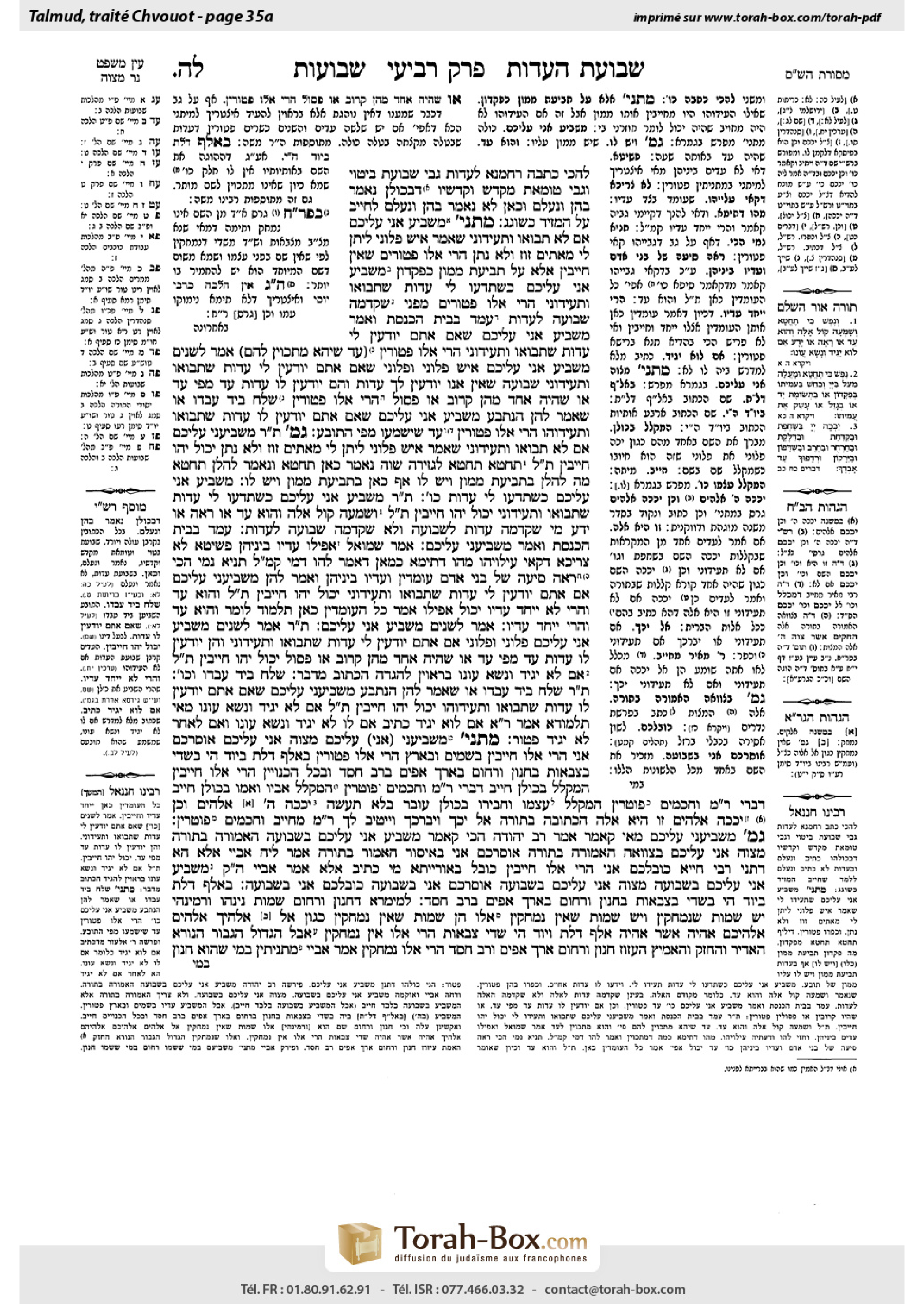
Shevuot 35a: Talmud study for Daf Yomi
Daf Yomi is the daily study of one Talmud folio. Explore 37 tractates with scans, Hebrew text, Sefaria English and AI-generated French translations where annotated.
Passage selection and English or AI-generated French translation are available where the scan has annotations. Daf Study is independent of Torah-Box and Sefaria.
Browse Shevuot · שבועות · All tractatesShevuot 35a text and translations
This page of Shevuot includes the Aramaic text, an English translation and an AI-generated French translation, alongside the scan above.
שבועות ל״ה א · Aramaic and Hebrew text
לְהָכִי כַּתְבַהּ רַחֲמָנָא לְעֵדוּת גַּבֵּי שְׁבוּעַת בִּיטּוּי וְגַבֵּי טוּמְאַת מִקְדָּשׁ וְקָדָשָׁיו – דִּבְכוּלָּן נֶאֱמַר בָּהֶן ״וְנֶעְלַם״, וְכָאן לֹא נֶאֱמַר בָּהֶן ״וְנֶעְלַם״; לְחַיֵּיב עַל הַמֵּזִיד כַּשּׁוֹגֵג.
מַתְנִי׳ ״מַשְׁבִּיעַ אֲנִי עֲלֵיכֶם, אִם לֹא תָבוֹאוּ וּתְעִידוּנִי שֶׁאָמַר אִישׁ פְּלוֹנִי לִיתֵּן לִי מָאתַיִם זוּז וְלֹא נָתַן״ – הֲרֵי אֵלּוּ פְּטוּרִים, שֶׁאֵין חַיָּיבִין אֶלָּא עַל תְּבִיעַת מָמוֹן כְּפִקָּדוֹן.
״מַשְׁבִּיעַ אֲנִי עֲלֵיכֶם כְּשֶׁתֵּדְעוּ לִי עֵדוּת שֶׁתָּבוֹאוּ וּתְעִידוּנִי״ – הֲרֵי אֵלּוּ פְּטוּרִים, מִפְּנֵי שֶׁקָּדְמָה שְׁבוּעָה לְעֵדוּת.
עָמַד בְּבֵית הַכְּנֶסֶת וְאָמַר: ״מַשְׁבִּיעַ אֲנִי עֲלֵיכֶם, שֶׁאִם אַתֶּם יוֹדְעִין לִי עֵדוּת שֶׁתָּבוֹאוּ וּתְעִידוּנִי״ – הֲרֵי אֵלּוּ פְּטוּרִין, עַד שֶׁיְּהֵא מִתְכַּוֵּין לָהֶם.
אָמַר לִשְׁנַיִם: ״מַשְׁבִּיעַ אֲנִי עֲלֵיכֶם אִישׁ פְּלוֹנִי וּפְלוֹנִי, שֶׁאִם אַתֶּם יוֹדְעִין לִי עֵדוּת שֶׁתָּבוֹאוּ וּתְעִידוּנִי״, ״שְׁבוּעָה שֶׁאֵין אָנוּ יוֹדְעִין לָךְ עֵדוּת״; וְהֵם יוֹדְעִין לוֹ עֵדוּת עֵד מִפִּי עֵד, אוֹ שֶׁהָיָה אֶחָד מֵהֶן קָרוֹב אוֹ פָּסוּל – הֲרֵי אֵלּוּ פְּטוּרִין.
שִׁלַּח בְּיַד עַבְדּוֹ, אוֹ שֶׁאָמַר לָהֶן הַנִּתְבָּע: ״מַשְׁבִּיעַ אֲנִי עֲלֵיכֶם, שֶׁאִם אַתֶּם יוֹדְעִין לוֹ עֵדוּת שֶׁתָּבוֹאוּ וּתְעִידוּהוּ״ – הֲרֵי אֵלּוּ פְּטוּרִין, עַד שֶׁיִּשְׁמְעוּ מִפִּי הַתּוֹבֵעַ.
גְּמָ׳ תָּנוּ רַבָּנַן: ״מַשְׁבִּיעַנִי עֲלֵיכֶם אִם לֹא תָבוֹאוּ וּתְעִידוּנִי שֶׁאָמַר אִישׁ פְּלוֹנִי לִיתֵּן לִי מָאתַיִם זוּז וְלֹא נָתַן״ – יָכוֹל יְהוּ חַיָּיבִין? תַּלְמוּד לוֹמַר: ״תֶּחֱטָא״–״תֶּחֱטָא״ לִגְזֵירָה שָׁוָה.
נֶאֱמַר כָּאן ״תֶּחֱטָא״, וְנֶאֱמַר לְהַלָּן ״תֶּחֱטָא״; מָה לְהַלָּן בִּתְבִיעַת מָמוֹן – וְיֵשׁ לוֹ, אַף כָּאן בִּתְבִיעַת מָמוֹן – וְיֵשׁ לוֹ.
״מַשְׁבִּיעַ אֲנִי עֲלֵיכֶם כְּשֶׁתֵּדְעוּ לִי עֵדוּת״ כּוּ׳.
תָּנוּ רַבָּנַן: ״מַשְׁבִּיעַ אֲנִי עֲלֵיכֶם כְּשֶׁתֵּדְעוּ לִי עֵדוּת שֶׁתָּבוֹאוּ וּתְעִידוּנִי״ – יָכוֹל יְהוּ חַיָּיבִין? תַּלְמוּד לוֹמַר: ״וְשָׁמְעָה קוֹל אָלָה וְהוּא עֵד אוֹ רָאָה אוֹ יָדַע״ – מִי שֶׁקָּדְמָה עֵדוּת לִשְׁבוּעָה, וְלֹא שֶׁקָּדְמָה שְׁבוּעָה לְעֵדוּת.
עָמַד בְּבֵית הַכְּנֶסֶת וְאָמַר ״מַשְׁבִּיעַנִי עֲלֵיכֶם״. אָמַר שְׁמוּאֵל: אֲפִילּוּ עֵדָיו בֵּינֵיהֶן.
פְּשִׁיטָא! לָא צְרִיכָא, דְּקָאֵי עִילָּוַיְהוּ; מַהוּ דְּתֵימָא: כְּמַאן דְּאָמַר לְהוּ דָּמֵי, קָא מַשְׁמַע לַן.
תַּנְיָא נָמֵי הָכִי: רָאָה סִיעָה שֶׁל בְּנֵי אָדָם עוֹמְדִין, וְעֵדָיו בֵּינֵיהֶן, וְאָמַר לָהֶן: ״מַשְׁבִּיעַנִי עֲלֵיכֶם אִם אַתֶּם יוֹדְעִין לִי עֵדוּת שֶׁתָּבוֹאוּ וּתְעִידוּנִי״ – יָכוֹל יְהוּ חַיָּיבִין? תַּלְמוּד לוֹמַר: ״וְהוּא עֵד״ – וַהֲרֵי לֹא יִיחֵד עֵדָיו. יָכוֹל אֲפִילּוּ אָמַר ״כׇּל הָעוֹמְדִין כָּאן״? תַּלְמוּד לוֹמַר: ״וְהוּא עֵד״ – וַהֲרֵי יִיחֵד עֵדָיו.
אָמַר לִשְׁנַיִם: ״מַשְׁבִּיעַ אֲנִי עֲלֵיכֶם״. תָּנוּ רַבָּנַן, אָמַר לִשְׁנַיִם: ״מַשְׁבִּיעַ אֲנִי עֲלֵיכֶם פְּלוֹנִי וּפְלוֹנִי, אִם אַתֶּם יוֹדְעִין לִי עֵדוּת שֶׁתָּבוֹאוּ וּתְעִידוּנִי״; וְהֵן יוֹדְעִין לוֹ עֵדוּת עֵד מִפִּי עֵד, אוֹ שֶׁהָיָה אֶחָד מֵהֶן קָרוֹב אוֹ פָּסוּל – יָכוֹל יְהוּ חַיָּיבִין? תַּלְמוּד לוֹמַר: ״אִם לוֹא יַגִּיד וְנָשָׂא עֲוֹנוֹ״ – בִּרְאוּיִן לְהַגָּדָה הַכָּתוּב מְדַבֵּר.
שִׁלַּח בְּיַד עַבְדּוֹ וְכוּ׳. תָּנוּ רַבָּנַן: שִׁלַּח בְּיַד עַבְדּוֹ, אוֹ שֶׁאָמַר לָהֶן הַנִּתְבָּע: ״מַשְׁבִּיעַנִי עֲלֵיכֶם שֶׁאִם אַתֶּם יוֹדְעִין לוֹ עֵדוּת שֶׁתָּבוֹאוּ וּתְעִידוּהוּ״ – יָכוֹל יְהוּ חַיָּיבִין? תַּלְמוּד לוֹמַר: ״אִם לֹא יַגִּיד וְנָשָׂא עֲוֹנוֹ״.
מַאי תַּלְמוּדָא? אָמַר רַבִּי אֶלְעָזָר: ״אִם לוֹא יַגִּיד״ כְּתִיב; אִם לוֹ לֹא יַגִּיד – וְנָשָׂא עֲוֹנוֹ, וְאִם לְאַחֵר לֹא יַגִּיד – פָּטוּר.
מַתְנִי׳ ״מַשְׁבִּיעַנִי (אֲנִי) עֲלֵיכֶם״; ״מְצַוֶּה אֲנִי עֲלֵיכֶם״; ״אוֹסֶרְכֶם אֲנִי״ – הֲרֵי אֵלּוּ חַיָּיבִין.
״בַּשָּׁמַיִם וּבָאָרֶץ״ – הֲרֵי אֵלּוּ פְּטוּרִין. ״בְּאָלֶף דָּלֶת״; ״בְּיוֹד הֵי״; ״בְּשַׁדַּי״; ״בִּצְבָאוֹת״; ״בְּחַנּוּן וְרַחוּם״; ״בְּאֶרֶךְ אַפַּיִם״; ״בְּרַב חֶסֶד״; וּבְכָל הַכִּנּוּיִין – הֲרֵי אֵלּוּ חַיָּיבִין.
הַמְקַלֵּל בְּכוּלָּן – חַיָּיב; דִּבְרֵי רַבִּי מֵאִיר. וַחֲכָמִים פּוֹטְרִין.
הַמְקַלֵּל אָבִיו וְאִמּוֹ בְּכוּלָּן – חַיָּיב; דִּבְרֵי רַבִּי מֵאִיר. וַחֲכָמִים פּוֹטְרִין.
הַמְקַלֵּל עַצְמוֹ וַחֲבֵירוֹ בְּכוּלָּן – עוֹבֵר בְּלֹא תַעֲשֶׂה. ״יַכְּכָה ה׳ אֱלֹהִים״, וְכֵן ״יַכְּכָה אֱלֹהִים״ – זוֹ הִיא אָלָה הַכְּתוּבָה בַּתּוֹרָה.
״אַל יַכְּךָ״, וִ״יבָרֶכְךָ״ וְ״יֵיטִיב לָךְ״ – רַבִּי מֵאִיר מְחַיֵּיב, וַחֲכָמִים פּוֹטְרִין.
גְּמָ׳ ״מַשְׁבִּיעַנִי עֲלֵיכֶם״ – מַאי קָאָמַר? אָמַר רַב יְהוּדָה, הָכִי קָאָמַר: ״מַשְׁבִּיעַ אֲנִי עֲלֵיכֶם בִּשְׁבוּעָה הָאֲמוּרָה בַּתּוֹרָה״; ״מְצַוֶּה אֲנִי עֲלֵיכֶם בְּצַוָּואָה הָאֲמוּרָה בַּתּוֹרָה״; ״אוֹסֶרְכֶם אֲנִי בְּאִיסּוּר הָאָמוּר בַּתּוֹרָה״.
אֲמַר לֵיהּ אַבָּיֵי, אֶלָּא הָא דְתָנֵי רַבִּי חִיָּיא: ״כּוֹבֶלְכֶם אֲנִי״ – הֲרֵי אֵלּוּ חַיָּיבִין; כּוֹבֵל בְּאוֹרָיְיתָא מִי כְּתִיב?!
אֶלָּא אָמַר אַבָּיֵי, הָכִי קָאָמַר: ״מַשְׁבִּיעַ אֲנִי עֲלֵיכֶם בִּשְׁבוּעָה״; ״מְצַוֶּה אֲנִי עֲלֵיכֶם בִּשְׁבוּעָה״; ״אוֹסֶרְכֶם אֲנִי בִּשְׁבוּעָה״; ״כּוֹבֶלְכֶם אֲנִי בִּשְׁבוּעָה״.
״בְּאָלֶף דָּלֶת״; ״בְּיוֹד הֵי״; ״בְּשַׁדַּי״; ״בִּצְבָאוֹת״; ״בְּחַנּוּן וְרַחוּם״; ״בְּאֶרֶךְ אַפַּיִם״; ״בְּרַב חֶסֶד״.
לְמֵימְרָא דְּחַנּוּן וְרַחוּם שֵׁמוֹת נִינְהוּ?! וּרְמִינְהִי: יֵשׁ שֵׁמוֹת שֶׁנִּמְחָקִין, וְיֵשׁ שֵׁמוֹת שֶׁאֵין נִמְחָקִין – אֵלּוּ הֵן שֵׁמוֹת שֶׁאֵין נִמְחָקִין: כְּגוֹן ״אֵל״, ״אֱלֹהֶיךָ״, ״אֱלֹהִים״, ״אֱלֹהֵיכֶם״, ״אֶהְיֶה אֲשֶׁר אֶהְיֶה״, ״אָלֶף דָּלֶת״ וְ״יוֹד הֵי״, ״שַׁדַּי״, ״צְבָאוֹת״ – הֲרֵי אֵלּוּ אֵין נִמְחָקִין.
אֲבָל ״הַגָּדוֹל״, ״הַגִּבּוֹר״, ״הַנּוֹרָא״, ״הָאַדִּיר״ וְ״הֶחָזָק״ וְ״הָאַמִּיץ״, ״הָעִזּוּז״, ״חַנּוּן וְרַחוּם״, ״אֶרֶךְ אַפַּיִם״ וְ״רַב חֶסֶד״ – הֲרֵי אֵלּוּ נִמְחָקִין.
אָמַר אַבָּיֵי: מַתְנִיתִין ״בְּמִי שֶׁהוּא חַנּוּן״
Shevuot 35a · English translation
The Gemara answers: For that reason, the Merciful One writes the verse with regard to an oath of testimony near the verse with regard to an oath on an utterance and near the verse with regard to the defiling of the Temple or its sacrificial foods, as in all of those passages it is stated concerning them: “And it is hidden,” and here, with regard to an oath of testimony, it is not stated concerning them: And it is hidden. The Torah did so to underscore the contrast between them and to deem liable one who takes an intentional false oath of testimony like one who takes an unwitting false oath of testimony.
MISHNA: If one said to witnesses: I administer an oath to you concerning your refusal to testify if you do not come and testify on my behalf that so-and-so said he is going to give me two hundred dinars and he did not give them to me, and they take false oaths that they have no knowledge of the matter, they are exempt from liability to bring an offering for taking a false oath of testimony, as one is liable for taking a false oath of testimony only in a case involving a monetary claim like a deposit in the sense that were the witnesses to testify, the individual would be liable to pay. In the case of a promise to give a gift he could claim that he merely reconsidered.
If one said to witnesses: I administer an oath to you that when you will know testimony relevant to me you will come and testify on my behalf, these witnesses are exempt from liability for taking a false oath of testimony even if they do not testify, due to the fact that the oath preceded their knowledge of the relevant testimony.
If one stood in the synagogue and said for all to hear: I administer an oath to you that if you know testimony relevant to me you will come and testify on my behalf, these witnesses are exempt until he directs his demand to specific individuals.
If one said to two people: I administer an oath to you, so-and-so and so-and-so, that if you know testimony relevant to me you will come and testify on my behalf, and they respond: On our oath we do not know any testimony relevant to you, and they know testimony relevant to him, not based on an incident they witnessed but based on hearsay testimony, which is not valid testimony, or if one of the witnesses is found to be a relative or disqualified, these witnesses are exempt from liability for taking a false oath of testimony because they are unfit witnesses.
If the plaintiff sent the demand for their testimony by means of his slave, or in a case where the defendant said to the witnesses: I administer an oath to you that if you know any testimony relevant to the plaintiff that you will come and testify on his behalf, and they took a false oath that they have no knowledge of the matter, these witnesses are exempt from liability for taking a false oath of testimony until they will hear the demand to testify directly from the mouth of the plaintiff.
GEMARA: The Gemara cites proof for the halakhot in the mishna from verses in the Torah. The Sages taught: I administer an oath to you concerning your refusal to testify if you do not come and testify on my behalf that so-and-so said that he is going to give me two hundred dinars and he did not give them to me; in such a case one might have thought that they would be liable. Therefore, the verse states the term “shall sin” with regard to an oath of testimony and “shall sin” with regard to an oath on a deposit in order to derive a verbal analogy.
Here, it is stated with regard to an oath of testimony “shall sin” (Leviticus 5:1), and there, it is stated with regard to an oath on a deposit “shall sin” (Leviticus 5:21). Just as there, with regard to an oath on a deposit, the verse is speaking only with regard to a monetary claim and in a case where the plaintiff has a legitimate claim, so too here, with regard to an oath of testimony, the verse is speaking only with regard to a monetary claim and in a case where the plaintiff has a legitimate claim. In the case cited in the baraita and in the first clause of the mishna, the plaintiff does not have a legitimate claim.
The mishna teaches: I administer an oath to you that when you will know testimony relevant to me you will come and testify on my behalf.
The Sages taught: I administer an oath to you that when you will know testimony relevant to me you will come and testify on my behalf; in such a case one might have thought that they would be liable. Therefore, the verse states: “And he heard the voice of an oath and he is a witness or he saw or he knew” (Leviticus 5:1). One is liable to bring an offering for a false oath only in a case where knowledge of the testimony preceded the oath, and not in a case where the oath preceded knowledge of the testimony.
The mishna continues: If one stood in the synagogue and said for all to hear: I administer an oath to you that if you know testimony relevant to me you will come and testify on my behalf, these witnesses are exempt. Shmuel says: That is the halakha even if his witnesses were among the people in the synagogue.
The Gemara asks: Isn’t this obvious? Otherwise, there would be no novel element in this halakha of the mishna. The Gemara answers: No, it is necessary to cite this case only in a situation where he is standing right next to those witnesses. Lest you say he is comparable to one who spoke to them directly and those witnesses would be liable, the tanna teaches us that until he specifies to whom he is directing his demand, he does not render those witnesses obligated to take an oath of testimony.
The Gemara notes: This is also taught in a baraita: If one saw a group of people standing, and his witnesses were among them, and he said to the entire group: I administer an oath to you that if you know testimony relevant to me you will come and testify on my behalf, in such a case one might have thought that they would be liable. The verse states: “And he is a witness” (Leviticus 5:1), and in this case he did not specify his witnesses; therefore, they are not liable. One might have thought that the halakha is the same even if he said: I administer an oath to everyone who is standing here that you will come and testify on my behalf. The verse states: “And he is a witness” (Leviticus 5:1), and in this case, although he spoke to a group, he specified his witnesses; therefore, they are liable.
The mishna teaches that if one said to two individuals: I administer an oath to you, and they know testimony relevant to him based on hearsay, or if one of the witnesses is found to be a relative or disqualified, they are exempt. The Gemara cites that which the Sages taught: If one said to two individuals: I administer an oath to you, so-and-so and so-and-so, that if you know testimony relevant to me you will come and testify on my behalf, and they know testimony relevant to him based on hearsay testimony, or if one of the witnesses is a relative or disqualified, in such a case one might have thought that they would be liable. The verse states: “If he does not state it, then he shall bear his iniquity” (Leviticus 5:1), teaching that it is with regard to those eligible for the statement of testimony that the verse is speaking, not those who are ineligible.
The mishna teaches: If the plaintiff sent the demand for their testimony by means of his slave, etc. The Sages taught: If the plaintiff sent the demand for their testimony by means of his slave, or in a case where the defendant said to the witnesses: I administer an oath to you that if you know any testimony relevant to the plaintiff that you will come and testify on his behalf, might one have thought that they would be liable? The verse states: “If he does not state it, then he shall bear his iniquity” (Leviticus 5:1); therefore, they are not liable.
The Gemara asks: What is the biblical derivation that leads to that conclusion? Rabbi Elazar said: The derivation is based on the fact that it is written: Im lo yaggid. In the verse the word lo is spelled lamed, vav, alef and interpreted as both “not,” spelled lamed alef, and “to him,” spelled lamed vav. It is derived: If the witness who knows the testimony does not state it to the plaintiff, he shall bear his iniquity, and he is liable; but if he does not state it to another, he is exempt.
MISHNA: The mishna discusses the formula of an oath of testimony. If the plaintiff said to the witnesses: I administer an oath to you concerning your refusal to testify if you do not come and testify on my behalf, or even if he said: I command you, or I bind you, although he did not employ an unequivocal formula of an oath, these witnesses are liable for taking a false oath of testimony.
If one administered the oath to the witnesses in the name of heaven and in the name of earth, these witnesses are exempt from liability for taking a false oath of testimony, as that is not an oath in the name of God. If one administered the oath to the witnesses in the name of alef dalet, i.e., Adonai; in the name of yod heh, the Tetragrammaton; in the name of the Almighty [Shaddai]; in the name of the Lord of Hosts [Tzevaot]; in the name of the Gracious and Compassionate One; in the name of He Who is Slow to Anger; in the name of He Who is Abounding in Loving-kindness; or in the name of any of the appellations of God, even though he did not mention the ineffable name of God, these witnesses are liable for taking a false oath of testimony.
One who curses God employing any of these names or appellations of God is liable to be executed through stoning; this is the statement of Rabbi Meir. And the Rabbis deem him exempt, as they hold that one is liable for cursing God only if he employs the ineffable name of God.
One who curses his father or his mother employing any of these names or appellations of God is liable to be executed through stoning; this is the statement of Rabbi Meir. And the Rabbis deem him exempt, as they hold that one is liable for cursing his father and his mother only if he employs the ineffable name of God.
One who curses himself or another employing any of these names or appellations of God violates a prohibition. If one says: The Lord God shall strike you (see Deuteronomy 28:22), and likewise if one says: God shall strike you if you do not come to testify, that is a curse that is written in the Torah, and in such a case one is certainly liable if he fails to testify.
If one says to the witnesses: God shall not strike you, or: God shall bless you, or: God shall benefit you if you come and testify, Rabbi Meir deems him liable, as one may infer from that statement that if he fails to testify God will strike him, or will not bless or benefit him. And the Rabbis deem him exempt because the curse is not explicitly stated.
GEMARA: The mishna teaches that if the plaintiff said to the witnesses: I administer an oath to you, I command you, or I bind you, these witnesses are liable for taking a false oath of testimony. The Gemara asks: What is the plaintiff saying? He merely said that he is administering an oath, but he did not say in the name of what he is administering the oath. Rav Yehuda said: This is what the plaintiff is saying: I administer an oath to you with the oath mentioned in the Torah, I command you with the command mentioned in the Torah, I bind you with the bond mentioned in the Torah, and in the Torah all of these include mention of the name of God.
Abaye said to Rav Yehuda: But according to that interpretation, concerning that which Rabbi Ḥiyya teaches, that if the plaintiff said to the witnesses: I chain you, these witnesses are liable for taking a false oath of testimony, is chaining written in the Torah? Apparently, the reference in the mishna and the baraita is not to similar language in the Torah.
Rather, Abaye said that this is what the plaintiff is saying: I administer an oath to you with an oath, I command you with an oath, I bind you with an oath, I chain you with an oath. The witnesses are liable in all these cases provided that the plaintiff mentions an oath.
§ The mishna teaches: If one administered the oath to the witnesses in the name of alef dalet, in the name of yod heh, in the name of the Almighty [Shaddai], in the name of the Lord of Hosts [Tzevaot], in the name of the Gracious and Compassionate One, in the name of He Who is Slow to Anger, or in the name of He Who is Abounding in Loving-kindness, these witnesses are liable for taking a false oath of testimony.
Is that to say that gracious and compassionate are sacred names? The Gemara raises a contradiction from a baraita: There are names of God that may be erased and there are names of God that may not be erased due to their inherent sanctity. These are names that may not be erased: For example, several variations of the name God [Elohim]: El, Elohekha with a second person singular suffix, Elohim, Eloheikhem with a second person plural suffix; I Shall Be As I Shall Be, alef dalet, yod heh, Almighty [Shaddai], Lord of Hosts [Tzevaot], these names may not be erased.
But adjectives that describe the Holy One, Blessed be He, e.g., the Great, the Mighty, the Awesome, the Prodigious, the Powerful, the Courageous, the Strong, gracious, compassionate, slow to anger, or abounding in loving-kindness; these may be erased. Apparently, gracious and compassionate are adjectives and not actual names of God; how, then, does an oath or a curse in the name of gracious and compassionate take effect?
Abaye said: In the mishna, it is with regard to one who administers an oath or curses in the name of He Who is Gracious,
Shevuot 35a · Traduction française (IA)
La Guemara répond : C’est pour cette raison que le Miséricordieux place le verset relatif au serment de témoignage à proximité du verset relatif au serment portant sur une parole, ainsi que de celui relatif à la souillure du Temple ou de ses aliments sacrificiels. En effet, dans tous ces passages, il est dit à leur sujet : « Et cela lui était caché », tandis qu’ici, à propos du serment de témoignage, il n’est pas dit : « Et cela lui était caché ». La Torah a procédé ainsi pour souligner le contraste entre ces cas et rendre passible celui qui prête intentionnellement un faux serment de témoignage, au même titre que celui qui en prête un involontairement.
MICHNA : Si quelqu’un dit à des témoins : « Je vous adjure, sous peine de sanction pour votre refus de témoigner, de venir déposer en ma faveur que Untel a dit qu’il allait me donner deux cents dinars et qu’il ne me les a pas donnés », et qu’ils prêtent un faux serment en affirmant qu’ils ne connaissent pas cette affaire, ils sont dispensés d’apporter une offrande pour faux serment de témoignage. En effet, on n’est passible d’un faux serment de témoignage que dans le cadre d’une réclamation pécuniaire, comme celle portant sur un dépôt, c’est-à-dire dans un cas où, si les témoins déposaient, l’intéressé serait tenu de payer. S’il s’agit d’une promesse de don, il pourrait prétendre qu’il a simplement changé d’avis.
Si quelqu’un dit à des témoins : « Je vous adjure de venir déposer en ma faveur lorsque vous connaîtrez un témoignage qui me concerne », ces témoins sont dispensés de toute responsabilité pour faux serment de témoignage, même s’ils ne déposent pas, car le serment a précédé leur connaissance du témoignage en question.
Si quelqu’un se tient dans la synagogue et dit à tous ceux qui l’entendent : « Je vous adjure de venir déposer en ma faveur si vous connaissez un témoignage qui me concerne », ces témoins sont dispensés de toute responsabilité jusqu’à ce qu’il adresse sa demande à des personnes précises.
Si quelqu’un dit à deux personnes : « Je vous adjure, Untel et Untel, de venir déposer en ma faveur si vous connaissez un témoignage qui me concerne », et qu’elles répondent : « Nous jurons que nous ne connaissons aucun témoignage qui vous concerne », alors qu’elles connaissent un témoignage le concernant non pas parce qu’elles ont assisté à l’événement, mais parce qu’elles en ont eu connaissance par ouï-dire, ce qui ne constitue pas un témoignage recevable ; ou si l’un des témoins se révèle être un parent ou être inapte, ces témoins sont dispensés de toute responsabilité pour faux serment de témoignage, car ils ne sont pas aptes à témoigner.
Si le demandeur fait transmettre sa demande de témoignage par son esclave, ou si le défendeur dit aux témoins : « Je vous adjure de venir déposer en faveur du demandeur si vous connaissez un témoignage le concernant », et qu’ils prêtent un faux serment en affirmant ne rien savoir de l’affaire, ces témoins sont dispensés de toute responsabilité pour faux serment de témoignage tant qu’ils n’ont pas entendu la demande de témoigner directement de la bouche du demandeur.
GUEMARA : La Guemara apporte, à partir des versets de la Torah, des preuves à l’appui des halakhot de la Michna. Les Sages ont enseigné : Si quelqu’un dit à des témoins : « Je vous adjure, sous peine de sanction pour votre refus de témoigner, de venir déposer en ma faveur que Untel a dit qu’il allait me donner deux cents dinars et qu’il ne me les a pas donnés », on aurait pu penser qu’ils sont passibles. Le verset emploie donc l’expression « il sera coupable » à propos du serment de témoignage et l’expression « il sera coupable » à propos du serment portant sur un dépôt, afin d’établir une analogie verbale.
Ici, à propos du serment de témoignage, il est écrit « il sera coupable » (Lévitique 5:1), et là, à propos du serment portant sur un dépôt, il est écrit « il sera coupable » (Lévitique 5:21). De même que là, à propos du serment portant sur un dépôt, le verset ne traite que d’une réclamation pécuniaire et d’un cas où le demandeur a une réclamation fondée, de même ici, à propos du serment de témoignage, le verset ne traite que d’une réclamation pécuniaire et d’un cas où le demandeur a une réclamation fondée. Dans le cas cité dans la baraïta et dans la première partie de la Michna, le demandeur n’a pas de réclamation fondée.
La Michna enseigne : « Je vous adjure de venir déposer en ma faveur lorsque vous connaîtrez un témoignage qui me concerne. »
Les Sages ont enseigné : Si quelqu’un dit à des témoins : « Je vous adjure de venir déposer en ma faveur lorsque vous connaîtrez un témoignage qui me concerne », on aurait pu penser qu’ils sont passibles. Le verset dit donc : « S’il entend la voix d’un serment, et qu’il est témoin, ou s’il a vu ou s’il a su » (Lévitique 5:1). On n’est tenu d’apporter une offrande pour faux serment que dans le cas où la connaissance du témoignage a précédé le serment, et non dans le cas où le serment a précédé cette connaissance.
La Michna poursuit : Si quelqu’un se tient dans la synagogue et dit à tous ceux qui l’entendent : « Je vous adjure de venir déposer en ma faveur si vous connaissez un témoignage qui me concerne », ces témoins sont dispensés. Chmouel dit : Telle est la halakha même si ses témoins se trouvent parmi les personnes présentes dans la synagogue.
La Guemara demande : N’est-ce pas évident ? Sinon, cette halakha de la Michna ne présenterait aucun élément nouveau. La Guemara répond : Non, ce cas est nécessaire uniquement lorsqu’il se tient juste à côté de ces témoins. De peur que tu ne dises qu’il est comparable à quelqu’un qui leur a parlé directement et que ces témoins soient passibles, le tanna nous enseigne que, tant qu’il ne précise pas à qui il adresse sa demande, il ne rend pas ces témoins passibles du serment de témoignage.
La Guemara relève que cela est également enseigné dans une baraïta : Si quelqu’un voit un groupe de personnes debout, parmi lesquelles se trouvent ses témoins, et qu’il dit à tout le groupe : « Je vous adjure de venir déposer en ma faveur si vous connaissez un témoignage qui me concerne », on aurait pu penser qu’ils sont passibles. Le verset dit : « Et qu’il est témoin » (Lévitique 5:1). Or, dans ce cas, il n’a pas désigné ses témoins ; ils ne sont donc pas passibles. On aurait pu penser que la même halakha s’applique même s’il dit : « J’adjure tous ceux qui se tiennent ici de venir déposer en ma faveur. » Le verset dit : « Et qu’il est témoin » (Lévitique 5:1). Dans ce cas, bien qu’il se soit adressé à un groupe, il a désigné ses témoins ; ils sont donc passibles.
La Michna enseigne que si quelqu’un dit à deux personnes : « Je vous adjure », et qu’elles connaissent un témoignage le concernant par ouï-dire, ou si l’un des témoins se révèle être un parent ou être inapte, elles sont dispensées. La Guemara cite ce que les Sages ont enseigné : Si quelqu’un dit à deux personnes : « Je vous adjure, Untel et Untel, de venir déposer en ma faveur si vous connaissez un témoignage qui me concerne », et qu’elles connaissent un témoignage le concernant par ouï-dire, ou si l’un des témoins est un parent ou est inapte, on aurait pu penser qu’elles sont passibles. Le verset dit : « S’il ne le déclare pas, il portera sa faute » (Lévitique 5:1), enseignant qu’il s’agit de personnes aptes à déposer, et non de personnes qui ne le sont pas.
La Michna enseigne : « Si le demandeur a fait transmettre sa demande de témoignage par son esclave, etc. » Les Sages ont enseigné : Si le demandeur a fait transmettre sa demande de témoignage par son esclave, ou si le défendeur dit aux témoins : « Je vous adjure de venir déposer en faveur du demandeur si vous connaissez un témoignage le concernant », aurait-on pu penser qu’ils sont passibles ? Le verset dit : « S’il ne le déclare pas, il portera sa faute » (Lévitique 5:1) ; ils ne sont donc pas passibles.
La Guemara demande : Quelle déduction biblique mène à cette conclusion ? Rabbi Elazar dit : La déduction repose sur le fait qu’il est écrit : Im lo yaggid. Dans le verset, le mot lo s’écrit avec un lamed, un vav et un alef, et s’interprète à la fois comme « ne pas », écrit lamed alef, et comme « à lui », écrit lamed vav. On en déduit : Si le témoin qui connaît le témoignage ne le déclare pas au demandeur, il portera sa faute et sera passible ; mais s’il ne le déclare pas à quelqu’un d’autre, il est dispensé.
MICHNA : La Michna traite de la formulation du serment de témoignage. Si le demandeur dit aux témoins : « Je vous adjure, sous peine de sanction pour votre refus de témoigner, de venir déposer en ma faveur », ou même s’il dit : « Je vous l’ordonne » ou « Je vous lie », bien qu’il n’emploie pas une formule de serment explicite, ces témoins sont passibles pour faux serment de témoignage.
Si quelqu’un fait prêter serment aux témoins au nom du ciel et au nom de la terre, ces témoins sont dispensés de toute responsabilité pour faux serment de témoignage, car ce n’est pas un serment au nom de Dieu. Si quelqu’un fait prêter serment aux témoins au nom de alef dalet, c’est-à-dire Adonaï ; au nom de yod heh, le Tétragramme ; au nom du Tout-Puissant [Shaddaï] ; au nom du Seigneur des armées [Tzevaot] ; au nom du Clément et du Miséricordieux ; au nom de Celui qui est lent à la colère ; au nom de Celui qui abonde en bonté ; ou au nom de l’une quelconque des appellations de Dieu, ces témoins sont passibles pour faux serment de témoignage, même si le nom ineffable de Dieu n’a pas été mentionné.
Celui qui maudit Dieu en employant l’un quelconque de ces noms ou appellations de Dieu est passible de la lapidation ; telle est l’opinion de Rabbi Meïr. Les Sages le dispensent, car ils estiment qu’on n’est passible d’avoir maudit Dieu que si l’on emploie le nom ineffable de Dieu.
Celui qui maudit son père ou sa mère en employant l’un quelconque de ces noms ou appellations de Dieu est passible de la lapidation ; telle est l’opinion de Rabbi Meïr. Les Sages le dispensent, car ils estiment qu’on n’est passible d’avoir maudit son père et sa mère que si l’on emploie le nom ineffable de Dieu.
Celui qui se maudit lui-même ou maudit quelqu’un d’autre en employant l’un quelconque de ces noms ou appellations de Dieu transgresse une interdiction. Si quelqu’un dit : « Que le Seigneur Dieu te frappe » (voir Deutéronome 28:22), et de même s’il dit : « Que Dieu te frappe si tu ne viens pas déposer », c’est une malédiction écrite dans la Torah ; dans un tel cas, celui qui ne dépose pas est certainement passible.
Si quelqu’un dit aux témoins : « Que Dieu ne vous frappe pas », ou : « Que Dieu vous bénisse », ou : « Que Dieu vous soit favorable si vous venez déposer », Rabbi Meïr le déclare passible, car on peut déduire de ces propos que, s’ils ne déposent pas, Dieu les frappera, ne les bénira pas ou ne leur sera pas favorable. Les Sages le dispensent, car la malédiction n’est pas formulée explicitement.
GUEMARA : La Michna enseigne que si le demandeur dit aux témoins : « Je vous adjure », « Je vous l’ordonne » ou « Je vous lie », ces témoins sont passibles pour faux serment de témoignage. La Guemara demande : Que dit le demandeur ? Il a simplement dit qu’il les adjure, mais il n’a pas précisé au nom de quoi il le faisait. Rav Yehouda dit : Voici ce que dit le demandeur : « Je vous adjure par le serment mentionné dans la Torah, je vous l’ordonne par l’ordre mentionné dans la Torah, je vous lie par le lien mentionné dans la Torah » ; or, dans la Torah, toutes ces expressions incluent la mention du nom de Dieu.
Abayé dit à Rav Yehouda : Mais selon cette interprétation, à propos de ce qu’enseigne Rabbi Ḥiyya — à savoir que si le demandeur dit aux témoins : « Je vous enchaîne », ces témoins sont passibles pour faux serment de témoignage —, le fait d’enchaîner est-il mentionné dans la Torah ? Il semble donc que les expressions de la Michna et de la baraïta ne renvoient pas à des formulations semblables dans la Torah.
Abayé dit plutôt que voici ce que dit le demandeur : « Je vous adjure par un serment, je vous l’ordonne par un serment, je vous lie par un serment, je vous enchaîne par un serment. » Dans tous ces cas, les témoins sont passibles à condition que le demandeur mentionne un serment.
§ La Michna enseigne : Si quelqu’un fait prêter serment aux témoins au nom de alef dalet, au nom de yod heh, au nom du Tout-Puissant [Shaddaï], au nom du Seigneur des armées [Tzevaot], au nom du Clément, du Miséricordieux, de Celui qui est lent à la colère ou de Celui qui abonde en bonté, ces témoins sont passibles pour faux serment de témoignage.
Cela signifie-t-il que « Clément » et « Miséricordieux » sont des noms sacrés ? La Guemara soulève une contradiction à partir d’une baraïta : Il existe des noms de Dieu que l’on peut effacer et d’autres que l’on ne peut pas effacer en raison de leur sainteté intrinsèque. Voici les noms que l’on ne peut pas effacer : plusieurs variantes du nom Dieu [Elohim], par exemple El, Elohekha, avec un suffixe de deuxième personne du singulier ; Elohim ; Eloheikhem, avec un suffixe de deuxième personne du pluriel ; « Je serai ce que Je serai » ; alef dalet ; yod heh ; Tout-Puissant [Shaddaï] ; Seigneur des armées [Tzevaot]. Ces noms ne peuvent pas être effacés.
Mais les adjectifs qui décrivent le Saint, béni soit-Il — par exemple le Grand, le Puissant, le Redoutable, l’Extraordinaire, le Fort, le Courageux, le Vigoureux, le Clément, le Miséricordieux, Celui qui est lent à la colère ou Celui qui abonde en bonté — peuvent être effacés. Il semble donc que « Clément » et « Miséricordieux » soient des adjectifs et non des noms de Dieu à proprement parler. Comment, dès lors, un serment ou une malédiction prononcés au nom du Clément et du Miséricordieux peuvent-ils prendre effet ?
Abayé dit : Dans la Michna, il s’agit de celui qui fait prêter serment ou qui maudit au nom de Celui qui est clément,
Traduction française générée par IA à partir de l’édition anglaise de Sefaria. Vérifie toujours un passage avec le texte source.
Text from Sefaria: William Davidson Edition - Vocalized Aramaic (CC BY NC); William Davidson Edition - English (CC BY NC).