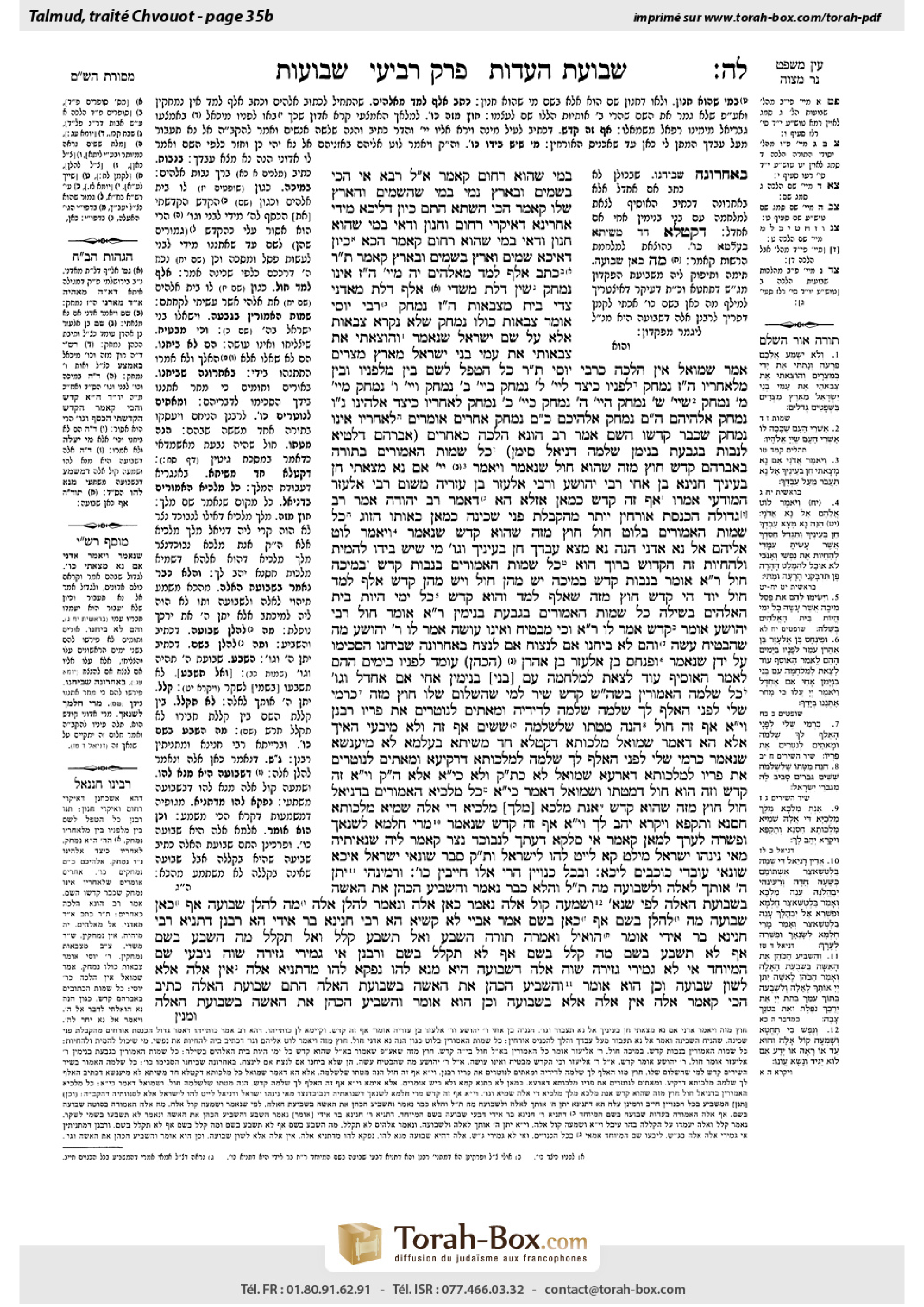
Shevuot 35b: Talmud study for Daf Yomi
Daf Yomi is the daily study of one Talmud folio. Explore 37 tractates with scans, Hebrew text, Sefaria English and AI-generated French translations where annotated.
Passage selection and English or AI-generated French translation are available where the scan has annotations. Daf Study is independent of Torah-Box and Sefaria.
Browse Shevuot · שבועות · All tractatesShevuot 35b text and translations
This page of Shevuot includes the Aramaic text, an English translation and an AI-generated French translation, alongside the scan above.
שבועות ל״ה ב · Aramaic and Hebrew text
״בְּמִי שֶׁהוּא רַחוּם״ קָאָמַר.
אֲמַר לֵיהּ רָבָא: אִי הָכִי, ״בַּשָּׁמַיִם וּבָאָרֶץ״ נָמֵי – ״בְּמִי שֶׁהַשָּׁמַיִם וְהָאָרֶץ שֶׁלּוֹ״ קָאָמַר!
הָכִי הַשְׁתָּא?! הָתָם, כֵּיוָן דְּלֵיכָּא מִידֵּי אַחֲרִינָא דְּאִיקְּרִי רַחוּם וְחַנּוּן – וַדַּאי ״בְּמִי שֶׁהוּא חַנּוּן״, וַדַּאי ״בְּמִי שֶׁהוּא רַחוּם״ קָאָמַר. הָכָא, כֵּיוָן דְּאִיכָּא שָׁמַיִם וָאָרֶץ – ״בַּשָּׁמַיִם וּבָאָרֶץ״ קָאָמַר.
תָּנוּ רַבָּנַן: כָּתַב אָלֶף לָמֶד מֵ״אֱלֹהִים״, ״יָהּ״ מֵ״יְיָ״ – הֲרֵי זֶה אֵינוֹ נִמְחָק. שִׁין דָּלֶת מִ״שַּׁדַּי״, אָלֶף דָּלֶת מֵ״אֲדֹנָי״, צָדִי בֵּית מִ״צְּבָאוֹת״ – הֲרֵי זֶה נִמְחָק.
רַבִּי יוֹסֵי אוֹמֵר: ״צְבָאוֹת״ כּוּלּוֹ נִמְחָק – שֶׁלֹּא נִקְרָא צְבָאוֹת אֶלָּא עַל שֵׁם יִשְׂרָאֵל, שֶׁנֶּאֱמַר: ״וְהוֹצֵאתִי אֶת צִבְאֹתַי אֶת עַמִּי בְנֵי יִשְׂרָאֵל מֵאֶרֶץ מִצְרַיִם״. אָמַר שְׁמוּאֵל: אֵין הֲלָכָה כְּרַבִּי יוֹסֵי.
תָּנוּ רַבָּנַן: כׇּל הַטָּפֵל לַשֵּׁם, בֵּין מִלְּפָנָיו וּבֵין מִלְּאַחֲרָיו – הֲרֵי זֶה נִמְחָק. לְפָנָיו כֵּיצַד? ״לַייָ׳״ – ל׳ נִמְחָק; ״בַּייָ׳״ – ב׳ נִמְחָק; ״וַייָ׳״ – ו׳ נִמְחָק; ״מֵיְיָ׳״ – מ׳ נִמְחָק; ״שֶׁיְיָ׳״ – ש׳ נִמְחָק; ״הַיְיָ׳״ – ה׳ נִמְחָק; ״כַּייָ׳״ – כ׳ נִמְחָק.
לְאַחֲרָיו כֵּיצַד? ״אֱלֹהֵינוּ״ – נוּ נִמְחָק, ״אֱלֹהֵיהֶם״ – הֶם נִמְחָק, ״אֱלֹהֵיכֶם״ – כֶם נִמְחָק. אֲחֵרִים אוֹמְרִים: לְאַחֲרָיו אֵינוֹ נִמְחָק, שֶׁכְּבָר קִדְּשׁוֹ הַשֵּׁם. אָמַר רַב הוּנָא: הֲלָכָה כַּאֲחֵרִים.
(אַבְרָהָם, דְּלָטְיָא, לְנָבוֹת, בְּגִבְעַת בִּנְיָמִן, שְׁלֹמֹה, דָּנִיאֵל – סִימָן)
כׇּל שֵׁמוֹת הָאֲמוּרִים בַּתּוֹרָה בְּאַבְרָהָם – קֹדֶשׁ; חוּץ מִזֶּה שֶׁהוּא חוֹל – שֶׁנֶּאֱמַר: ״וַיֹּאמַר, אֲדֹנָי אִם נָא מָצָאתִי חֵן בְּעֵינֶיךָ״.
חֲנִינָא בֶּן אֲחִי רַבִּי יְהוֹשֻׁעַ וְרַבִּי אֶלְעָזָר בֶּן עֲזַרְיָה מִשּׁוּם רַבִּי אֶלְעָזָר הַמּוֹדָעִי אָמְרוּ: אַף זֶה קֹדֶשׁ. כְּמַאן אָזְלָא הָא דְּאָמַר רַב יְהוּדָה אָמַר רַב: גְּדוֹלָה הַכְנָסַת אוֹרְחִין יוֹתֵר מֵהַקְבָּלַת פְּנֵי שְׁכִינָה – כְּמַאן? כְּאוֹתוֹ הַזּוּג.
כָּל שֵׁמוֹת הָאֲמוּרִים בְּלוֹט – חוֹל; חוּץ מִזֶּה שֶׁהוּא קֹדֶשׁ – שֶׁנֶּאֱמַר: ״וַיֹּאמֶר לוֹט אֲלֵהֶם, אַל נָא אֲדֹנָי, הִנֵּה נָא מָצָא עַבְדְּךָ חֵן בְּעֵינֶיךָ וְגוֹ׳״ – מִי שֶׁיֵּשׁ בְּיָדוֹ לְהָמִית וּלְהַחֲיוֹת, זֶה הַקָּדוֹשׁ בָּרוּךְ הוּא.
כָּל שֵׁמוֹת הָאֲמוּרִים בְּנָבוֹת – קֹדֶשׁ, בְּמִיכָה – חוֹל. רַבִּי אֱלִיעֶזֶר אוֹמֵר: בְּנָבוֹת – קֹדֶשׁ, בְּמִיכָה – יֵשׁ מֵהֶן חוֹל וְיֵשׁ מֵהֶן קֹדֶשׁ. אָלֶף לָמֶד – חוֹל, יוֹד הֵי – קֹדֶשׁ; חוּץ מִזֶּה, שֶׁאָלֶף לָמֶד וְהוּא קֹדֶשׁ: ״כׇּל יְמֵי הֱיוֹת בֵּית הָאֱלֹהִים בְּשִׁילֹה״.
כָּל שֵׁמוֹת הָאֲמוּרִים בְּגִבְעַת בִּנְיָמִין – רַבִּי אֱלִיעֶזֶר אוֹמֵר: חוֹל, רַבִּי יְהוֹשֻׁעַ אוֹמֵר: קֹדֶשׁ.
אָמַר לוֹ רַבִּי אֱלִיעֶזֶר: וְכִי מַבְטִיחַ וְאֵינוֹ עוֹשֶׂה?!
אָמַר לוֹ רַבִּי יְהוֹשֻׁעַ: מַה שֶּׁהִבְטִיחַ עָשָׂה; וְהֵם לֹא בִּיחֲנוּ אִם לִנְצוֹחַ אִם לִנָּצֵחַ. בָּאַחֲרוֹנָה שֶׁבִּיחֲנוּ – הִסְכִּימוּ עַל יָדָן, שֶׁנֶּאֱמַר: ״וּפִנְחָס בֶּן אֶלְעָזָר בֶּן אַהֲרֹן (הַכֹּהֵן) עֹמֵד לְפָנָיו בַּיָּמִים הָהֵם לֵאמֹר, הַאוֹסִף עוֹד לָצֵאת לַמִּלְחָמָה עִם [בְּנֵי] בִנְיָמִן אָחִי אִם אֶחְדָּל וְגוֹ׳״.
כׇּל ״שְׁלֹמֹה״ הָאֲמוּרִין בְּשִׁיר הַשִּׁירִים – קֹדֶשׁ, שִׁיר לְמִי שֶׁהַשָּׁלוֹם שֶׁלּוֹ; חוּץ מִזֶּה: ״כַּרְמִי שֶׁלִּי לְפָנָי הָאֶלֶף לְךָ שְׁלֹמֹה״ – שְׁלֹמֹה לְדִידֵיהּ, ״וּמָאתַיִם לְנֹטְרִים אֶת פִּרְיוֹ״ – רַבָּנַן. וְיֵשׁ אוֹמְרִים, אַף זֶה חוֹל: ״הִנֵּה מִטָּתוֹ שֶׁלִּשְׁלֹמֹה שִׁשִּׁים״.
אַף זֶה – וְלָא מִיבְּעֵי הַאיְךְ?! אֶלָּא הָא דְּאָמַר שְׁמוּאֵל: מַלְכוּתָא דְּקָטְלָא חַד מִשִּׁיתָּא בְּעָלְמָא לָא מִיעַנְשָׁא, שֶׁנֶּאֱמַר: ״כַּרְמִי שֶׁלִּי לְפָנָי הָאֶלֶף לְךָ שְׁלֹמֹה״ – לְמַלְכוּתָא דִרְקִיעָא, ״וּמָאתַיִם לְנֹטְרִים אֶת פִּרְיוֹ״ – לְמַלְכוּתָא דְּאַרְעָא; שְׁמוּאֵל לָא כְּתַנָּא קַמָּא וְלָא כְּיֵשׁ אוֹמְרִים?!
אֶלָּא הָכִי קָאָמַר, וְיֵשׁ אוֹמְרִים: זֶה – קֹדֶשׁ; וְזֶה הוּא חוֹל – דְּמִטָּתוֹ. וּשְׁמוּאֵל דְּאָמַר כְּיֵשׁ אוֹמְרִים.
כָּל מַלְכַיָּא הָאֲמוּרִים בְּדָנִיֵּאל – חוֹל; חוּץ מִזֶּה שֶׁהוּא קֹדֶשׁ: ״אַנְתְּ מַלְכָּא [מֶלֶךְ] מַלְכַיָּא דִּי אֱלָהּ שְׁמַיָּא, מַלְכוּתָא חִסְנָא וְתׇקְפָּא וִיקָרָא יְהַב לָךְ״.
וְיֵשׁ אוֹמְרִים: אַף זֶה קֹדֶשׁ – שֶׁנֶּאֱמַר: ״מָרִי חֶלְמָא לְשָׂנְאָךְ וּפִשְׁרֵהּ לְעָרָךְ״ – לְמַאן קָאָמַר? אִי סָלְקָא דַעְתָּךְ לִנְבוּכַדְ נֶצַּר קָאָמַר לֵיהּ, שָׂנְאוֹתֵיהּ מַאי נִינְהוּ – יִשְׂרָאֵל; מֵילָט קָא לָיֵיט לְהוּ לְיִשְׂרָאֵל?!
וְתַנָּא קַמָּא סָבַר: שׂוֹנְאֵי יִשְׂרָאֵל אִיכָּא, שׂוֹנְאֵי גוֹיִם לֵיכָּא?!
וּבְכָל כִּנּוּיִין – הֲרֵי אֵלּוּ חַיָּיבִין כּוּ׳.
וּרְמִינְהִי: ״יִתֵּן ה׳ אוֹתָךְ לְאָלָה וְלִשְׁבֻעָה״ – מָה תַּלְמוּד לוֹמַר? וַהֲלֹא כְּבָר נֶאֱמַר: ״וְהִשְׁבִּיעַ הַכֹּהֵן אֶת הָאִשָּׁה בִּשְׁבֻעַת הָאָלָה״! לְפִי שֶׁנֶּאֱמַר: ״וְשָׁמְעָה קוֹל אָלָה״ – נֶאֱמַר כָּאן ״אָלָה״ וְנֶאֱמַר לְהַלָּן ״אָלָה״; מָה לְהַלָּן שְׁבוּעָה, אַף כָּאן שְׁבוּעָה; מָה לְהַלָּן בַּשֵּׁם, אַף כָּאן בַּשֵּׁם.
אָמַר אַבָּיֵי: לָא קַשְׁיָא; הָא רַבִּי חֲנִינָא בַּר אִידִי, הָא רַבָּנַן. דְּתַנְיָא, רַבִּי חֲנִינָא בַּר אִידִי אוֹמֵר: הוֹאִיל וְאָמְרָה תּוֹרָה ״הִשָּׁבַע״ וְ״אַל תִּשָּׁבַע״, ״קַלֵּל״ וְ״אַל תְּקַלֵּל״ – מָה ״הִשָּׁבַע״ בַּשֵּׁם, אַף ״לֹא תִּשָּׁבַע״ בַּשֵּׁם; מָה ״קַלֵּל״ בַּשֵּׁם, אַף ״לֹא תְּקַלֵּל״ בַּשֵּׁם.
וְרַבָּנַן, אִי גְּמִירִי גְּזֵירָה שָׁוָה – נִיבְעֵי שֵׁם הַמְיוּחָד! אִי לָא גְּמִירִי גְּזֵירָה שָׁוָה – ״אָלָה״ דִּשְׁבוּעָה הִיא מְנָא לְהוּ?
נָפְקָא לְהוּ מִדְּתַנְיָא: ״אָלָה״ – אֵין ״אָלָה״ אֶלָּא לְשׁוֹן שְׁבוּעָה, וְכֵן הוּא אוֹמֵר: ״וְהִשְׁבִּיעַ הַכֹּהֵן אֶת הָאִשָּׁה בִּשְׁבוּעַת הָאָלָה״.
הָתָם ״שְׁבוּעַת הָאָלָה״ כְּתִיב! הָכִי קָאָמַר: ״אָלָה״ – אֵין ״אָלָה״ אֶלָּא בִּשְׁבוּעָה, וְכֵן הוּא אוֹמֵר: ״וְהִשְׁבִּיעַ הַכֹּהֵן אֶת הָאִשָּׁה בִּשְׁבֻעַת הָאָלָה״.
Shevuot 35b · English translation
or in the name of He Who is compassionate, that the tanna is stating the halakha. Although gracious and compassionate are not names of God, the reference in the mishna is to an oath in the name of God.
Rava said to Abaye: If so, in the case of one who administered the oath to the witnesses in the name of heaven and in the name of earth as well, say that it is with regard to an oath in the name of He for Whom the heaven and the earth are His that the tanna is stating the halakha. Why, then, does the mishna say that for an oath in the name of heaven and in the name of earth, these witnesses are exempt from liability?
The Gemara rejects this: How can these cases be compared? There, since there is no other entity that is called gracious and compassionate, certainly it is in the name of He Who is gracious, and certainly it is in the name of He Who is compassionate that the tanna is speaking. By contrast, here, since there are heaven and earth that exist as independent entities, perhaps when he administers an oath in the name of heaven and in the name of earth, it is in the name of the actual heaven and in the name of the actual earth that he is speaking, and not in the name of He for Whom the heaven and the earth are His.
§ Apropos the names of God that may be erased and those that may not be erased, the Gemara discusses the details of the matter. The Sages taught: If one wrote the letters alef lamed from the name Elohim, or yod heh from the Tetragrammaton, this pair of letters and that pair of letters may not be erased. But if one wrote the letters shin dalet from Shaddai, or alef dalet from Adonai, or tzadi beit from Tzevaot, this may be erased.
Rabbi Yosei says: The word tzevaot may be erased in its entirety, as God is called Tzevaot only in the context of the children of Israel, and it is not an independent name of God, as it is stated: “And I shall bring forth My hosts [tzivotai], My people the children of Israel, out of the land of Egypt” (Exodus 7:4). Shmuel says: The halakha is not in accordance with the opinion of Rabbi Yosei.
The Sages taught: Any letters ancillary to the name of God, whether as a prefix preceding the name or as a suffix succeeding the name, this addition may be erased. Preceding it, how so? If one wrote the Tetragrammaton with the prefix lamed, meaning: To the Lord, the lamed may be erased; the Tetragrammaton with the prefix beit, meaning: By the Lord, the beit may be erased; the Tetragrammaton with the prefix vav, meaning: And the Lord, the vav may be erased; the Tetragrammaton with the prefix mem, meaning: From the Lord, the mem may be erased; the Tetragrammaton with the prefix shin, meaning: That the Lord, the shin may be erased; the Tetragrammaton with the prefix heh, meaning: Is the Lord, the heh may be erased; the Tetragrammaton with the prefix kaf, meaning: Like the Lord, the kaf may be erased.
Succeeding it, how so? If one wrote Eloheinu, meaning: Our God, the nun vav suffix may be erased; Eloheihem, meaning: Their God, the heh mem suffix may be erased; Eloheikhem, meaning: Your God, second person plural, the kaf mem suffix may be erased. Aḥerim say: The suffix succeeding the name of God may not be erased as the name of God to which it is appended already sanctified it and it is considered as though it is part of the name. Rav Huna says: The halakha is in accordance with the opinion of Aḥerim.
§ Abraham; who cursed Naboth; in Gibeah of Benjamin; Solomon; Daniel; this is a mnemonic for the halakhot that follow.
All names that could be understood as the name of God that are stated in the Torah with regard to Abraham are sacred and are referring to God, except for this name, which is non-sacred, as it is stated: “My lords, if I have found favor in your eyes” (Genesis 18:3). In that passage, Abraham is addressing the angels who appeared to him in the guise of men, not God.
Ḥanina, son of the brother of Rabbi Yehoshua, and Rabbi Elazar ben Azarya in the name of Rabbi Elazar HaModa’i, say: This too is sacred. The Gemara asks: In accordance with whose opinion is that which Rabbi Yehuda says that Rav says: Hospitality accorded to guests is greater than receiving the Divine Presence? In accordance with whose opinion is that statement? It is in accordance with the opinion of that pair of tanna’im, Ḥanina, son of the brother of Rabbi Yehoshua, and Rabbi Elazar ben Azarya, who understood that Abraham was speaking to God.
All names that could be understood as the name of God that are stated in the Torah with regard to Lot are non-sacred and are referring to angels, except for this one, which is sacred, as it is stated: “And Lot said to them: Please, not so Adonai. Behold your servant has found favor in your eyes, and you have magnified Your mercy that You have performed for me by saving my life” (Genesis 19:18–19). It is apparent from the context that Lot is addressing He Who has the capacity to kill and to vivify; that is the Holy One, Blessed be He.
All names that are stated with regard to Naboth are sacred, e.g., in the verse: “Naboth blasphemed Elohim and the king” (I Kings 21:13), and those stated with regard to Micah are non-sacred and are referring to the graven image that he fashioned (see Judges, chapters 17–18). Rabbi Eliezer says: Indeed, all names that are stated with regard to Naboth are sacred; but those stated with regard to Micah, some of them are non-sacred and some of them are sacred. The names beginning with the letters alef lamed, i.e., Elohim, are non-sacred, as the reference is to the idol that he crafted, and all the names beginning with the letters yod heh, i.e., the Tetragrammaton, are sacred, except for this name that begins with the letters alef lamed and it is sacred: “All the time that the house of Elohim was in Shiloh” (Judges 18:31).
All names that are stated in the passage concerning Gibeah of Benjamin, where the rest of the tribes consulted God to determine whether they should go to war against the tribe of Benjamin (see Judges, chapter 20), Rabbi Eliezer says: They are non-sacred, as they were consulting an idol, not God. Rabbi Yehoshua says: They are sacred.
Rabbi Eliezer said to Rabbi Yehoshua: How can you say that those names are sacred? Does God promise and not fulfill the promise? Twice the tribes received the response to go to war against Benjamin, and twice they were vanquished.
Rabbi Yehoshua said to Rabbi Eliezer: That which God promised, He fulfilled. In each case, He responded to their question. The first time they consulted God through the Urim VeTummim, but they did not seek to ascertain if they are to triumph in the war or if they are to be defeated. In the last time that they consulted God through the Urim VeTummim, where they sought to ascertain whether they would emerge triumphant, they consented in Heaven to their endeavor, as it is stated: “And Pinehas, son of Elazar, son of Aaron was standing before it in those days, saying: Shall I yet again go out to battle against the children of Benjamin my brother, or shall I cease? And the Lord said: Go up, as tomorrow I will deliver them into your hand” (Judges 20:28).
All mentions of the name Shlomo that are stated in the Song of Songs, such as: “The song of songs that is Shlomo’s” (Song of Songs 1:1), are not references to King Solomon; rather, they are sacred, meaning a song to the One for Whom peace [shehashalom] is His, except for this mention: “My vineyard, which is mine, is before me; you, Solomon shall have the one thousand,” i.e., one thousand are for Solomon himself; “and two hundred for those who guard its fruit” (Song of Songs 8:12), which is a reference to the Sages. And some say: This verse too is non-sacred: “Behold, the bed of Solomon; sixty mighty men are around it” (Song of Songs 3:7).
The Gemara asks: Does this mean: This verse too is non-sacred, and it is not necessary to say that the verse cited earlier is non-sacred? But that which Shmuel says: A monarchy that kills one of every six individuals in the world is not punished for doing so, as that is the prerogative of a monarch, as it is stated: “My vineyard, which is mine, is before me; you, Shlomo shall have the one thousand,” this is a reference to the monarchy of Heaven; “and two hundred for those who guard its fruit,” this is a reference to the monarchy of earth. Of the 1,200 mentioned in the two parts of the verse, two hundred, or one-sixth, are the prerogative of the earthly monarch. Shmuel, who interprets the mention of Shlomo in this verse as referring to God, holds neither in accordance with the opinion of the first tanna nor in accordance with the opinion introduced with the term: Some say. Both tanna’im agree that the reference in the verse is to Solomon and not to the Holy One, Blessed be He.
Rather, Shmuel cites a different version of the opinion introduced with the term: Some say, according to which this is what it is saying. And some say: This Shlomo that appears in the verse with regard to the one thousand is sacred, and that Shlomo that appears in the verse with regard to the bed of Solomon is non-sacred, and it is Shmuel who states his opinion in accordance with the opinion introduced with the term: Some say.
All kings that are stated with regard to Daniel are non-sacred, except for this one, which is sacred: “You, O king, king of kings, unto whom the God of heaven has given you the kingdom, the power, and the strength, and the glory” (Daniel 2:37).
And some say: This too is sacred, as it is stated: “My Lord, the dream shall be for your enemy and its interpretation for your foe” (Daniel 4:16). To whom is Daniel saying this? If it enters your mind that when Daniel says: “My lord,” it is to Nebuchadnezzar that he is saying it, his enemy, who are they? They are the Jewish people. Would Daniel curse the Jewish people?
And the first tanna, who understands that Daniel is referring to Nebuchadnezzar, holds: Are there Jewish enemies for Nebuchadnezzar and there are no gentile enemies for him? Daniel was cursing the gentile enemies, not the Jewish enemies.
§ The mishna teaches: Or if one administered the oath to the witnesses in the name of any of the appellations of God, even though he did not mention the ineffable name of God, these witnesses are liable for taking a false oath of testimony.
And the Gemara raises a contradiction from a baraita that cites the verse: “The Lord shall render you as a curse and as an oath” (Numbers 5:21). Why must the verse state this? Isn’t it already stated at the beginning of the verse: “And the priest shall administer to the woman with the oath of cursing”? Due to the fact that it is stated with regard to an oath of testimony: “And he heard the voice of an ala” (Leviticus 5:1), one may infer: Ala is stated here with regard to an oath of testimony and ala is stated there with regard to a sota; just as there, with regard to a sota, the reference is to an oath, so too here, with regard to an oath of testimony, the reference is to an oath. And just as there, the oath is administered in the name of God, so too here, the oath is administered in the name of God. This is contrary to the mishna, where the ruling is that an oath of testimony may be administered even in the name of appellations of God.
Abaye said: This is not difficult. This baraita is the opinion of Rabbi Ḥanina bar Idi, and that mishna is the opinion of the Rabbis, as it is taught in a baraita that Rabbi Ḥanina bar Idi says: Since the Torah says in some cases: Take an oath, and in some cases: Do not take an oath; and it says in some cases: Curse, and in some cases: Do not curse, just as when the Torah says: Take an oath, it is in the name of God, so too, when the Torah states: Do not take an oath, it is in the name of God. And just as when the Torah states: Curse, it is in the name of God, so too, when the Torah says: Do not curse, it is in the name of God.
The Gemara asks: And the Rabbis say: If they derive an oath of testimony from sota by means of a verbal analogy, let us require that both an oath of testimony and the curse will be specifically in the ineffable name of God. If they do not derive an oath of testimony from sota by means of a verbal analogy, from where do they derive that the instance of the word ala that is written with regard to an oath of testimony is an oath?
The Gemara answers: They derive it from that which is taught in a baraita: It is written with regard to an oath of testimony: “And he hears the voice of an ala” (Leviticus 5:1); ala is nothing other than an expression meaning oath. And likewise it says: “And the priest shall administer to the woman with the oath of cursing [ha’ala]” (Numbers 5:21).
The Gemara asks: It is not merely ala that is written there; the oath of an ala is written there. Apparently, ala alone does not mean oath. The Gemara explains that this is what the tanna is saying: “And he hears the voice of an ala”; ala is used only when accompanied by an oath. And likewise it says: “And the priest shall administer to the woman with the oath of cursing.”
Shevuot 35b · Traduction française (IA)
ou au nom de Celui qui est miséricordieux, le tanna énonce la halakha. Bien que « gracieux » et « miséricordieux » ne soient pas des noms de Dieu, la Michna fait référence à un serment prêté au nom de Dieu.
Rava dit à Abaye : Dans ce cas, à propos de celui qui a fait prêter serment aux témoins au nom du ciel et au nom de la terre également, dis que le tanna énonce la halakha au sujet d’un serment prêté au nom de Celui à qui appartiennent le ciel et la terre. Pourquoi, alors, la Michna dit-elle que, pour un serment prêté au nom du ciel et au nom de la terre, ces témoins sont exempts de responsabilité ?
La Guemara rejette cette comparaison : Comment comparer ces cas ? Dans le premier cas, puisqu’aucune autre entité n’est appelée « gracieuse » ou « miséricordieuse », il est certain que le tanna parle de Celui qui est gracieux et de Celui qui est miséricordieux. En revanche, ici, puisqu’il existe un ciel et une terre en tant qu’entités indépendantes, peut-être que, lorsqu’il fait prêter serment au nom du ciel et au nom de la terre, il parle du ciel lui-même et de la terre elle-même, et non de Celui à qui appartiennent le ciel et la terre.
§ À propos des noms de Dieu qu’il est permis d’effacer et de ceux qu’il est interdit d’effacer, la Guemara examine la question en détail. Les Sages ont enseigné : Si quelqu’un a écrit les lettres alef lamed du nom Elohim, ou yod heh du Tétragramme, ces deux paires de lettres ne peuvent pas être effacées. Mais s’il a écrit les lettres shin dalet de Shaddai, alef dalet de Adonai ou tzadi beit de Tzevaot, celles-ci peuvent être effacées.
Rabbi Yosei dit : Le mot tzevaot peut être effacé dans son intégralité, car Dieu n’est appelé Tzevaot que dans le contexte des enfants d’Israël ; ce n’est pas un nom indépendant de Dieu, comme il est dit : « Je ferai sortir mes armées [tzivotai], mon peuple, les enfants d’Israël, du pays d’Égypte » (Exode 7:4). Shmuel dit : La halakha ne suit pas l’opinion de Rabbi Yosei.
Les Sages ont enseigné : Toute lettre ajoutée au nom de Dieu, qu’elle le précède comme préfixe ou le suive comme suffixe, peut être effacée. Comment cela, lorsqu’elle le précède ? Si quelqu’un a écrit le Tétragramme précédé du préfixe lamed, signifiant « vers le Seigneur », le lamed peut être effacé ; le Tétragramme précédé du préfixe beit, signifiant « par le Seigneur », le beit peut être effacé ; le Tétragramme précédé du préfixe vav, signifiant « et le Seigneur », le vav peut être effacé ; le Tétragramme précédé du préfixe mem, signifiant « du Seigneur », le mem peut être effacé ; le Tétragramme précédé du préfixe shin, signifiant « que le Seigneur », le shin peut être effacé ; le Tétragramme précédé du préfixe heh, signifiant « est-ce le Seigneur », le heh peut être effacé ; le Tétragramme précédé du préfixe kaf, signifiant « comme le Seigneur », le kaf peut être effacé.
Comment cela, lorsqu’elle le suit ? Si quelqu’un a écrit Eloheinu, signifiant « notre Dieu », le suffixe nun vav peut être effacé ; Eloheihem, signifiant « leur Dieu », le suffixe heh mem peut être effacé ; Eloheikhem, signifiant « votre Dieu », à la deuxième personne du pluriel, le suffixe kaf mem peut être effacé. Aḥerim disent : Le suffixe qui suit le nom de Dieu ne peut pas être effacé, car le nom de Dieu auquel il est accolé l’a déjà sanctifié et il est considéré comme faisant partie du nom. Rav Huna dit : La halakha suit l’opinion de Aḥerim.
Abraham ; celui qui a maudit Naboth ; à Guibea de Benjamin ; Salomon ; Daniel : voici un moyen mnémotechnique pour les halakhot qui suivent.
Tous les noms susceptibles d’être compris comme le nom de Dieu et qui sont mentionnés dans la Torah à propos d’Abraham sont sacrés et désignent Dieu, à l’exception de celui-ci, qui n’est pas sacré, comme il est dit : « Mes seigneurs, si j’ai trouvé grâce à vos yeux » (Genèse 18:3). Dans ce passage, Abraham s’adresse aux anges qui lui sont apparus sous l’apparence d’hommes, et non à Dieu.
Ḥanina, fils du frère de Rabbi Yehoshua, et Rabbi Elazar ben Azarya, au nom de Rabbi Elazar HaModa’i, disent : Celui-ci aussi est sacré. La Guemara demande : Selon l’opinion de qui faut-il comprendre ce que Rabbi Yehuda dit au nom de Rav : l’hospitalité accordée aux invités est supérieure à l’accueil de la Présence divine ? Selon l’opinion de qui cette déclaration est-elle faite ? Elle suit l’opinion de cette paire de tannaïm, Ḥanina, fils du frère de Rabbi Yehoshua, et Rabbi Elazar ben Azarya, qui comprenaient qu’Abraham s’adressait à Dieu.
Tous les noms susceptibles d’être compris comme le nom de Dieu et qui sont mentionnés dans la Torah à propos de Lot ne sont pas sacrés et désignent des anges, à l’exception de celui-ci, qui est sacré, comme il est dit : « Et Lot leur dit : Je vous prie, pas ainsi, Adonai. Voici, ton serviteur a trouvé grâce à tes yeux, et tu as accru la miséricorde que tu m’as témoignée en sauvant ma vie » (Genèse 19:18–19). Le contexte montre que Lot s’adresse à Celui qui a le pouvoir de faire mourir et de rendre la vie : le Saint, béni soit-Il.
Tous les noms mentionnés à propos de Naboth sont sacrés, par exemple dans le verset : « Naboth a blasphémé Elohim et le roi » (I Rois 21:13), tandis que ceux mentionnés à propos de Michée ne sont pas sacrés et désignent l’idole qu’il a fabriquée (voir Juges, chapitres 17–18). Rabbi Eliezer dit : En effet, tous les noms mentionnés à propos de Naboth sont sacrés ; mais, à propos de Michée, certains ne sont pas sacrés et d’autres sont sacrés. Les noms commençant par les lettres alef lamed, c’est-à-dire Elohim, ne sont pas sacrés, car ils désignent l’idole qu’il a fabriquée ; tous les noms commençant par les lettres yod heh, c’est-à-dire le Tétragramme, sont sacrés, à l’exception de ce nom, qui commence par alef lamed et qui est sacré : « Tant que la maison d’Elohim se trouvait à Silo » (Juges 18:31).
Tous les noms mentionnés dans le passage concernant Guibea de Benjamin, où les autres tribus consultèrent Dieu afin de savoir si elles devaient partir en guerre contre la tribu de Benjamin (voir Juges, chapitre 20), sont, selon Rabbi Eliezer, non sacrés, car les tribus consultaient une idole, et non Dieu. Rabbi Yehoshua dit qu’ils sont sacrés.
Rabbi Eliezer dit à Rabbi Yehoshua : Comment peux-tu dire que ces noms sont sacrés ? Dieu promettrait-Il sans tenir Sa promesse ? À deux reprises, les tribus reçurent la réponse qu’elles devaient partir en guerre contre Benjamin, et à deux reprises elles furent vaincues.
Rabbi Yehoshua dit à Rabbi Eliezer : Dieu a tenu Sa promesse. Chaque fois, Il a répondu à leur question. La première fois, ils consultèrent Dieu par l’intermédiaire des Ourim et des Toumim, mais ils ne cherchèrent pas à savoir s’ils devaient triompher dans la guerre ou être vaincus. La dernière fois qu’ils consultèrent Dieu par l’intermédiaire des Ourim et des Toumim, lorsqu’ils cherchèrent à savoir s’ils sortiraient victorieux, le Ciel approuva leur entreprise, comme il est dit : « Et Pinhas, fils d’Eléazar, fils d’Aaron, se tenait devant elle en ces jours-là, disant : Dois-je encore une fois partir en guerre contre les enfants de Benjamin, mon frère, ou dois-je m’arrêter ? Et le Seigneur dit : Monte, car demain Je les livrerai entre tes mains » (Juges 20:28).
Toutes les occurrences du nom Shlomo dans le Cantique des Cantiques, comme dans « Le Cantique des cantiques, qui est de Shlomo » (Cantique des Cantiques 1:1), ne font pas référence au roi Salomon ; elles sont plutôt sacrées et désignent un chant adressé à Celui à qui appartient la paix [shehashalom], à l’exception de cette occurrence : « Ma vigne, qui est à moi, est devant moi ; toi, Salomon, tu auras les mille », c’est-à-dire que les mille reviennent à Salomon lui-même ; « et deux cents à ceux qui en gardent les fruits » (Cantique des Cantiques 8:12), en référence aux Sages. Et certains disent que ce verset aussi n’est pas sacré : « Voici le lit de Salomon ; soixante hommes vaillants l’entourent » (Cantique des Cantiques 3:7).
La Guemara demande : Cela signifie-t-il que ce verset aussi n’est pas sacré, sans qu’il soit nécessaire de préciser que le verset cité auparavant ne l’est pas ? Mais Shmuel dit : Une monarchie qui tue un individu sur six dans le monde n’est pas punie pour cela, car c’est le privilège d’un monarque, comme il est dit : « Ma vigne, qui est à moi, est devant moi ; toi, Shlomo, tu auras les mille » : cela fait référence à la monarchie du Ciel ; « et deux cents à ceux qui en gardent les fruits » : cela fait référence à la monarchie terrestre. Sur les 1 200 mentionnés dans les deux parties du verset, deux cents, soit un sixième, relèvent du privilège du monarque terrestre. Shmuel, qui interprète ici le nom Shlomo comme faisant référence à Dieu, ne suit ni l’opinion du premier tanna ni celle introduite par les mots « Certains disent ». Les deux tannaïm s’accordent à dire que, dans ce verset, il est question de Salomon et non du Saint, béni soit-Il.
Shmuel cite plutôt une autre version de l’opinion introduite par les mots « Certains disent », selon laquelle voici ce qu’elle affirme : Certains disent que le Shlomo mentionné dans le verset à propos des mille est sacré, tandis que le Shlomo mentionné dans le verset à propos du lit de Salomon n’est pas sacré ; et c’est Shmuel qui exprime son opinion conformément à celle introduite par les mots « Certains disent ».
Tous les rois mentionnés à propos de Daniel ne sont pas sacrés, à l’exception de celui-ci, qui est sacré : « Toi, ô roi, roi des rois, à qui le Dieu du ciel a donné le royaume, la puissance, la force et la gloire » (Daniel 2:37).
Et certains disent que celui-ci aussi est sacré, comme il est dit : « Mon seigneur, que le rêve soit pour ton ennemi et son interprétation pour ton adversaire » (Daniel 4:16). À qui Daniel dit-il cela ? Si l’on pense que, lorsqu’il dit « mon seigneur », il s’adresse à Nabuchodonosor, qui sont alors ses ennemis ? Ce sont les nations non juives. Daniel maudirait-il le peuple juif ?
Et le premier tanna, qui comprend que Daniel parle de Nabuchodonosor, soutient : Nabuchodonosor aurait-il des ennemis juifs, mais aucun ennemi non juif ? Daniel maudissait ses ennemis non juifs, et non ses ennemis juifs.
§ La Michna enseigne : Si quelqu’un a fait prêter serment aux témoins au nom de l’une des appellations de Dieu, même s’il n’a pas prononcé le nom ineffable de Dieu, ces témoins sont passibles d’une sanction pour avoir prêté un faux serment de témoignage.
La Guemara soulève une contradiction à partir d’une baraïta qui cite le verset : « Le Seigneur fera de toi un objet de malédiction et de serment » (Nombres 5:21). Pourquoi le verset doit-il le préciser ? N’est-il pas déjà dit au début du verset : « Et le prêtre fera prêter serment à la femme par le serment d’imprécation » ? Puisqu’il est dit, à propos d’un serment de témoignage : « Et il entend la voix d’une ala » (Lévitique 5:1), on peut déduire ceci : le terme ala apparaît ici, à propos d’un serment de témoignage, et le terme ala apparaît là, à propos d’une sota ; de même que là, à propos d’une sota, il s’agit d’un serment, de même ici, à propos d’un serment de témoignage, il s’agit d’un serment. Et de même que là le serment est prêté au nom de Dieu, de même ici le serment est prêté au nom de Dieu. Cela contredit la Michna, selon laquelle un serment de témoignage peut être prêté même au nom des appellations de Dieu.
Abaye dit : Il n’y a pas de difficulté. Cette baraïta exprime l’opinion de Rabbi Ḥanina bar Idi, tandis que cette Michna exprime celle des Rabbins, comme il est enseigné dans une baraïta que Rabbi Ḥanina bar Idi dit : Puisque la Torah dit dans certains cas « prête serment » et dans d’autres « ne prête pas serment », et qu’elle dit dans certains cas « maudis » et dans d’autres « ne maudis pas », de même que, lorsque la Torah dit « prête serment », il s’agit d’un serment prêté au nom de Dieu, de même, lorsque la Torah dit « ne prête pas serment », il s’agit d’un serment prêté au nom de Dieu. Et de même que, lorsque la Torah dit « maudis », il s’agit d’une malédiction prononcée au nom de Dieu, de même, lorsque la Torah dit « ne maudis pas », il s’agit d’une malédiction prononcée au nom de Dieu.
La Guemara demande : Et que répondent les Rabbins ? S’ils déduisent le serment de témoignage du cas de la sota au moyen d’une analogie verbale, pourquoi n’exigent-ils pas que le serment de témoignage et la malédiction soient prononcés spécifiquement au nom ineffable de Dieu ? S’ils ne déduisent pas le serment de témoignage du cas de la sota au moyen d’une analogie verbale, d’où déduisent-ils que le terme ala écrit à propos d’un serment de témoignage désigne un serment ?
La Guemara répond : Ils le déduisent de ce qui est enseigné dans une baraïta : Il est écrit à propos d’un serment de témoignage : « Et il entend la voix d’une ala » (Lévitique 5:1) ; ala ne désigne rien d’autre qu’un serment. Et de même, il est dit : « Et le prêtre fera prêter serment à la femme par le serment d’imprécation [ha’ala] » (Nombres 5:21).
La Guemara demande : Il n’est pas seulement écrit ala là-bas ; il y est écrit « le serment d’une ala ». Il semble donc que ala, à elle seule, ne signifie pas « serment ». La Guemara explique que voici ce que dit le tanna : « Et il entend la voix d’une ala » ; ala ne s’emploie qu’en association avec un serment. Et de même, il est dit : « Et le prêtre fera prêter serment à la femme par le serment d’imprécation. »
Traduction française générée par IA à partir de l’édition anglaise de Sefaria. Vérifie toujours un passage avec le texte source.
Text from Sefaria: William Davidson Edition - Vocalized Aramaic (CC BY NC); William Davidson Edition - English (CC BY NC).