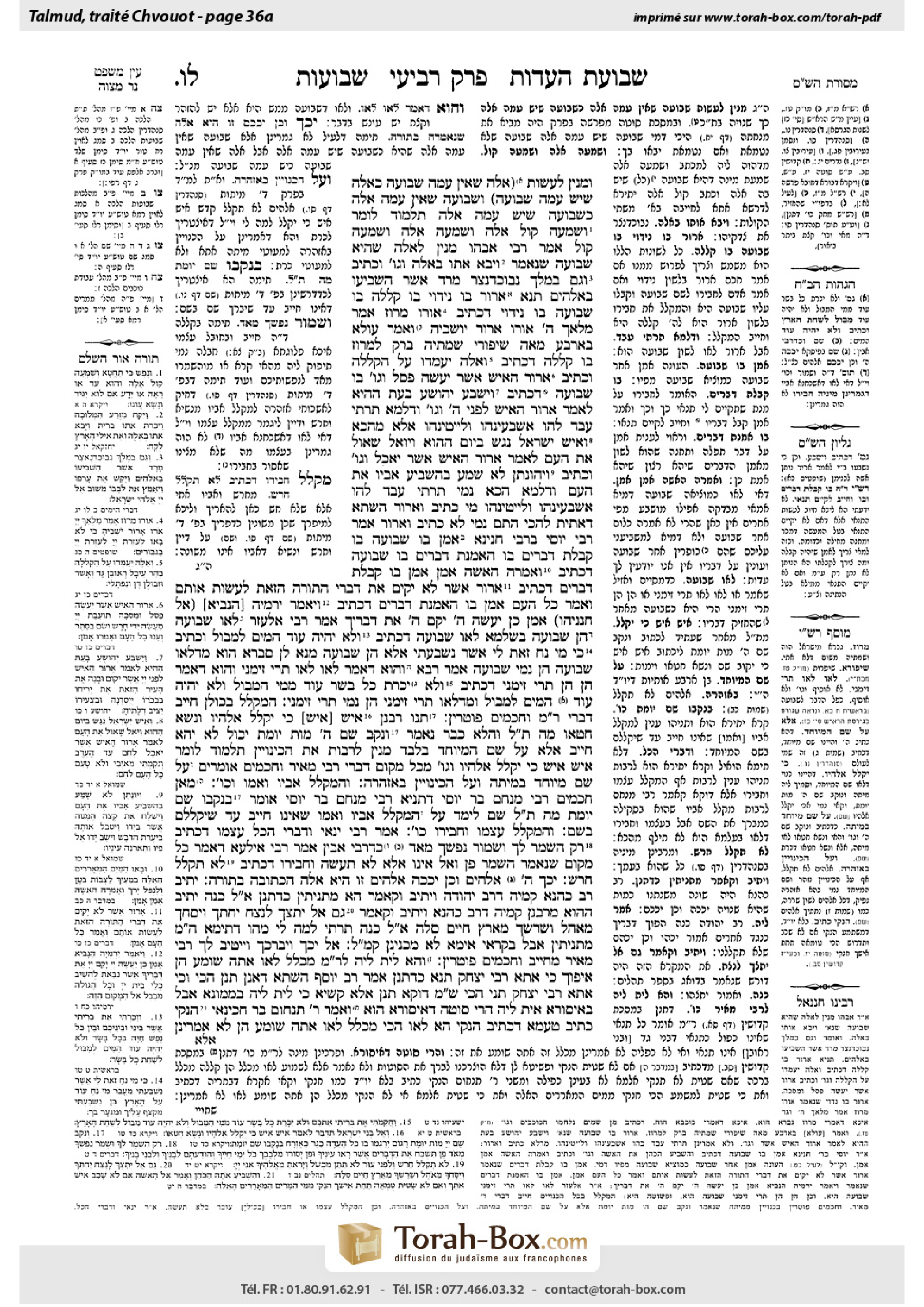
Shevuot 36a: Talmud study for Daf Yomi
Daf Yomi is the daily study of one Talmud folio. Explore 37 tractates with scans, Hebrew text, Sefaria English and AI-generated French translations where annotated.
Passage selection and English or AI-generated French translation are available where the scan has annotations. Daf Study is independent of Torah-Box and Sefaria.
Browse Shevuot · שבועות · All tractatesShevuot 36a text and translations
This page of Shevuot includes the Aramaic text, an English translation and an AI-generated French translation, alongside the scan above.
שבועות ל״ו א · Aramaic and Hebrew text
וּמִנַּיִן לַעֲשׂוֹת אָלָה שֶׁאֵין עִמָּהּ שְׁבוּעָה כְּאָלָה שֶׁיֵּשׁ עִמָּהּ שְׁבוּעָה, וּשְׁבוּעָה שֶׁאֵין עִמָּהּ אָלָה כִּשְׁבוּעָה שֶׁיֵּשׁ עִמָּהּ אָלָה? תַּלְמוּד לוֹמַר: ״וְשָׁמְעָה קוֹל אָלָה״ – וְשָׁמְעָה אָלָה, וְשָׁמְעָה קוֹל.
אָמַר רַבִּי אֲבָהוּ: מִנַּיִן לְ״אָלָה״ שֶׁהִיא שְׁבוּעָה? שֶׁנֶּאֱמַר: ״וַיָּבֵא אֹתוֹ בְּאָלָה וְגוֹ׳״; וּכְתִיב: ״וְגַם בַּמֶּלֶךְ נְבוּכַדְנֶצַּר מָרָד אֲשֶׁר הִשְׁבִּיעוֹ בֵּאלֹהִים״.
תָּנָא: ״אָרוּר״ – בּוֹ נִידּוּי, בּוֹ קְלָלָה, בּוֹ שְׁבוּעָה.
בּוֹ נִידּוּי – דִּכְתִיב: ״אוֹרוּ מֵרוֹז אָמַר מַלְאַךְ ה׳, אֹרוּ אָרוֹר יֹשְׁבֶיהָ״, וְאָמַר עוּלָּא: בְּאַרְבַּע מְאָה שִׁיפּוּרֵי שַׁמְּתֵיהּ בָּרָק לְמֵרוֹז.
בּוֹ קְלָלָה – דִּכְתִיב: ״וְאֵלֶּה יַעַמְדוּ עַל הַקְּלָלָה״, וּכְתִיב: ״אָרוּר הָאִישׁ אֲשֶׁר יַעֲשֶׂה פֶסֶל וְגוֹ׳״.
בּוֹ שְׁבוּעָה – דִּכְתִיב: ״וַיַּשְׁבַּע יְהוֹשֻׁעַ בָּעֵת הַהִיא לֵאמֹר, אָרוּר הָאִישׁ לִפְנֵי ה׳ וְגוֹ׳״. וְדִלְמָא תַּרְתֵּי עֲבַד לְהוּ – אַשְׁבְּעִינְהוּ וְלַיְיטִינְהוֹ?
אֶלָּא מֵהָכָא: ״וְאִישׁ יִשְׂרָאֵל נִגַּשׂ בַּיּוֹם הַהוּא, וַיֹּאֶל שָׁאוּל אֶת הָעָם לֵאמֹר, אָרוּר הָאִישׁ אֲשֶׁר יֹאכַל וְגוֹ׳״, וּכְתִיב: ״וִיהוֹנָתָן לֹא שָׁמַע בְּהַשְׁבִּיעַ אָבִיו אֶת הָעָם״. וְדִלְמָא הָכָא נָמֵי תַּרְתֵּי עֲבַד לְהוּ – אַשְׁבְּעִינְהוּ וְלַיְיטִינְהוֹ?
מִי כְּתִיב ״וְאָרוּר״?! הַשְׁתָּא דְּאָתֵית לְהָכִי, הָתָם נָמֵי לָא כְּתִיב ״וְאָרוּר״.
אָמַר רַבִּי יוֹסֵי בְּרַבִּי חֲנִינָא: ״אָמֵן״ – בּוֹ שְׁבוּעָה, בּוֹ קַבָּלַת דְּבָרִים, בּוֹ הַאֲמָנַת דְּבָרִים.
בּוֹ שְׁבוּעָה – דִּכְתִיב: ״וְאָמְרָה הָאִשָּׁה אָמֵן אָמֵן״.
בּוֹ קַבָּלַת דְּבָרִים – דִּכְתִיב: ״אָרוּר אֲשֶׁר לֹא יָקִים אֶת דִּבְרֵי הַתּוֹרָה הַזֹּאת לַעֲשׂוֹת אוֹתָם, וְאָמַר כׇּל הָעָם אָמֵן״.
בּוֹ הַאֲמָנַת דְּבָרִים – דִּכְתִיב: ״וַיֹּאמֶר יִרְמְיָה [הַנָּבִיא] (אֶל חֲנַנְיָהוּ), אָמֵן כֵּן יַעֲשֶׂה ה׳, יָקֵם ה׳ אֶת דְּבָרֶיךָ״.
אָמַר רַבִּי אֶלְעָזָר: ״לָאו״ – שְׁבוּעָה, ״הֵן״ – שְׁבוּעָה. בִּשְׁלָמָא ״לָאו״ שְׁבוּעָה – דִּכְתִיב: ״וְלֹא יִהְיֶה עוֹד הַמַּיִם לְמַבּוּל״, וּכְתִיב: ״כִּי מֵי נֹחַ זֹאת לִי אֲשֶׁר נִשְׁבַּעְתִּי״. אֶלָּא ״הֵן״ שְׁבוּעָה – מְנָא לַן? סְבָרָא הוּא – מִדְּ״לָאו״ שְׁבוּעָה, ״הֵן״ נָמֵי שְׁבוּעָה.
אָמַר רָבָא: וְהוּא דְּאָמַר ״לָאו״ ״לָאו״ תְּרֵי זִימְנֵי, וְהוּא דְּאָמַר ״הֵן״ ״הֵן״ תְּרֵי זִימְנֵי; דִּכְתִיב: ״וְלֹא יִכָּרֵת כׇּל בָּשָׂר עוֹד מִמֵּי הַמַּבּוּל״, ״וְלֹא יִהְיֶה עוֹד הַמַּיִם לְמַבּוּל״; וּמִדְּ״לָאו״ תְּרֵי זִימְנֵי, ״הֵן״ נָמֵי תְּרֵי זִימְנֵי.
הַמְקַלֵּל בְּכוּלָּן – חַיָּיב, דִּבְרֵי רַבִּי מֵאִיר, וַחֲכָמִים פּוֹטְרִין.
תָּנוּ רַבָּנַן: ״אִישׁ [אִישׁ] כִּי יְקַלֵּל אֱלֹהָיו וְנָשָׂא חֶטְאוֹ״ – מָה תַּלְמוּד לוֹמַר? וַהֲלֹא כְּבָר נֶאֱמַר: ״וְנֹקֵב שֵׁם ה׳ מוֹת יוּמָת״! יָכוֹל לֹא יְהֵא חַיָּיב אֶלָּא עַל שֵׁם הַמְיוּחָד בִּלְבַד, מִנַּיִן לְרַבּוֹת אֶת הַכִּינּוּיִין? תַּלְמוּד לוֹמַר: ״אִישׁ אִישׁ כִּי יְקַלֵּל אֱלֹהָיו וְגוֹ׳״ – מִכׇּל מָקוֹם. דִּבְרֵי רַבִּי מֵאִיר. וַחֲכָמִים אוֹמְרִים: עַל שֵׁם מְיוּחָד בְּמִיתָה, וְעַל הַכִּינּוּיִין בְּאַזְהָרָה.
וְהַמְקַלֵּל אָבִיו וְאִמּוֹ וְכוּ׳. מַאן חֲכָמִים?
רַבִּי מְנַחֵם בַּר יוֹסֵי. דְּתַנְיָא: רַבִּי מְנַחֵם בַּר יוֹסֵי אוֹמֵר: ״בְּנׇקְבוֹ שֵׁם יוּמָת״ – מָה תַּלְמוּד לוֹמַר ״שֵׁם״? לִימֵּד עַל הַמְקַלֵּל אָבִיו וְאִמּוֹ, שֶׁאֵינוֹ חַיָּיב עַד שֶׁיְּקַלְּלֵם בַּשֵּׁם.
וְהַמְקַלֵּל עַצְמוֹ וַחֲבֵירוֹ כּוּ׳. אָמַר רַבִּי יַנַּאי: וְדִבְרֵי הַכֹּל.
עַצְמוֹ – דִּכְתִיב: ״רַק הִשָּׁמֶר לְךָ וּשְׁמֹר נַפְשְׁךָ מְאֹד״ – כִּדְרַבִּי אָבִין אָמַר רַבִּי אִילְעָא, דְּאָמַר: כׇּל מָקוֹם שֶׁנֶּאֱמַר ״הִשָּׁמֶר״, ״פֶּן״ וְ״אַל״ – אֵינוֹ אֶלָּא לֹא תַעֲשֶׂה. וַחֲבֵירוֹ – דִּכְתִיב: ״לֹא תְקַלֵּל חֵרֵשׁ״.
״יַכְּךָ ה׳ אֱלֹהִים״, וְכֵן ״יַכְּכָה אֱלֹהִים״ – זוֹ הִיא אָלָה הַכְּתוּבָה בַּתּוֹרָה. יָתֵיב רַב כָּהֲנָא קַמֵּיהּ דְּרַב יְהוּדָה, וְיָתֵיב וְקָאָמַר הָא מַתְנִיתִין כְּדִתְנַן. אֲמַר לֵיהּ: כַּנֵּה.
יָתֵיב הָהוּא מֵרַבָּנַן קַמֵּיהּ דְּרַב כָּהֲנָא, וְיָתֵיב וְקָאָמַר: ״גַּם אֵל יִתׇּצְךָ לָנֶצַח, יַחְתְּךָ וְיִסָּחֲךָ מֵאֹהֶל, וְשֵׁרֶשְׁךָ מֵאֶרֶץ חַיִּים סֶלָה״. אֲמַר לֵיהּ: כַּנֵּה.
תַּרְתֵּי לְמָה לִי? מַהוּ דְּתֵימָא: הָנֵי מִילֵּי מַתְנִיתִין, אֲבָל בִּקְרָאֵי אֵימָא לָא מְכַנֵּינַן; קָא מַשְׁמַע לַן.
״אַל יַכְּךָ״, וִ״יבָרֶכְךָ״, וְ״יֵיטִיב לָךְ״ – רַבִּי מֵאִיר מְחַיֵּיב, וַחֲכָמִים פּוֹטְרִין.
וְהָא לֵית לֵיהּ לְרַבִּי מֵאִיר מִכְּלָל לָאו אַתָּה שׁוֹמֵעַ הֵן! אֵיפוֹךְ.
כִּי אֲתָא רַבִּי יִצְחָק, תְּנָא כְּדִתְנַן. אָמַר רַב יוֹסֵף: הַשְׁתָּא דַּאֲנַן תְּנַן הָכִי, וְכִי אֲתָא רַבִּי יִצְחָק תָּנֵי הָכִי, שְׁמַע מִינַּהּ דַּוְקָא תְּנַן.
אֶלָּא קַשְׁיָא! כִּי לֵית לֵיהּ – בְּמָמוֹנָא; אֲבָל בְּאִיסּוּרָא אִית לֵיהּ.
הֲרֵי סוֹטָה – דְּאִיסּוּרָא הוּא,
וְאָמַר רַבִּי תַּנְחוּם בַּר חֲכִינַאי: ״הִנָּקִי״ כְּתִיב; טַעְמָא דִּכְתִיב ״הִנָּקִי״, הָא לָאו הָכִי – מִכְּלַל לָאו אַתָּה שׁוֹמֵעַ הֵן לָא אָמְרִינַן!
Shevuot 36a · English translation
And from where is it derived to render an ala with which the word oath is not written like an ala with which the word oath is written and an oath with which the word ala is not written like an oath with which the word ala is written? The verse states: “And he hears the voice of an ala” (Leviticus 5:1). The phrase “the voice of an ala” is unnecessary, as it would have been sufficient to write: And he heard an ala. It is interpreted as though it were written: And he heard an ala and he heard a voice.
Rabbi Abbahu says: From where is it derived with regard to ala that it is an oath? It is derived as it is stated: “And he took from the seed of the monarchy…and brought it into an ala” (Ezekiel 17:13); and it is stated with regard to Zedekiah, who was from the seed of the monarchy: “And he also rebelled against Nebuchadnezzar who had administered an oath to him by God” (II Chronicles 36:13). This indicates that the ala is an oath.
§ The Gemara proceeds to define a related term. It is taught with regard to the term arur: There is an element of ostracism within it, there is an element of curse within it, and there is an element of oath within it.
The Gemara elaborates: There is an element of ostracism within it, as it is written in the song of Deborah: “Curse [oru] Meroz, said the angel of God; cursed with a curse [oru aror] are its inhabitants” (Judges 5:23). And Ulla says: With blasts from four hundred shofarot, Barak ostracized the city of Meroz, indicating that the term arur has the connotation of ostracism.
There is an element of curse within it, as it is written with regard to the ceremony at Mount Gerizim and Mount Ebal: “And these shall stand for the curse” (Deuteronomy 27:13), and it is written: “Cursed [arur] be the man who fashions a graven image, an abomination to the Lord, the work of the hands of the craftsman, and sets it up in secret. And all the people shall answer and say: Amen” (Deuteronomy 27:15).
There is an element of oath within it, as it is written: “And Joshua administered an oath at that time saying: Arur be the man before God who shall arise and rebuild this city, Jericho” (Joshua 6:26). The Gemara challenges: But perhaps Joshua performed two actions to the people; he administered an oath to them and he cursed them, and the term arur relates to the curse, not to the oath.
Rather, the fact that there is an element of oath in the term arur is derived from here: “And the men of Israel were distressed on that day, and Saul administered an oath [vayyoel] to the people, saying: Arur is the man who eats bread until the evening and I will be avenged on my enemies” (I Samuel 14:24). And it is written: “But Jonathan did not hear when his father administered the oath to the people” (I Samuel 14:27). The Gemara challenges: But perhaps, here too, Saul performed two actions to the people; he administered an oath to them and he cursed them.
The Gemara answers: Is it written in that context ve’arur, with a conjunctional prefix, which would indicate that arur is independent of the oath that was administered? Arur is written without a prefix, indicating that it is an intrinsic part of the oath. The Gemara notes: Now that you have arrived at this insight, there too, in the context of Joshua, ve’arur with a conjunctional prefix is not written, indicating that arur is an intrinsic part of the oath.
§ Rabbi Yosei, son of Rabbi Ḥanina, says with regard to the term amen: There is an element of oath within it, there is an element of acceptance of the statement and agreement within it, and there is an element of confirmation of the statement, i.e., that he believes and prays that the statement will be fulfilled, within it.
The Gemara elaborates: There is an element of oath within it, as it is written: “And the priest shall administer an oath to the woman…and the woman shall say: Amen, amen” (Numbers 5:21–22). “Amen” is the oath that the woman takes.
There is an element of acceptance of the statement within it, as it is written: “Cursed is he who shall not confirm the matters of this Torah to perform them; and all the people shall say: Amen” (Deuteronomy 27:26), expressing their agreement to fulfill all the matters of the Torah.
There is an element of confirmation of the statement within it, as it is written: “And Jeremiah the prophet said: Amen, may the Lord do so; may the Lord uphold your statement” (Jeremiah 28:6).
§ Rabbi Elazar says: No, or any negative expression, can be an oath, and yes, or any positive expression, can be an oath. The Gemara notes: Granted that no can be an oath, as it is written: “And the waters shall no more become a flood” (Genesis 9:15). And it is written with regard to that negative commitment: “As this is as the waters of Noah unto Me; as I have taken an oath that the waters of Noah shall no more pass over the earth” (Isaiah 54:9). But from where do we derive the fact that yes can be an oath? The Gemara answers: It is based on logical reasoning; from the fact that no can be an oath, yes too can be an oath.
Rava said: And a negative expression is an oath only in a case where one said no, no, stating the term two times, or it is in a case where one said yes, yes, stating the term two times, as it is written: “All flesh shall not be excised any more by floodwaters” (Genesis 9:11), and it is again written: “And the waters shall no more become a flood” (Genesis 9:15). And from the fact that no is an oath only when stated two times, yes, too, is an oath only when stated two times.
§ The mishna teaches: One who curses God employing any of these names or appellations of God is liable to be executed; this is the statement of Rabbi Meir. And the Rabbis deem him exempt.
The Sages taught that it is written: “Each and every man who shall curse his God shall bear his sin” (Leviticus 24:15). Why must the verse state this? Wasn’t it already stated: “And he who blasphemes the name of the Lord shall be put to death” (Leviticus 24:16)? One might have thought that one would be liable only for cursing the ineffable name of God alone. From where is it derived to include liability for one who curses the appellations of God? It is derived as the verse states: “Each and every man who shall curse his God,” indicating that one is liable in any case, even for cursing an appellation. This is the statement of Rabbi Meir. The Rabbis say: For cursing the ineffable name of God, one is liable to be executed with a court-imposed death penalty, as it is stated explicitly in the verse. And for cursing one of the appellations of God, one is liable for violating a prohibition, but he is not liable to be executed.
The mishna teaches: And one who curses his father and his mother employing any of these names or appellations of God is liable to be executed; this is the statement of Rabbi Meir. And the Rabbis deem him exempt. The Gemara asks: Who are the Rabbis whose opinion is cited here?
The Gemara answers: It is Rabbi Menaḥem bar Yosei, as it is taught in a baraita that Rabbi Menaḥem bar Yosei says: It is stated with regard to one who blasphemes God: “When he blasphemes a name, he shall be put to death” (Leviticus 24:16). Why must the verse state “a name,” when it is stated at the beginning of the verse: “And he who blasphemes the name of the Lord shall be put to death”? This extraneous word “name” taught with regard to one who curses his father or his mother that he is not liable to be executed through stoning until he curses them in the name of God.
The mishna teaches: One who curses himself or another employing any of these names or appellations of God violates a prohibition. Rabbi Yannai says: And everyone agrees that this is the halakha. Even the Rabbis, who hold that one who blasphemes God or curses his parents is liable only if he employs the Tetragrammaton, agree here that one is liable to receive lashes when he curses employing an appellation.
The Gemara proceeds to cite sources for these prohibitions. The prohibition against cursing oneself is derived as it is written: “Only observe for yourself, and keep your soul diligently” (Deuteronomy 4:9). This is in accordance with that which Rabbi Avin says that Rabbi Ile’a says: Everywhere in the Torah that the terms observe, lest, or do not are stated, it is nothing other than a prohibition. One who curses himself does not keep, i.e., take care of, himself and consequently violates the prohibition. And cursing another is derived as it is written: “Do not curse the deaf” (Leviticus 19:14), which applies to others just as it does to one who is deaf.
§ The mishna teaches that if one says: The Lord God shall strike you (see Deuteronomy 28:22), and likewise if one says: God shall strike you if you do not come to testify, that is a curse that is written in the Torah. The Gemara relates: Rav Kahana sat before Rav Yehuda, and he sat and stated the mishna verbatim as we learned it. Rav Yehuda said to him: Employ a euphemism and formulate it in the third person rather than the second person: God shall strike him instead of you, so that it will not sound as though you are cursing your teacher.
Likewise, the Gemara relates: A certain one of the Sages sat before Rav Kahana, and he sat and said the verse: “God will likewise break you forever; He will take you up and pluck you from the tent, and uproot you from the land of the living, Selah” (Psalms 52:7). Rav Kahana said to him: Employ a euphemism and formulate it in the third person rather than the second person, so that it will not sound as though you are cursing your teacher.
The Gemara asks: Why do I need two incidents to relate the same concept? The Gemara answers: It was necessary to relate the second incident as well. Lest you say that this statement applies only to the mishna, as in the Oral Torah, where the content, not the formulation, is significant, emending the text in the interest of euphemism is permitted; but with regard to verses in the Bible, where the formulation, i.e., each word, is significant, say that we do not employ a euphemism. Therefore, the Gemara teaches us that it is permitted to employ a euphemism even when reciting verses.
§ The mishna teaches that if one says to the witnesses: God shall not strike you, or: God shall bless you, or: God shall benefit you if you come and testify, Rabbi Meir deems him liable, as one may infer from that statement that if he fails to testify God will strike him, or will not bless or benefit him. And the Rabbis deem him exempt because the curse is not explicitly stated.
The Gemara asks: But isn’t it so that Rabbi Meir does not accept the principle: From a negative statement you can infer a positive statement, and in an agreement, he requires the parties to explicitly state both the positive and the negative stipulations? The Gemara says: Reverse the attribution of the opinions and say that it is the Rabbis who hold that the witness is liable and it is Rabbi Meir who deems him exempt.
The Gemara relates: When Rabbi Yitzḥak came from Eretz Yisrael to Babylonia, he taught the mishna as we learned it and did not reverse the attribution of the opinions. Rav Yosef said: Now that we have learned the mishna in this formulation, and when he came, Rabbi Yitzḥak taught the mishna in this formulation, conclude from it that the formulation that we learned in the mishna was taught specifically in that manner and that is the correct formulation.
The Gemara challenges: But the question remains difficult, as Rabbi Meir does not accept the principle: From a negative statement you can infer a positive statement. The Gemara answers: When Rabbi Meir does not accept that principle, it is only in cases involving monetary matters; but in cases involving ritual matters, e.g., an oath of testimony discussed in the mishna, he accepts the principle, and the witness is liable even in that case.
The Gemara asks: But sota is a case involving ritual, and not monetary matters, and the verse states only what will befall the sota if she did not commit adultery: “And if you did not go astray to defilement, while under your husband, you shall be absolved [hinnaki]” (Numbers 5:19), and the verse does not state what will befall the woman if she committed adultery.
A difficulty is raised: According to Rabbi Meir, who does not accept the principle: From a negative statement you can infer a positive statement, both the positive and the negative eventualities should have been written in the verse. And Rabbi Tanḥum bar Ḥakhinai says to resolve the difficulty: Hinnaki is written, meaning: You shall be absolved. But since it is written without the letter yod, it is interpreted as though ḥinnaki is written, meaning: You shall be strangulated, which is the eventuality if she committed adultery. The Gemara concludes: The reason that this verse is not difficult is that hinnaki is written and ḥinnaki is interpreted; but if that were not the case, we do not say: From a negative statement you can infer a positive statement. Apparently, even in ritual matters, Rabbi Meir does not accept the principle.
Shevuot 36a · Traduction française (IA)
Et d’où déduit-on qu’une ala dans laquelle le mot « serment » ne figure pas équivaut à une ala dans laquelle il figure, et qu’un serment dans lequel le mot ala ne figure pas équivaut à un serment dans lequel il figure ? Le verset dit : « Et il entend la voix d’une ala » (Lévitique 5:1). L’expression « la voix d’une ala » est superflue, car il aurait suffi d’écrire : « Et il entend une ala ». On l’interprète comme si le texte disait : « Et il entend une ala et il entend une voix. »
Rabbi Abbahou dit : D’où déduit-on qu’une ala est un serment ? On le déduit de ce qui est écrit : « Il prit un descendant de la famille royale… et le fit entrer dans une ala » (Ézéchiel 17:13), et de ce qui est écrit au sujet de Sédécias, qui était issu de la famille royale : « Il se révolta aussi contre Nabuchodonosor, qui lui avait fait prêter serment par Dieu » (II Chroniques 36:13). Cela indique que l’ala est un serment.
§ La Guemara définit un terme apparenté. Il est enseigné au sujet du terme arur : il comporte un élément d’excommunication, un élément de malédiction et un élément de serment.
La Guemara développe : il comporte un élément d’excommunication, comme il est écrit dans le chant de Débora : « Maudissez [orou] Méroz, dit l’ange de Dieu ; maudits d’une malédiction [orou aror] sont ses habitants » (Juges 5:23). Et Oulla dit : Au son de quatre cents chofars, Barak excommunia la ville de Méroz, ce qui indique que le terme arur a le sens d’excommunication.
Il comporte un élément de malédiction, comme il est écrit au sujet de la cérémonie du mont Garizim et du mont Ébal : « Et ceux-ci se tiendront pour la malédiction » (Deutéronome 27:13), et il est écrit : « Maudit [arur] soit l’homme qui fait une image sculptée, abomination pour l’Éternel, ouvrage des mains d’un artisan, et la place en secret. Et tout le peuple répondra et dira : Amen » (Deutéronome 27:15).
Il comporte un élément de serment, comme il est écrit : « Et Josué fit prêter serment à cette époque, en disant : Maudit devant Dieu soit l’homme qui se lèvera pour rebâtir cette ville, Jéricho » (Josué 6:26). La Guemara objecte : Mais peut-être Josué a-t-il accompli deux actes envers le peuple : il lui a fait prêter serment et l’a maudit ; le terme arur se rapporte alors à la malédiction, et non au serment.
On déduit plutôt d’ici que le terme arur comporte un élément de serment : « Les hommes d’Israël furent dans la détresse ce jour-là, et Saül fit prêter serment [vayyoel] au peuple, en disant : Maudit soit l’homme qui mangera du pain avant le soir, afin que je me venge de mes ennemis » (I Samuel 14:24). Et il est écrit : « Mais Jonathan n’avait pas entendu son père faire prêter serment au peuple » (I Samuel 14:27). La Guemara objecte : Mais peut-être Saül a-t-il, là aussi, accompli deux actes envers le peuple : il lui a fait prêter serment et l’a maudit.
La Guemara répond : Est-il écrit dans ce passage ve’arur, avec un préfixe de coordination, ce qui indiquerait que arur est indépendant du serment prêté ? Arur est écrit sans préfixe, ce qui indique qu’il fait partie intégrante du serment. La Guemara remarque : Maintenant que tu es parvenu à cette compréhension, là aussi, dans le passage relatif à Josué, ve’arur n’est pas écrit avec un préfixe de coordination, ce qui indique que arur fait partie intégrante du serment.
§ Rabbi Yossé, fils de Rabbi Ḥanina, dit au sujet du terme amen : il comporte un élément de serment, un élément d’acceptation de la déclaration et d’assentiment, ainsi qu’un élément de confirmation de la déclaration, c’est-à-dire que celui qui le prononce croit à la déclaration et prie pour qu’elle se réalise.
La Guemara développe : il comporte un élément de serment, comme il est écrit : « Le prêtre fera prêter serment à la femme… et la femme dira : Amen, amen » (Nombres 5:21-22). « Amen » est le serment que prête la femme.
Il comporte un élément d’acceptation de la déclaration, comme il est écrit : « Maudit soit celui qui ne confirmera pas les paroles de cette Torah en les accomplissant ; et tout le peuple dira : Amen » (Deutéronome 27:26), exprimant ainsi son assentiment à accomplir toutes les paroles de la Torah.
Il comporte un élément de confirmation de la déclaration, comme il est écrit : « Le prophète Jérémie dit : Amen, que l’Éternel fasse ainsi ; que l’Éternel accomplisse tes paroles » (Jérémie 28:6).
§ Rabbi Elazar dit : « Non », ainsi que toute expression négative, peut constituer un serment ; et « oui », ainsi que toute expression positive, peut constituer un serment. La Guemara remarque : Il est compréhensible que « non » puisse constituer un serment, comme il est écrit : « Les eaux ne deviendront plus un déluge » (Genèse 9:15). Et il est écrit au sujet de cet engagement négatif : « Car cela est pour Moi comme les eaux de Noé ; comme J’ai juré que les eaux de Noé ne passeraient plus sur la terre » (Isaïe 54:9). Mais d’où déduit-on que « oui » peut constituer un serment ? La Guemara répond : cela relève du raisonnement logique ; puisque « non » peut constituer un serment, « oui » aussi peut constituer un serment.
Rava dit : Une expression négative ne constitue un serment que dans le cas où l’on a dit « non, non », en répétant le terme deux fois, ou dans le cas où l’on a dit « oui, oui », en répétant le terme deux fois, comme il est écrit : « Toute chair ne sera plus retranchée par les eaux du déluge » (Genèse 9:11), et il est écrit de nouveau : « Les eaux ne deviendront plus un déluge » (Genèse 9:15). Et puisque « non » ne constitue un serment que lorsqu’il est prononcé deux fois, « oui » aussi ne constitue un serment que lorsqu’il est prononcé deux fois.
§ La Michna enseigne : Celui qui maudit Dieu en employant l’un de ces noms ou appellations de Dieu est passible de mort ; telle est l’opinion de Rabbi Meïr. Et les Sages le déclarent exempt.
Les Sages ont enseigné qu’il est écrit : « Tout homme qui maudira son Dieu portera son péché » (Lévitique 24:15). Pourquoi le verset doit-il le préciser ? N’est-il pas déjà écrit : « Celui qui blasphème le nom de l’Éternel sera mis à mort » (Lévitique 24:16) ? On aurait pu penser qu’on n’est passible que pour avoir maudit le nom ineffable de Dieu. D’où déduit-on qu’est également passible celui qui maudit les appellations de Dieu ? On le déduit de ce que le verset dit : « Tout homme qui maudira son Dieu », ce qui indique qu’on est passible dans tous les cas, même pour avoir maudit une appellation. Telle est l’opinion de Rabbi Meïr. Les Sages disent : Pour avoir maudit le nom ineffable de Dieu, on est passible de la peine de mort prononcée par le tribunal, comme le verset le dit explicitement. Pour avoir maudit l’une des appellations de Dieu, on est passible pour avoir transgressé une interdiction, mais on n’est pas passible de mort.
La Michna enseigne : Celui qui maudit son père et sa mère en employant l’un de ces noms ou appellations de Dieu est passible de mort ; telle est l’opinion de Rabbi Meïr. Et les Sages le déclarent exempt. La Guemara demande : Qui sont les Sages dont l’opinion est citée ici ?
La Guemara répond : Il s’agit de Rabbi Menaḥem bar Yossé, car il est enseigné dans une baraïta que Rabbi Menaḥem bar Yossé dit : Au sujet de celui qui blasphème Dieu, il est écrit : « Lorsqu’il blasphème un nom, il sera mis à mort » (Lévitique 24:16). Pourquoi le verset doit-il préciser « un nom », alors qu’il est écrit au début du verset : « Celui qui blasphème le nom de l’Éternel sera mis à mort » ? Ce mot « nom », superflu, enseigne au sujet de celui qui maudit son père ou sa mère qu’il n’est passible de lapidation que s’il les maudit au nom de Dieu.
La Michna enseigne : Celui qui se maudit lui-même ou maudit autrui en employant l’un de ces noms ou appellations de Dieu transgresse une interdiction. Rabbi Yannai dit : Et tous s’accordent sur cette halakha. Même les Sages, qui soutiennent qu’on n’est passible que si l’on blasphème Dieu ou maudit ses parents en employant le Tétragramme, conviennent ici qu’on est passible de flagellation lorsqu’on maudit en employant une appellation.
La Guemara cite les sources de ces interdictions. L’interdiction de se maudire soi-même se déduit de ce qui est écrit : « Prends seulement garde à toi et veille attentivement sur ton âme » (Deutéronome 4:9). Cela correspond à ce que Rabbi Avin dit au nom de Rabbi Iléa : partout dans la Torah où figurent les termes « garde-toi », « de peur que » ou « ne… pas », il s’agit uniquement d’une interdiction. Celui qui se maudit lui-même ne veille donc pas sur lui-même, c’est-à-dire qu’il ne prend pas soin de lui, et transgresse par conséquent l’interdiction. L’interdiction de maudire autrui se déduit de ce qui est écrit : « Ne maudis pas le sourd » (Lévitique 19:14), ce qui s’applique aux autres tout comme à celui qui est sourd.
§ La Michna enseigne que si quelqu’un dit : « Que l’Éternel te frappe » (voir Deutéronome 28:22), et de même s’il dit : « Que Dieu te frappe si tu ne viens pas témoigner », il s’agit d’une malédiction écrite dans la Torah. La Guemara rapporte : Rav Kahana était assis devant Rav Yehouda et récitait la Michna mot pour mot, telle que nous l’avons apprise. Rav Yehouda lui dit : Emploie un euphémisme et formule la phrase à la troisième personne plutôt qu’à la deuxième : « Que Dieu le frappe », au lieu de « te frappe », afin qu’il ne semble pas que tu maudisses ton maître.
De même, la Guemara rapporte : Un certain Sage était assis devant Rav Kahana et récitait le verset : « Dieu te brisera aussi à jamais ; Il te saisira et t’arrachera de la tente, et Il te déracinera du pays des vivants, Séla » (Psaumes 52:7). Rav Kahana lui dit : Emploie un euphémisme et formule le verset à la troisième personne plutôt qu’à la deuxième, afin qu’il ne semble pas que tu maudisses ton maître.
La Guemara demande : Pourquoi faut-il rapporter deux incidents exprimant la même idée ? La Guemara répond : Il était également nécessaire de rapporter le second incident. De peur que tu ne dises que cette règle ne concerne que la Michna, c’est-à-dire la Torah orale, où c’est le contenu qui importe, et non la formulation, de sorte qu’il est permis de modifier le texte par euphémisme ; mais qu’en ce qui concerne les versets de la Bible, où la formulation, c’est-à-dire chaque mot, est importante, on ne devrait pas employer d’euphémisme. La Guemara nous enseigne donc qu’il est permis d’employer un euphémisme même en récitant des versets.
§ La Michna enseigne que si quelqu’un dit aux témoins : « Que Dieu ne vous frappe pas », ou : « Que Dieu vous bénisse », ou : « Que Dieu vous fasse du bien si vous venez témoigner », Rabbi Meïr le déclare passible, car on peut déduire de ces paroles que, s’ils ne témoignent pas, Dieu les frappera, ou ne les bénira pas, ou ne leur fera pas de bien. Et les Sages le déclarent exempt, car la malédiction n’est pas énoncée explicitement.
La Guemara demande : Mais Rabbi Meïr n’admet-il pas le principe selon lequel on peut déduire une affirmation positive d’une formulation négative, et n’exige-t-il pas, dans un contrat, que les parties énoncent explicitement aussi bien les conditions positives que négatives ? La Guemara dit : Inverse l’attribution des opinions et dis que ce sont les Sages qui considèrent le témoin comme passible, tandis que Rabbi Meïr le déclare exempt.
La Guemara rapporte : Lorsque Rabbi Yitzḥak vint de la terre d’Israël en Babylonie, il enseigna la Michna telle que nous l’avions apprise, sans inverser l’attribution des opinions. Rav Yossef dit : Puisque nous avons appris la Michna dans cette formulation et que, lorsqu’il vint, Rabbi Yitzḥak enseigna la Michna dans cette même formulation, conclus que la formulation que nous avions apprise dans la Michna fut enseignée précisément ainsi et qu’il s’agit de la formulation correcte.
La Guemara objecte : Mais la question reste difficile, car Rabbi Meïr n’admet pas le principe selon lequel on peut déduire une affirmation positive d’une formulation négative. La Guemara répond : Lorsque Rabbi Meïr n’admet pas ce principe, cela ne concerne que les affaires financières ; mais dans les domaines rituels, par exemple le serment de témoignage dont traite la Michna, il l’admet, et le témoin est passible même dans ce cas.
La Guemara demande : Mais le cas de la sota relève du domaine rituel, et non des affaires financières, et le verset n’indique que ce qui arrivera à la sota si elle n’a pas commis d’adultère : « Si tu ne t’es pas détournée pour te souiller, alors que tu étais sous ton mari, tu seras quitte [hinnaki] » (Nombres 5:19), sans indiquer ce qui arrivera à la femme si elle a commis un adultère.
Une difficulté est soulevée : Selon Rabbi Meïr, qui n’admet pas le principe selon lequel on peut déduire une affirmation positive d’une formulation négative, le verset aurait dû énoncer aussi bien les conséquences positives que négatives. Rabbi Tanḥoum bar Ḥakhinai apporte une solution : hinnaki est écrit, c’est-à-dire « tu seras quitte ». Mais comme le mot est écrit sans la lettre yod, on l’interprète comme si ḥinnaki était écrit, c’est-à-dire « tu seras étranglée », ce qui arrivera si elle a commis un adultère. La Guemara conclut : Si ce verset ne pose pas de difficulté, c’est parce que hinnaki est écrit et ḥinnaki est interprété ; mais sans cela, on ne déduit pas d’une formulation négative une affirmation positive. Il apparaît donc que même dans les domaines rituels, Rabbi Meïr n’admet pas ce principe.
Traduction française générée par IA à partir de l’édition anglaise de Sefaria. Vérifie toujours un passage avec le texte source.
Text from Sefaria: William Davidson Edition - Vocalized Aramaic (CC BY NC); William Davidson Edition - English (CC BY NC).