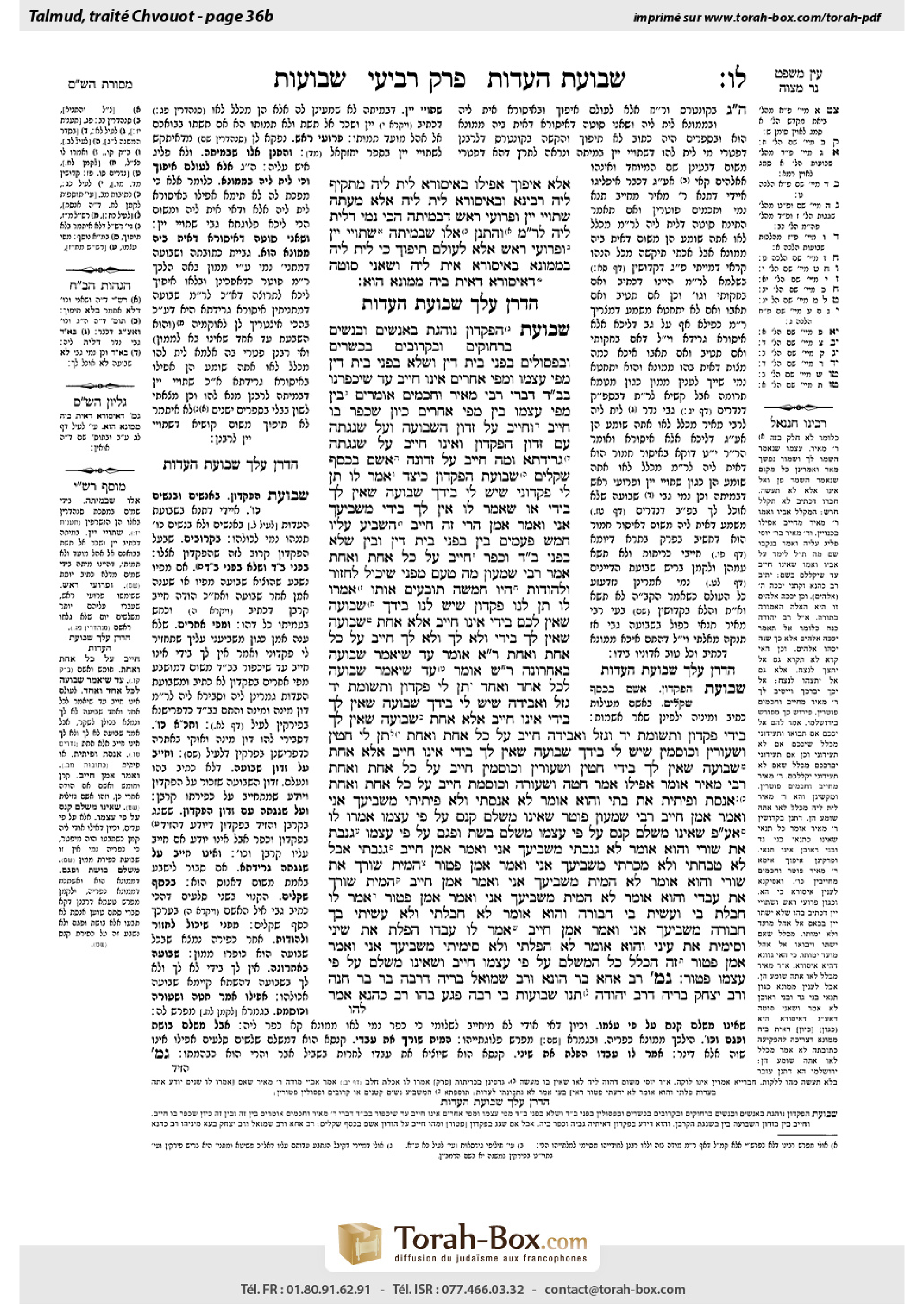
Shevuot 36b: Talmud study for Daf Yomi
Daf Yomi is the daily study of one Talmud folio. Explore 37 tractates with scans, Hebrew text, Sefaria English and AI-generated French translations where annotated.
Passage selection and English or AI-generated French translation are available where the scan has annotations. Daf Study is independent of Torah-Box and Sefaria.
Browse Shevuot · שבועות · All tractatesShevuot 36b text and translations
This page of Shevuot includes the Aramaic text, an English translation and an AI-generated French translation, alongside the scan above.
שבועות ל״ו ב · Aramaic and Hebrew text
אֶלָּא אֵיפוֹךְ – אֲפִילּוּ בְּאִיסּוּרָא לֵית לֵיהּ.
מַתְקֵיף לֵיהּ רָבִינָא: וּבְאִיסּוּרָא לֵית לֵיהּ?! אֶלָּא מֵעַתָּה, שְׁתוּיֵי יַיִן וּפְרוּעֵי רֹאשׁ – דִּבְמִיתָה; הָכִי נָמֵי דְּלֵית לֵיהּ לְרַבִּי מֵאִיר?! וְהָתְנַן: אֵלּוּ שֶׁבְּמִיתָה – שְׁתוּיֵי יַיִן וּפְרוּעֵי רֹאשׁ!
אֶלָּא לְעוֹלָם תֵּיפוֹךְ; כִּי לֵית לֵיהּ – בְּמָמוֹנָא, בְּאִיסּוּרָא אִית לֵיהּ; וְשָׁאנֵי סוֹטָה דְּאִיסּוּרָא דְּאִית בֵּיהּ מָמוֹנָא הוּא.
הֲדַרַן עֲלָךְ שְׁבוּעַת הָעֵדוּת
מַתְנִי׳ שְׁבוּעַת הַפִּקָּדוֹן נוֹהֶגֶת בַּאֲנָשִׁים וּבְנָשִׁים, בִּרְחוֹקִים וּבִקְרוֹבִים, בִּכְשֵׁרִים וּבִפְסוּלִים;
בִּפְנֵי בֵּית דִּין וְשֶׁלֹּא בִּפְנֵי בֵּית דִּין – מִפִּי עַצְמוֹ; וּמִפִּי אֲחֵרִים – אֵינוֹ חַיָּיב עַד שֶׁיִּכְפְּרֶנּוּ בְּבֵית דִּין. דִּבְרֵי רַבִּי מֵאִיר.
וַחֲכָמִים אוֹמְרִים: בֵּין מִפִּי עַצְמוֹ בֵּין מִפִּי אֲחֵרִים – כֵּיוָן שֶׁכָּפַר בּוֹ חַיָּיב.
וְחַיָּיב עַל זְדוֹן הַשְּׁבוּעָה, וְעַל שִׁגְגָתָהּ עִם זְדוֹן הַפִּקָּדוֹן; וְאֵינוֹ חַיָּיב עַל שִׁגְגָתָהּ גְּרֵידְתָּא. וּמָה חַיָּיב עַל זְדוֹנָהּ? אָשָׁם בְּכֶסֶף שְׁקָלִים.
שְׁבוּעַת הַפִּקָּדוֹן כֵּיצַד? אָמַר לוֹ: ״תֵּן לִי פִּקְדוֹנִי שֶׁיֵּשׁ לִי בְּיָדְךָ״, ״שְׁבוּעָה שֶׁאֵין לְךָ בְּיָדִי״; אוֹ שֶׁאָמַר לוֹ: ״אֵין לְךָ בְּיָדִי״, ״מַשְׁבִּיעֲךָ אֲנִי״, וְאָמַר ״אָמֵן״ – הֲרֵי זֶה חַיָּיב.
הִשְׁבִּיעַ עָלָיו חָמֵשׁ פְּעָמִים, בֵּין בִּפְנֵי בֵּית דִּין וּבֵין שֶׁלֹּא בִּפְנֵי בֵּית דִּין, וְכָפַר – חַיָּיב עַל כׇּל אַחַת וְאַחַת. אָמַר רַבִּי שִׁמְעוֹן: מָה טַעַם? מִפְּנֵי שֶׁיָּכוֹל לַחֲזוֹר וּלְהוֹדוֹת.
הָיוּ חֲמִשָּׁה תּוֹבְעִים אוֹתוֹ – אָמְרוּ לוֹ: ״תֵּן לָנוּ פִּקָּדוֹן שֶׁיֵּשׁ לָנוּ בְּיָדְךָ״; ״שְׁבוּעָה שֶׁאֵין לָכֶם בְּיָדִי״ – אֵינוֹ חַיָּיב אֶלָּא אַחַת. ״שְׁבוּעָה שֶׁאֵין לְךָ בְּיָדִי, וְלֹא לְךָ וְלֹא לָךְ״ – חַיָּיב עַל כׇּל אַחַת וְאַחַת. רַבִּי אֱלִיעֶזֶר אוֹמֵר: עַד שֶׁיֹּאמַר שְׁבוּעָה בָּאַחֲרוֹנָה. רַבִּי שִׁמְעוֹן אוֹמֵר: עַד שֶׁיֹּאמַר שְׁבוּעָה לְכׇל אֶחָד וְאֶחָד.
״תֵּן לִי פִּקָּדוֹן וּתְשׂוּמֶת יָד גָּזֵל וַאֲבֵידָה שֶׁיֵּשׁ לִי בְּיָדְךָ״; ״שְׁבוּעָה שֶׁאֵין לְךָ בְּיָדִי״ – אֵינוֹ חַיָּיב אֶלָּא אַחַת, ״שְׁבוּעָה שֶׁאֵין לְךָ בְּיָדִי פִּקָּדוֹן וּתְשׂוּמֶת יָד וְגָזֵל וַאֲבֵידָה״ – חַיָּיב עַל כׇּל אַחַת וְאַחַת.
״תֵּן לִי חִטִּין וּשְׂעוֹרִין וְכוּסְּמִין שֶׁיֵּשׁ לִי בְּיָדְךָ״; ״שְׁבוּעָה שֶׁאֵין לְךָ בְּיָדִי״ – אֵינוֹ חַיָּיב אֶלָּא אַחַת, ״שְׁבוּעָה שֶׁאֵין לְךָ בְּיָדִי חִטִּין וּשְׂעוֹרִין וְכוּסְּמִין״ – חַיָּיב עַל כׇּל אַחַת וְאַחַת. רַבִּי מֵאִיר אוֹמֵר: אֲפִילּוּ אָמַר ״חִטָּה וּשְׂעוֹרָה וְכוּסֶּמֶת״ – חַיָּיב עַל כׇּל אַחַת וְאַחַת.
״אָנַסְתָּ וּפִיתִּיתָ אֶת בִּתִּי״, וְהוּא אוֹמֵר: ״לֹא אָנַסְתִּי וְלֹא פִּיתִּיתִי״; ״מַשְׁבִּיעֲךָ אֲנִי״, וְאָמַר: ״אָמֵן״ – חַיָּיב. רַבִּי שִׁמְעוֹן פּוֹטֵר, שֶׁאֵינוֹ מְשַׁלֵּם קְנָס עַל פִּי עַצְמוֹ. אָמְרוּ לוֹ: אַף עַל פִּי שֶׁאֵינוֹ מְשַׁלֵּם קְנָס עַל פִּי עַצְמוֹ, מְשַׁלֵּם בּשֶׁת וּפְגָם עַל פִּי עַצְמוֹ.
״גָּנַבְתָּ אֶת שׁוֹרִי״, וְהוּא אוֹמֵר ״לֹא גָּנַבְתִּי״; ״מַשְׁבִּיעֲךָ אֲנִי״, וְאָמַר ״אָמֵן״ – חַיָּיב. ״גָּנַבְתִּי, אֲבָל לֹא טָבַחְתִּי וְלֹא מָכַרְתִּי״; ״מַשְׁבִּיעֲךָ אֲנִי״, וְאָמַר ״אָמֵן״ – פָּטוּר.
״הֵמִית שׁוֹרְךָ אֶת שׁוֹרִי״, וְהוּא אוֹמֵר ״לֹא הֵמִית״; ״מַשְׁבִּיעֲךָ אֲנִי״, וְאָמַר ״אָמֵן״ – חַיָּיב. ״הֵמִית שׁוֹרְךָ אֶת עַבְדִּי״, וְהוּא אוֹמֵר ״לֹא הֵמִית״; ״מַשְׁבִּיעֲךָ אֲנִי״, וְאָמַר ״אָמֵן״ – פָּטוּר.
אָמַר לוֹ: ״חָבַלְתָּ בִּי וְעָשִׂיתָ בִּי חַבּוּרָה״, וְהוּא אוֹמֵר: ״לֹא חָבַלְתִּי וְלֹא עָשִׂיתִי בְּךָ חַבּוּרָה״; ״מַשְׁבִּיעֲךָ אֲנִי״, וְאָמַר ״אָמֵן״ – חַיָּיב. אָמַר לוֹ עַבְדּוֹ: ״הִפַּלְתָּ אֶת שִׁינִּי וְסִימִּיתָ אֶת עֵינִי״, וְהוּא אוֹמֵר: ״לֹא הִפַּלְתִּי וְלֹא סִימִּיתִי״; ״מַשְׁבִּיעֲךָ אֲנִי״, וְאָמַר ״אָמֵן״ – פָּטוּר.
זֶה הַכְּלָל: כׇּל הַמְשַׁלֵּם עַל פִּי עַצְמוֹ – חַיָּיב, וְשֶׁאֵינוֹ מְשַׁלֵּם עַל פִּי עַצְמוֹ – פָּטוּר.
גְּמָ׳ רַב אַחָא בַּר הוּנָא וְרַב שְׁמוּאֵל בְּרֵיהּ דְּרַבָּה בַּר בַּר חָנָה וְרַב יִצְחָק בְּרֵיהּ דְּרַב יְהוּדָה, תְּנוֹ שְׁבוּעוֹת בֵּי רַבָּה. פְּגַע בְּהוּ רַב כָּהֲנָא, אָמַר
Shevuot 36b · English translation
Rather, nevertheless, reverse the attribution of the opinions in the mishna and say that Rabbi Meir deems the witness exempt from liability for an oath of testimony, as even in ritual matters, Rabbi Meir does not accept the principle: From a negative statement you can infer a positive statement.
Ravina objects to this: And in ritual matters, does Rabbi Meir not accept the principle? But if that is so, with regard to the halakha that priests who perform the Temple service while intoxicated with wine, and priests who perform the Temple service with overgrown hair on their head, who, based on this principle, are liable to receive death at the hand of Heaven, so too does Rabbi Meir not accept this principle? But didn’t we learn in a baraita: And these are they who are liable to receive death at the hand of Heaven: Priests who perform the Temple service while intoxicated with wine and priests who perform the Temple service with overgrown hair on their head, and Rabbi Meir does not disagree with that ruling?
Rather, actually reverse the attribution of the opinions in the mishna and say that Rabbi Meir deems the witness exempt from liability for an oath of testimony. When Rabbi Meir does not accept that principle, it is only in cases involving monetary matters; but in cases involving ritual matters, he accepts the principle. That is the reason he does not dispute the halakha in the baraita with regard to a priest intoxicated with wine or with overgrown hair on his head. And the reason that he does not accept the principle: From a negative statement you can infer a positive statement, in the case of sota is that sota is different because it is a ritual matter in which there are ramifications involving monetary matters, i.e., payment of the marriage contract. The same is true with regard to an oath of testimony in the mishna; although it is a ritual matter, it is a ritual matter with ramifications involving monetary matters.
MISHNA: One who takes a false oath denying that he is in possession of an item that another deposited with him is liable to return the item with an additional one-fifth of its value and to bring a guilt-offering (see Leviticus 5:20–26). The halakhot of an oath on a deposit apply to men and to women, to non-relatives and to relatives, i.e., even if the owner of the deposit and the purported bailee are related, to those fit to serve as witnesses and to those disqualified from doing so.
These halakhot apply when the oath is taken in the presence of a court and when taken not in the presence of a court, as long as the oath is taken on his own, i.e., stated by the defendant himself. But if the oath is administered by others, he is not liable unless he denies the claim in court; this is the statement of Rabbi Meir.
And the Rabbis say: Both when the defendant takes an oath on his own and when the oath is administered by others, once he has falsely denied the claim against him, he is liable to bring a guilt-offering and to pay restitution and an additional one-fifth, even if the oath was not administered in the presence of a court.
And one is liable to bring an offering for intentionally taking a false oath on a deposit and for unwittingly taking a false oath about the intentional misappropriation of the deposit, i.e., if one knowingly took a false oath but was unaware that he is liable to bring an offering for taking the oath. But he is not liable for unwittingly taking a false oath by itself, where he mistakenly thought that he did not owe anything. And what is he liable for when he intentionally takes a false oath? He must bring a guilt-offering worth at least two silver shekels.
The mishna continues: What is the case of an oath on a deposit? It is where the claimant said to the defendant: Give me my deposit, which is in your possession, and the defendant replied: On my oath nothing of yours is in my possession; or the defendant said to him: Nothing of yours is in my possession, the claimant responded: I administer an oath to you, and the defendant said: Amen. In either case this defendant is liable to bring a guilt-offering if he lied.
If the claimant administered an oath to him five times, whether in the presence of a court or not in the presence of a court, and the defendant falsely denied each claim, he is liable to bring a guilt-offering for each and every denial. Rabbi Shimon said: What is the reason? It is due to the fact that he is able to retract and confess after each oath and repay the claimant. Since he did not do so, each oath is considered a separate denial of a monetary claim.
If five people were suing him and they said to him: Give us back our deposit that is in your possession, and the defendant says: On my oath nothing of yours is in my possession, he is liable for only one false oath. But if he responds to each claimant: On my oath nothing of yours is in my possession, and nothing of yours, and nothing of yours, he is liable for his oath concerning each and every claim that he denied. Rabbi Eliezer says: He is not liable for his oath concerning each claim unless he says: On my oath, at the end of the denial, i.e., he says: Nothing of yours is in my possession, and nothing of yours, on my oath, so that it is clear that he is taking an oath to each one. Rabbi Shimon says: He is not liable for his oath concerning each claim unless he says: On my oath, to each and every claimant, i.e., he says: On my oath nothing of yours is in my possession, and on my oath nothing of yours, to each claimant separately.
In a case where the claimant said: Give me back my deposit, and pledge, stolen item, and lost item that are in your possession, and the defendant responds: On my oath nothing of yours is in my possession, he is liable for only one false oath. But if he responds: On my oath I do not have in my possession your deposit, or pledge, stolen item, or lost item, he is liable for his oath concerning each and every claim.
In a case where the claimant said: Give me back my wheat, and barley, and spelt that are in your possession, if the defendant responds: On my oath nothing of yours is in my possession, he is liable for only one false oath. But if he responds: On my oath I do not have in my possession your wheat, barley, or spelt, he is liable for his oath concerning each and every claim. Rabbi Meir says: Even if the defendant says: On my oath I do not have in my possession your grain of wheat, or grain of barley, or grain of spelt, he is liable for his oath concerning each and every claim.
The mishna continues: If one accuses another: You raped or you seduced my daughter, and the other says: I did not rape and I did not seduce your daughter, to which the father replied: I administer an oath to you, and the defendant said: Amen, the defendant is liable to bring a guilt-offering if it is a false oath. Rabbi Shimon deems him exempt, since one does not pay a fine based on his own admission. Had he confessed he would have been exempt from paying the fine; he is therefore not liable for his denial. The Rabbis said to him: Even though he does not pay the fine based on his own admission, he does pay compensation for humiliation and compensation for degradation resulting from her being raped or seduced, which are monetary claims and not fines, based on his own admission. He is therefore liable for a false oath, as he denied a monetary claim.
Similarly, in a case where one person accuses another: You stole my ox, and the defendant says: I did not steal your ox, if the claimant replied: I administer an oath to you, and the defendant said: Amen, he is liable to pay for the ox due to the theft and to bring a guilt-offering if he lied, since by his oath he is denying that he owes the value of the ox that he would have to pay if he admitted to stealing it. But in a case where the claimant accuses the defendant of stealing the ox and slaughtering or selling it, and the defendant says: I stole the ox, but I did not slaughter or sell it, and this is a lie, if the claimant replied: I administer an oath to you, and he said: Amen, then the defendant is exempt from the fivefold payment for slaughtering or selling another’s ox, since it is a fine.
If the claimant says: Your ox killed my ox, and the defendant lies and says: It did not kill your ox, to which the claimant replied: I administer an oath to you, and he said: Amen, then he is liable for his false oath. But if the claimant says: Your ox killed my Canaanite slave and you are therefore liable to pay me a fine of thirty shekels, and he lies and says: It did not kill your slave, to which the claimant replied: I administer an oath to you, and he said: Amen, then he is exempt, because payment for the slave is a fine.
If the claimant said to him: You injured me and caused me a wound, and the defendant says: I did not injure you and I did not cause you a wound, to which the claimant replies: I administer an oath to you, and he said: Amen, he is liable. But if one’s Canaanite slave said to him: You knocked out my tooth, or: You blinded my eye, and you are therefore required to emancipate me, and he says: I did not knock out your tooth, or: I did not blind your eye, to which the slave replies: I administer an oath to you, and he said: Amen, he is exempt from bringing a guilt-offering even though he lied, since the obligation to emancipate one’s slave in these cases is a penalty.
This is the principle: For any claim that the defendant would have to pay based on his own admission, he is liable to bring a guilt-offering for taking a false oath concerning that claim. And for any claim that he would not pay based on his own admission but would pay only by the testimony of witnesses, he is exempt from bringing a guilt-offering for taking a false oath concerning that claim.
GEMARA: Rav Aḥa bar Huna and Rav Shmuel, son of Rabba bar bar Ḥana, and Rav Yitzḥak, son of Rav Yehuda, studied tractate Shevuot in the study hall of Rabba. Rav Kahana encountered them and inquired with regard to a matter in the mishna. He said
Shevuot 36b · Traduction française (IA)
Mais alors, inverse néanmoins l’attribution des opinions dans la Michna et dis que Rabbi Meïr estime que le témoin est exempt de responsabilité pour un serment de témoignage, car même en matière rituelle, Rabbi Meïr n’admet pas le principe selon lequel on peut déduire une affirmation positive d’une formulation négative.
Ravina objecte : Et en matière rituelle, Rabbi Meïr n’admet-il pas ce principe ? Mais si tel est le cas, concernant la halakha selon laquelle les prêtres qui accomplissent le service du Temple en état d’ivresse due au vin, ainsi que ceux qui l’accomplissent avec les cheveux trop longs, sont passibles de mort par la main du Ciel, Rabbi Meïr n’admet-il pas non plus ce principe ? Pourtant, n’avons-nous pas appris dans une baraïta : « Voici ceux qui sont passibles de mort par la main du Ciel : les prêtres qui accomplissent le service du Temple en état d’ivresse due au vin et les prêtres qui l’accomplissent avec les cheveux trop longs » ? Et Rabbi Meïr ne conteste pas cette décision.
Mais, en réalité, inverse l’attribution des opinions dans la Michna et dis que Rabbi Meïr estime que le témoin est exempt de responsabilité pour un serment de témoignage. Si Rabbi Meïr n’admet pas ce principe, c’est uniquement dans les affaires pécuniaires ; en matière rituelle, en revanche, il l’admet. Voilà pourquoi il ne conteste pas la halakha énoncée dans la baraïta au sujet d’un prêtre ivre de vin ou aux cheveux trop longs. S’il n’admet pas le principe selon lequel on peut déduire une affirmation positive d’une formulation négative dans le cas de la sota, c’est parce que la sota constitue un cas particulier : il s’agit d’une matière rituelle qui a des conséquences pécuniaires, à savoir le paiement de la ketouba. Il en va de même pour le serment de témoignage dans la Michna : bien qu’il s’agisse d’une matière rituelle, celle-ci a des conséquences pécuniaires.
MICHNA : Celui qui prête un faux serment en niant détenir un objet qu’un autre lui a confié doit restituer l’objet, y ajouter un cinquième de sa valeur et apporter un sacrifice de culpabilité (voir Lévitique 5, 20-26). Les lois relatives au serment portant sur un dépôt s’appliquent aux hommes comme aux femmes, aux personnes sans lien de parenté comme aux parents, c’est-à-dire même si le propriétaire du dépôt et celui qui est censé le garder sont apparentés ; elles s’appliquent aussi bien à ceux qui sont aptes à témoigner qu’à ceux qui ne le sont pas.
Ces lois s’appliquent que le serment soit prêté devant un tribunal ou hors de sa présence, à condition qu’il soit prêté de sa propre initiative, c’est-à-dire formulé par le défendeur lui-même. Mais si le serment lui est imposé par d’autres, il n’est passible que s’il nie la réclamation devant un tribunal. Telle est l’opinion de Rabbi Meïr.
Les Sages disent : que le défendeur prête serment de sa propre initiative ou que le serment lui soit imposé par d’autres, dès lors qu’il a faussement nié la réclamation portée contre lui, il est passible d’apporter un sacrifice de culpabilité, de restituer le bien et d’y ajouter un cinquième, même si le serment n’a pas été prêté devant un tribunal.
On est passible d’apporter un sacrifice pour avoir intentionnellement prêté un faux serment concernant un dépôt, ainsi que pour avoir prêté involontairement un faux serment au sujet du détournement intentionnel du dépôt, c’est-à-dire si l’on a sciemment prêté un faux serment, mais sans savoir que ce serment oblige à apporter un sacrifice. En revanche, on n’est pas passible pour avoir prêté involontairement un faux serment en soi, lorsqu’on croyait par erreur ne rien devoir. Et que doit apporter celui qui prête intentionnellement un faux serment ? Un sacrifice de culpabilité d’une valeur minimale de deux sicles d’argent.
La Michna poursuit : En quoi consiste le serment portant sur un dépôt ? Le demandeur dit au défendeur : « Rends-moi le dépôt qui est en ta possession », et le défendeur répond : « Par serment, je ne détiens rien qui t’appartienne » ; ou bien le défendeur lui dit : « Je ne détiens rien qui t’appartienne », le demandeur lui fait prêter serment et le défendeur répond : « Amen ». Dans les deux cas, le défendeur est passible d’apporter un sacrifice de culpabilité s’il a menti.
Si le demandeur lui a fait prêter serment cinq fois, devant un tribunal ou hors de sa présence, et que le défendeur a faussement nié chacune des réclamations, il est passible d’apporter un sacrifice de culpabilité pour chaque dénégation. Rabbi Shimon dit : Pour quelle raison ? Parce qu’il peut revenir sur sa parole, avouer et rembourser le demandeur après chaque serment. Puisqu’il ne l’a pas fait, chaque serment est considéré comme une dénégation distincte d’une créance pécuniaire.
Si cinq personnes le poursuivent en justice et lui disent : « Rends-nous le dépôt qui est en ta possession », et que le défendeur répond : « Par serment, je ne détiens rien qui vous appartienne », il n’est passible que pour un seul faux serment. Mais s’il répond à chaque demandeur : « Par serment, je ne détiens rien qui t’appartienne », puis « rien qui t’appartienne », puis « rien qui t’appartienne », il est passible pour son serment concernant chacune des réclamations qu’il a niées. Rabbi Eliezer dit : Il n’est passible pour son serment concernant chaque réclamation que s’il dit « par serment » à la fin de sa dénégation, c’est-à-dire s’il dit : « Je ne détiens rien qui t’appartienne, ni rien qui t’appartienne ; par serment », de sorte qu’il soit clair qu’il prête serment au sujet de chacun. Rabbi Shimon dit : Il n’est passible pour son serment concernant chaque réclamation que s’il dit « par serment » à chacun des demandeurs, c’est-à-dire s’il dit séparément à chacun : « Par serment, je ne détiens rien qui t’appartienne », puis : « Par serment, je ne détiens rien qui t’appartienne. »
Si le demandeur dit : « Rends-moi mon dépôt, ainsi que le gage, l’objet volé et l’objet perdu qui sont en ta possession », et que le défendeur répond : « Par serment, je ne détiens rien qui t’appartienne », il n’est passible que pour un seul faux serment. Mais s’il répond : « Par serment, je ne détiens pas ton dépôt, ni ton gage, ni ton objet volé, ni ton objet perdu », il est passible pour son serment concernant chacune des réclamations.
Si le demandeur dit : « Rends-moi le blé, l’orge et l’épeautre qui sont en ta possession », et que le défendeur répond : « Par serment, je ne détiens rien qui t’appartienne », il n’est passible que pour un seul faux serment. Mais s’il répond : « Par serment, je ne détiens ni ton blé, ni ton orge, ni ton épeautre », il est passible pour son serment concernant chacune des réclamations. Rabbi Meïr dit : Même si le défendeur dit : « Par serment, je ne détiens ni ton grain de blé, ni ton grain d’orge, ni ton grain d’épeautre », il est passible pour son serment concernant chacune des réclamations.
La Michna poursuit : Si quelqu’un accuse un autre : « Tu as violé ou séduit ma fille », et que l’autre répond : « Je n’ai ni violé ni séduit ta fille », puis que le père lui fait prêter serment et que le défendeur répond : « Amen », le défendeur est passible d’apporter un sacrifice de culpabilité si son serment est mensonger. Rabbi Shimon l’en estime exempt, car on ne paie pas d’amende sur la foi de son propre aveu. S’il avait avoué, il aurait été exempté du paiement de l’amende ; il n’est donc pas passible pour avoir nié. Les Sages lui dirent : Bien qu’il ne paie pas l’amende sur la foi de son propre aveu, il paie néanmoins, sur la foi de son propre aveu, une indemnité pour l’humiliation et une indemnité pour l’atteinte à la dignité résultant du viol ou de la séduction de sa fille ; il s’agit de créances pécuniaires, non d’amendes. Il est donc passible pour son faux serment, puisqu’il a nié une créance pécuniaire.
De même, si quelqu’un accuse un autre : « Tu as volé mon bœuf », et que le défendeur répond : « Je n’ai pas volé ton bœuf », puis que le demandeur lui fait prêter serment et que le défendeur répond : « Amen », il doit payer la valeur du bœuf en raison du vol et apporter un sacrifice de culpabilité s’il a menti, car, par son serment, il nie devoir la valeur du bœuf qu’il aurait à payer s’il avouait l’avoir volé. Mais si le demandeur accuse le défendeur d’avoir volé le bœuf puis de l’avoir abattu ou vendu, et que le défendeur dit : « J’ai volé le bœuf, mais je ne l’ai ni abattu ni vendu », ce qui est mensonger, puis que le demandeur lui fait prêter serment et qu’il répond : « Amen », le défendeur est exempt du paiement quintuple pour avoir abattu ou vendu le bœuf d’autrui, car il s’agit d’une amende.
Si le demandeur dit : « Ton bœuf a tué mon bœuf », et que le défendeur ment en répondant : « Il n’a pas tué ton bœuf », puis que le demandeur lui fait prêter serment et que le défendeur répond : « Amen », il est passible pour son faux serment. Mais si le demandeur dit : « Ton bœuf a tué mon esclave cananéen, et tu es donc passible de me payer une amende de trente sicles », et que le défendeur ment en répondant : « Il n’a pas tué ton esclave », puis que le demandeur lui fait prêter serment et que le défendeur répond : « Amen », il est exempt, car le paiement dû pour l’esclave est une amende.
Si le demandeur lui dit : « Tu m’as blessé et tu m’as fait une plaie », et que le défendeur répond : « Je ne t’ai ni blessé ni fait de plaie », puis que le demandeur lui fait prêter serment et que le défendeur répond : « Amen », il est passible. Mais si son esclave cananéen lui dit : « Tu m’as fait tomber une dent » ou « Tu m’as rendu aveugle d’un œil », et donc que tu dois m’affranchir, et que le maître répond : « Je ne t’ai pas fait tomber une dent » ou « Je ne t’ai pas rendu aveugle d’un œil », puis que l’esclave lui fait prêter serment et que le maître répond : « Amen », celui-ci est exempt d’apporter un sacrifice de culpabilité, même s’il a menti, car l’obligation d’affranchir son esclave dans ces cas constitue une peine.
Voici le principe : pour toute réclamation que le défendeur devrait payer sur la foi de son propre aveu, il est passible d’apporter un sacrifice de culpabilité pour avoir prêté un faux serment à ce sujet. En revanche, pour toute réclamation qu’il ne paierait pas sur la foi de son propre aveu, mais uniquement sur le témoignage de témoins, il est exempt d’apporter un sacrifice de culpabilité pour avoir prêté un faux serment à ce sujet.
GUEMARA : Rav Aḥa bar Houna, Rav Shmouel, fils de Rabba bar bar Ḥana, et Rav Yitsḥak, fils de Rav Yehouda, étudièrent le traité Chevouot dans la maison d’étude de Rabba. Rav Kahana les rencontra et les interrogea sur un point de la Michna. Il dit
Traduction française générée par IA à partir de l’édition anglaise de Sefaria. Vérifie toujours un passage avec le texte source.
Text from Sefaria: William Davidson Edition - Vocalized Aramaic (CC BY NC); William Davidson Edition - English (CC BY NC).