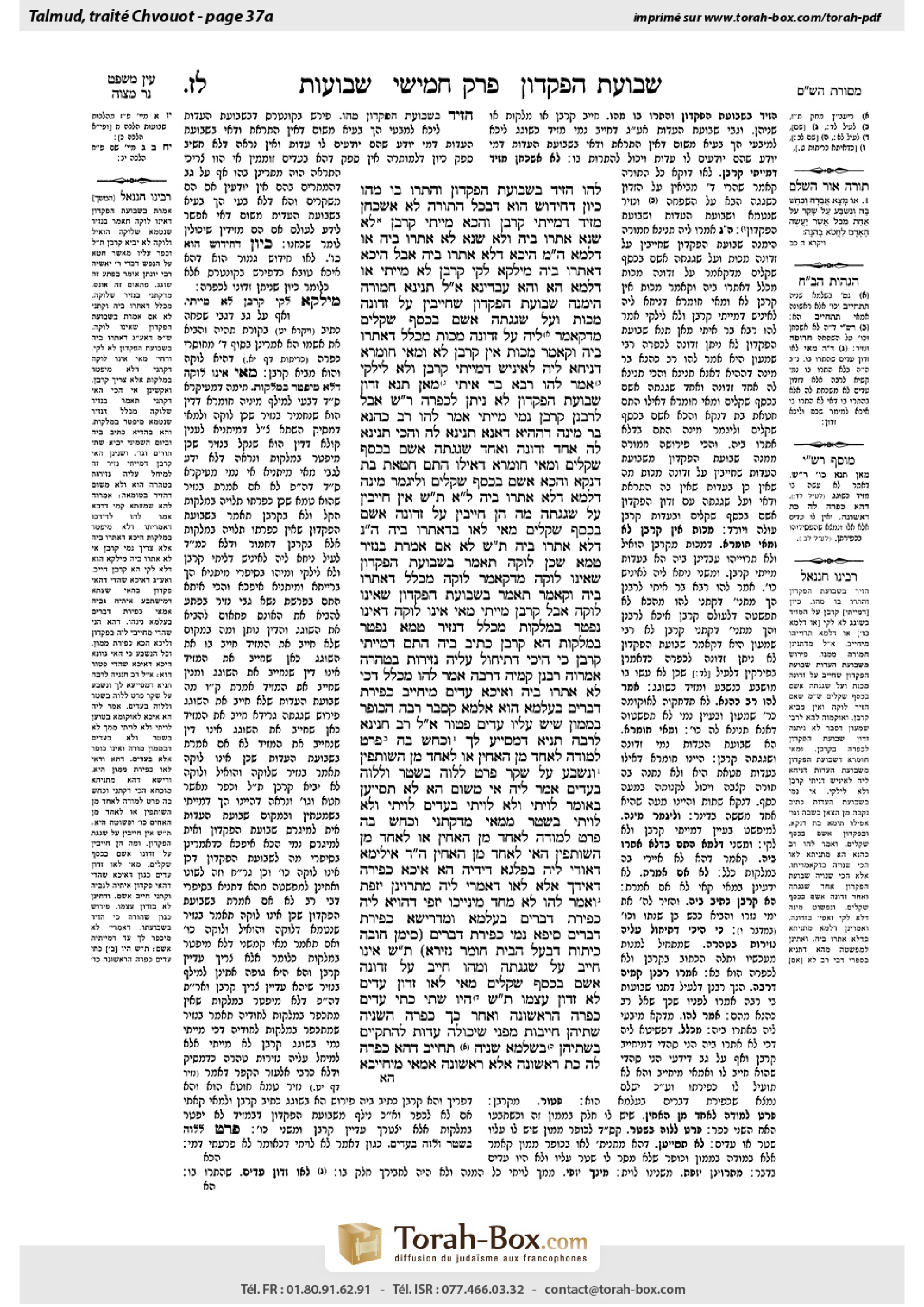
Shevuot 37a: Talmud study for Daf Yomi
Daf Yomi is the daily study of one Talmud folio. Explore 37 tractates with scans, Hebrew text, Sefaria English and AI-generated French translations where annotated.
Passage selection and English or AI-generated French translation are available where the scan has annotations. Daf Study is independent of Torah-Box and Sefaria.
Browse Shevuot · שבועות · All tractatesShevuot 37a text and translations
This page of Shevuot includes the Aramaic text, an English translation and an AI-generated French translation, alongside the scan above.
שבועות ל״ז א · Aramaic and Hebrew text
לְהוּ: הֵזִיד בִּשְׁבוּעַת הַפִּקָּדוֹן וְהִתְרוּ בּוֹ, מַהוּ? כֵּיוָן דְּחִידּוּשׁ הוּא – דִּבְכׇל הַתּוֹרָה לָא אַשְׁכְּחַן מֵזִיד דְּמַיְיתֵי קׇרְבָּן, וְהָכָא מַיְיתֵי קׇרְבָּן – לָא שְׁנָא אַתְרוֹ בֵּיהּ וְלָא שְׁנָא לָא אַתְרוֹ בֵּיהּ? אוֹ דִּלְמָא, הָנֵי מִילֵּי הֵיכָא דְּלָא אַתְרוֹ בֵּיהּ; אֲבָל הֵיכָא דְּאַתְרוֹ בֵּיהּ – מִילְקָא לָקֵי, קׇרְבָּן לָא מַיְיתֵי; אוֹ דִלְמָא, הָא וְהָא עָבְדִינַן.
אֲמַרוּ לֵיהּ, תְּנֵינָא: חֲמוּרָה הֵימֶנָּה שְׁבוּעַת הַפִּקָּדוֹן, שֶׁחַיָּיבִין עַל זְדוֹנָהּ מַכּוֹת וְעַל שִׁגְגָתָהּ אָשָׁם בְּכֶסֶף שְׁקָלִים. מִדְּקָאָמַר לֵיהּ עַל זְדוֹנָהּ מַכּוֹת – מִכְּלָל דְּאַתְרוֹ בֵּיהּ; וְקָאָמַר מַכּוֹת אִין, קׇרְבָּן לָא.
וּמַאי חוּמְרָא? דְּנִיחָא לֵיהּ לְאִינִישׁ דְּמַיְיתֵי קׇרְבָּן וְלָא לִילְקֵי.
אֲמַר לְהוּ רָבָא בַּר אִיתַּי: מַאן תָּנָא זְדוֹן שְׁבוּעַת הַפִּקָּדוֹן לֹא נִיתַּן לְכַפָּרָה – רַבִּי שִׁמְעוֹן; אֲבָל לְרַבָּנַן – קׇרְבָּן נָמֵי מַיְיתֵי.
אֲמַר לְהוּ רַב כָּהֲנָא: בַּר מִינַּהּ דְּהַהִיא; דַּאֲנָא תָּנֵינָא לַהּ – וְהָכִי תָּנֵינָא לַהּ: אֶחָד זְדוֹנָהּ וְאֶחָד שִׁגְגָתָהּ, אָשָׁם בְּכֶסֶף שְׁקָלִים. וּמַאי חוּמְרָא? דְּאִילּוּ הָתָם חַטָּאת בַּת דַּנְקָא, וְהָכָא אָשָׁם בְּכֶסֶף שְׁקָלִים.
וְלִיגְמַר מִינַּהּ! דִּלְמָא דְּלָא אַתְרוֹ בֵּיהּ.
לִישָּׁנָא אַחֲרִינָא, תָּא שְׁמַע: אֵין חַיָּיבִין עַל שִׁגְגָתָהּ. מָה הֵן חַיָּיבִין עַל זְדוֹנָהּ? אָשָׁם בְּכֶסֶף שְׁקָלִים. מַאי, לָאו בִּדְאַתְרוֹ בֵּיהּ? הָכָא נָמֵי דְּלָא אַתְרוֹ בֵּיהּ.
תָּא שְׁמַע: לֹא; אִם אָמַרְתָּ בְּנָזִיר טָמֵא – שֶׁכֵּן לוֹקֶה; תֹּאמַר בִּשְׁבוּעַת הַפִּקָּדוֹן – שֶׁאֵינוֹ לוֹקֶה?! מִדְּקָאָמַר לוֹקֶה – מִכְּלָל דְּאַתְרוֹ בֵּיהּ; וְקָאָמַר תֹּאמַר בִּשְׁבוּעַת הַפִּקָּדוֹן שֶׁאֵינוֹ לוֹקֶה – אֲבָל קׇרְבָּן מַיְיתֵי!
מַאי אֵינוֹ לוֹקֶה – דְּאֵינוֹ נִפְטָר בְּמַלְקוֹת. מִכְּלָל דְּנָזִיר טָמֵא נִפְטָר בְּמַלְקוֹת?! הָא ״קׇרְבָּן״ כְּתִיב בֵּיהּ! הָתָם דְּמַיְיתֵי קׇרְבָּן כִּי הֵיכִי דְּתֵיחוּל עֲלֵיהּ נְזִירוּת בְּטׇהֳרָה.
אַמְרוּהָ רַבָּנַן קַמֵּיהּ דְּרַבָּה. אֲמַר לְהוּ: מִכְּלָל דְּכִי לָא אַתְרוֹ בֵּיהּ וְאִיכָּא עֵדִים – מִיחַיַּיב?! כְּפִירַת דְּבָרִים בְּעָלְמָא הוּא! אַלְמָא קָסָבַר רַבָּה: הַכּוֹפֵר בְּמָמוֹן שֶׁיֵּשׁ עָלָיו עֵדִים – פָּטוּר.
אֲמַר לֵיהּ רַב חֲנִינָא לְרַבָּה, תַּנְיָא דִּמְסַיַּיע לָךְ: ״וְכִחֵשׁ בָּהּ״ – פְּרָט לְמוֹדֶה לְאֶחָד מִן הָאַחִין אוֹ לְאֶחָד מִן הַשּׁוּתָּפִין. ״וְנִשְׁבַּע עַל שָׁקֶר״ – פְּרָט לְלֹוֶה בִּשְׁטָר וּלְלֹוֶה בְּעֵדִים.
אֲמַר לֵיהּ: אִי מִשּׁוּם הָא – לָא תְּסַיְּיעַן; בְּאוֹמֵר ״לָוִיתִי, וְלֹא לָוִיתִי בְּעֵדִים״, ״לָוִיתִי, וְלֹא לָוִיתִי בִּשְׁטָר״.
מִמַּאי? מִדְּקָתָנֵי ״וְכִחֵשׁ בָּהּ״ – פְּרָט לְמוֹדֶה לְאֶחָד מִן הָאַחִין אוֹ לְאֶחָד מִן הַשּׁוּתָּפִין. הַאי לְאֶחָד מִן הָאַחִין הֵיכִי דָמֵי? אִילֵּימָא דְּאוֹדִי לֵיהּ בְּפַלְגָא דִּידֵיהּ – הָא אִיכָּא כְּפִירָה דְּאִידַּךְ! אֶלָּא לָאו דְּאָמְרִי לֵיהּ: מִתַּרְוֵינַן יְזַפְתְּ; וַאֲמַר לְהוּ: לָא, מֵחַד מִינַּיְיכוּ יְזַפִי – דְּהָוְיָא לֵיהּ כְּפִירַת דְּבָרִים בְּעָלְמָא? וּמִדְּרֵישָׁא כְּפִירַת דְּבָרִים – סֵיפָא נָמֵי כְּפִירַת דְּבָרִים.
(סִימָן – חוֹבָה; כִּיתּוֹת; דְּבַעַל הַבַּיִת; חוֹמֶר; נְזִירָא) תָּא שְׁמַע: אֵינוֹ חַיָּיב עַל שִׁגְגָתָהּ. וּמַהוּ חַיָּיב עַל זְדוֹנָהּ? אָשָׁם בְּכֶסֶף שְׁקָלִים. מַאי, לָאו זְדוֹן עֵדִים? לָא, זְדוֹן עַצְמוֹ.
תָּא שְׁמַע: הָיוּ שְׁתֵּי כִּתֵּי עֵדִים, כָּפְרָה הָרִאשׁוֹנָה וְאַחַר כָּךְ כָּפְרָה הַשְּׁנִיָּה – שְׁתֵּיהֶן חַיָּיבוֹת, מִפְּנֵי שֶׁיְּכוֹלָה עֵדוּת לְהִתְקַיֵּים בִּשְׁתֵּיהֶן. בִּשְׁלָמָא שְׁנִיָּה תִּחַיַּיב – דְּהָא כָּפְרָה לָהּ כַּת רִאשׁוֹנָה; אֶלָּא רִאשׁוֹנָה אַמַּאי מִיחַיְּיבָא?
Shevuot 37a · English translation
to them: If one intentionally took a false oath on a deposit and witnesses forewarned him, what is the halakha? Is it the case that since the halakha of an oath on a deposit is a novelty, as in the entire Torah we do not find another case where one who transgressed intentionally brings an offering for atonement, but here he does bring an offering for transgressing the prohibition intentionally, there is no difference whether witnesses forewarned him and there is no difference whether they did not forewarn him, and he is liable to bring a guilt-offering, though generally, there is no offering brought when there was forewarning? Or perhaps, that matter of bringing a guilt-offering when one intentionally takes a false oath applies only when they did not forewarn him; but when they forewarned him, he is flogged, as this is the standard punishment for an intentional transgression, and he does not bring an offering. Or perhaps, we impose both lashes and a guilt-offering.
They said to Rav Kahana: We learn in a baraita: The halakhot of an oath on a deposit are more stringent than the halakhot of an oath of testimony, as one is liable to receive lashes for intentionally taking a false oath on a deposit, and for unwittingly taking a false oath on a deposit one is liable to bring a guilt-offering worth at least two silver shekels; whereas one who takes a false oath of testimony, whether intentionally or unwittingly, brings a sin-offering. From the fact that the baraita states that for intentionally taking a false oath on a deposit one is liable to receive lashes, by inference it can be understood that the baraita is referring to a case where witnesses forewarned him, as one cannot receive lashes without forewarning, and it is stating: Yes, he is liable to receive lashes, but he is not liable to bring an offering. The baraita, then, resolves the question of Rav Kahana.
The Gemara elaborates: And what is the stringency in the fact that one who intentionally takes a false oath on a deposit receives lashes? It is due to the fact that a person prefers to bring an offering rather than receive lashes.
Rava bar Itai said to the students of Rabba: You cannot answer the question from that baraita, as who is the tanna who taught that intentionally taking a false oath on a deposit is not subject to atonement? It is Rabbi Shimon. But according to the Rabbis, he is liable to bring a guilt-offering, as well as receiving lashes. Therefore, the question remains unanswered.
Rav Kahana said to the students: Apart from this, you cannot answer my question from this baraita, as I am the one who teaches this baraita and this is how I teach it: An oath on a deposit is more stringent than an oath of testimony, since for taking a false oath on a deposit either intentionally or unwittingly one is liable to bring a guilt-offering worth at least two silver shekels. And what is the stringency in this halakha? It is that there, with regard to an oath of testimony, he is liable to bring a sin-offering that can be worth even one-sixth of one dinar, and here, the guilt-offering incurred for an oath on a deposit must be worth at least two silver shekels.
The Gemara suggests: And let him derive an answer to his question from his version of the baraita, which indicates that one who intentionally takes a false oath on a deposit brings an offering and does not receive lashes. The Gemara responds: Perhaps it is referring to a case where they did not forewarn him; had he been forewarned, he would be flogged.
The Gemara presents a different version of the previous discussion: Come and hear an answer to the question of Rav Kahana from the mishna: One is not liable for taking a false oath on a deposit unwittingly. And what is he liable for when he intentionally takes a false oath? A guilt-offering worth at least two silver shekels. The Gemara explains: What, is it not that the mishna is referring to a case where witnesses forewarned him, and the mishna nevertheless rules only that he must bring an offering? The Gemara rejects the proof: Here, too, the mishna is referring to a case where the witnesses did not forewarn him.
The Gemara continues to seek an answer to Rav Kahana’s question: Come and hear an answer from a baraita. After comparing the case of a nazirite to one who takes an oath on a deposit, the baraita states: No, if you said that the halakha that baraita discusses is true with regard to an impure nazirite, who is indeed flogged for intentionally becoming impure, shall you also say that this is the case with regard to one who took an oath on a deposit, who is not flogged? The Gemara notes: Now, from the fact that the baraita states that a nazirite is flogged, by inference it can be understood that the baraita is referring to a case where witnesses forewarned him, as one is not liable to receive lashes without forewarning; and yet the baraita states: Shall you say that this is the case with regard to one who took an oath on a deposit, who is not flogged? One can infer: But he does bring a guilt-offering.
The Gemara rejects the proof: What does the baraita mean when it states that he is not flogged? It means that he is not exempted through lashes alone and he must also bring an offering. The Gemara asks: By inference, does this mean that an impure nazirite is exempted through lashes alone? Isn’t it written in the Torah explicitly with regard to him that there is a requirement to bring an offering? The Gemara responds: The offering brought by an impure nazirite does not serve as an atonement. Rather, there, the nazirite brings an offering in order to purify himself so that his naziriteship can go into effect while he is in a state of purity. The offering must be brought even if the nazirite became impure unwittingly.
The Sages said this matter before Rabba, i.e., they related the question of Rav Kahana as to whether one who intentionally takes a false oath and was forewarned by witnesses is liable to bring an offering. Rabba said to them: May one conclude by inference that in a case when they did not warn him but there are witnesses to the fact that the defendant owes money to the claimant, he is liable to bring an offering? Isn’t this case merely a verbal denial that does not have any effect with regard to liability to pay? Since there are witnesses who will testify that the defendant owes the claimant, his denial and false oath did not exempt him from payment and he therefore should not be liable to bring a guilt-offering for taking a false oath. The Gemara infers: Evidently, Rabba holds that one who denies a monetary claim to which there are witnesses is exempt from bringing a guilt-offering for taking a false oath, since the witnesses will testify to the validity of the claimant’s claim and the denial of the defendant is of no consequence.
Rav Ḥanina said to Rabba: A baraita is taught that supports your opinion: The verse states with regard to an oath denying a monetary claim: “And deal falsely therein” (Leviticus 5:22), which serves to exclude one who admits to the truth of the claim of one of a group of brothers or to one of a group of partners, even if he denies the claim to the rest of the brothers or partners. The same verse also states: “And swear to a lie,” which serves to exclude one who borrows money with a promissory note or one who borrows money in the presence of witnesses. Evidently, one is not liable for taking a false oath concerning a monetary claim when there are witnesses who can testify to it.
Rabba said to him: If your proof is because of that baraita, you have not supported us, since that baraita is referring to a case where the defendant says: I borrowed, but I did not borrow in the presence of witnesses, or he says: I borrowed, but I did not borrow with a promissory note. Since his denial is only with regard to the circumstances of the loan and not to the actual debt, he is exempt from liability for taking the false oath.
Rabba elaborates: From where in the baraita is this explanation apparent? From the fact that it teaches that the verse “and deal falsely therein” serves to exclude one who admits to one of the brothers or to one of the partners. What are the circumstances of that case where one admits to one of the brothers? If we say that he admitted only the portion of the debt owed to that brother, then why is he exempt? Isn’t there the denial of the claim of the other brother, which is a denial of a monetary claim? Rather, is it not that the brothers said to him: You borrowed from both of us, and he said to them: No, I borrowed all of the amount in question from only one of you, which is merely a verbal denial, as he admits that he owes the claimed amount and disputes only the circumstances of the debt. And since the first clause of the baraita is referring to a case of a verbal denial, the last clause is also referring to a verbal denial. Consequently, one cannot cite a proof from this baraita.
The Gemara attempts to prove that one who takes a false oath on a deposit is liable to bring an offering even when there are witnesses, and presents a mnemonic to remember the series of proofs: Liability, sets, of the homeowner, stringent, nazirite. The Gemara suggests: Come and hear a proof from the mishna: He is not liable for unwittingly taking a false oath by itself. And what is he liable for when he intentionally takes a false oath? He must bring a guilt-offering worth at least two silver shekels. The Gemara continues: What, is it not referring to a case where he intentionally denies the claim of witnesses, and the mishna nevertheless teaches that he is liable to bring a guilt-offering? The Gemara rejects the proof: No, the mishna is referring to a case where there are no witnesses and he admits on his own that he intentionally took a false oath. Had there been witnesses, he would have been exempt from bringing an offering.
The Gemara suggests: Come and hear a proof from a mishna (31b) that discusses an oath of testimony: If there were two sets of witnesses who took an oath of testimony, and the first set falsely denied knowledge of the matter and then the second set falsely denied knowledge of the matter, both are liable, because the testimony can exist with either of them. The Gemara clarifies: Granted, the second set should be liable, since the first set already denied knowledge of the incident and the validity of the claimant’s monetary claim now depends upon their testimony. But why is the first set liable?
Shevuot 37a · Traduction française (IA)
Ils leur dirent : Si quelqu’un a prêté intentionnellement un faux serment au sujet d’un dépôt et que des témoins l’ont prévenu, quelle est la halakha ? Peut-être que, puisque la halakha relative au serment concernant un dépôt constitue une nouveauté — car, dans toute la Torah écrite, on ne trouve aucun autre cas où celui qui a transgressé intentionnellement apporte une offrande pour expier sa faute, alors qu’ici il en apporte une pour avoir transgressé intentionnellement l’interdit —, il n’y a pas de différence entre le cas où des témoins l’ont prévenu et celui où ils ne l’ont pas prévenu, et il est tenu d’apporter un sacrifice de culpabilité, bien qu’en général aucune offrande ne soit apportée lorsqu’il y a eu avertissement ? Ou peut-être l’obligation d’apporter un sacrifice de culpabilité pour un faux serment intentionnel ne s’applique-t-elle que lorsqu’ils ne l’ont pas prévenu ; mais s’ils l’ont prévenu, il reçoit la flagellation, peine habituelle pour une transgression intentionnelle, et n’apporte pas d’offrande. Ou peut-être lui impose-t-on à la fois la flagellation et un sacrifice de culpabilité.
On dit à Rav Kahana : Nous apprenons dans une baraïta : Les règles relatives au serment concernant un dépôt sont plus strictes que celles relatives au serment de témoignage, car celui qui prête intentionnellement un faux serment au sujet d’un dépôt est passible de flagellation, et celui qui le fait par inadvertance est tenu d’apporter un sacrifice de culpabilité d’une valeur d’au moins deux sicles d’argent ; tandis que celui qui prête un faux serment de témoignage, intentionnellement ou par inadvertance, apporte un sacrifice expiatoire. Le fait que la baraïta dise que celui qui prête intentionnellement un faux serment au sujet d’un dépôt est passible de flagellation permet de déduire qu’elle parle d’un cas où des témoins l’ont prévenu, car on ne peut recevoir la flagellation sans avertissement. Elle affirme donc qu’il est passible de flagellation, mais non tenu d’apporter une offrande. La baraïta répond ainsi à la question de Rav Kahana.
La Guemara précise : En quoi consiste la rigueur du fait que celui qui prête intentionnellement un faux serment au sujet d’un dépôt reçoit la flagellation ? C’est qu’une personne préfère apporter une offrande plutôt que de recevoir la flagellation.
Rava bar Itai dit aux élèves de Rabba : Vous ne pouvez pas répondre à la question à partir de cette baraïta, car quel est le tanna qui a enseigné que celui qui prête intentionnellement un faux serment au sujet d’un dépôt n’est pas soumis à l’expiation ? C’est Rabbi Shimon. Mais selon les Sages, il est tenu d’apporter un sacrifice de culpabilité en plus de recevoir la flagellation. La question reste donc sans réponse.
Rav Kahana dit aux élèves : En outre, vous ne pouvez pas répondre à ma question à partir de cette baraïta, car c’est moi qui l’enseigne, et voici comment je l’enseigne : Le serment concernant un dépôt est plus strict que le serment de témoignage, puisque celui qui prête un faux serment au sujet d’un dépôt, intentionnellement ou par inadvertance, est tenu d’apporter un sacrifice de culpabilité d’une valeur d’au moins deux sicles d’argent. Et en quoi consiste la rigueur de cette halakha ? Dans le cas du serment de témoignage, il est tenu d’apporter un sacrifice expiatoire qui peut ne valoir qu’un sixième de dinar, tandis que, dans le cas du serment concernant un dépôt, le sacrifice de culpabilité doit valoir au moins deux sicles d’argent.
La Guemara propose : Qu’il déduise la réponse à sa question de sa version de la baraïta, qui indique que celui qui prête intentionnellement un faux serment au sujet d’un dépôt apporte une offrande et ne reçoit pas la flagellation. La Guemara répond : Peut-être s’agit-il d’un cas où ils ne l’ont pas prévenu ; s’ils l’avaient prévenu, il aurait reçu la flagellation.
La Guemara présente une autre version de la discussion précédente : Viens et entends une réponse à la question de Rav Kahana à partir de la Michna : On n’est pas passible pour avoir prêté par inadvertance un faux serment au sujet d’un dépôt. Et de quoi est-on passible lorsqu’on prête intentionnellement un faux serment ? D’un sacrifice de culpabilité d’une valeur d’au moins deux sicles d’argent. La Guemara explique : La Michna ne parle-t-elle pas d’un cas où des témoins l’ont prévenu et ne statue-t-elle pas néanmoins qu’il doit seulement apporter une offrande ? La Guemara rejette cette preuve : ici aussi, la Michna parle d’un cas où les témoins ne l’ont pas prévenu.
La Guemara poursuit sa recherche d’une réponse à la question de Rav Kahana : Viens et entends une réponse à partir d’une baraïta. Après avoir comparé le cas du nazir à celui de celui qui prête un serment concernant un dépôt, la baraïta dit : Non. Si tu dis que la halakha évoquée par cette baraïta est vraie pour un nazir impur, qui reçoit effectivement la flagellation pour s’être rendu impur intentionnellement, diras-tu aussi que c’est le cas pour celui qui a prêté un serment concernant un dépôt, qui ne reçoit pas la flagellation ? La Guemara fait remarquer : Puisque la baraïta dit qu’un nazir reçoit la flagellation, on peut en déduire qu’elle parle d’un cas où des témoins l’ont prévenu, car on ne peut recevoir la flagellation sans avertissement. Et pourtant, la baraïta dit : Dirais-tu que c’est le cas pour celui qui a prêté un serment concernant un dépôt, qui ne reçoit pas la flagellation ? On peut en déduire qu’il apporte néanmoins un sacrifice de culpabilité.
La Guemara rejette cette preuve : Que signifie la déclaration de la baraïta selon laquelle il ne reçoit pas la flagellation ? Elle signifie qu’il n’est pas quitte par la seule flagellation et qu’il doit également apporter une offrande. La Guemara demande : Faut-il en déduire qu’un nazir impur est quitte par la seule flagellation ? La Torah n’indique-t-elle pas explicitement à son sujet qu’il doit apporter une offrande ? La Guemara répond : L’offrande apportée par un nazir impur ne sert pas à expier sa faute. Le nazir apporte plutôt cette offrande afin de se purifier, pour que son naziréat puisse prendre effet alors qu’il est en état de pureté. Cette offrande doit être apportée même si le nazir s’est rendu impur par inadvertance.
Les Sages exposèrent cette question devant Rabba, c’est-à-dire qu’ils lui rapportèrent la question de Rav Kahana : celui qui prête intentionnellement un faux serment après avoir été prévenu par des témoins est-il tenu d’apporter une offrande ? Rabba leur dit : Peut-on déduire que, dans le cas où ils ne l’ont pas prévenu, mais où des témoins attestent que le défendeur doit de l’argent au demandeur, il est tenu d’apporter une offrande ? Ce cas ne consiste-t-il pas simplement en un déni verbal sans effet sur l’obligation de payer ? Puisque des témoins attesteront que le défendeur doit de l’argent au demandeur, son déni et son faux serment ne l’ont pas libéré du paiement ; il ne devrait donc pas être tenu d’apporter un sacrifice de culpabilité pour avoir prêté un faux serment. La Guemara en déduit que Rabba estime manifestement que celui qui nie une créance monétaire alors qu’il existe des témoins est dispensé d’apporter un sacrifice de culpabilité pour avoir prêté un faux serment, car les témoins attesteront le bien-fondé de la réclamation du demandeur et le déni du défendeur n’a aucune conséquence.
Rav Ḥanina dit à Rabba : Une baraïta est enseignée à l’appui de ton opinion : À propos d’un serment par lequel on nie une créance monétaire, le verset dit : « et qu’il a agi faussement à son égard » (Lévitique 5, 22), ce qui exclut celui qui reconnaît la véracité de la réclamation de l’un des frères d’un groupe ou de l’un des associés, même s’il nie la réclamation des autres frères ou associés. Le même verset dit aussi : « et qu’il a prêté un faux serment », ce qui exclut celui qui emprunte de l’argent au moyen d’un acte de prêt ou celui qui emprunte de l’argent en présence de témoins. Il est donc évident qu’on n’est pas passible pour avoir prêté un faux serment concernant une créance monétaire lorsque des témoins peuvent en attester.
Rabba lui dit : Si ta preuve repose sur cette baraïta, tu ne nous as pas soutenus, car elle parle d’un cas où le défendeur dit : « J’ai emprunté, mais pas en présence de témoins », ou bien : « J’ai emprunté, mais pas au moyen d’un acte de prêt. » Puisque son déni porte uniquement sur les circonstances du prêt, et non sur la dette elle-même, il n’est pas passible pour avoir prêté ce faux serment.
Rabba développe : Qu’est-ce qui, dans la baraïta, rend cette explication manifeste ? Le fait qu’elle enseigne que le verset « et qu’il a agi faussement à son égard » sert à exclure celui qui reconnaît sa dette envers l’un des frères ou l’un des associés. Dans quelles circonstances reconnaît-il sa dette envers l’un des frères ? Si l’on dit qu’il n’a reconnu que la part de la dette due à ce frère, pourquoi serait-il dispensé ? Ne nie-t-il pas alors la réclamation de l’autre frère, ce qui constitue un déni de créance monétaire ? Il faut plutôt comprendre que les frères lui ont dit : « Tu as emprunté à nous deux », et qu’il leur a répondu : « Non, j’ai emprunté toute la somme en question à un seul d’entre vous. » Il s’agit alors d’un simple déni verbal, puisqu’il reconnaît devoir la somme réclamée et ne conteste que les circonstances de la dette. Puisque la première partie de la baraïta parle d’un déni verbal, sa dernière partie parle elle aussi d’un déni verbal. On ne peut donc pas invoquer cette baraïta comme preuve.
La Guemara tente de prouver que celui qui prête un faux serment au sujet d’un dépôt est tenu d’apporter une offrande même lorsqu’il existe des témoins, et donne un aide-mémoire pour retenir la série de preuves : obligation, groupes, propriétaire, rigueur, nazir. La Guemara propose : Viens et entends une preuve à partir de la Michna : On n’est pas passible pour le seul fait d’avoir prêté un faux serment par inadvertance. Et de quoi est-on passible lorsqu’on prête intentionnellement un faux serment ? Il faut apporter un sacrifice de culpabilité d’une valeur d’au moins deux sicles d’argent. La Guemara poursuit : Ne s’agit-il pas d’un cas où il nie intentionnellement la réclamation de témoins, et la Michna enseigne néanmoins qu’il est tenu d’apporter un sacrifice de culpabilité ? La Guemara rejette cette preuve : Non, la Michna parle d’un cas où il n’y a pas de témoins et où il reconnaît de lui-même avoir prêté intentionnellement un faux serment. S’il y avait eu des témoins, il aurait été dispensé d’apporter une offrande.
La Guemara propose : Viens et entends une preuve à partir d’une Michna (31b) qui traite du serment de témoignage : S’il y avait deux groupes de témoins qui ont prêté un serment de témoignage, et que le premier groupe a nié à tort connaître l’affaire, puis que le second groupe a lui aussi nié à tort la connaître, les deux groupes sont passibles, car le témoignage peut être apporté par l’un ou l’autre. La Guemara précise : Il est compréhensible que le second groupe soit passible, puisque le premier a déjà nié connaître l’affaire et que le bien-fondé de la créance monétaire du demandeur dépend désormais de leur témoignage. Mais pourquoi le premier groupe est-il passible ?
Traduction française générée par IA à partir de l’édition anglaise de Sefaria. Vérifie toujours un passage avec le texte source.
Text from Sefaria: William Davidson Edition - Vocalized Aramaic (CC BY NC); William Davidson Edition - English (CC BY NC).