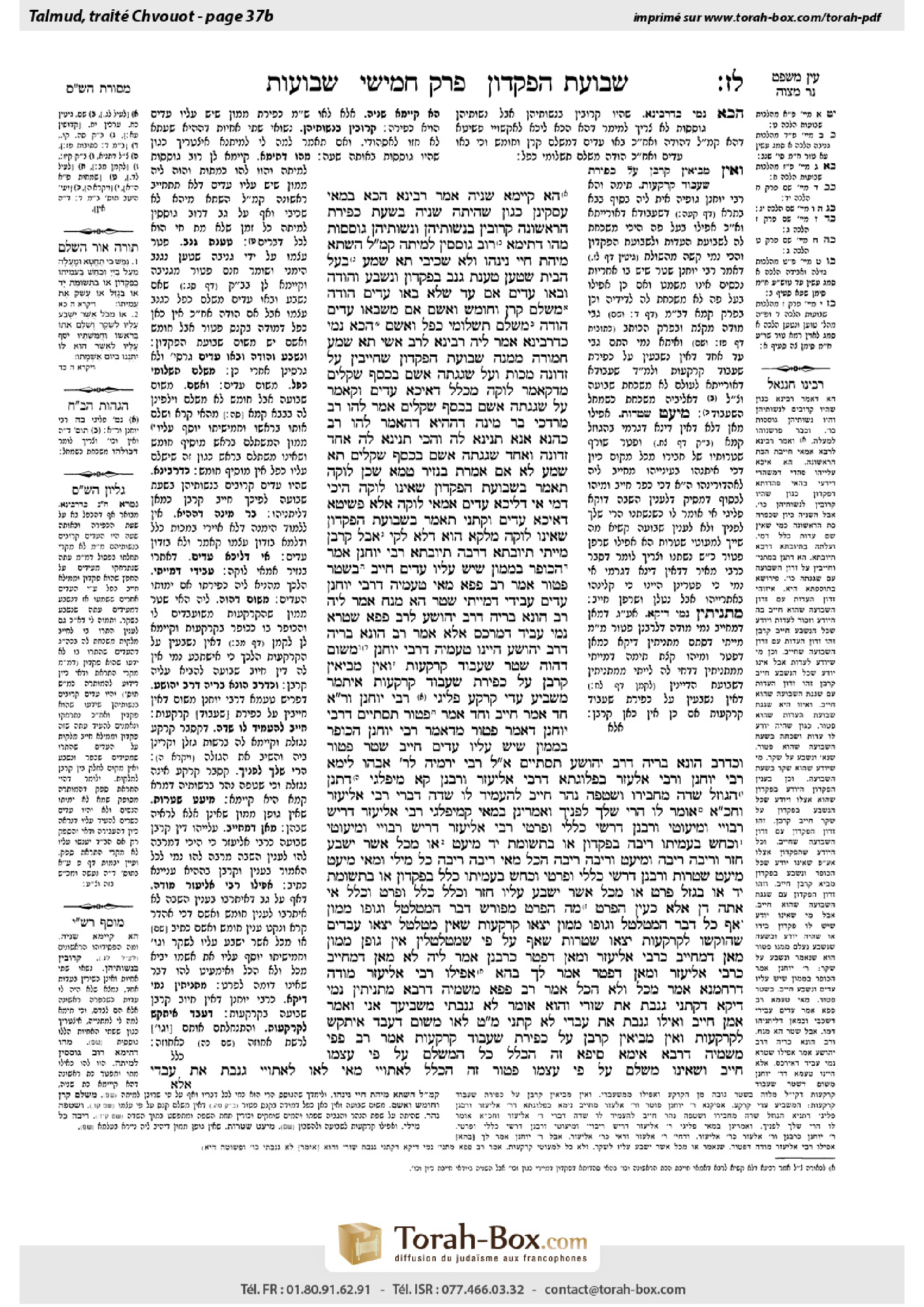
Shevuot 37b: Talmud study for Daf Yomi
Daf Yomi is the daily study of one Talmud folio. Explore 37 tractates with scans, Hebrew text, Sefaria English and AI-generated French translations where annotated.
Passage selection and English or AI-generated French translation are available where the scan has annotations. Daf Study is independent of Torah-Box and Sefaria.
Browse Shevuot · שבועות · All tractatesShevuot 37b text and translations
This page of Shevuot includes the Aramaic text, an English translation and an AI-generated French translation, alongside the scan above.
שבועות ל״ז ב · Aramaic and Hebrew text
הָא קָיְימָא שְׁנִיָּה!
אָמַר רָבִינָא: הָכָא בְּמַאי עָסְקִינַן – כְּגוֹן שֶׁהָיְתָה שְׁנִיָּה בִּשְׁעַת כְּפִירַת הָרִאשׁוֹנָה קְרוֹבִין בִּנְשׁוֹתֵיהֶן, וּנְשׁוֹתֵיהֶן גּוֹסְסוֹת. מַהוּ דְּתֵימָא: רוֹב גּוֹסְסִין לְמִיתָה; קָא מַשְׁמַע לַן: הַשְׁתָּא מִיהַת חָיֵי נִינְהוּ וְלָא שְׁכִיבֵי.
תָּא שְׁמַע: בַּעַל הַבַּיִת שֶׁטָּעַן טַעֲנַת גַּנָּב בְּפִקָּדוֹן, וְנִשְׁבַּע, וְהוֹדָה, וּבָאוּ עֵדִים; אִם עַד שֶׁלֹּא בָּאוּ עֵדִים הוֹדָה – מְשַׁלֵּם קֶרֶן וָחוֹמֶשׁ וְאָשָׁם. אִם מִשֶּׁבָּאוּ עֵדִים הוֹדָה – מְשַׁלֵּם תַּשְׁלוּמֵי כֶפֶל וְאָשָׁם!
הָכָא נָמֵי, כִּדְרָבִינָא.
אֲמַר לֵיהּ רָבִינָא לְרַב אָשֵׁי, תָּא שְׁמַע: חֲמוּרָה מִמֶּנָּה שְׁבוּעַת הַפִּקָּדוֹן – שֶׁחַיָּיבִין עַל זְדוֹנָהּ מַכּוֹת, וְעַל שִׁגְגָתָהּ אָשָׁם בְּכֶסֶף שְׁקָלִים. מִדְּקָאָמַר לוֹקֶה – מִכְּלָל דְּאִיכָּא עֵדִים; וְקָאָמַר: עַל שִׁגְגָתָהּ אָשָׁם בְּכֶסֶף שְׁקָלִים!
אֲמַר לְהוּ רַב מָרְדֳּכַי: בַּר מִינַּהּ דְּהַהִיא; דְּהָאָמַר לְהוּ רַב כָּהֲנָא: אֲנָא תְּנֵינָא לַהּ – וְהָכִי תְּנֵינָא לַהּ: אֶחָד זְדוֹנָהּ וְאֶחָד שִׁגְגָתָהּ, אָשָׁם בְּכֶסֶף שְׁקָלִים.
תָּא שְׁמַע: לֹא; אִם אָמַרְתָּ בְּנָזִיר טָמֵא – שֶׁכֵּן לוֹקֶה; תֹּאמַר בִּשְׁבוּעַת הַפִּקָּדוֹן – שֶׁאֵינוֹ לוֹקֶה?! הֵיכִי דָמֵי? אִי דְּלֵיכָּא עֵדִים – אַמַּאי לוֹקֶה? אֶלָּא פְּשִׁיטָא דְּאִיכָּא עֵדִים; וְקָתָנֵי: תֹּאמַר בִּשְׁבוּעַת הַפִּקָּדוֹן שֶׁאֵינוֹ לוֹקֶה; מִלְקָא הוּא דְּלָא לָקֵי – אֲבָל קׇרְבָּן מַיְיתֵי; תְּיוּבְתָּא דְּרַבָּה! תְּיוּבְתָּא.
רַבִּי יוֹחָנָן אָמַר: הַכּוֹפֵר בְּמָמוֹן שֶׁיֵּשׁ עָלָיו עֵדִים – חַיָּיב. בִּשְׁטָר – פָּטוּר. אָמַר רַב פָּפָּא: מַאי טַעְמֵיהּ דְּרַבִּי יוֹחָנָן? עֵדִים – עֲבִידִי דְּמָיְיתִי, שְׁטָר – הָא מַנַּח.
אֲמַר לֵיהּ רַב הוּנָא בְּרֵיהּ דְּרַב יְהוֹשֻׁעַ לְרַב פָּפָּא: שְׁטָרָא נָמֵי עֲבִיד דְּמִרְכַס! אֶלָּא אָמַר רַב הוּנָא בְּרֵיהּ דְּרַב יְהוֹשֻׁעַ: הַיְינוּ טַעְמֵיהּ דְּרַבִּי יוֹחָנָן – מִשּׁוּם דְּהָוֵה שְׁטָר שִׁעְבּוּד קַרְקָעוֹת, וְאֵין מְבִיאִין קׇרְבָּן עַל כְּפִירַת שִׁעְבּוּד קַרְקָעוֹת.
אִיתְּמַר: מַשְׁבִּיעַ עֵדֵי קַרְקַע – פְּלִיגִי רַבִּי יוֹחָנָן וְרַבִּי אֶלְעָזָר; חַד אָמַר חַיָּיב, וְחַד אָמַר פָּטוּר. תִּסְתַּיַּים דְּרַבִּי יוֹחָנָן דְּאָמַר פָּטוּר – מִדְּאָמַר רַבִּי יוֹחָנָן: הַכּוֹפֵר בְּמָמוֹן שֶׁיֵּשׁ עָלָיו עֵדִים – חַיָּיב, שְׁטָר – פָּטוּר; וְכִדְרַב הוּנָא בְּרֵיהּ דְּרַב יְהוֹשֻׁעַ. תִּסְתַּיַּים.
אֲמַר לֵיהּ רַבִּי יִרְמְיָה לְרַבִּי אֲבָהוּ: לֵימָא רַבִּי יוֹחָנָן וְרַבִּי אֶלְעָזָר בִּפְלוּגְתָּא דְּרַבִּי אֱלִיעֶזֶר וְרַבָּנַן קָא מִיפַּלְגִי? דִּתְנַן: הַגּוֹזֵל שָׂדֶה מֵחֲבֵירוֹ וּשְׁטָפָהּ נָהָר – חַיָּיב לְהַעֲמִיד לוֹ שָׂדֶה. דִּבְרֵי רַבִּי אֱלִיעֶזֶר. וַחֲכָמִים אוֹמְרִים: אוֹמֵר לוֹ ״הֲרֵי שֶׁלְּךָ לְפָנֶיךָ״.
וְאָמְרִינַן: בְּמַאי קָמִיפַּלְגִי? רַבִּי אֱלִיעֶזֶר דָּרֵישׁ רִבּוּיֵי וּמִיעוּטֵי, וְרַבָּנַן דָּרְשִׁי כְּלָלֵי וּפְרָטֵי.
רַבִּי אֱלִיעֶזֶר דָּרֵישׁ רִבּוּיֵי וּמִיעוּטֵי: ״וְכִחֵשׁ בַּעֲמִיתוֹ״ – רִיבָּה, ״בְּפִקָּדוֹן אוֹ בִתְשׂוּמֶת יָד״ – מִיעֵט, ״אוֹ מִכֹּל אֲשֶׁר יִשָּׁבַע״ – חָזַר וְרִיבָּה.
רִיבָּה וּמִיעֵט וְרִיבָּה – רִיבָּה הַכֹּל. מַאי רִיבָּה? רִיבָּה כֹּל מִילֵּי; וּמַאי מִיעֵט? מִיעֵט שְׁטָרוֹת.
וְרַבָּנַן דָּרְשִׁי כְּלָלֵי וּפְרָטֵי: ״וְכִחֵשׁ בַּעֲמִיתוֹ״ – כְּלָל, ״בְּפִקָּדוֹן אוֹ בִתְשׂוּמֶת יָד אוֹ בְגָזֵל״ – פְּרָט, ״אוֹ מִכֹּל אֲשֶׁר יִשָּׁבַע עָלָיו״ – חָזַר וְכָלַל. כְּלָל וּפְרָט וּכְלָל – אִי אַתָּה דָן אֶלָּא כְּעֵין הַפְּרָט.
מָה הַפְּרָט מְפוֹרָשׁ – דָּבָר הַמִּטַּלְטֵל וְגוּפוֹ מָמוֹן; אַף כׇּל דָּבָר הַמִּטַּלְטֵל וְגוּפוֹ מָמוֹן. יָצְאוּ קַרְקָעוֹת – שֶׁאֵין (מטלטל) [מִטַּלְטְלִין]; יָצְאוּ עֲבָדִים – שֶׁהוּקְּשׁוּ לְקַרְקָעוֹת; יָצְאוּ שְׁטָרוֹת – שֶׁאַף עַל פִּי שֶׁמִּטַּלְטְלִין, אֵין גּוּפָן מָמוֹן.
מַאן דִּמְחַיֵּיב – כְּרַבִּי אֱלִיעֶזֶר, וּמַאן דְּפָטַר – כְּרַבָּנַן.
אֲמַר לֵיהּ: לָא; מַאן דִּמְחַיֵּיב – כְּרַבִּי אֱלִיעֶזֶר; וּמַאן דְּפָטַר אָמַר לָךְ: בְּהָא אֲפִילּוּ רַבִּי אֱלִיעֶזֶר מוֹדֶה, דְּרַחֲמָנָא אָמַר ״מִכֹּל״ – וְלֹא הַכֹּל.
אָמַר רַב פָּפָּא מִשְּׁמֵיהּ דְּרָבָא: מַתְנִיתִין נָמֵי דַּיְקָא, דְּקָתָנֵי: ״גָּנַבְתָּ אֶת שׁוֹרִי״, וְהוּא אוֹמֵר: ״לֹא גָּנַבְתִּי״; ״מַשְׁבִּיעֲךָ אֲנִי״, וְאָמַר: ״אָמֵן״ – חַיָּיב. וְאִילּוּ ״גָּנַבְתָּ אֶת עַבְדִּי״ – לָא קָתָנֵי; מַאי טַעְמָא? לָאו מִשּׁוּם דְּעֶבֶד אִיתַּקַּשׁ לְקַרְקָעוֹת, וְאֵין מְבִיאִין קׇרְבָּן עַל כְּפִירַת שִׁעְבּוּד קַרְקָעוֹת?
אָמַר רַב פַּפֵּי מִשְּׁמֵיהּ דְּרָבָא: אֵימָא סֵיפָא, זֶה הַכְּלָל: כׇּל הַמְשַׁלֵּם עַל פִּי עַצְמוֹ – חַיָּיב, וְשֶׁאֵינוֹ מְשַׁלֵּם עַל פִּי עַצְמוֹ – פָּטוּר. ״זֶה הַכְּלָל״ לְאֵתוֹיֵי מַאי? לָאו לְאֵתוֹיֵי ״גָּנַבְתָּ אֶת עַבְדִּי״?
Shevuot 37b · English translation
Doesn’t the second set stand ready to testify, so that the refusal of the first set of witnesses does not affect a monetary claim? Evidently, a denial of a monetary claim to which there are witnesses is still considered a denial.
Ravina said: Here we are dealing with a case where at the time of the denial by the first set, the second set of witnesses were related to one another through their wives, so that the second set was unfit to provide testimony; and their wives were moribund. Lest you say: Most moribund people actually die soon thereafter, and the witnesses are considered fit to provide testimony, the baraita teaches us that in any event they are currently alive and have not died. The second set was therefore unfit to provide testimony.
The Gemara suggests: Come and hear a proof from a baraita: In the case of a homeowner acting as a bailee who falsely claimed that a thief stole a deposit from him, and the homeowner took an oath to that effect and then admitted that he was lying, and witnesses came and testified that the item was not stolen from the homeowner, the halakha depends on the circumstances. If he admitted to his lie before the witnesses came and testified, he pays the principal value of the item and the additional one-fifth payment for denying that he possessed the deposit, and he brings a guilt-offering as atonement for a false oath on a deposit. If he admitted his guilt after the witnesses came and testified, he pays the double payment and brings a guilt-offering. The baraita indicates that even in the case of a monetary claim to which there are witnesses, one is liable to bring a guilt-offering.
The Gemara responds: Here, too, explain this baraita as Ravina explained the previous baraita, that at the time the homeowner took his oath, the witnesses were related through their moribund wives and were unfit to provide testimony.
Ravina said to Rav Ashi: Come and hear another proof from that which is taught in a baraita: The halakhot of an oath on a deposit are more stringent than the halakhot of an oath of testimony, as one is liable to receive lashes for intentionally taking a false oath on a deposit, and one is liable to bring a guilt-offering worth at least two silver shekels for taking the oath unwittingly. Ravina infers: From the fact that the baraita states that one is flogged, by inference it can be understood that the baraita is referring to a case where there are witnesses to the fact that the deposit is in the defendant’s possession and the defendant was forewarned, and yet it states: One is liable to bring a guilt-offering worth at least two silver shekels for taking the oath unwittingly.
Rav Mordekhai said to them: Apart from this, you cannot cite this baraita as a proof. As, didn’t Rav Kahana already say to the students (37a): I am the one who teaches this baraita and this is how I teach it: An oath on a deposit is more stringent than an oath of testimony, since for taking a false oath on a deposit either intentionally or unwittingly one is liable to bring a guilt-offering worth at least two silver shekels. The baraita is not referring to a case in which there were witnesses who forewarned him.
The Gemara suggests: Come and hear a proof from another baraita: No, if you said that the halakha that baraita discusses is true with regard to an impure nazirite, who is indeed flogged for intentionally becoming impure, shall you also say that this is the case with regard to one who took an oath on a deposit, who is not flogged? The Gemara elaborates: What are the circumstances of the baraita? If it is a case where there were no witnesses, why is the nazirite flogged? Rather, isn’t it obvious that there are witnesses, and yet, the baraita teaches: Shall you also say that this is the case with regard to one who took an oath on a deposit, who is not flogged? It may be inferred that he does not receive lashes but does bring an offering, even though there are witnesses. The Gemara concludes: The refutation of the opinion of Rabba is indeed a conclusive refutation.
§ Rabbi Yoḥanan says: One who denies a monetary claim to which there are witnesses is liable to bring a guilt-offering for a false oath on a deposit. But if he denies a debt concerning which there is a promissory note, he is exempt. Rav Pappa said: What is the reasoning of Rabbi Yoḥanan? It occurs that witnesses die, and it is therefore possible that he would not be found liable through their testimony; he is therefore considered to have denied a monetary claim. By contrast, a promissory note remains in its place, and his denial would never have exempted him from payment.
Rav Huna, son of Rav Yehoshua, said to Rav Pappa: This cannot be the reasoning of Rabbi Yoḥanan, as it also occurs that a promissory note becomes lost. Rather, Rav Huna, son of Rav Yehoshua, said: This is the reasoning of Rabbi Yoḥanan: It is because a promissory note comprises a lien on land, since the promissory note places a lien on the debtor’s property, and one does not bring an offering for an oath on a deposit for denying a lien on land, since one does not take an oath concerning land.
It was stated: In a case where one administers an oath to witnesses who deny knowing information with regard to ownership of land and they deny knowledge of the matter, Rabbi Yoḥanan and Rabbi Elazar disagree: One says that the witnesses are liable to bring a sin-offering for a false oath of testimony, and one says that they are exempt. The Gemara notes: It may be concluded that it is Rabbi Yoḥanan who says they are exempt. This can be inferred from the fact that Rabbi Yoḥanan says: One who denies a monetary claim to which there are witnesses is liable, but one who denies a claim concerning which there is a promissory note is exempt. And this conclusion is in accordance with the explanation of Rav Huna, son of Rav Yehoshua, that the reasoning of Rabbi Yoḥanan is that a promissory note comprises a lien on land, and one does not bring an offering for denying a lien on land. The Gemara affirms: Indeed, it may be concluded.
Rabbi Yirmeya said to Rabbi Abbahu: Shall we say that Rabbi Yoḥanan and Rabbi Elazar disagree with regard to the issue that is the subject of the dispute of Rabbi Eliezer and the Rabbis? As we learned in a baraita: In the case of one who robbed another of a field and then a river flooded it, he is liable to provide the field’s owner with a different field, since the value of the flooded field was significantly decreased and the robber must return the value of that which he stole; this is the statement of Rabbi Eliezer. And the Rabbis say: He is exempt from doing so, as he can say to the owner: That which is yours is before you. The robber may return the flooded field to its owner without reimbursing him for the loss in its value, since according to the Rabbis, land cannot be stolen. Consequently, the field is considered to be in the possession of its owner, and the thief is not obligated in the mitzva of returning a stolen item.
Rabbi Yirmeya continues: And we say: With regard to what do they disagree? Rabbi Eliezer interprets the verses that discuss an oath on a deposit and the mitzva to return stolen items according to the hermeneutical principle of amplifications and restrictions, and the Rabbis interpret them according to the hermeneutical principle of generalizations and details.
He explains: Rabbi Eliezer interprets the verses: “If anyone sin, and commit a trespass against the Lord, and deal falsely with his neighbor in a matter of deposit or of pledge, or of robbery, or have oppressed his neighbor…or of anything about which he has sworn falsely, he shall restore it in full” (Leviticus 5:21–24), according to the hermeneutical principle of amplifications and restrictions. The phrase “if anyone sin, and commit a trespass against the Lord, and deal falsely with his neighbor” amplified the halakha. When the verse states: “In a matter of deposit or of pledge,” it has restricted the halakha to the case of a deposit. When the verse then states: “Or of anything about which he has sworn falsely, he shall restore it in full,” it has then amplified the halakha again.
Accordingly, as the Torah amplified and then restricted and then amplified again, it has amplified the halakha to include everything except for the specific matter excluded by the restriction. What is included due to the fact that the verse has amplified the halakha? The verse has amplified the halakha to include everything that one steals. And what is excluded due to the fact that the verse restricted the halakha? It restricted the halakha to exclude financial documents, which are dissimilar to a deposit in that their value is not intrinsic but rather due to their function. Consequently, according to Rabbi Eliezer, land that was stolen is included in the halakhot stated in these verses, and one who steals land must reimburse the field’s owner.
And the Rabbis interpreted these verses according to the hermeneutical principle of generalizations and details. The phrase “and deal falsely with his neighbor” is a generalization, while the subsequent phrase, “in a matter of deposit or of pledge, or of robbery,” is a detail. When the verse then states: “Or of anything about which he has sworn falsely, he shall restore it in full,” it has then generalized again. In the case of a generalization, and a detail, and a generalization, you may deduce that the verse is referring only to items similar to the detail.
Accordingly, just as the detail, i.e., a deposit, is explicitly a case of movable property and has intrinsic monetary value, so too, the verse includes anything that is movable property and has intrinsic monetary value. Consequently, land has been excluded, as it is not movable property. Canaanite slaves have been excluded, as they are compared to land with regard to many areas of halakha. Financial documents have been excluded because although they are movable property, they do not have intrinsic monetary value.
Rabbi Yirmeya concludes: Shall we say that the one who deems the witnesses liable in a case of an oath of testimony concerning land, i.e., Rabbi Elazar, holds in accordance with the opinion of Rabbi Eliezer, that land is included in the mitzva of returning stolen property and in the halakhot of an oath on a deposit, and by extension, in the halakhot of an oath of testimony; and the one who deems them exempt, i.e., Rabbi Yoḥanan, holds in accordance with the opinion of the Rabbis, that land is excluded from these halakhot?
Rabbi Abbahu said to Rabbi Yirmeya: No, the two disagreements do not completely correspond. The one who deems the witnesses liable must in fact hold in accordance with the opinion of Rabbi Eliezer. But the one who deems them exempt could have said to you: In this case of an oath of testimony, even Rabbi Eliezer concedes that they are exempt from bringing an offering, as the Merciful One states: “Of anything about which he has sworn falsely,” and not: Everything about which he has sworn falsely. The verse indicates that only certain items are included in the halakhot of an oath of testimony. Therefore, land is excluded, since it is dissimilar to the specific instances mentioned in the verse.
Rav Pappa said in the name of Rava: The mishna is also precisely formulated, as it teaches: In a case where one accuses another: You stole my ox, and the defendant says: I did not steal your ox, if the claimant replied: I administer an oath to you, and the defendant said: Amen, he is liable. The mishna discusses a claim of a stolen ox, whereas it does not teach a claim of: You stole my Canaanite slave. What is the reason? Is it not due to the fact that a Canaanite slave is compared to land, and one is not liable to bring an offering for a denial in a matter of a lien on land?
Rav Pappi said in the name of Rava: There is no proof from the mishna, as say the last clause of the mishna: This is the principle: For any claim that the defendant would have to pay based on his own admission, he is liable. And for any claim that he would not pay based on his own admission, but by the testimony of witnesses, he is exempt, even if he denies the claim against him and takes an oath to that effect. Rav Pappi asks: What is added by the phrase: This is the principle? Is it not to include even an accusation of: You stole my Canaanite slave, in the halakha of oaths on a deposit?
Shevuot 37b · Traduction française (IA)
La seconde paire n’est-elle pas prête à témoigner, de sorte que le refus de la première paire de témoins n’a aucune incidence sur une réclamation pécuniaire ? Il apparaît donc qu’une dénégation portant sur une réclamation pécuniaire pour laquelle il existe des témoins est tout de même considérée comme une dénégation.
Ravina dit : Ici, nous avons affaire à un cas où, au moment où la première paire a nié, les témoins de la seconde paire étaient apparentés par l’intermédiaire de leurs épouses, si bien que cette seconde paire était inapte à témoigner ; or, leurs épouses étaient moribondes. De peur que tu ne dises : « La plupart des moribonds meurent peu après, et les témoins sont donc considérés comme aptes à témoigner », la baraïta nous enseigne qu’en tout état de cause, elles sont encore en vie et ne sont pas mortes. La seconde paire était donc inapte à témoigner.
La Guemara suggère : Viens et entends une preuve tirée d’une baraïta : dans le cas d’un propriétaire qui agit comme gardien d’un dépôt et prétend faussement qu’un voleur lui a dérobé l’objet qui lui avait été confié, puis prête serment en ce sens avant de reconnaître qu’il a menti, et où des témoins viennent attester que l’objet n’a pas été volé au propriétaire, la halakha dépend des circonstances. S’il reconnaît son mensonge avant que les témoins ne viennent témoigner, il paie la valeur principale de l’objet ainsi que le supplément d’un cinquième, pour avoir nié détenir le dépôt, et apporte un sacrifice de culpabilité afin d’expier son faux serment concernant un dépôt. S’il reconnaît sa faute après la venue des témoins et leur témoignage, il paie le double et apporte un sacrifice de culpabilité. La baraïta indique que même dans le cas d’une réclamation pécuniaire pour laquelle il existe des témoins, on est tenu d’apporter un sacrifice de culpabilité.
La Guemara répond : Ici aussi, explique cette baraïta comme Ravina a expliqué la précédente : au moment où le propriétaire a prêté serment, les témoins étaient apparentés par l’intermédiaire de leurs épouses moribondes et étaient inaptes à témoigner.
Ravina dit à Rav Ashi : Viens et entends une autre preuve tirée de ce qui est enseigné dans une baraïta : les lois du serment concernant un dépôt sont plus rigoureuses que celles du serment de témoignage, car celui qui prête intentionnellement un faux serment concernant un dépôt est passible de flagellation, et celui qui prête ce serment par inadvertance est tenu d’apporter un sacrifice de culpabilité d’une valeur d’au moins deux sicles d’argent. Ravina déduit : Puisque la baraïta dit que l’on est flagellé, on peut en déduire qu’elle parle d’un cas où des témoins attestent que le dépôt est en possession du défendeur et où celui-ci a été averti au préalable ; et pourtant, elle enseigne : « Celui qui prête ce serment par inadvertance est tenu d’apporter un sacrifice de culpabilité d’une valeur d’au moins deux sicles d’argent. »
Rav Mordekhaï leur dit : De plus, vous ne pouvez pas citer cette baraïta comme preuve. Rav Kahana n’a-t-il pas déjà dit aux étudiants (37a) : « C’est moi qui enseigne cette baraïta, et voici comment je l’enseigne : Le serment concernant un dépôt est plus rigoureux que le serment de témoignage, car celui qui prête un faux serment concernant un dépôt, intentionnellement ou par inadvertance, est tenu d’apporter un sacrifice de culpabilité d’une valeur d’au moins deux sicles d’argent. » La baraïta ne parle pas d’un cas où des témoins l’avaient averti au préalable.
La Guemara suggère : Viens et entends une preuve tirée d’une autre baraïta : « Non, si tu as dit que la halakha dont traite cette baraïta est vraie au sujet d’un nazir impur, qui est effectivement flagellé pour s’être rendu impur intentionnellement, diras-tu aussi qu’il en va de même pour celui qui a prêté un serment concernant un dépôt, qui n’est pas flagellé ? » La Guemara précise : Dans quelles circonstances la baraïta s’applique-t-elle ? S’il s’agit d’un cas où il n’y avait pas de témoins, pourquoi le nazir est-il flagellé ? N’est-il pas évident, au contraire, qu’il y a des témoins ? Et pourtant, la baraïta enseigne : « Dirais-tu aussi qu’il en va de même pour celui qui a prêté un serment concernant un dépôt, qui n’est pas flagellé ? » On peut en déduire qu’il ne reçoit pas de flagellation, mais qu’il apporte bien un sacrifice, même s’il y a des témoins. La Guemara conclut : La réfutation de l’opinion de Rabba est bien définitive.
§ Rabbi Yoḥanan dit : Celui qui nie une réclamation pécuniaire pour laquelle il existe des témoins est tenu d’apporter un sacrifice de culpabilité pour un faux serment concernant un dépôt. Mais s’il nie une dette attestée par un acte de prêt, il en est exempt. Rav Pappa dit : Quel est le raisonnement de Rabbi Yoḥanan ? Il arrive que des témoins meurent ; il est donc possible que la personne ne soit pas déclarée responsable sur la base de leur témoignage et elle est, de ce fait, considérée comme ayant nié une réclamation pécuniaire. En revanche, un acte de prêt subsiste, et sa dénégation ne l’aurait jamais dispensée de payer.
Rav Houna, fils de Rav Yehoshoua, dit à Rav Pappa : Cela ne peut pas être le raisonnement de Rabbi Yoḥanan, car il arrive aussi qu’un acte de prêt soit perdu. Rav Houna, fils de Rav Yehoshoua, dit plutôt : Voici le raisonnement de Rabbi Yoḥanan : un acte de prêt constitue un privilège sur un bien-fonds, puisqu’il grève les biens du débiteur ; or, on n’apporte pas de sacrifice pour un serment concernant un dépôt lorsqu’on nie un privilège sur un bien-fonds, car on ne prête pas serment au sujet d’un bien-fonds.
Il a été dit : Lorsqu’on fait prêter serment à des témoins qui nient connaître des informations relatives à la propriété d’un bien-fonds et qu’ils nient connaître l’affaire, Rabbi Yoḥanan et Rabbi Elazar sont en désaccord : l’un dit que les témoins sont tenus d’apporter un sacrifice expiatoire pour un faux serment de témoignage, et l’autre dit qu’ils en sont exemptés. La Guemara note : On peut conclure que c’est Rabbi Yoḥanan qui dit qu’ils en sont exemptés. On peut le déduire du fait que Rabbi Yoḥanan dit : « Celui qui nie une réclamation pécuniaire pour laquelle il existe des témoins est tenu d’apporter un sacrifice, mais celui qui nie une réclamation attestée par un acte de prêt en est exempt. » Cette conclusion concorde avec l’explication de Rav Houna, fils de Rav Yehoshoua, selon laquelle le raisonnement de Rabbi Yoḥanan est qu’un acte de prêt constitue un privilège sur un bien-fonds, et que l’on n’apporte pas de sacrifice pour avoir nié un privilège sur un bien-fonds. La Guemara confirme : On peut effectivement en conclure ainsi.
Rabbi Yirmeya dit à Rabbi Abbahou : Faut-il dire que Rabbi Yoḥanan et Rabbi Elazar sont en désaccord sur la question qui fait l’objet du différend entre Rabbi Eliezer et les Sages ? Car nous avons appris dans une baraïta : Dans le cas de celui qui a volé le champ d’autrui, puis qu’une rivière l’a inondé, il est tenu de fournir au propriétaire un autre champ, puisque la valeur du champ inondé a considérablement diminué et que le voleur doit restituer la valeur de ce qu’il a volé ; telle est l’opinion de Rabbi Eliezer. Les Sages disent : Il n’est pas tenu de le faire, car il peut dire au propriétaire : « Ce qui est à toi est devant toi. » Le voleur peut rendre le champ inondé à son propriétaire sans le dédommager de la perte de valeur, car, selon les Sages, un bien-fonds ne peut pas être volé. Par conséquent, le champ est considéré comme étant en possession de son propriétaire, et le voleur n’est pas tenu d’accomplir la mitsva de restituer un objet volé.
Rabbi Yirmeya poursuit : Et nous disons : Sur quoi porte leur désaccord ? Rabbi Eliezer interprète les versets qui traitent du serment concernant un dépôt et de la mitsva de restituer les objets volés selon le principe herméneutique des amplifications et des restrictions, tandis que les Sages les interprètent selon le principe herméneutique des généralités et des détails.
Il explique : Rabbi Eliezer interprète les versets : « Si quelqu’un pèche et commet une infidélité envers l’Éternel, en trompant son prochain au sujet d’un dépôt, d’un gage, d’un vol, ou en opprimant son prochain… ou au sujet de toute chose sur laquelle il a fait un faux serment, il la restituera intégralement » (Lévitique 5:21–24), selon le principe herméneutique des amplifications et des restrictions. L’expression « si quelqu’un pèche et commet une infidélité envers l’Éternel, en trompant son prochain » élargit la halakha. Lorsque le verset dit : « au sujet d’un dépôt ou d’un gage », il restreint la halakha au cas d’un dépôt. Puis, lorsque le verset dit : « ou au sujet de toute chose sur laquelle il a fait un faux serment, il la restituera intégralement », il élargit de nouveau la halakha.
Ainsi, puisque la Torah élargit d’abord la halakha, puis la restreint, avant de l’élargir de nouveau, elle l’étend à tout, sauf au cas précis exclu par la restriction. Qu’est-ce qui est inclus du fait que le verset élargit la halakha ? Il y inclut tout ce que l’on vole. Et qu’est-ce qui est exclu du fait que le verset restreint la halakha ? Il en exclut les documents financiers, qui diffèrent d’un dépôt en ce que leur valeur n’est pas intrinsèque, mais tient à leur fonction. Par conséquent, selon Rabbi Eliezer, un bien-fonds volé est inclus dans les lois énoncées dans ces versets, et celui qui vole un bien-fonds doit dédommager le propriétaire du champ.
Les Sages interprètent ces versets selon le principe herméneutique des généralités et des détails. L’expression « en trompant son prochain » est une généralité, tandis que l’expression qui suit, « au sujet d’un dépôt, d’un gage ou d’un vol », est un détail. Puis, lorsque le verset dit : « ou au sujet de toute chose sur laquelle il a fait un faux serment, il la restituera intégralement », il énonce de nouveau une généralité. Lorsqu’il y a une généralité, puis un détail, puis une généralité, on peut en déduire que le verset ne porte que sur des éléments semblables à ceux du détail.
Ainsi, de même que le détail — c’est-à-dire un dépôt — concerne explicitement un bien meuble ayant une valeur pécuniaire intrinsèque, le verset inclut aussi tout bien meuble ayant une valeur pécuniaire intrinsèque. Par conséquent, les biens-fonds sont exclus, car ils ne sont pas des biens meubles. Les esclaves cananéens sont exclus, car ils sont assimilés aux biens-fonds dans de nombreux domaines de la halakha. Les documents financiers sont exclus car, bien qu’ils soient des biens meubles, ils n’ont pas de valeur pécuniaire intrinsèque.
Rabbi Yirmeya conclut : Faut-il dire que celui qui considère les témoins comme tenus d’apporter un sacrifice dans le cas d’un serment de témoignage portant sur un bien-fonds, c’est-à-dire Rabbi Elazar, suit l’opinion de Rabbi Eliezer, selon laquelle un bien-fonds est inclus dans la mitsva de restituer les biens volés et dans les lois du serment concernant un dépôt, et, par extension, dans celles du serment de témoignage ; tandis que celui qui considère les témoins comme exemptés, c’est-à-dire Rabbi Yoḥanan, suit l’opinion des Sages, selon laquelle un bien-fonds est exclu de ces lois ?
Rabbi Abbahou dit à Rabbi Yirmeya : Non, les deux désaccords ne se correspondent pas entièrement. Celui qui considère les témoins comme tenus d’apporter un sacrifice doit effectivement suivre l’opinion de Rabbi Eliezer. Mais celui qui les considère comme exemptés aurait pu te répondre : Dans ce cas de serment de témoignage, même Rabbi Eliezer reconnaît qu’ils sont exemptés d’apporter un sacrifice, car le Miséricordieux dit : « au sujet de toute chose sur laquelle il a fait un faux serment », et non : « tout ce sur quoi il a fait un faux serment ». Le verset indique que seuls certains éléments sont inclus dans les lois du serment de témoignage. Le bien-fonds en est donc exclu, car il diffère des cas précis mentionnés dans le verset.
Rav Pappa dit au nom de Rava : La Michna est également formulée avec précision, car elle enseigne : Dans le cas où quelqu’un accuse un autre en disant : « Tu as volé mon bœuf », et où le défendeur répond : « Je n’ai pas volé ton bœuf », si le demandeur lui dit : « Je te fais prêter serment », et que le défendeur répond : « Amen », il est tenu d’apporter un sacrifice. La Michna traite d’une accusation de vol d’un bœuf, mais n’enseigne pas une accusation du type : « Tu as volé mon esclave cananéen ». Pour quelle raison ? N’est-ce pas parce qu’un esclave cananéen est assimilé à un bien-fonds et que l’on n’est pas tenu d’apporter un sacrifice pour avoir nié une réclamation portant sur un privilège sur un bien-fonds ?
Rav Pappi dit au nom de Rava : La Michna ne fournit aucune preuve, car considérons la dernière clause de la Michna : « Voici le principe : pour toute réclamation au sujet de laquelle le défendeur devrait payer sur la base de ses propres aveux, il est tenu d’apporter un sacrifice. Pour toute réclamation au sujet de laquelle il ne paierait pas sur la base de ses propres aveux, mais sur la base du témoignage de témoins, il en est exempt, même s’il nie la réclamation formulée contre lui et prête serment en ce sens. » Rav Pappi demande : Qu’ajoute l’expression « Voici le principe » ? N’est-ce pas pour inclure aussi, dans les lois des serments concernant un dépôt, une accusation du type : « Tu as volé mon esclave cananéen » ?
Traduction française générée par IA à partir de l’édition anglaise de Sefaria. Vérifie toujours un passage avec le texte source.
Text from Sefaria: William Davidson Edition - Vocalized Aramaic (CC BY NC); William Davidson Edition - English (CC BY NC).