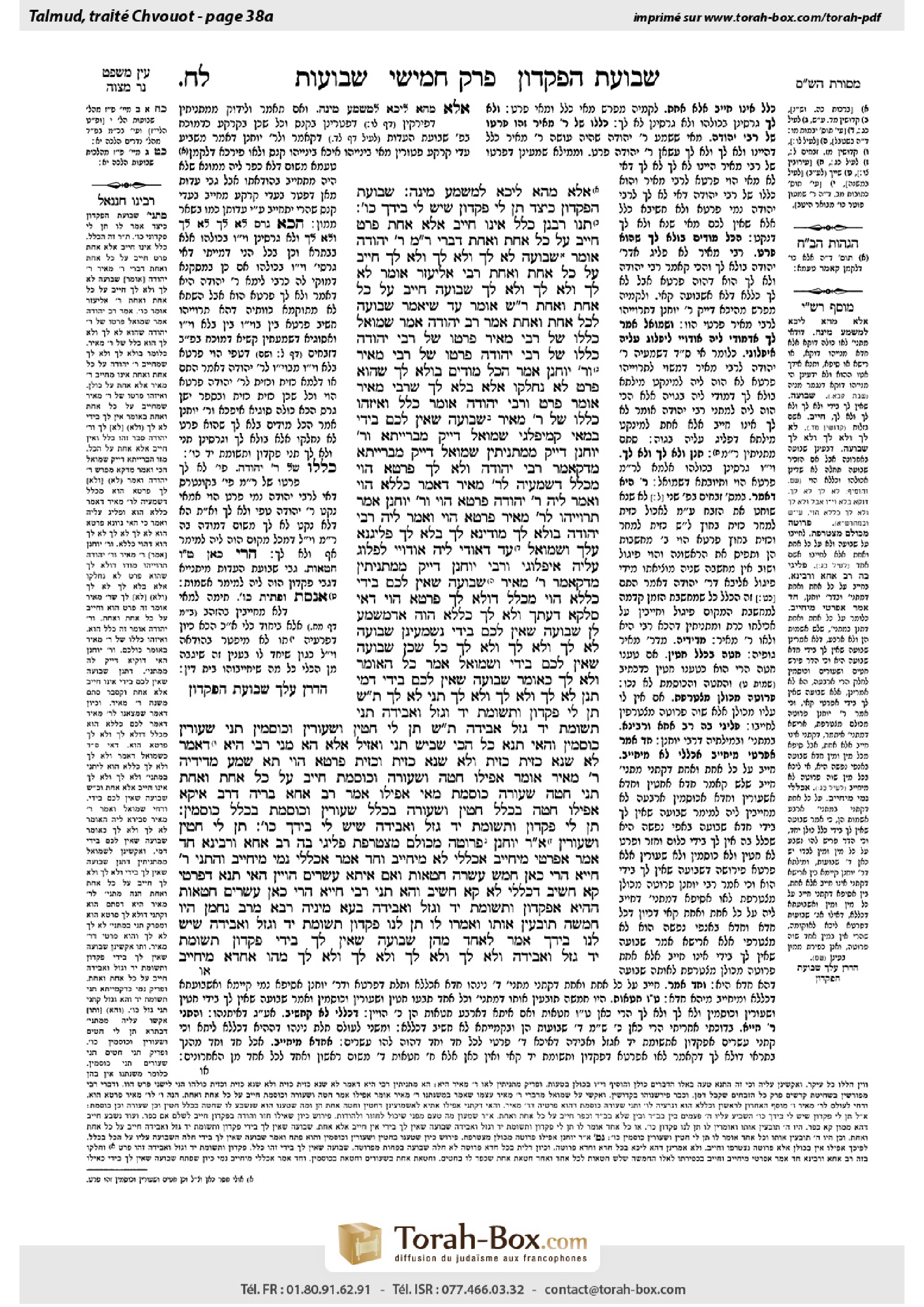
Shevuot 38a: Talmud study for Daf Yomi
Daf Yomi is the daily study of one Talmud folio. Explore 37 tractates with scans, Hebrew text, Sefaria English and AI-generated French translations where annotated.
Passage selection and English or AI-generated French translation are available where the scan has annotations. Daf Study is independent of Torah-Box and Sefaria.
Browse Shevuot · שבועות · All tractatesShevuot 38a text and translations
This page of Shevuot includes the Aramaic text, an English translation and an AI-generated French translation, alongside the scan above.
שבועות ל״ח א · Aramaic and Hebrew text
אֶלָּא מֵהָא לֵיכָּא לְמִשְׁמַע מִינַּהּ.
שְׁבוּעַת הַפִּקָּדוֹן כֵּיצַד? ״תֵּן לִי פִּקָּדוֹן שֶׁיֵּשׁ לִי בְּיָדְךָ״ כּוּ׳. תָּנוּ רַבָּנַן: כְּלָל – אֵינוֹ חַיָּיב אֶלָּא אַחַת. פְּרָט – חַיָּיב עַל כׇּל אַחַת וְאַחַת. דִּבְרֵי רַבִּי מֵאִיר. רַבִּי יְהוּדָה אוֹמֵר: ״שְׁבוּעָה לֹא לְךָ וְלֹא לְךָ וְלֹא לָךְ״ – חַיָּיב עַל כׇּל אַחַת וְאַחַת.
רַבִּי אֱלִיעֶזֶר אוֹמֵר: ״לֹא לְךָ וְלֹא לְךָ וְלֹא לְךָ, שְׁבוּעָה״ – חַיָּיב עַל כׇּל אַחַת וְאַחַת. רַבִּי שִׁמְעוֹן אוֹמֵר: עַד שֶׁיֹּאמַר שְׁבוּעָה לְכׇל אַחַת וְאַחַת.
אָמַר רַב יְהוּדָה אָמַר שְׁמוּאֵל: כְּלָלוֹ שֶׁל רַבִּי מֵאִיר – פְּרָטוֹ שֶׁל רַבִּי יְהוּדָה; כְּלָלוֹ שֶׁל רַבִּי יְהוּדָה – פְּרָטוֹ שֶׁל רַבִּי מֵאִיר.
וְרַבִּי יוֹחָנָן אָמַר: הַכֹּל מוֹדִים בִּ״וְלֹא לָךְ״ – שֶׁהוּא פְּרָט; לֹא נֶחְלְקוּ אֶלָּא בְּ״לֹא לָךְ״ – שֶׁרַבִּי מֵאִיר אוֹמֵר פְּרָט, וְרַבִּי יְהוּדָה אוֹמֵר כְּלָל. וְאֵיזֶהוּ כְּלָלוֹ שֶׁל רַבִּי מֵאִיר? ״שְׁבוּעָה שֶׁאֵין לָכֶם בְּיָדִי״.
בְּמַאי קָמִיפַּלְגִי? שְׁמוּאֵל דָּיֵיק מִבָּרַיְיתָא, וְרַבִּי יוֹחָנָן דָּיֵיק מִמַּתְנִיתִין. שְׁמוּאֵל דָּיֵיק מִבָּרַיְיתָא: מִדְּקָאָמַר רַבִּי יְהוּדָה ״וְלֹא לָךְ״ פְּרָטָא הָוֵי – מִכְּלָל דְּשַׁמְעֵיהּ לְרַבִּי מֵאִיר דְּאָמַר כְּלָלָא הָוֵי, וַאֲמַר לֵיהּ רַבִּי יְהוּדָה: פְּרָטָא הָוֵי.
וְרַבִּי יוֹחָנָן אָמַר: תַּרְוַיְיהוּ לְרַבִּי מֵאִיר פְּרָטָא הָוֵי; וַאֲמַר לֵיהּ רַבִּי יְהוּדָה: בִּ״וְלֹא לָךְ״ מוֹדֵינָא לָךְ, בְּ״לֹא לָךְ״ פְּלִיגְנָא עֲלָךְ. וּשְׁמוּאֵל – עַד דְּאוֹדִי לֵיהּ אוֹדוֹיֵי, לִפְלוֹג עֲלֵיהּ אִיפְּלוֹגֵי!
וְרַבִּי יוֹחָנָן דָּיֵיק מִמַּתְנִיתִין – מִדְּקָאָמַר רַבִּי מֵאִיר: ״שְׁבוּעָה שֶׁאֵין לָכֶם בְּיָדִי״ – כְּלָלָא הָוֵי, מִכְּלָל דִּ״וְלֹא לָךְ״ – פְּרָטָא הָוֵי; דְּאִי סָלְקָא דַעְתָּךְ ״וְלֹא לָךְ״ כְּלָלָא הָוֵי – אַדְּמַשְׁמַע לַן ״שְׁבוּעָה שֶׁאֵין לָכֶם בְּיָדִי״, נַשְׁמְעִינַן ״שְׁבוּעָה לֹא לָךְ וְלֹא לָךְ וְלֹא לָךְ״, כׇּל שֶׁכֵּן ״שְׁבוּעָה שֶׁאֵין לָכֶם בְּיָדִי״!
וּשְׁמוּאֵל אָמַר: כׇּל הָאוֹמֵר ״וְלֹא לָךְ״, כְּאוֹמֵר ״שְׁבוּעָה שֶׁאֵין לָכֶם בְּיָדִי״ דָּמֵי.
תְּנַן: ״לֹא לָךְ וְלֹא לָךְ וְלֹא לָךְ״! תְּנִי: ״לֹא לָךְ״.
תָּא שְׁמַע: ״תֵּן לִי פִּקָּדוֹן וּתְשׂוּמֶת יָד וְגָזֵל וַאֲבֵידָה״! תְּנִי: ״תְּשׂוּמֶת יָד גָּזֵל אֲבֵידָה״.
תָּא שְׁמַע: ״תֵּן לִי חִטִּין וּשְׂעוֹרִין וְכוּסְּמִין״! תְּנִי: ״שְׂעוֹרִין כּוּסְּמִין״.
וְהַאי תַּנָּא כֹּל הָכִי שָׁבֵישׁ תָּנֵי וְאָזֵיל?! אֶלָּא הָא מַנִּי – רַבִּי הִיא, דְּאָמַר: לָא שְׁנָא ״כְּזַיִת, כְּזַיִת״, וְלָא שְׁנָא ״כְּזַיִת וּכְזַיִת״ – פְּרָטָא הָוֵי.
תָּא שְׁמַע מִדִּידֵיהּ: רַבִּי מֵאִיר אוֹמֵר, אֲפִילּוּ ״חִטָּה וּשְׂעוֹרָה וְכוּסֶּמֶת״ – חַיָּיב עַל כׇּל אַחַת וְאַחַת. תְּנִי: ״חִטָּה שְׂעוֹרָה כּוּסֶּמֶת״.
מַאי ״אֲפִילּוּ״? אָמַר רַב אַחָא בְּרֵיהּ דְּרַב אִיקָא: אֲפִילּוּ חִטָּה בִּכְלַל חִטִּין, וּשְׂעוֹרָה בִּכְלַל שְׂעוֹרִין, וְכוּסֶּמֶת בִּכְלַל כּוּסְּמִין.
״תֵּן לִי פִּקָּדוֹן וּתְשׂוּמֶת יָד גָּזֵל וַאֲבֵידָה שֶׁיֵּשׁ לִי בְּיָדְךָ״ כּוּ׳. ״תֵּן לִי חִטִּין וּשְׂעוֹרִין״ – אָמַר רַבִּי יוֹחָנָן: פְּרוּטָה מִכּוּלָּם מִצְטָרֶפֶת.
פְּלִיגִי בַּהּ רַב אַחָא וְרָבִינָא – חַד אָמַר: אַפְּרָטֵי מִיחַיַּיב, אַכְּלָלֵי לָא מִיחַיַּיב; וְחַד אָמַר: אַכְּלָלֵי נָמֵי מִיחַיַּיב.
וְהָתָנֵי רַבִּי חִיָּיא: הֲרֵי כָּאן חֲמֵשׁ עֶשְׂרֵה חַטָּאוֹת; וְאִם אִיתָא – עֶשְׂרִים הָוְיָין! הַאי תַּנָּא – דִּפְרָטֵי קָא חָשֵׁיב, דִּכְלָלֵי לָא קָא חָשֵׁיב.
וְהָא תָּנֵי רַבִּי חִיָּיא: ״הֲרֵי כָּאן עֶשְׂרִים חַטָּאוֹת״! הָהִיא אַפִּקָּדוֹן וּתְשׂוּמֶת יָד וְגָזֵל וַאֲבֵידָה.
בְּעָא מִינֵּיהּ רָבָא מֵרַב נַחְמָן: הָיוּ חֲמִשָּׁה תּוֹבְעִין אוֹתוֹ, וְאָמְרוּ לוֹ: ״תֵּן לָנוּ פִּקָּדוֹן תְּשׂוּמֶת יָד וְגָזֵל וַאֲבֵידָה שֶׁיֵּשׁ לָנוּ בְּיָדְךָ״; אָמַר לְאֶחָד מֵהֶן: ״שְׁבוּעָה שֶׁאֵין לְךָ בְּיָדִי פִּקָּדוֹן תְּשׂוּמֶת יָד גָּזֵל וַאֲבֵידָה, וְלֹא לָךְ וְלֹא לָךְ וְלֹא לָךְ וְלֹא לָךְ״ – מַהוּ? אַחֲדָא מִיחַיַּיב,
Shevuot 38a · English translation
Rather, no inference is to be learned from the mishna.
§ The mishna teaches: What is the case of an oath on a deposit? It is where the claimant said to the defendant: Give me my deposit, which is in your possession, and the defendant replied: On my oath nothing of yours is in my possession, or the defendant said to him: Nothing of yours is in my possession; the claimant responded: I administer an oath to you, and the defendant said: Amen. In either case this defendant is liable to bring a guilt-offering if he lied. The mishna then discusses a case where five people sued him and he took an oath denying all of their claims. With regard to this case, the Sages taught in a baraita: If he included all the denials in one oath, he is liable for only one false oath; if he specified them, he is liable for his oath concerning each and every claim; this is the statement of Rabbi Meir. Rabbi Yehuda says that if he said: On my oath nothing of yours is in my possession, and nothing of yours, and nothing of yours, he is liable for his oath concerning each and every claim.
The baraita continues: Rabbi Eliezer says that only if he said: Nothing of yours is in my possession, and nothing of yours, and nothing of yours, on my oath, i.e., he said the word oath at the end, is he liable for his oath concerning each and every claim. Rabbi Shimon says: He is not liable for his oath concerning each individual claim unless he says: On my oath, to each and every claimant.
Shmuel and Rabbi Yoḥanan disagree with regard to the dispute between Rabbi Meir and Rabbi Yehuda: Rav Yehuda says that Shmuel says: The phrasing where one uses the conjunction: And, between denials is considered by Rabbi Meir to be a general denial and is considered by Rabbi Yehuda to be a specific denial; and the phrasing where one refrains from using the conjunction: And, is considered by Rabbi Yehuda to be a general denial and is considered by Rabbi Meir to be a specific denial.
And Rabbi Yoḥanan says: All concede in a case where the defendant says: And nothing of yours, that it is considered specific and that he is liable for his oath concerning each claim, even Rabbi Meir. They disagree only with regard to a case where the defendant said: Nothing of yours, without the conjunctive: And. As Rabbi Meir says: It is considered specific, and Rabbi Yehuda says: It is considered general. And what is the case of a general denial according to Rabbi Meir, where one is liable for only one oath? It is the case where the defendant says, in the plural: On my oath nothing of yours is in my possession.
The Gemara asks: With regard to what do they disagree that they explain the opinion of Rabbi Meir differently? The Gemara responds: Shmuel inferred his explanation from the baraita, and Rabbi Yoḥanan inferred his explanation from the mishna. The Gemara explains: Shmuel inferred his explanation from the baraita as follows: From the fact that Rabbi Yehuda says that the phrase: And nothing of yours, is considered a specific denial, for which one is liable for his oath concerning each and every claim, one may conclude by inference that Rabbi Yehuda understood that Rabbi Meir said that it is considered a general denial, and therefore, Rabbi Yehuda disagreed and said to him: No, it is considered a specific denial.
And Rabbi Yoḥanan says in response to this inference that the baraita can be explained differently: Both phrases: Nothing of yours, and: And nothing of yours, are deemed specific denials by Rabbi Meir; and Rabbi Yehuda said to him: With regard to: And nothing of yours, I concede to you that it is considered specific. But with regard to: Nothing of yours, I disagree with you and consider it a general denial. And Shmuel would respond: If that is so, then why does Rabbi Yehuda state in the baraita the instance in which he concedes to Rabbi Meir? Instead of conceding, let him disagree and state the instance in which they differ.
The Gemara proceeds to explain the opinion of Rabbi Yoḥanan: And Rabbi Yoḥanan inferred his explanation from the mishna as follows: From the fact that Rabbi Meir, who is the tanna associated with unattributed statements in the Mishna, says: If he addressed all of the claimants and said: On my oath nothing of yours is in my possession, it is deemed a general denial, one may conclude by inference that a denial phrased: And nothing of yours, is deemed specific. As if it would enter your mind that Rabbi Meir also deems: And nothing of yours, to be a general denial, then instead of teaching us that when one states in the plural: On my oath nothing of yours is in my possession, it is deemed general, let him teach us that when one states: On my oath nothing of yours is in my possession, and nothing of yours, and nothing of yours, it is general, and all the more so it would be clear that when one states in the plural: On my oath nothing of yours is in my possession, it is considered general.
And Shmuel says that one may interpret the statement of Rabbi Meir as follows: Anyone who says: And nothing of yours, is considered as though he says in the plural: On my oath nothing of yours is in my possession.
The Gemara attempts to bring a proof for the opinion of Rabbi Yoḥanan: We learned in the mishna that if the defendant said: On my oath nothing of yours is in my possession, and nothing of yours, and nothing of yours, he is liable for his oath concerning each and every claim that he falsely denied. Evidently, Rabbi Meir deems: And nothing of yours, to be specific. The Gemara rejects the proof: Emend the language of the mishna and teach: Nothing of yours, nothing of yours, nothing of yours.
The Gemara suggests: Come and hear an additional proof from that which is taught in the mishna: In a case where the claimant says: Give me back my deposit, and pledge, and stolen item, and lost item that are in your possession, and the defendant responds: On my oath I do not have in my possession your deposit, or pledge, or stolen item, or lost item, he is liable for his oath concerning each and every claim. Evidently, by using the conjunction: Or, Rabbi Meir deems the denials specific, counter to the explanation of Shmuel. The Gemara rejects the proof: Emend the language of the mishna and teach: On my oath you do not have a deposit, a pledge, a stolen item, a lost item, in my possession.
The Gemara suggests: Come and hear another proof from the mishna: In a case where the claimant said: Give me back my wheat, and barley, and spelt that are in your possession, if the defendant responds: On my oath nothing of yours is in my possession, he is liable for only one false oath. But if he responds: On my oath I do not have in my possession your wheat, or barley, or spelt, he is liable for his oath concerning each and every claim. The mishna is therefore counter to the explanation of Shmuel. The Gemara rejects the proof: Again, emend the language of the mishna and teach: Wheat, barley, spelt, without the conjunction: Or.
The Gemara asks: But could it be that this tanna errs so much as he teaches the mishna? The Gemara offers an alternative explanation: According to Shmuel, the mishna is not in accordance with the opinion of Rabbi Meir. Rather, in accordance with whose opinion is this mishna? It is in accordance with the opinion of Rabbi Yehuda HaNasi, who says: There is no difference if one says: An olive-bulk an olive-bulk, and there is no difference if one says: An olive-bulk and an olive-bulk; both are considered specific formulations.
The Gemara suggests: Come and hear a proof from Rabbi Meir’s own statement in the mishna: Rabbi Meir says: Even if the defendant says: On my oath I do not have in my possession your grain of wheat, or grain of barley, or grain of spelt, he is liable for his oath concerning each and every claim. Clearly, the conjunction: Or, renders the denial specific according to Rabbi Meir, counter to the explanation of Shmuel. The Gemara rejects the proof: Emend the language of the mishna and teach: On my oath I do not have in my possession a grain of wheat, a grain of barley, a grain of spelt of yours.
The Gemara explains: What novelty is there in a case where one takes an oath in this manner, that Rabbi Meir says: Even? Rav Aḥa, son of Rav Ika, said: Even the singular form for wheat includes much wheat, and the singular form for barley includes much barley, and the singular form for spelt includes much spelt, i.e., although the defendant refers to the grains in the singular, his denial is referring to all wheat, all barley, and all spelt.
§ The mishna teaches: Give me back my deposit, and pledge, stolen item, and lost item that are in your possession, etc. If the claimant said: Give me back my wheat and barley, and spelt, and the defendant responds: On my oath I do not have in my possession your wheat, or barley, or spelt, he is liable for his oath concerning each and every claim. Rabbi Yoḥanan says: If all of the wheat, barley, and spelt were collectively worth at least one peruta, then even if each type of grain was worth less than one peruta, their total value combines to render him liable.
Rav Aḥa and Ravina disagree with regard to the ruling of the mishna. One says that when the mishna teaches that one is liable for his oath concerning each and every claim, it means that he is liable for the three specific denials of wheat, barley, and spelt, and he must bring three separate offerings; but he is not liable for the general oath taken at the beginning of his denial, i.e., when he said: On my oath I do not have in my possession. Accordingly, the statement of Rabbi Yoḥanan was said with regard to the previous case in the mishna, where the defendant said: On my oath I do not have in my possession. And one says that he is liable also for the general oath taken at the beginning of his denial, so that the defendant is liable to bring a total of four offerings. Accordingly, even if the grains were worth only one peruta collectively and the defendant is not liable for any of the specific oaths, the defendant remains liable to bring an offering for the general oath according to Rabbi Yoḥanan.
The Gemara questions the second opinion: But didn’t Rabbi Ḥiyya teach in a baraita: If five people claimed from one defendant wheat, barley, and spelt, and the defendant took an oath denying each claim of each claimant, there are then fifteen sin-offerings here that the defendant is liable to bring? And if it is so that the defendant is liable for the general oath as well, there would be a total of twenty sin-offerings that he is liable to bring. The Gemara responds: That tanna calculated the defendant’s liability for the specific oaths; he did not calculate the defendant’s liability for the general oaths.
The Gemara now questions the first opinion: But didn’t Rabbi Ḥiyya teach in a different baraita: There are twenty sin-offerings here? Evidently, Rabbi Ḥiyya does calculate the general oaths. The Gemara responds: That baraita does not count the general oaths either; rather, it is referring to a different case entirely, where each of the five claimants claimed from the defendant a deposit and a pledge and a stolen item and a lost item.
Rava raised a dilemma before Rav Naḥman: In a case where five people were suing another and they said to him: Give us back our deposit, pledge, and stolen item, and lost item that are in your possession, and the defendant said to one of them: On my oath your deposit, pledge, stolen item, and lost item are not in my possession, and neither are yours, and neither are yours, and neither are yours, and neither are yours, what is the halakha? Is he liable for only one oath for each of the four claimants to whom he said: And neither are yours, since these are considered general oaths?
Shevuot 38a · Traduction française (IA)
Au contraire, on ne peut tirer aucune déduction de la Michna.
§ La Michna enseigne : Quel est le cas d’un serment portant sur un dépôt ? C’est lorsque le demandeur dit au défendeur : « Rends-moi mon dépôt, qui est en ta possession », et que le défendeur répond : « Par serment, je n’ai rien qui t’appartienne en ma possession », ou qu’il lui dit : « Je n’ai rien qui t’appartienne en ma possession », puis que le demandeur lui fait prêter serment et que le défendeur répond : « Amen ». Dans les deux cas, si ce défendeur a menti, il est tenu d’apporter un sacrifice de culpabilité. La Michna examine ensuite le cas où cinq personnes le poursuivent en justice et où il prête serment en niant toutes leurs réclamations. À propos de ce cas, les Sages ont enseigné dans une baraïta : S’il a réuni toutes les dénégations en un seul serment, il n’est passible que d’un seul serment mensonger ; s’il les a énoncées séparément, il est passible d’un serment pour chacune des réclamations ; telle est l’opinion de Rabbi Meïr. Rabbi Yehouda dit que s’il a dit : « Par serment, je n’ai rien qui t’appartienne en ma possession », puis « et rien qui t’appartienne », puis « et rien qui t’appartienne », il est passible d’un serment pour chacune des réclamations.
La baraïta poursuit : Rabbi Eliezer dit qu’il n’est passible d’un serment pour chacune des réclamations que s’il a dit : « Rien qui t’appartienne en ma possession, et rien qui t’appartienne, et rien qui t’appartienne, par serment », c’est-à-dire s’il a prononcé le mot « serment » à la fin. Rabbi Shimon dit : Il n’est passible d’un serment pour chacune des réclamations que s’il dit à chaque demandeur : « Par serment. »
Shmuel et Rabbi Yoḥanan divergent au sujet du désaccord entre Rabbi Meïr et Rabbi Yehouda. Rav Yehouda rapporte au nom de Shmuel : Selon Rabbi Meïr, la formulation où l’on emploie la conjonction « et » entre les dénégations est considérée comme une dénégation générale, tandis que selon Rabbi Yehouda, elle est considérée comme une dénégation particulière ; inversement, la formulation où l’on s’abstient d’employer la conjonction « et » est considérée comme une dénégation générale selon Rabbi Yehouda et comme une dénégation particulière selon Rabbi Meïr.
Et Rabbi Yoḥanan dit : Tous reconnaissent que si le défendeur dit : « Et rien qui t’appartienne », cette formulation est considérée comme particulière et qu’il est passible d’un serment pour chaque réclamation, même selon Rabbi Meïr. Ils ne divergent que dans le cas où le défendeur dit : « Rien qui t’appartienne », sans la conjonction « et ». Rabbi Meïr dit que cette formulation est considérée comme particulière, tandis que Rabbi Yehouda dit qu’elle est considérée comme générale. Et quel est, selon Rabbi Meïr, le cas d’une dénégation générale, pour laquelle on n’est passible que d’un seul serment ? C’est le cas où le défendeur dit, au pluriel : « Par serment, je n’ai rien qui vous appartienne en ma possession. »
La Guemara demande : Sur quoi portent leurs divergences, pour qu’ils interprètent différemment l’opinion de Rabbi Meïr ? La Guemara répond : Shmuel a déduit son explication de la baraïta, tandis que Rabbi Yoḥanan l’a déduite de la Michna. La Guemara explique : Shmuel a déduit son explication de la baraïta de la manière suivante : Du fait que Rabbi Yehouda dit que l’expression « et rien qui t’appartienne » est considérée comme une dénégation particulière, pour laquelle on est passible d’un serment pour chacune des réclamations, on peut déduire que Rabbi Yehouda comprenait que Rabbi Meïr avait dit qu’elle était considérée comme une dénégation générale. Rabbi Yehouda lui a donc répondu : « Non, elle est considérée comme une dénégation particulière. »
Rabbi Yoḥanan répond à cette déduction que la baraïta peut s’expliquer autrement : Selon Rabbi Meïr, les deux expressions, « rien qui t’appartienne » et « et rien qui t’appartienne », sont considérées comme des dénégations particulières ; et Rabbi Yehouda lui dit : « Pour ce qui est de “et rien qui t’appartienne”, je suis d’accord avec toi : cette formulation est considérée comme particulière. Mais pour “rien qui t’appartienne”, je ne suis pas d’accord avec toi et je la considère comme une dénégation générale. » Et Shmuel répondrait : Si c’est ainsi, pourquoi Rabbi Yehouda énonce-t-il dans la baraïta le cas où il est d’accord avec Rabbi Meïr ? Au lieu de concéder ce point, qu’il conteste et expose le cas où ils divergent.
La Guemara poursuit en expliquant l’opinion de Rabbi Yoḥanan : Celui-ci a déduit son explication de la Michna de la manière suivante : Du fait que Rabbi Meïr, le tanna auquel sont attribuées les opinions anonymes de la Michna, dit que si le défendeur s’est adressé à tous les demandeurs et a dit : « Par serment, je n’ai rien qui vous appartienne en ma possession », cela est considéré comme une dénégation générale, on peut déduire que la dénégation formulée « et rien qui t’appartienne » est considérée comme particulière. En effet, si l’on pouvait penser que Rabbi Meïr considère également « et rien qui t’appartienne » comme une dénégation générale, alors, au lieu de nous enseigner que lorsqu’on dit au pluriel : « Par serment, je n’ai rien qui vous appartienne en ma possession », cela est considéré comme général, qu’il nous enseigne que lorsqu’on dit : « Par serment, je n’ai rien qui t’appartienne en ma possession, et rien qui t’appartienne, et rien qui t’appartienne », cela est général ; à plus forte raison serait-il alors évident que lorsqu’on dit au pluriel : « Par serment, je n’ai rien qui vous appartienne en ma possession », cela est considéré comme général.
Et Shmuel dit qu’on peut interpréter ainsi la déclaration de Rabbi Meïr : Quiconque dit « et rien qui t’appartienne » est considéré comme s’il disait au pluriel : « Par serment, je n’ai rien qui vous appartienne en ma possession. »
La Guemara tente d’apporter une preuve à l’opinion de Rabbi Yoḥanan : Nous avons appris dans la Michna que si le défendeur a dit : « Par serment, je n’ai rien qui t’appartienne en ma possession, et rien qui t’appartienne, et rien qui t’appartienne », il est passible d’un serment pour chacune des réclamations qu’il a faussement niées. De toute évidence, Rabbi Meïr considère « et rien qui t’appartienne » comme une formulation particulière. La Guemara rejette cette preuve : corrige la formulation de la Michna et enseigne : « Rien qui t’appartienne, rien qui t’appartienne, rien qui t’appartienne. »
La Guemara propose : Viens et entends une preuve supplémentaire tirée de ce qui est enseigné dans la Michna : Dans le cas où le demandeur dit : « Rends-moi mon dépôt, mon objet confié en gage, mon objet volé et mon objet perdu qui sont en ta possession », et où le défendeur répond : « Par serment, je n’ai pas en ma possession ton dépôt, ton objet confié en gage, ton objet volé ni ton objet perdu », il est passible d’un serment pour chacune des réclamations. De toute évidence, en employant la conjonction « ou », Rabbi Meïr considère les dénégations comme particulières, contrairement à l’explication de Shmuel. La Guemara rejette cette preuve : corrige la formulation de la Michna et enseigne : « Par serment, tu n’as pas en ma possession de dépôt, d’objet confié en gage, d’objet volé ni d’objet perdu. »
La Guemara propose : Viens et entends une autre preuve tirée de la Michna : Dans le cas où le demandeur dit : « Rends-moi mon blé, mon orge et mon épeautre qui sont en ta possession », si le défendeur répond : « Par serment, je n’ai rien qui t’appartienne en ma possession », il n’est passible que d’un seul serment mensonger. Mais s’il répond : « Par serment, je n’ai pas en ma possession ton blé, ou ton orge, ou ton épeautre », il est passible d’un serment pour chacune des réclamations. La Michna contredit donc l’explication de Shmuel. La Guemara rejette cette preuve : là encore, corrige la formulation de la Michna et enseigne : « Blé, orge, épeautre », sans la conjonction « ou ».
La Guemara demande : Se pourrait-il que ce tanna se trompe à ce point en enseignant la Michna ? La Guemara propose une autre explication : Selon Shmuel, la Michna ne suit pas l’opinion de Rabbi Meïr. Mais alors, de l’opinion de qui relève cette Michna ? Elle relève de l’opinion de Rabbi Yehouda HaNassi, qui dit : Il n’y a pas de différence entre dire « une olive de volume, une olive de volume » et dire « une olive de volume et une olive de volume » ; dans les deux cas, ces formulations sont considérées comme particulières.
La Guemara propose : Viens et entends une preuve tirée de la propre déclaration de Rabbi Meïr dans la Michna : Rabbi Meïr dit que même si le défendeur dit : « Par serment, je n’ai pas en ma possession ton grain de blé, ou ton grain d’orge, ou ton grain d’épeautre », il est passible d’un serment pour chacune des réclamations. De toute évidence, selon Rabbi Meïr, la conjonction « ou » rend la dénégation particulière, contrairement à l’explication de Shmuel. La Guemara rejette cette preuve : corrige la formulation de la Michna et enseigne : « Par serment, je n’ai pas en ma possession un grain de blé, un grain d’orge, un grain d’épeautre qui t’appartienne. »
La Guemara explique : Quelle nouveauté y a-t-il dans le cas où l’on prête serment de cette manière, pour que Rabbi Meïr dise « même si » ? Rav Aḥa, fils de Rav Ika, a dit : Même le singulier « un grain de blé » inclut une grande quantité de blé, le singulier « un grain d’orge » inclut une grande quantité d’orge, et le singulier « un grain d’épeautre » inclut une grande quantité d’épeautre ; c’est-à-dire que, bien que le défendeur parle des grains au singulier, sa dénégation porte sur tout le blé, toute l’orge et tout l’épeautre.
§ La Michna enseigne : « Rends-moi mon dépôt, mon objet confié en gage, mon objet volé et mon objet perdu qui sont en ta possession », etc. Si le demandeur a dit : « Rends-moi mon blé, mon orge et mon épeautre », et que le défendeur répond : « Par serment, je n’ai pas en ma possession ton blé, ou ton orge, ou ton épeautre », il est passible d’un serment pour chacune des réclamations. Rabbi Yoḥanan dit : Si l’ensemble du blé, de l’orge et de l’épeautre valait au moins une perouta, alors, même si chaque type de grain valait moins d’une perouta, leur valeur totale se cumule et le rend passible.
Rav Aḥa et Ravina divergent au sujet de la décision de la Michna. Selon l’un, lorsque la Michna enseigne qu’on est passible d’un serment pour chacune des réclamations, cela signifie qu’on est passible pour les trois dénégations particulières portant sur le blé, l’orge et l’épeautre, et qu’on doit apporter trois sacrifices distincts ; mais on n’est pas passible pour le serment général prononcé au début de sa dénégation, c’est-à-dire lorsqu’il a dit : « Par serment, je n’ai pas en ma possession. » Selon cette interprétation, la déclaration de Rabbi Yoḥanan porte sur le cas précédent de la Michna, où le défendeur a dit : « Par serment, je n’ai pas en ma possession. » Selon l’autre, on est également passible pour le serment général prononcé au début de sa dénégation, de sorte que le défendeur doit apporter en tout quatre sacrifices. Selon cette interprétation, même si les grains ne valaient ensemble qu’une perouta et que le défendeur n’est passible pour aucun des serments particuliers, il reste tenu d’apporter un sacrifice pour le serment général, selon Rabbi Yoḥanan.
La Guemara met en question la seconde opinion : Rabbi Ḥiyya n’a-t-il pas enseigné dans une baraïta que si cinq personnes réclament à un défendeur du blé, de l’orge et de l’épeautre, et que le défendeur prête serment en niant chacune des réclamations de chacun des demandeurs, il y a alors quinze sacrifices expiatoires que le défendeur est tenu d’apporter ? Or, s’il était passible également pour le serment général, il devrait apporter en tout vingt sacrifices expiatoires. La Guemara répond : ce tanna a calculé la responsabilité du défendeur pour les serments particuliers ; il n’a pas calculé sa responsabilité pour les serments généraux.
La Guemara met maintenant en question la première opinion : Rabbi Ḥiyya n’a-t-il pas enseigné dans une autre baraïta qu’il y a ici vingt sacrifices expiatoires ? De toute évidence, Rabbi Ḥiyya tient également compte des serments généraux. La Guemara répond : cette baraïta ne compte pas non plus les serments généraux ; elle se rapporte à un cas entièrement différent, où chacun des cinq demandeurs a réclamé au défendeur un dépôt, un objet confié en gage, un objet volé et un objet perdu.
Rava souleva un dilemme devant Rav Naḥman : Dans le cas où cinq personnes poursuivent quelqu’un en justice et lui disent : « Rends-nous notre dépôt, notre objet confié en gage, notre objet volé et notre objet perdu qui sont en ta possession », et où le défendeur dit à l’un d’eux : « Par serment, ton dépôt, ton objet confié en gage, ton objet volé et ton objet perdu ne sont pas en ma possession, et les tiens non plus, et les tiens non plus, et les tiens non plus, et les tiens non plus », quelle est la halakha ? Est-il passible d’un seul serment pour chacun des quatre demandeurs auxquels il a dit : « Les tiens non plus », puisque ces serments sont considérés comme généraux ?
Traduction française générée par IA à partir de l’édition anglaise de Sefaria. Vérifie toujours un passage avec le texte source.
Text from Sefaria: William Davidson Edition - Vocalized Aramaic (CC BY NC); William Davidson Edition - English (CC BY NC).