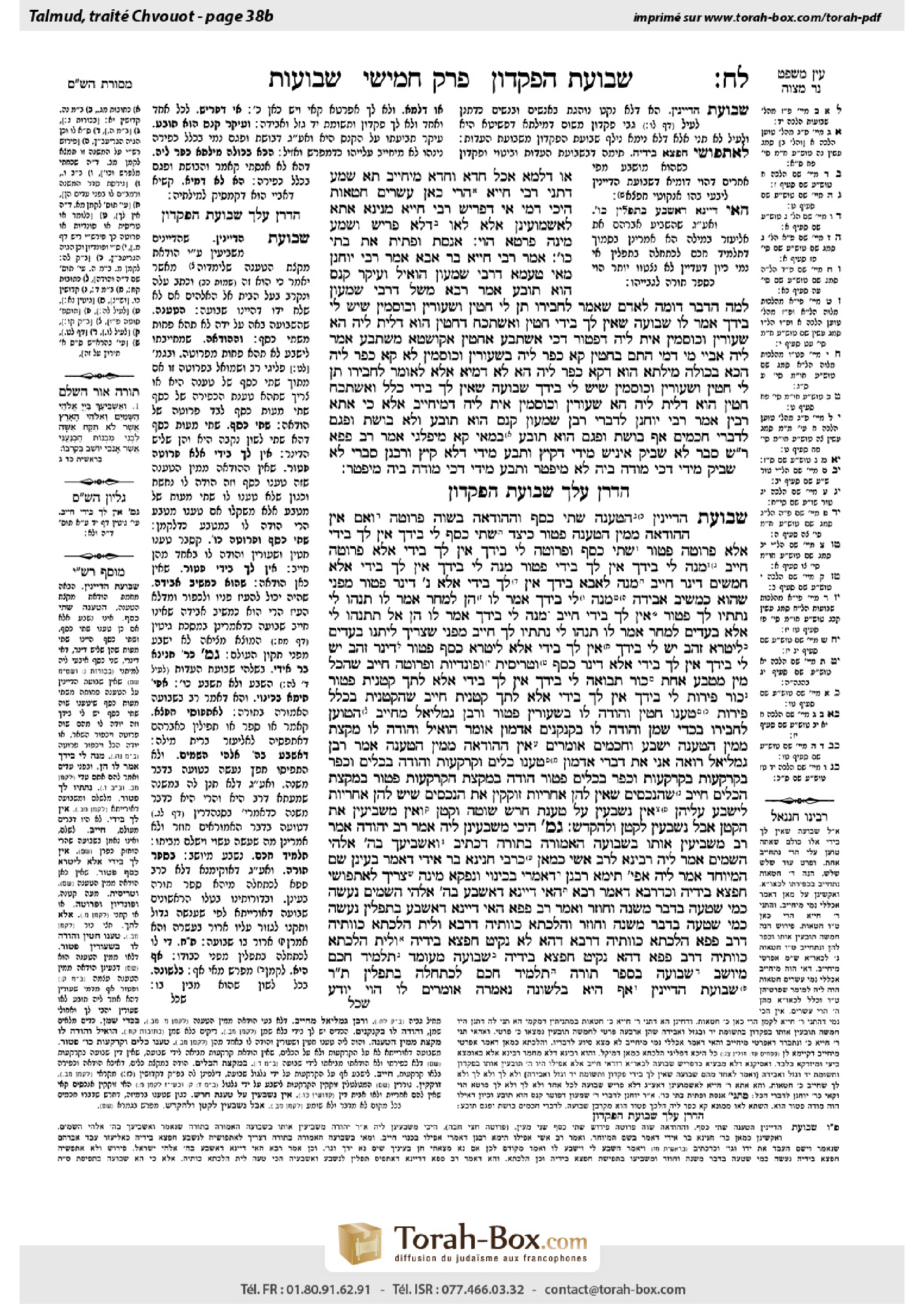
Shevuot 38b: Talmud study for Daf Yomi
Daf Yomi is the daily study of one Talmud folio. Explore 37 tractates with scans, Hebrew text, Sefaria English and AI-generated French translations where annotated.
Passage selection and English or AI-generated French translation are available where the scan has annotations. Daf Study is independent of Torah-Box and Sefaria.
Browse Shevuot · שבועות · All tractatesShevuot 38b text and translations
This page of Shevuot includes the Aramaic text, an English translation and an AI-generated French translation, alongside the scan above.
שבועות ל״ח ב · Aramaic and Hebrew text
אוֹ דִלְמָא אַכׇּל חֲדָא וַחֲדָא מִיחַיַּיב?
תָּא שְׁמַע, דְּתָנֵי רַבִּי חִיָּיא: הֲרֵי כָּאן עֶשְׂרִים חַטָּאוֹת. הֵיכִי דָמֵי? אִי דְּפָרֵישׁ – רַבִּי חִיָּיא מִנְיָנָא אֲתָא לְאַשְׁמוֹעִינַן? אֶלָּא לָאו דְּלָא פָּרֵישׁ – וּשְׁמַע מִינַּהּ פְּרָטָא הָוֵי?
אָנַסְתָּ וּפִתִּיתָ אֶת בִּתִּי כּוּ׳. אָמַר רַבִּי חִיָּיא בַּר אַבָּא, אָמַר רַבִּי יוֹחָנָן: מַאי טַעְמָא דְּרַבִּי שִׁמְעוֹן? הוֹאִיל וְעִיקַּר קְנָס הוּא תּוֹבֵעַ.
אָמַר רָבָא: מָשָׁל דְּרַבִּי שִׁמְעוֹן, לְמָה הַדָּבָר דּוֹמֶה? לְאָדָם שֶׁאָמַר לַחֲבֵירוֹ: ״תֵּן לִי חִטִּין וּשְׂעוֹרִין וְכוּסְּמִין שֶׁיֵּשׁ לִי בְּיָדְךָ״, אָמַר לוֹ: ״שְׁבוּעָה שֶׁאֵין לְךָ בְּיָדִי חִטִּין״; וְאִשְׁתְּכַח דְּחִטִּין הוּא דְּלֵית לֵיהּ, הָא שְׂעוֹרִין וְכוּסְּמִין אִית לֵיהּ – דְּפָטוּר; דְּכִי אִשְׁתְּבַע אַחִטִּין – אַקּוּשְׁטָא מִשְׁתְּבַע.
אֲמַר לֵיהּ אַבָּיֵי: מִי דָּמֵי?! הָתָם – בְּחִטִּין קָא כָפַר לֵיהּ, בִּשְׂעוֹרִין וְכוּסְּמִין לָא קָא כָפַר לֵיהּ. הָכָא – בְּכוּלַּהּ מִילְּתָא הוּא דְּקָא כָפַר לֵיהּ! הָא לָא דָּמְיָא אֶלָּא לְאוֹמֵר לַחֲבֵירוֹ: ״תֵּן לִי חִטִּין וּשְׂעוֹרִין וְכוּסְּמִין שֶׁיֵּשׁ לִי בְּיָדְךָ״, ״שְׁבוּעָה שֶׁאֵין לְךָ בְּיָדִי כְּלָל״; וְאִשְׁתְּכַח חִטִּין הוּא דְּלֵית לֵיהּ, הָא שְׂעוֹרִין וְכוּסְּמִין אִית לֵיהּ – דְּמִיחַיַּיב!
אֶלָּא כִּי אֲתָא רָבִין אָמַר רַבִּי יוֹחָנָן: לְדִבְרֵי רַבָּן שִׁמְעוֹן – קְנָס הוּא תּוֹבֵעַ, וְלֹא בּוֹשֶׁת וּפְגָם; לְדִבְרֵי חֲכָמִים – אַף בּוֹשֶׁת וּפְגָם הוּא תּוֹבֵעַ. בְּמַאי קָא מִיפַּלְגִי? אָמַר רַב פָּפָּא, רַבִּי שִׁמְעוֹן סָבַר: לָא שָׁבֵיק אִינִישׁ מִידֵּי דְּקִיץ, וְתָבַע מִידֵּי דְּלָא קִיץ. וְרַבָּנַן סָבְרִי: לָא שָׁבֵיק מִידֵּי דְּכִי מוֹדֵה בֵּיהּ לָא מִיפְּטַר, וְתָבַע מִידֵּי דְּכִי מוֹדֵה בֵּיהּ מִיפְּטַר.
הֲדַרַן עֲלָךְ שְׁבוּעַת הַפִּקָּדוֹן
מַתְנִי׳ שְׁבוּעַת הַדַּיָּינִין – הַטַּעֲנָה שְׁתֵּי כֶּסֶף, וְהַהוֹדָאָה בְּשָׁוֶה פְּרוּטָה. וְאִם אֵין הַהוֹדָאָה מִמִּין הַטַּעֲנָה – פָּטוּר.
כֵּיצַד? ״שְׁתֵּי כֶּסֶף לִי בְּיָדְךָ״, ״אֵין לְךָ בְּיָדִי אֶלָּא פְּרוּטָה״ – פָּטוּר. ״שְׁתֵּי כֶּסֶף וּפְרוּטָה לִי בְּיָדְךָ״, ״אֵין לְךָ בְּיָדִי אֶלָּא פְּרוּטָה״ – חַיָּיב.
״מָנֶה לִי בְּיָדְךָ״, ״אֵין לְךָ בְּיָדִי״ – פָּטוּר. ״מָנֶה לִי בְּיָדְךָ״, ״אֵין לְךָ בְּיָדִי אֶלָּא חֲמִשִּׁים דִּינָר״ – חַיָּיב.
״מָנָה לְאַבָּא בְּיָדְךָ״, ״אֵין לְךָ בְּיָדִי אֶלָּא חֲמִישִּׁים דִּינָר״ – פָּטוּר, מִפְּנֵי שֶׁהוּא כְּמֵשִׁיב אֲבֵידָה.
״מָנֶה לִי בְּיָדְךָ״, אָמַר לוֹ ״הֵן״; לְמָחָר אָמַר לוֹ: ״תְּנֵהוּ לִי״, ״נְתַתִּיו לָךְ״ – פָּטוּר. ״אֵין לְךָ בְּיָדִי״ – חַיָּיב.
״מָנֶה לִי בְּיָדְךָ״, אָמַר לוֹ ״הֵן״; ״אַל תִּתְּנֵהוּ לִי אֶלָּא בְּעֵדִים״, לְמָחָר אָמַר לוֹ ״תְּנֵהוּ לִי״, ״נְתַתִּיו לָךְ״ – חַיָּיב, מִפְּנֵי שֶׁצָּרִיךְ לִיתְּנוֹ בְּעֵדִים.
״לִיטְרָא זָהָב יֵשׁ לִי בְּיָדְךָ״, ״אֵין לְךָ בְּיָדִי אֶלָּא לִיטְרָא כֶּסֶף״ – פָּטוּר. ״דִּינַר זָהָב יֵשׁ לִי בְּיָדְךָ״, ״אֵין לְךָ בְּיָדִי אֶלָּא דִּינָר כֶּסֶף וּטְרֵיסִית וּפוּנְדָּיוֹת וּפְרוּטָה״ – חַיָּיב, שֶׁהַכֹּל מִין מַטְבֵּעַ אַחַת.
״כּוֹר תְּבוּאָה לִי בְּיָדְךָ״, ״אֵין לְךָ בְּיָדִי אֶלָּא לֶתֶךְ קִטְנִית״ – פָּטוּר. ״כּוֹר פֵּירוֹת לִי בְּיָדְךָ״, ״אֵין לְךָ בְּיָדִי אֶלָּא לֶתֶךְ קִטְנִית״ – חַיָּיב, שֶׁהַקִּטְנִית בִּכְלַל פֵּירוֹת.
טְעָנוֹ חִטִּין, וְהוֹדָה לוֹ בִּשְׂעוֹרִין – פָּטוּר. וְרַבָּן גַּמְלִיאֵל מְחַיֵּיב.
הַטּוֹעֵן לַחֲבֵירוֹ בְּכַדֵּי שֶׁמֶן, וְהוֹדָה לוֹ בְּקַנְקַנִּים – אַדְמוֹן אוֹמֵר: הוֹאִיל וְהוֹדָה לוֹ מִקְצָת מִמִּין הַטַּעֲנָה, יִשָּׁבַע. וַחֲכָמִים אוֹמְרִים: אֵין הַהוֹדָאָה מִמִּין הַטַּעֲנָה. אָמַר רַבָּן גַּמְלִיאֵל: רוֹאֶה אֲנִי אֶת דִּבְרֵי אַדְמוֹן.
טְעָנוֹ כֵּלִים וְקַרְקָעוֹת; וְהוֹדָה בַּכֵּלִים וְכָפַר בַּקַּרְקָעוֹת, בַּקַּרְקָעוֹת וְכָפַר בַּכֵּלִים – פָּטוּר. הוֹדָה בְּמִקְצָת הַקַּרְקָעוֹת – פָּטוּר. בְּמִקְצָת הַכֵּלִים – חַיָּיב, שֶׁהַנְּכָסִים שֶׁאֵין לָהֶן אַחְרָיוּת זוֹקְקִין אֶת הַנְּכָסִים שֶׁיֵּשׁ לָהֶן אַחְרָיוּת לִישָּׁבַע עֲלֵיהֶן.
אֵין נִשְׁבָּעִין עַל טַעֲנַת חֵרֵשׁ שׁוֹטֶה וְקָטָן, וְאֵין מַשְׁבִּיעִין אֶת הַקָּטָן; אֲבָל נִשְׁבָּעִין לַקָּטָן וְלַהֶקְדֵּשׁ.
גְּמָ׳ הֵיכִי מַשְׁבְּעִינַן לֵיהּ? אָמַר רַב יְהוּדָה אָמַר רַב: מַשְׁבִּיעִין אוֹתוֹ בִּשְׁבוּעָה הָאֲמוּרָה בְּתוֹרָה, דִּכְתִיב: ״וְאַשְׁבִּיעֲךָ בַּה׳ אֱלֹהֵי הַשָּׁמַיִם״.
אֲמַר לֵיהּ רָבִינָא לְרַב אָשֵׁי: כְּמַאן – כְּרַבִּי חֲנִינָא בַּר אִידִי, דְּאָמַר: בָּעֵינַן שֵׁם הַמְיוּחָד?
אֲמַר לֵיהּ: אֲפִילּוּ תֵּימָא רַבָּנַן, דְּאָמְרִי בְּכִינּוּי; וְנָפְקָא מִינַּהּ צְרִיךְ לְאַתְפּוֹשֵׂי חֶפְצָא בִּידֵיהּ.
וְכִדְרָבָא – דְּאָמַר רָבָא: הַאי דַּיָּינָא דְּאַשְׁבַּע ״בַּה׳ אֱלֹהֵי הַשָּׁמַיִם״ – נַעֲשָׂה כְּמִי שֶׁטָּעָה בִּדְבַר מִשְׁנָה, וְחוֹזֵר. וְאָמַר רַב פָּפָּא: הַאי דַּיָּינָא דְּאַשְׁבַּע בִּתְפִלִּין – נַעֲשָׂה כְּמִי שֶׁטָּעָה בִּדְבַר מִשְׁנָה, וְחוֹזֵר.
וְהִלְכְתָא כְּוָותֵיהּ דְּרָבָא, וְלֵית הִלְכְתָא כְּוָותֵיהּ דְּרַב פָּפָּא. הִלְכְתָא כְּוָותֵיהּ דְּרָבָא – דְּהָא לָא נָקֵיט חֶפְצָא בִּידֵיהּ; וְלֵית הִלְכְתָא כְּוָותֵיהּ דְּרַב פָּפָּא – דְּהָא נָקֵיט חֶפְצָא בִּידֵיהּ.
שְׁבוּעָה מְעוּמָּד; תַּלְמִיד חָכָם – מְיוּשָּׁב. שְׁבוּעָה בְּסֵפֶר תּוֹרָה; תַּלְמִיד חָכָם – לְכַתְּחִלָּה בִּתְפִלִּין.
תָּנוּ רַבָּנַן: שְׁבוּעַת הַדַּיָּינִין, אַף הִיא בִּלְשׁוֹנָהּ נֶאֶמְרָה.
אוֹמְרִים לוֹ: הֱוֵי יוֹדֵעַ,
Shevuot 38b · English translation
Or perhaps he is liable for his oath concerning each and every claim made by each claimant.
The Gemara suggests: Come and hear a proof from that which Rabbi Ḥiyya taught in a baraita: There are twenty sin-offerings here that the defendant must bring. The Gemara elaborates: What are the circumstances of the baraita? If the defendant specified each claim of each of the claimants in his oath, does Rabbi Ḥiyya come to teach us a number? Obviously, the defendant is liable to bring twenty offerings. Rather, is it not that the baraita is referring to a case where he did not specify an oath to each claimant, but he specified it to the first claimant and said: And neither are yours, to each of the remaining claimants? And therefore, conclude from the baraita that such a denial is considered specific.
§ The mishna teaches that if one accuses another: You raped or you seduced my daughter, and the other says: I did not rape and I did not seduce your daughter, to which the father replied: I administer an oath to you, and the defendant said: Amen, the defendant is liable to bring a guilt-offering if it is a false oath, and Rabbi Shimon deems him exempt from liability for a false oath on a deposit. The reason is that the payment for rape or seduction is a fine, and one does not pay a fine based on his own admission; therefore, he is also exempt from bringing a guilt-offering for having taken a false oath. The Rabbis hold that he is liable since he would have been liable to pay compensation for humiliation and degradation resulting from her being raped or seduced, which are monetary claims. Rabbi Ḥiyya bar Abba says that Rabbi Yoḥanan says: What is the reasoning of Rabbi Shimon? Rabbi Shimon holds that since the father is primarily claiming the fine and his claim to the other payments is secondary, the defendant is exempt from liability.
Rava says: To what case is this explanation of the opinion of Rabbi Shimon compared? It is compared to a case where a person said to another: Give me back my wheat and barley and spelt that are in your possession, and the other said to him: On my oath your wheat is not in my possession; and it was then discovered that it was only wheat that he did not have, but he did have the claimant’s barley and spelt. In that case, the halakha is that he is exempt from liability for an oath on a deposit, as when he took an oath with regard to the wheat, he took a truthful oath.
Abaye said to Rava: Are the two cases comparable? There, in the case of the grain, the defendant denies only the other’s claim of wheat, but he does not deny his claim of barley and spelt. Here, the defendant denies the entire matter, as he claims that he never raped or seduced the man’s daughter. Rather, this explanation is comparable only to a case where one said to another: Give me back my wheat and barley and spelt that are in your possession, and the defendant said to him: On my oath nothing of yours is in my possession at all, and it was then discovered that it was only wheat that he did not have, but he did have the claimant’s barley and spelt. In that case, the halakha is that he is liable for an oath on a deposit. This, then, cannot be the reasoning of Rabbi Shimon, as he exempts the defendant from liability.
Rather, when Ravin came from Eretz Yisrael to Babylonia, he said that Rabbi Yoḥanan said: According to the statement of Rabban Shimon, the father is claiming only the fine and not the compensation for humiliation and degradation resulting from his daughter’s having been raped or seduced. According to the statement of the Rabbis, he is also claiming payment for humiliation and degradation resulting from her having been raped or seduced. The Gemara asks: With regard to what principle do they disagree? Rav Pappa said: Rabbi Shimon holds: A person does not forgo a claim to something with a fixed value, such as a fine, and claim something whose value is not fixed and requires an appraisal, such as humiliation and degradation resulting from being raped or seduced. And the Rabbis hold that one does not forgo a claim to something that the defendant is not exempt from paying if he admits his guilt, and claim something that the defendant is exempt from paying if he admits his guilt, such as a fine.
MISHNA: By Torah law, the oath imposed by the judges upon one who admits to part of a claim is administered only when the claim is for the value of at least two silver ma’a, and the defendant’s admission is for the value of at least one peruta. And furthermore, if the admission is not of the same type as the claim, i.e., the defendant admitted to a debt that the claimant did not claim, the defendant is exempt from taking an oath.
How so? If the claimant said to the defendant: I have two silver ma’a in your possession, and the latter responded: You have only one peruta, a coin made from copper, in my possession, he is exempt from taking an oath (see 39b). But if the claimant said: I have two silver ma’a and one peruta in your possession, and the defendant responded: You have only one peruta in my possession, he is liable to take an oath.
If the claimant said: I have one hundred dinars in your possession, and the defendant responded: Nothing of yours is in my possession, he is exempt, as he denies the entire claim. But if the claimant said: I have one hundred dinars in your possession, and the defendant responded: You have only fifty dinars in my possession, he is liable to take an oath, as he admitted to a part of the claim.
If the claimant said: My late father had one hundred dinars in your possession, and I am now claiming them, and the defendant responded: You have only fifty dinars in my possession, he is exempt from taking an oath, as he is like one returning a lost item, since he could have easily denied the entire claim.
§ The mishna discusses other cases where the defendant denies an entire claim. In a case where one said to another: I have one hundred dinars in your possession, and the latter said to him: Yes, I acknowledge that claim; and the next day the claimant said to him: Give the money to me, and the defendant responded: I already gave it to you, he is exempt. But if he responded: Nothing of yours is in my possession, i.e., he denies that a debt ever existed, he is liable to pay, as he already admitted that he owed him the amount.
In a case where the claimant said: I have one hundred dinars in your possession, and the defendant said to him: Yes, to which the claimant responded: Give the money to me only in the presence of witnesses, then if the next day the claimant said to him: Give the money to me, and the defendant responded: I already gave it to you, he is liable to pay, as he is required to give it to him in the presence of witnesses, and he cannot prove that he did so.
§ The mishna resumes discussion of the oath imposed by the court in a case where the defendant admits to a part of a claim. If the claimant said: I have a litra, i.e., a specific weight, of gold in your possession, and the defendant responded: You have only a litra of silver in my possession, he is exempt from taking an oath, as his admission relates to a different item than that which the claim relates to. But if the claimant said: I have a gold dinar in your possession, and the defendant responded: You have only a silver dinar, or a tereisit, or a pundeyon, or a peruta in my possession, he is liable to take an oath, as they are all of one type; they are all coins. Since the claim concerns money, the difference between the different types of coins is disregarded, as the claim is essentially referring to the monetary value, not to a specific type of coin.
If the claimant said: I have a kor of grain in your possession, and the defendant responded: You have only a half-kor of legumes in my possession, he is exempt. But if the claimant said: I have a kor of produce in your possession, and the defendant responded: You have only a half-kor of legumes in my possession, he is liable, as legumes are included in produce.
If one claimed that another owes him wheat, and the defendant admitted to owing him barley, he is exempt; and Rabban Gamliel deems him liable to take an oath. According to Rabban Gamliel, one who admits to a part of the claim is liable to take an oath even if the admission is not of the same type as the claim.
With regard to one who claims that another owes him jugs of oil, and the latter then admitted that he owes him pitchers, i.e., the jugs themselves, but not the oil, Admon says: Since he admitted to him with regard to a part of the claim, and his admission was of the same type as the claim, i.e., the claim included both containers and oil and he admitted to owing him containers, he must take an oath. And the Rabbis say: The partial admission in this case is not of the same type as the claim, as he completely denied owing him oil. Rabban Gamliel said: I see the statement of Admon as correct.
If one claimed that another owes him vessels and land, and the defendant admitted to owing him vessels but denied the claim of land, or conversely, he admitted to owing him land but denied the claim of vessels, he is exempt from taking an oath, as oaths are not taken concerning claims involving land. If he admitted to part of the claim about the land, he is exempt. If he admitted to part of the claim about the vessels, he is liable to take an oath concerning the entire claim, as property that does not serve as a guarantee, i.e., movable property, binds the property that serves as a guarantee, i.e., the land, so that the oath about the movable property can be extended to require him to take an oath concerning the land as well.
One does not take an oath concerning the claim of a deaf-mute, an imbecile, or a minor. And the court does not administer an oath to a minor. But one does take an oath to a minor, or to a representative of the Temple treasury with regard to consecrated property.
GEMARA: How does the court administer an oath to someone who is liable to take an oath? Rav Yehuda says that Rav says: The court administers to him the oath stated in the Torah, as it is written in Abraham’s instruction to his servant: “And I will make you swear by the Lord, the God of heaven” (Genesis 24:3).
Ravina said to Rav Ashi: In accordance with whose opinion is Rav’s statement? Is it in accordance with the opinion of Rabbi Ḥanina bar Idi, who says that when one is liable to take an oath, we require him to take it using the ineffable name of God?
Rav Ashi said to him: You may even say it is in accordance with the opinion of the Rabbis, who say that one is merely required to take an oath using an appellation of God. And the practical ramification of Rav’s statement is that just as in the aforementioned verse, Abraham said: “Please put your hand under my thigh, and I will make you swear” (Genesis 24:2–3), instructing his servant to grasp his circumcised penis, which is considered sacred to some degree, so too, in oaths administered by the court, one must grasp a sacred item in his hand while taking the oath.
And this is in accordance with the opinion of Rava; as Rava said: This judge who administers an oath “by the Lord, the God of heaven,” without instructing the litigant to grasp a sacred item, is considered like one who made a mistake with regard to a matter that appears in the Mishna; in which case his ruling is revoked, and the litigant must repeat the oath. And Rav Pappa said: This judge who administers an oath in which the litigant grasps phylacteries, not a Torah scroll, is considered like one who made a mistake with regard to a matter that appears in the Mishna; in which case his ruling is revoked, and the litigant must repeat the oath.
The Gemara concludes: And the halakha is in accordance with the opinion of Rava, but the halakha is not in accordance with the opinion of Rav Pappa. The halakha is in accordance with the opinion of Rava that if the litigant merely took an oath using the ineffable name of God, he is required to take another oath, as he was not grasping any sacred item in his hand; but the halakha is not in accordance with the opinion of Rav Pappa, that if the litigant was grasping phylacteries he is required to take another oath, as he was grasping a sacred item in his hand, even though it was not a Torah scroll.
One takes an oath while standing, but a Torah scholar takes an oath while sitting. One takes an oath grasping a Torah scroll ab initio, but a Torah scholar may take an oath grasping phylacteries ab initio.
§ The Sages taught in a baraita: An oath imposed by the judges may also be recited in its language, i.e., in any language spoken by the one taking the oath. It is not required that the oath be in Hebrew.
Before he takes the oath, the judges say to him: Be aware
Shevuot 38b · Traduction française (IA)
Ou peut-être est-il passible d’un sacrifice pour son serment concernant chacune des réclamations formulées par chacun des demandeurs.
La Guemara propose : Viens et écoute une preuve tirée de ce que Rabbi Ḥiyya a enseigné dans une baraïta : il y a ici vingt sacrifices expiatoires que le défendeur doit apporter. La Guemara précise : Dans quelles circonstances la baraïta s’applique-t-elle ? Si le défendeur a précisé dans son serment chacune des réclamations de chacun des demandeurs, Rabbi Ḥiyya vient-il nous enseigner un nombre ? Il est évident que le défendeur est tenu d’apporter vingt sacrifices. N’est-ce pas plutôt que la baraïta parle d’un cas où il n’a pas formulé de serment distinct pour chacun des demandeurs, mais l’a fait pour le premier, puis a dit à chacun des autres demandeurs : « Et les vôtres non plus » ? Il faut donc conclure de la baraïta qu’un tel déni est considéré comme spécifique.
§ La Michna enseigne que si quelqu’un accuse un autre en disant : « Tu as violé ou séduit ma fille », et que l’autre répond : « Je n’ai ni violé ni séduit ta fille », puis que le père lui dit : « Je t’impose un serment », et que le défendeur répond : « Amen », le défendeur est tenu d’apporter un sacrifice de culpabilité si son serment est mensonger ; Rabbi Shimon, lui, le tient quitte de l’obligation liée à un serment mensonger concernant un dépôt. La raison en est que le paiement dû pour un viol ou une séduction est une amende, et qu’on ne paie pas une amende sur la base de son propre aveu ; le défendeur est donc également quitte d’apporter un sacrifice de culpabilité pour avoir prêté un serment mensonger. Les Rabbins estiment qu’il est tenu de payer, puisqu’il aurait dû verser une indemnité pour l’humiliation et l’atteinte à la dignité résultant du viol ou de la séduction de la fille, qui constituent des créances pécuniaires. Rabbi Ḥiyya bar Abba dit au nom de Rabbi Yoḥanan : Quelle est la raison de Rabbi Shimon ? Rabbi Shimon considère que, puisque le père réclame principalement l’amende et que sa demande concernant les autres paiements est secondaire, le défendeur est quitte.
Rava dit : À quel cas peut-on comparer cette explication de l’opinion de Rabbi Shimon ? À celui d’un homme qui dit à un autre : « Rends-moi mon blé, mon orge et mon épeautre qui sont en ta possession », et l’autre lui répond : « Je jure que ton blé n’est pas en ma possession » ; puis il s’avère qu’il n’avait pas le blé, mais qu’il avait bien l’orge et l’épeautre du demandeur. Dans ce cas, la halakha est qu’il est quitte de l’obligation liée à un serment concernant un dépôt, car, lorsqu’il a prêté serment au sujet du blé, il a prêté un serment véridique.
Abayé dit à Rava : Ces deux cas sont-ils comparables ? Dans le cas des céréales, le défendeur nie uniquement la réclamation de l’autre au sujet du blé, mais il ne nie pas sa réclamation concernant l’orge et l’épeautre. Ici, le défendeur nie toute l’affaire, puisqu’il affirme n’avoir jamais violé ni séduit la fille de l’homme. Cette explication ne peut être comparée qu’au cas où quelqu’un dit à un autre : « Rends-moi mon blé, mon orge et mon épeautre qui sont en ta possession », et où le défendeur lui répond : « Je jure que rien de ce qui t’appartient n’est en ma possession », puis où il s’avère qu’il n’avait pas le blé, mais qu’il avait bien l’orge et l’épeautre du demandeur. Dans ce cas, la halakha est qu’il est tenu de répondre d’un serment concernant un dépôt. Telle ne peut donc pas être la raison de Rabbi Shimon, puisqu’il tient le défendeur quitte.
Cependant, lorsque Ravin arriva d’Eretz Israël en Babylonie, il rapporta que Rabbi Yoḥanan avait dit : Selon l’enseignement de Rabban Shimon, le père ne réclame que l’amende, et non l’indemnité pour l’humiliation et l’atteinte à la dignité résultant du viol ou de la séduction de sa fille. Selon l’enseignement des Rabbins, il réclame aussi une indemnité pour l’humiliation et l’atteinte à la dignité résultant du viol ou de la séduction de sa fille. La Guemara demande : Sur quel principe sont-ils en désaccord ? Rav Pappa dit : Rabbi Shimon estime qu’une personne ne renonce pas à réclamer une somme d’un montant fixe, comme une amende, pour réclamer une somme dont le montant n’est pas fixe et qui nécessite une évaluation, comme l’indemnité pour l’humiliation et l’atteinte à la dignité résultant d’un viol ou d’une séduction. Les Rabbins, eux, estiment qu’on ne renonce pas à réclamer une somme que le défendeur n’est pas dispensé de payer s’il reconnaît sa faute, pour réclamer une somme dont il est dispensé s’il reconnaît sa faute, comme une amende.
MICHNA : Selon la Torah écrite, le serment que les juges imposent à celui qui reconnaît une partie d’une réclamation n’est exigé que lorsque la réclamation porte sur une valeur d’au moins deux ma’a d’argent et que l’aveu du défendeur porte sur une valeur d’au moins une perouta. En outre, si l’aveu ne porte pas sur le même type de bien que la réclamation, c’est-à-dire si le défendeur reconnaît une dette que le demandeur n’a pas réclamée, le défendeur est quitte du serment.
Comment cela ? Si le demandeur dit au défendeur : « Tu détiens deux ma’a d’argent qui m’appartiennent », et que celui-ci répond : « Je ne détiens qu’une perouta, une pièce de cuivre, qui t’appartient », il est quitte du serment (voir 39b). Mais si le demandeur dit : « Tu détiens deux ma’a d’argent et une perouta qui m’appartiennent », et que le défendeur répond : « Je ne détiens qu’une perouta qui t’appartient », il est tenu de prêter serment.
Si le demandeur dit : « Tu détiens cent dinars qui m’appartiennent », et que le défendeur répond : « Je ne détiens rien qui t’appartienne », il est quitte, puisqu’il nie toute la réclamation. Mais si le demandeur dit : « Tu détiens cent dinars qui m’appartiennent », et que le défendeur répond : « Tu n’en as que cinquante chez moi », il est tenu de prêter serment, puisqu’il a reconnu une partie de la réclamation.
Si le demandeur dit : « Mon père défunt avait cent dinars en ta possession, et je te les réclame maintenant », et que le défendeur répond : « Tu n’en as que cinquante chez moi », il est quitte du serment, car il est comme quelqu’un qui restitue un objet perdu, puisqu’il aurait facilement pu nier toute la réclamation.
§ La Michna examine d’autres cas où le défendeur nie toute une réclamation. Si quelqu’un dit à un autre : « Tu détiens cent dinars qui m’appartiennent », et que celui-ci lui répond : « Oui, je reconnais cette dette », puis que le lendemain le demandeur lui dit : « Rends-moi l’argent », et que le défendeur répond : « Je te l’ai déjà rendu », il est quitte. Mais s’il répond : « Je ne détiens rien qui t’appartienne », c’est-à-dire s’il nie qu’une dette ait jamais existé, il est tenu de payer, puisqu’il a déjà reconnu lui devoir cette somme.
Si le demandeur dit : « Tu détiens cent dinars qui m’appartiennent », et que le défendeur lui répond : « Oui », puis que le demandeur précise : « Rends-moi l’argent uniquement en présence de témoins », alors, si le lendemain le demandeur lui dit : « Rends-moi l’argent », et que le défendeur répond : « Je te l’ai déjà rendu », il est tenu de payer, car il doit le lui remettre en présence de témoins et ne peut pas prouver qu’il l’a fait.
§ La Michna reprend l’examen du serment imposé par le tribunal dans le cas où le défendeur reconnaît une partie d’une réclamation. Si le demandeur dit : « Tu détiens une litra, c’est-à-dire un poids déterminé, d’or qui m’appartient », et que le défendeur répond : « Je ne détiens qu’une litra d’argent qui t’appartient », il est quitte du serment, car son aveu porte sur un bien différent de celui qui fait l’objet de la réclamation. Mais si le demandeur dit : « Tu détiens un dinar d’or qui m’appartient », et que le défendeur répond : « Tu n’as chez moi qu’un dinar d’argent, un tereisit, un pundeyon ou une perouta », il est tenu de prêter serment, car tous ces biens sont du même type : ce sont des pièces de monnaie. Puisque la réclamation porte sur de l’argent, la différence entre les types de pièces est ignorée, car la réclamation vise essentiellement leur valeur monétaire, et non un type de pièce particulier.
Si le demandeur dit : « Tu détiens un kor de céréales qui m’appartient », et que le défendeur répond : « Je ne détiens qu’un demi-kor de légumineuses qui t’appartiennent », il est quitte. Mais si le demandeur dit : « Tu détiens un kor de produits agricoles qui m’appartiennent », et que le défendeur répond : « Je ne détiens qu’un demi-kor de légumineuses qui t’appartiennent », il est tenu de prêter serment, car les légumineuses sont incluses dans les produits agricoles.
Si quelqu’un réclame à un autre du blé et que le défendeur reconnaît lui devoir de l’orge, il est quitte ; Rabban Gamliel le tient pour tenu de prêter serment. Selon Rabban Gamliel, celui qui reconnaît une partie de la réclamation est tenu de prêter serment, même si son aveu ne porte pas sur le même type de bien que la réclamation.
Au sujet de celui qui réclame à un autre des cruches d’huile, et que ce dernier reconnaît lui devoir les récipients, mais pas l’huile, Admon dit : puisqu’il a reconnu une partie de la réclamation et que son aveu porte sur le même type de bien que la réclamation — celle-ci portant à la fois sur les récipients et sur l’huile, et lui reconnaissant devoir les récipients —, il doit prêter serment. Les Rabbins disent : dans ce cas, la reconnaissance partielle ne porte pas sur le même type de bien que la réclamation, puisqu’il a entièrement nié devoir de l’huile. Rabban Gamliel dit : « Je considère que l’avis d’Admon est juste. »
Si quelqu’un réclame à un autre des ustensiles et un terrain, et que le défendeur reconnaît devoir les ustensiles mais nie la réclamation concernant le terrain, ou, inversement, reconnaît devoir le terrain mais nie la réclamation concernant les ustensiles, il est quitte du serment, car on ne prête pas serment au sujet de réclamations portant sur un terrain. S’il reconnaît une partie de la réclamation concernant le terrain, il est quitte. S’il reconnaît une partie de la réclamation concernant les ustensiles, il est tenu de prêter serment au sujet de toute la réclamation, car les biens qui ne servent pas de garantie, c’est-à-dire les biens meubles, entraînent avec eux les biens qui servent de garantie, c’est-à-dire les terrains ; le serment concernant les biens meubles peut ainsi être étendu au terrain, de sorte qu’il doit aussi prêter serment à son sujet.
On ne prête pas serment au sujet de la réclamation d’un sourd-muet, d’un déficient intellectuel ou d’un mineur. Le tribunal n’impose pas de serment à un mineur. Mais on prête serment à un mineur, ou à un représentant du Trésor du Temple, au sujet de biens consacrés.
GUEMARA : Comment le tribunal fait-il prêter serment à quelqu’un qui est tenu de le faire ? Rav Yehouda dit au nom de Rav : Le tribunal lui fait prêter le serment énoncé dans la Torah, comme il est écrit dans les instructions d’Abraham à son serviteur : « Je te ferai jurer par l’Éternel, le Dieu du ciel » (Genèse 24, 3).
Ravina dit à Rav Ashi : Selon quelle opinion s’explique l’enseignement de Rav ? Est-ce celle de Rabbi Ḥanina bar Idi, qui dit que lorsqu’une personne est tenue de prêter serment, on exige qu’elle le fasse en prononçant le Nom ineffable de Dieu ?
Rav Ashi lui dit : On peut même dire que cela correspond à l’opinion des Rabbins, qui disent qu’il suffit de prêter serment en employant une appellation de Dieu. La conséquence pratique de l’enseignement de Rav est que, tout comme, dans le verset cité plus haut, Abraham dit : « Mets, je te prie, ta main sous ma cuisse, et je te ferai jurer » (Genèse 24, 2-3), demandant à son serviteur de saisir son pénis circoncis, considéré comme sacré dans une certaine mesure, de même, lorsqu’on prête un serment imposé par le tribunal, il faut tenir en main un objet sacré.
Et cela est conforme à l’opinion de Rava, car Rava a dit : Ce juge qui fait prêter serment « par l’Éternel, le Dieu du ciel » sans demander au plaideur de tenir en main un objet sacré est considéré comme ayant commis une erreur sur un point explicite dans la Michna ; sa décision est alors annulée et le plaideur doit prêter serment à nouveau. Rav Pappa a dit : Ce juge qui fait prêter serment au plaideur en lui faisant tenir des téfilines, et non un rouleau de la Torah, est considéré comme ayant commis une erreur sur un point explicite dans la Michna ; sa décision est alors annulée et le plaideur doit prêter serment à nouveau.
La Guemara conclut : la halakha est conforme à l’opinion de Rava, mais non à celle de Rav Pappa. La halakha est conforme à l’opinion de Rava : si le plaideur a simplement prêté serment en prononçant le Nom ineffable de Dieu, il doit prêter un nouveau serment, puisqu’il ne tenait aucun objet sacré en main. En revanche, la halakha n’est pas conforme à l’opinion de Rav Pappa : si le plaideur tenait des téfilines, il n’a pas à prêter un nouveau serment, puisqu’il tenait en main un objet sacré, même s’il ne s’agissait pas d’un rouleau de la Torah.
On prête serment debout, mais un érudit en Torah prête serment assis. En principe, on prête serment en tenant un rouleau de la Torah ; toutefois, un érudit en Torah peut prêter serment en tenant des téfilines.
§ Les Sages ont enseigné dans une baraïta : le serment imposé par les juges peut également être prononcé dans la langue de celui qui prête serment, c’est-à-dire dans toute langue qu’il parle. Il n’est pas nécessaire que le serment soit prononcé en hébreu.
Avant qu’il ne prête serment, les juges lui disent : « Sachez »
Traduction française générée par IA à partir de l’édition anglaise de Sefaria. Vérifie toujours un passage avec le texte source.
Text from Sefaria: William Davidson Edition - Vocalized Aramaic (CC BY NC); William Davidson Edition - English (CC BY NC).