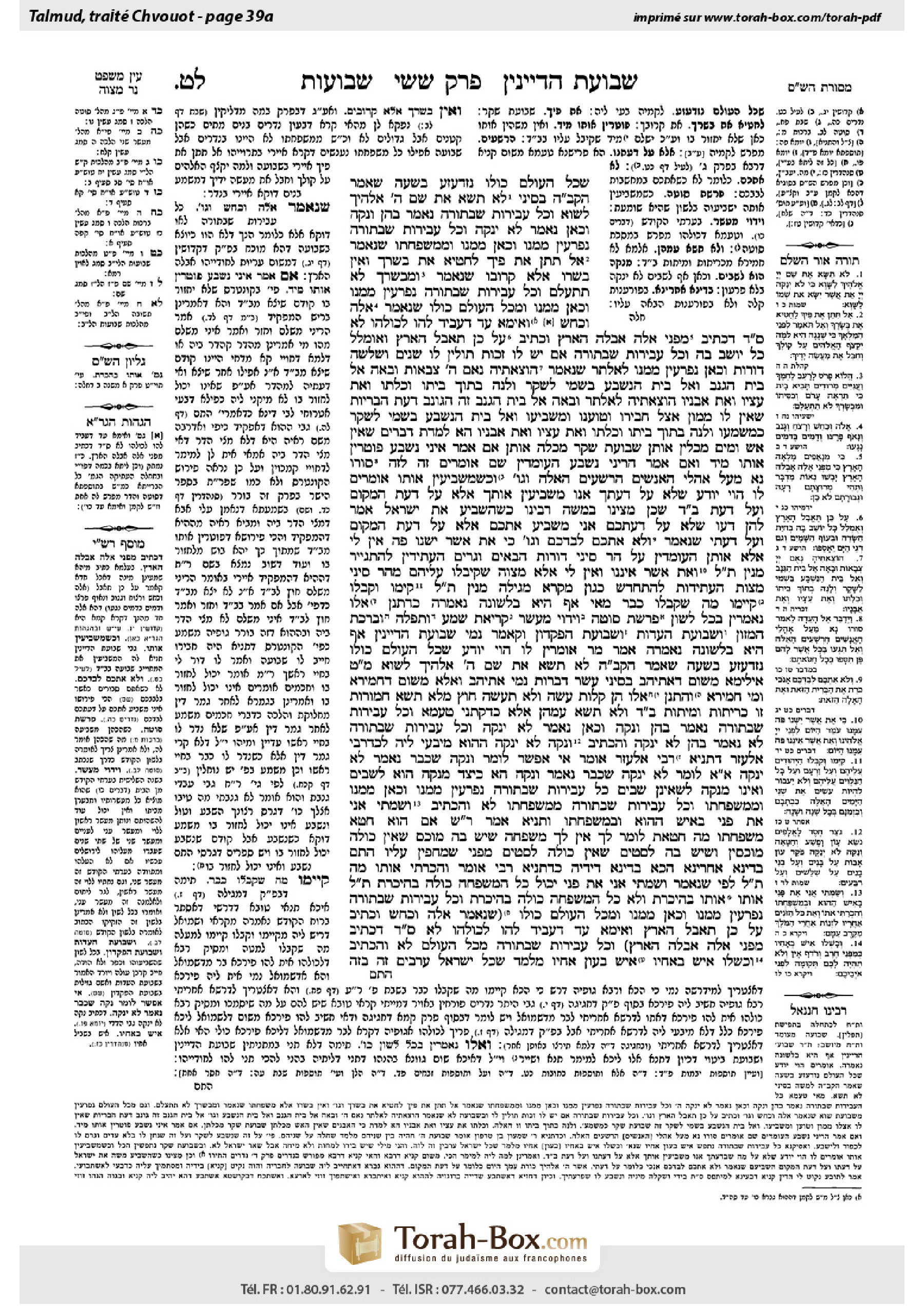
Shevuot 39a: Talmud study for Daf Yomi
Daf Yomi is the daily study of one Talmud folio. Explore 37 tractates with scans, Hebrew text, Sefaria English and AI-generated French translations where annotated.
Passage selection and English or AI-generated French translation are available where the scan has annotations. Daf Study is independent of Torah-Box and Sefaria.
Browse Shevuot · שבועות · All tractatesShevuot 39a text and translations
This page of Shevuot includes the Aramaic text, an English translation and an AI-generated French translation, alongside the scan above.
שבועות ל״ט א · Aramaic and Hebrew text
שֶׁכׇּל הָעוֹלָם כּוּלּוֹ נִזְדַּעְזַע בְּשָׁעָה שֶׁאָמַר הַקָּדוֹשׁ בָּרוּךְ הוּא בְּסִינַי ״לֹא תִשָּׂא אֶת שֵׁם ה׳ אֱלֹהֶיךָ לַשָּׁוְא״.
וְכׇל עֲבֵירוֹת שֶׁבַּתּוֹרָה נֶאֱמַר בָּהֶן ״וְנַקֵּה״, וְכָאן נֶאֱמַר ״לֹא יְנַקֶּה״. וְכׇל עֲבֵירוֹת שֶׁבַּתּוֹרָה נִפְרָעִין מִמֶּנּוּ, וְכָאן מִמֶּנּוּ וּמִמִּשְׁפַּחְתּוֹ; שֶׁנֶּאֱמַר: ״אַל תִּתֵּן אֶת פִּיךָ לַחֲטִיא אֶת בְּשָׂרֶךָ״ – וְאֵין בְּשָׂרוֹ אֶלָּא קְרוֹבוֹ, שֶׁנֶּאֱמַר: ״וּמִבְּשָׂרְךָ לֹא תִּתְעַלָּם״.
וְכׇל עֲבֵירוֹת שֶׁבַּתּוֹרָה נִפְרָעִין מִמֶּנּוּ, וְכָאן מִמֶּנּוּ וּמִכׇּל הָעוֹלָם כּוּלּוֹ; שֶׁנֶּאֱמַר: ״אָלֹה וְכַחֵשׁ״.
וְאֵימָא עַד דְּעָבֵיד לְהוּ לְכוּלְּהוּ! לָא סָלְקָא דַּעְתָּךְ; דִּכְתִיב: ״מִפְּנֵי אָלָה אָבְלָה הָאָרֶץ״, וּכְתִיב: ״עַל כֵּן תֶּאֱבַל הָאָרֶץ וְאֻמְלַל כׇּל יוֹשֵׁב בָּהּ״.
וְכׇל עֲבֵירוֹת שֶׁבַּתּוֹרָה – אִם יֵשׁ לוֹ זְכוּת, תּוֹלִין לוֹ שְׁנַיִם וּשְׁלֹשָׁה דּוֹרוֹת; וְכָאן נִפְרָעִין מִמֶּנּוּ לְאַלְתַּר – שֶׁנֶּאֱמַר: ״הוֹצֵאתִיהָ נְאֻם ה׳ צְבָאוֹת, וּבָאָה אֶל בֵּית הַגַּנָּב וְאֶל בֵּית הַנִּשְׁבָּע בִּשְׁמִי לַשָּׁקֶר, וְלָנֶה בְּתוֹךְ בֵּיתוֹ וְכִלַּתּוּ וְאֶת עֵצָיו וְאֶת אֲבָנָיו״.
״הוֹצֵאתִיהָ״ – לְאַלְתַּר. ״וּבָאָה אֶל בֵּית הַגַּנָּב״ – זֶה הַגּוֹנֵב דַּעַת הַבְּרִיּוֹת; שֶׁאֵין לוֹ מָמוֹן אֵצֶל חֲבֵירוֹ, וְטוֹעֲנוֹ וּמַשְׁבִּיעוֹ. ״וְאֶל בֵּית הַנִּשְׁבָּע בִּשְׁמִי לַשָּׁקֶר״ – כְּמַשְׁמָעוֹ. ״וְלָנֶה בְּתוֹךְ בֵּיתוֹ וְכִלַּתּוּ וְאֶת עֵצָיו וְאֶת אֲבָנָיו״ – הָא לָמַדְתָּ, דְּבָרִים שֶׁאֵין אֵשׁ וּמַיִם מְכַלִּין אוֹתָן, שְׁבוּעַת שֶׁקֶר מְכַלָּה אוֹתָן.
אִם אָמַר: ״אֵינִי נִשְׁבָּע״ – פּוֹטְרִין אוֹתוֹ מִיָּד. וְאִם אָמַר: ״הֲרֵינִי נִשְׁבָּע״ – הָעוֹמְדִין שָׁם אוֹמְרִים זֶה לָזֶה: ״סוּרוּ נָא מֵעַל אׇהֳלֵי הָאֲנָשִׁים הָרְשָׁעִים הָאֵלֶּה וְגוֹ׳״. וּכְשֶׁמַּשְׁבִּיעִין אוֹתוֹ אוֹמְרִים לוֹ: הֱוֵי יוֹדֵעַ, שֶׁלֹּא עַל דַּעְתְּךָ אָנוּ מַשְׁבִּיעִין אוֹתְךָ, אֶלָּא עַל דַּעַת הַמָּקוֹם וְעַל דַּעַת בֵּית דִּין.
שֶׁכֵּן מָצִינוּ בְּמֹשֶׁה רַבֵּינוּ, כְּשֶׁהִשְׁבִּיעַ אֶת יִשְׂרָאֵל, אָמַר לָהֶן: דְּעוּ, שֶׁלֹּא עַל דַּעְתְּכֶם אֲנִי מַשְׁבִּיעַ אֶתְכֶם, אֶלָּא עַל דַּעַת הַמָּקוֹם וְעַל דַּעְתִּי; שֶׁנֶּאֱמַר: ״וְלֹא אִתְּכֶם לְבַדְּכֶם וְגוֹ׳״.
״כִּי אֶת אֲשֶׁר יֶשְׁנוֹ פֹּה״ – אֵין לִי אֶלָּא אוֹתָן הָעוֹמְדִין עַל הַר סִינַי; דּוֹרוֹת הַבָּאִים וְגֵרִים הָעֲתִידִין לְהִתְגַּיֵּיר – מִנַּיִן? תַּלְמוּד לוֹמַר: ״וְאֵת אֲשֶׁר אֵינֶנּוּ״.
וְאֵין לִי אֶלָּא מִצְוָה שֶׁקִּיבְּלוּ עֲלֵיהֶם מֵהַר סִינַי; מִצְוֹת הָעֲתִידוֹת לְהִתְחַדֵּשׁ, כְּגוֹן מִקְרָא מְגִילָּה – מִנַּיִן? תַּלְמוּד לוֹמַר: ״קִיְּמוּ וְקִבְּלוּ״ – קִיְּימוּ מַה שֶּׁקִּבְּלוּ כְּבָר.
מַאי ״אַף הִיא בִּלְשׁוֹנָהּ נֶאֶמְרָה״?
כְּדִתְנַן: אֵלּוּ נֶאֱמָרִין בְּכׇל לְשׁוֹן – פָּרָשַׁת סוֹטָה, וִידּוּי מַעֲשֵׂר, קְרִיאַת שְׁמַע, וּתְפִלָּה, וּבִרְכַּת הַמָּזוֹן, וּשְׁבוּעַת הָעֵדוּת, וּשְׁבוּעַת הַפִּקָּדוֹן. וְקָאָמַר נָמֵי: שְׁבוּעַת הַדַּיָּינִין – אַף הִיא בִּלְשׁוֹנָהּ נֶאֶמְרָה.
אָמַר מָר, אוֹמְרִין לוֹ: הֱוֵי יוֹדֵעַ, שֶׁכׇּל הָעוֹלָם כּוּלּוֹ נִזְדַּעְזַע בְּשָׁעָה שֶׁאָמַר הַקָּדוֹשׁ בָּרוּךְ הוּא: ״לֹא תִשָּׂא אֶת שֵׁם ה׳ אֱלֹהֶיךָ לַשָּׁוְא״. מַאי טַעְמָא? אִילֵּימָא מִשּׁוּם דְּאִתְיְהֵב בְּסִינַי – עֶשֶׂר דִּבְּרוֹת נָמֵי אִתְיְהֵב!
וְאֶלָּא מִשּׁוּם דַּחֲמִירָא – וּמִי חֲמִירָא?! וְהָתְנַן: אֵלּוּ הֵן קַלּוֹת – עֲשֵׂה וְלֹא תַעֲשֶׂה, חוּץ מִ״לֹּא תִשָּׂא״. חֲמוּרוֹת – זוֹ כָּרֵיתוֹת וּמִיתוֹת בֵּית דִּין, וְ״לֹא תִשָּׂא״ עִמָּהֶן!
אֶלָּא כִּדְקָתָנֵי טַעְמָא – וְכׇל עֲבֵירוֹת שֶׁבַּתּוֹרָה נֶאֱמַר בָּהֶן ״וְנַקֵּה״, וְכָאן נֶאֱמַר ״לֹא יְנַקֶּה״.
וְכׇל עֲבֵירוֹת שֶׁבַּתּוֹרָה לֹא נֶאֱמַר בָּהֶן ״לֹא יְנַקֶּה״?! וְהָכְתִיב: ״וְנַקֵּה לֹא יְנַקֶּה״!
הָהוּא מִיבְּעֵי לֵיהּ לְכִדְרַבִּי אֶלְעָזָר – דְּתַנְיָא, רַבִּי אֶלְעָזָר אוֹמֵר: אִי אֶפְשָׁר לוֹמַר ״וְנַקֵּה״ – שֶׁכְּבָר נֶאֱמַר ״לֹא יְנַקֶּה״; אִי אֶפְשָׁר לוֹמַר ״לֹא יְנַקֶּה״ – שֶׁכְּבָר נֶאֱמַר ״וְנַקֵּה״. הָא כֵּיצַד? מְנַקֶּה הוּא לַשָּׁבִים, וְאֵינוֹ מְנַקֶּה לְשֶׁאֵינָן שָׁבִים.
כׇּל עֲבֵירוֹת שֶׁבַּתּוֹרָה נִפְרָעִין מִמֶּנּוּ, וְכָאן מִמֶּנּוּ וּמִמִּשְׁפַּחְתּוֹ. וְכׇל עֲבֵירוֹת שֶׁבַּתּוֹרָה מִמִּשְׁפַּחְתּוֹ לָא?!
וְהָכְתִיב: ״וְשַׂמְתִּי אֲנִי אֶת פָּנַי בָּאִישׁ הַהוּא וּבְמִשְׁפַּחְתּוֹ״; וְתַנְיָא, אָמַר רַבִּי שִׁמְעוֹן: אִם הוּא חָטָא, מִשְׁפַּחְתּוֹ מָה חָטָאת? לוֹמַר לְךָ: אֵין לְךָ מִשְׁפָּחָה שֶׁיֵּשׁ בָּהּ מוֹכֵס – שֶׁאֵין כּוּלָּהּ מוֹכְסִין; וְשֶׁיֵּשׁ בָּהּ לִסְטִים – שֶׁאֵין כּוּלָּהּ לִסְטִים; מִפְּנֵי שֶׁמְּחַפִּין עָלָיו!
הָתָם בְּדִינָא אַחֲרִינָא, הָכָא בְּדִינָא דִּידֵיהּ; כִּדְתַנְיָא, רַבִּי אוֹמֵר: ״וְהִכְרַתִּי אוֹתוֹ״ – מָה תַּלְמוּד לוֹמַר? לְפִי שֶׁנֶּאֱמַר: ״וְשַׂמְתִּי אֲנִי אֶת פָּנַי״ – יָכוֹל כׇּל הַמִּשְׁפָּחָה כּוּלָּהּ בְּהִיכָּרֵת? תַּלְמוּד לוֹמַר: ״אוֹתוֹ״ – אוֹתוֹ בְּהִיכָּרֵת, וְלֹא כׇּל הַמִּשְׁפָּחָה כּוּלָּהּ בְּהִיכָּרֵת.
וְכׇל עֲבֵירוֹת שֶׁבַּתּוֹרָה נִפְרָעִין מִמֶּנּוּ, וְכָאן מִמֶּנּוּ וּמִכׇּל הָעוֹלָם כּוּלּוֹ; שֶׁנֶּאֱמַר: ״אָלֹה וְכַחֵשׁ״, וּכְתִיב: ״עַל כֵּן תֶּאֱבַל הָאָרֶץ״. וְאֵימָא עַד דְּעָבֵיד לְהוּ לְכוּלְּהוּ! לָא סָלְקָא דַּעְתָּךְ, דִּכְתִיב: ״מִפְּנֵי אָלָה אָבְלָה הָאָרֶץ״.
וְכׇל עֲבֵירוֹת שֶׁבַּתּוֹרָה – מִכׇּל הָעוֹלָם לָא?! וְהָכְתִיב: ״וְכָשְׁלוּ אִישׁ בְּאָחִיו״ – אִישׁ בַּעֲוֹן אָחִיו; מְלַמֵּד שֶׁכׇּל יִשְׂרָאֵל עֲרֵבִים זֶה בָּזֶה!
Shevuot 39a · English translation
that the entire world trembled when the Holy One, Blessed be He, said at Mount Sinai: “You shall not take the name of the Lord, your God, in vain, for the Lord will not hold guiltless one who takes His name in vain” (Exodus 20:7).
And be aware that with regard to all of the other transgressions in the Torah it is stated: “And will…clear the guilty [venakkeh]” (Exodus 34:7); whereas here, with regard to taking a false oath, it is stated: “Will not hold guiltless [lo yenakkeh].” And be aware that with regard to all of the other transgressions in the Torah, punishment is exacted only from the transgressor, whereas here, punishment is exacted from him and from his family, as it is stated: “Do not allow your mouth to bring your flesh into guilt” (Ecclesiastes 5:5). The verse indicates that one who sins with his mouth, by taking a false oath, causes his flesh to be punished as well; and one’s flesh is nothing other than his relative, as it is stated: “And that you not hide yourself from your own flesh” (Isaiah 58:7).
And be aware that with regard to all of the other transgressions in the Torah, punishment is exacted only from the transgressor; whereas here, punishment is exacted from him and from the entire world, as it is stated: “Swearing, and lying, and murdering, and stealing, and committing adultery, they break all bounds…Therefore, the land mourns, and everyone who dwells therein languishes” (Hosea 4:2–3).
The Gemara suggests: And why not say that punishment is not exacted from the entire world unless he commits all of the sins mentioned in the verse? The Gemara answers: This should not enter your mind, as it is written: “Because of swearing the land mourns” (Jeremiah 23:10), indicating that taking a false oath is sufficient to cause the land to mourn. And it is similarly written in the verse in Hosea: “Therefore, the land mourns, and everyone who dwells therein languishes.” Both verses employ a term of mourning.
The baraita continues with the judges’ forewarning: And be aware that with regard to all the other transgressions in the Torah, if the transgressor has merit, God suspends his punishment for two or three generations, and only if his descendants follow in his ways are they punished. Whereas here, punishment is exacted from him immediately, as it is stated: “This is the curse that goes forth over the face of the whole land…I cause it to go forth, says the Lord of hosts, and it shall enter into the house of the thief, and into the house of he who swears falsely by My name; and it shall abide in the midst of his house and shall consume it, with its timber and its stones” (Zechariah 5:3–4).
The baraita analyzes the verse: “I cause it to go forth” means immediately. “And it shall enter into the house of the thief”; this is referring to one who deceives people, e.g., one who has no money in the possession of another, but claims money from him and administers an oath to him in court, thereby causing an oath to be taken in vain. “And into the house of he who swears falsely by My name” is as it indicates, in accordance with its straightforward meaning. From the end of the verse: “And it shall abide in the midst of his house and shall consume it, with its timber and its stones,” you have therefore learned that a false oath consumes things that even fire and water do not consume, such as stones.
The baraita continues: If the defendant says at this point: I will not take an oath, the court dismisses him immediately, and rules him liable to pay. And if he says: I will take an oath, the people standing there say to each other: “Depart, I pray you, from the tents of these wicked men, and touch nothing of theirs, lest you be swept away in all their sins” (Numbers 16:26). And when the judges administer the oath to him, they say to him: Be aware that we administer an oath to you not according to your understanding of the oath, but according to the objective understanding of the Omnipresent and according to the understanding of the court, i.e., the judges’ intention.
This is as we have found written with regard to Moses, our teacher. When he administered an oath to the Jewish people in the plains of Moab so that they would accept the Torah upon themselves, he said to them: Know that it is not according to your understanding that I administer an oath to you, but according to the understanding of the Omnipresent and according to my understanding. As it is stated: “Neither with you only do I make this covenant and this oath” (Deuteronomy 29:13), which is homiletically interpreted to mean: Not only according to your intention.
Having quoted a verse, the baraita tangentially interprets the subsequent verse. From the phrase: “But with he who stands here with us this day” (Deuteronomy 29:14), I have derived only that those who stood at Mount Sinai were included in this covenant. From where do I derive that the subsequent generations, and the converts who will convert in the future, were also included? The verse states: “And also with he who is not here with us this day” (Deuteronomy 29:14).
And I have derived only that the mitzvot that the Jewish people accepted upon themselves at Mount Sinai were included in the oath. From where is it derived that mitzvot that were to be initiated in the future, for example, the reading of the Megilla, the Scroll of Esther, on Purim, were also included? The verse states: “The Jews ordained and took upon themselves…that they would keep these two days” (Esther 9:27), which is homiletically interpreted to mean: They ordained, in the generation of Esther, mitzvot that they had already accepted upon themselves by oath in the plains of Moab.
§ The Gemara analyzes the baraita. What is the precise meaning of the statement: An oath imposed by the judges may also be recited in its language?
The Gemara answers: It is as we learned in a mishna (Sota 32a): These are recited in any language and it is not required that they be recited in Hebrew: The portion of the warning and the oath administered by the priest to a woman suspected by her husband of having been unfaithful [sota]; the declaration of tithes, which occurs after the third and the sixth year of the seven-year Sabbatical cycle, when one declares that he has given his tithes appropriately; the recitation of Shema; and the Amida prayer; and Grace after Meals; and the oath of testimony, where one takes an oath that he does not have any testimony to provide on a given issue; and the oath on a deposit, where one takes an oath that he does not have possession of another’s deposit. All these may be recited in any language. And the baraita also states, as an addendum to this halakha, that an oath imposed by the judges may also be recited in its language, i.e., in any language.
§ The Master said in the baraita above that the judges say to him: Be aware that the entire world trembled when the Holy One, Blessed be He, said: “You shall not take the name of the Lord, your God, in vain.” What is the reason that the entire world trembled? If we say it was because this prohibition was given at Mount Sinai, this is difficult, as when the entire world trembled, the rest of the Ten Commandments were also given at Mount Sinai. This quality is not unique to this specific prohibition.
And if it is rather due to the fact that this prohibition is severe, is it more severe than all the other prohibitions? But didn’t we learn in a baraita: These are minor transgressions: Violation of an ordinary positive mitzva and an ordinary negative mitzva, except for: “You shall not take the name of the Lord, your God, in vain.” And these are major transgressions: Those for which one is liable to receive excision from the World-to-Come [karet] or a court-imposed death penalty; and “You shall not take the name of the Lord, your God, in vain” is also among them. Evidently, this transgression is no more severe than transgressions that incur karet or the death penalty.
Rather, the reason the world trembled particularly when this prohibition was given is as it is taught subsequently in the baraita: And with regard to all of the other transgressions in the Torah it is stated: “And will…clear the guilty,” whereas here, it is stated: “Will not hold guiltless.”
The Gemara asks: And is it not stated with regard to all of the other transgressions in the Torah that God “will not hold guiltless [lo yenakkeh]” one who transgresses? But isn’t it written: “And Who will by no means clear the guilty [venakkeh lo yenakkeh]” (Exodus 34:7)?
The Gemara answers: That verse is necessary for that which is derived through the homiletic interpretation of Rabbi Elazar, as it is taught in a baraita: Rabbi Elazar says: It is not possible to say: And will clear the guilty [venakkeh], about all transgressions, since: Will not clear the guilty [lo yenakkeh], is already stated. And it is not possible to say: Will not clear the guilty [lo yenakkeh], since: And will clear the guilty [venakkeh], is already stated. How can these texts be reconciled? The Holy One, Blessed be He, clears those guilty ones who repent and does not clear those who do not repent.
§ It is stated in the baraita that with regard to all of the transgressions in the Torah, punishment is exacted only from the transgressor, whereas here, punishment is exacted from him and from his family. The Gemara asks: And is punishment not exacted from the transgressor’s family with regard to all of the other transgressions in the Torah?
But isn’t it written in the Torah with regard to one who worships Molech: “Then I will set My face against that man, and against his family, and I will cut him off” (Leviticus 20:5)? And it is taught in a baraita: Rabbi Shimon said: If he sinned, how did his family sin? Why are they punished? This serves to tell you that there is no family that has an unauthorized tax collector among them in which all of the family members are not regarded as unauthorized tax collectors, and similarly, there is no family that has a bandit [listim] among them in which all of the family members are not regarded as bandits. This is because they cover for him. Evidently, punishment is exacted from the transgressor’s family with regard to transgressions other than taking a false oath.
The Gemara answers: There, with regard to other transgressions, the transgressor’s family is punished with another punishment, less severe than the one the transgressor receives, whereas here, with regard to a false oath, the transgressor’s family is punished with his punishment. As it is taught in a baraita: Rabbi Yehuda HaNasi says: Why must the verse state with regard to one who worships Molech: “And I will cut him off”? Since it is stated earlier in the verse: “Then I will set My face against that man, and against his family,” one might have thought that the entire family is liable to be punished with karet. Therefore, the verse states: “And I will cut him off,” indicating that only he is liable to be punished with karet, whereas his entire family is not liable to be punished with karet.
§ The baraita teaches: And with regard to all of the other transgressions in the Torah, punishment is exacted only from him, whereas here, punishment is exacted from him and from the entire world, as it is stated: “Swearing and lying, and murdering, and stealing, and committing adultery,” and it is written: “Therefore, the land mourns.” The Gemara suggests: And why not say that punishment is not exacted from the entire world unless he commits all the sins mentioned in the verse? The Gemara answers: This should not enter your mind, as it is written: “Because of swearing the land mourns” (Jeremiah 23:10), indicating that a false oath is sufficient to cause the land to mourn.
The Gemara asks: And with regard to all of the other transgressions in the Torah, is punishment not exacted from the entire world? But isn’t it written: “And they shall stumble one upon another” (Leviticus 26:37)? This verse is homiletically interpreted to mean that they shall stumble spiritually, one due to the iniquity of another, which teaches that the entire Jewish people are considered guarantors for one another. Apparently, any transgression makes the entire world liable to be punished.
Shevuot 39a · Traduction française (IA)
que le monde entier trembla lorsque le Saint, béni soit-Il, déclara au mont Sinaï : « Tu ne prendras pas en vain le nom du Seigneur, ton Dieu, car le Seigneur ne tiendra pas pour innocent celui qui prendra Son nom en vain » (Exode 20:7).
Sache que, pour toutes les autres transgressions de la Torah, il est dit : « Et Il… absout [venakkeh] » (Exode 34:7), tandis qu’ici, au sujet d’un serment mensonger, il est dit : « Il ne tient pas pour innocent [lo yenakkeh]. » Sache également que, pour toutes les autres transgressions de la Torah, la punition ne frappe que le transgresseur, tandis qu’ici, elle le frappe, lui et sa famille, comme il est dit : « Ne laisse pas ta bouche entraîner ta chair dans la faute » (Ecclésiaste 5:5). Le verset indique que celui qui pèche par sa bouche en prêtant un serment mensonger fait également punir sa chair ; or, sa chair désigne son parent, comme il est dit : « Ne te dérobe pas à ta propre chair » (Isaïe 58:7).
Sache également que, pour toutes les autres transgressions de la Torah, la punition ne frappe que le transgresseur, tandis qu’ici, elle le frappe, lui et le monde entier, comme il est dit : « Ils jurent, mentent, assassinent, volent et commettent l’adultère ; ils dépassent toute limite… C’est pourquoi le pays est en deuil, et tous ses habitants dépérissent » (Osée 4:2–3).
La Guemara propose : Pourquoi ne pas dire que la punition ne frappe le monde entier que si l’homme commet tous les péchés mentionnés dans le verset ? La Guemara répond : Cette possibilité ne doit pas te venir à l’esprit, car il est écrit : « À cause des serments, le pays est en deuil » (Jérémie 23:10), ce qui indique qu’un serment mensonger suffit à mettre le pays en deuil. De même, le verset d’Osée dit : « C’est pourquoi le pays est en deuil, et tous ses habitants dépérissent. » Les deux versets emploient un terme exprimant le deuil.
La baraïta poursuit en rapportant l’avertissement des juges : Sache également que, pour toutes les autres transgressions de la Torah, si le transgresseur a des mérites, Dieu suspend sa punition pendant deux ou trois générations ; ses descendants ne sont punis que s’ils suivent ses voies. Ici, en revanche, la punition le frappe immédiatement, comme il est dit : « Voici la malédiction qui s’avance sur toute la surface du pays… Je la fais sortir, déclare le Seigneur des armées, et elle entrera dans la maison du voleur et dans la maison de celui qui jure faussement par Mon nom ; elle demeurera au milieu de sa maison et la consumera, avec son bois et ses pierres » (Zacharie 5:3–4).
La baraïta analyse le verset : « Je la fais sortir » signifie qu’elle sort immédiatement. « Et elle entrera dans la maison du voleur » : cela désigne celui qui trompe les gens, par exemple celui qui n’a pas d’argent chez autrui, mais qui lui réclame une somme et lui fait prêter serment au tribunal, provoquant ainsi un serment prononcé en vain. « Et dans la maison de celui qui jure faussement par Mon nom » s’entend conformément à son sens littéral. De la fin du verset — « elle demeurera au milieu de sa maison et la consumera, avec son bois et ses pierres » — tu apprends donc qu’un serment mensonger consume des choses que même le feu et l’eau ne consument pas, comme des pierres.
La baraïta poursuit : Si, à ce stade, l’accusé dit : « Je ne prêterai pas serment », le tribunal le congédie immédiatement et le déclare redevable du paiement. S’il dit : « Je prêterai serment », les personnes présentes se disent les unes aux autres : « Éloignez-vous, je vous prie, des tentes de ces hommes méchants, et ne touchez à rien de ce qui leur appartient, de peur que vous ne soyez emportés avec tous leurs péchés » (Nombres 16:26). Lorsque les juges lui font prêter serment, ils lui disent : Sache que nous te faisons prêter serment non selon ta propre compréhension, mais selon le sens objectif voulu par le Tout-Puissant et selon l’intention du tribunal, c’est-à-dire des juges.
C’est ce que nous trouvons écrit au sujet de Moïse, notre maître. Lorsqu’il fit prêter serment au peuple juif dans les plaines de Moab, afin qu’il accepte la Torah, il lui dit : Sachez que je ne vous fais pas prêter serment selon votre propre compréhension, mais selon le sens voulu par le Tout-Puissant et selon mon intention. Car il est dit : « Ce n’est pas avec vous seuls que je conclus cette alliance et ce serment » (Deutéronome 29:13), ce qui est interprété de façon homilétique ainsi : pas seulement selon votre intention.
Après avoir cité un verset, la baraïta interprète incidemment le verset suivant. De l’expression « mais avec celui qui se tient ici avec nous aujourd’hui » (Deutéronome 29:14), j’ai seulement déduit que ceux qui se tenaient au mont Sinaï étaient inclus dans cette alliance. D’où déduit-on que les générations suivantes, ainsi que les convertis qui se convertiront à l’avenir, étaient également inclus ? Le verset dit : « Et aussi avec celui qui n’est pas ici avec nous aujourd’hui » (Deutéronome 29:14).
J’ai seulement déduit que les mitsvot que le peuple juif avait acceptées au mont Sinaï étaient incluses dans le serment. D’où déduit-on que les mitsvot qui devaient être instituées ultérieurement, par exemple la lecture de la Meguila, le rouleau d’Esther, à Pourim, étaient également incluses ? Le verset dit : « Les Juifs établirent et acceptèrent sur eux-mêmes… d’observer ces deux jours » (Esther 9:27), ce qui est interprété de façon homilétique ainsi : à l’époque d’Esther, ils instituèrent des mitsvot qu’ils avaient déjà acceptées par serment dans les plaines de Moab.
§ La Guemara analyse la baraïta. Quel est le sens précis de cette affirmation : un serment imposé par les juges peut également être prononcé dans sa langue ?
La Guemara répond : C’est ce que nous avons appris dans une Michna (Sota 32a) : Voici les textes que l’on peut réciter dans n’importe quelle langue, sans qu’il soit nécessaire de les réciter en hébreu : le passage de l’avertissement et le serment que le prêtre fait prononcer à une femme que son mari soupçonne d’infidélité [sota] ; la déclaration des dîmes, faite après la troisième et la sixième année du cycle sabbatique de sept ans, lorsqu’on déclare avoir prélevé correctement ses dîmes ; la récitation du Chéma ; la prière de la Amida ; la bénédiction après les repas ; le serment de témoignage, par lequel on jure ne pas avoir de témoignage à fournir sur une affaire donnée ; et le serment relatif à un dépôt, par lequel on jure ne pas détenir le dépôt d’autrui. Tous ces textes peuvent être récités dans n’importe quelle langue. La baraïta ajoute à cette halakha qu’un serment imposé par les juges peut également être prononcé dans sa langue, c’est-à-dire dans n’importe quelle langue.
§ Le maître a dit dans la baraïta ci-dessus que les juges lui disent : Sache que le monde entier trembla lorsque le Saint, béni soit-Il, déclara : « Tu ne prendras pas en vain le nom du Seigneur, ton Dieu. » Pourquoi le monde entier trembla-t-il ? Si l’on dit que c’est parce que cette interdiction fut énoncée au mont Sinaï, cela pose difficulté : lorsque le monde entier trembla, les autres Dix Commandements furent également énoncés au mont Sinaï. Cette caractéristique n’est donc pas propre à cette interdiction.
Et si c’est plutôt parce que cette interdiction est grave, est-elle plus grave que toutes les autres interdictions ? N’avons-nous pas appris dans une baraïta : Voici les transgressions mineures : la violation d’une mitsva positive ordinaire et d’une mitsva négative ordinaire, à l’exception de « Tu ne prendras pas en vain le nom du Seigneur, ton Dieu ». Et voici les transgressions majeures : celles qui exposent à l’excision du monde à venir [karet] ou à la peine capitale prononcée par un tribunal ; l’interdiction « Tu ne prendras pas en vain le nom du Seigneur, ton Dieu » en fait également partie. Il apparaît donc que cette transgression n’est pas plus grave que celles qui entraînent le karet ou la peine capitale.
La raison pour laquelle le monde trembla particulièrement lorsque cette interdiction fut énoncée est plutôt celle enseignée ensuite dans la baraïta : pour toutes les autres transgressions de la Torah, il est dit : « Et Il… absout », tandis qu’ici, il est dit : « Il ne tient pas pour innocent. »
La Guemara demande : N’est-il pas dit, au sujet de toutes les autres transgressions de la Torah, que Dieu « ne tient pas pour innocent [lo yenakkeh] » celui qui les commet ? N’est-il pas écrit : « Et qui n’absout nullement le coupable [venakkeh lo yenakkeh] » (Exode 34:7) ?
La Guemara répond : Ce verset est nécessaire pour ce qui est déduit de l’interprétation homilétique de Rabbi Elazar, comme il est enseigné dans une baraïta : Rabbi Elazar dit : Il n’est pas possible de dire, au sujet de toutes les transgressions, « Et Il absout [venakkeh] », puisque « Il n’absout pas [lo yenakkeh] » est déjà énoncé. Et il n’est pas possible de dire « Il n’absout pas [lo yenakkeh] », puisque « Et Il absout [venakkeh] » est déjà énoncé. Comment concilier ces textes ? Le Saint, béni soit-Il, absout les coupables qui se repentent et n’absout pas ceux qui ne se repentent pas.
§ La baraïta affirme que, pour toutes les transgressions de la Torah, la punition ne frappe que le transgresseur, tandis qu’ici, elle le frappe, lui et sa famille. La Guemara demande : La famille du transgresseur n’est-elle pas punie pour toutes les autres transgressions de la Torah ?
N’est-il pas écrit dans la Torah, au sujet de celui qui sert Molekh : « Je tournerai Ma face contre cet homme et contre sa famille, et Je l’exclurai » (Lévitique 20:5) ? Et il est enseigné dans une baraïta : Rabbi Shimon dit : S’il a péché, en quoi sa famille a-t-elle péché ? Pourquoi est-elle punie ? Cela vient t’apprendre qu’il n’y a pas de famille au sein de laquelle se trouve un percepteur d’impôts non autorisé sans que tous les membres de cette famille soient considérés comme des percepteurs d’impôts non autorisés ; de même, il n’y a pas de famille au sein de laquelle se trouve un brigand [listim] sans que tous ses membres soient considérés comme des brigands. C’est parce qu’ils le couvrent. Il apparaît donc que la famille du transgresseur est punie pour des transgressions autres que le serment mensonger.
La Guemara répond : Dans le cas des autres transgressions, la famille du transgresseur reçoit une autre punition, moins sévère que celle qui le frappe, tandis qu’ici, pour un serment mensonger, sa famille reçoit la même punition que lui. Car il est enseigné dans une baraïta : Rabbi Yehouda HaNassi dit : Pourquoi le verset doit-il dire, au sujet de celui qui sert Molekh : « Et Je l’exclurai » ? Puisque le début du verset dit : « Je tournerai Ma face contre cet homme et contre sa famille », on aurait pu penser que toute la famille est passible de karet. Le verset dit donc : « Et Je l’exclurai », ce qui indique que lui seul est passible de karet, tandis que toute sa famille ne l’est pas.
§ La baraïta enseigne : Pour toutes les autres transgressions de la Torah, la punition ne frappe que le transgresseur, tandis qu’ici, elle le frappe, lui et le monde entier, comme il est dit : « Ils jurent, mentent, assassinent, volent et commettent l’adultère », et comme il est écrit : « C’est pourquoi le pays est en deuil. » La Guemara propose : Pourquoi ne pas dire que la punition ne frappe le monde entier que si l’homme commet tous les péchés mentionnés dans le verset ? La Guemara répond : Cette possibilité ne doit pas te venir à l’esprit, car il est écrit : « À cause des serments, le pays est en deuil » (Jérémie 23:10), ce qui indique qu’un serment mensonger suffit à mettre le pays en deuil.
La Guemara demande : Pour toutes les autres transgressions de la Torah, la punition ne frappe-t-elle pas le monde entier ? N’est-il pas écrit : « Ils trébucheront les uns sur les autres » (Lévitique 26:37) ? Ce verset est interprété de façon homilétique : ils trébucheront spirituellement, chacun à cause de la faute d’autrui. Cela enseigne que tout le peuple juif est considéré comme garant l’un de l’autre. Il apparaît donc que toute transgression rend le monde entier passible de punition.
Traduction française générée par IA à partir de l’édition anglaise de Sefaria. Vérifie toujours un passage avec le texte source.
Text from Sefaria: William Davidson Edition - Vocalized Aramaic (CC BY NC); William Davidson Edition - English (CC BY NC).