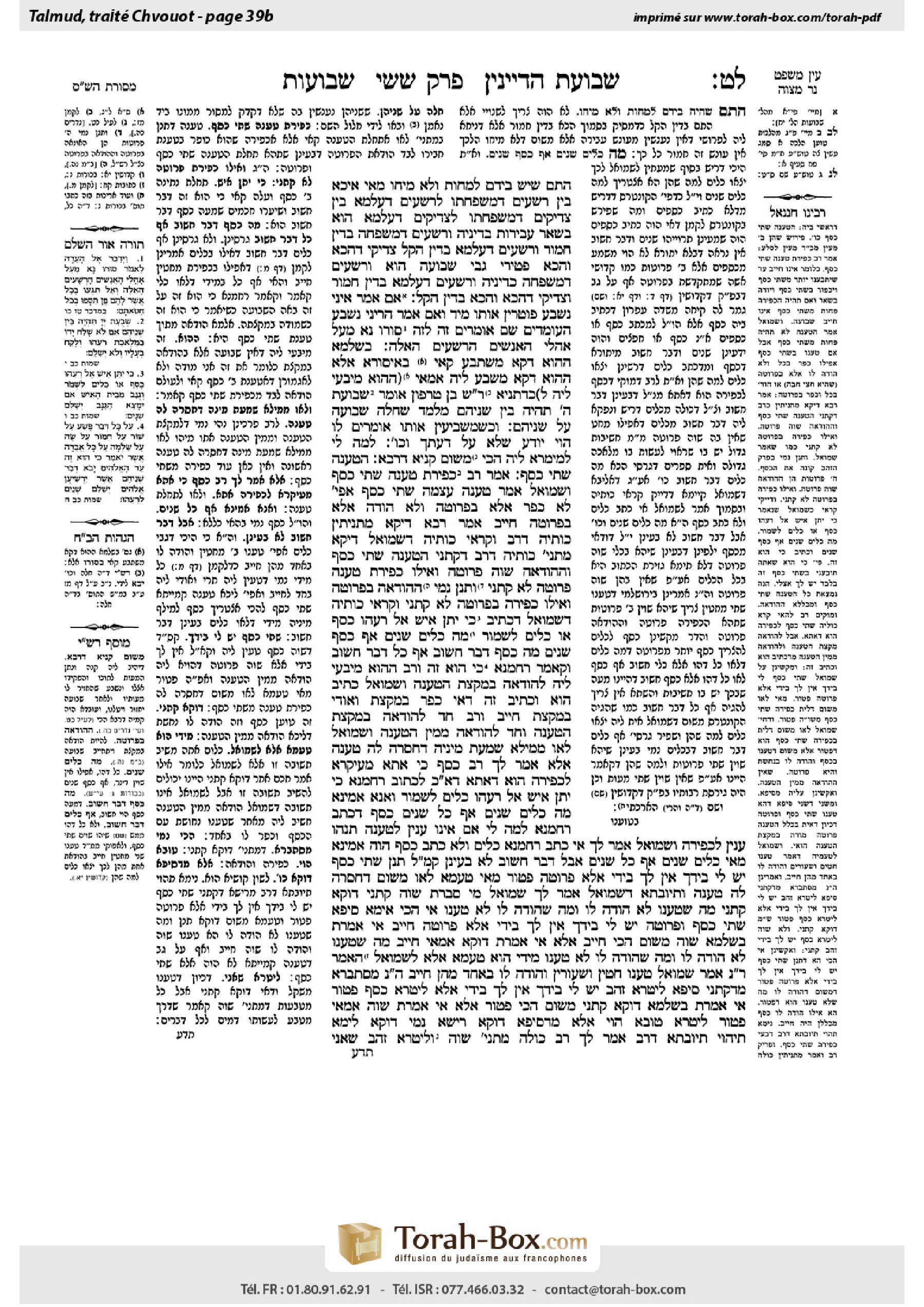
Shevuot 39b: Talmud study for Daf Yomi
Daf Yomi is the daily study of one Talmud folio. Explore 37 tractates with scans, Hebrew text, Sefaria English and AI-generated French translations where annotated.
Passage selection and English or AI-generated French translation are available where the scan has annotations. Daf Study is independent of Torah-Box and Sefaria.
Browse Shevuot · שבועות · All tractatesShevuot 39b text and translations
This page of Shevuot includes the Aramaic text, an English translation and an AI-generated French translation, alongside the scan above.
שבועות ל״ט ב · Aramaic and Hebrew text
הָתָם שֶׁיֵּשׁ בְּיָדָם לְמַחוֹת, וְלֹא מִיחוּ.
מַאי אִיכָּא בֵּין רְשָׁעִים דְּמִשְׁפַּחְתּוֹ לָרְשָׁעִים דְּעָלְמָא; בֵּין צַדִּיקִים דְּמִשְׁפַּחְתּוֹ לְצַדִּיקִים דְּעָלְמָא?
הוּא בִּשְׁאָר עֲבֵירוֹת – בְּדִינֵיהּ; וּרְשָׁעִים דְּמִשְׁפָּחָה – בְּדִין חָמוּר; וּרְשָׁעִים דְּעָלְמָא – בְּדִין הַקַּל; צַדִּיקֵי דְּהָכָא וְהָכָא – פְּטִירִי.
גַּבֵּי שְׁבוּעָה, הוּא וּרְשָׁעִים דְּמִשְׁפָּחָה – כְּדִינֵיהּ; וּרְשָׁעִים דְּעָלְמָא – בְּדִין חָמוּר; וְצַדִּיקֵי דְּהָכָא וְהָכָא – בְּדִין הַקַּל.
אִם אָמַר ״אֵינִי נִשְׁבָּע״ – פּוֹטְרִין אוֹתוֹ מִיָּד, וְאִם אָמַר ״הֲרֵינִי נִשְׁבָּע״ – הָעוֹמְדִים שָׁם אוֹמְרִים זֶה לָזֶה: ״סוּרוּ נָא מֵעַל אׇהֳלֵי הָאֲנָשִׁים הָרְשָׁעִים הָאֵלֶּה״. בִּשְׁלָמָא הָהוּא דְּקָא מִשְׁתְּבַע – קָאֵי בְּאִיסּוּרָא; אֶלָּא הָהוּא דְּקָא מַשְׁבַּע לֵיהּ – אַמַּאי?
הָהוּא מִיבְּעֵי לֵיהּ לְכִדְתַנְיָא, רַבִּי שִׁמְעוֹן בֶּן טַרְפוֹן אוֹמֵר: ״שְׁבֻעַת ה׳ תִּהְיֶה בֵּין שְׁנֵיהֶם״ – מְלַמֵּד שֶׁחָלָה שְׁבוּעָה עַל שְׁנֵיהֶם.
וּכְשֶׁמַּשְׁבִּיעִין אוֹתוֹ, אוֹמְרִים לוֹ: הֱוֵי יוֹדֵעַ שֶׁלֹּא עַל דַּעְתְּךָ וְכוּ׳. לְמָה לִי לְמֵימְרָא לֵיהּ הָכִי? מִשּׁוּם קַנְיָא דְּרָבָא.
הַטַּעֲנָה שְׁתֵּי כֶּסֶף. אָמַר רַב: כְּפִירַת טַעֲנָה שְׁתֵּי כֶּסֶף. וּשְׁמוּאֵל אָמַר: טַעֲנָה עַצְמָהּ שְׁתֵּי כֶּסֶף; אֲפִילּוּ לֹא כָּפַר אֶלָּא בִּפְרוּטָה, וְלֹא הוֹדָה אֶלָּא בִּפְרוּטָה – חַיָּיב.
אָמַר רָבָא: דַּיְקָא מַתְנִיתִין כְּוָתֵיהּ דְּרַב, וּקְרָאֵי כְּוָתֵיהּ דִּשְׁמוּאֵל. דַּיְקָא מַתְנִיתִין כְּוָתֵיהּ דְּרַב – דְּקָתָנֵי הַטַּעֲנָה שְׁתֵּי כֶּסֶף וְהַהוֹדָאָה שָׁוֶה פְּרוּטָה, וְאִילּוּ כְּפִירַת טַעֲנָה פְּרוּטָה לָא קָתָנֵי. וּתְנַן נָמֵי הַהוֹדָאָה בִּפְרוּטָה, וְאִילּוּ כְּפִירָה בִּפְרוּטָה לָא קָתָנֵי.
וּקְרָאֵי כְּוָתֵיהּ דִּשְׁמוּאֵל – דִּכְתִיב: ״כִּי יִתֵּן אִישׁ אֶל רֵעֵהוּ כֶּסֶף אוֹ כֵלִים לִשְׁמוֹר״ – מָה ״כֵּלִים״ שְׁנַיִם, אַף ״כֶּסֶף״ שְׁנַיִם; מָה כֶּסֶף דָּבָר חָשׁוּב, אַף כׇּל דָּבָר חָשׁוּב; וְקָאָמַר רַחֲמָנָא: ״כִּי הוּא זֶה״.
וְרַב – הָהוּא מִיבְּעֵי לֵיהּ לְהוֹדָאָה בְּמִקְצָת הַטַּעֲנָה. וּשְׁמוּאֵל – כְּתִיב ״הוּא״ וּכְתִיב ״זֶה״, דְּאִי כְּפַר בְּמִקְצָת וְאוֹדִי בְּמִקְצָת – חַיָּיב.
וְרַב – חַד לְהוֹדָאָה בְּמִקְצָת הַטַּעֲנָה, וְחַד לְהוֹדָאָה מִמִּין הַטַּעֲנָה. וּשְׁמוּאֵל – לָאו מִמֵּילָא שָׁמְעַתְּ מִינֵּיהּ דְּחָסְרָה לַהּ טַעֲנָה?
אֶלָּא אָמַר לְךָ רַב: ״כֶּסֶף״ כִּי אֲתָא מֵעִיקָּרָא – לִכְפִירָה הוּא דַּאֲתָא; דְּאִם כֵּן, לִכְתּוֹב רַחֲמָנָא: ״כִּי יִתֵּן אִישׁ אֶל רֵעֵהוּ כֵּלִים לִשְׁמוֹר״ – וַאֲנָא אָמֵינָא: מָה כֵּלִים שְׁנַיִם, אַף כֹּל שְׁנַיִם; ״כֶּסֶף״ דִּכְתַב רַחֲמָנָא לְמָה לִי? אִם אֵינוֹ עִנְיָן לְטַעֲנָה, תְּנֵהוּ עִנְיָן לִכְפִירָה.
וּשְׁמוּאֵל אָמַר לָךְ: אִי כְּתַב רַחֲמָנָא ״כֵּלִים״ וְלָא כְּתַב ״כֶּסֶף״, הֲוָה אָמֵינָא: מַאי כֵּלִים שְׁנַיִם, אַף כֹּל שְׁנַיִם – אֲבָל דָּבָר חָשׁוּב לָא בָּעֵינַן; קָא מַשְׁמַע לַן.
תְּנַן: ״שְׁתֵּי כֶּסֶף יֵשׁ לִי בְּיָדְךָ״, ״אֵין לְךָ בְּיָדִי אֶלָּא פְּרוּטָה״ – פָּטוּר. מַאי טַעְמָא? לָאו מִשּׁוּם דְּחָסְרָה לָהּ טַעֲנָה – וּתְיוּבְתָּא דִּשְׁמוּאֵל?
אָמַר לְךָ שְׁמוּאֵל: מִי סָבְרַתְּ שָׁוֶה קָתָנֵי?! דַּוְקָא קָתָנֵי – מַה שֶּׁטְּעָנוֹ לֹא הוֹדָה לוֹ, וּמַה שֶּׁהוֹדָה לוֹ לֹא טְעָנוֹ.
אִי הָכִי, אֵימָא סֵיפָא: ״שְׁתֵּי כֶּסֶף וּפְרוּטָה יֵשׁ לִי בְּיָדְךָ״, ״אֵין לְךָ בְּיָדִי אֶלָּא פְּרוּטָה״ – חַיָּיב. אִי אָמְרַתְּ בִּשְׁלָמָא שָׁוֶה – מִשּׁוּם הָכִי חַיָּיב; אֶלָּא אִי אָמְרַתְּ דַּוְקָא – אַמַּאי חַיָּיב? מַה שֶּׁטְּעָנוֹ לֹא הוֹדָה לוֹ, וּמָה שֶׁהוֹדָה לוֹ לֹא טְעָנוֹ!
מִידֵּי הוּא טַעְמָא – אֶלָּא לִשְׁמוּאֵל; הָאָמַר רַב נַחְמָן, אָמַר שְׁמוּאֵל: טְעָנוֹ חִטִּין וּשְׂעוֹרִין וְהוֹדָה לוֹ בְּאֶחָד מֵהֶן – חַיָּיב.
הָכִי נָמֵי מִסְתַּבְּרָא – מִדְּקָתָנֵי סֵיפָא: ״לִיטְרָא זָהָב יֵשׁ לִי בְּיָדְךָ״, ״אֵין לְךָ בְּיָדִי אֶלָּא לִיטְרָא כֶּסֶף״ – פָּטוּר. אִי אָמְרַתְּ בִּשְׁלָמָא דַּוְקָא קָתָנֵי – מִשּׁוּם הָכִי פָּטוּר; אֶלָּא אִי אָמְרַתְּ שָׁוֶה – אַמַּאי פָּטוּר? לִיטְרָא טוּבָא הָוֵי!
אֶלָּא מִדְּסֵיפָא דַּוְקָא, רֵישָׁא נָמֵי דַּוְקָא.
לֵימָא תֶּיהְוֵי תְּיוּבְתָּא דְּרַב? אָמַר לְךָ רַב: כּוּלַּהּ מַתְנִיתִין – שָׁוֶה, וְלִיטְרָא זָהָב שָׁאנֵי.
Shevuot 39b · English translation
The Gemara answers: There, in that verse, the reference is to a case where the others had the ability to protest the transgression, and nevertheless, they did not protest. By contrast, when one takes a false oath, the entire world is punished, even those who were not able to protest.
The Gemara asks: What difference is there between the punishment of the wicked people in a transgressor’s family and the punishment of the other wicked people of the world, and between the punishment of the righteous people in his family and the punishment of the other righteous people of the world?
The Gemara answers: With regard to other transgressions, the transgressor himself is punished with his own punishment, i.e., that which is written in the Torah for that transgression. And the wicked people of his family, who covered for him, are punished with another severe punishment, and the wicked people of the rest of the world, who refrained from protesting his action, are punished with a light punishment. The righteous people both here and here, i.e., both his family members who did not cover for him, and others who were not able to protest his action, are exempt from punishment.
With regard to one who takes a false oath, by contrast, he and the wicked people of his family are all punished with his punishment, i.e., they receive the same punishment he does. And the wicked people of the rest of the world, who refrained from protesting his action, are punished with a severe punishment, and the righteous people both here, in his family, and here, in the rest of the world, are punished with a light punishment, even though they did not behave inappropriately. Accordingly, the consequences of taking a false oath are more severe than those of other transgressions.
§ The baraita states: If the defendant says: I will not take an oath, the court dismisses him immediately, and rules him liable to pay. And if he says: I will take an oath, the people standing there say to each other: “Depart, I pray you, from the tents of these wicked men.” The Gemara asks: Granted that one who is taking the oath stands to transgress the prohibition against taking a false oath; but why is the one administering the oath to him, i.e., the claimant, considered a wicked man?
The Gemara answers: That designation is necessary for that which is taught in a baraita: Rabbi Shimon ben Tarfon says that the verse: “The oath of the Lord shall be between them both” (Exodus 22:10), teaches that the punishment for a false oath applies to both the one who took the oath and the one who administered it to him.
§ The baraita states: And when the judges administer the oath to him, they say to him: Be aware that we administer an oath to you not according to your understanding, but according to the understanding of the Omnipresent and according to the understanding of the court. The Gemara explains: Why does the court need to say this to him? It is due to deceptions like that of the reed in Rava’s court, where the defendant secretly inserted into a hollow reed the money he owed and gave it to the claimant to hold for him, whereupon he took an oath that he had already given him the money. He then took back the reed, as the claimant was unaware of its contents. In this way, he was able to state an oath that was technically true, although he was guilty of deception. To prevent this, the court stipulates that the oath must be true according to the court’s understanding.
§ The mishna teaches that the court administers an oath to one who admits to part of a claim only when the claim is for at least the value of two silver ma’a. Rav and Shmuel disagree with regard to the exact meaning of this statement. Rav says that the denial of the claim must be at least the value of two silver ma’a. And Shmuel says that the claim itself must be at least the value of two silver ma’a; i.e., even if the defendant denied only one peruta of the claim, or conversely, if he admitted to only one peruta of the two-ma’a claim, he is liable to take an oath.
Rava said: The language of the mishna is precise in accordance with the opinion of Rav, and the biblical verses are precise in accordance with the opinion of Shmuel. The language of the mishna is precise in accordance with the opinion of Rav, as it teaches: The claim must be for at least the value of two silver ma’a and the admission must be at least the value of one peruta, whereas it does not teach that the minimum denial of the claim is one peruta, indicating that it must be more. And also, we learned in a mishna (Bava Metzia 55a) that the minimum admission to part of a claim that renders one liable to take an oath is the value of one peruta, whereas that mishna does not teach that the minimum denial is the value of one peruta.
And the verses are precise in accordance with the opinion of Shmuel, as it is written with regard to the case where an oath is administered due to admission to part of a claim: “If a man delivers to his neighbor silver or vessels to safeguard” (Exodus 22:6). It is derived from the juxtaposition of silver and vessels that just as “vessels,” in the plural, is referring to at least two, so too, “silver” is referring to at least two ma’a of silver. It is derived further that just as silver is an item of substantial value, so too, any item of substantial value is included. And the Merciful One states in the subsequent verses that an oath is administered in a case “where one says: This is it” (Exodus 22:8), i.e., where the defendant admits to only part of the claim of “silver or vessels” and denies the rest of the claim. Evidently, the denial can be for an amount less than two silver ma’a.
And Rav would respond that the phrase “this is it” is necessary to indicate admission to a part of the claim, but it does not indicate the value being denied, which must be at least two silver ma’a. The Gemara asks: And how does Shmuel derive both halakhot from the verse, namely, that admission to part of a claim is necessary for an oath to be administered, and that the denial can be less than the value of two ma’a? The Gemara answers: It is written: “This is,” and it is written: “It.” The repetition of these similar terms is homiletically interpreted to indicate that if the defendant denied part of the two-ma’a claim and admitted to the other part, he is liable to take an oath.
And Rav would respond that the repetition should be interpreted differently: One of the two terms is stated to indicate admission of a part of the claim, and the other one is stated to indicate admission of the same type of item as the claim. And Shmuel would respond: Even if you do not accept the derivation from the repetitious words, don’t you derive from this halakha by itself that the denial may be less than two ma’a, since the admission reduces the value of the claim? If the claim was for two ma’a, as derived from the verse, and the defendant admitted to a part of the claim, then the value of denial was clearly less than two ma’a.
Rather, Rav could have said to you that when the word “silver” came initially, it came as a source for the value of the denial, not the claim; as if this were not so, if it were meant to refer to the value of the claim, let the Merciful One write in the verse: If a man delivers to his neighbor vessels to safeguard, without mentioning silver, and I would say that just as vessels are at least two, so too, the claim must be for at least two of any item, including coins of silver. Accordingly, why do I need the word “silver” that the Merciful One wrote? Rather, if it is not needed for the matter of the claim, apply it to the matter of the denial, and derive from it that the denial must be at least the value of two silver ma’a.
And Shmuel could have said to you that if the Merciful One had written the word “vessels” and had not written the word “silver” I would say that just as vessels are at least two, so too, the claim must be for at least two of any item; but we do not need it to be an item of substantial value. Therefore, the word “silver” teaches us that it must be an item of substantial value, like silver.
The Gemara attempts to prove Rav’s opinion from the mishna. We learned in the mishna that if the claimant said to the defendant: I have two silver ma’a in your possession, and the latter responded: You have only one copper peruta in my possession, he is exempt from taking an oath. What is the reason? Is it not because the amount of the claim that was denied by the defendant was lacking, i.e., was less than, the minimum value of two ma’a? And accordingly, this is a conclusive refutation of the opinion of Shmuel.
The Gemara answers: Shmuel could have said to you: Do you maintain that the case that is taught is one where the claim was for the value of two ma’a? The claim in the case that is taught was specifically for two silver ma’a. The defendant is exempt because the claim was for silver and he admitted to owing one peruta of copper; that which he claimed from him, he did not admit to at all, and that which he admitted to, he had not claimed from him.
The Gemara asks: If so, say the latter clause: If the claimant said: I have two silver ma’a and one peruta in your possession, and the defendant responded: You have only one peruta in my possession, he is liable to take an oath. Granted, if you say that the claim was for the value of two ma’a, due to that reason he is liable in this case; unlike the previous case, here the defendant denied a debt of two full ma’a. But if you say the claim was specifically for two silver ma’a and one copper peruta, why is he liable to take an oath? In this case too, that which he claimed from him, he did not admit to at all, and that which he admitted to, he had not claimed from him.
The Gemara answers: Isn’t this discussion only according to Shmuel? The proof was presented in order to attempt to refute the opinion of Shmuel, and doesn’t Rav Naḥman say that Shmuel says that if one claimed that another owes him both wheat and barley, and the defendant admitted to owing him one of them, he is liable to take an oath? Here too, the claim was for two types of items, silver and copper, and the defendant admitted to owing one of the types, one peruta of copper. Therefore, according to Shmuel he is liable to take an oath.
This, too, stands to reason, from the fact that the latter clause of the mishna teaches that if the claimant said: I have a litra of gold in your possession, and the defendant responded: You have only a litra of silver in my possession, he is exempt. Granted, if you say that the mishna is teaching a case where the claim was specifically for gold, it is due to that reason that he is exempt, as the admission was of a different item from the claim. But if you say the claim was for the value of a litra of gold, why is he exempt? A litra is a large amount, and certainly both the claim and the denial are each worth more than two ma’a.
Rather, it is clearly a case where the claim was specifically for two silver ma’a, and from the fact that in the latter clause, the claim was specifically for gold, it should be derived that also in the former clause, the claim was specifically for two ma’a.
The Gemara asks: If so, shall we say this is a conclusive refutation of the opinion of Rav? The Gemara answers: No, Rav could have said to you that the entire mishna is referring to claims in terms of the value of silver, not actual silver, but the case where the claim was for a litra of gold is different. All of the other cases in the mishna are referring to a certain monetary value, but this case is referring to actual gold, as a litra is not a coin or a monetary unit, but a measurement of weight.
Shevuot 39b · Traduction française (IA)
La Guemara répond : Dans ce verset, il s’agit d’un cas où les autres avaient la possibilité de protester contre la transgression, mais ne l’ont pas fait. En revanche, lorsqu’un homme prête un faux serment, le monde entier est puni, y compris ceux qui n’étaient pas en mesure de protester.
La Guemara demande : Quelle différence y a-t-il entre le châtiment des méchants de la famille du transgresseur et celui des autres méchants du monde, et entre le châtiment des justes de sa famille et celui des autres justes du monde ?
La Guemara répond : Pour les autres transgressions, le transgresseur lui-même reçoit le châtiment qui lui est propre, c’est-à-dire celui que la Torah prévoit pour cette transgression. Les méchants de sa famille, qui l’ont couvert, reçoivent un autre châtiment sévère, tandis que les méchants du reste du monde, qui se sont abstenus de protester contre son acte, reçoivent un châtiment léger. Les justes des deux groupes, c’est-à-dire les membres de sa famille qui ne l’ont pas couvert et les autres, qui n’étaient pas en mesure de protester contre son acte, sont exempts de châtiment.
En revanche, lorsqu’un homme prête un faux serment, lui et les méchants de sa famille reçoivent tous son châtiment, c’est-à-dire qu’ils subissent le même châtiment que lui. Les méchants du reste du monde, qui se sont abstenus de protester contre son acte, reçoivent un châtiment sévère, et les justes des deux groupes, ceux de sa famille comme ceux du reste du monde, reçoivent un châtiment léger, bien qu’ils n’aient pas eu de comportement inconvenant. Ainsi, les conséquences d’un faux serment sont plus sévères que celles des autres transgressions.
§ La baraïta enseigne : Si le défendeur dit : « Je ne prêterai pas serment », le tribunal le congédie immédiatement et le condamne à payer. S’il dit : « Je prêterai serment », les personnes présentes se disent les unes aux autres : « Éloignez-vous, je vous prie, des tentes de ces méchants. » La Guemara demande : Il est compréhensible que celui qui prête serment risque de transgresser l’interdiction de prêter un faux serment ; mais pourquoi celui qui lui fait prêter serment, c’est-à-dire le demandeur, est-il considéré comme un méchant ?
La Guemara répond : Cette désignation est nécessaire en raison de ce qui est enseigné dans une baraïta : Rabbi Shimon ben Tarfon dit que le verset « Le serment de l’Éternel sera entre eux deux » (Exode 22, 10) enseigne que le châtiment pour un faux serment s’applique à la fois à celui qui prête serment et à celui qui le lui fait prêter.
§ La baraïta enseigne : Lorsque les juges lui font prêter serment, ils lui disent : « Sache que nous te faisons prêter serment non selon ta propre compréhension, mais selon la compréhension du Tout-Puissant et celle du tribunal. » La Guemara explique : Pourquoi le tribunal doit-il lui dire cela ? À cause de tromperies comme celle du roseau au tribunal de Rava : le défendeur avait secrètement glissé l’argent qu’il devait dans un roseau creux, puis l’avait remis au demandeur pour qu’il le garde. Il prêta alors serment en affirmant qu’il lui avait déjà remis l’argent. Puis il reprit le roseau, le demandeur ignorant ce qu’il contenait. De cette manière, il pouvait prêter un serment techniquement véridique tout en étant coupable de tromperie. Pour empêcher cela, le tribunal précise que le serment doit être véridique selon sa compréhension.
§ La Michna enseigne que le tribunal fait prêter serment à celui qui reconnaît une partie d’une réclamation uniquement lorsque celle-ci atteint au moins la valeur de deux ma’a d’argent. Rav et Shmuel sont en désaccord sur le sens exact de cet enseignement. Rav dit que la partie contestée de la réclamation doit atteindre au moins la valeur de deux ma’a d’argent. Shmuel dit que la réclamation elle-même doit atteindre au moins la valeur de deux ma’a d’argent ; ainsi, même si le défendeur ne conteste qu’une seule perouta de la réclamation ou, à l’inverse, ne reconnaît qu’une seule perouta sur une réclamation de deux ma’a, il est tenu de prêter serment.
Rava dit : La formulation de la Michna correspond précisément à l’opinion de Rav, tandis que les versets bibliques correspondent précisément à celle de Shmuel. La formulation de la Michna correspond à l’opinion de Rav, car elle enseigne que la réclamation doit atteindre au moins la valeur de deux ma’a d’argent et que l’aveu doit atteindre au moins la valeur d’une perouta, mais elle n’enseigne pas que la partie contestée de la réclamation doit atteindre au moins la valeur d’une perouta, ce qui indique qu’elle doit être supérieure. De plus, nous avons appris dans une Michna (Bava Metsia 55a) que l’aveu minimal d’une partie d’une réclamation qui oblige à prêter serment est d’une perouta, tandis que cette Michna n’enseigne pas que la contestation minimale doit atteindre la valeur d’une perouta.
Les versets correspondent précisément à l’opinion de Shmuel, car il est écrit, à propos du cas où l’on fait prêter serment à quelqu’un parce qu’il a reconnu une partie d’une réclamation : « Si un homme remet à son prochain de l’argent ou des objets à garder » (Exode 22, 6). On déduit de la juxtaposition de l’argent et des objets que, de même que les « objets », au pluriel, désignent au moins deux objets, de même l’« argent » désigne au moins deux ma’a d’argent. On déduit en outre que, de même que l’argent est un bien de valeur substantielle, tout bien de valeur substantielle est également inclus. Et le Miséricordieux indique dans les versets suivants que l’on fait prêter serment dans le cas où quelqu’un dit : « C’est bien cela » (Exode 22, 8), c’est-à-dire lorsque le défendeur reconnaît seulement une partie de la réclamation portant sur de l’« argent ou des objets » et conteste le reste. Il apparaît donc que la partie contestée peut être d’un montant inférieur à deux ma’a d’argent.
Rav répondrait que l’expression « c’est bien cela » est nécessaire pour indiquer la reconnaissance d’une partie de la réclamation, mais qu’elle ne précise pas le montant de la partie contestée, qui doit atteindre au moins deux ma’a d’argent. La Guemara demande : Et comment Shmuel déduit-il du verset ces deux halakhot, à savoir qu’il faut reconnaître une partie de la réclamation pour que l’on fasse prêter serment, et que la partie contestée peut être inférieure à la valeur de deux ma’a ? La Guemara répond : Il est écrit « c’est bien » et il est écrit « cela ». La répétition de ces expressions similaires est interprétée par exégèse comme signifiant que si le défendeur conteste une partie de la réclamation de deux ma’a et reconnaît l’autre partie, il est tenu de prêter serment.
Rav répondrait que la répétition doit être interprétée autrement : l’une des deux expressions indique la reconnaissance d’une partie de la réclamation, et l’autre indique la reconnaissance d’un bien de même nature que celui qui fait l’objet de la réclamation. Shmuel répondrait : Même si tu n’acceptes pas la déduction tirée des mots répétés, ne déduis-tu pas de cette halakha elle-même que la partie contestée peut être inférieure à deux ma’a, puisque l’aveu réduit le montant de la réclamation ? Si la réclamation portait sur deux ma’a, comme on le déduit du verset, et que le défendeur en a reconnu une partie, alors le montant contesté est manifestement inférieur à deux ma’a.
Rav aurait plutôt pu te répondre que, lorsque le mot « argent » apparaît au début, il sert à indiquer le montant de la partie contestée et non celui de la réclamation. En effet, si ce mot devait désigner le montant de la réclamation, que le Miséricordieux écrive dans le verset : « Si un homme remet à son prochain des objets à garder », sans mentionner l’argent. On pourrait alors dire que, de même que les objets sont au moins deux, la réclamation doit aussi porter sur au moins deux unités de n’importe quel bien, y compris des pièces d’argent. Alors, pourquoi le Miséricordieux a-t-il écrit le mot « argent » ? S’il n’est pas nécessaire pour déterminer la nature de la réclamation, appliquons-le à la partie contestée et déduisons-en que celle-ci doit atteindre au moins la valeur de deux ma’a d’argent.
Shmuel aurait pu te répondre que si le Miséricordieux avait écrit le mot « objets » sans écrire le mot « argent », j’aurais dit que, de même que les objets sont au moins deux, la réclamation doit également porter sur au moins deux unités de n’importe quel bien ; mais qu’il n’est pas nécessaire qu’il s’agisse d’un bien de valeur substantielle. Le mot « argent » nous enseigne donc qu’il doit s’agir d’un bien de valeur substantielle, comme l’argent.
La Guemara tente de prouver l’opinion de Rav à partir de la Michna. Nous avons appris dans la Michna que si le demandeur dit au défendeur : « J’ai chez toi deux ma’a d’argent », et que celui-ci répond : « Tu n’as chez moi qu’une perouta de cuivre », il est exempt de serment. Pour quelle raison ? N’est-ce pas parce que le montant de la réclamation que le défendeur conteste est insuffisant, c’est-à-dire inférieur au minimum de deux ma’a ? Cela constitue donc une réfutation décisive de l’opinion de Shmuel.
La Guemara répond : Shmuel aurait pu te dire : Penses-tu que le cas enseigné porte sur une réclamation d’une valeur de deux ma’a ? Dans le cas enseigné, la réclamation portait précisément sur deux ma’a d’argent. Le défendeur est exempt parce que la réclamation portait sur de l’argent, alors qu’il a reconnu devoir une perouta de cuivre ; il n’a nullement reconnu ce qu’on lui réclamait, et ce qu’il a reconnu ne lui avait pas été réclamé.
La Guemara demande : Si tel est le cas, considère la clause suivante : si le demandeur dit : « J’ai chez toi deux ma’a d’argent et une perouta », et que le défendeur répond : « Tu n’as chez moi qu’une perouta », il est tenu de prêter serment. Il est compréhensible que, si tu dis que la réclamation portait sur une valeur de deux ma’a, il soit tenu de prêter serment pour cette raison dans ce cas ; contrairement au cas précédent, ici, le défendeur conteste une dette entière de deux ma’a. Mais si tu dis que la réclamation portait précisément sur deux ma’a d’argent et une perouta de cuivre, pourquoi est-il tenu de prêter serment ? Dans ce cas aussi, il n’a nullement reconnu ce qu’on lui réclamait, et ce qu’il a reconnu ne lui avait pas été réclamé.
La Guemara répond : Cette discussion ne porte-t-elle pas uniquement sur l’opinion de Shmuel ? La preuve a été présentée pour tenter de réfuter l’opinion de Shmuel. Or Rav Naḥman ne dit-il pas que Shmuel affirme que si quelqu’un réclame à un autre du blé et de l’orge, et que le défendeur reconnaît lui en devoir l’un des deux, il est tenu de prêter serment ? Ici aussi, la réclamation portait sur deux sortes de biens, l’argent et le cuivre, et le défendeur a reconnu devoir l’une d’elles, une perouta de cuivre. Par conséquent, selon Shmuel, il est tenu de prêter serment.
Cela aussi est logique, comme le montre la clause suivante de la Michna : si le demandeur dit : « J’ai chez toi une litra d’or », et que le défendeur répond : « Tu n’as chez moi qu’une litra d’argent », il est exempt. Il est compréhensible que, si tu dis que la Michna enseigne un cas où la réclamation porte précisément sur de l’or, il soit exempt pour cette raison, puisque son aveu porte sur un bien différent de celui qui est réclamé. Mais si tu dis que la réclamation portait sur la valeur d’une litra d’or, pourquoi serait-il exempt ? Une litra représente une grande quantité, et il est certain que la réclamation comme la partie contestée valent chacune plus de deux ma’a.
Il s’agit donc manifestement d’un cas où la réclamation portait précisément sur deux ma’a d’argent. Et puisque, dans la clause suivante, la réclamation portait précisément sur de l’or, on doit en déduire que, dans la clause précédente également, la réclamation portait précisément sur deux ma’a.
La Guemara demande : Dans ce cas, faut-il dire que cela constitue une réfutation décisive de l’opinion de Rav ? La Guemara répond : Non. Rav aurait pu te dire que toute la Michna traite de réclamations portant sur une valeur en argent, et non sur de l’argent au sens propre ; mais le cas où la réclamation porte sur une litra d’or est différent. Tous les autres cas de la Michna portent sur une certaine valeur monétaire, tandis que celui-ci porte sur de l’or au sens propre, car une litra n’est ni une pièce ni une unité monétaire, mais une mesure de poids.
Traduction française générée par IA à partir de l’édition anglaise de Sefaria. Vérifie toujours un passage avec le texte source.
Text from Sefaria: William Davidson Edition - Vocalized Aramaic (CC BY NC); William Davidson Edition - English (CC BY NC).