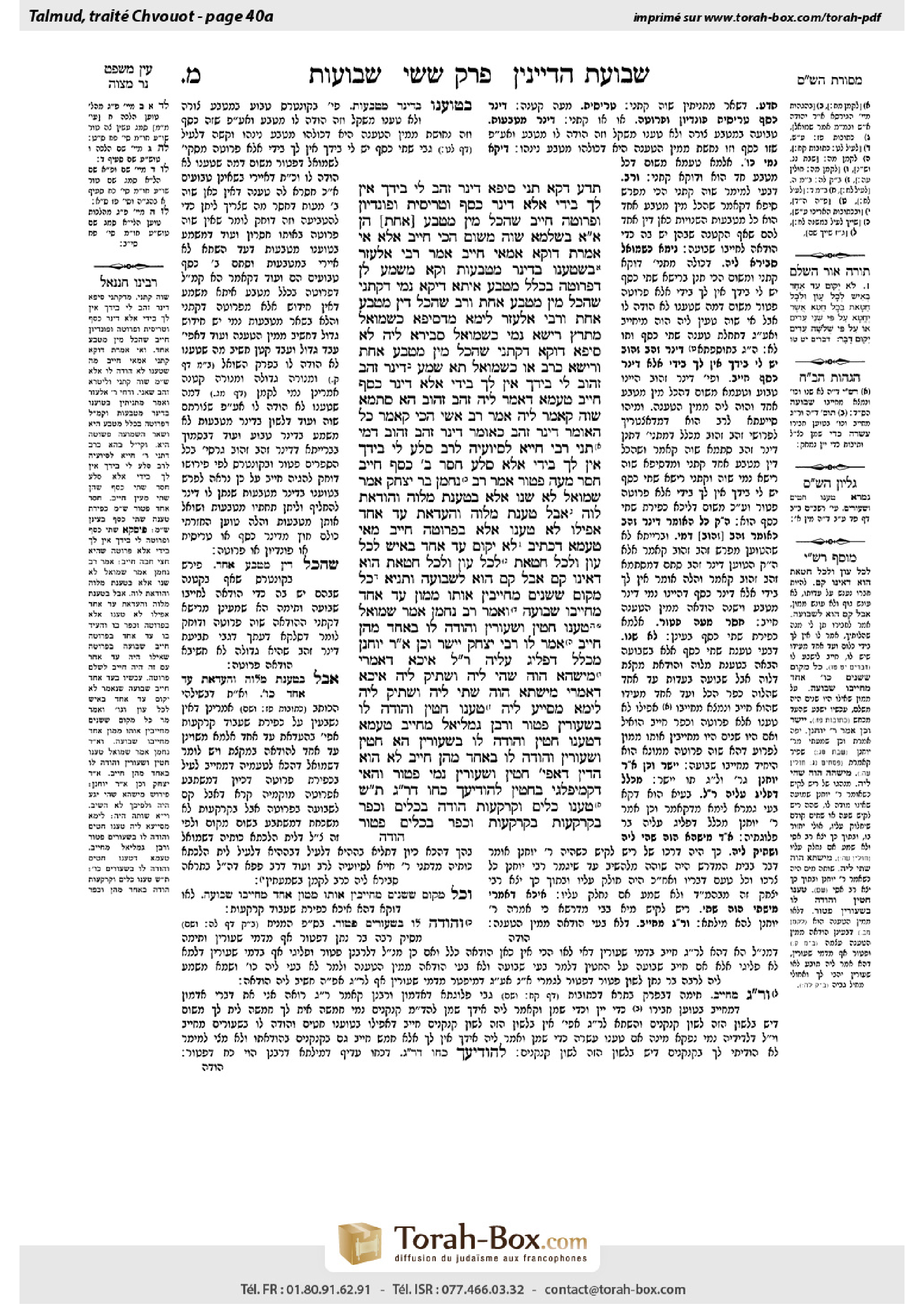
Shevuot 40a: Talmud study for Daf Yomi
Daf Yomi is the daily study of one Talmud folio. Explore 37 tractates with scans, Hebrew text, Sefaria English and AI-generated French translations where annotated.
Passage selection and English or AI-generated French translation are available where the scan has annotations. Daf Study is independent of Torah-Box and Sefaria.
Browse Shevuot · שבועות · All tractatesShevuot 40a text and translations
This page of Shevuot includes the Aramaic text, an English translation and an AI-generated French translation, alongside the scan above.
שבועות מ׳ א · Aramaic and Hebrew text
תֵּדַע, דְּקָא תָנֵי סֵיפָא: ״דִּינַר זָהָב לִי בְּיָדֶךָ״, ״אֵין לְךָ בְּיָדִי אֶלָּא דִּינָר כֶּסֶף וּטְרֵיסִית וּפוּנְדְּיוֹן וּפְרוּטָה״ – חַיָּיב, שֶׁהַכֹּל מִין מַטְבֵּעַ [אַחַת] הֵן. אִי אָמְרַתְּ בִּשְׁלָמָא שָׁוֶה – מִשּׁוּם הָכִי חַיָּיב; אֶלָּא אִי אָמְרַתְּ דַּוְקָא – אַמַּאי חַיָּיב?
אָמַר רַבִּי אֶלְעָזָר: בְּשֶׁטְּעָנוֹ בְּדִינָר מַטְבְּעוֹת, וְקָא מַשְׁמַע לַן דִּפְרוּטָה בִּכְלַל מַטְבֵּעַ אִיתָא. דַּיְקָא נָמֵי, דְּקָתָנֵי: שֶׁהַכֹּל מִין מַטְבֵּעַ אַחַת.
וְרַב – שֶׁהַכֹּל דִּין מַטְבֵּעַ אַחַת.
וְרַבִּי אֶלְעָזָר – לֵימָא מִדְּסֵיפָא כִּשְׁמוּאֵל מְתָרֵץ, רֵישָׁא נָמֵי כִּשְׁמוּאֵל סְבִירָא לֵיהּ?
לָא; סֵיפָא דַּוְקָא, דְּקָתָנֵי ״שֶׁהַכֹּל מִין מַטְבֵּעַ אַחַת״; וְרֵישָׁא – כְּרַב אוֹ כִּשְׁמוּאֵל.
תָּא שְׁמַע: ״דִּינַר זָהָב זָהוּב לִי בְּיָדֶךָ״, ״אֵין לְךָ בְּיָדִי אֶלָּא דִּינַר כֶּסֶף״ – חַיָּיב. טַעְמָא דַּאֲמַר לֵיהּ ״זָהָב זָהוּב״, הָא סְתָמָא – שָׁוֶה קָאָמַר לֵיהּ!
אָמַר רַב אָשֵׁי, הָכִי קָאָמַר: כׇּל הָאוֹמֵר ״דִּינַר זָהָב״, כְּאוֹמֵר ״דִּינַר זָהָב זָהוּב״ דָּמֵי.
תָּנֵי רַבִּי חִיָּיא לְסַיּוֹעֵיהּ לְרַב: ״סֶלַע לִי בְּיָדֶךָ״, ״אֵין לְךָ בְּיָדִי אֶלָּא סֶלַע חָסֵר שְׁתֵּי כֶּסֶף״ – חַיָּיב, ״חָסֵר מָעָה״ – פָּטוּר.
אָמַר רַב נַחְמָן בַּר יִצְחָק אָמַר שְׁמוּאֵל: לֹא שָׁנוּ אֶלָּא בְּטַעֲנַת מַלְוֶה וְהוֹדָאַת לֹוֶה; אֲבָל טַעֲנַת מַלְוֶה וְהַעֲדָאַת עֵד אֶחָד, אֲפִילּוּ לֹא טְעָנוֹ אֶלָּא בִּפְרוּטָה – חַיָּיב.
מַאי טַעְמָא? דִּכְתִיב: ״לֹא יָקוּם עֵד אֶחָד בְּאִישׁ לְכׇל עָוֹן וּלְכׇל חַטָּאת״ – לְכׇל עָוֹן וּלְכׇל חַטָּאת הוּא דְּאֵינוֹ קָם, אֲבָל קָם הוּא לִשְׁבוּעָה. וְתַנְיָא: כׇּל מָקוֹם שֶׁשְּׁנַיִם מְחַיְּיבִין אוֹתוֹ מָמוֹן, עֵד אֶחָד מְחַיְּיבוֹ שְׁבוּעָה.
וְאָמַר רַב נַחְמָן אָמַר שְׁמוּאֵל: טְעָנוֹ חִטִּין וּשְׂעוֹרִין, וְהוֹדָה לוֹ בְּאֶחָד מֵהֶן – חַיָּיב.
אָמַר לוֹ רַבִּי יִצְחָק: יִישַׁר, וְכֵן אָמַר רַבִּי יוֹחָנָן. מִכְּלָל דִּפְלִיג עֲלֵיהּ רֵישׁ לָקִישׁ? אִיכָּא דְּאָמְרִי: מִישְׁהָא הֲוָה שָׁהֵי לֵיהּ וְשָׁתֵיק לֵיהּ, אִיכָּא דְאָמְרִי: מִישְׁתָּא הֲוָה שָׁתֵי לֵיהּ וּשְׁתֵיק לֵיהּ.
לֵימָא מְסַיַּיע לֵיהּ: טְעָנוֹ חִטִּין וְהוֹדָה לוֹ בִּשְׂעוֹרִין – פָּטוּר. וְרַבָּן גַּמְלִיאֵל מְחַיֵּיב. טַעְמָא דִּטְעָנוֹ חִטִּין וְהוֹדָה לוֹ בִּשְׂעוֹרִין, הָא חִטִּין וּשְׂעוֹרִין וְהוֹדָה לוֹ בְּאֶחָד מֵהֶן – חַיָּיב!
לָא; הוּא הַדִּין דַּאֲפִילּוּ חִטִּין וּשְׂעוֹרִין נָמֵי פָּטוּר; וְהַאי דְּקָמִיפַּלְגִי בְּחִטִּין – לְהוֹדִיעֲךָ כֹּחוֹ דְּרַבָּן גַּמְלִיאֵל.
תָּא שְׁמַע: טְעָנוֹ כֵּלִים וְקַרְקָעוֹת; הוֹדָה בַּכֵּלִים וְכָפַר בַּקַּרְקָעוֹת, בְּקַרְקָעוֹת וְכָפַר בַּכֵּלִים – פָּטוּר.
Shevuot 40a · English translation
The Gemara discusses the basis for Rav’s explanation. Know that the mishna is referring to claims of monetary value, as it teaches in the latter clause that if the claimant said: I have a gold dinar in your possession, and the defendant responded: You have only a silver dinar, or a tereisit, or a pundeyon, or a peruta in my possession, he is liable to take an oath, as they are all of one type; they are all coins. Granted, if you say that the claim was for the value of a gold dinar, it is due to that reason that he is liable to take an oath, as he admitted to a part of the claim. But if you say that the claim was specifically for a dinar of gold, why is he liable? The claim was for gold, and he admitted to owing silver or copper.
The Gemara rejects this proof: Rabbi Elazar says: This mishna is referring to a case where one claimed that the defendant owes him a dinar of coins, i.e., coins worth a dinar. The claim was for specific coins, and not a monetary value. Since the claim concerned coins and not a specific weight of metal, and all coins are used for commercial transactions, all types of coins are considered of the same type. And it teaches us that a peruta is included in the category of a coin. According to this explanation, the language of the mishna is also precise, as it teaches: The defendant is liable to take an oath, as they are all of one type [min]; they are all coins. In other words, even a peruta is a type of coin.
The Gemara asks: And how would Rav, who holds that the claim in this case was for the value of a dinar, explain the fact that the mishna states: As they are all of one type; they are all coins? Why does it matter that they are all of one type? The Gemara answers that according to Rav, the reason the defendant is liable to take an oath is that because the claim is for the value of a dinar, all descriptions of monetary value based on different coins have one status under halakha [din]; they are all coins, and it is of no significance that they are made of different materials.
The Gemara asks: And concerning the opinion of Rabbi Elazar, shall we say that since he explains the latter clause in the mishna as referring to a specific item and not a value, in accordance with the opinion of Shmuel, then also with regard to the former clause, that states the claim must be for two silver ma’a, he apparently holds in accordance with the opinion of Shmuel, i.e., that it is referring to two actual ma’a, and not the value of two ma’a?
The Gemara rejects this suggestion: No, Rabbi Elazar explains that the latter clause of the mishna is referring specifically to actual items in accordance with the opinion of Shmuel, as it teaches explicitly: As they are all of one type; they are all coins. But the former clause can be interpreted either in accordance with the opinion of Rav or in accordance with the opinion of Shmuel.
The Gemara suggests: Come and hear another proof that a claim for a coin is referring to its value: It is taught in a baraita that if the claimant said: I have a coined gold dinar in your possession, and the defendant responded: You have only a silver dinar in my possession, he is liable to take an oath, as the claim and the admission are both referring to a coin. The Gemara infers: The reason this claim is referring specifically to a coin is that the claimant says to him: You owe me a coined gold dinar; but if the claim was for an unspecified gold dinar, i.e., without specifying that it was coined, the claimant is saying to him that he owes him an item with the value of a dinar, not necessarily a coin, in accordance with the opinion of Rav.
Rav Ashi said in response that according to the opinion of Shmuel, this is what the baraita is saying: Anyone who says: A gold dinar, is considered like one who says: A coined gold dinar; i.e., he is referring to the coin and not to its value.
Rabbi Ḥiyya teaches a baraita in support of the opinion of Rav: If the claimant said: I have a sela in your possession, and the defendant responded: You have only a sela minus two silver ma’a in my possession, he is liable to take an oath. If the defendant responded: I owe you only a sela minus one silver ma’a, he is exempt. Clearly, the reason is that he denied less than two ma’a of the claim, in accordance with the opinion of Rav.
§ Rav Naḥman bar Yitzḥak says that Shmuel says: The requirement that the claim be at least the value of two silver ma’a to render the defendant liable to take an oath was taught only with regard to a case where the oath is due to the claim of the creditor and the partial admission of the debtor. But in a case where the defendant’s liability to take an oath is due to the claim of the creditor and the testimony of one witness in support of the claim, even if the claimant claimed from him only one peruta, the defendant is liable to take an oath.
What is the reason for this distinction? As it is written: “One witness shall not rise up against a man for any iniquity, or for any sin” (Deuteronomy 19:15). It is inferred from here that it is for any iniquity or for any sin that he may not rise up, as the testimony of one witness is not enough for this purpose, but he may rise up to render one liable to take an oath. And it is taught in a baraita: In any place where two witnesses render a defendant liable to pay money, the testimony of one witness renders him liable to take an oath. Therefore, since two witnesses render the defendant liable to pay if the claim is worth at least one peruta, so too, one witness renders him liable to take an oath with regard to a claim of this value.
§ And Rav Naḥman says that Shmuel says: If one claimed that another owed him wheat and barley, and the defendant admitted to owing him one of these types, he is liable to take an oath, as he admitted to part of a claim.
Rabbi Yitzḥak said to him: You have spoken well, and so also said Rabbi Yoḥanan. The Gemara asks: By inference, does this mean that Reish Lakish disagrees with Rabbi Yoḥanan with regard to this matter, since Rabbi Yitzḥak mentioned that Rabbi Yoḥanan agreed, and did not reference Reish Lakish, who often engages in disputes with Rabbi Yoḥanan? The Gemara answers: There is no record of Reish Lakish expressing his opinion at that time. There are those who say that this is because he was tarrying and remaining silent, waiting for Rabbi Yoḥanan to finish his statement, and Rabbi Yitzḥak did not find out whether or not he subsequently disagreed with him, and there are those who say that Reish Lakish was drinking at the time, and he therefore remained silent and did not respond to Rabbi Yoḥanan’s statement.
Let us say that the wording of the mishna supports Shmuel’s opinion: If one claimed that another owes him wheat, and the defendant admitted to owing him barley, he is exempt; and Rabban Gamliel deems him liable to take an oath. The Gemara infers: The reason he is exempt according to the first tanna is that he claimed that he owes him wheat and the defendant admitted to owing him barley; but if the claim was for both wheat and barley, and the defendant admitted to owing him one of them, it can be inferred he is liable to take an oath.
The Gemara rejects this proof: No, it is possible that the same is true, i.e., that even if the claim was for both wheat and barley the defendant is exempt. And the fact that the mishna states that the first tanna and Rabban Gamliel disagree with regard to a case where the claim was specifically for wheat and the defendant admitted to owing him barley is in order to convey to you the far-reaching nature of the opinion of Rabban Gamliel, that the defendant is liable to take an oath even if his admission is not at all of the same type as the claim.
The Gemara suggests: Come and hear another proof from the mishna: If one claimed that another owes him vessels and land, and the defendant admitted to owing him vessels but denied the claim of land, or conversely, if he admitted to owing him land but denied the claim of vessels, he is exempt from taking an oath.
Shevuot 40a · Traduction française (IA)
La Guemara examine le fondement de l’explication de Rav. Sache que la Michna parle de revendications portant sur une valeur monétaire, puisqu’elle enseigne dans sa dernière clause que si le demandeur dit : « Tu détiens un dinar d’or qui m’appartient », et que le défendeur répond : « Tu ne détiens chez moi qu’un dinar d’argent, un tereisit, un pundeyon ou une perouta », il est tenu de prêter serment, car ils relèvent tous d’une même catégorie : ce sont toutes des pièces de monnaie. Certes, si l’on dit que la revendication portait sur la valeur d’un dinar d’or, c’est pour cette raison qu’il est tenu de prêter serment, puisqu’il a reconnu une partie de la revendication. Mais si l’on dit que la revendication portait précisément sur un dinar d’or, pourquoi est-il tenu de prêter serment ? La revendication portait sur de l’or, tandis qu’il a reconnu devoir de l’argent ou du cuivre.
La Guemara rejette cette preuve : Rabbi Elazar dit que cette Michna parle d’un cas où le demandeur a affirmé que le défendeur lui devait un dinar en pièces, c’est-à-dire des pièces valant un dinar. La revendication portait sur des pièces précises et non sur une valeur monétaire. Comme elle concernait des pièces, et non un poids déterminé de métal, et que toutes les pièces servent aux transactions commerciales, tous les types de pièces sont considérés comme relevant d’une même catégorie. La Michna nous apprend ainsi qu’une perouta relève également de la catégorie des pièces de monnaie. Selon cette explication, le libellé de la Michna est également précis, puisqu’elle enseigne : « Le défendeur est tenu de prêter serment, car elles relèvent toutes d’une même catégorie [min] ; ce sont toutes des pièces de monnaie. » Autrement dit, même une perouta est un type de pièce.
La Guemara demande : Comment Rav, qui soutient que la revendication portait ici sur la valeur d’un dinar, expliquerait-il que la Michna dise : « Elles relèvent toutes d’une même catégorie ; ce sont toutes des pièces de monnaie » ? Pourquoi importe-t-il qu’elles relèvent toutes d’une même catégorie ? La Guemara répond que, selon Rav, le défendeur est tenu de prêter serment parce que, la revendication portant sur la valeur d’un dinar, toutes les désignations de valeurs monétaires fondées sur différentes pièces ont le même statut en halakha [din] : ce sont toutes des pièces de monnaie, et le fait qu’elles soient faites de matériaux différents n’a aucune importance.
La Guemara demande : Quant à l’opinion de Rabbi Elazar, doit-on dire que, puisqu’il explique la dernière clause de la Michna comme portant sur un objet précis et non sur une valeur, conformément à l’opinion de Shmuel, il soutient également, au sujet de la première clause, qui stipule que la revendication doit porter sur deux ma’a d’argent, qu’elle est conforme à l’opinion de Shmuel, c’est-à-dire qu’elle porte sur deux ma’a réels et non sur la valeur de deux ma’a ?
La Guemara rejette cette suggestion : Non, Rabbi Elazar explique que la dernière clause de la Michna porte précisément sur des objets réels, conformément à l’opinion de Shmuel, puisqu’elle enseigne explicitement : « Elles relèvent toutes d’une même catégorie ; ce sont toutes des pièces de monnaie. » Mais la première clause peut être interprétée soit conformément à l’opinion de Rav, soit conformément à celle de Shmuel.
La Guemara suggère : Viens et entends une autre preuve que, lorsqu’on revendique une pièce, il s’agit de sa valeur : une baraïta enseigne que si le demandeur dit : « Tu détiens un dinar d’or frappé qui m’appartient », et que le défendeur répond : « Tu ne détiens chez moi qu’un dinar d’argent », il est tenu de prêter serment, car la revendication comme l’aveu portent sur une pièce. La Guemara en déduit que si la revendication porte précisément sur une pièce, c’est parce que le demandeur lui dit : « Tu me dois un dinar d’or frappé » ; mais si la revendication portait sur un dinar d’or sans autre précision, c’est-à-dire sans préciser qu’il s’agissait d’une pièce frappée, le demandeur lui réclamerait un objet d’une valeur d’un dinar, pas nécessairement une pièce, conformément à l’opinion de Rav.
Rav Ashi répondit que, selon l’opinion de Shmuel, voici ce que dit la baraïta : quiconque dit « un dinar d’or » est considéré comme disant « un dinar d’or frappé », c’est-à-dire qu’il parle de la pièce et non de sa valeur.
Rabbi Ḥiyya enseigne une baraïta à l’appui de l’opinion de Rav : si le demandeur dit : « Tu détiens un sela qui m’appartient », et que le défendeur répond : « Tu ne détiens chez moi qu’un sela moins deux ma’a d’argent », il est tenu de prêter serment. Si le défendeur répond : « Je ne te dois qu’un sela moins un ma’a d’argent », il est exempté. Il est clair que la raison est qu’il a nié moins de deux ma’a sur la revendication, conformément à l’opinion de Rav.
§ Rav Naḥman bar Yitzḥak dit au nom de Shmuel : L’exigence selon laquelle la revendication doit atteindre au moins la valeur de deux ma’a d’argent pour que le défendeur soit tenu de prêter serment ne s’applique qu’au cas où le serment est dû à la revendication du créancier et à l’aveu partiel du débiteur. Mais si le défendeur est tenu de prêter serment en raison de la revendication du créancier et du témoignage d’un témoin à l’appui de celle-ci, même si le demandeur ne lui réclame qu’une perouta, le défendeur est tenu de prêter serment.
Quelle est la raison de cette distinction ? Il est écrit : « Un seul témoin ne peut se lever contre un homme pour une faute ou pour un péché » (Deutéronome 19, 15). On en déduit qu’il ne peut se lever contre lui pour une faute ou pour un péché, car le témoignage d’un seul témoin ne suffit pas à cette fin, mais qu’il peut se lever pour obliger quelqu’un à prêter serment. Et une baraïta enseigne : Partout où deux témoins obligent un défendeur à verser de l’argent, le témoignage d’un seul témoin l’oblige à prêter serment. Par conséquent, puisque deux témoins obligent le défendeur à payer lorsque la revendication vaut au moins une perouta, de même, un seul témoin l’oblige à prêter serment pour une revendication de cette valeur.
§ Rav Naḥman dit au nom de Shmuel : Si quelqu’un affirme qu’un autre lui doit du blé et de l’orge, et que le défendeur reconnaît lui devoir l’un de ces deux types de céréales, il est tenu de prêter serment, puisqu’il a reconnu une partie de la revendication.
Rabbi Yitzḥak lui dit : « Tu as bien parlé, et Rabbi Yoḥanan a dit la même chose. » La Guemara demande : Faut-il en déduire que Reish Lakish est en désaccord avec Rabbi Yoḥanan sur ce point, puisque Rabbi Yitzḥak a mentionné l’accord de Rabbi Yoḥanan sans faire référence à Reish Lakish, qui est souvent en désaccord avec Rabbi Yoḥanan ? La Guemara répond : Rien n’indique que Reish Lakish ait exprimé son opinion à ce moment-là. Certains disent que c’est parce qu’il attendait en silence que Rabbi Yoḥanan termine son propos ; Rabbi Yitzḥak n’a donc pas su s’il était ensuite en désaccord avec lui ou non. D’autres disent que Reish Lakish était en train de boire à ce moment-là et qu’il est donc resté silencieux, sans répondre aux propos de Rabbi Yoḥanan.
Disons que le libellé de la Michna appuie l’opinion de Shmuel : si quelqu’un affirme qu’un autre lui doit du blé et que le défendeur reconnaît lui devoir de l’orge, il est exempté ; Rabban Gamliel, lui, le considère comme tenu de prêter serment. La Guemara en déduit que, selon le premier tanna, il est exempté parce qu’il a affirmé qu’on lui devait du blé et que le défendeur a reconnu lui devoir de l’orge ; mais si la revendication portait à la fois sur du blé et de l’orge et que le défendeur reconnaissait lui devoir l’un des deux, on peut en déduire qu’il est tenu de prêter serment.
La Guemara rejette cette preuve : Non, il est possible qu’il en soit de même, c’est-à-dire que même si la revendication portait à la fois sur du blé et de l’orge, le défendeur soit exempté. Si la Michna précise que le premier tanna et Rabban Gamliel sont en désaccord dans un cas où la revendication portait précisément sur du blé et où le défendeur a reconnu devoir de l’orge, c’est pour nous enseigner toute la portée de l’opinion de Rabban Gamliel : le défendeur est tenu de prêter serment même si son aveu ne relève aucunement de la même catégorie que la revendication.
La Guemara suggère : Viens et entends une autre preuve tirée de la Michna : si quelqu’un affirme qu’un autre lui doit des ustensiles et un terrain, et que le défendeur reconnaît lui devoir des ustensiles mais nie la revendication portant sur le terrain, ou inversement, s’il reconnaît lui devoir un terrain mais nie la revendication portant sur les ustensiles, il est exempté de prêter serment.
Traduction française générée par IA à partir de l’édition anglaise de Sefaria. Vérifie toujours un passage avec le texte source.
Text from Sefaria: William Davidson Edition - Vocalized Aramaic (CC BY NC); William Davidson Edition - English (CC BY NC).