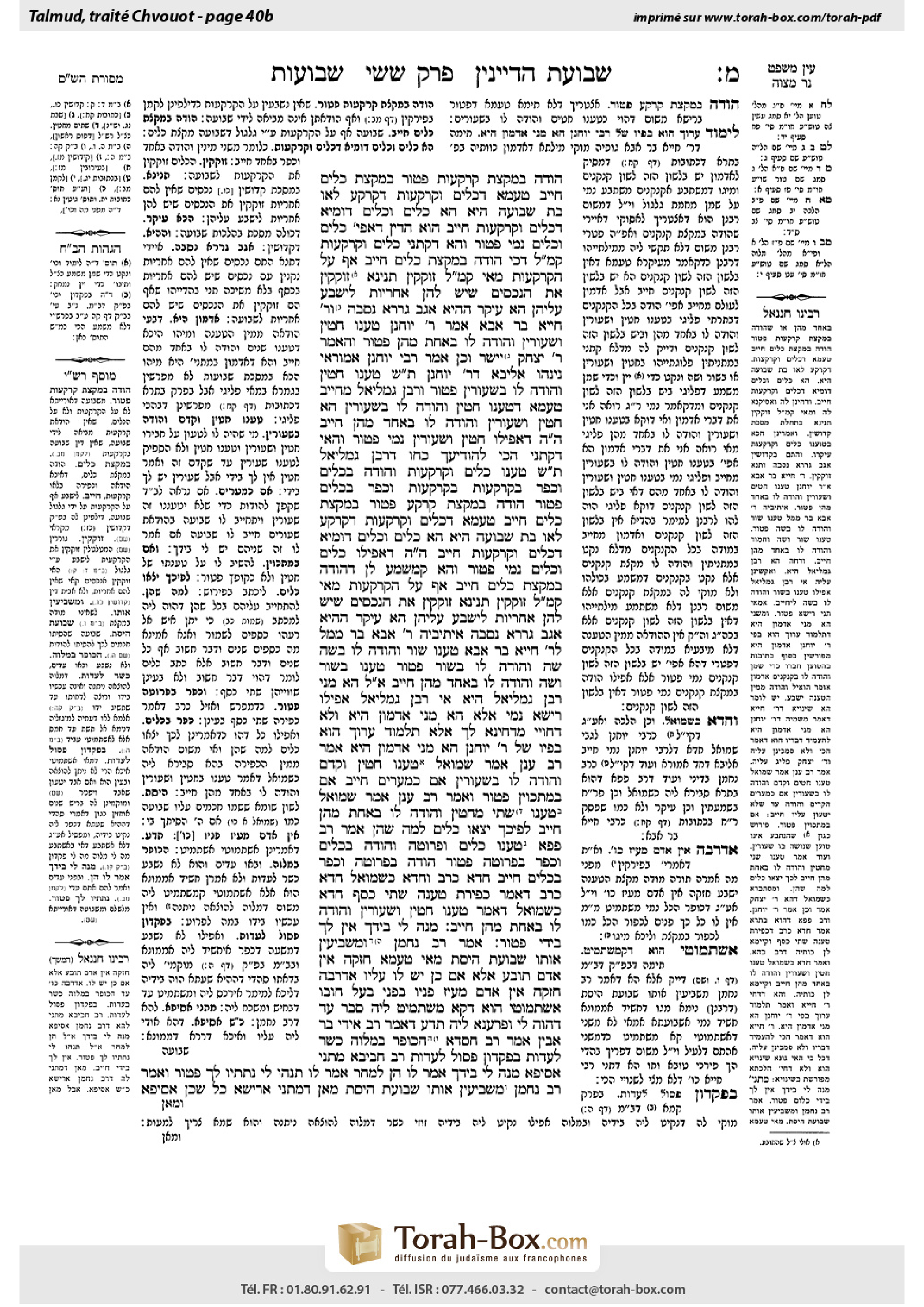
Shevuot 40b: Talmud study for Daf Yomi
Daf Yomi is the daily study of one Talmud folio. Explore 37 tractates with scans, Hebrew text, Sefaria English and AI-generated French translations where annotated.
Passage selection and English or AI-generated French translation are available where the scan has annotations. Daf Study is independent of Torah-Box and Sefaria.
Browse Shevuot · שבועות · All tractatesShevuot 40b text and translations
This page of Shevuot includes the Aramaic text, an English translation and an AI-generated French translation, alongside the scan above.
שבועות מ׳ ב · Aramaic and Hebrew text
הוֹדָה בְּמִקְצָת קַרְקָעוֹת – פָּטוּר. בְּמִקְצָת כֵּלִים – חַיָּיב.
טַעְמָא דְּכֵלִים וְקַרְקָעוֹת – דְּקַרְקַע לָאו בַּת שְׁבוּעָה הִיא; הָא כֵּלִים וְכֵלִים דּוּמְיָא דְּכֵלִים וְקַרְקָעוֹת – חַיָּיב!
הוּא הַדִּין דַּאֲפִילּוּ כֵּלִים וְכֵלִים נָמֵי פָּטוּר; וְהָא דְּקָתָנֵי כֵּלִים וְקַרְקָעוֹת – קָא מַשְׁמַע לַן דְּכִי הוֹדָה בְּמִקְצָת כֵּלִים, חַיָּיב אַף עַל הַקַּרְקָעוֹת.
מַאי קָא מַשְׁמַע לַן? זוֹקְקִין?! תְּנֵינָא: ״זוֹקְקִין אֶת הַנְּכָסִים שֶׁיֵּשׁ לָהֶן אַחְרָיוּת לִישָּׁבַע עֲלֵיהֶן״!
הָא עִיקָּר, הָהִיא אַגַּב גְּרָרָא נַסְבַהּ.
וְרַבִּי חִיָּיא בַּר אַבָּא אָמַר רַבִּי יוֹחָנָן: טְעָנוֹ חִטִּין וּשְׂעוֹרִין, וְהוֹדָה לוֹ בְּאַחַת מֵהֶן – פָּטוּר. וְהָאָמַר רַבִּי יִצְחָק: יִישַׁר, וְכֵן אָמַר רַבִּי יוֹחָנָן! אָמוֹרָאֵי נִינְהוּ אַלִּיבָּא דְּרַבִּי יוֹחָנָן.
תָּא שְׁמַע: טְעָנוֹ חִטִּין וְהוֹדָה לוֹ בִּשְׂעוֹרִין – פָּטוּר, וְרַבָּן גַּמְלִיאֵל מְחַיֵּיב. טַעְמָא דִּטְעָנוֹ חִטִּין וְהוֹדָה לוֹ בִּשְׂעוֹרִין; הָא חִטִּין וּשְׂעוֹרִין וְהוֹדָה לוֹ בְּאֶחָד מֵהֶן – חַיָּיב!
הוּא הַדִּין דַּאֲפִילּוּ חִטִּין וּשְׂעוֹרִין נָמֵי פָּטוּר, וְהַאי דְּקָתָנֵי הָכִי – לְהוֹדִיעֲךָ כֹּחוֹ דְּרַבָּן גַּמְלִיאֵל.
תָּא שְׁמַע: טְעָנוֹ כֵּלִים וְקַרְקָעוֹת; וְהוֹדָה בַּכֵּלִים וְכָפַר בַּקַּרְקָעוֹת, בְּקַרְקָעוֹת וְכָפַר בַּכֵּלִים – פָּטוּר. הוֹדָה בְּמִקְצָת קַרְקַע – פָּטוּר. בְּמִקְצָת כֵּלִים – חַיָּיב. טַעְמָא דְּכֵלִים וְקַרְקָעוֹת – דְּקַרְקַע לָאו בַּת שְׁבוּעָה הִיא; הָא כֵּלִים וְכֵלִים דּוּמְיָא דְּכֵלִים וְקַרְקָעוֹת – חַיָּיב!
הוּא הַדִּין דַּאֲפִילּוּ כֵּלִים וְכֵלִים נָמֵי פָּטוּר; וְהָא קָמַשְׁמַע לַן – דְּהוֹדָה בְּמִקְצָת כֵּלִים, חַיָּיב אַף עַל הַקַּרְקָעוֹת. מַאי קָא מַשְׁמַע לַן? זוֹקְקִין?! תְּנֵינָא: זוֹקְקִין אֶת הַנְּכָסִים שֶׁיֵּשׁ לָהֶן אַחְרָיוּת, לִישָּׁבַע עֲלֵיהֶן! הָא עִיקָּר, הָהִיא אַגַּב גְּרָרָא נַסְבַהּ.
אֵיתִיבֵיהּ רַבִּי אַבָּא בַּר מֶמֶל לְרַבִּי חִיָּיא בַּר אַבָּא: טְעָנוֹ שׁוֹר וְהוֹדָה לוֹ בְּשֶׂה, שֶׂה וְהוֹדָה לוֹ בְּשׁוֹר – פָּטוּר. טְעָנוֹ בְּשׁוֹר וָשֶׂה וְהוֹדָה לוֹ בְּאֶחָד מֵהֶן – חַיָּיב.
אֲמַר לֵיהּ: הָא מַנִּי – רַבָּן גַּמְלִיאֵל הִיא. אִי רַבָּן גַּמְלִיאֵל, אֲפִילּוּ רֵישָׁא נָמֵי!
אֶלָּא הָא מַנִּי – אַדְמוֹן הִיא; וְלָא דַּחוֹיֵי מְדַחֵינָא לָךְ, אֶלָּא תַּלְמוּד עָרוּךְ הוּא בְּפִיו שֶׁל רַבִּי יוֹחָנָן: הָא מַנִּי – אַדְמוֹן הִיא.
אָמַר רַב עָנָן אָמַר שְׁמוּאֵל: טְעָנוֹ חִטִּין, וְקָדַם וְהוֹדָה לוֹ בִּשְׂעוֹרִין – אִם כְּמַעֲרִים, חַיָּיב. אִם בְּמִתְכַּוֵּין, פָּטוּר.
וְאָמַר רַב עָנָן אָמַר שְׁמוּאֵל: טְעָנוֹ שְׁתֵּי מְחָטִין וְהוֹדָה לוֹ בְּאַחַת מֵהֶן – חַיָּיב; לְפִיכָךְ יָצְאוּ כֵּלִים לְמָה שֶׁהֵן.
אָמַר רַב פָּפָּא: טְעָנוֹ כֵּלִים וּפְרוּטָה, וְהוֹדָה בַּכֵּלִים וְכָפַר בַּפְּרוּטָה – פָּטוּר. הוֹדָה בַּפְּרוּטָה וְכָפַר בַּכֵּלִים – חַיָּיב.
חֲדָא כְּרַב, וַחֲדָא כִּשְׁמוּאֵל. חֲדָא כְּרַב – דְּאָמַר: כְּפִירַת טַעֲנָה שְׁתֵּי כֶּסֶף. חֲדָא כִּשְׁמוּאֵל – דְּאָמַר: טְעָנוֹ חִטִּין וּשְׂעוֹרִין וְהוֹדָה לוֹ בְּאַחַת מֵהֶן – חַיָּיב.
״מָנֶה לִי בְּיָדֶךָ״, ״אֵין לְךָ בְּיָדִי״ – פָּטוּר. אָמַר רַב נַחְמָן: וּמַשְׁבִּיעִין אוֹתוֹ שְׁבוּעַת הֶיסֵּת. מַאי טַעְמָא? חֲזָקָה אֵין אָדָם תּוֹבֵעַ, אֶלָּא אִם כֵּן יֵשׁ לוֹ עָלָיו.
אַדְּרַבָּה, חֲזָקָה אֵין אָדָם מֵעִיז פָּנָיו בִּפְנֵי בַּעַל חוֹבוֹ! אִשְׁתְּמוֹטֵי הוּא דְּקָא מִשְׁתְּמִיט לֵיהּ, סָבַר: עַד דְּהָוֵי לִי וּפָרַעְנָא לֵיהּ.
תִּדַּע, דְּאָמַר רַב אִידִי בַּר אָבִין אָמַר רַב חִסְדָּא: הַכּוֹפֵר בְּמִלְוֶה – כָּשֵׁר לְעֵדוּת. בְּפִקָּדוֹן – פָּסוּל לְעֵדוּת.
רַב חֲבִיבָא מַתְנֵי אַסֵּיפָא – ״מָנֶה לִי בְּיָדֶךָ״, אָמַר לוֹ ״הֵן״; לְמָחָר אָמַר לוֹ ״תְּנֵהוּ לִי״, ״נְתַתִּיו לָךְ״ – פָּטוּר. וְאָמַר רַב נַחְמָן: מַשְׁבִּיעִין אוֹתוֹ שְׁבוּעַת הֶיסֵּת.
מַאן דְּמַתְנֵי אַרֵישָׁא – כׇּל שֶׁכֵּן אַסֵּיפָא;
Shevuot 40b · English translation
If he admitted to part of the claim about the land, he is exempt. If he admitted to part of the claim about the vessels, he is liable to take an oath.
The Gemara infers: The reason he is exempt in the first cases is that the claim was for vessels and land, as a claim with regard to land is not subject to an oath; but if the claim was for vessels of one type and vessels of another type, or for wheat and barley, similar to the case of a claim for vessels and land in that the defendant admitted to owing one type and denied owing the other type, he is liable to take an oath.
The Gemara rejects the inference: No, it is possible that the same is true, i.e., that even if the claim was for vessels of one type and vessels of another type, and the defendant admitted to owing one type and denied owing the other type, he is exempt. And the reason that the mishna teaches specifically the case where the claim is for vessels and land is that this teaches us that in a case where the defendant admitted to a part of the claim with regard to the vessels, he is liable to take an oath concerning the land as well.
The Gemara asks: What is this teaching us? Does it teach the halakha that an admission to a part of the claim about vessels also binds the land to the oath? We learn this in a mishna in tractate Kiddushin (26a): When there is a claim against a person for movable property and land, and he is liable to take an oath concerning the movable property, the movable property binds the property that serves as a guarantee, i.e., land, so that he is forced to take an oath concerning it too.
The Gemara answers: This mishna is the primary reference to this halakha, as it discusses the halakhot of oaths, whereas that mishna cites it incidentally, in the context of a broader survey of the difference between these two types of property.
And Rabbi Ḥiyya bar Abba disagrees with Shmuel and says that Rabbi Yoḥanan says: If one claimed that another owes him both wheat and barley, and the latter admitted to owing him one of them, he is exempt from taking an oath. The Gemara asks: But doesn’t Rabbi Yitzḥak say to Rav Naḥman: You have spoken well in the name of Shmuel, i.e., in saying that the defendant is liable to take an oath in the aforementioned case; and so also said Rabbi Yoḥanan? If so, Rabbi Yoḥanan agrees with Shmuel, and not with Rabbi Ḥiyya bar Abba. The Gemara answers: They are amora’im, and they disagree with regard to the opinion of Rabbi Yoḥanan.
The Gemara suggests: Come and hear a proof against the opinion of Rabbi Ḥiyya bar Abba from the mishna: If one claimed that another owes him wheat, and the defendant admitted to owing him barley, he is exempt; and Rabban Gamliel deems him liable to take an oath. The Gemara infers: The reason he is exempt is that he claimed that he owes him wheat and the defendant admitted to owing him barley; but if the claim was for both wheat and barley, and the defendant admitted to owing him one of them, he would be liable to take an oath.
The Gemara rejects this proof: It is possible that the same is true, i.e., that even if the claim was for both wheat and barley the defendant is exempt. And the fact that the mishna teaches specifically this case, where the claim was specifically for wheat, is in order to convey to you the far-reaching nature of the opinion of Rabban Gamliel, as he holds that even in this case one is liable to take an oath.
The Gemara suggests: Come and hear another proof from the mishna: If one claimed that another owes him vessels and land, and the defendant admitted to owing him vessels but denied the claim of land, or if he admitted to owing him land but denied the claim of vessels, he is exempt from taking an oath. If he admitted to part of the claim with regard to the land, he is exempt. If he admitted to part of the claim with regard to the vessels, he is liable to take an oath. The Gemara infers: The reason he is exempt in the first cases is that the claim was for vessels and land, as a claim with regard to land is not subject to an oath; but if the claim was for vessels of one type and vessels of another type, similar to the case of a claim for vessels and land in that the defendant admitted to owing one type and denied owing the other type, he is liable to take an oath.
The Gemara rejects this: It is possible that the same is true, that even if the claim was for vessels of one type and vessels of another type he is exempt. And the mishna teaches specifically the case where the claim is for vessels and land because this teaches us that if the defendant admitted to a part of the claim with regard to the vessels, he is liable to take an oath concerning the land as well. The Gemara asks: What is this teaching us? Does it teach the halakha that an admission to part of the claim about vessels also binds the land to the oath? We learn this in a mishna in tractate Kiddushin (26a): The movable property binds the property that serves as a guarantee, so that he is forced to take an oath concerning it too. The Gemara answers: This mishna is the primary reference to this halakha, whereas that mishna cites it incidentally.
Rabbi Abba bar Memel raised an objection to the opinion of Rabbi Ḥiyya bar Abba from a baraita: If one claimed that another owes him an ox, and the latter admitted to owing him a sheep, or conversely, if the claim was for a sheep and the defendant admitted to owing him an ox, he is exempt from taking an oath. If one claimed that another owes him an ox and a sheep, and the defendant admitted to owing him one of them, he is liable to take an oath.
Rabbi Ḥiyya bar Abba said to him in response: In accordance with whose opinion is this baraita? It is in accordance with the opinion of Rabban Gamliel, who deems the defendant liable to take an oath even if his admission was not of the same type of item as the claim. Rabbi Abba bar Memel responded: If it is in accordance with the opinion of Rabban Gamliel, the defendant should be liable to take an oath even in the first clause of the baraita, where the claim is for an ox and the admission is with regard to a sheep.
Rabbi Ḥiyya bar Abba explained: Rather, in accordance with whose opinion is this? It is in accordance with the opinion of Admon, who holds that the admission must be of the same type as the claim, and maintains nevertheless that in a case where one claims that another owes him jugs of oil, and the latter admits that he owes him jugs, but not the oil, the defendant is liable to take an oath (see 38b). And I am not dismissing your objection insubstantially; rather, it is a set tradition in the mouth of Rabbi Yoḥanan, who would say: In accordance with whose opinion is this baraita? It is in accordance with the opinion of Admon.
§ Rav Anan says that Shmuel says: If one intended to claim from another wheat and barley, and claimed that he owes him wheat, and before he finished his claim, the defendant first admitted that he owes him barley, in this case, if the defendant did so as one who employs artifice, so that he would be exempt from taking an oath concerning the wheat, he is liable to take an oath. But if he did so as one who intends to respond to the claim, without any ulterior motive, he is exempt.
And Rav Anan says that Shmuel says: If one claimed that another owes him two needles, and the latter admitted to owing him one of them, he is liable to take an oath. It is for this reason that vessels were singled out in the verse, to teach that one is liable to take an oath in a case of admission to part of a claim involving vessels of any value.
Rav Pappa says: If one claimed that another owes him vessels and also one peruta, and the latter admitted to owing him the vessels but denied the claim that he owes him the peruta, he is exempt from taking an oath. If he admitted that he owes him one peruta but denied the claim that he owes him the vessels, he is liable to take an oath.
The Gemara comments: One of these rulings is in accordance with the opinion of Rav, and the other one is in accordance with the opinion of Shmuel. The former one, that if the defendant denied owing the peruta he is exempt, is in accordance with the opinion of Rav, who says that the denial of a claim must be of least the value of two silver ma’a in order to render the defendant liable to take an oath. The latter one, that if he denied owing the vessels he is liable to take an oath, is in accordance with the opinion of Shmuel, who says that if one claimed that another owes him both wheat and barley, and the latter admitted to owing him one of them, he is liable to take an oath.
§ The mishna teaches that if the claimant said: I have one hundred dinars in your possession, and the defendant responded: Nothing of yours is in my possession, he is exempt. Rav Naḥman says: And the court administers an oath of inducement [heisset], an oath instituted by the Sages, to him. What is the reason? There is a presumption that one does not make a claim unless he has a valid case against the other party. Therefore, even though there is no admission to part of the claim, the defendant’s denial should be examined through an oath.
The Gemara objects: On the contrary; there is a presumption that a person does not exhibit insolence by lying in the presence of his creditor to deny the entire debt. Therefore, the defendant’s denial of the entire claim suggests that he is telling the truth. The Gemara answers that a debtor’s categorical denial is not necessarily out of insolence; he may be temporarily avoiding paying him. He rationalizes doing so by saying to himself: I am avoiding him only until the time that I have enough money, and then I will repay him.
Know that denial of a debt is not considered an outright lie, as Rav Idi bar Avin says that Rav Ḥisda says: One who denies a claim with regard to a loan is fit to bear witness even if his denial is proven untrue. By contrast, one who denies a claim with regard to a deposit and is proven to be lying is disqualified from bearing witness. The distinction is clearly based on the aforementioned reasoning: A debtor who denies the debt may be avoiding payment until he has enough money, whereas a bailee who denies having been given a deposit clearly intends to steal the item.
Rav Ḥaviva teaches Rav Naḥman’s statement as referring to the latter clause in the mishna: If one said to another: I have one hundred dinars in your possession, and the latter said to him: Yes, and the next day the claimant said to him: Give the money to me, and the defendant responded: I already gave it to you, he is exempt. And Rav Naḥman says: Nevertheless, the court administers an oath of inducement to him.
The Gemara explains the difference between the two versions of Rav Naḥman’s statement: With regard to the one who teaches it in reference to the former clause, where the defendant denied the existence of the debt, all the more so does this amora agree that an oath of inducement is administered in the case of the latter clause, where the defendant admitted to the existence of the debt, and merely claimed that he paid it.
Shevuot 40b · Traduction française (IA)
S’il a reconnu une partie de la réclamation concernant le terrain, il est exempt. S’il a reconnu une partie de la réclamation concernant les ustensiles, il est tenu de prêter serment.
La Guemara déduit que, s’il est exempt dans les premiers cas, c’est parce que la réclamation portait sur des ustensiles et un terrain, car une réclamation concernant un terrain n’est pas soumise au serment. Mais si la réclamation portait sur des ustensiles d’un type et des ustensiles d’un autre type, ou sur du blé et de l’orge — comme dans le cas d’une réclamation portant sur des ustensiles et un terrain, en ce que le défendeur reconnaît devoir un type de bien et nie devoir l’autre — il est tenu de prêter serment.
La Guemara rejette cette déduction : non, il est possible qu’il en soit de même, c’est-à-dire que même si la réclamation portait sur des ustensiles d’un type et des ustensiles d’un autre type, et que le défendeur ait reconnu devoir l’un et nié devoir l’autre, il soit exempt. Si la Michna enseigne précisément le cas où la réclamation porte sur des ustensiles et un terrain, c’est pour nous apprendre que, lorsque le défendeur a reconnu une partie de la réclamation concernant les ustensiles, il est également tenu de prêter serment au sujet du terrain.
La Guemara demande : Que nous apprend-on ici ? Est-ce la halakha selon laquelle reconnaître une partie de la réclamation concernant des ustensiles entraîne aussi le terrain dans le serment ? Nous l’apprenons dans une Michna du traité Kiddouchin (26a) : lorsqu’une personne fait l’objet d’une réclamation portant sur des biens mobiliers et un terrain, et qu’elle est tenue de prêter serment au sujet des biens mobiliers, ceux-ci entraînent avec eux les biens servant de garantie, c’est-à-dire le terrain, de sorte qu’elle est également tenue de prêter serment à son sujet.
La Guemara répond : cette Michna est la source principale de cette halakha, car elle traite des lois relatives aux serments, tandis que l’autre la mentionne incidemment, dans le cadre d’un exposé plus général des différences entre ces deux catégories de biens.
Rabbi Ḥiyya bar Abba est en désaccord avec Shmuel et rapporte au nom de Rabbi Yoḥanan : si quelqu’un réclame à un autre du blé et de l’orge, et que ce dernier reconnaît lui devoir l’un des deux, il est exempt de prêter serment. La Guemara demande : Mais Rabbi Yitzḥak ne dit-il pas à Rav Naḥman : « Tu as bien parlé au nom de Shmuel », c’est-à-dire en disant que le défendeur est tenu de prêter serment dans le cas susmentionné ? Rabbi Yoḥanan a lui aussi dit la même chose. Si tel est le cas, Rabbi Yoḥanan est d’accord avec Shmuel et non avec Rabbi Ḥiyya bar Abba. La Guemara répond : Ce sont des amoraïm qui sont en désaccord sur l’opinion de Rabbi Yoḥanan.
La Guemara propose : Viens et entends une preuve contre l’opinion de Rabbi Ḥiyya bar Abba, tirée de la Michna : si quelqu’un réclame à un autre du blé et que le défendeur reconnaît lui devoir de l’orge, il est exempt ; Rabban Gamliel le tient pour tenu de prêter serment. La Guemara déduit que s’il est exempt, c’est parce qu’on lui a réclamé du blé et que le défendeur a reconnu lui devoir de l’orge. Mais si la réclamation portait à la fois sur du blé et de l’orge et que le défendeur reconnaissait lui devoir l’un des deux, il serait tenu de prêter serment.
La Guemara rejette cette preuve : il est possible qu’il en soit de même, c’est-à-dire que même si la réclamation portait à la fois sur du blé et de l’orge, le défendeur soit exempt. Si la Michna enseigne précisément le cas où la réclamation portait uniquement sur du blé, c’est pour faire ressortir jusqu’où va l’opinion de Rabban Gamliel, qui considère que même dans ce cas, le défendeur est tenu de prêter serment.
La Guemara propose : Viens et entends une autre preuve tirée de la Michna : si quelqu’un réclame à un autre des ustensiles et un terrain, et que le défendeur reconnaît devoir les ustensiles mais conteste la réclamation concernant le terrain, ou s’il reconnaît devoir le terrain mais conteste la réclamation concernant les ustensiles, il est exempt de prêter serment. S’il a reconnu une partie de la réclamation concernant le terrain, il est exempt. S’il a reconnu une partie de la réclamation concernant les ustensiles, il est tenu de prêter serment. La Guemara déduit que s’il est exempt dans les premiers cas, c’est parce que la réclamation portait sur des ustensiles et un terrain, car une réclamation concernant un terrain n’est pas soumise au serment. Mais si la réclamation portait sur des ustensiles d’un type et des ustensiles d’un autre type — comme dans le cas d’une réclamation portant sur des ustensiles et un terrain, en ce que le défendeur reconnaît devoir un type de bien et nie devoir l’autre — il est tenu de prêter serment.
La Guemara rejette cette déduction : il est possible qu’il en soit de même, c’est-à-dire que même si la réclamation portait sur des ustensiles d’un type et des ustensiles d’un autre type, le défendeur soit exempt. Si la Michna enseigne précisément le cas où la réclamation porte sur des ustensiles et un terrain, c’est pour nous apprendre que, lorsque le défendeur reconnaît une partie de la réclamation concernant les ustensiles, il est également tenu de prêter serment au sujet du terrain. La Guemara demande : Que nous apprend-on ici ? Est-ce la halakha selon laquelle reconnaître une partie de la réclamation concernant des ustensiles entraîne aussi le terrain dans le serment ? Nous l’apprenons dans une Michna du traité Kiddouchin (26a) : les biens mobiliers entraînent avec eux les biens servant de garantie, de sorte que le défendeur est également tenu de prêter serment à leur sujet. La Guemara répond : cette Michna est la source principale de cette halakha, tandis que l’autre la mentionne incidemment.
Rabbi Abba bar Memel soulève une objection contre l’opinion de Rabbi Ḥiyya bar Abba à partir d’une baraïta : si quelqu’un réclame à un autre un bœuf et que ce dernier reconnaît lui devoir un mouton, ou inversement, si la réclamation porte sur un mouton et que le défendeur reconnaît lui devoir un bœuf, il est exempt de prêter serment. Si quelqu’un réclame à un autre un bœuf et un mouton, et que le défendeur reconnaît lui devoir l’un des deux, il est tenu de prêter serment.
Rabbi Ḥiyya bar Abba lui répond : De l’opinion de qui relève cette baraïta ? De celle de Rabban Gamliel, qui tient le défendeur pour tenu de prêter serment même lorsque sa reconnaissance ne porte pas sur un bien du même type que celui qui fait l’objet de la réclamation. Rabbi Abba bar Memel réplique : si elle relève de l’opinion de Rabban Gamliel, le défendeur devrait être tenu de prêter serment même dans la première partie de la baraïta, où la réclamation porte sur un bœuf et la reconnaissance sur un mouton.
Rabbi Ḥiyya bar Abba explique : alors, de l’opinion de qui relève cette baraïta ? De celle d’Admon, qui considère que la reconnaissance doit porter sur un bien du même type que celui qui fait l’objet de la réclamation, mais soutient néanmoins que, lorsqu’on réclame à quelqu’un des cruches d’huile et que celui-ci reconnaît devoir les cruches, mais pas l’huile, le défendeur est tenu de prêter serment (voir 38b). Et je ne rejette pas ton objection à la légère ; c’est au contraire une tradition établie rapportée par Rabbi Yoḥanan, qui disait : « De l’opinion de qui relève cette baraïta ? De celle d’Admon. »
§ Rav Anan rapporte au nom de Shmuel : si quelqu’un avait l’intention de réclamer à un autre du blé et de l’orge, mais ne lui réclame d’abord que du blé, et qu’avant qu’il ait achevé sa réclamation le défendeur reconnaît devoir de l’orge, dans ce cas, si le défendeur agit ainsi par ruse afin d’être exempt du serment concernant le blé, il est tenu de prêter serment. Mais s’il agit ainsi pour répondre à la réclamation, sans arrière-pensée, il est exempt.
Rav Anan rapporte également au nom de Shmuel : si quelqu’un réclame à un autre deux aiguilles et que ce dernier reconnaît lui en devoir une, il est tenu de prêter serment. C’est pour cette raison que les ustensiles sont mentionnés spécifiquement dans le verset : pour enseigner qu’on est tenu de prêter serment lorsqu’on reconnaît une partie d’une réclamation portant sur des ustensiles, quelle que soit leur valeur.
Rav Pappa dit : si quelqu’un réclame à un autre des ustensiles ainsi qu’une pérouta, et que ce dernier reconnaît lui devoir les ustensiles mais conteste la réclamation concernant la pérouta, il est exempt de prêter serment. S’il reconnaît lui devoir une pérouta mais conteste la réclamation concernant les ustensiles, il est tenu de prêter serment.
La Guemara commente : l’une de ces décisions suit l’opinion de Rav, et l’autre celle de Shmuel. La première, selon laquelle le défendeur est exempt s’il nie devoir la pérouta, suit l’opinion de Rav, qui dit que pour que le défendeur soit tenu de prêter serment, la valeur de la créance contestée doit être d’au moins deux ma’a d’argent. La seconde, selon laquelle il est tenu de prêter serment s’il nie devoir les ustensiles, suit l’opinion de Shmuel, qui dit que si quelqu’un réclame à un autre du blé et de l’orge et que ce dernier reconnaît lui devoir l’un des deux, il est tenu de prêter serment.
§ La Michna enseigne que si le demandeur dit : « J’ai cent dinars en ta possession », et que le défendeur répond : « Je n’ai rien qui t’appartienne en ma possession », il est exempt. Rav Naḥman dit : le tribunal lui fait néanmoins prêter le serment d’induction [heisset], un serment institué par les Sages. Pour quelle raison ? On présume qu’on ne formule pas de réclamation contre quelqu’un sans avoir une cause valable à faire valoir contre lui. Par conséquent, même s’il n’y a pas reconnaissance d’une partie de la réclamation, le démenti du défendeur doit être vérifié par un serment.
La Guemara objecte : au contraire, on présume qu’une personne ne fait pas preuve d’insolence en mentant en présence de son créancier pour nier la totalité de sa dette. Le démenti de la totalité de la réclamation par le défendeur laisse donc penser qu’il dit la vérité. La Guemara répond qu’un débiteur qui nie catégoriquement n’agit pas nécessairement par insolence ; il peut chercher à éviter temporairement de payer. Il se justifie en se disant : « Je ne fais que l’éviter jusqu’à ce que j’aie assez d’argent, et alors je le rembourserai. »
Sache que nier une dette n’est pas considéré comme un mensonge pur et simple, car Rav Idi bar Avin rapporte au nom de Rav Ḥisda : celui qui nie une réclamation concernant un prêt est apte à témoigner, même si son démenti est prouvé faux. En revanche, celui qui nie une réclamation concernant un dépôt et dont le mensonge est établi est disqualifié pour témoigner. La distinction repose clairement sur le raisonnement susmentionné : un débiteur qui nie sa dette peut chercher à éviter de payer jusqu’à ce qu’il ait assez d’argent, tandis qu’un dépositaire qui nie avoir reçu un dépôt entend clairement dérober l’objet.
Rav Ḥaviva rapporte la déclaration de Rav Naḥman comme se référant à la seconde partie de la Michna : si quelqu’un dit à un autre : « J’ai cent dinars en ta possession », et que celui-ci lui répond : « Oui », puis que, le lendemain, le demandeur lui dit : « Rends-moi l’argent », et que le défendeur répond : « Je te l’ai déjà rendu », il est exempt. Rav Naḥman dit : néanmoins, le tribunal lui fait prêter le serment d’induction.
La Guemara explique la différence entre les deux versions de la déclaration de Rav Naḥman : selon celui qui la rapporte à propos de la première partie, où le défendeur nie l’existence de la dette, cet amora reconnaît à plus forte raison qu’un serment d’induction est administré dans le cas de la seconde partie, où le défendeur reconnaît l’existence de la dette et prétend seulement l’avoir remboursée.
Traduction française générée par IA à partir de l’édition anglaise de Sefaria. Vérifie toujours un passage avec le texte source.
Text from Sefaria: William Davidson Edition - Vocalized Aramaic (CC BY NC); William Davidson Edition - English (CC BY NC).