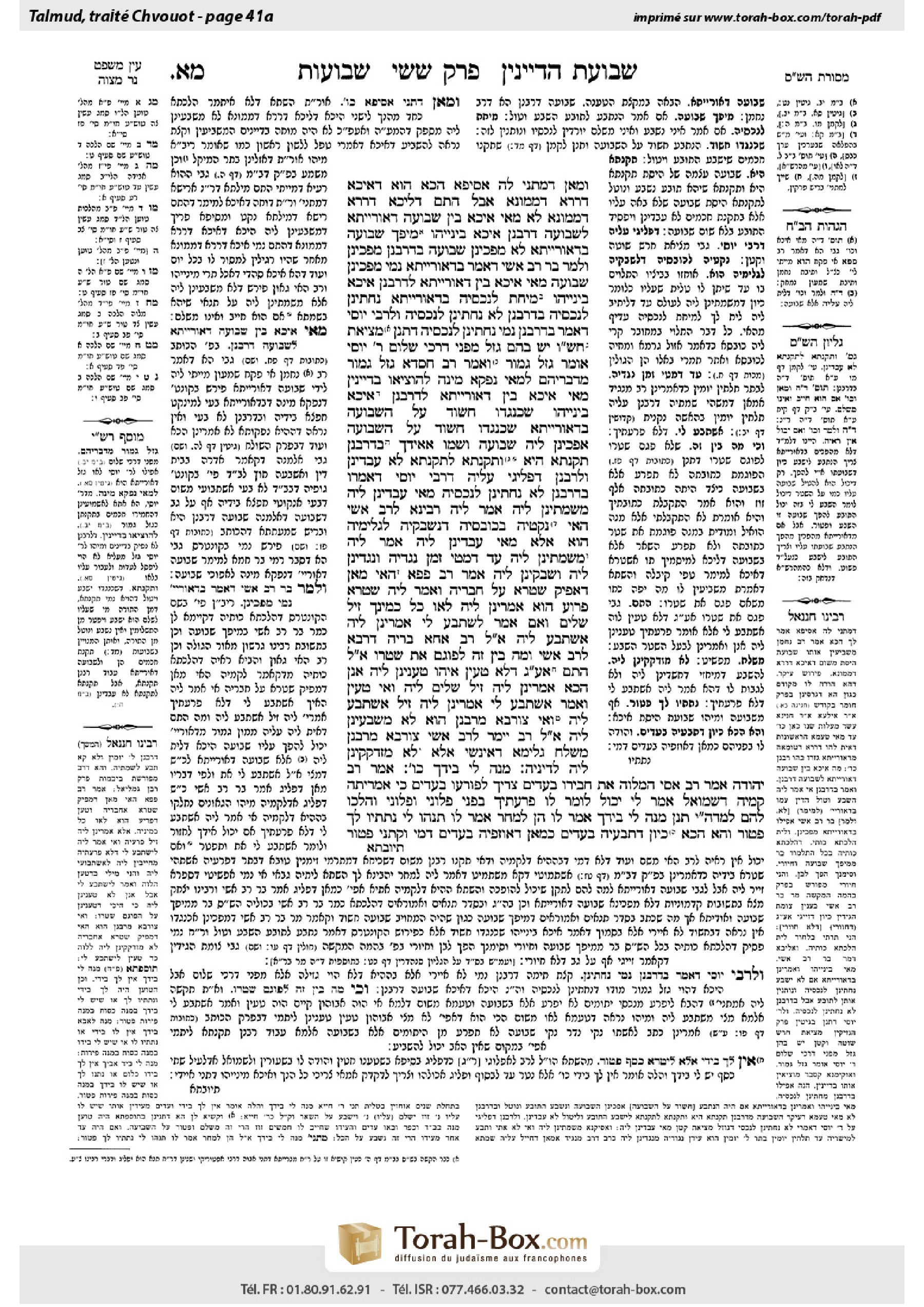
Shevuot 41a: Talmud study for Daf Yomi
Daf Yomi is the daily study of one Talmud folio. Explore 37 tractates with scans, Hebrew text, Sefaria English and AI-generated French translations where annotated.
Passage selection and English or AI-generated French translation are available where the scan has annotations. Daf Study is independent of Torah-Box and Sefaria.
Browse Shevuot · שבועות · All tractatesShevuot 41a text and translations
This page of Shevuot includes the Aramaic text, an English translation and an AI-generated French translation, alongside the scan above.
שבועות מ״א א · Aramaic and Hebrew text
וּמַאן דְּמַתְנֵי לַהּ אַסֵּיפָא – הָכָא הוּא דְּאִיכָּא דְּרָרָא דְמָמוֹנָא, אֲבָל הָתָם דְּלֵיכָּא דְּרָרָא דְמָמוֹנָא – לָא.
מַאי אִיכָּא בֵּין שְׁבוּעָה דְּאוֹרָיְיתָא לִשְׁבוּעָה דְּרַבָּנַן? אִיכָּא בֵּינַיְיהוּ מֵיפָךְ שְׁבוּעָה – בִּדְאוֹרָיְיתָא לָא מַפְּכִינַן שְׁבוּעָה, בִּדְרַבָּנַן מַפְּכִינַן.
וּלְמָר בַּר רַב אָשֵׁי, דְּאָמַר בִּדְאוֹרָיְיתָא נָמֵי מַפְּכִינַן שְׁבוּעָה – מַאי אִיכָּא בֵּין דְּאוֹרָיְיתָא לִדְרַבָּנַן? אִיכָּא בֵּינַיְיהוּ מֵיחַת לְנִכְסֵיהּ – בִּדְאוֹרָיְיתָא נָחֲתִינַן לְנִכְסֵיהּ, בִּדְרַבָּנַן לָא נָחֲתִינַן לְנִכְסֵיהּ.
וּלְרַבִּי יוֹסֵי, דְּאָמַר בִּדְרַבָּנַן נָמֵי נָחֲתִינַן לְנִכְסֵיהּ?
דִּתְנַן: מְצִיאַת חֵרֵשׁ שׁוֹטֶה וְקָטָן, יֵשׁ בָּהֶם גָּזֵל מִפְּנֵי דַּרְכֵי שָׁלוֹם. רַבִּי יוֹסֵי אוֹמֵר: גָּזֵל גָּמוּר. וְאָמַר רַב חִסְדָּא: גָּזֵל גָּמוּר – מִדִּבְרֵיהֶם. לְמַאי נָפְקָא מִינַּהּ? לְהוֹצִיאוֹ בְּדַיָּינִין. מַאי אִיכָּא בֵּין דְּאוֹרָיְיתָא לִדְרַבָּנַן?
אִיכָּא בֵּינַיְיהוּ שֶׁכְּנֶגְדּוֹ חָשׁוּד עַל הַשְּׁבוּעָה; בִּדְאוֹרָיְיתָא – שֶׁכְּנֶגְדּוֹ חָשׁוּד עַל הַשְּׁבוּעָה, אָפְכִינַן לֵיהּ שְׁבוּעָה (וְשָׂמוּ) אַאִידַּךְ; בִּדְרַבָּנַן – תַּקַּנְתָּא הִיא, וְתַקַּנְתָּא לְתַקַּנְתָּא לָא עָבְדִינַן.
וּלְרַבָּנַן דִּפְלִיגִי עֲלֵיהּ דְּרַבִּי יוֹסֵי, דְּאָמְרוּ בִּדְרַבָּנַן לָא נָחֲתִינַן לְנִכְסֵיהּ – מַאי עָבְדִינַן לֵיהּ? מְשַׁמְּתִינַן לֵיהּ.
אֲמַר לֵיהּ רָבִינָא לְרַב אָשֵׁי: הַאי נָקְטֵיהּ בְּכוּבְסֵיהּ דְּנִשְׁבְּקֵיהּ לִגְלִימֵיהּ הוּא! אֶלָּא מַאי עָבְדִינַן לֵיהּ? אֲמַר לֵיהּ: מְשַׁמְּתִינַן לֵיהּ עַד דְּמָטֵי זְמַן נִגְדֵּיהּ, וְנָגְדִינַן לֵיהּ וְשָׁבְקִינַן לֵיהּ.
אָמַר רַב פָּפָּא: הַאי מַאן דְּאַפֵּיק שְׁטָרָא עַל חַבְרֵיהּ, וְאָמַר לֵיהּ: שְׁטָרָא פְּרִיעַ הוּא – אָמְרִינַן לֵיהּ: לָאו כֹּל כְּמִינָּךְ, זִיל שַׁלֵּים. וְאִם אָמַר: לִשְׁתְּבַע לִי, אָמְרִינַן לֵיהּ: אִשְׁתְּבַע לֵיהּ.
אֲמַר לֵיהּ רַב אַחָא בְּרֵיהּ דְּרָבָא לְרַב אָשֵׁי: וּמָה בֵּין זֶה לְפוֹגֵם אֶת שְׁטָרוֹ?
אֲמַר לֵיהּ: הָתָם, אַף עַל גַּב דְּלָא טָעֵין אִיהוּ – טָעֲנִינַן לֵיהּ אֲנַן; הָכָא, אָמְרִינַן לֵיהּ: זִיל שַׁלֵּים לֵיהּ, וְאִי טָעֵין וְאָמַר אִשְׁתְּבַע לִי – אָמְרִינַן לֵיהּ: זִיל אִשְׁתְּבַע לֵיהּ. וְאִי צוּרְבָּא מֵרַבָּנַן הוּא – לָא מַשְׁבְּעִינַן לֵיהּ.
אֲמַר לֵיהּ רַב יֵימַר לְרַב אָשֵׁי: צוּרְבָּא מֵרַבָּנַן מַשְׁלַח גְּלִימָא דְּאִינָשֵׁי?! אֶלָּא לָא מִזְדַּקְקִינַן לֵיהּ לְדִינֵיהּ.
״מָנֶה לִי בְּיָדְךָ״ כּוּ׳. אָמַר רַב יְהוּדָה אָמַר רַב אַסִּי: הַמַּלְוֶה אֶת חֲבֵירוֹ בְּעֵדִים – צָרִיךְ לְפוֹרְעוֹ בְּעֵדִים. כִּי אַמְרִיתַהּ קַמֵּיהּ דִּשְׁמוּאֵל, אָמַר לִי, יָכוֹל לוֹמַר לוֹ: ״פְּרַעְתִּיךָ בִּפְנֵי פְּלוֹנִי וּפְלוֹנִי, וְהָלְכוּ לָהֶם לִמְדִינַת הַיָּם״.
תְּנַן: ״מָנֶה לִי בְּיָדְךָ״, אָמַר לוֹ ״הֵן״; לְמָחָר אָמַר לוֹ: ״תְּנֵהוּ לִי״, ״נְתַתִּיו לָךְ״ – פָּטוּר. וְהָא הָכָא, כֵּיוָן דְּתַבְעֵיהּ בְּעֵדִים – כְּמַאן דְּאוֹזְפֵיהּ בְּעֵדִים דָּמֵי, וְקָתָנֵי פָּטוּר!
Shevuot 41a · English translation
But the one who teaches it in reference to the latter clause maintains that specifically here, in this case, an oath of inducement is administered to the defendant, as he admits that there is a matter of financial association between them; but there, in the case of the first clause, where the defendant maintains that the claim is baseless, and there is no matter of financial association between them, the court does not administer to him an oath of inducement.
§ The Gemara asks: Practically speaking, what difference is there between an oath administered by Torah law and an oath administered by rabbinic law, i.e., an oath of inducement? The Gemara answers: The practical difference between them is with regard to the transfer of an oath to the other party. In a case where the defendant suggests that instead of taking an oath himself, the claimant should take an oath and collect that which he claims, if the oath is administered by Torah law, we do not transfer the oath to the claimant; the defendant must either take an oath himself or pay. If the oath is administered by rabbinic law, we do transfer the oath.
The Gemara asks: And according to Mar bar Rav Ashi, who says that we transfer an oath that is administered by Torah law as well, what difference is there between an oath administered by Torah law and an oath administered by rabbinic law? The Gemara answers: The practical difference between them is with regard to whether or not the court enters the property of the defendant to collect payment if he refuses to take an oath. With regard to an oath administered by Torah law, we enter his property, and with regard to an oath administered by rabbinic law, we do not enter his property.
The Gemara asks: And what is the practical difference according to Rabbi Yosei, who says that even with regard to a debt that is owed by rabbinic law, we enter the property of the debtor to collect the debt?
As we learned in a mishna (Gittin 59b): A lost item found by a deaf-mute, an imbecile, or a minor is not acquired by him, since he lacks the legal competence to effect acquisition. Nevertheless, taking such an item from him is considered robbery on account of the ways of peace. Although these individuals lack halakhic competence and are unable to acquire lost items by Torah law, taking such items from them is considered robbery. Rabbi Yosei says: This is full-fledged robbery. And Rav Ḥisda says that Rabbi Yosei means that it is full-fledged robbery by rabbinic law. Accordingly, what is the practical difference between the opinion of the first tanna and Rabbi Yosei’s opinion there? The difference is that according to Rabbi Yosei, if one refuses to return the stolen item, it is appropriated by the judges and returned to the one who found it. The Gemara completes its question: Since according to the opinion of Rabbi Yosei the court enters one’s property to appropriate even an item that is owed by rabbinic law, what difference is there between an oath administered by Torah law and an oath administered by rabbinic law?
The Gemara answers: The practical difference between them is with regard to a case where the one opposing the claimant, the defendant, is suspected with regard to oaths. With regard to an oath administered by Torah law, if the one opposing the claimant is suspected with regard to oaths, we transfer the obligation to take an oath and impose it on the other litigant, i.e., the claimant, who may take an oath and collect that which he claims he is owed. With regard to an oath administered by rabbinic law, the court does not transfer the oath, as transference of an oath is by rabbinic ordinance, and we do not institute one rabbinic ordinance upon another rabbinic ordinance.
The Gemara asks: And according to the Rabbis who disagree with Rabbi Yosei, as they say that with regard to an item that is owed by rabbinic law, we do not enter his property to collect the item, what do we do to one who refuses to take an oath of inducement? The Gemara answers: We excommunicate him until he takes an oath.
Ravina said to Rav Ashi: This sanction is no less severe than entering his property and collecting the debt; it is like grabbing him by his testicles [bekhuveseih] until he surrenders his cloak. Rather, what do we do to him? Rav Ashi said to him: We excommunicate him until the time to flog him comes, i.e., for thirty days, and if he still refuses to take an oath or reach a settlement with the claimant, we flog him and then leave him alone.
§ Rav Pappa said: With regard to one who produced a promissory note against another in court, and the defendant said to him: The debt in the note is already repaid, but for some reason I did not get the promissory note returned to me when I paid you, we say to the defendant: It is not in your power to deny the debt; go pay. But if the defendant said: Let him take an oath to me that I did not repay him, we say to the claimant: Take an oath to him.
Rav Aḥa, son of Rava, said to Rav Ashi: But what is the difference between this case and the case of one who vitiates his promissory note by acknowledging that he has received partial payment? In the latter case, the Sages instituted that the creditor can collect the remainder of the debt only after taking an oath that he was not repaid more than the amount he admitted receiving. According to Rav Pappa, an oath can be administered to any creditor who produces a promissory note, even if he did not vitiate it.
Rav Ashi said to him: There, in the case of a creditor who vitiated his promissory note, even if the defendant does not himself make a claim demanding that the creditor take an oath, we, the court, make such a claim on his behalf. Here, in a case where the creditor did not vitiate his promissory note, we say to the defendant: Go pay him the debt, but if the defendant demands an oath, saying: Take an oath to me, we say to the creditor: Go take an oath to him. And if he is a Torah scholar [tzurva merabbanan], we do not administer an oath to him.
Rav Yeimar said to Rav Ashi: Can a Torah scholar uncloak people? Does his being a Torah scholar give him the right to collect money that the defendant claims he does not owe? Rather, if he is a Torah scholar we do not attend to his case.
§ The mishna teaches that if the claimant said: I have one hundred dinars in your possession, and the defendant initially acknowledged the debt, but when he claimed the money the next day the defendant said that he already repaid him, the defendant is exempt from taking an oath. Rav Yehuda says that Rav Asi says: In the case of one who lends money to another in the presence of witnesses, the latter is required to repay him in the presence of witnesses. Therefore, if there are no witnesses to the fact that he repaid him, he is liable. Rav Yehuda continues: When I said this in the presence of Shmuel, he said to me that the debtor can say to the claimant: I repaid you in the presence of so-and-so and so-and-so, and they went overseas.
The Gemara raises an objection to Rav Asi’s statement: We learned in the mishna that in a case where the claimant said: I have one hundred dinars in your possession, and the latter said to him: Yes, and the next day the claimant said to him: Give the money to me, if the defendant responded: I gave it to you, he is exempt. The Gemara infers: And here, since the claimant claimed the debt from the defendant in the presence of witnesses, and the latter admitted the debt, he is similar to one who lent him the money in the presence of witnesses, and nevertheless, the mishna teaches that the defendant is exempt.
Shevuot 41a · Traduction française (IA)
Mais celui qui enseigne cette halakha à propos de la dernière clause soutient que c’est précisément dans ce cas qu’on fait prêter au défendeur un serment d’incitation, puisqu’il reconnaît qu’il existe entre eux un lien financier ; en revanche, dans le cas de la première clause, où le défendeur soutient que la réclamation est sans fondement et qu’il n’existe entre eux aucun lien financier, le tribunal ne lui fait pas prêter de serment d’incitation.
§ La Guemara demande : En pratique, quelle différence y a-t-il entre un serment imposé par la Torah et un serment imposé par les rabbins, c’est-à-dire un serment d’incitation ? La Guemara répond : La différence pratique concerne le transfert du serment à l’autre partie. Si le défendeur propose que, plutôt que de prêter lui-même serment, le demandeur prête serment et recouvre ce qu’il réclame, alors, si le serment est imposé par la Torah, nous ne transférons pas le serment au demandeur ; le défendeur doit soit prêter lui-même serment, soit payer. Si le serment est imposé par les rabbins, nous transférons le serment.
La Guemara demande : Et selon Mar bar Rav Ashi, qui dit que nous transférons également un serment imposé par la Torah, quelle différence y a-t-il entre un serment imposé par la Torah et un serment imposé par les rabbins ? La Guemara répond : La différence pratique concerne le fait que le tribunal saisisse ou non les biens du défendeur pour recouvrer la somme due s’il refuse de prêter serment. Pour un serment imposé par la Torah, nous saisissons ses biens ; pour un serment imposé par les rabbins, nous ne les saisissons pas.
La Guemara demande : Et quelle est la différence pratique selon Rabbi Yosei, qui dit que même pour une dette due en vertu du droit rabbinique, nous saisissons les biens du débiteur pour recouvrer la dette ?
Comme nous l’avons appris dans une Michna (Guitin 59b) : Un objet perdu trouvé par un sourd-muet, un déficient mental ou un mineur ne lui est pas acquis, car il n’a pas la capacité juridique nécessaire pour en faire l’acquisition. Néanmoins, le lui prendre est considéré comme un vol au nom des voies de la paix. Bien que ces personnes n’aient pas la capacité juridique requise par la halakha et ne puissent pas acquérir des objets perdus selon la Torah, leur prendre de tels objets est considéré comme un vol. Rabbi Yosei dit : Il s’agit d’un vol à part entière. Et Rav Ḥisda dit que Rabbi Yosei veut dire qu’il s’agit d’un vol à part entière selon le droit rabbinique. Par conséquent, quelle est la différence pratique entre l’opinion du premier tanna et celle de Rabbi Yosei ? La différence est que, selon Rabbi Yosei, si quelqu’un refuse de rendre l’objet volé, les juges le saisissent et le rendent à celui qui l’a trouvé. La Guemara achève sa question : Puisque, selon Rabbi Yosei, le tribunal saisit les biens d’une personne pour s’emparer même d’un objet dû en vertu du droit rabbinique, quelle différence y a-t-il entre un serment imposé par la Torah et un serment imposé par les rabbins ?
La Guemara répond : La différence pratique concerne le cas où le défendeur, c’est-à-dire celui qui s’oppose au demandeur, est suspect en matière de serments. Pour un serment imposé par la Torah, si le défendeur est suspect en matière de serments, nous transférons l’obligation de prêter serment à l’autre plaideur, c’est-à-dire au demandeur, qui peut prêter serment et recouvrer ce qu’il affirme lui être dû. Pour un serment imposé par les rabbins, le tribunal ne transfère pas le serment, car ce transfert relève d’une ordonnance rabbinique et nous n’instituons pas une ordonnance rabbinique sur la base d’une autre ordonnance rabbinique.
La Guemara demande : Et selon les Rabbins qui sont en désaccord avec Rabbi Yosei, puisqu’ils disent que, pour un objet dû en vertu du droit rabbinique, nous ne saisissons pas les biens de la personne pour recouvrer l’objet, que fait-on à celui qui refuse de prêter un serment d’incitation ? La Guemara répond : Nous le mettons au ḥérèm jusqu’à ce qu’il prête serment.
Ravina dit à Rav Ashi : Cette sanction n’est pas moins sévère que la saisie de ses biens et le recouvrement de la dette ; c’est comme le saisir par les testicules [bekhuveseih] jusqu’à ce qu’il cède son manteau. Alors, que fait-on à son égard ? Rav Ashi lui dit : Nous le mettons au ḥérèm jusqu’au moment où il peut être fouetté, c’est-à-dire pendant trente jours ; s’il refuse encore de prêter serment ou de parvenir à un règlement avec le demandeur, nous le fouettons, puis nous le laissons tranquille.
§ Rav Pappa dit : Si quelqu’un présente au tribunal un acte de prêt contre une autre personne et que le défendeur lui dit : « La dette indiquée dans l’acte a déjà été remboursée, mais, pour une raison quelconque, lorsque je t’ai payé, je n’ai pas récupéré l’acte de prêt », nous disons au défendeur : « Tu ne peux pas nier la dette ; va payer. » Mais si le défendeur dit : « Qu’il prête serment devant moi que je ne l’ai pas remboursé », nous disons au demandeur : « Prête-lui serment. »
Rav Aḥa, fils de Rava, dit à Rav Ashi : Mais quelle différence y a-t-il entre ce cas et celui d’un créancier qui invalide son acte de prêt en reconnaissant avoir reçu un paiement partiel ? Dans ce dernier cas, les Sages ont institué que le créancier ne peut recouvrer le solde de la dette qu’après avoir prêté serment qu’il n’a pas reçu davantage que la somme qu’il reconnaît avoir reçue. Selon Rav Pappa, on peut faire prêter serment à tout créancier qui présente un acte de prêt, même s’il ne l’a pas invalidé.
Rav Ashi lui dit : Dans le cas d’un créancier qui a invalidé son acte de prêt, même si le défendeur ne demande pas lui-même que le créancier prête serment, nous, le tribunal, formulons cette demande en son nom. Ici, dans le cas où le créancier n’a pas invalidé son acte de prêt, nous disons au défendeur : « Va payer la dette » ; mais si le défendeur demande un serment en disant : « Prête-moi serment », nous disons au créancier : « Va lui prêter serment. » Et s’il s’agit d’un érudit en Torah [tzurva merabbanan], nous ne lui faisons pas prêter serment.
Rav Yeimar dit à Rav Ashi : Un érudit en Torah peut-il dépouiller les gens ? Le fait d’être un érudit en Torah lui donne-t-il le droit de recouvrer une somme que le défendeur affirme ne pas lui devoir ? Au contraire, s’il s’agit d’un érudit en Torah, nous ne nous occupons pas de son affaire.
§ La Michna enseigne que si le demandeur dit : « J’ai cent dinars en ta possession », que le défendeur reconnaît d’abord la dette, puis que, lorsque le demandeur réclame l’argent le lendemain, le défendeur répond qu’il l’a déjà remboursé, ce dernier est dispensé de prêter serment. Rav Yehuda dit au nom de Rav Asi : Celui qui prête de l’argent à quelqu’un en présence de témoins doit être remboursé en présence de témoins. Par conséquent, s’il n’y a pas de témoins attestant le remboursement, le débiteur est tenu de payer. Rav Yehuda poursuit : Lorsque j’ai dit cela en présence de Shmuel, il m’a répondu que le débiteur peut dire au demandeur : « Je t’ai remboursé en présence d’Untel et d’Untel, mais ils sont partis outre-mer. »
La Guemara soulève une objection à l’affirmation de Rav Asi : Nous avons appris dans la Michna que si le demandeur dit : « J’ai cent dinars en ta possession », que l’autre lui répond : « Oui », puis que le lendemain le demandeur lui dit : « Donne-moi l’argent », et que le défendeur répond : « Je te l’ai donné », celui-ci est dispensé. La Guemara en déduit : Or, ici, puisque le demandeur a réclamé la dette au défendeur en présence de témoins et que celui-ci l’a reconnue, le cas est semblable à celui d’un prêt consenti en présence de témoins ; pourtant, la Michna enseigne que le défendeur est dispensé.
Traduction française générée par IA à partir de l’édition anglaise de Sefaria. Vérifie toujours un passage avec le texte source.
Text from Sefaria: William Davidson Edition - Vocalized Aramaic (CC BY NC); William Davidson Edition - English (CC BY NC).