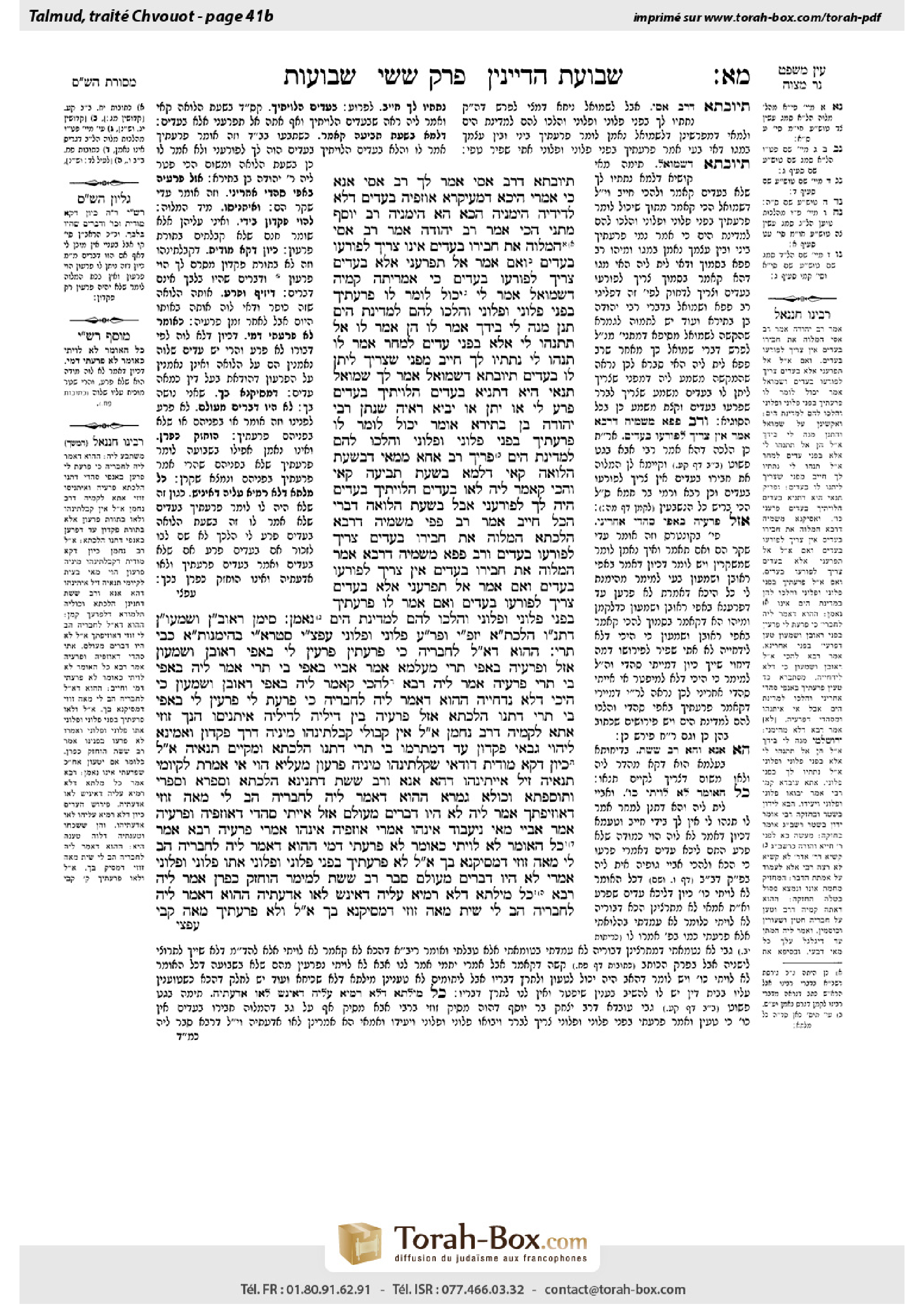
Shevuot 41b: Talmud study for Daf Yomi
Daf Yomi is the daily study of one Talmud folio. Explore 37 tractates with scans, Hebrew text, Sefaria English and AI-generated French translations where annotated.
Passage selection and English or AI-generated French translation are available where the scan has annotations. Daf Study is independent of Torah-Box and Sefaria.
Browse Shevuot · שבועות · All tractatesShevuot 41b text and translations
This page of Shevuot includes the Aramaic text, an English translation and an AI-generated French translation, alongside the scan above.
שבועות מ״א ב · Aramaic and Hebrew text
תְּיוּבְתָּא דְּרַב אַסִּי!
אָמַר לְךָ רַב אַסִּי: אֲנָא כִּי אָמְרִי – הֵיכָא דְּמֵעִיקָּרָא אוֹזְפֵיהּ בְּעֵדִים, דְּלָא לְדִידֵיהּ הֵימְנֵיהּ; הָכָא – הָא הֵימְנֵיהּ.
רַב יוֹסֵף מַתְנִי הָכִי – אָמַר רַב יְהוּדָה, אָמַר רַב אַסִּי: הַמַּלְוֶה אֶת חֲבֵירוֹ בְּעֵדִים – אֵינוֹ צָרִיךְ לְפוֹרְעוֹ בְּעֵדִים. וְאִם אָמַר: ״אַל תִּפְרָעֵנִי אֶלָּא בְּעֵדִים״ – צָרִיךְ לְפוֹרְעוֹ בְּעֵדִים. כִּי אַמְרִיתַהּ קַמֵּיהּ דִּשְׁמוּאֵל, אָמַר לִי: יָכוֹל לוֹמַר לוֹ: ״פְּרַעְתִּיךָ בִּפְנֵי פְּלוֹנִי וּפְלוֹנִי, וְהָלְכוּ לָהֶם לִמְדִינַת הַיָּם״.
תְּנַן: ״מָנֶה לִי בְּיָדְךָ״, אָמַר לוֹ ״הֵן״; אָמַר לוֹ: ״אַל תִּתְּנֵהוּ לִי אֶלָּא בִּפְנֵי עֵדִים״; לְמָחָר אָמַר לוֹ ״תְּנֵהוּ לִי״, ״נְתַתִּיו לָךְ״ – חַיָּיב, מִפְּנֵי שֶׁצָּרִיךְ לִיתֵּן לוֹ בְּעֵדִים. תְּיוּבְתָּא דִּשְׁמוּאֵל!
אָמַר לְךָ שְׁמוּאֵל: תַּנָּאֵי הִיא, דְּתַנְיָא: ״בְּעֵדִים הִלְוִיתִיךָ, בְּעֵדִים פְּרַע לִי״ – אוֹ יִתֵּן, אוֹ יָבִיא רְאָיָה שֶׁנָּתַן. רַבִּי יְהוּדָה בֶּן בְּתִירָא אוֹמֵר, יָכוֹל לוֹמַר לוֹ: ״פְּרַעְתִּיךָ בִּפְנֵי פְּלוֹנִי וּפְלוֹנִי, וְהָלְכוּ לָהֶם לִמְדִינַת הַיָּם״.
פָּרֵיךְ רַב אַחָא: מִמַּאי דְּבִשְׁעַת הַלְוָאָה קָאֵי? דִּלְמָא בִּשְׁעַת תְּבִיעָה קָאֵי – וְהָכִי קָאָמַר לֵיהּ: ״לָאו בְּעֵדִים הִלְוִיתִיךָ? בְּעֵדִים הָיָה לְךָ לְפוֹרְעֵנִי!״ אֲבָל בִּשְׁעַת הַלְוָאָה – דִּבְרֵי הַכֹּל חַיָּיב.
אָמַר רַב פַּפֵּי מִשְּׁמֵיהּ דְּרָבָא, הִלְכְתָא: הַמַּלְוֶה אֶת חֲבֵירוֹ בְּעֵדִים – צָרִיךְ לְפוֹרְעוֹ בְּעֵדִים. וְרַב פָּפָּא מִשְּׁמֵיהּ דְּרָבָא אָמַר: הַמַּלְוֶה אֶת חֲבֵירוֹ בְּעֵדִים – אֵין צָרִיךְ לְפוֹרְעוֹ בְּעֵדִים, וְאִם אָמַר ״אַל תִּפְרָעֵנִי אֶלָּא בְּעֵדִים״ – צָרִיךְ לְפוֹרְעוֹ בְּעֵדִים; וְאִם אָמַר לוֹ: ״פְּרַעְתִּיךָ בִּפְנֵי פְּלוֹנִי וּפְלוֹנִי, וְהָלְכוּ לָהֶם לִמְדִינַת הַיָּם״ – נֶאֱמָן.
סִימָן – רְאוּבֵן וְשִׁמְעוֹן, דְּתָנוּ הִלְכְתָא, יָזְפִי וּפָרַע, פְּלוֹנִי וּפְלוֹנִי, עַפְצֵי סִטְרָאֵי, בְּהֵימָנוּתָא כְּבֵי תְרֵי.
הָהוּא דַּאֲמַר לֵיהּ לְחַבְרֵיהּ: ״כִּי (פָּרְעַתַּן) [פָּרְעַתְּ לִי], פִּרְעַן (לִי) בְּאַפֵּי רְאוּבֵן וְשִׁמְעוֹן״. אֲזַל וּפַרְעֵיהּ בְּאַפֵּי תְרֵי מֵעָלְמָא. אָמַר אַבָּיֵי: בְּאַפֵּי בֵּי תְרֵי אֲמַר לֵיהּ, בְּאַפֵּי בֵּי תְרֵי פַּרְעֵיהּ. אֲמַר לֵיהּ רָבָא: לְהָכִי קָאָמַר לֵיהּ ״בְּאַפֵּי רְאוּבֵן וְשִׁמְעוֹן״ – כִּי הֵיכִי דְּלָא נִדְחֲיֵיהּ!
הָהוּא דַּאֲמַר לֵיהּ לְחַבְרֵיהּ: ״כִּי פָּרְעַתְּ לִי, פִּרְעַן (לִי) בְּאַפֵּי בֵּי תְרֵי דְּתָנוּ הִלְכְתָא״. אֲזַל פַּרְעֵיהּ בֵּין דִּילֵיהּ לְדִילֵיהּ, אִיתְּנִיסוּ הָנָךְ זוּזֵי.
אֲתָא לְקַמֵּיהּ דְּרַב נַחְמָן, אֲמַר לֵיהּ: ״אִין, קַבּוֹלֵי קַבֵּלְתִּינְהוּ מִינֵּיהּ – דֶּרֶךְ פִּקָּדוֹן; וְאָמֵינָא לֶיהֱוֵי גַּבַּאי פִּקָּדוֹן, עַד דְּמִתְרְמוּ בֵּי תְרֵי דְּתָנוּ הִלְכְתָא וּמְקַיֵּים תְּנָאֵיהּ״.
אֲמַר לֵיהּ: כֵּיוָן דְּקָא מוֹדֵית דְּוַדַּאי שְׁקַלְתִּינְהוּ מִינֵּיהּ – פֵּרָעוֹן מְעַלְּיָא הָוֵי; אִי אָמְרַתְּ לְקַיּוֹמֵי תְּנָאֵיהּ – זִיל אַיְיתִינְהוּ. דְּהָא אֲנָא וְרַב שֵׁשֶׁת, דִּתְנֵינָא הִלְכְתָא וְסִפְרָא וְסִפְרֵי וְתוֹסֶפְתָּא וְכוֹלָּא תַּלְמוּדָא.
הָהוּא דַּאֲמַר לֵיהּ לְחַבְרֵיהּ: ״הַב לִי מְאָה זוּזֵי דְּאוֹזֵיפְתָּךְ״. אֲמַר לֵיהּ: ״לֹא הָיוּ דְבָרִים מֵעוֹלָם״. אֲזַל אַיְיתִי סָהֲדִי דְּאוֹזְפֵיהּ וּפַרְעֵיהּ. אָמַר אַבָּיֵי: מַאי נִיעְבּוּד? אִינְהוּ אָמְרִי אוֹזְפֵיהּ, אִינְהוּ אָמְרִי פַּרְעֵיהּ. רָבָא אָמַר: כׇּל הָאוֹמֵר ״לֹא לָוִיתִי״ – כְּאוֹמֵר ״לֹא פָּרַעְתִּי״ דָּמֵי.
הָהוּא דַּאֲמַר לֵיהּ לְחַבְרֵיהּ: ״הַב לִי מְאָה זוּזֵי דְּמַסֵּיקְנָא בָּךְ״. אֲמַר לֵיהּ: ״לֹא פְּרַעְתִּיךָ בִּפְנֵי פְּלוֹנִי וּפְלוֹנִי?״ אֲתוֹ פְּלוֹנִי וּפְלוֹנִי אָמְרִי: ״לֹא הָיוּ דְבָרִים מֵעוֹלָם״. סָבַר רַב שֵׁשֶׁת לְמֵימַר: הוּחְזַק כַּפְרָן, אֲמַר לֵיהּ רָבָא: כֹּל מִילְּתָא דְלָא רַמְיָא עֲלֵיהּ דְּאִינָשׁ – לָאו אַדַּעְתֵּיהּ.
הָהוּא דַּאֲמַר לֵיהּ לְחַבְרֵיהּ: ״הַב לִי שֵׁית מְאָה זוּזֵי דְּמַסֵּיקְנָא בָּךְ״. אֲמַר לֵיהּ: ״וְלָא פְּרַעְתָּיךָ מְאָה קַבֵּי
Shevuot 41b · English translation
Evidently, he is not required to repay him in the presence of witnesses. The Gemara suggests: This is a conclusive refutation of the opinion of Rav Asi.
The Gemara rejects this suggestion: Rav Asi could have said to you: When I said that the debtor is liable to repay him in the presence of witnesses, it was with regard to a case where the creditor lent the money to him in the presence of witnesses at the outset, as he did not trust him. But here, he trusted him at the outset, as he lent it to him in the absence of witnesses. Therefore, the debtor is not required to repay the debt in the presence of witnesses.
Rav Yosef teaches another version of this discussion, like this: Rav Yehuda says that Rav Asi says: In the case of one who lends money to another in the presence of witnesses, the latter need not repay him in the presence of witnesses. But if the creditor said: Repay me only in the presence of witnesses, the debtor is required to repay him in the presence of witnesses. Rav Yehuda continued: When I said this in the presence of Shmuel, he said to me that the debtor can say to the claimant: I repaid you in the presence of so-and-so and so-and-so, and they went overseas.
The Gemara raises an objection against Shmuel’s opinion: We learned in the mishna that in a case where the claimant said: I have one hundred dinars in your possession, and the defendant said to him: Yes, and the claimant then said to him: Give the money to me only in the presence of witnesses, then if the next day the claimant said to him: Give the money to me, and the defendant responded: I already gave it to you, he is liable to pay, as he is required to give it to him in the presence of witnesses. The Gemara suggests: This is a conclusive refutation of the opinion of Shmuel.
The Gemara answers: Shmuel could have said to you that it is a dispute between tanna’im, as it is taught in a baraita: If the creditor said to the debtor: I lent the money to you in the presence of witnesses and therefore you must repay me in the presence of witnesses, the debtor must either give him the money or bring proof that he already gave it to him. Rabbi Yehuda ben Beteira says that he can say to him: I repaid you in the presence of so-and-so and so-and-so, and they subsequently went overseas.
Rav Aḥa refutes this answer: From where is it derived that the baraita is referring to a case where the creditor said this at the time of the loan? Perhaps it is referring to a case where he made no stipulation at the time of the loan, but rather said this at the time of the claim, when the debtor claimed that he had repaid the debt; and this is what he says to him: Didn’t I lend the money you in the presence of witnesses? You should have repaid me in the presence of witnesses. But if he made this stipulation at the time of the loan, all agree that the debtor is liable. Therefore, there is no evidence that Rabbi Yehuda ben Beteira agrees with the opinion of Shmuel.
In conclusion, Rav Pappi says in the name of Rava: The halakha is that if one lends money to another in the presence of witnesses, the latter is required to repay him in the presence of witnesses. And Rav Pappa says in the name of Rava: In the case of one who lends money to another in the presence of witnesses, the latter is not required to repay him in the presence of witnesses. But if the creditor says: Repay me only in the presence of witnesses, the debtor is required to repay him in the presence of witnesses. And if he said to him: I repaid you in the presence of so-and-so and so-and-so, and they went overseas, his claim is deemed credible.
§ The Gemara cites several incidents involving loans and witnesses, and provides a mnemonic device for them: Reuven and Shimon, who learned halakha, borrowed, and repaid so-and-so and so-and-so gallnuts for a different debt, deeming them credible like two witnesses.
The Gemara relates: There was a certain creditor who said to the debtor: When you repay me, repay me in the presence of Reuven and Shimon. The debtor went and repaid him in the presence of two other witnesses from the general public. When the case was brought before the Sages, Abaye said: The creditor said to the debtor to repay him in the presence of two people who would serve as witnesses, and he repaid him in the presence of two people. Therefore, the creditor has no further claim. Rava said to him: It is for this reason that the creditor said to him to repay him in the presence of Reuven and Shimon: So that he will not be able to dismiss him by saying that he repaid him in the presence of other witnesses.
The Gemara relates: There was a certain creditor who said to the debtor: When you repay me, repay me in the presence of two people who have learned halakha. The debtor went and repaid him between the two of them, i.e., in the absence of witnesses. Those dinars were subsequently taken from the creditor due to circumstances beyond his control.
The creditor came before Rav Naḥman for judgment, and said to him: Yes, I received the money from him; but since he did not repay me as stipulated, I accepted it only as a deposit. I accepted it as an unpaid bailee, not as payment, and said to myself: Let it be with me as a deposit until two people who have learned halakha happen to arrive, and the debtor will fulfill his condition. Since the money was taken from me due to circumstances beyond my control, and I had it in my possession only as an unpaid bailee, I am not responsible for it, and the debtor is still liable to repay me.
Rav Naḥman said to him: Since you admit that you certainly took the money from him, it is a proper repayment. If you say that the debtor is still required to fulfill his condition, go bring the money now, as Rav Sheshet and I have learned halakha, and Sifra, and Sifrei, and Tosefta, and the entire Talmud. Let him give you the money in our presence, and the condition will thereby be fulfilled. Since he gave you the money intending to repay the debt, and did not agree to entrust it to you as an unpaid bailee, your claim is not valid.
The Gemara relates: There was a certain person who said to another: Give me the hundred dinars that I lent you. The latter said to him: This matter never happened; you did not lend me money. The creditor went and brought witnesses who testified that he lent the money to him and that the debtor had repaid him. Abaye said: What is there for the court to do in this case? The same witnesses said both statements; they said that the creditor lent him the money, and they also said that the debtor repaid him. Rava said: Anyone who says: I did not borrow, is considered like one who says: I did not repay. Since there is testimony that he borrowed the money, and he admits that he did not repay it, he is liable to repay the debt.
The Gemara relates: There was a certain person who said to another: Give me the hundred dinars that I claim from you. The latter said to him: Didn’t I repay you in the presence of so-and-so and so-and-so? The two people he mentioned, so-and-so and so-and-so, came and said: This matter never happened. Rav Sheshet thought to say that based on the testimony of the witnesses, the debtor assumes the presumptive status of one who falsely denies his debts; his claim that he repaid the debt is no longer accepted, and he is liable to pay. Rava said to him: Anything that is not incumbent upon a person is not on his mind, i.e., he is apt to forget it.
The Gemara relates: There was a certain person who said to another: Give me the six hundred dinars that I claim from you. The latter said to him: But didn’t I repay you with one hundred kav
Shevuot 41b · Traduction française (IA)
Il apparaît donc qu’il n’est pas tenu de le rembourser en présence de témoins. La Guemara suggère : cela constitue une réfutation irréfutable de l’opinion de Rav Asi.
La Guemara rejette cette suggestion : Rav Asi aurait pu te répondre que, lorsqu’il a dit que le débiteur était tenu de le rembourser en présence de témoins, il parlait d’un cas où le créancier lui avait prêté l’argent d’emblée en présence de témoins, parce qu’il ne lui faisait pas confiance. Mais ici, il lui faisait confiance d’emblée, puisqu’il lui avait prêté l’argent en l’absence de témoins. Le débiteur n’est donc pas tenu de rembourser la dette en présence de témoins.
Rav Yossef enseigne une autre version de cette discussion, comme suit : Rav Yehouda dit au nom de Rav Asi : dans le cas de quelqu’un qui prête de l’argent à un autre en présence de témoins, ce dernier n’est pas tenu de le rembourser en présence de témoins. Mais si le créancier lui a dit : « Ne me rembourse qu’en présence de témoins », le débiteur est tenu de le rembourser en présence de témoins. Rav Yehouda poursuit : lorsque j’ai dit cela en présence de Chmouel, il m’a répondu que le débiteur peut dire au demandeur : « Je t’ai remboursé en présence d’Untel et d’Untel, mais ils sont partis outre-mer. »
La Guemara soulève une objection contre l’opinion de Chmouel : nous avons appris dans la Michna que, dans le cas où le demandeur dit : « J’ai cent dinars en ta possession », et où le défendeur lui répond : « Oui », puis où le demandeur lui dit : « Ne me remets l’argent qu’en présence de témoins », si, le lendemain, le demandeur lui réclame l’argent et que le défendeur répond : « Je te l’ai déjà remis », il est tenu de payer, car il devait le lui remettre en présence de témoins. La Guemara suggère : cela constitue une réfutation irréfutable de l’opinion de Chmouel.
La Guemara répond : Chmouel aurait pu te répondre qu’il s’agit d’un désaccord entre des tannaïm, comme l’enseigne une baraïta : si le créancier dit au débiteur : « Je t’ai prêté l’argent en présence de témoins ; tu dois donc me rembourser en présence de témoins », le débiteur doit soit lui remettre l’argent, soit apporter la preuve qu’il le lui a déjà remis. Rabbi Yehouda ben Beteira dit qu’il peut lui répondre : « Je t’ai remboursé en présence d’Untel et d’Untel, mais ils sont ensuite partis outre-mer. »
Rav Aḥa réfute cette réponse : d’où sait-on que la baraïta parle d’un cas où le créancier a posé cette condition au moment du prêt ? Peut-être parle-t-elle d’un cas où il n’a posé aucune condition au moment du prêt, mais où il a dit cela au moment de la réclamation, lorsque le débiteur a affirmé avoir remboursé la dette ; voici ce qu’il lui dit alors : « Ne t’ai-je pas prêté l’argent en présence de témoins ? Tu aurais dû me rembourser en présence de témoins. » Mais s’il a posé cette condition au moment du prêt, tous conviennent que le débiteur est tenu de payer. Il n’y a donc aucune preuve que Rabbi Yehouda ben Beteira soit d’accord avec l’opinion de Chmouel.
En conclusion, Rav Pappi dit au nom de Rava : la halakha est que, si quelqu’un prête de l’argent à un autre en présence de témoins, ce dernier est tenu de le rembourser en présence de témoins. Et Rav Pappa dit au nom de Rava : dans le cas de quelqu’un qui prête de l’argent à un autre en présence de témoins, ce dernier n’est pas tenu de le rembourser en présence de témoins. Mais si le créancier lui dit : « Ne me rembourse qu’en présence de témoins », le débiteur est tenu de le rembourser en présence de témoins. Et s’il lui dit : « Je t’ai remboursé en présence d’Untel et d’Untel, mais ils sont partis outre-mer », son affirmation est tenue pour crédible.
§ La Guemara rapporte plusieurs incidents concernant des prêts et des témoins, et en donne un moyen mnémotechnique : Reouven et Chim’on, qui avaient étudié la halakha, empruntèrent des galles de noix à Untel et Untel pour une autre dette, les remboursèrent, et furent tenus pour crédibles comme deux témoins.
La Guemara rapporte : un certain créancier dit au débiteur : « Lorsque tu me rembourseras, fais-le en présence de Reouven et de Chim’on. » Le débiteur alla le rembourser en présence de deux autres témoins pris dans le public. Lorsque l’affaire fut portée devant les Sages, Abayé dit : le créancier avait demandé au débiteur de le rembourser en présence de deux personnes qui serviraient de témoins, et il l’a remboursé en présence de deux personnes. Le créancier ne peut donc plus rien réclamer. Rava lui dit : c’est précisément pour cette raison que le créancier lui a demandé de le rembourser en présence de Reouven et de Chim’on : afin qu’il ne puisse pas se décharger de sa dette en prétendant l’avoir remboursée en présence d’autres témoins.
La Guemara rapporte : un certain créancier dit au débiteur : « Lorsque tu me rembourseras, fais-le en présence de deux personnes qui ont étudié la halakha. » Le débiteur alla le rembourser en leur présence, mais à l’écart, c’est-à-dire sans témoins. Par la suite, ces dinars furent pris au créancier en raison de circonstances indépendantes de sa volonté.
Le créancier se présenta devant Rav Naḥman pour être jugé et lui dit : « Oui, j’ai reçu l’argent de lui ; mais, puisqu’il ne m’a pas remboursé comme convenu, je ne l’ai accepté qu’en dépôt. Je l’ai accepté comme dépositaire bénévole, et non comme paiement, et je me suis dit : qu’il reste chez moi en dépôt jusqu’à ce que deux personnes ayant étudié la halakha arrivent par hasard ; alors le débiteur remplira sa condition. Puisque l’argent m’a été pris en raison de circonstances indépendantes de ma volonté et que je ne le détenais qu’en qualité de dépositaire bénévole, je n’en suis pas responsable, et le débiteur reste tenu de me rembourser. »
Rav Naḥman lui dit : « Puisque tu reconnais avoir effectivement pris son argent, il s’agit d’un remboursement valable. Si tu prétends que le débiteur doit encore remplir sa condition, va chercher l’argent maintenant, car Rav Sheshet et moi avons étudié la halakha, le Sifra, le Sifrei, la Tosefta et tout le Talmud. Qu’il te remette l’argent en notre présence : la condition sera ainsi remplie. Puisqu’il t’a remis l’argent avec l’intention de rembourser la dette et qu’il n’a pas accepté de te le confier comme dépositaire bénévole, ta réclamation n’est pas fondée. »
La Guemara rapporte : un certain homme dit à un autre : « Rends-moi les cent dinars que je t’ai prêtés. » L’autre lui dit : « Cela n’est jamais arrivé ; tu ne m’as pas prêté d’argent. » Le créancier alla chercher des témoins, qui attestèrent qu’il lui avait prêté l’argent et que le débiteur l’avait remboursé. Abayé dit : que peut faire le tribunal dans ce cas ? Les mêmes témoins ont affirmé les deux choses : ils ont dit que le créancier lui avait prêté l’argent et aussi que le débiteur l’avait remboursé. Rava dit : quiconque affirme « Je n’ai pas emprunté » est considéré comme s’il disait « Je n’ai pas remboursé ». Puisqu’il est attesté qu’il a emprunté l’argent et qu’il reconnaît ne pas l’avoir remboursé, il est tenu de rembourser la dette.
La Guemara rapporte : un certain homme dit à un autre : « Rends-moi les cent dinars que je te réclame. » L’autre lui dit : « Ne t’ai-je pas remboursé en présence d’Untel et d’Untel ? » Les deux personnes qu’il avait nommées, Untel et Untel, vinrent et dirent : « Cela n’est jamais arrivé. » Rav Sheshet songea à dire que, sur la foi du témoignage de ces témoins, le débiteur acquiert le statut présumé de quelqu’un qui nie faussement ses dettes ; on n’accepte plus son affirmation selon laquelle il a remboursé la dette, et il est tenu de payer. Rava lui dit : « Ce qui n’incombe pas à une personne ne lui vient pas à l’esprit », c’est-à-dire qu’elle est susceptible de l’oublier.
La Guemara rapporte : un certain homme dit à un autre : « Rends-moi les six cents dinars que je te réclame. » L’autre lui dit : « Mais ne t’ai-je pas remboursé avec cent kav
Traduction française générée par IA à partir de l’édition anglaise de Sefaria. Vérifie toujours un passage avec le texte source.
Text from Sefaria: William Davidson Edition - Vocalized Aramaic (CC BY NC); William Davidson Edition - English (CC BY NC).