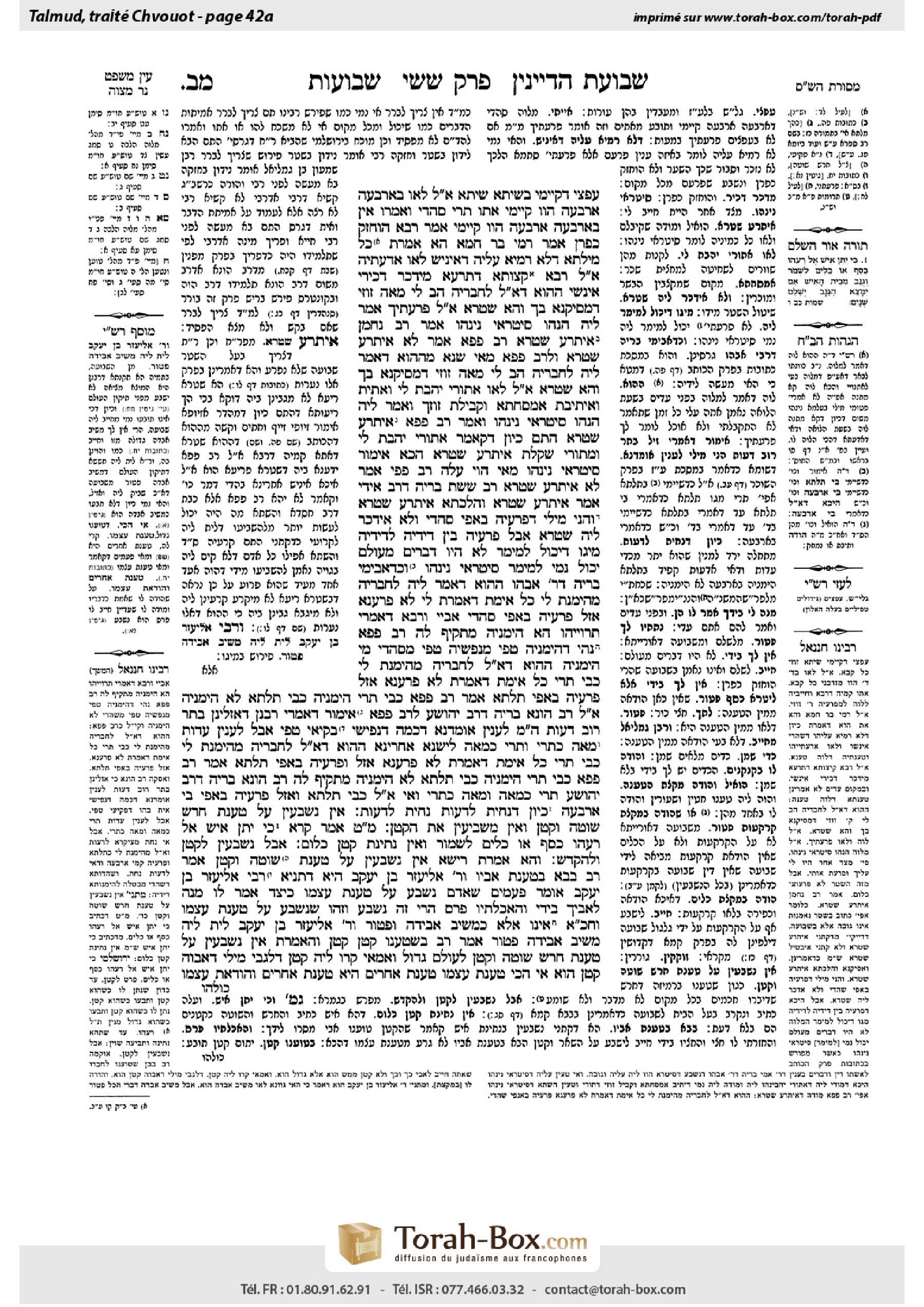
Shevuot 42a: Talmud study for Daf Yomi
Daf Yomi is the daily study of one Talmud folio. Explore 37 tractates with scans, Hebrew text, Sefaria English and AI-generated French translations where annotated.
Passage selection and English or AI-generated French translation are available where the scan has annotations. Daf Study is independent of Torah-Box and Sefaria.
Browse Shevuot · שבועות · All tractatesShevuot 42a text and translations
This page of Shevuot includes the Aramaic text, an English translation and an AI-generated French translation, alongside the scan above.
שבועות מ״ב א · Aramaic and Hebrew text
עַפְצֵי דְּקָיְימִי בְּשִׁיתָּא שִׁיתָּא?״ אֲמַר לֵיהּ: ״לָאו בְּאַרְבְּעָה אַרְבָּעָה הֲווֹ קָיְימִי?״ אֲתוֹ תְּרֵי סָהֲדִי וַאֲמַרוּ: ״אִין, בְּאַרְבְּעָה אַרְבָּעָה הֲווֹ קָיְימִי״. אָמַר רָבָא: הוּחְזַק כַּפְרָן. אֲמַר רָמֵי בַּר חָמָא: הָא אָמְרַתְּ כֹּל מִילְּתָא דְּלָא רַמְיָא עֲלֵיהּ דְּאִינִישׁ לָאו אַדַּעְתֵּיהּ! אֲמַר לֵיהּ רָבָא: קִצּוּתָא דְּתַרְעָא מִידְכָּר דְּכִירִי אִינָשֵׁי.
הָהוּא דַּאֲמַר לֵיהּ לְחַבְרֵיהּ: ״הַב לִי מְאָה זוּזֵי דְּמַסֵּיקְנָא בָּךְ, וְהָא שְׁטָרָא״. אֲמַר לֵיהּ: ״פְּרַעְתִּיךָ״. אֲמַר לֵיהּ: ״הָנְהוּ סִיטְרָאֵי נִינְהוּ״. אָמַר רַב נַחְמָן: אִיתְּרַע שְׁטָרָא. רַב פָּפָּא אָמַר: לָא אִיתְּרַע שְׁטָרָא.
וּלְרַב פָּפָּא – מַאי שְׁנָא מֵהָהוּא דַּאֲמַר לֵיהּ לְחַבְרֵיהּ: ״הַב לִי מְאָה זוּזֵי דְּמַסֵּיקְנָא בָּךְ, וְהָא שְׁטָרָא״; אֲמַר לֵיהּ: ״לָאו אַתּוֹרֵי יְהַבְתְּ לִי, וַאֲתֵית וְאִיתֵּיבְתְּ אַמְּסַחְתָּא – וְקַבֵּילְתְּ זוּזָךְ?״ וַאֲמַר לֵיהּ: ״הָנְהוּ סִיטְרָאֵי נִינְהוּ״; וַאֲמַר רַב פָּפָּא: אִיתְּרַע שְׁטָרָא.
הָתָם, כֵּיוָן דְּקָאָמַר ״אַתּוֹרֵי יְהַבְתְּ לִי וּמִתּוֹרֵי שָׁקְלַתְּ״ – אִיתְּרַע שְׁטָרָא; הָכָא, אֵימוֹר סִיטְרָאֵי נִינְהוּ.
מַאי הָוֵי עֲלַהּ? רַב פַּפֵּי אָמַר: לָא אִיתְּרַע שְׁטָרָא. רַב שֵׁשֶׁת בְּרֵיהּ דְּרַב אִידִי אָמַר: אִיתְּרַע שְׁטָרָא. וְהִלְכְתָא: אִיתְּרַע שְׁטָרָא.
וְהָנֵי מִילֵּי, דְּפַרְעֵיהּ בְּאַפֵּי סָהֲדִי וְלָא אִידְּכַר לֵיהּ שְׁטָרָא; אֲבָל פַּרְעֵיהּ בֵּין דִּידֵיהּ לְדִידֵיהּ – מִיגּוֹ דְּיָכוֹל לְמֵימַר ״לֹא הָיוּ דְבָרִים מֵעוֹלָם״, יָכוֹל נָמֵי לְמֵימַר ״סִיטְרָאֵי נִינְהוּ״, וּכְדַאֲבִימִי בְּרֵיהּ דְּרַבִּי אֲבָהוּ.
הָהוּא דַּאֲמַר לֵיהּ לְחַבְרֵיהּ: ״מְהֵימְנַתְּ לִי כֹּל אֵימַת דְּאָמְרַתְּ לִי לָא פָּרַעְנָא״. אֲזַל פַּרְעֵיהּ בְּאַפֵּי סָהֲדִי. אַבָּיֵי וְרָבָא דְּאָמְרִי תַּרְוַיְיהוּ: הָא הֵימְנֵיהּ. מַתְקֵיף לַהּ רַב פָּפָּא: נְהִי דְּהֵימְנֵיהּ טְפֵי מִנַּפְשֵׁיהּ, טְפֵי מִסָּהֲדֵי מִי הֵימְנֵיהּ?!
הָהוּא דַּאֲמַר לֵיהּ לְחַבְרֵיהּ: ״מְהֵימְנַתְּ לִי כְּבֵי תְרֵי, כׇּל אֵימַת דְּאָמְרַתְּ לָא פָּרַעְנָא״. אֲזַל פַּרְעֵיהּ בְּאַפֵּי תְּלָתָא. אָמַר רַב פָּפָּא: כְּבֵי תְרֵי הֵימְנֵיהּ, כְּבֵי תְלָתָא לָא הֵימְנֵיהּ.
אֲמַר לֵיהּ רַב הוּנָא בְּרֵיהּ דְּרַב יְהוֹשֻׁעַ לְרַב פָּפָּא: אֵימוֹר דְּאָמְרִי רַבָּנַן דְּאָזְלִינַן בָּתַר רוֹב דֵּעוֹת – הָנֵי מִילֵּי לְעִנְיַן אוּמְדָּנָא, דְּכַמָּה דִּנְפִישִׁי בְּקִיאִי טְפֵי; אֲבָל לְעִנְיַן עֵדוּת – מְאָה כִּתְרֵי, וּתְרֵי כִּמְאָה!
לִישָּׁנָא אַחֲרִינָא, הָהוּא דַּאֲמַר לֵיהּ לְחַבְרֵיהּ: ״מְהֵימְנַתְּ לִי כְּבֵי תְרֵי, כֹּל אֵימַת דְּאָמְרַתְּ לָא פָּרַעְנָא״. אֲזַל וּפַרְעֵיהּ בְּאַפֵּי תְּלָתָא. אָמַר רַב פָּפָּא: כְּבֵי תְרֵי הֵימְנֵיהּ, כְּבֵי תְלָתָא לָא הֵימְנֵיהּ.
מַתְקֵיף לַהּ רַב הוּנָא בְּרֵיהּ דְּרַב יְהוֹשֻׁעַ: תְּרֵי כִּמְאָה, וּמְאָה כִּתְרֵי! וְאִי אֲמַר לֵיהּ ״כְּבֵי תְלָתָא״, וַאֲזַל פַּרְעֵיהּ בְּאַפֵּי בֵּי אַרְבְּעָה – כֵּיוָן דִּנְחֵית לְדֵעוֹת, נְחֵית לְדֵעוֹת.
אֵין נִשְׁבָּעִין עַל טַעֲנַת חֵרֵשׁ שׁוֹטֶה וְקָטָן, וְאֵין מַשְׁבִּיעִין אֶת הַקָּטָן. מַאי טַעְמָא? אָמַר קְרָא: ״כִּי יִתֵּן אִישׁ אֶל רֵעֵהוּ כֶּסֶף אוֹ כֵלִים לִשְׁמוֹר״, וְאֵין נְתִינַת קָטָן כְּלוּם.
אֲבָל נִשְׁבָּעִין לְקָטָן וּלְהֶקְדֵּשׁ. וְהָא אָמְרַתְּ רֵישָׁא: אֵין נִשְׁבָּעִין עַל טַעֲנַת שׁוֹטֶה וְקָטָן!
אָמַר רַב: בְּבָא בְּטַעֲנַת אָבִיו, וְרַבִּי אֱלִיעֶזֶר בֶּן יַעֲקֹב הִיא; דְּתַנְיָא, רַבִּי אֱלִיעֶזֶר בֶּן יַעֲקֹב אוֹמֵר: פְּעָמִים שֶׁאָדָם נִשְׁבָּע עַל טַעֲנַת עַצְמוֹ. כֵּיצַד? אָמַר לוֹ: ״מָנֶה לְאָבִיךָ בְּיָדִי וְהֶאֱכַלְתִּיו פְּרָס״ – הֲרֵי זֶה נִשְׁבָּע, וְזֶהוּ שֶׁנִּשְׁבָּע עַל טַעֲנַת עַצְמוֹ. וַחֲכָמִים אוֹמְרִים: אֵינוֹ אֶלָּא כְּמֵשִׁיב אֲבֵידָה, וּפָטוּר.
וְרַבִּי אֱלִיעֶזֶר בֶּן יַעֲקֹב – לֵית לֵיהּ מֵשִׁיב אֲבֵידָה פָּטוּר?! אָמַר רַב: בְּשֶׁטְּעָנוֹ קָטָן.
קָטָן?! וְהָאָמְרַתְּ: אֵין נִשְׁבָּעִין עַל טַעֲנַת חֵרֵשׁ שׁוֹטֶה וְקָטָן! לְעוֹלָם גָּדוֹל, וְאַמַּאי קָרוּ לֵיהּ קָטָן? דִּלְגַבֵּי מִילֵּי דַּאֲבוּהּ – קָטָן הוּא.
אִי הָכִי, ״טַעֲנַת עַצְמוֹ״?! טַעֲנַת אֲחֵרִים הִיא! טַעֲנַת אֲחֵרִים, וְהוֹדָאַת עַצְמוֹ.
Shevuot 42a · English translation
of gallnuts [aftzei] that were worth six dinars for each kav at the time? The creditor said to him: Weren’t they worth four dinars for each kav at the time? Two witnesses came and said: Yes, they were worth four dinars per kav. Rava said that the debtor assumes the presumptive status of one who falsely denies his debts. Rami bar Ḥama said: But didn’t you say that anything that is not incumbent upon a person is not on his mind? Perhaps he merely forgot what the price of gallnuts was at the time that he paid. Rava said to him: People remember the standard, set market price.
The Gemara relates: There was a certain person who said to another: Give me the hundred dinars that I claim from you, and this is the promissory note attesting to the debt. The latter said to him: I already repaid you. The creditor said to him: That money you gave me was for a different debt. Rav Naḥman said that the promissory note is undermined by the fact that the creditor admits that he received payment equal to the amount specified in the note, and his claim that there was an additional debt is unsubstantiated. Rav Pappa said that the promissory note is not undermined.
The Gemara asks: But according to Rav Pappa, in what way is this case different from the incident where a certain person said to another: Give me the hundred dinars that I claim from you, and this is the promissory note. The latter said to him: Didn’t you give me that money as an investment to be used for buying oxen to be slaughtered? And you came and sat in the slaughterhouse and received your money, including your share of the profits, from the sale of the slaughtered oxen. And the creditor said to him: That money you gave me was for a different debt. And Rav Pappa said that in that case the promissory note is undermined.
The Gemara answers: There, since the debtor said: You gave me the money for oxen and you took payment from oxen, and the creditor admitted that this had happened, the promissory note is undermined because there is no support for his claim that there was another debt in addition to the acknowledged transaction for the oxen. Here, say that the payment was in fact for a different debt.
What halakhic conclusion was reached about this matter? Rav Pappi said: The promissory note is not undermined, and Rav Sheshet, son of Rav Idi, said: The promissory note is undermined. And the halakha is that the promissory note is undermined.
And this statement applies in a case where he repaid him in the presence of witnesses and did not mention the promissory note to the creditor; but in a case where he repaid him privately, between the two of them, in the absence of witnesses, since [miggo] the creditor can say to him: This matter never happened, i.e., he could deny that he received any payment, he can also say that this money was for a different debt. And this is like the case involving Avimi, son of Rabbi Abbahu, who repaid a debt in the absence of witnesses, and the creditor then claimed that the payment was for another debt (see Ketubot 85a).
The Gemara relates: There was a certain person who said to another who had lent him money: I deem you credible whenever you say to me that I did not repay the debt. He then went and repaid the debt in the presence of witnesses, and the creditor later denied that he had been repaid. Abaye and Rava both say that the witnesses are not deemed credible and the creditor can collect payment, as the debtor deemed him credible at the outset. Rav Pappa objects to this and says: Although he deemed him more credible than himself concerning the possibility that the debtor would claim that he repaid the debt and the creditor would deny having been repaid, did he deem him more credible than witnesses? Therefore, he is exempt.
The Gemara relates: There was a certain person who said to another who had lent him money: I deem you credible like two witnesses whenever you say that I did not repay the debt. He went and repaid the debt in the presence of three witnesses. Rav Pappa said that the creditor cannot deny the testimony of three witnesses, as the debtor deemed him credible like two witnesses; he did not deem him credible like three witnesses.
Rav Huna, son of Rav Yehoshua, said to Rav Pappa: Say that although the Sages say that we follow the majority of opinions, and the opinion of three people is therefore accepted against the opinion of two, this statement applies with regard to assessing value, as the more people there are, the more knowledgeable they are. But with regard to testimony, one hundred witnesses are like two, and two are like one hundred. Therefore, in this case there is no distinction between two witnesses and three witnesses.
The Gemara presents another version of the incident: A certain person said to another who had lent him money: I deem you credible like two witnesses whenever you say that I did not repay. He went and repaid the debt in the presence of three witnesses. Rav Pappa said that the creditor cannot deny their testimony, as the debtor deemed him credible like two witnesses; he did not deem him credible like three witnesses.
Rav Huna, son of Rav Yehoshua, objects to this: Two witnesses are like one hundred, and one hundred are like two. But if the debtor said to the creditor that he deems him credible like three witnesses, and then went and repaid him in the presence of four, then once he entered, by mentioning a larger number than what is necessary for testimony, the realm of opinions, in which three people carry greater weight than two, he has entered the realm of opinions, and four witnesses are deemed more credible than three. Therefore, the creditor is not deemed credible against them.
§ The mishna teaches: One does not take an oath concerning the claim of a deaf-mute, an imbecile, or a minor, and the court does not administer an oath to a minor. The Gemara asks: What is the reason? The Gemara answers that in the passage from which the halakhot of admission to part of a claim are derived, the verse states: “If a man delivers to his neighbor silver or vessels to safeguard” (Exodus 22:6). The word “man” indicates that the reference is only to adults, and delivery by a minor is nothing, i.e., it is not recognized as a halakhically significant act, as a minor is not halakhically competent.
§ The mishna teaches: But one does take an oath to a minor, or to a representative of the Temple treasury with regard to consecrated property. The Gemara asks: But didn’t you say in the first clause that one does not take an oath concerning the claim of a deaf-mute, an imbecile, or a minor?
Rav said: The halakha that one takes an oath concerning the claim of a deaf-mute, an imbecile, or a minor is with regard to one who comes to court with a claim for a debt owed to his late father, and it is in accordance with the opinion of Rabbi Eliezer ben Ya’akov, as it is taught in a baraita that Rabbi Eliezer ben Ya’akov says: There are times when although no one claimed of a person that he owes money, that person takes an oath on the basis of his own claim. How so? If one said to another: Your father had one hundred dinars in my possession, but I provided him with repayment of half that amount, he is liable to take an oath that he repaid half; and that is the case of one who takes an oath on the basis of his own claim. And the Rabbis say: In that case he is only like one returning a lost item, as the son did not claim the money at all, and is exempt from taking an oath.
The Gemara asks: But is Rabbi Eliezer ben Ya’akov not of the opinion that one who returns a lost item is exempt from taking an oath attesting to the fact that he did not take anything from it? Rav said: The baraita is referring to a case where a minor advanced a claim against him. The creditor’s minor son claimed that the debtor did not repay any part of the loan to his father. The debtor’s partial admission came in response to that claim. Therefore, his admission is not comparable to the act of returning a lost item.
The Gemara asks: How can the baraita be referring to the claim of a minor? But didn’t you say in the mishna that one does not take an oath concerning the claim of a deaf-mute, an imbecile, or a minor? The Gemara answers: Actually, the reference is to an adult son; and why did Rav call him a minor? It was due to the fact that with regard to his father’s matters, one is like a minor, as he is uncertain about the particulars of his father’s dealings. Here, too, Rav explains that the halakha in the mishna that one takes an oath to a minor is referring to an adult claiming a debt owed to his late father.
The Gemara asks: If so, if the son making the claim has already reached majority, the language of the baraita is imprecise. Why does the tanna describe the individual as one taking an oath on the basis of his own claim? This is not his own claim; it is the claim of others. The Gemara answers: The baraita employed that language because although it is the claim of others, he is taking an oath on the basis of that claim and his own partial admission.
Shevuot 42a · Traduction française (IA)
de noix de galle [aftzei] qui valaient six dinars par kav à l’époque ? Le créancier lui dit : Ne valaient-elles pas quatre dinars par kav à l’époque ? Deux témoins vinrent et dirent : Oui, elles valaient quatre dinars par kav. Rava dit que le débiteur est présumé être quelqu’un qui nie faussement ses dettes. Rami bar Ḥama dit : Mais n’as-tu pas dit que tout ce qui n’incombe pas à une personne ne lui vient pas à l’esprit ? Peut-être a-t-il simplement oublié quel était le prix des noix de galle au moment où il a payé. Rava lui répondit : Les gens se souviennent du prix courant fixé par le marché.
La Guemara rapporte : Un homme dit à un autre : Rends-moi les cent dinars que je te réclame ; voici le billet à ordre qui atteste la dette. L’autre lui répondit : Je t’ai déjà remboursé. Le créancier lui dit : L’argent que tu m’as donné était destiné à une autre dette. Rav Naḥman dit que le billet à ordre est invalidé, puisque le créancier reconnaît avoir reçu un paiement égal au montant qui y est indiqué et que son affirmation concernant une dette supplémentaire n’est pas étayée. Rav Pappa dit que le billet à ordre n’est pas invalidé.
La Guemara demande : Mais, selon Rav Pappa, en quoi ce cas diffère-t-il de l’incident où un homme dit à un autre : Rends-moi les cent dinars que je te réclame ; voici le billet à ordre. L’autre lui répondit : Ne m’as-tu pas donné cet argent comme investissement pour acheter des bœufs destinés à l’abattage ? Tu es ensuite venu t’asseoir à l’abattoir et tu as reçu ton argent, y compris ta part des bénéfices tirés de la vente des bœufs abattus. Le créancier lui dit : L’argent que tu m’as donné était destiné à une autre dette. Or, Rav Pappa a dit que, dans ce cas, le billet à ordre est invalidé.
La Guemara répond : Là-bas, puisque le débiteur a dit : Tu m’as donné l’argent pour des bœufs et tu as été payé avec des bœufs, et que le créancier a reconnu que cela s’était produit, le billet à ordre est invalidé, car rien ne vient étayer son affirmation selon laquelle il existait une autre dette en plus de la transaction reconnue concernant les bœufs. Ici, disons que le paiement concernait en fait une autre dette.
Quelle conclusion halakhique a-t-on tirée à ce sujet ? Rav Pappi dit : Le billet à ordre n’est pas invalidé ; Rav Sheshet, fils de Rav Idi, dit : Le billet à ordre est invalidé. Et la halakha est que le billet à ordre est invalidé.
Cette déclaration s’applique au cas où il l’a remboursé en présence de témoins sans mentionner le billet à ordre au créancier. Mais s’il l’a remboursé en privé, seuls tous deux étant présents, et sans témoins, puisque [miggo] le créancier peut lui dire : « Cela ne s’est jamais produit », c’est-à-dire qu’il pourrait nier avoir reçu le moindre paiement, il peut aussi dire que cet argent était destiné à une autre dette. C’est comme dans le cas d’Avimi, fils de Rabbi Abbahu, qui remboursa une dette en l’absence de témoins, après quoi le créancier prétendit que le paiement était destiné à une autre dette (voir Ketoubot 85a).
La Guemara rapporte : Un homme dit à un autre, qui lui avait prêté de l’argent : Je te tiendrai pour crédible chaque fois que tu me diras que je n’ai pas remboursé la dette. Il alla ensuite rembourser la dette en présence de témoins, puis le créancier nia qu’il l’avait remboursé. Abaye et Rava disent tous deux que les témoins ne sont pas crus et que le créancier peut recouvrer le paiement, puisque le débiteur l’avait tenu pour crédible dès le départ. Rav Pappa s’y oppose et dit : Même s’il l’a tenu pour plus crédible que lui-même concernant la possibilité que le débiteur prétende avoir remboursé la dette et que le créancier nie avoir été remboursé, l’a-t-il tenu pour plus crédible que des témoins ? Il est donc quitte.
La Guemara rapporte : Un homme dit à un autre, qui lui avait prêté de l’argent : Je te tiendrai pour crédible comme deux témoins chaque fois que tu diras que je n’ai pas remboursé la dette. Il alla ensuite rembourser la dette en présence de trois témoins. Rav Pappa dit que le créancier ne peut pas contester le témoignage des trois témoins, puisque le débiteur l’avait tenu pour crédible comme deux témoins, et non comme trois.
Rav Houna, fils de Rav Yehoshoua, dit à Rav Pappa : Disons que, bien que les Sages enseignent qu’on suit l’opinion de la majorité, de sorte que l’avis de trois personnes l’emporte sur celui de deux, cette règle s’applique à l’évaluation, car plus les personnes sont nombreuses, plus elles sont compétentes. Mais en matière de témoignage, cent témoins équivalent à deux, et deux équivalent à cent. Par conséquent, dans ce cas, il n’y a pas de différence entre deux témoins et trois témoins.
La Guemara présente une autre version de l’incident : Un homme dit à un autre, qui lui avait prêté de l’argent : Je te tiendrai pour crédible comme deux témoins chaque fois que tu diras que je n’ai pas remboursé. Il alla ensuite rembourser la dette en présence de trois témoins. Rav Pappa dit que le créancier ne peut pas contester leur témoignage, puisque le débiteur l’avait tenu pour crédible comme deux témoins, et non comme trois.
Rav Houna, fils de Rav Yehoshoua, s’y oppose : Deux témoins équivalent à cent, et cent équivalent à deux. Mais si le débiteur a dit au créancier qu’il le tenait pour crédible comme trois témoins, puis est allé le rembourser en présence de quatre témoins, alors, en mentionnant un nombre supérieur à celui qui est nécessaire pour constituer un témoignage, il est entré dans le domaine des opinions, où trois personnes ont plus de poids que deux. Dès lors, quatre témoins sont tenus pour plus crédibles que trois. Par conséquent, le créancier n’est pas cru contre eux.
§ La Michna enseigne : On ne prête pas serment au sujet de la réclamation d’un sourd-muet, d’un simple d’esprit ou d’un mineur, et le tribunal ne fait pas prêter serment à un mineur. La Guemara demande : Quelle en est la raison ? La Guemara répond que, dans le passage dont sont déduites les halakhot de l’aveu partiel d’une réclamation, le verset dit : « Si un homme remet à son prochain de l’argent ou des objets à garder » (Exode 22:6). Le mot « homme » indique qu’il s’agit uniquement d’adultes ; la remise par un mineur ne compte pas, c’est-à-dire qu’elle n’est pas reconnue comme un acte ayant une portée halakhique, car un mineur n’a pas la capacité juridique requise par la halakha.
§ La Michna enseigne : Mais on prête serment à un mineur, ou à un représentant du Trésor du Temple au sujet de biens consacrés. La Guemara demande : Mais n’as-tu pas dit, dans la première partie, qu’on ne prête pas serment au sujet de la réclamation d’un sourd-muet, d’un simple d’esprit ou d’un mineur ?
Rav dit : La halakha selon laquelle on prête serment au sujet de la réclamation d’un sourd-muet, d’un simple d’esprit ou d’un mineur concerne celui qui vient au tribunal réclamer une dette due à son père défunt, et elle est conforme à l’opinion de Rabbi Eliézer ben Yaakov. En effet, il est enseigné dans une baraïta que Rabbi Eliézer ben Yaakov dit : Il arrive qu’une personne prête serment alors que personne ne lui a réclamé d’argent, mais qu’elle le fasse sur la base de sa propre déclaration. Comment cela ? Si quelqu’un dit à un autre : « Ton père avait cent dinars en ma possession, mais je lui en ai remboursé la moitié », il est tenu de prêter serment qu’il en a remboursé la moitié ; c’est le cas de celui qui prête serment sur la base de sa propre déclaration. Les Sages disent : Dans ce cas, il est comme quelqu’un qui restitue un objet perdu, puisque le fils ne lui a rien réclamé ; il est donc dispensé de prêter serment.
La Guemara demande : Mais Rabbi Eliézer ben Yaakov n’est-il pas d’avis que celui qui restitue un objet perdu est dispensé de prêter serment pour attester qu’il n’en a rien pris ? Rav dit : La baraïta parle d’un cas où un mineur a formulé une réclamation contre lui. Le fils mineur du créancier a prétendu que le débiteur n’avait remboursé aucune partie du prêt à son père. L’aveu partiel du débiteur répondait à cette réclamation. Son aveu n’est donc pas comparable à la restitution d’un objet perdu.
La Guemara demande : Comment la baraïta pourrait-elle parler de la réclamation d’un mineur ? N’as-tu pas dit dans la Michna qu’on ne prête pas serment au sujet de la réclamation d’un sourd-muet, d’un simple d’esprit ou d’un mineur ? La Guemara répond : En réalité, il s’agit d’un fils adulte ; et pourquoi Rav l’a-t-il appelé mineur ? Parce que, pour ce qui est des affaires de son père, on est comme un mineur, puisqu’on ignore les détails des transactions de son père. Ici aussi, Rav explique que la halakha de la Michna, selon laquelle on prête serment à un mineur, concerne un adulte qui réclame une dette due à son père défunt.
La Guemara demande : Si c’est ainsi, si le fils qui formule la réclamation a déjà atteint la majorité, la formulation de la baraïta manque de précision. Pourquoi le tanna décrit-il cette personne comme prêtant serment sur la base de sa propre réclamation ? Ce n’est pas sa propre réclamation, mais celle d’autrui. La Guemara répond : La baraïta a employé cette formulation parce que, même s’il s’agit de la réclamation d’autrui, il prête serment sur la base de cette réclamation et de son propre aveu partiel.
Traduction française générée par IA à partir de l’édition anglaise de Sefaria. Vérifie toujours un passage avec le texte source.
Text from Sefaria: William Davidson Edition - Vocalized Aramaic (CC BY NC); William Davidson Edition - English (CC BY NC).