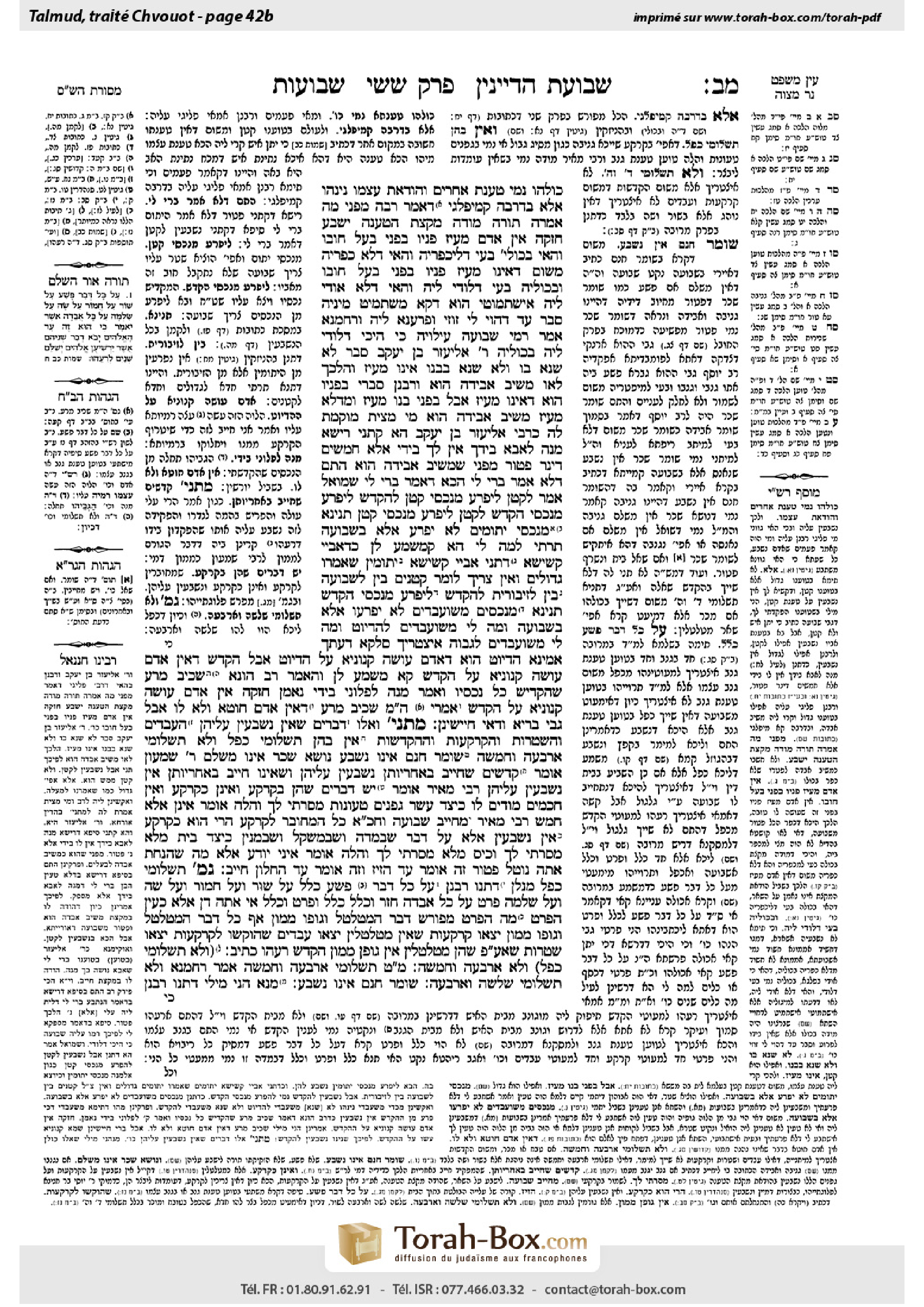
Shevuot 42b: Talmud study for Daf Yomi
Daf Yomi is the daily study of one Talmud folio. Explore 37 tractates with scans, Hebrew text, Sefaria English and AI-generated French translations where annotated.
Passage selection and English or AI-generated French translation are available where the scan has annotations. Daf Study is independent of Torah-Box and Sefaria.
Browse Shevuot · שבועות · All tractatesShevuot 42b text and translations
This page of Shevuot includes the Aramaic text, an English translation and an AI-generated French translation, alongside the scan above.
שבועות מ״ב ב · Aramaic and Hebrew text
כּוּלְּהוּ נָמֵי טַעֲנַת אֲחֵרִים וְהוֹדָאַת עַצְמוֹ נִינְהוּ!
אֶלָּא בִּדְרַבָּה קָמִיפַּלְגִי – דְּאָמַר רַבָּה: מִפְּנֵי מָה אָמְרָה תּוֹרָה מוֹדֶה מִקְצָת הַטַּעֲנָה יִשָּׁבַע? חֲזָקָה אֵין אָדָם מֵעִיז פָּנָיו בִּפְנֵי בַּעַל חוֹבוֹ. וְהַאי – בְּכוּלֵּיהּ בָּעֵי דְּלִיכְפְּרֵיהּ, וְהַאי דְּלָא כַּפְרֵיהּ – מִשּׁוּם דְּאֵינוֹ מֵעִיז פָּנָיו בִּפְנֵי בַּעַל חוֹבוֹ;
וּבְכוּלֵּיהּ בָּעֵי דְּלוֹדֵי לֵיהּ, וְהַאי דְּלָא אוֹדִי לֵיהּ – אִישְׁתְּמוֹטֵי הוּא דְּקָא מִשְׁתְּמִיט מִינֵּיהּ, סָבַר: עַד דְּהָוֵי לִי זוּזֵי וּפָרַעְנָא לֵיהּ; וְרַחֲמָנָא אָמַר רְמִי שְׁבוּעָה עִילָּוֵיהּ, כִּי הֵיכִי דְּלוֹדֵי לֵיהּ בְּכוּלֵּיהּ.
רַבִּי אֱלִיעֶזֶר בֶּן יַעֲקֹב סָבַר: לָא שְׁנָא בּוֹ וְלָא שְׁנָא בִּבְנוֹ – אֵינוֹ מֵעֵיז, וְהִלְכָּךְ לָאו מֵשִׁיב אֲבֵידָה הוּא. וְרַבָּנַן סָבְרִי: בְּפָנָיו הוּא דְּאֵינוֹ מֵעֵיז, אֲבָל בִּפְנֵי בְּנוֹ מֵעֵיז; וּמִדְּלֹא מֵעֵיז – מֵשִׁיב אֲבֵידָה הוּא.
מִי מָצֵית מוֹקְמַתְּ לַהּ כְּרַבִּי אֱלִיעֶזֶר בֶּן יַעֲקֹב?! הָא קָתָנֵי רֵישָׁא: ״מָנֶה לְאַבָּא בְּיָדְךָ״, ״אֵין לְךָ בְּיָדִי אֶלָּא חֲמִשִּׁים דִּינָר״ – פָּטוּר, מִפְּנֵי שֶׁמֵּשִׁיב אֲבֵידָה הוּא! הָתָם דְּלָא אָמַר ״בָּרִי לִי״, הָכָא דְּאָמַר ״בָּרִי לִי״.
שְׁמוּאֵל אָמַר: ״לְקָטָן״ – לִיפָּרַע מִנִּכְסֵי קָטָן, ״לַהֶקְדֵּשׁ״ – לִיפָּרַע מִנִּכְסֵי הֶקְדֵּשׁ.
לְקָטָן לִיפָּרַע מִנִּכְסֵי קָטָן – תְּנֵינָא: מִנִּכְסֵי יְתוֹמִים לֹא יִפָּרַע אֶלָּא בִּשְׁבוּעָה! תַּרְתֵּי לְמָה לִי?
הָא קָמַשְׁמַע לַן – כִּדְאַבָּיֵי קַשִּׁישָׁא; דְּתָנֵי אַבָּיֵי קַשִּׁישָׁא: יְתוֹמִין שֶׁאָמְרוּ – גְּדוֹלִים, וְאֵין צָרִיךְ לוֹמַר קְטַנִּים; בֵּין לִשְׁבוּעָה בֵּין לְזִיבּוּרִית.
לְהֶקְדֵּשׁ לִיפָּרַע מִנִּכְסֵי הֶקְדֵּשׁ – תְּנֵינָא: מִנְּכָסִים מְשׁוּעְבָּדִים לֹא יִפָּרְעוּ אֶלָּא בִּשְׁבוּעָה; וּמָה לִי מְשׁוּעְבָּדִים לְהֶדְיוֹט, וּמָה לִי מְשׁוּעְבָּדִים לְגָבוֹהַּ?
אִיצְטְרִיךְ; סָלְקָא דַּעְתָּךְ אָמֵינָא: הֶדְיוֹט הוּא דְּאָדָם עוֹשֶׂה קְנוּנְיָא עַל הֶדְיוֹט; אֲבָל הֶקְדֵּשׁ, דְּאֵין אָדָם עוֹשֶׂה קְנוּנְיָא עַל הֶקְדֵּשׁ – קָא מַשְׁמַע לַן.
וְהָאָמַר רַב הוּנָא: שְׁכִיב מְרַע שֶׁהִקְדִּישׁ כׇּל נְכָסָיו, וְאָמַר: ״מָנֶה לִפְלוֹנִי בְּיָדִי״ – נֶאֱמָן, חֲזָקָה אֵין אָדָם עוֹשֶׂה קְנוּנְיָא עַל הֶקְדֵּשׁ! אָמְרִי: הָנֵי מִילֵּי שְׁכִיב מְרַע, דְּאֵין אָדָם חוֹטֵא וְלֹא לוֹ; אֲבָל גַּבֵּי בָּרִיא, וַדַּאי חָיְישִׁינַן.
מַתְנִי׳ וְאֵלּוּ דְּבָרִים שֶׁאֵין נִשְׁבָּעִין עֲלֵיהֶן: הָעֲבָדִים וְהַשְּׁטָרוֹת וְהַקַּרְקָעוֹת וְהַהֶקְדֵּשׁוֹת. אֵין בָּהֶן תַּשְׁלוּמֵי כֶפֶל וְלֹא תַּשְׁלוּמֵי אַרְבָּעָה וַחֲמִשָּׁה, שׁוֹמֵר חִנָּם אֵינוֹ נִשְׁבָּע, נוֹשֵׂא שָׂכָר אֵינוֹ מְשַׁלֵּם.
רַבִּי שִׁמְעוֹן אוֹמֵר: קֳדָשִׁים שֶׁחַיָּיב בְּאַחְרָיוּתָן – נִשְׁבָּעִין עֲלֵיהֶן, וְשֶׁאֵינוֹ חַיָּיב בְּאַחְרָיוּתָן – אֵין נִשְׁבָּעִין עֲלֵיהֶן.
רַבִּי מֵאִיר אוֹמֵר: יֵשׁ דְּבָרִים שֶׁהֵן בְּקַרְקַע וְאֵינָן כְּקַרְקַע; וְאֵין חֲכָמִים מוֹדִים לוֹ. כֵּיצַד? ״עֶשֶׂר גְּפָנִים טְעוּנוֹת מָסַרְתִּי לָךְ״, וְהַלָּה אוֹמֵר: ״אֵינָן אֶלָּא חָמֵשׁ״. רַבִּי מֵאִיר מְחַיֵּיב שְׁבוּעָה, וַחֲכָמִים אוֹמְרִים: כׇּל הַמְחוּבָּר לְקַרְקַע – הֲרֵי הוּא כְּקַרְקַע.
אֵין נִשְׁבָּעִין אֶלָּא עַל דָּבָר שֶׁבְּמִדָּה וְשֶׁבְּמִשְׁקָל וְשֶׁבְּמִנְיָן. כֵּיצַד? ״בַּיִת מָלֵא מָסַרְתִּי לָךְ״ וְ״כִיס מָלֵא מָסַרְתִּי לָךְ״, וְהַלָּה אוֹמֵר: ״אֵינִי יוֹדֵעַ, אֶלָּא מָה שֶׁהִנַּחְתָּ אַתָּה נוֹטֵל״ – פָּטוּר. זֶה אוֹמֵר ״עַד הַזִּיז״ וְזֶה אוֹמֵר ״עַד הַחַלּוֹן״ – חַיָּיב.
גְּמָ׳ תַּשְׁלוּמֵי כֶפֶל מְנָלַן? דְּתָנוּ רַבָּנַן: ״עַל כׇּל דְּבַר פֶּשַׁע״ – כְּלָל; ״עַל שׁוֹר״ וְ״עַל חֲמוֹר״ וְ״עַל שֶׂה״ וְ״עַל שַׂלְמָה״ – פְּרָט; ״עַל כׇּל אֲבֵדָה״ – חָזַר וְכָלַל.
כְּלָל וּפְרָט וּכְלָל – אִי אַתָּה דָן אֶלָּא כְּעֵין הַפְּרָט; מָה הַפְּרָט מְפוֹרָשׁ – דָּבָר הַמִּטַּלְטֵל וְגוּפוֹ מָמוֹן, אַף כׇּל דָּבָר הַמִּטַּלְטֵל וְגוּפוֹ מָמוֹן.
יָצְאוּ קַרְקָעוֹת – שֶׁאֵין מְטַלְטְלִין; יָצְאוּ עֲבָדִים – שֶׁהוּקְּשׁוּ לְקַרְקָעוֹת; יָצְאוּ שְׁטָרוֹת – שֶׁאַף עַל פִּי שֶׁהֵן מִטַּלְטְלִין, אֵין גּוּפָן מָמוֹן; הֶקְדֵּשׁ – ״רֵעֵהוּ״ כְּתִיב.
וְלֹא תַּשְׁלוּמֵי כֶפֶל וְלֹא אַרְבָּעָה וַחֲמִשָּׁה. מַאי טַעְמָא? תַּשְׁלוּמֵי אַרְבָּעָה וַחֲמִשָּׁה אָמַר רַחֲמָנָא, וְלֹא תַּשְׁלוּמֵי שְׁלֹשָׁה וְאַרְבָּעָה.
שׁוֹמֵר חִנָּם אֵינוֹ נִשְׁבָּע. מְנָא הָנֵי מִילֵּי? דְּתָנוּ רַבָּנַן:
Shevuot 42b · English translation
The Gemara challenges: All other cases where the defendant is required to take an oath due to a partial admission are also cases of a claim of others and his own admission. Yet in the baraita Rabbi Eliezer ben Ya’akov introduces his opinion with the term: There are times, indicating that the case to which he is referring, of one taking an oath on the basis of his own claim, is not the standard case of an oath due to a partial admission.
The Gemara answers: Rather, Rabbi Eliezer ben Ya’akov and the Rabbis disagree with regard to the statement of Rabba, as Rabba says: For what reason did the Torah say that one who admits to a part of the claim must take an oath? It is because there is a presumption that a person does not exhibit insolence by lying in the presence of his creditor, who did him a favor by lending money to him. And this person who denies part of the claim actually wants to deny all of the debt, so as to be exempt, and this fact, i.e., that he does not deny all of it, is because a person does not exhibit insolence in the presence of his creditor.
Rabba continues: And in order not to exhibit insolence, he wants to admit to the creditor with regard to all of the debt; and this fact, i.e., that he did not admit the entire debt to him, is because he may be temporarily avoiding paying him. He rationalizes doing so by saying to himself: I am avoiding him only until the time that I have enough money, and then I will repay him. And therefore, the Merciful One says in the Torah: Impose an oath on him in order to induce the debtor to admit the entire debt to him.
With regard to this principle, Rabbi Eliezer ben Ya’akov maintains: It is no different with regard to the creditor himself, and it is no different with regard to his son; the debtor would not exhibit insolence and deny the debt. And therefore, he is not deemed as one returning a lost item on his own initiative; rather, this is an ordinary case where one admits to a part of a claim and is therefore required to take an oath. And the Rabbis maintain: It is in the presence of the original creditor that one would not exhibit insolence; but in the presence of his son, who did not lend him the money, he would exhibit insolence and deny the claim entirely. And since this debtor is not exhibiting insolence, as he could have denied the loan completely but instead is opting to admit to part of the claim, he is deemed as one returning a lost item, and his claim is accepted without his taking an oath.
The Gemara asks: Can you interpret the mishna in accordance with the opinion of Rabbi Eliezer ben Ya’akov? Isn’t it taught in the former clause that if the claimant said: My late father had one hundred dinars in your possession, and the defendant responded: You have only fifty dinars in my possession, he is exempt from taking an oath, as he is like one returning a lost item? The Gemara answers: There, it is referring to a case where the claimant did not say: I am certain that you owe my father this money, but rather made an uncertain claim. In such a case, Rabbi Eliezer ben Ya’akov agrees that the defendant is like one returning a lost item. Here, by contrast, it is a case where he said: I am certain that you owe him.
Returning to the Gemara’s question with regard to the last clause of the mishna, which states that one takes an oath to a minor, or to a representative of the Temple treasury, Shmuel said a different answer: When the mishna spoke about taking an oath to a minor, it was referring to a case where the debtor died; the creditor must take an oath to the minor heir attesting that he was not repaid in order to collect from the minor’s property. Similarly, if one’s debtor consecrated his property, he takes an oath to a representative of the Temple treasury in order to collect from the consecrated property.
The Gemara challenges: The halakha that one takes an oath to a minor in order to collect from a minor’s property is one that we learn in the mishna (45a): A woman who comes to collect the payment for her marriage contract from the property of orphans collects only by means of an oath. Why do I need two mishnayot to teach this halakha?
The Gemara answers: By mentioning this halakha twice, the Mishna teaches us this: The halakha applies with regard to both minor and adult orphans, in accordance with the statement of Abaye the Elder; as Abaye the Elder taught: The orphans of which the Sages spoke are adult orphans, and needless to say, the same halakha also applies to minor orphans. This principle applies with regard to both the halakha that a debt can be collected from the property of an orphan only by means of an oath, and to the halakha that a debt can be collected from the property of an orphan only from inferior-quality land.
With regard to Shmuel’s explanation of the mishna that one takes an oath to a representative of the Temple treasury in order to collect a debt from consecrated property, the Gemara asks: We learn this halakha in the mishna (45a): From liened property that has been sold one collects a debt only by means of an oath. And what difference is it to me whether the property was liened to an ordinary person, and what difference is it to me whether the property was liened to the Most High, i.e., it was consecrated?
The Gemara answers: It was necessary for this halakha to be stated separately with regard to collecting a debt from the Temple treasury. Otherwise it might enter your mind to say that it is specifically in order to collect a debt from an ordinary person that one is required to take an oath, as a person is liable to collude with another against an ordinary person who purchased property, by producing a promissory note for a debt that was already repaid in order to collect property from the purchasers of land that had been liened to that debt. But one might have thought that in order to collect a debt from the Temple treasury, a person is not required to take an oath, as a person does not collude with another against the Temple treasury. Therefore, the mishna teaches us that one is required to take an oath even in order to collect a debt from the Temple treasury, as one is suspected of collusion in this case as well.
The Gemara asks: But doesn’t Rav Huna say that in the case of a person on his deathbed who consecrated all of his property, and said: So-and-so has one hundred dinars in my possession, his statement is deemed credible, as the presumption is that a person does not collude with another against the Temple treasury? The Sages said in response: That statement applies only in the case of a person on his deathbed, as a person sins only for his own benefit. One is not suspected of deceiving the Temple treasury for the benefit of his heirs. But with regard to a healthy person, we are certainly concerned about collusion, even against the Temple treasury.
MISHNA: And these are items concerning which one does not take an oath by Torah law: Canaanite slaves, and financial documents, and land, and consecrated property. In a case where these items are stolen, there is no payment of double the principal, nor is there payment of four or five times the principal in a case where one stole a consecrated animal and slaughtered or sold it. An unpaid bailee who lost one of these items does not take an oath that he was not negligent in safeguarding it, and a paid bailee does not pay for the loss or theft of one of these items.
Rabbi Shimon says there is a distinction between different types of consecrated property: With regard to consecrated property for which one bears the financial responsibility to compensate the Temple treasury in the event of their loss, such as in a case where he vowed to bring an offering and then set aside an animal to be sacrificed in fulfillment of the vow, one takes an oath concerning them, as they are considered his own property. But with regard to consecrated property for which he does not bear the financial responsibility for their loss, one does not take an oath concerning them.
Rabbi Meir says: There are certain items that are physically on the land but are not treated like land from a halakhic perspective, and the Rabbis do not concede to him concerning this point. How so? If one makes the claim: I assigned you ten grapevines laden with fruit to safeguard, and the other one says: They are only five vines, Rabbi Meir deems the defendant liable to take an oath, as he admitted to a part of the claim, and although the claim concerned grapevines, the primary aspect of the claim was the grapes. And the Rabbis say: The halakhic status of anything that is attached to the land is like the land itself, and therefore he is exempt from taking an oath.
One takes an oath only concerning an item that is defined by size, by weight, or by number. How so? If the claimant says: I transferred to you a house full of produce, or: I transferred to you a pouch full of money, and the other person says: I do not know how much you gave me, but what you left in my possession you may take, and the amount in the house or pouch at that time is less than that claimed by the claimant, the defendant is exempt from taking an oath, as the amounts in the claim and the admission are undefined. But if this party says that the house was full up to the ledge, and that party says that it was full up to the window, the defendant is liable to take an oath, as the dispute relates to a defined amount.
GEMARA: From where do we derive that one is exempt from the payment of double the principal with regard to the items mentioned in the mishna? It is as the Sages taught in a baraita with regard to the verse that discusses double payment: “For every matter of trespass, whether it be for an ox, for a donkey, for a sheep, for clothing, or for any manner of lost thing…he shall pay double to his neighbor” (Exodus 22:8). This verse is expounded in the following manner: The phrase “for every matter of trespass” is a generalization; the phrase “whether it be for an ox, for a donkey, for a sheep, for clothing” is a detail; and when the verse states: “Or for any manner of lost thing,” it then generalized again.
Consequently, this verse contains a generalization, and a detail, and a generalization, and one of the thirteen principles of exegesis states that in such a case you may deduce that the verse is referring only to items similar to the detail. Applying this principle here, one may conclude that just as each of the items mentioned in the detail is clearly defined as an item that is movable property and has intrinsic monetary value, so too, anything that is movable property and has intrinsic monetary value is subject to double payment.
Land is therefore excluded, as it is not movable property. Canaanite slaves are also excluded, as they are compared to land in many areas of halakha. Financial documents are excluded, since although they are movable property, they do not have intrinsic monetary value. The value of the paper itself is negligible; documents are valuable only because they serve as proof of monetary claims. Finally, consecrated property is excluded because it is written in the verse: “He shall pay double to his neighbor,” i.e., to his fellow man, but not to a representative of the Temple treasury.
The mishna teaches: And there is no payment of double the principal, nor is there payment of four or five times the principal for stealing consecrated animals. The Gemara asks: What is the reason for the exclusion of the payment of four or five times the principal? The Gemara answers: Since payment of double the principal is excluded, that leaves, in a case where one steals and then slaughters or sells a consecrated animal, a total payment of only three or four times the principal, as the payment of double the principal is included in the larger payment for selling or slaughtering it. Therefore, since the Merciful One states in the Torah fourfold or fivefold payment, and not threefold or fourfold payment, one who steals a consecrated animal and slaughters it or sells it is exempt from the additional payments.
§ The mishna teaches: An unpaid bailee who lost one of the excluded items does not take an oath. The Gemara asks: From where are these matters derived? The Gemara answers that it is as the Sages taught in a baraita:
Shevuot 42b · Traduction française (IA)
La Guemara objecte : Tous les autres cas où le défendeur doit prêter serment à la suite d’un aveu partiel sont également des cas où un tiers formule une réclamation et où le défendeur reconnaît une partie de la dette. Pourtant, dans la baraïta, Rabbi Eliezer ben Ya’akov introduit son opinion par les mots : « Il arrive parfois », ce qui indique que le cas auquel il fait référence — celui d’une personne qui prête serment sur la base de sa propre réclamation — n’est pas le cas ordinaire d’un serment consécutif à un aveu partiel.
La Guemara répond : Rabbi Eliezer ben Ya’akov et les Rabbins sont plutôt en désaccord au sujet de l’énoncé de Rabba, car Rabba dit : Pour quelle raison la Torah a-t-elle décrété que celui qui reconnaît une partie de la réclamation doit prêter serment ? C’est parce qu’on présume qu’une personne n’ose pas mentir en présence de son créancier, qui lui a rendu service en lui prêtant de l’argent. Or, cet homme qui nie une partie de la réclamation voudrait en réalité nier toute la dette afin d’en être quitte ; s’il ne le fait pas, c’est parce qu’une personne n’ose pas mentir en présence de son créancier.
Rabba poursuit : Pour ne pas se montrer insolent, il voudrait reconnaître toute la dette envers le créancier ; s’il ne la reconnaît pas entièrement, c’est parce qu’il peut chercher à différer temporairement le paiement. Il se justifie en se disant : « Je ne fais que gagner du temps jusqu’à ce que j’aie assez d’argent, puis je le rembourserai. » C’est pourquoi le Miséricordieux dit dans la Torah de lui imposer un serment, afin d’inciter le débiteur à reconnaître toute la dette envers le créancier.
Au sujet de ce principe, Rabbi Eliezer ben Ya’akov considère qu’il en va de même envers le créancier lui-même et envers son fils : le débiteur n’oserait pas nier la dette. Il n’est donc pas considéré comme quelqu’un qui restitue spontanément un objet perdu ; il s’agit plutôt d’un cas ordinaire où une personne reconnaît une partie d’une réclamation et doit, par conséquent, prêter serment. Les Rabbins, eux, considèrent qu’on n’oserait pas mentir en présence du créancier initial, mais qu’on oserait le faire en présence de son fils, qui n’a pas prêté l’argent, et qu’on nierait alors toute la réclamation. Puisque ce débiteur n’ose pas mentir — car il aurait pu nier entièrement le prêt, mais choisit plutôt de reconnaître une partie de la réclamation —, il est considéré comme quelqu’un qui restitue un objet perdu, et sa déclaration est acceptée sans qu’il prête serment.
La Guemara demande : Peut-on interpréter la Michna conformément à l’opinion de Rabbi Eliezer ben Ya’akov ? N’est-il pas enseigné dans la première partie que, si le demandeur dit : « Mon père défunt avait cent dinars chez toi », et que le défendeur répond : « Tu n’as que cinquante dinars chez moi », celui-ci est dispensé de prêter serment, car il est considéré comme quelqu’un qui restitue un objet perdu ? La Guemara répond : Dans ce cas, le demandeur n’a pas dit : « Je suis certain que tu dois cet argent à mon père », mais a formulé une réclamation incertaine. Dans un tel cas, Rabbi Eliezer ben Ya’akov convient que le défendeur est considéré comme quelqu’un qui restitue un objet perdu. Ici, en revanche, il s’agit d’un cas où il a dit : « Je suis certain que tu le lui dois. »
Revenant à la question de la Guemara concernant la dernière partie de la Michna, qui dit qu’on prête serment à un mineur ou à un représentant du Trésor du Temple, Chmouel donne une autre réponse : Lorsque la Michna parle de prêter serment à un mineur, elle fait référence au cas où le débiteur est mort ; le créancier doit prêter serment devant l’héritier mineur, attestant qu’il n’a pas été remboursé, afin de recouvrer sa créance sur les biens du mineur. De même, si le débiteur d’une personne a consacré ses biens, celle-ci prête serment devant un représentant du Trésor du Temple afin de recouvrer sa créance sur les biens consacrés.
La Guemara objecte : La halakha selon laquelle on prête serment à un mineur afin de recouvrer une créance sur les biens d’un mineur est enseignée dans la Michna (45a) : une femme qui vient recouvrer le paiement de sa ketouba sur les biens d’orphelins ne peut le faire qu’au moyen d’un serment. Pourquoi faut-il deux michnayot pour enseigner cette halakha ?
La Guemara répond : En mentionnant cette halakha deux fois, la Michna nous enseigne qu’elle s’applique aussi bien aux orphelins mineurs qu’aux orphelins adultes, conformément à l’énoncé d’Abaye l’Ancien. En effet, Abaye l’Ancien enseignait : Les orphelins dont parlent les Sages sont des orphelins adultes ; à plus forte raison, la même halakha s’applique-t-elle également aux orphelins mineurs. Ce principe vaut aussi bien pour la halakha selon laquelle une dette ne peut être recouvrée sur les biens d’un orphelin qu’au moyen d’un serment que pour celle selon laquelle elle ne peut l’être que sur des terres de qualité inférieure.
Au sujet de l’explication de Chmouel selon laquelle on prête serment devant un représentant du Trésor du Temple afin de recouvrer une dette sur des biens consacrés, la Guemara demande : Cette halakha est enseignée dans la Michna (45a) : on ne recouvre une dette sur des biens grevés d’un privilège puis vendus qu’au moyen d’un serment. Quelle différence cela fait-il que les biens aient été grevés d’un privilège envers une personne ordinaire ou envers le Très-Haut, c’est-à-dire qu’ils aient été consacrés ?
La Guemara répond : Il fallait énoncer séparément cette halakha au sujet du recouvrement d’une dette auprès du Trésor du Temple. Autrement, on aurait pu penser qu’il est nécessaire de prêter serment précisément pour recouvrer une dette auprès d’une personne ordinaire, car une personne peut s’entendre avec une autre contre un acquéreur ordinaire en produisant un billet à ordre relatif à une dette déjà remboursée, afin de recouvrer des biens auprès des acquéreurs de terres qui avaient été grevées d’un privilège garantissant cette dette. Mais on aurait pu penser qu’il n’est pas nécessaire de prêter serment pour recouvrer une dette auprès du Trésor du Temple, car une personne ne s’entend pas avec une autre contre le Trésor du Temple. La Michna nous enseigne donc qu’il faut prêter serment même pour recouvrer une dette auprès du Trésor du Temple, car on soupçonne également les gens de collusion dans ce cas.
La Guemara demande : Rav Houna ne dit-il pas que, dans le cas d’un homme sur son lit de mort qui a consacré tous ses biens et déclaré : « Untel a cent dinars chez moi », sa déclaration est considérée comme crédible, car on présume qu’une personne ne s’entend pas avec une autre contre le Trésor du Temple ? Les Sages répondirent : Cet énoncé ne concerne que le cas d’un homme sur son lit de mort, car une personne ne pèche que dans son propre intérêt. On ne soupçonne pas quelqu’un de tromper le Trésor du Temple au profit de ses héritiers. Mais, pour un homme en bonne santé, on craint assurément une collusion, même contre le Trésor du Temple.
MICHNA : Voici les biens au sujet desquels on ne prête pas de serment selon la Torah : les esclaves cananéens, les documents financiers, les terres et les biens consacrés. Si ces biens sont volés, il n’y a pas de paiement du double du principal ; il n’y a pas non plus de paiement quadruple ou quintuple dans le cas où quelqu’un a volé un animal consacré puis l’a abattu ou vendu. Un gardien non rémunéré qui perd l’un de ces biens ne prête pas serment pour attester qu’il n’a pas été négligent dans sa garde, et un gardien rémunéré ne paie pas en cas de perte ou de vol de l’un de ces biens.
Rabbi Chimon distingue les différentes catégories de biens consacrés : pour les biens consacrés dont on assume la responsabilité financière et dont il faut indemniser le Trésor du Temple en cas de perte — par exemple, lorsqu’on a fait le vœu d’apporter une offrande, puis mis à part un animal à sacrifier pour accomplir ce vœu —, on prête serment, car ils sont considérés comme sa propriété. Mais pour les biens consacrés dont on n’assume pas la responsabilité financière en cas de perte, on ne prête pas serment.
Rabbi Meïr dit : Certains biens se trouvent physiquement sur la terre, mais ne sont pas considérés comme des terres du point de vue de la halakha, et les Rabbins ne lui concèdent pas ce point. Comment cela ? Si quelqu’un affirme : « Je t’ai confié dix ceps de vigne chargés de fruits pour que tu les gardes », et que l’autre répond : « Il n’y en avait que cinq », Rabbi Meïr considère le défendeur comme tenu de prêter serment, puisqu’il a reconnu une partie de la réclamation ; en effet, bien que la réclamation porte sur des ceps de vigne, son objet principal est le raisin. Les Rabbins disent : Tout ce qui est attaché à la terre a, du point de vue de la halakha, le statut de la terre elle-même ; le défendeur est donc dispensé de prêter serment.
On ne prête serment qu’au sujet d’un bien dont la quantité est définie par sa mesure, son poids ou son nombre. Comment cela ? Si le demandeur dit : « Je t’ai confié une maison pleine de produits », ou : « Je t’ai confié une bourse pleine d’argent », et que l’autre répond : « Je ne sais pas quelle quantité tu m’as remise, mais tu peux prendre ce que tu as laissé chez moi », et que la quantité qui se trouvait alors dans la maison ou la bourse est inférieure à celle réclamée par le demandeur, le défendeur est dispensé de prêter serment, car les quantités faisant l’objet de la réclamation et de l’aveu ne sont pas définies. Mais si l’une des parties dit que la maison était pleine jusqu’au rebord, et l’autre qu’elle était pleine jusqu’à la fenêtre, le défendeur est tenu de prêter serment, car le litige porte sur une quantité définie.
GUEMARA : D’où déduit-on qu’on est dispensé de payer le double du principal pour les biens mentionnés dans la Michna ? C’est ce que les Sages ont enseigné dans une baraïta au sujet du verset qui traite du paiement du double : « Pour toute affaire de détournement, qu’il s’agisse d’un bœuf, d’un âne, d’un mouton, d’un vêtement ou de tout objet perdu… il paiera le double à son prochain » (Exode 22, 8). Ce verset est interprété de la manière suivante : l’expression « pour toute affaire de détournement » est une généralité ; l’expression « qu’il s’agisse d’un bœuf, d’un âne, d’un mouton, d’un vêtement » est une précision ; et lorsque le verset dit ensuite « ou de tout objet perdu », il énonce à nouveau une généralité.
Par conséquent, ce verset comporte une généralité, une précision, puis une généralité ; or, l’un des treize principes d’exégèse enseigne qu’en pareil cas, on peut déduire que le verset ne porte que sur des biens semblables à ceux de la précision. En appliquant ici ce principe, on peut conclure que, de même que chacun des biens énumérés dans la précision est clairement défini comme un bien meuble ayant une valeur pécuniaire intrinsèque, de même tout bien meuble ayant une valeur pécuniaire intrinsèque est soumis au paiement du double.
Les terres sont donc exclues, puisqu’elles ne sont pas des biens meubles. Les esclaves cananéens sont également exclus, car ils sont assimilés à la terre dans de nombreux domaines de la halakha. Les documents financiers sont exclus car, bien qu’ils soient des biens meubles, ils n’ont pas de valeur pécuniaire intrinsèque. La valeur du papier lui-même est négligeable ; les documents n’ont de valeur que parce qu’ils servent de preuve à des créances pécuniaires. Enfin, les biens consacrés sont exclus, car le verset dit : « Il paiera le double à son prochain », c’est-à-dire à son semblable, mais pas à un représentant du Trésor du Temple.
La Michna enseigne : Il n’y a pas de paiement du double du principal, ni de paiement quadruple ou quintuple, pour le vol d’animaux consacrés. La Guemara demande : Pour quelle raison le paiement quadruple ou quintuple est-il exclu ? La Guemara répond : Puisque le paiement du double du principal est exclu, il ne reste, lorsqu’on vole un animal consacré puis qu’on l’abat ou le vend, qu’un paiement total égal à trois ou quatre fois le principal, car le paiement du double est inclus dans le montant supérieur dû pour sa vente ou son abattage. Par conséquent, puisque le Miséricordieux énonce dans la Torah un paiement quadruple ou quintuple, et non triple ou quadruple, celui qui vole un animal consacré puis l’abat ou le vend est dispensé de ces paiements supplémentaires.
§ La Michna enseigne : Un gardien non rémunéré qui perd l’un des biens exclus ne prête pas serment. La Guemara demande : D’où ces règles sont-elles déduites ? La Guemara répond que c’est ce que les Sages ont enseigné dans une baraïta :
Traduction française générée par IA à partir de l’édition anglaise de Sefaria. Vérifie toujours un passage avec le texte source.
Text from Sefaria: William Davidson Edition - Vocalized Aramaic (CC BY NC); William Davidson Edition - English (CC BY NC).