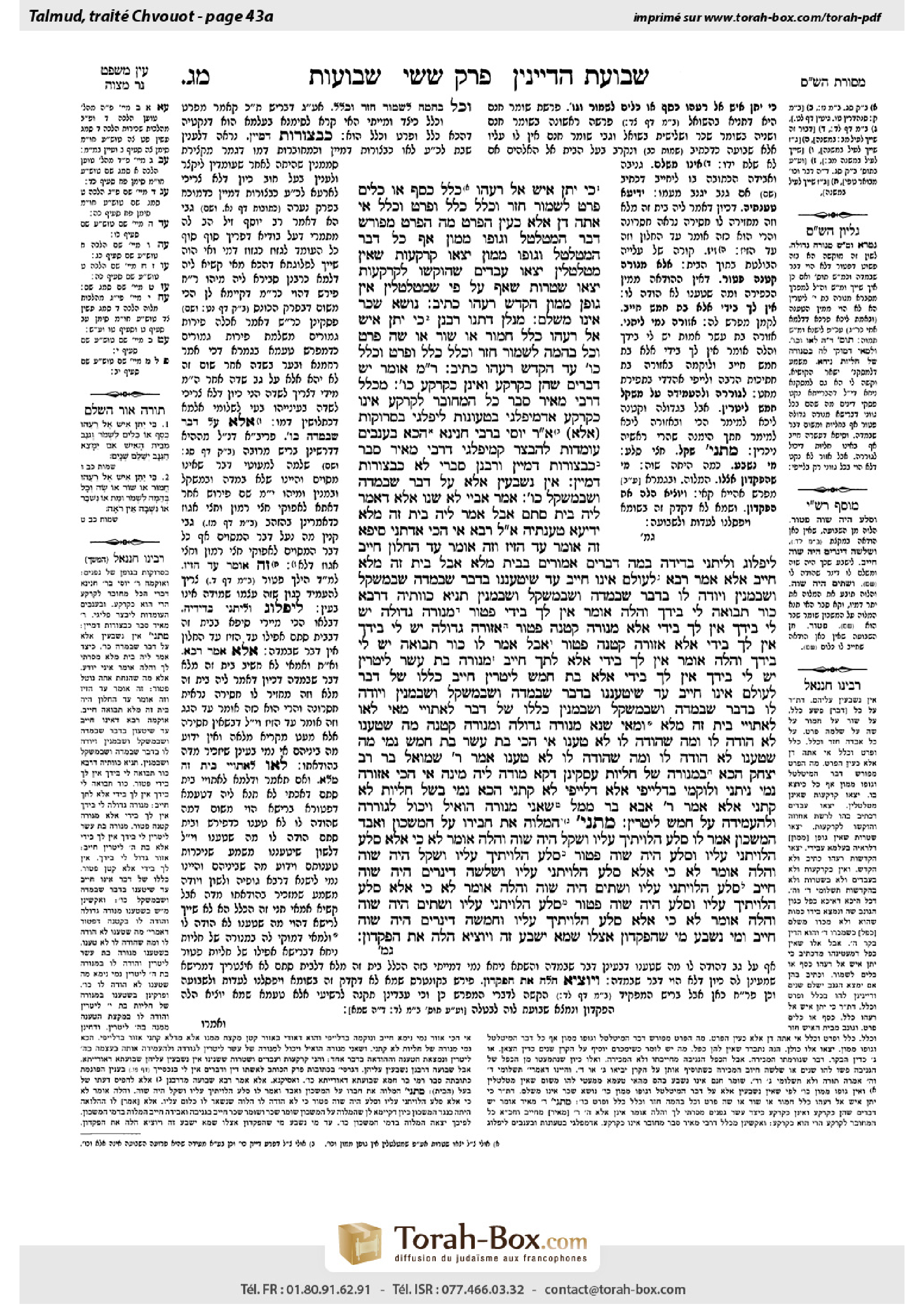
Shevuot 43a: Talmud study for Daf Yomi
Daf Yomi is the daily study of one Talmud folio. Explore 37 tractates with scans, Hebrew text, Sefaria English and AI-generated French translations where annotated.
Passage selection and English or AI-generated French translation are available where the scan has annotations. Daf Study is independent of Torah-Box and Sefaria.
Browse Shevuot · שבועות · All tractatesShevuot 43a text and translations
This page of Shevuot includes the Aramaic text, an English translation and an AI-generated French translation, alongside the scan above.
שבועות מ״ג א · Aramaic and Hebrew text
״כִּי יִתֵּן אִישׁ אֶל רֵעֵהוּ״ – כְּלָל, ״כֶּסֶף אוֹ כֵּלִים״ – פְּרָט, ״לִשְׁמֹר״ – חָזַר וְכָלַל. כְּלָל וּפְרָט וּכְלָל – אִי אַתָּה דָן אֶלָּא כְּעֵין הַפְּרָט; מָה הַפְּרָט מְפוֹרָשׁ – דָּבָר הַמִּטַּלְטֵל וְגוּפוֹ מָמוֹן, אַף כׇּל דָּבָר הַמִּטַּלְטֵל וְגוּפוֹ מָמוֹן.
יָצְאוּ קַרְקָעוֹת – שֶׁאֵין מְטַלְטְלִין; יָצְאוּ עֲבָדִים – שֶׁהוּקְּשׁוּ לְקַרְקָעוֹת; יָצְאוּ שְׁטָרוֹת – שֶׁאַף עַל פִּי שֶׁמִּטַּלְטְלִין, אֵין גּוּפָן מָמוֹן; הֶקְדֵּשׁ – ״רֵעֵהוּ״ כְּתִיב.
נוֹשֵׂא שָׂכָר אֵינוֹ מְשַׁלֵּם. מְנָלַן? דְּתָנוּ רַבָּנַן: ״כִּי יִתֵּן אִישׁ אֶל רֵעֵהוּ״ – כְּלָל, ״חֲמוֹר אוֹ שׁוֹר אוֹ שֶׂה״ – פְּרָט, ״וְכׇל בְּהֵמָה לִשְׁמֹר״ – חָזַר וְכָלַל. כְּלָל וּפְרָט וּכְלָל כּוּ׳, עַד הֶקְדֵּשׁ – ״רֵעֵהוּ״ כְּתִיב.
רַבִּי מֵאִיר אוֹמֵר: יֵשׁ דְּבָרִים שֶׁהֵן כְּקַרְקַע וְאֵינָן כְּקַרְקַע כּוּ׳. מִכְּלָל דְּרַבִּי מֵאִיר סָבַר: כׇּל הַמְחוּבָּר לַקַּרְקַע אֵינוֹ כְּקַרְקַע?! אַדְּמִיפַּלְגִי בִּטְעוּנוֹת, לִיפַּלְגִי בִּסְרוּקוֹת!
(אֶלָּא) אָמַר רַבִּי יוֹסֵי בְּרַבִּי חֲנִינָא: הָכָא בַּעֲנָבִים עוֹמְדוֹת לְהִבָּצֵר קָמִיפַּלְגִי; דְּרַבִּי מֵאִיר סָבַר: כִּבְצוּרוֹת דָּמְיָין, וְרַבָּנַן סָבְרִי: לָא כִּבְצוּרוֹת דָּמְיָין.
אֵין נִשְׁבָּעִין אֶלָּא עַל דָּבָר שֶׁבְּמִדָּה וְשֶׁבְּמִשְׁקָל כּוּ׳. אָמַר אַבָּיֵי: לֹא שָׁנוּ אֶלָּא דַּאֲמַר לֵיהּ ״בַּיִת״ סְתָם, אֲבָל אֲמַר לֵיהּ ״בַּיִת זֶה מָלֵא״ – יְדִיעָא טַעַנְתֵּיהּ.
אֲמַר לֵיהּ רָבָא: אִי הָכִי, אַדְּתָנֵי סֵיפָא: זֶה אוֹמֵר ״עַד הַזִּיז״ וְזֶה אוֹמֵר ״עַד הַחַלּוֹן״ – חַיָּיב; לִיפְלוֹג וְלִיתְנֵי בְּדִידַהּ: בַּמֶּה דְּבָרִים אֲמוּרִים – בְּ״בַיִת מָלֵא״, אֲבָל ״בַּיִת זֶה מָלֵא״ – חַיָּיב!
אֶלָּא אָמַר רָבָא: לְעוֹלָם אֵינוֹ חַיָּיב עַד שֶׁיִּטְעָנֶנּוּ בְּדָבָר שֶׁבְּמִדָּה שֶׁבְּמִשְׁקָל וְשֶׁבְּמִנְיָן, וְיוֹדֶה לוֹ בְּדָבָר שֶׁבְּמִדָּה וְשֶׁבְּמִשְׁקָל וְשֶׁבְּמִנְיָן.
תַּנְיָא כְּוָותֵיהּ דְּרָבָא: ״כּוֹר תְּבוּאָה לִי בְּיָדְךָ״, וְהַלָּה אוֹמֵר ״אֵין לְךָ בְּיָדִי״ – פָּטוּר. ״מְנוֹרָה גְּדוֹלָה יֵשׁ לִי בְּיָדְךָ״, ״אֵין לְךָ בְּיָדִי אֶלָּא מְנוֹרָה קְטַנָּה״ – פָּטוּר. ״אֲזוֹרָה גְּדוֹלָה יֵשׁ לִי בְּיָדְךָ״, ״אֵין לְךָ בְּיָדִי אֶלָּא אֲזוֹרָה קְטַנָּה״ – פָּטוּר.
אֲבָל אָמַר לוֹ: ״כּוֹר תְּבוּאָה יֵשׁ לִי בְּיָדְךָ״, וְהַלָּה אוֹמֵר: ״אֵין לְךָ בְּיָדִי אֶלָּא לֶתֶךְ״ – חַיָּיב. ״מְנוֹרָה בַּת עֶשֶׂר לִיטְרִין יֵשׁ לִי בְּיָדְךָ״, ״אֵין לְךָ בְּיָדִי אֶלָּא בַּת חָמֵשׁ לִיטְרִין״ – חַיָּיב.
כְּלָלוֹ שֶׁל דָּבָר: לְעוֹלָם אֵינוֹ חַיָּיב עַד שֶׁיִּטְעָנֶנּוּ בְּדָבָר שֶׁבְּמִדָּה וְשֶׁבְּמִשְׁקָל וְשֶׁבְּמִנְיָן, וְיוֹדֶה לוֹ בְּדָבָר שֶׁבְּמִדָּה וְשֶׁבְּמִשְׁקָל וְשֶׁבְּמִנְיָן.
״כְּלָלוֹ שֶׁל דָּבָר״ לְאֵתוֹיֵי מַאי? לָאו לְאֵתוֹיֵי ״בַּיִת זֶה מָלֵא״?
וּמַאי שְׁנָא מְנוֹרָה גְּדוֹלָה וּמְנוֹרָה קְטַנָּה? מַה שֶּׁטְּעָנוֹ לֹא הוֹדָה לוֹ, וּמַה שֶּׁהוֹדָה לוֹ לֹא טְעָנוֹ! אִי הָכִי, בַּת עֶשֶׂר בַּת חָמֵשׁ נָמֵי – מַה שֶּׁטְּעָנוֹ לֹא הוֹדָה לוֹ, וּמַה שֶּׁהוֹדָה לוֹ לֹא טְעָנוֹ!
אָמַר רַבִּי שְׁמוּאֵל בַּר רַב יִצְחָק: הָכָא בִּמְנוֹרָה שֶׁל חֻלְיוֹת עָסְקִינַן, דְּקָא מוֹדֶה לֵיהּ מִינַּהּ.
אִי הָכִי, אֲזוֹרָה נָמֵי נִיתְנֵי – וְלוֹקְמֵי בִּדְלַיְיפִי! אֶלָּא דְּלַיְיפִי לָא קָתָנֵי; הָכָא נָמֵי – בְּשֶׁל חֻלְיוֹת לָא קָתָנֵי!
אֶלָּא אָמַר רַבִּי אַבָּא בַּר מֶמֶל: שָׁאנֵי מְנוֹרָה, הוֹאִיל וְיָכוֹל לְגוֹרְרָהּ וּלְהַעֲמִידָהּ עַל חָמֵשׁ לִיטְרִין.
מַתְנִי׳ הַמַּלְוֶה אֶת חֲבֵירוֹ עַל הַמַּשְׁכּוֹן וְאָבַד הַמַּשְׁכּוֹן, אָמַר לוֹ: ״סֶלַע הִלְוִיתִיךָ עָלָיו וְשֶׁקֶל הָיָה שָׁוֶה״, וְהַלָּה אוֹמֵר: ״לֹא כִּי, אֶלָּא סֶלַע הִלְוִיתַנִי עָלָיו וְסֶלַע הָיָה שָׁוֶה״ – פָּטוּר.
״סֶלַע הִלְוִיתִיךָ עָלָיו, וְשֶׁקֶל הָיָה שָׁוֶה״, וְהַלָּה אוֹמֵר: ״לֹא כִי, אֶלָּא סֶלַע הִלְוִיתַנִי עָלָיו, וּשְׁלֹשָׁה דִּינָרִים הָיָה שָׁוֶה״ – חַיָּיב.
״סֶלַע הִלְוִיתַנִי עָלָיו וּשְׁתַּיִם הָיָה שָׁוֶה״, וְהַלָּה אוֹמֵר: ״לֹא כִי, אֶלָּא סֶלַע הִלְוִיתִיךָ עָלָיו וְסֶלַע הָיָה שָׁוֶה״ – פָּטוּר. ״סֶלַע הִלְוִיתַנִי עָלָיו וּשְׁתַּיִם הָיָה שָׁוֶה״, וְהַלָּה אוֹמֵר: ״לֹא כִי, אֶלָּא סֶלַע הִלְוִיתִיךָ עָלָיו וַחֲמִשָּׁה דִּינָרִים הָיָה שָׁוֶה״ – חַיָּיב.
וּמִי נִשְׁבָּע? מִי שֶׁהַפִּקָּדוֹן אֶצְלוֹ. שֶׁמָּא יִשָּׁבַע זֶה, וְיוֹצִיא הַלָּה אֶת הַפִּקָּדוֹן.
Shevuot 43a · English translation
The verse introduces the halakhot with regard to an unpaid bailee with the phrase: “If a man delivers to his neighbor silver or vessels to safeguard” (Exodus 22:6). The phrase “if a man delivers to his neighbor” is a generalization, “silver or vessels” is a detail, and when the verse states: “To safeguard,” it then generalized again. Consequently, this verse contains a generalization and a detail and a generalization, in which case you may deduce that the verse is referring only to items similar to the detail. Applying this principle here, one concludes that just as each of the items mentioned in the detail is clearly defined as an item that is movable property and has intrinsic monetary value, so too, an unpaid bailee takes an oath concerning anything that is movable property and has intrinsic monetary value.
Land is therefore excluded, as it is not movable property. Canaanite slaves are excluded, as they are compared to land in many areas of halakha. Financial documents are excluded, since although they are movable property, they do not have intrinsic monetary value. Consecrated property is excluded because it is written in the verse: “If a man delivers to his neighbor.” This term indicates that both the one depositing the item and the bailee must be people, and not the Temple treasury.
§ The mishna teaches that a paid bailee does not pay for the loss or theft of one of these items. The Gemara asks: From where do we derive this halakha? The Gemara answers: It is as the Sages taught in a baraita: The verse introduces the halakhot with regard to a paid bailee with the phrase: “If a man delivers to his neighbor a donkey, or an ox, or a sheep, or any animal to guard” (Exodus 22:9). The phrase “if a man delivers to his neighbor” is a generalization, the phrase “a donkey, or an ox, or a sheep” is a detail, and when the verse states: “Or any animal to safeguard,” it then generalized again. Consequently, this verse contains a generalization, and a detail, and a generalization, which excludes any item that is not similar to the detail, as delineated in the previous baraita with regard to an unpaid bailee, up to and including the last clause of that baraita: Consecrated property is excluded because it is written in the verse: “If a man delivers to his neighbor.”
§ The mishna teaches: Rabbi Meir says: There are certain items that are like land with regard to their form, but are not treated like land from a halakhic perspective; and the Rabbis do not concede that this is so, as they hold that the halakhic status of anything that is attached to the land is like the land itself. The Gemara challenges: By inference, does Rabbi Meir hold that the halakhic status of anything that is attached to the land is not like land? If so, rather than disagreeing with regard to grapevines laden with fruit, let them disagree with regard to fruitless vines, as Rabbi Meir holds that the halakhic status of the vines themselves is not like that of the land.
Rabbi Yosei, son of Rabbi Ḥanina, said that they disagree here not with regard to any item that is attached to the land, as Rabbi Meir concedes that such items usually have the halakhic status of the land itself. The dispute is specifically with regard to grapes that are ready to be harvested, as Rabbi Meir holds that their halakhic status is similar to that of grapes that are already harvested, and the Rabbis hold that their halakhic status is not similar to that of grapes that are already harvested, and that they still have the status of land.
§ The mishna teaches that one takes an oath only concerning an item that is defined by size, by weight, or by number. How so? If the claimant says: I delivered to you a house full of produce, and the other person says: I do not know how much you gave me, but what you left in my possession you may take, and the amount in the house is less that that claimed by the claimant, the defendant is exempt from taking an oath. Abaye said: They taught this halakha only in a case where the claimant said to him: I gave you a house full of produce, without specification. But if he said to him: I gave you this specific house full of produce, his claim is known and defined, and the defendant is therefore required to take an oath concerning it.
Rava said to him: If so, rather than teaching in the last clause of the mishna: If this party says that the house was full up to the ledge, and that party says that it was full up to the window, the defendant is liable to take an oath, let the tanna distinguish and teach the distinction within the case itself, where the claim was for a house full of produce, and say: In what case is this statement, that the defendant is exempt, said? It is said in a case where the claim was for an unspecified house full of produce; but if the claim was for this particular house full of produce, the defendant is liable to take an oath. Since the mishna did not make this distinction, evidently the defendant is exempt even if the claim is referring to a specific house.
Rather, Rava said: The defendant is never liable to take an oath unless the claimant claims from him an item that is defined by size, by weight, or by number, and the defendant admits to him with regard to a part of the claim that is an item that is defined by size, by weight, or by number.
The Gemara comments: It is taught in a baraita in accordance with the opinion of Rava: If the claimant says: I have a kor of produce in your possession, and the other one says: Nothing of yours is in my possession, the defendant is exempt from taking an oath, as he denies the entire debt. If he says: I have a large candelabrum in your possession, and the defendant responds: You have only a small candelabrum in my possession, he is exempt from taking an oath, as he admits not to part of the claim, but to possessing a different item. Similarly, if the claimant says: I have a large belt in your possession, and the defendant responds: You have only a small belt in my possession, he is exempt from taking an oath.
The baraita continues: But if the claimant said to him: I have a kor of produce in your possession, and the other one says: You have only a half-kor in my possession, he is liable to take an oath. Similarly, if the claimant says: I have a candelabrum weighing ten litra in your possession, and the defendant responds: You have only a five-litra candelabrum in my possession, he is liable to take an oath.
The baraita concludes: The principle of the matter is that the defendant is never liable to take an oath unless the claimant claims from him an item that is defined by size, or by weight, or by number, and the defendant admits to him with regard to a part of the claim that is an item that is defined by size, by weight, or by number.
The Gemara asks: What does the baraita add that was not already taught, by mentioning the principle of the matter? Doesn’t the baraita mention this principle to add that even if the claim is for this specific house full of produce, the defendant is exempt, as this is not considered an item defined by size? Accordingly, the baraita is in accordance with the opinion of Rava.
Having cited the baraita, the Gemara now analyzes it: What is different about a case where the claimant claimed a large candelabrum and the defendant admitted to owing a small candelabrum that renders the defendant exempt from taking an oath? It is because that which he claimed from him, he did not admit to at all, and that which he admitted to, he had not claimed from him. If so, in a case where the claimant claimed a ten-litra candelabrum and the defendant admitted to owing a five-litra candelabrum, the defendant should also be exempt, as that which he claimed from him, a heavier candelabrum, he did not admit to at all, and that which he admitted to, a lighter candelabrum, he had not claimed from him.
Rabbi Shmuel bar Rav Yitzḥak said: Here in the latter case we are dealing with a candelabrum composed of segments that detach; the defendant is liable to take an oath because he admits to owing him part of the candelabrum claimed by the claimant.
The Gemara asks: If so, let the baraita teach the case in which the defendant is liable to take an oath involving a belt as well, and interpret the case as referring to a belt made of pieces that are connected to each other; the claimant claims a belt with a larger number of pieces, and the defendant claims that he owes him a belt with fewer pieces. Rather, clearly the baraita is not teaching cases involving items made of pieces connected to each other. Here too, in the case of the candelabrum, the baraita is not teaching a case of a candelabrum composed of segments that detach.
Rather, Rabbi Abba bar Memel said that the case of a candelabrum is different because one can scrape a ten-litra candelabrum and reduce it to a five-litra one. Therefore, he admitted to a part of the claim.
MISHNA: There is a case of one who lends money to another on the basis of collateral, and the collateral was lost while in the possession of the creditor, and the creditor says to the debtor: I lent you a sela on the basis of that collateral and that collateral was worth a shekel, i.e., a half-sela. Therefore, you owe me a shekel. And the other individual, the debtor, says in response to that claim: That is not the case. Rather, you lent me a sela on the basis of that collateral, and the collateral was worth a sela; I owe you nothing. In this case, the debtor is exempt from payment.
There is a case of a creditor who claims: I lent you a sela on the basis of that collateral and it was worth a shekel. And the other individual, the debtor, says: That is not the case; rather, you lent me a sela on the basis of that collateral, and the collateral was worth three dinars, i.e., three-quarters of a sela. In this case, the debtor is liable to take an oath, due to the fact that he responded to the claim of the creditor with a partial admission.
If in that case the debtor said: You lent me a sela on the basis of that collateral and the collateral was worth two sela, so now you owe me a sela. And the other party, i.e., the creditor, said: That is not the case; rather, I lent you a sela on the basis of that collateral and the collateral was worth a sela. Here, the creditor is exempt. If in that case the debtor said: You lent me a sela on the basis of that collateral and the collateral was worth two sela. And the other party, i.e., the creditor, said: That is not the case; rather, I lent you a sela on the basis of that collateral and the collateral was worth five dinars. Here, the creditor is liable to take an oath due to the fact that he responded to the claim of the debtor with a partial admission.
And who takes the oath? The one in whose possession the deposit had been located, i.e., the creditor, who took collateral from the debtor. The Sages instituted this provision lest this party, i.e., the debtor, take an oath and the other party, i.e., the creditor, produce the deposit and prove the oath false.
Shevuot 43a · Traduction française (IA)
Le verset introduit les halakhot relatives au dépositaire non rémunéré par les mots : « Si un homme remet à son prochain de l’argent ou des objets à garder » (Exode 22, 6). L’expression « si un homme remet à son prochain » est une généralité, « de l’argent ou des objets » une précision, puis le verset généralise de nouveau en disant : « à garder ». Par conséquent, le verset présente une généralité, une précision et une généralité, ce qui permet d’en déduire qu’il ne concerne que les éléments semblables à ceux de la précision. En appliquant ce principe ici, on conclut que, de même que chacun des éléments mentionnés dans la précision est clairement défini comme un bien meuble ayant une valeur monétaire intrinsèque, de même le dépositaire non rémunéré prête serment au sujet de tout bien meuble ayant une valeur monétaire intrinsèque.
Les biens-fonds sont donc exclus, puisqu’ils ne sont pas des biens meubles. Les esclaves cananéens sont exclus, car ils sont assimilés aux biens-fonds dans de nombreux domaines de la halakha. Les documents financiers sont exclus, car, bien qu’ils soient des biens meubles, ils n’ont pas de valeur monétaire intrinsèque. Les biens consacrés sont exclus, car il est écrit dans le verset : « Si un homme remet à son prochain ». Cette expression indique que tant celui qui dépose l’objet que le dépositaire doivent être des personnes, et non le Trésor du Temple.
§ La Michna enseigne qu’un dépositaire rémunéré ne paie pas en cas de perte ou de vol de l’un de ces objets. La Guemara demande : De quelle source déduit-on cette halakha ? La Guemara répond : C’est ce que les Sages ont enseigné dans une baraïta : le verset introduit les halakhot relatives au dépositaire rémunéré par les mots : « Si un homme remet à son prochain un âne, un bœuf, un mouton ou un animal quelconque à garder » (Exode 22, 9). L’expression « si un homme remet à son prochain » est une généralité, « un âne, un bœuf ou un mouton » une précision, puis le verset généralise de nouveau en disant : « ou un animal quelconque à garder ». Par conséquent, le verset présente une généralité, une précision et une généralité, ce qui exclut tout élément qui n’est pas semblable à ceux de la précision, comme l’indiquait la baraïta précédente au sujet du dépositaire non rémunéré, jusqu’à sa dernière clause incluse : les biens consacrés sont exclus, car il est écrit dans le verset : « Si un homme remet à son prochain ».
§ La Michna enseigne : Rabbi Meïr dit qu’il existe certains éléments qui, par leur forme, ressemblent à des biens-fonds, mais qui ne sont pas considérés comme tels du point de vue de la halakha ; les Rabbins ne reconnaissent pas cette distinction, car ils estiment que tout ce qui est attaché au sol a le même statut halakhique que le sol lui-même. La Guemara objecte : Cela implique-t-il que, selon Rabbi Meïr, tout ce qui est attaché au sol n’a pas le même statut halakhique que les biens-fonds ? Si tel est le cas, au lieu de diverger au sujet des vignes chargées de fruits, qu’ils divergent au sujet des vignes sans fruits, puisque Rabbi Meïr estime que les vignes elles-mêmes n’ont pas le statut des biens-fonds.
Rabbi Yossei, fils de Rabbi Ḥanina, dit que leur désaccord ne porte pas ici sur les éléments attachés au sol, car Rabbi Meïr reconnaît que ceux-ci ont généralement le statut halakhique du sol lui-même. Leur désaccord porte précisément sur les raisins prêts à être vendangés : Rabbi Meïr estime que leur statut halakhique est semblable à celui des raisins déjà vendangés, tandis que les Rabbins estiment qu’il en diffère et qu’ils ont encore le statut de biens-fonds.
§ La Michna enseigne qu’on ne prête serment qu’au sujet d’un élément défini par sa mesure, son poids ou son nombre. Comment cela s’applique-t-il ? Si le demandeur dit : « Je t’ai remis une maison pleine de produits », et que l’autre répond : « Je ne sais pas quelle quantité tu m’as donnée, mais tu peux prendre ce que tu as laissé en ma possession », et que la quantité présente dans la maison est inférieure à celle réclamée par le demandeur, le défendeur est dispensé de prêter serment. Abayé dit : Cette halakha n’a été enseignée que dans le cas où le demandeur lui a dit : « Je t’ai donné une maison pleine de produits », sans autre précision. Mais s’il lui a dit : « Je t’ai donné cette maison précise, pleine de produits », sa réclamation est connue et définie, et le défendeur doit donc prêter serment à ce sujet.
Rava lui dit : Dans ce cas, au lieu d’enseigner dans la dernière clause de la Michna : « Si l’un dit que la maison était pleine jusqu’au rebord et que l’autre dit qu’elle était pleine jusqu’à la fenêtre, le défendeur doit prêter serment », que le tanna distingue les cas dans l’énoncé même portant sur une maison pleine de produits et dise : « Dans quel cas le défendeur est-il dispensé ? Lorsque la réclamation porte sur une maison pleine de produits sans autre précision. Mais si elle porte sur cette maison précise, pleine de produits, le défendeur doit prêter serment. » Puisque la Michna n’établit pas cette distinction, il est évident que le défendeur est dispensé même si la réclamation porte sur une maison précise.
Rava dit plutôt : Le défendeur ne doit prêter serment que si le demandeur lui réclame un élément défini par sa mesure, son poids ou son nombre, et que le défendeur reconnaît lui en devoir une partie, elle-même définie par sa mesure, son poids ou son nombre.
La Guemara fait remarquer : Une baraïta enseigne conformément à l’opinion de Rava : si le demandeur dit : « Tu as en ta possession un kor de produits qui m’appartient », et que l’autre répond : « Je n’ai rien qui t’appartienne en ma possession », le défendeur est dispensé de prêter serment, puisqu’il nie la totalité de la dette. Si le demandeur dit : « Tu as en ta possession un grand candélabre qui m’appartient », et que le défendeur répond : « Tu n’as en ma possession qu’un petit candélabre », il est dispensé de prêter serment, puisqu’il ne reconnaît pas devoir une partie de l’élément réclamé, mais affirme posséder un élément différent. De même, si le demandeur dit : « Tu as en ta possession une grande ceinture qui m’appartient », et que le défendeur répond : « Tu n’as en ma possession qu’une petite ceinture », il est dispensé de prêter serment.
La baraïta poursuit : mais si le demandeur lui dit : « Tu as en ta possession un kor de produits qui m’appartient », et que l’autre répond : « Tu n’en as qu’un demi-kor en ma possession », le défendeur doit prêter serment. De même, si le demandeur dit : « Tu as en ta possession un candélabre de dix litra qui m’appartient », et que le défendeur répond : « Tu n’as en ma possession qu’un candélabre de cinq litra », il doit prêter serment.
La baraïta conclut : le principe général est que le défendeur ne doit prêter serment que si le demandeur lui réclame un élément défini par sa mesure, son poids ou son nombre, et que le défendeur reconnaît lui en devoir une partie, elle-même définie par sa mesure, son poids ou son nombre.
La Guemara demande : Qu’ajoute la baraïta en mentionnant le principe général ? Ne le mentionne-t-elle pas pour ajouter que, même si la réclamation porte sur cette maison précise, pleine de produits, le défendeur est dispensé, car cela n’est pas considéré comme un élément défini par sa mesure ? Ainsi, la baraïta est conforme à l’opinion de Rava.
Après avoir cité la baraïta, la Guemara l’analyse : En quoi le cas où le demandeur réclame un grand candélabre et où le défendeur reconnaît lui devoir un petit candélabre diffère-t-il, de sorte que le défendeur soit dispensé de prêter serment ? C’est parce qu’il n’a pas reconnu devoir ce que le demandeur lui réclamait, et que ce qu’il a reconnu devoir ne lui avait pas été réclamé. Dans ce cas, si le demandeur réclame un candélabre de dix litra et que le défendeur reconnaît lui devoir un candélabre de cinq litra, le défendeur devrait également être dispensé : il n’a pas reconnu devoir ce qui lui était réclamé, à savoir un candélabre plus lourd, et ce qu’il a reconnu devoir, à savoir un candélabre plus léger, ne lui avait pas été réclamé.
Rabbi Shmuel bar Rav Yitzḥak dit : dans le cas évoqué ensuite, il s’agit d’un candélabre composé de sections détachables ; le défendeur doit prêter serment, car il reconnaît devoir au demandeur une partie du candélabre réclamé.
La Guemara demande : Dans ce cas, que la baraïta enseigne également le cas d’une ceinture pour lequel le défendeur doit prêter serment, en interprétant qu’il s’agit d’une ceinture faite de pièces reliées entre elles : le demandeur réclame une ceinture comportant davantage de pièces, et le défendeur affirme lui en devoir une qui en comporte moins. Il est donc clair que la baraïta n’enseigne pas de cas portant sur des éléments composés de pièces reliées entre elles. De même ici, dans le cas du candélabre, la baraïta n’enseigne pas le cas d’un candélabre composé de sections détachables.
Rabbi Abba bar Memel dit plutôt que le cas du candélabre est différent, car on peut gratter un candélabre de dix litra et le réduire à cinq litra. Le défendeur a donc reconnu devoir une partie de ce qui lui était réclamé.
MICHNA : Il s’agit du cas d’une personne qui prête de l’argent à une autre en prenant un gage, lequel est perdu alors qu’il se trouve en possession du créancier. Le créancier dit au débiteur : « Je t’ai prêté un sela en prenant ce gage, et ce gage valait un shekel », c’est-à-dire un demi-sela. « Tu me dois donc un shekel. » Le débiteur répond : « Ce n’est pas le cas. Tu m’as plutôt prêté un sela en prenant ce gage, et le gage valait un sela ; je ne te dois rien. » Dans ce cas, le débiteur est dispensé de payer.
Il s’agit du cas où le créancier réclame : « Je t’ai prêté un sela en prenant ce gage, et celui-ci valait un shekel. » Le débiteur répond : « Ce n’est pas le cas ; tu m’as plutôt prêté un sela en prenant ce gage, et le gage valait trois dinars », c’est-à-dire les trois quarts d’un sela. Dans ce cas, le débiteur doit prêter serment, puisqu’il a répondu à la réclamation du créancier par une reconnaissance partielle.
Dans ce cas, si le débiteur dit : « Tu m’as prêté un sela en prenant ce gage, et le gage valait deux sela ; tu me dois donc maintenant un sela », et que l’autre partie, c’est-à-dire le créancier, répond : « Ce n’est pas le cas ; je t’ai plutôt prêté un sela en prenant ce gage, et le gage valait un sela », le créancier est dispensé. Si le débiteur dit : « Tu m’as prêté un sela en prenant ce gage, et le gage valait deux sela », et que l’autre partie, c’est-à-dire le créancier, répond : « Ce n’est pas le cas ; je t’ai plutôt prêté un sela en prenant ce gage, et le gage valait cinq dinars », le créancier doit prêter serment, puisqu’il a répondu à la réclamation du débiteur par une reconnaissance partielle.
Et qui prête serment ? Celui en la possession de qui se trouvait le dépôt, c’est-à-dire le créancier, qui avait pris le gage du débiteur. Les Sages ont institué cette disposition de peur que le débiteur ne prête serment et que le créancier ne produise le dépôt et ne prouve que le serment était mensonger.
Traduction française générée par IA à partir de l’édition anglaise de Sefaria. Vérifie toujours un passage avec le texte source.
Text from Sefaria: William Davidson Edition - Vocalized Aramaic (CC BY NC); William Davidson Edition - English (CC BY NC).