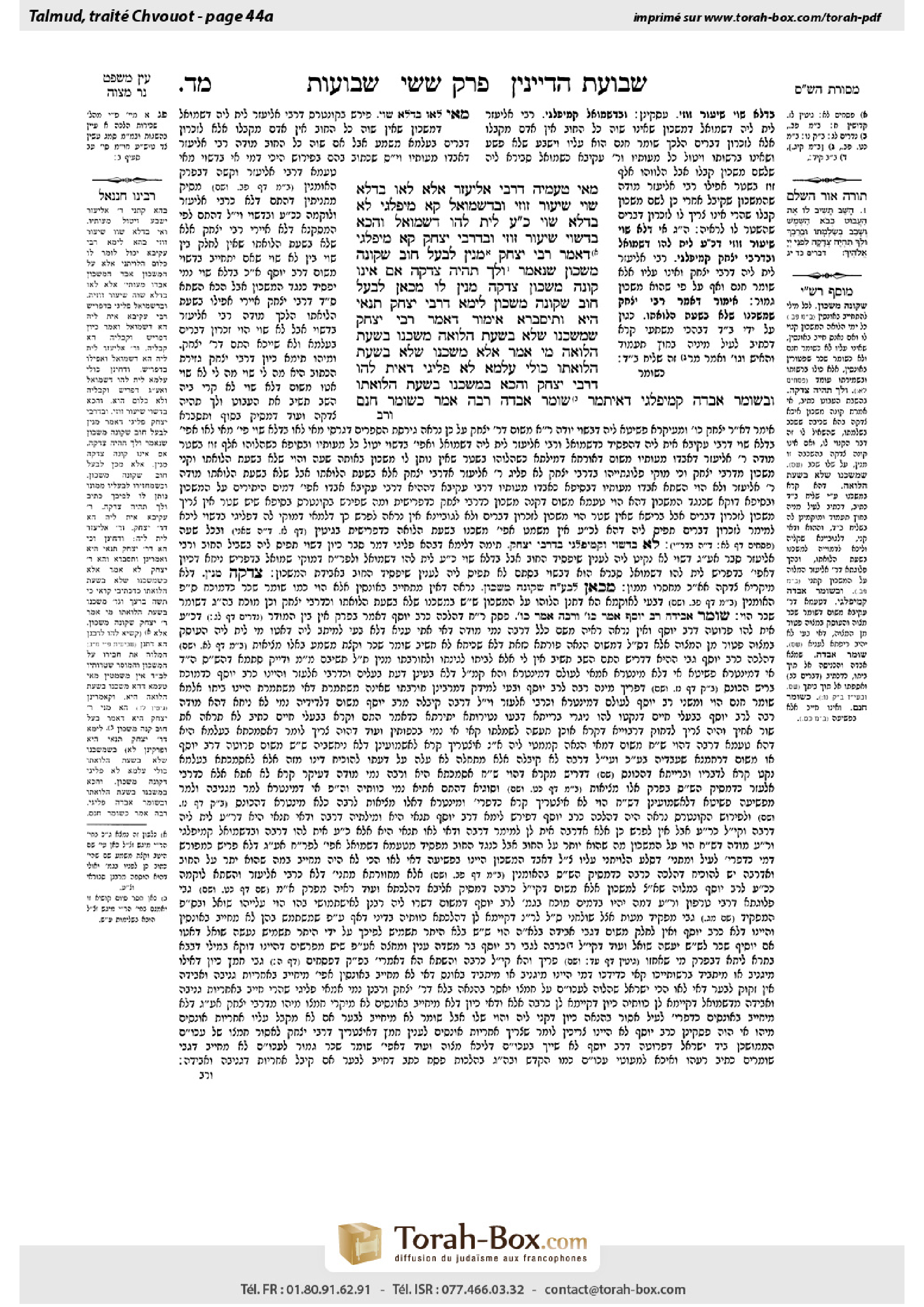
Shevuot 44a: Talmud study for Daf Yomi
Daf Yomi is the daily study of one Talmud folio. Explore 37 tractates with scans, Hebrew text, Sefaria English and AI-generated French translations where annotated.
Passage selection and English or AI-generated French translation are available where the scan has annotations. Daf Study is independent of Torah-Box and Sefaria.
Browse Shevuot · שבועות · All tractatesShevuot 44a text and translations
This page of Shevuot includes the Aramaic text, an English translation and an AI-generated French translation, alongside the scan above.
שבועות מ״ד א · Aramaic and Hebrew text
מַאי טַעְמֵיהּ דְּרַבִּי אֱלִיעֶזֶר? אֶלָּא לָאו בִּדְלָא שָׁוֵי שִׁיעוּר זוּזֵי – וּבְדִשְׁמוּאֵל קָא מִיפַּלְגִי?
לָא; בִּדְלָא שָׁוֵי – כּוּלֵּי עָלְמָא לֵית לְהוּ דִּשְׁמוּאֵל; וְהָכָא בִּדְשָׁוֵי שִׁיעוּר זוּזֵי, וּבִדְרַבִּי יִצְחָק קָא מִיפַּלְגִי – דְּאָמַר רַבִּי יִצְחָק: מִנַּיִן לְבַעַל חוֹב שֶׁקּוֹנֶה מַשְׁכּוֹן? שֶׁנֶּאֱמַר: ״וּלְךָ תִּהְיֶה צְדָקָה״.
אִם אֵינוֹ קוֹנֶה מַשְׁכּוֹן, צְדָקָה מִנַּיִן לוֹ? מִכָּאן לְבַעַל חוֹב שֶׁקּוֹנֶה מַשְׁכּוֹן.
לֵימָא דְּרַבִּי יִצְחָק תַּנָּאֵי הִיא? וְתִיסְבְּרָא?! אֵימוֹר דְּאָמַר רַבִּי יִצְחָק – שֶׁמִּשְׁכְּנוֹ שֶׁלֹּא בִּשְׁעַת הַלְוָאָה; מִשְׁכְּנוֹ בִּשְׁעַת הַלְוָאָה מִי אָמַר?!
אֶלָּא מִשְׁכְּנוֹ שֶׁלֹּא בִּשְׁעַת הַלְוָאָתוֹ – כּוּלֵּי עָלְמָא לָא פְּלִיגִי דְּאִית לְהוּ דְּרַבִּי יִצְחָק. וְהָכָא – בְּמִשְׁכְּנוֹ בִּשְׁעַת הַלְוָאָתוֹ,
וּבְשׁוֹמֵר אֲבֵדָה קָמִיפַּלְגִי; דְּאִיתְּמַר: שׁוֹמֵר אֲבֵדָה – רַבָּה אָמַר: כְּשׁוֹמֵר חִנָּם,
Shevuot 44a · English translation
what is the reasoning of Rabbi Eliezer, who holds that although the collateral was lost, the debtor is still liable to pay? Rather, is it not a case where the collateral was not worth the amount of money that he lent him? And accordingly, they disagree with regard to the ruling of Shmuel. Rabbi Akiva holds in accordance with the opinion of Shmuel, that if the collateral is lost the entire debt is canceled, and Rabbi Eliezer disagrees with this opinion.
The Gemara rejects this suggestion: No, in a case where the collateral was not worth the value of the loan everyone is of the opinion that the ruling is not in accordance with the opinion of Shmuel. But here the dispute is with regard to a case where the collateral was worth the amount of money that he lent him, and they disagree with regard to the opinion of Rabbi Yitzḥak. As Rabbi Yitzḥak says: From where is it derived that a creditor acquires collateral given to him and is considered its owner as long as the item is in his possession? As it is stated with regard to a creditor who returns the collateral to the debtor for his personal use: “And it shall be a righteousness for you” (Deuteronomy 24:13).
Rabbi Yitzḥak infers: If the creditor does not acquire the collateral, then from where is his righteousness? If the collateral is not his, the creditor would not be giving up anything of his own. From here it is derived that a creditor acquires the collateral. Rabbi Eliezer disagrees with this opinion, maintaining that the creditor has the halakhic status of an unpaid bailee with respect to the collateral, so that he is exempt from paying restitution if it is stolen or lost. He can therefore collect the entire debt from the debtor. Rabbi Akiva agrees with the opinion of Rabbi Yitzḥak, and holds that since the creditor acquires the collateral, he bears financial responsibility to pay its value in the event of its loss. Therefore, he must deduct the value of the collateral when collecting payment of the debt.
The Gemara asks: If so, shall we say that the opinion of Rabbi Yitzḥak is the subject of a dispute between tanna’im? The Gemara answers: And how can you understand that? Say that Rabbi Yitzḥak says that a creditor acquires the collateral in a case where he took the collateral from him not at the time of the loan, but afterward, in order to induce him to return the loan, as described in the context of the aforementioned verse. But in a case where the creditor took the collateral from him at the time of the loan, does Rabbi Yitzḥak say that he has acquired it?
Rather, in a case where he took the collateral from him not at the time of the loan, everyone agrees that the opinion of Rabbi Yitzḥak is accepted, and here, the dispute between Rabbi Eliezer and Rabbi Akiva is with regard to a case where he took the collateral from him at the time of the loan.
And they disagree with regard to the halakhic status of one who is safeguarding a lost item that he found but has not yet returned. As it was stated: With regard to one who is safeguarding a lost item, Rabba says that his halakhic status is like that of an unpaid bailee, who is exempt from paying restitution in the event that the item is lost or stolen,
Shevuot 44a · Traduction française (IA)
Quel est le raisonnement de Rabbi Eliezer, qui estime que, même si le gage a été perdu, le débiteur reste tenu de payer ? Ne s’agit-il pas plutôt d’un cas où le gage ne valait pas le montant du prêt qu’il lui avait accordé ? Par conséquent, leur désaccord porte sur la décision de Shmuel. Rabbi Akiva suit l’opinion de Shmuel, selon laquelle, si le gage est perdu, la dette entière est annulée, tandis que Rabbi Eliezer rejette cette opinion.
La Guemara rejette cette proposition : non, dans le cas où le gage ne valait pas le montant du prêt, tous estiment que la halakha ne suit pas l’opinion de Shmuel. Ici, en revanche, le désaccord porte sur un cas où le gage valait le montant du prêt, et sur l’opinion de Rabbi Yitzḥak. En effet, Rabbi Yitzḥak dit : D’où apprend-on qu’un créancier acquiert le gage qui lui a été remis et en est considéré comme le propriétaire tant que l’objet est en sa possession ? Car il est dit, au sujet d’un créancier qui rend le gage au débiteur pour son usage personnel : « Ce sera pour toi un acte de justice » (Deutéronome 24:13).
Rabbi Yitzḥak déduit : si le créancier n’acquiert pas le gage, en quoi consiste son acte de justice ? Si le gage ne lui appartient pas, le créancier ne renoncerait à rien qui soit à lui. On en déduit qu’un créancier acquiert le gage. Rabbi Eliezer rejette cette opinion et soutient que, selon la halakha, le créancier a, à l’égard du gage, le statut d’un dépositaire non rémunéré ; il est donc exempt d’indemniser le débiteur si le gage est volé ou perdu. Il peut par conséquent recouvrer la totalité de la dette auprès du débiteur. Rabbi Akiva partage l’opinion de Rabbi Yitzḥak et estime que, puisque le créancier acquiert le gage, il est financièrement tenu d’en payer la valeur s’il venait à être perdu. Il doit donc déduire la valeur du gage lorsqu’il recouvre la dette.
La Guemara demande : Dans ce cas, faut-il dire que l’opinion de Rabbi Yitzḥak fait l’objet d’un désaccord entre des tannaïm ? La Guemara répond : Comment peux-tu comprendre les choses ainsi ? Dis plutôt que Rabbi Yitzḥak affirme qu’un créancier acquiert le gage dans un cas où il l’a pris au débiteur, non pas au moment du prêt, mais par la suite, afin de l’inciter à rembourser le prêt, comme l’indique le contexte du verset précité. Mais, dans un cas où le créancier a pris le gage au débiteur au moment du prêt, Rabbi Yitzḥak dit-il qu’il l’a acquis ?
En revanche, dans un cas où le créancier a pris le gage au débiteur non pas au moment du prêt, tous conviennent que l’opinion de Rabbi Yitzḥak est retenue. Ici, le désaccord entre Rabbi Eliezer et Rabbi Akiva porte sur un cas où le créancier a pris le gage au débiteur au moment du prêt.
Leur désaccord porte sur le statut halakhique de celui qui garde un objet perdu qu’il a trouvé, mais qu’il n’a pas encore rendu. En effet, il a été enseigné : au sujet de celui qui garde un objet perdu, Rabba dit qu’il a le statut d’un dépositaire non rémunéré, lequel est exempt d’indemniser le propriétaire si l’objet est perdu ou volé,
Traduction française générée par IA à partir de l’édition anglaise de Sefaria. Vérifie toujours un passage avec le texte source.
Text from Sefaria: William Davidson Edition - Vocalized Aramaic (CC BY NC); William Davidson Edition - English (CC BY NC).