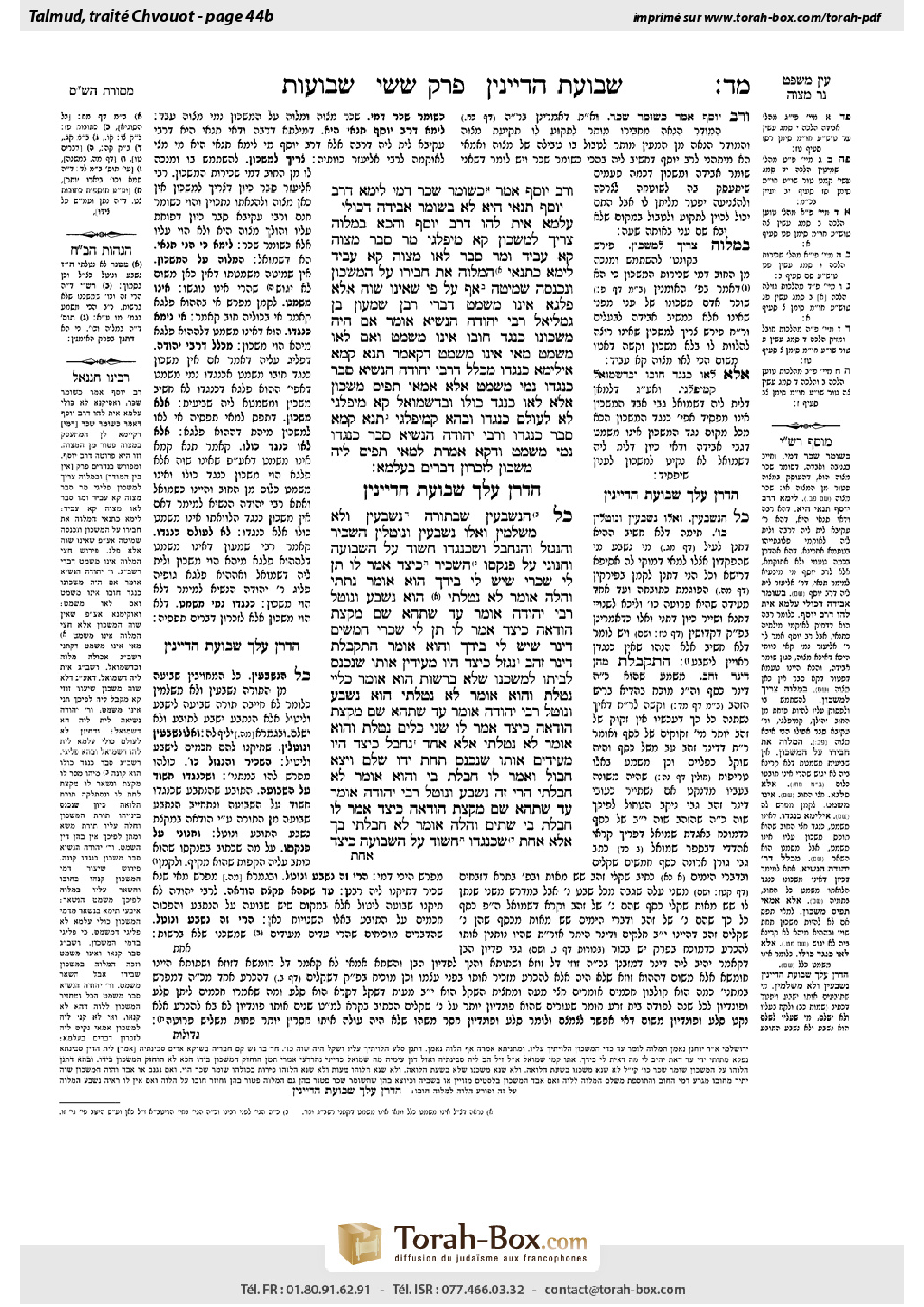
Shevuot 44b: Talmud study for Daf Yomi
Daf Yomi is the daily study of one Talmud folio. Explore 37 tractates with scans, Hebrew text, Sefaria English and AI-generated French translations where annotated.
Passage selection and English or AI-generated French translation are available where the scan has annotations. Daf Study is independent of Torah-Box and Sefaria.
Browse Shevuot · שבועות · All tractatesShevuot 44b text and translations
This page of Shevuot includes the Aramaic text, an English translation and an AI-generated French translation, alongside the scan above.
שבועות מ״ד ב · Aramaic and Hebrew text
וְרַב יוֹסֵף אָמַר: כְּשׁוֹמֵר שָׂכָר דָּמֵי.
לֵימָא דְּרַב יוֹסֵף תַּנָּאֵי הִיא? לָא; בְּשׁוֹמֵר אֲבֵידָה – דְּכוּלֵּי עָלְמָא אִית לְהוּ דְּרַב יוֹסֵף; וְהָכָא בְּמַלְוֶה צָרִיךְ לְמַשְׁכּוֹן קָא מִיפַּלְגִי: מָר סָבַר מִצְוָה קָא עָבֵיד, וּמָר סָבַר לָאו מִצְוָה קָא עָבֵיד.
לֵימָא כְּתַנָּאֵי: הַמַּלְוֶה אֶת חֲבֵירוֹ עַל הַמַּשְׁכּוֹן וְנִכְנְסָה שְׁמִיטָּה, אַף עַל פִּי שֶׁאֵינוֹ שָׁוֶה אֶלָּא פְּלַג – אֵינוֹ מְשַׁמֵּט. דִּבְרֵי רַבָּן שִׁמְעוֹן בֶּן גַּמְלִיאֵל. רַבִּי יְהוּדָה הַנָּשִׂיא אוֹמֵר: אִם הָיָה מַשְׁכּוֹנוֹ כְּנֶגֶד חוֹבוֹ – אֵינוֹ מְשַׁמֵּט, וְאִם לָאו – מְשַׁמֵּט.
מַאי ״אֵינוֹ מְשַׁמֵּט״ דְּקָאָמַר תַּנָּא קַמָּא? אִילֵימָא כְּנֶגְדּוֹ – מִכְּלָל דְּרַבִּי יְהוּדָה הַנָּשִׂיא סָבַר: כְּנֶגְדּוֹ נָמֵי מְשַׁמֵּט?! אֶלָּא אַמַּאי תָּפֵיס מַשְׁכּוֹן?
אֶלָּא לָאו כְּנֶגֶד כּוּלּוֹ – וּבְדִשְׁמוּאֵל קָא מִיפַּלְגִי?
לָא; לְעוֹלָם כְּנֶגְדּוֹ, וּבְהָא קָמִיפַּלְגִי – תַּנָּא קַמָּא סָבַר: כְּנֶגְדּוֹ; וְרַבִּי יְהוּדָה הַנָּשִׂיא סָבַר: כְּנֶגְדּוֹ נָמֵי מְשַׁמֵּט. וּדְקָא אָמְרַתְּ: לְמַאי תָּפֵיס לֵיהּ מַשְׁכּוֹן? לְזִכְרוֹן דְּבָרִים בְּעָלְמָא.
הֲדַרַן עֲלָךְ שְׁבוּעַת הַדַּיָּינִין
מַתְנִי׳ כׇּל הַנִּשְׁבָּעִין שֶׁבַּתּוֹרָה – נִשְׁבָּעִין וְלֹא מְשַׁלְּמִין. וְאֵלּוּ נִשְׁבָּעִין וְנוֹטְלִין: הַשָּׂכִיר, וְהַנִּגְזָל, וְהַנֶּחְבָּל, וְשֶׁכְּנֶגְדּוֹ חָשׁוּד עַל הַשְּׁבוּעָה, וְחֶנְוָנִי עַל פִּנְקָסוֹ.
הַשָּׂכִיר – כֵּיצַד? אָמַר לוֹ: ״תֵּן לִי שְׂכָרִי שֶׁיֵּשׁ לִי בְּיָדְךָ״; הוּא אוֹמֵר: ״נָתַתִּי״, וְהַלָּה אוֹמֵר: ״לֹא נָטַלְתִּי״ – הוּא נִשְׁבָּע וְנוֹטֵל. רַבִּי יְהוּדָה אוֹמֵר: עַד שֶׁתְּהֵא שָׁם מִקְצָת הוֹדָאָה. כֵּיצַד? אָמַר לוֹ: ״תֵּן לִי שְׂכָרִי חֲמִשִּׁים דִּינָר שֶׁיֵּשׁ לִי בְּיָדְךָ״, וְהוּא אוֹמֵר: ״הִתְקַבַּלְתָּ דִּינַר זָהָב״.
נִגְזָל – כֵּיצַד? הָיוּ מְעִידִין אוֹתוֹ שֶׁנִּכְנַס לְבֵיתוֹ לְמַשְׁכְּנוֹ שֶׁלֹּא בִּרְשׁוּת; הוּא אוֹמֵר ״כֶּלְיִי נָטַלְתָּ״, וְהוּא אוֹמֵר ״לֹא נָטַלְתִּי״ – הוּא נִשְׁבָּע וְנוֹטֵל. רַבִּי יְהוּדָה אוֹמֵר: עַד שֶׁתְּהֵא שָׁם מִקְצָת הוֹדָאָה. כֵּיצַד? אָמַר לוֹ ״שְׁנֵי כֵּלִים נָטַלְתָּ״, וְהוּא אוֹמֵר ״לֹא נָטַלְתִּי אֶלָּא אֶחָד״.
נֶחְבָּל – כֵּיצַד? הָיוּ מְעִידִים אוֹתוֹ שֶׁנִּכְנַס תַּחַת יָדוֹ שָׁלֵם וְיָצָא חָבוּל; וְאָמַר לוֹ: ״חָבַלְתָּ בִּי״, וְהוּא אוֹמֵר: ״לֹא חָבַלְתִּי״ – הֲרֵי זֶה נִשְׁבָּע וְנוֹטֵל. רַבִּי יְהוּדָה אוֹמֵר: עַד שֶׁתְּהֵא שָׁם מִקְצָת הוֹדָאָה. כֵּיצַד? אָמַר לוֹ: ״חָבַלְתָּ בִּי שְׁתַּיִם״, וְהַלָּה אוֹמֵר: ״לֹא חָבַלְתִּי בְּךָ אֶלָּא אֶחָת״.
שֶׁכְּנֶגְדּוֹ חָשׁוּד עַל הַשְּׁבוּעָה – כֵּיצַד?
Shevuot 44b · English translation
and Rav Yosef says that it is like that of a paid bailee, as while performing the mitzva of taking care of a lost item he is exempt from performing other mitzvot that involve the outlay of money, and the money that he saves is tantamount to payment received. Similarly, since safeguarding collateral is part of the mitzva to lend money to the needy, one who does so is exempt during that time from performing other mitzvot that involve the outlay of money. Therefore, Rabbi Eliezer’s ruling, that even if the collateral was lost the creditor collects the entire debt, is in accordance with the opinion of Rabba, and Rabbi Akiva’s ruling, that the creditor loses the value of the collateral, is in accordance with the opinion of Rav Yosef.
The Gemara asks: If so, shall we say that the opinion of Rav Yosef is the subject of a dispute between tanna’im? The Gemara rejects this suggestion: No, with regard to one who is safeguarding a lost item, everyone accepts the opinion of Rav Yosef. And here they disagree with regard to a case where the creditor needs the collateral and uses it with the permission of the debtor, deducting a usage fee from the debt. One Sage, Rabbi Akiva, holds that he is still performing a mitzva by safeguarding it, and is therefore exempt from performing other mitzvot during that time. Consequently, he has the status of a paid bailee. And one Sage, Rabbi Eliezer, holds that since he derives benefit from the collateral, he is safeguarding it for his own benefit, and is not performing a mitzva. Therefore, he has the status of an unpaid bailee.
§ The Gemara resumes discussion of Shmuel’s statement that if the creditor loses the collateral, the debt is canceled. Let us say that Shmuel’s ruling is the subject of a dispute between tanna’im, as it is stated in a baraita with regard to the halakha that the Sabbatical Year does not abrogate debts for which collateral was taken: If one lends money to another on the basis of collateral and the Sabbatical Year commences, then even if the collateral is worth only half the value of the loan, the Sabbatical Year does not abrogate the debt; this is the statement of Rabban Shimon ben Gamliel. Rabbi Yehuda HaNasi says: If the value of the collateral was commensurate with his debt, the Sabbatical Year does not abrogate the debt, but if it was not commensurate with the debt, the Sabbatical Year abrogates the debt.
The Gemara asks: What is the meaning of the statement: The Sabbatical Year does not abrogate the debt, which the first tanna, Rabban Shimon ben Gamliel, says? If we say it means that the Sabbatical Year does not abrogate that part of the debt that is commensurate with the collateral, but it does abrogate the rest, this indicates by inference that Rabbi Yehuda HaNasi holds that the Sabbatical Year abrogates the entire debt, including the part commensurate with the collateral as well. But if this is so, why did the creditor seize collateral from the debtor at all?
Rather, is it not that Rabban Shimon ben Gamliel says that the Sabbatical Year does not abrogate the debt at all, and the debtor is liable to pay an amount commensurate with the entire debt? And accordingly, they disagree with regard to Shmuel’s principle that collateral is considered equivalent to the entire debt, even if it is worth less than the debt.
The Gemara rejects this suggestion: No, actually, the statement of Rabban Shimon ben Gamliel that the Sabbatical Year does not abrogate the debt is referring only to the part of the debt commensurate with the collateral, and they disagree with regard to that part of the debt. The first tanna, Rabban Shimon ben Gamliel, holds that the Sabbatical Year does not abrogate the part of the debt commensurate with the collateral, and Rabbi Yehuda HaNasi holds that it abrogates the part of the debt commensurate with the collateral as well. And as for the question you said: For what purpose did he seize collateral from him at all, the answer is that he takes it merely as a reminder, to increase the likelihood that the debt will be paid.
MISHNA: All those who take an oath that is legislated by the Torah take an oath and do not pay. By Torah law, one takes an oath only in order to exempt himself from a monetary claim. And these litigants take a rabbinically instituted oath and receive possession of the disputed funds or property, i.e., their claim is upheld by means of the oath, even though they are not in possession of the property in question: A hired worker who claims that he has not received his wages; and one who was robbed and sues the person who robbed him; and one who was injured, who claims compensation from the person who injured him; and one whose opposing litigant is suspect with regard to the taking of an oath. When a person suspected of taking false oaths is liable to take an oath in order to exempt himself, the claimant takes an oath instead and receives payment. And a storekeeper relying on his ledger also takes an oath and is paid.
How does this halakha apply to the hired worker? The case is where one says to his employer: Give me my wages that are still in your possession. The employer says: I already gave them to you. And that worker says: I have not received them. In such a case, the worker takes an oath that he has not received his wages, and he receives payment from his employer. Rabbi Yehuda says: This oath cannot be administered unless there is partial admission on the part of the employer. How so? The case is where the worker said to him: Give me my wages, fifty silver dinars, which are still in your possession. And the employer says: You have already received one golden dinar, which is worth twenty-five silver dinars. Since the employer has admitted that he owes part of the sum, the worker takes an oath and is paid the whole sum.
How does this halakha apply to one who was robbed? The case is where witnesses testified about the defendant that he entered the claimant’s house to seize collateral from him without the authority to do so. The claimant said: You took items that belong to me. And the defendant said: I did not take them. The claimant takes an oath and receives payment of his claim. Rabbi Yehuda says: This oath cannot be administered unless there is partial admission on the part of the defendant. How so? The case is where the claimant said to him: You took two items. And he says: I took only one. Since the defendant admits that he took one item from the house, the claimant takes an oath and receives payment of his whole claim.
How does this halakha apply to one who was injured? The case is where witnesses testified about the injured person that he entered into the domain of the defendant whole but left injured, and the claimant said to the defendant: You injured me. And the defendant says: I did not injure you. The injured party takes an oath and receives compensation. Rabbi Yehuda says: This oath cannot be administered unless there is partial admission. How so? The case is where the claimant said to the defendant: You injured me twice. And the other says: I injured you only once. In such a case, the injured party takes an oath that he was injured twice and receives compensation for both injuries.
How does this halakha apply to one whose opposing litigant is suspect with regard to the taking of an oath and therefore is not permitted to take the oath?
Shevuot 44b · Traduction française (IA)
Et Rav Yosef dit que son statut est celui d’un gardien rémunéré : lorsqu’il accomplit la mitsva de prendre soin d’un objet perdu, il est dispensé d’accomplir les autres mitsvot qui impliquent une dépense d’argent, et l’argent qu’il économise équivaut à une rémunération reçue. De même, puisque garder un gage fait partie de la mitsva de prêter de l’argent aux nécessiteux, celui qui le fait est alors dispensé d’accomplir les autres mitsvot qui impliquent une dépense d’argent. Par conséquent, la décision de Rabbi Eliezer, selon laquelle le créancier recouvre la totalité de la dette même si le gage a été perdu, est conforme à l’opinion de Rabba, tandis que la décision de Rabbi Akiva, selon laquelle le créancier perd la valeur du gage, est conforme à l’opinion de Rav Yosef.
La Guemara demande : Si tel est le cas, faut-il dire que l’opinion de Rav Yosef fait l’objet d’un désaccord entre tannaïm ? La Guemara écarte cette suggestion : Non. Au sujet de celui qui garde un objet perdu, tous acceptent l’opinion de Rav Yosef. Ici, ils sont en désaccord au sujet d’un cas où le créancier a besoin du gage et l’utilise avec l’autorisation du débiteur, en déduisant de la dette une somme pour cet usage. Un Sage, Rabbi Akiva, considère qu’il accomplit encore une mitsva en gardant le gage et qu’il est donc dispensé d’accomplir les autres mitsvot pendant ce temps. Il a par conséquent le statut d’un gardien rémunéré. L’autre Sage, Rabbi Eliezer, considère que, puisqu’il tire profit du gage, il le garde pour son propre bénéfice et n’accomplit pas de mitsva. Il a donc le statut d’un gardien non rémunéré.
§ La Guemara reprend l’examen de la déclaration de Shmuel selon laquelle, si le créancier perd le gage, la dette est annulée. Peut-on dire que la décision de Shmuel fait l’objet d’un désaccord entre tannaïm ? En effet, il est enseigné dans une baraïta, au sujet de la halakha selon laquelle l’année sabbatique n’annule pas les dettes garanties par un gage : si quelqu’un prête de l’argent à un autre en prenant un gage et que l’année sabbatique commence, même si le gage ne vaut que la moitié du prêt, l’année sabbatique n’annule pas la dette ; telle est la déclaration de Rabban Shimon ben Gamliel. Rabbi Yehouda HaNassi dit : si la valeur du gage correspond à celle de la dette, l’année sabbatique n’annule pas la dette ; mais si elle ne lui correspond pas, l’année sabbatique annule la dette.
La Guemara demande : Que signifie la déclaration du premier tanna, Rabban Shimon ben Gamliel, selon laquelle l’année sabbatique n’annule pas la dette ? Si l’on dit qu’elle signifie que l’année sabbatique n’annule pas la partie de la dette correspondant à la valeur du gage, mais qu’elle annule le reste, on en déduit que Rabbi Yehouda HaNassi considère que l’année sabbatique annule la totalité de la dette, y compris la partie correspondant à la valeur du gage. Mais si tel est le cas, pourquoi le créancier a-t-il pris un gage au débiteur ?
Mais ne faut-il pas plutôt dire que Rabban Shimon ben Gamliel considère que l’année sabbatique n’annule pas du tout la dette, et que le débiteur est tenu de payer une somme correspondant à la dette entière ? Ainsi, ils sont en désaccord au sujet du principe de Shmuel selon lequel le gage est considéré comme équivalant à la dette entière, même s’il vaut moins que la dette.
La Guemara écarte cette suggestion : Non, en réalité, la déclaration de Rabban Shimon ben Gamliel selon laquelle l’année sabbatique n’annule pas la dette ne concerne que la partie de la dette correspondant à la valeur du gage, et ils sont en désaccord au sujet de cette partie de la dette. Le premier tanna, Rabban Shimon ben Gamliel, considère que l’année sabbatique n’annule pas la partie de la dette correspondant à la valeur du gage, tandis que Rabbi Yehouda HaNassi considère qu’elle annule aussi cette partie. Quant à la question que vous avez posée — dans quel but a-t-il donc pris un gage ? —, la réponse est qu’il le prend simplement comme rappel, afin d’augmenter les chances que la dette soit payée.
MICHNA : Tous ceux qui prêtent un serment prescrit par la Torah prêtent serment et ne reçoivent pas de paiement. Selon la Torah, on ne prête serment que pour se libérer d’une réclamation financière. Les parties suivantes prêtent un serment institué par les rabbins et obtiennent les fonds ou les biens contestés, c’est-à-dire que leur réclamation est accueillie grâce au serment, bien qu’elles ne détiennent pas le bien en question : un salarié qui affirme ne pas avoir reçu son salaire ; une personne qui a été victime d’un vol et poursuit son voleur ; une personne qui a été blessée et réclame une indemnité à celui qui l’a blessée ; et une personne dont l’adversaire est suspect en matière de serment. Lorsqu’une personne soupçonnée de prêter de faux serments est tenue de prêter serment afin de se libérer d’une réclamation, le demandeur prête serment à sa place et reçoit le paiement. Un commerçant qui s’appuie sur son registre prête également serment et reçoit le paiement.
Comment cette halakha s’applique-t-elle au salarié ? Le cas est celui où il dit à son employeur : « Verse-moi le salaire que tu me dois encore. » L’employeur répond : « Je te l’ai déjà versé. » Le salarié dit : « Je ne l’ai pas reçu. » Dans un tel cas, le salarié prête serment qu’il n’a pas reçu son salaire et reçoit le paiement de son employeur. Rabbi Yehouda dit : ce serment ne peut être administré que si l’employeur reconnaît partiellement sa dette. Comment cela ? Le salarié lui dit : « Verse-moi mon salaire, cinquante dinars d’argent que tu me dois encore. » L’employeur répond : « Tu as déjà reçu un dinar d’or, qui vaut vingt-cinq dinars d’argent. » Puisque l’employeur a reconnu devoir une partie de la somme, le salarié prête serment et reçoit la somme entière.
Comment cette halakha s’applique-t-elle à une personne qui a été victime d’un vol ? Le cas est celui où des témoins ont déclaré que le défendeur était entré dans la maison du demandeur pour lui prendre un gage sans en avoir le droit. Le demandeur dit : « Tu as pris des objets qui m’appartiennent. » Le défendeur répond : « Je ne les ai pas pris. » Le demandeur prête serment et reçoit le paiement de sa réclamation. Rabbi Yehouda dit : ce serment ne peut être administré que si le défendeur reconnaît partiellement les faits. Comment cela ? Le demandeur lui dit : « Tu as pris deux objets. » Celui-ci répond : « Je n’en ai pris qu’un. » Puisque le défendeur reconnaît avoir pris un objet dans la maison, le demandeur prête serment et reçoit le paiement correspondant à la totalité de sa réclamation.
Comment cette halakha s’applique-t-elle à une personne qui a été blessée ? Le cas est celui où des témoins ont déclaré que la personne blessée était entrée dans le domaine du défendeur en bonne santé et en était sortie blessée. Le demandeur dit au défendeur : « Tu m’as blessé. » Le défendeur répond : « Je ne t’ai pas blessé. » La victime prête serment et reçoit une indemnité. Rabbi Yehouda dit : ce serment ne peut être administré que s’il y a reconnaissance partielle. Comment cela ? Le demandeur dit au défendeur : « Tu m’as blessé deux fois. » L’autre répond : « Je ne t’ai blessé qu’une fois. » Dans un tel cas, la victime prête serment qu’elle a été blessée deux fois et reçoit une indemnité pour les deux blessures.
Comment cette halakha s’applique-t-elle à une personne dont l’adversaire est suspect en matière de serment et n’est donc pas autorisé à prêter serment ?
Traduction française générée par IA à partir de l’édition anglaise de Sefaria. Vérifie toujours un passage avec le texte source.
Text from Sefaria: William Davidson Edition - Vocalized Aramaic (CC BY NC); William Davidson Edition - English (CC BY NC).