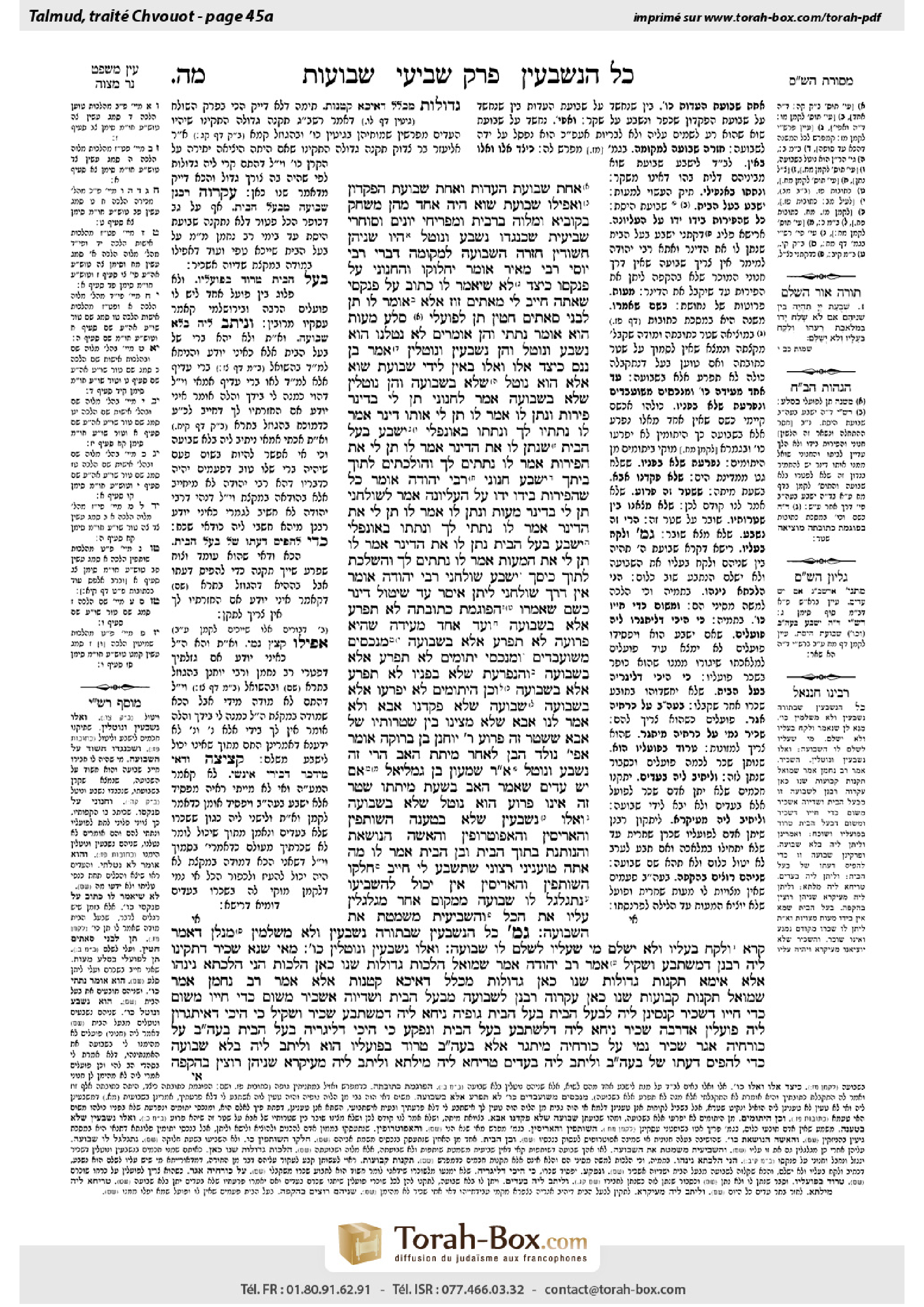
Shevuot 45a: Talmud study for Daf Yomi
Daf Yomi is the daily study of one Talmud folio. Explore 37 tractates with scans, Hebrew text, Sefaria English and AI-generated French translations where annotated.
Passage selection and English or AI-generated French translation are available where the scan has annotations. Daf Study is independent of Torah-Box and Sefaria.
Browse Shevuot · שבועות · All tractatesShevuot 45a text and translations
This page of Shevuot includes the Aramaic text, an English translation and an AI-generated French translation, alongside the scan above.
שבועות מ״ה א · Aramaic and Hebrew text
אַחַת שְׁבוּעַת הָעֵדוּת וְאַחַת שְׁבוּעַת הַפִּקָּדוֹן, וַאֲפִילּוּ שְׁבוּעַת שָׁוְא; הָיָה אֶחָד מֵהֶן מְשַׂחֵק בְּקוּבְיָא, וּמַלְוֶה בְּרִבִּית, וּמַפְרִיחֵי יוֹנִים, וְסוֹחֲרֵי שְׁבִיעִית – שֶׁכְּנֶגְדּוֹ נִשְׁבָּע וְנוֹטֵל.
הָיוּ שְׁנֵיהֶן חֲשׁוּדִין – חָזְרָה הַשְּׁבוּעָה לִמְקוֹמָהּ, דִּבְרֵי רַבִּי יוֹסֵי. רַבִּי מֵאִיר אוֹמֵר: יַחְלוֹקוּ.
וְהַחֶנְוָנִי עַל פִּנְקָסוֹ – כֵּיצַד? לֹא שֶׁיֹּאמַר לוֹ: ״כְּתוֹב עַל פִּנְקָסִי שֶׁאַתָּה חַיָּיב לִי מָאתַיִם זוּז״, אֶלָּא אוֹמֵר לוֹ: ״תֵּן לִבְנִי סָאתַיִם חִטִּין״, ״תֵּן לְפוֹעֲלַי (סלע) [בְּסֶלַע] מָעוֹת״. הוּא אוֹמֵר ״נָתַתִּי״, וְהֵן אוֹמְרִים ״לֹא נָטַלְנוּ״ – הוּא נִשְׁבָּע וְנוֹטֵל, וְהֵן נִשְׁבָּעִין וְנוֹטְלִין.
אָמַר בֶּן נַנָּס: כֵּיצַד אֵלּוּ וְאֵלּוּ בָּאִין לִידֵי שְׁבוּעַת שָׁוְא? אֶלָּא הוּא נוֹטֵל שֶׁלֹּא בִּשְׁבוּעָה, וְהֵן נוֹטְלִין שֶׁלֹּא בִּשְׁבוּעָה.
אָמַר לַחֶנְוָנִי: ״תֵּן לִי בְּדִינָר פֵּירוֹת״, וְנָתַן לוֹ; אָמַר לוֹ: ״תֵּן לִי אוֹתוֹ דִּינָר״, אָמַר לוֹ: ״נְתַתִּיו לָךְ וּנְתַתּוֹ בְּאוּנְפָּלִי״ – יִשָּׁבַע בַּעַל הַבַּיִת שֶׁנָּתַן לוֹ אֶת הַדִּינָר. אָמַר לוֹ: ״תֵּן לִי אֶת הַפֵּירוֹת״, אָמַר לוֹ: ״נְתַתִּים לָךְ וְהוֹלַכְתִּים לְתוֹךְ בֵּיתְךָ״ – יִשָּׁבַע חֶנְוָנִי. רַבִּי יְהוּדָה אוֹמֵר: כׇּל שֶׁהַפֵּירוֹת בְּיָדוֹ – יָדוֹ עַל הָעֶלְיוֹנָה.
אָמַר לַשּׁוּלְחָנִי: ״תֵּן לִי בְּדִינָר מָעוֹת״, וְנָתַן לוֹ; אָמַר לוֹ: ״תֵּן לִי אֶת הַדִּינָר״, אָמַר לוֹ: ״נָתַתִּי לְךָ וּנְתַתּוֹ בְּאוּנְפָּלִי״ – יִשָּׁבַע בַּעַל הַבַּיִת. נָתַן לוֹ אֶת הַדִּינָר; אָמַר לוֹ: ״תֵּן לִי אֶת הַמָּעוֹת״, אָמַר לוֹ: ״נְתַתִּים לָךְ וְהִשְׁלַכְתָּ לְתוֹךְ כִּיסְךָ״ – יִשָּׁבַע שׁוּלְחָנִי. רַבִּי יְהוּדָה אוֹמֵר: אֵין דֶּרֶךְ שׁוּלְחָנִי לִיתֵּן אִיסָּר עַד שֶׁיִּטּוֹל דִּינָר.
כְּשֵׁם שֶׁאָמְרוּ: הַפּוֹגֶמֶת כְּתוּבָּתָהּ – לֹא תִּפָּרַע אֶלָּא בִּשְׁבוּעָה; וְעֵד אֶחָד מְעִידָהּ שֶׁהִיא פְּרוּעָה – לֹא תִּפָּרַע אֶלָּא בִּשְׁבוּעָה; מִנְּכָסִים מְשׁוּעְבָּדִים וּמִנִּכְסֵי יְתוֹמִים – לֹא תִּפָּרַע אֶלָּא בִּשְׁבוּעָה; וְהַנִּפְרַעַת שֶׁלֹּא בְּפָנָיו – לֹא תִּפָּרַע אֶלָּא בִּשְׁבוּעָה. וְכֵן הַיְּתוֹמִים – לֹא יִפָּרְעוּ אֶלָּא בִּשְׁבוּעָה:
״שְׁבוּעָה שֶׁלֹּא פְּקָדַנוּ אַבָּא, וְלָא אָמַר לָנוּ אַבָּא, שֶׁלֹּא מָצִינוּ בֵּין שְׁטָרוֹתָיו שֶׁל אַבָּא שֶׁשְּׁטָר זֶה פָּרוּעַ״. רַבִּי יוֹחָנָן בֶּן בְּרוֹקָה אוֹמֵר: אֲפִילּוּ נוֹלַד הַבֵּן לְאַחַר מִיתַת הָאָב – הֲרֵי זֶה נִשְׁבָּע וְנוֹטֵל. אָמַר רַבָּן שִׁמְעוֹן בֶּן גַּמְלִיאֵל: אִם יֵשׁ עֵדִים שֶׁאָמַר הָאָב בִּשְׁעַת מִיתָתוֹ: ״שְׁטָר זֶה אֵינוֹ פָּרוּעַ״ – הוּא נוֹטֵל שֶׁלֹּא בִּשְׁבוּעָה.
וְאֵלּוּ נִשְׁבָּעִין שֶׁלֹּא בְּטַעֲנָה: הַשּׁוּתָּפִין, וְהָאֲרִיסִין, וְהָאַפּוֹטְרוֹפִּין, וְהָאִשָּׁה הַנּוֹשֵׂאת וְהַנּוֹתֶנֶת בְּתוֹךְ הַבַּיִת, וּבֶן הַבַּיִת. אָמַר לוֹ: ״מָה אַתָּה טוֹעֲנֵינִי?״ ״רְצוֹנִי שֶׁתִּשָּׁבַע לִי״ – חַיָּיב.
חָלְקוּ הַשּׁוּתָּפִין וְהָאֲרִיסִין – אֵין יָכוֹל לְהַשְׁבִּיעוֹ. (נתגלגל) [נִתְגַּלְגְּלָה] לוֹ שְׁבוּעָה מִמָּקוֹם אַחֵר – מְגַלְגְּלִין עָלָיו אֶת הַכֹּל. וְהַשְּׁבִיעִית מְשַׁמֶּטֶת אֶת הַשְּׁבוּעָה.
גְּמָ׳ כׇּל הַנִּשְׁבָּעִין שֶׁבַּתּוֹרָה נִשְׁבָּעִין וְלֹא מְשַׁלְּמִין. מְנָלַן? דְּאָמַר קְרָא: ״וְלָקַח בְּעָלָיו וְלֹא יְשַׁלֵּם״ – מִי שֶׁעָלָיו לְשַׁלֵּם, לוֹ שְׁבוּעָה.
וְאֵלּוּ נִשְׁבָּעִין וְנוֹטְלִין כּוּ׳. מַאי שְׁנָא שָׂכִיר דְּתַקִּינוּ לֵיה רַבָּנַן דְּמִשְׁתְּבַע וְשָׁקֵיל? אָמַר רַב יְהוּדָה אָמַר שְׁמוּאֵל: הֲלָכוֹת גְּדוֹלוֹת שָׁנוּ כָּאן. הֲלָכוֹת? הָנֵי הִלְכְתָא נִינְהוּ?! אֶלָּא אֵימָא: תַּקָּנוֹת גְּדוֹלוֹת שָׁנוּ כָּאן.
גְּדוֹלוֹת – מִכְּלָל דְּאִיכָּא קְטַנּוֹת?!
אֶלָּא אָמַר רַב נַחְמָן אָמַר שְׁמוּאֵל: תַּקָּנוֹת קְבוּעוֹת שָׁנוּ כָּאן – עַקְרוּהָ רַבָּנַן לִשְׁבוּעָה מִבַּעַל הַבַּיִת, וְשַׁדְיוּהָ אַשָּׂכִיר; מִשּׁוּם כְּדֵי חַיָּיו. מִשּׁוּם כְּדֵי חַיָּיו דְּשָׂכִיר – קָנְסִינַן לֵיהּ לְבַעַל הַבַּיִת?! בַּעַל הַבַּיִת גּוּפֵיהּ נִיחָא לֵיהּ דְּמִשְׁתְּבַע שָׂכִיר וְשָׁקֵיל, כִּי הֵיכִי (דְּאִיתַּגְרוּן) [דְּלִיתַּגְרוּן] לֵיהּ פּוֹעֲלִין.
אַדְּרַבָּה, שָׂכִיר נִיחָא לֵיהּ דִּלְשְׁתְּבַע בַּעַל הַבַּיִת, וְנִפְקַע, כִּי הֵיכִי דְּלֵיגְרֵיהּ בַּעַל הַבַּיִת! בַּעַל הַבַּיִת עַל כּוּרְחֵיהּ אָגַר. שָׂכִיר נָמֵי עַל כּוּרְחֵיהּ מִיתְּגַר! אֶלָּא בַּעַל הַבַּיִת טָרוּד בְּפוֹעֲלָיו הוּא.
וְלִיתֵּב לֵיהּ בְּלָא שְׁבוּעָה!
כְּדֵי לְהָפִיס דַּעְתּוֹ שֶׁל בַּעַל הַבַּיִת. וְלִיתֵּב לֵיהּ בְּעֵדִים! טְרִיחָא לֵיהּ מִילְּתָא. וְלִיתֵּב לֵיהּ מֵעִיקָּרָא! שְׁנֵיהֶן רוֹצִין בְּהַקָּפָה.
Shevuot 45a · English translation
One is considered suspect with regard to oaths if he has been found to have taken a false oath, whether it was an oath of testimony, or whether it was an oath on a deposit, or even an oath taken in vain, which is a less severe prohibition. There are also categories of people who by rabbinic decree are considered suspect with regard to oaths: If one of the litigants was a dice player, or one who lends with interest, or among those who fly pigeons, or among the vendors of produce of the Sabbatical Year, then the litigant opposing him takes an oath and receives payment of his claim.
If both litigants were suspect, the oath returned to its place. This is the statement of Rabbi Yosei, and will be explained in the Gemara. Rabbi Meir says: Since neither can take an oath, they divide the disputed amount.
And how does this halakha apply to the storekeeper relying on his ledger? This ruling is not referring to the case where a storekeeper says to a customer: It is written in my ledger that you owe me two hundred dinars. Rather, it is referring to a case where a customer says to a storekeeper: Give my son two se’a of wheat, or: Give my laborers a sela in small coins. And later the storekeeper says: I gave it to them; but they say: We did not receive it. In such a case, where the father or employer admits that he gave those instructions and it is also recorded in the storekeeper’s ledger, the storekeeper takes an oath that he gave the son the wheat or paid the laborers, and he receives compensation from the father or employer; and the laborers take an oath that they were not paid and receive their wages from the employer.
Ben Nannas said: How is it that both these and those come to take an oath in vain? One of them is certainly lying. Rather, the storekeeper receives his compensation without taking an oath, and the laborers receive their wages without taking an oath.
§ If one said to a storekeeper: Give me produce valued at a dinar, and he gave him the produce. And later the storekeeper said to him: Give me that dinar you owe me, and the customer said to him: I gave it to you, and you put it in your wallet [be’unpali], the customer shall take an oath that he gave him the dinar. If, after he gave the storekeeper the money, the customer said to him: Give me the produce, and the storekeeper said to him: I gave it to you and you transported it to your house, the storekeeper shall take an oath that he has already filled the order, and he is exempt from supplying the produce. Rabbi Yehuda says: Whoever has the produce in his possession has the advantage, and his claim is accepted without his taking an oath.
Similarly, if one said to a money changer: Give me small coins valued at a dinar, and he gave him the coins, and subsequently the money changer said to him: Give me the dinar, and the customer said to him: I gave it to you, and you put it in your wallet; the customer shall take an oath that he paid. If the customer gave the money changer the dinar, and then said to him: Give me the coins, and the money changer said to him: I gave them to you and you cast them into your purse, the money changer shall take an oath. Rabbi Yehuda says: It is not a money changer’s way to give even an issar until he receives a dinar. Therefore, the fact that the customer received the coins indicates that the money changer already received his payment.
§ These cases of taking an oath are just like other cases where the Sages said that one takes an oath and receives payment. The mishna (see Ketubot 87a) teaches: A woman who vitiates her marriage contract by acknowledging receipt of partial payment may collect the remainder only by taking an oath; or if one witness testifies that her marriage contract has been paid, she may collect it only by taking an oath. She may collect it from liened property that has been sold to a third party, or from the property of orphans, only by taking an oath, and a woman who collects it from her husband’s property when not in his presence may collect it only by taking an oath. And likewise, orphans may collect a loan with a promissory note inherited from their father only by taking an oath.
Orphans who wish to collect payment of money owed to their father must take the following oath: On our oath our father did not direct us on his deathbed not to collect with this promissory note, and our father did not say to us that this note was paid, and we did not find among our father’s documents a record showing that this promissory note was paid. After taking that oath, they may collect the money. Rabbi Yoḥanan ben Beroka says: Even if the son was born after the father’s death, he needs to take an oath in order to receive the money owed to his father. Rabban Shimon ben Gamliel said: If there are witnesses that the father said at the time of his death: This promissory note has not been paid, the son collects the debt without having to take an oath.
§ And these people are sometimes required to take an oath that they do not owe anything even when there is no explicit claim against them: Partners, sharecroppers, stewards [apotropin], a woman who does business from home, where she manages the property of orphans, and the member of the household appointed to manage the household’s affairs. For example, in a case where one of these people said to one of the people whose property he or she manages: What is your claim against me? If the other replied: It is simply my wish that you take an oath to me that you have not taken anything of mine, the former is liable to take that oath.
Once the partners or the sharecroppers have divided the common property, each taking his share, then one side may not require an oath of the other absent a definite claim. But if an oath was imposed upon him due to some other situation, that oath can be extended to impose upon him any other oath, i.e., it can be extended to apply to any other of their disputes. The mishna adds: And the Sabbatical Year abrogates the obligation to take an oath about a debt, just like it abrogates a debt.
GEMARA: The mishna teaches: All those who take an oath that is legislated by the Torah take an oath and do not pay. The Gemara asks: From where do we derive that oaths mandated by Torah law serve only to exempt one from payment? We derive it from the fact that the verse states: “The oath of the Lord shall be between them both, to see whether he has not put his hand on his neighbor’s goods; and its owner shall accept it, and he shall not make restitution” (Exodus 22:10). According to the verse, with regard to he who would otherwise need to pay, it is on him that the obligation to take the oath is imposed.
§ The mishna teaches: And these litigants take an oath and receive possession of the disputed funds or property, and it lists a hired worker in that category. The Gemara asks: What is different about a hired worker that the Sages instituted for him that he take an oath and receive his wages? Rav Yehuda said that Shmuel said: Great halakhot were taught here. The Gemara asks: Halakhot? Are these oaths actually halakhot transmitted to Moses from Sinai, as is usually indicated by the use of the term halakhot? They are instituted by rabbinic law. Rather, say: Great ordinances were taught here.
The Gemara asks: Since these ordinances are called great, can one conclude by inference that there are also minor ordinances? Are there rabbinic ordinances that are less important?
Rather, Rav Naḥman says that Shmuel says: Permanent ordinances were taught here; the Sages uprooted the oath from the employer and imposed it upon the hired worker due to the fact that his wages are his livelihood. The Gemara asks: Due to the need to protect the hired worker’s livelihood, do we penalize the employer by leaving him vulnerable to a dishonest worker? The Gemara answers: The employer himself is amenable to the hired worker taking an oath and collecting his wages, so that laborers will accept employment from him. If the workers are not protected in this manner, they will be wary of accepting work.
The Gemara asks: On the contrary, isn’t it preferable for the hired worker that in the case of a dispute between them the employer takes the oath and is released from payment? He would agree to this arrangement in order to create conditions in which the employer will readily hire him. If employers are exposed to the risk of being cheated by dishonest workers, they will be wary of hiring. The Gemara answers: The employer perforce hires workers, since he needs the work done. The Gemara asks: Doesn’t the hired worker also perforce accept employment, since he needs it for his livelihood? Rather, the reason the worker takes the oath is that the employer is distracted with managing his laborers, so it is reasonable to assume that he forgot to pay.
The Gemara raises a difficulty: But if it is presumed that the employer forgot to pay, let him give the wages to the worker without the worker taking an oath.
The Gemara explains: The oath was instituted to alleviate the concerns of the employer, to ensure him that he is not being cheated. And why did the Sages not institute that the employer should give the worker his wages in the presence of witnesses so that it could readily be established whether he was paid? The Gemara answers: Finding witnesses whenever he pays wages would be a burdensome matter for him. And why did the Sages not institute that the employer should give him his wages at the outset, when he hires him, so there would be no need for an oath? The Gemara answers: They both want the work to be done on credit, i.e., before the wages are paid, as sometimes the employer has no money ready when he hires a worker, and the worker also prefers receiving his money at the end of the day.
Shevuot 45a · Traduction française (IA)
On est considéré comme suspect en matière de serments si l’on a été reconnu coupable d’avoir prêté un faux serment, qu’il s’agisse d’un serment de témoignage, d’un serment relatif à un dépôt, ou même d’un serment prononcé en vain, qui constitue une interdiction moins grave. Il existe également des catégories de personnes que les Sages considèrent, par décret rabbinique, comme suspectes en matière de serments : si l’un des plaideurs est un joueur de dés, un prêteur à intérêt, un éleveur de pigeons voyageurs ou un vendeur de produits de l’année de la Chemita, alors le plaideur adverse prête serment et reçoit le montant de sa réclamation.
Si les deux plaideurs étaient suspects, le serment revenait à son point de départ. Telle est l’opinion de Rabbi Yossei, qui sera expliquée dans la Guemara. Rabbi Meïr dit : Puisqu’aucun des deux ne peut prêter serment, ils se partagent la somme contestée.
Et comment cette halakha s’applique-t-elle au commerçant qui se fonde sur son registre ? Cette règle ne concerne pas le cas où un commerçant dit à un client : « Il est écrit dans mon registre que tu me dois deux cents dinars. » Elle concerne plutôt le cas où un client dit à un commerçant : « Donne à mon fils deux séa de blé », ou : « Donne à mes ouvriers un séla en petites pièces. » Plus tard, le commerçant dit : « Je le leur ai donné », mais ils disent : « Nous ne l’avons pas reçu. » Dans ce cas, le père ou l’employeur reconnaît avoir donné ces instructions, qui sont également consignées dans le registre du commerçant. Celui-ci prête alors serment qu’il a donné le blé à son fils ou payé les ouvriers, et reçoit le paiement du père ou de l’employeur ; les ouvriers, quant à eux, prêtent serment qu’ils n’ont pas été payés et reçoivent leur salaire de l’employeur.
Ben Nannas dit : Comment se fait-il que les uns comme les autres viennent prêter un serment en vain ? L’un d’eux ment certainement. Le commerçant reçoit donc son paiement sans prêter serment, et les ouvriers reçoivent leur salaire sans prêter serment.
§ Si quelqu’un dit à un commerçant : « Donne-moi des produits d’une valeur d’un dinar », et que celui-ci les lui donne, puis que le commerçant lui dit plus tard : « Donne-moi le dinar que tu me dois », et que le client lui répond : « Je te l’ai donné et tu l’as mis dans ton portefeuille [be’unpali] », le client doit prêter serment qu’il lui a donné le dinar. Si, après avoir remis l’argent au commerçant, le client lui dit : « Donne-moi les produits », et que le commerçant lui répond : « Je te les ai donnés et tu les as transportés chez toi », le commerçant doit prêter serment qu’il a déjà exécuté la commande et il est dispensé de fournir les produits. Rabbi Yehouda dit : Celui qui a les produits en sa possession a l’avantage, et sa réclamation est acceptée sans qu’il ait à prêter serment.
De même, si quelqu’un dit à un changeur : « Donne-moi de la monnaie en petites pièces d’une valeur d’un dinar », et que celui-ci les lui donne, puis que le changeur lui dit : « Donne-moi le dinar », et que le client lui répond : « Je te l’ai donné et tu l’as mis dans ton portefeuille », le client doit prêter serment qu’il a payé. Si le client a remis le dinar au changeur, puis lui dit : « Donne-moi les pièces », et que le changeur lui répond : « Je te les ai données et tu les as jetées dans ta bourse », le changeur doit prêter serment. Rabbi Yehouda dit : Un changeur n’a pas coutume de donner ne serait-ce qu’un issar avant d’avoir reçu un dinar. Par conséquent, le fait que le client ait reçu les pièces indique que le changeur avait déjà reçu son paiement.
§ Ces cas où l’on prête serment sont semblables à d’autres cas dans lesquels les Sages ont statué qu’une personne prête serment et reçoit un paiement. La Michna (voir Ketoubot 87a) enseigne : une femme qui reconnaît avoir reçu un paiement partiel de sa ketouba ne peut en percevoir le solde qu’en prêtant serment ; de même, si un témoin atteste que sa ketouba a été payée, elle ne peut la percevoir qu’en prêtant serment. Elle ne peut recouvrer sa créance sur des biens grevés d’une sûreté vendus à un tiers, ni sur les biens d’orphelins, qu’en prêtant serment. Une femme qui recouvre sa ketouba sur les biens de son mari en l’absence de celui-ci ne peut également le faire qu’en prêtant serment. De même, des orphelins ne peuvent recouvrer un prêt au moyen d’un billet à ordre hérité de leur père qu’en prêtant serment.
Des orphelins qui souhaitent recouvrer une somme due à leur père doivent prêter le serment suivant : « Nous jurons que notre père ne nous a pas ordonné, sur son lit de mort, de ne pas recouvrer cette somme au moyen de ce billet à ordre, que notre père ne nous a pas dit que ce billet avait été payé, et que nous n’avons trouvé parmi les documents de notre père aucun écrit indiquant que ce billet à ordre avait été payé. » Après avoir prêté ce serment, ils peuvent recouvrer la somme. Rabbi Yoḥanan ben Beroka dit : Même si le fils est né après la mort de son père, il doit prêter serment pour recevoir la somme due à son père. Rabban Shimon ben Gamliel dit : S’il y a des témoins attestant que le père a dit au moment de sa mort : « Ce billet à ordre n’a pas été payé », le fils recouvre la dette sans avoir à prêter serment.
§ Les personnes suivantes peuvent être tenues de prêter serment qu’elles ne doivent rien, même lorsqu’aucune réclamation explicite n’a été formulée contre elles : des associés, des métayers, des intendants [apotropin], une femme qui fait des affaires depuis son domicile et gère les biens d’orphelins, ainsi que le membre du foyer chargé de gérer les affaires de la maisonnée. Par exemple, si l’une de ces personnes dit à l’une des personnes dont elle gère les biens : « Que me réclames-tu ? » et que l’autre répond : « Je souhaite simplement que tu me jures que tu n’as rien pris qui m’appartienne », la première est tenue de prêter ce serment.
Une fois que les associés ou les métayers ont partagé les biens communs, chacun prenant sa part, aucun des deux camps ne peut exiger de l’autre qu’il prête serment en l’absence d’une réclamation précise. Mais si un serment lui a été imposé en raison d’une autre situation, celui-ci peut être étendu à tout autre serment, c’est-à-dire à tout autre différend entre eux. La Michna ajoute : l’année de la Chemita annule l’obligation de prêter serment au sujet d’une dette, tout comme elle annule la dette elle-même.
GUEMARA : La Michna enseigne : Tous ceux qui prêtent un serment prescrit par la Torah écrite prêtent serment et ne paient pas. La Guemara demande : D’où savons-nous que les serments imposés par la Torah servent uniquement à dispenser quelqu’un d’un paiement ? Nous le déduisons du verset : « Le serment de l’Éternel sera entre les deux, pour établir s’il n’a pas porté la main sur le bien de son prochain ; le propriétaire l’acceptera, et l’autre ne fera pas de restitution » (Exode 22, 10). Selon le verset, lorsqu’une personne devrait autrement payer, c’est à elle qu’incombe l’obligation de prêter serment.
§ La Michna enseigne : Ces plaideurs prêtent serment et reçoivent les fonds ou les biens contestés ; elle inclut dans cette catégorie un salarié. La Guemara demande : En quoi le salarié se distingue-t-il pour que les Sages aient institué qu’il prête serment et reçoive son salaire ? Rav Yehouda a dit au nom de Shmuel : De grandes halakhot ont été enseignées ici. La Guemara demande : Des halakhot ? S’agit-il réellement de halakhot transmises à Moïse au Sinaï, comme le terme halakhot le désigne habituellement ? Elles relèvent pourtant d’une institution rabbinique. Il faut plutôt dire : de grandes ordonnances ont été enseignées ici.
La Guemara demande : Puisque ces ordonnances sont qualifiées de grandes, peut-on en déduire qu’il existe aussi de petites ordonnances ? Existe-t-il des ordonnances rabbiniques moins importantes ?
Rav Naḥman dit plutôt au nom de Shmuel : Des ordonnances permanentes ont été enseignées ici ; les Sages ont retiré le serment à l’employeur pour l’imposer au salarié, parce que son salaire assure sa subsistance. La Guemara demande : Pour protéger la subsistance du salarié, pénalise-t-on l’employeur en le laissant à la merci d’un salarié malhonnête ? La Guemara répond : L’employeur accepte lui-même que le salarié prête serment et recouvre son salaire, afin que les ouvriers acceptent de travailler pour lui. Si les ouvriers n’étaient pas protégés de cette manière, ils hésiteraient à accepter du travail.
La Guemara demande : Au contraire, n’est-il pas préférable pour le salarié que, lorsqu’un différend les oppose, l’employeur prête serment et soit dispensé de payer ? Le salarié accepterait cette règle afin de créer des conditions dans lesquelles l’employeur l’embaucherait volontiers. Si les employeurs risquaient d’être trompés par des salariés malhonnêtes, ils hésiteraient à les embaucher. La Guemara répond : L’employeur est contraint d’embaucher des ouvriers, car il a besoin que le travail soit fait. La Guemara demande : Le salarié aussi n’est-il pas contraint d’accepter un emploi, puisqu’il en a besoin pour subvenir à ses besoins ? Il faut donc plutôt dire que le salarié prête serment parce que l’employeur est accaparé par la gestion de ses ouvriers ; il est donc raisonnable de supposer qu’il a oublié de le payer.
La Guemara soulève une difficulté : Mais si l’on présume que l’employeur a oublié de payer, qu’il verse donc son salaire au salarié sans que celui-ci ait à prêter serment.
La Guemara explique : Le serment a été institué pour apaiser les inquiétudes de l’employeur et lui garantir qu’on ne le trompe pas. Pourquoi les Sages n’ont-ils pas institué que l’employeur verse le salaire au salarié en présence de témoins, afin qu’il soit facile d’établir s’il a été payé ? La Guemara répond : Trouver des témoins chaque fois qu’il paie un salaire serait une démarche contraignante pour lui. Pourquoi les Sages n’ont-ils pas institué que l’employeur verse son salaire au salarié dès le départ, au moment où il l’embauche, afin qu’aucun serment ne soit nécessaire ? La Guemara répond : Tous deux souhaitent que le travail soit effectué à crédit, c’est-à-dire avant le versement du salaire : parfois, l’employeur n’a pas d’argent disponible au moment d’embaucher un salarié, et le salarié préfère lui aussi recevoir son argent à la fin de la journée.
Traduction française générée par IA à partir de l’édition anglaise de Sefaria. Vérifie toujours un passage avec le texte source.
Text from Sefaria: William Davidson Edition - Vocalized Aramaic (CC BY NC); William Davidson Edition - English (CC BY NC).