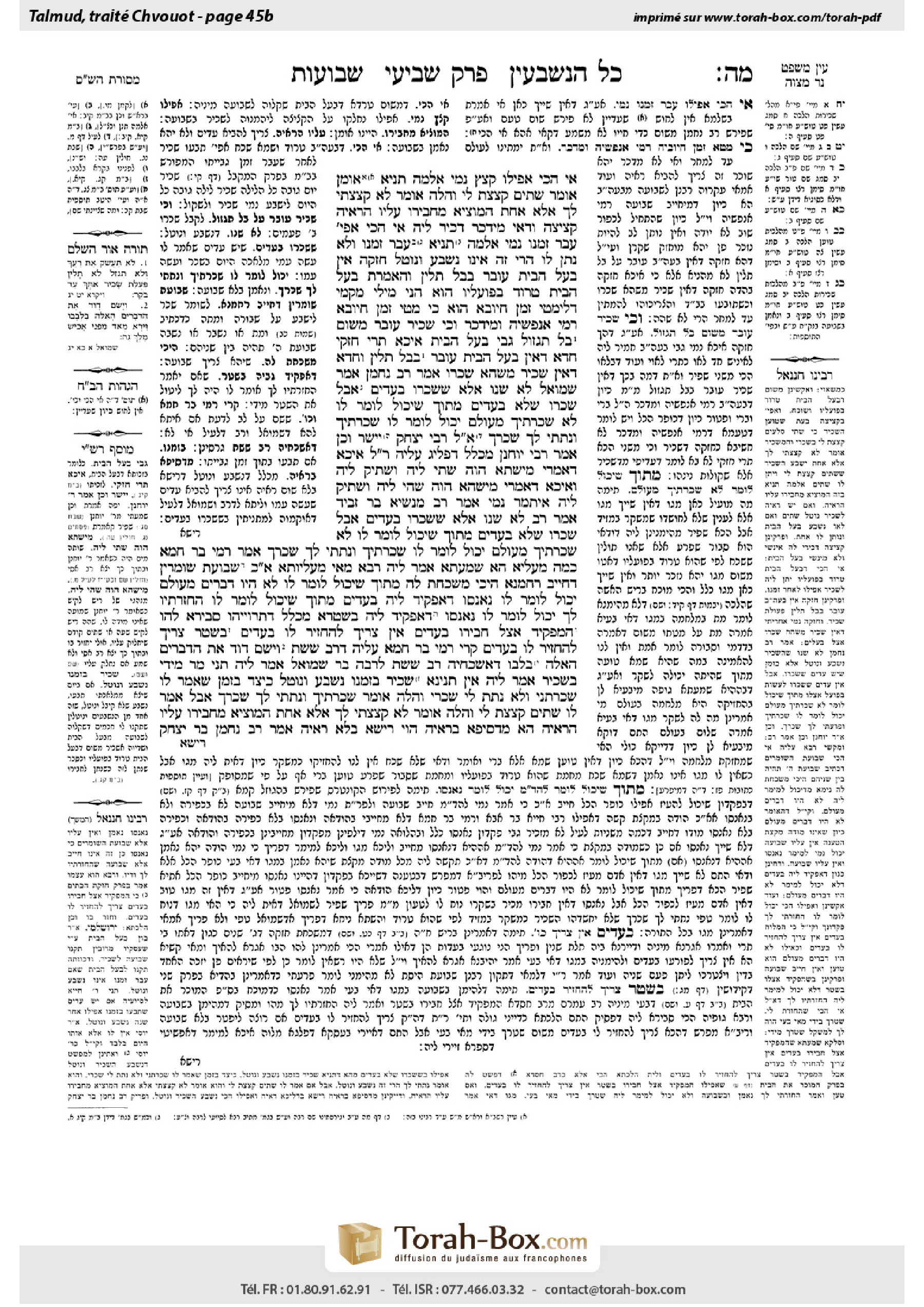
Shevuot 45b: Talmud study for Daf Yomi
Daf Yomi is the daily study of one Talmud folio. Explore 37 tractates with scans, Hebrew text, Sefaria English and AI-generated French translations where annotated.
Passage selection and English or AI-generated French translation are available where the scan has annotations. Daf Study is independent of Torah-Box and Sefaria.
Browse Shevuot · שבועות · All tractatesShevuot 45b text and translations
This page of Shevuot includes the Aramaic text, an English translation and an AI-generated French translation, alongside the scan above.
שבועות מ״ה ב · Aramaic and Hebrew text
אִי הָכִי, אֲפִילּוּ קָצַץ נָמֵי! אַלְּמָה תַּנְיָא: אוּמָּן אוֹמֵר ״שְׁתַּיִם קָצַצְתָּ לִי״, וְהַלָּה אוֹמֵר ״לֹא קָצַצְתִּי לְךָ אֶלָּא אַחַת״ – הַמּוֹצִיא מֵחֲבֵירוֹ עָלָיו הָרְאָיָה? קְצִיצָה וַדַּאי מִידְכָּר דְּכִיר לֵיהּ.
אִי הָכִי, אֲפִילּוּ עָבַר זְמַנּוֹ נָמֵי! אַלְּמָה תַּנְיָא: עָבַר זְמַנּוֹ וְלֹא נָתַן לוֹ – הֲרֵי זֶה אֵינוֹ נִשְׁבָּע וְנוֹטֵל?
חֲזָקָה אֵין בַּעַל הַבַּיִת עוֹבֵר בְּ״בַל תָּלִין״. וְהָאָמְרַתְּ: בַּעַל הַבַּיִת טָרוּד בְּפוֹעֲלָיו הוּא! הָנֵי מִילֵּי – מִקַּמֵּי דְּלִימְטֵי זְמַן חִיּוּבָא הוּא; כִּי מָטֵי זְמַן חִיּוּבָא – רָמֵי אַנַּפְשֵׁיהּ וּמִידְּכַר.
וְכִי שָׂכִיר עוֹבֵר מִשּׁוּם ״בַּל תִּגְזוֹל״?! גַּבֵּי בַּעַל הַבַּיִת אִיכָּא תְּרֵי חֲזָקֵי: חֲדָא דְּאֵין בַּעַל הַבַּיִת עוֹבֵר בְּ״בַל תָּלִין״, וַחֲדָא דְּאֵין שָׂכִיר מְשַׁהֶא שְׂכָרוֹ.
אָמַר רַב נַחְמָן, אָמַר שְׁמוּאֵל: לֹא שָׁנוּ אֶלָּא שֶׁשְּׂכָרוֹ בְּעֵדִים, אֲבָל שְׂכָרוֹ שֶׁלֹּא בְּעֵדִים – מִתּוֹךְ שֶׁיָּכוֹל לוֹמַר לוֹ: ״לֹא שְׂכַרְתִּיךָ מֵעוֹלָם״, יָכוֹל לוֹמַר לוֹ: ״שְׂכַרְתִּיךָ, וְנָתַתִּי לְךָ שְׂכָרְךָ״. אֲמַר לֵיהּ רַבִּי יִצְחָק: יִישַׁר, וְכֵן אָמַר רַבִּי יוֹחָנָן.
מִכְּלָל דִּפְלִיג עֲלֵיהּ רֵישׁ לָקִישׁ? אִיכָּא דְּאָמְרִי מִישְׁתָּא הֲוָה שָׁתֵי לֵיהּ וְשָׁתֵיק לֵיהּ, וְאִיכָּא דְּאָמְרִי מִישְׁהָא הֲוָה שָׁהֵי לֵיהּ וּשְׁתֵיק לֵיהּ.
אִיתְּמַר נָמֵי: אָמַר רַב מְנַשְּׁיָא בַּר זְבִיד, אָמַר רַב: לֹא שָׁנוּ אֶלָּא שֶׁשְּׂכָרוֹ בְּעֵדִים, אֲבָל שְׂכָרוֹ שֶׁלֹּא בְּעֵדִים – מִתּוֹךְ שֶׁיָּכוֹל לוֹמַר לוֹ: ״לֹא שְׂכַרְתִּיךָ מֵעוֹלָם״, יָכוֹל לוֹמַר לוֹ: ״שְׂכַרְתִּיךָ, וְנָתַתִּי לְךָ שְׂכָרֶךָ״.
אָמַר רָמֵי בַּר חָמָא: כַּמָּה מְעַלְּיָא הָא שְׁמַעְתָּא! אֲמַר לֵיהּ רָבָא: מַאי מְעַלְּיוּתָא? אִם כֵּן, שְׁבוּעַת שׁוֹמְרִין דְּחַיֵּיב רַחֲמָנָא – הֵיכִי מַשְׁכַּחַתְּ לַהּ? מִתּוֹךְ שֶׁיָּכוֹל לוֹמַר לוֹ ״לֹא הָיוּ דְבָרִים מֵעוֹלָם״, יָכוֹל לוֹמַר לוֹ ״נֶאֶנְסוּ״!
דְּאַפְקֵיד לֵיהּ בְּעֵדִים. מִתּוֹךְ שֶׁיָּכוֹל לוֹמַר לוֹ ״הֶחְזַרְתִּיו לָךְ״, יָכוֹל לוֹמַר לוֹ ״נֶאֶנְסוּ״!
דְּאַפְקֵיד לֵיהּ בִּשְׁטָרָא.
מִכְּלָל דְּתַרְוַיְיהוּ סְבִירָא לְהוּ: הַמַּפְקִיד אֵצֶל חֲבֵירוֹ בְּעֵדִים – אֵין צָרִיךְ לְהַחְזִיר לוֹ בְּעֵדִים; בִּשְׁטָר – צָרִיךְ לְהַחְזִיר לוֹ בְּעֵדִים.
קָרֵי רָמֵי בַּר חָמָא עֲלֵיהּ דְּרַב שֵׁשֶׁת: ״וַיָּשֶׂם דָּוִד אֶת הַדְּבָרִים הָאֵלֶּה בְּלִבּוֹ״. דְּאַשְׁכְּחֵיהּ רַב שֵׁשֶׁת לְרַבָּה בַּר שְׁמוּאֵל, אֲמַר לֵיהּ: תָּנֵי מָר מִידֵּי בְּשָׂכִיר? אֲמַר לֵיהּ: אִין, תְּנֵינָא: שָׂכִיר בִּזְמַנּוֹ – נִשְׁבָּע וְנוֹטֵל. כֵּיצַד – בִּזְמַן שֶׁאָמַר לוֹ: ״שְׂכַרְתַּנִי וְלֹא נָתַתָּ לִי שְׂכָרִי״, וְהַלָּה אוֹמֵר: ״שְׂכַרְתִּיךָ וְנָתַתִּי לְךָ שְׂכָרֶךָ״; אֲבָל אָמַר לוֹ: ״שְׁתַּיִם קָצַצְתָּ לִי״, וְהַלָּה אוֹמֵר: ״לֹא קָצַצְתִּי לְךָ אֶלָּא אֶחָת״ – הַמּוֹצִיא מֵחֲבֵירוֹ עָלָיו הָרְאָיָה.
הָא מִדְּסֵיפָא בִּרְאָיָה הָוֵי – רֵישָׁא בְּלֹא רְאָיָה.
אָמַר רַב נַחְמָן בַּר יִצְחָק:
Shevuot 45b · English translation
If so, then even with regard to the amount fixed as payment, the employer is apt to be forgetful. Why, then, is it taught in a baraita: If the craftsman says: You fixed two coins as my payment and the other, the employer, says: I fixed only one coin as your payment, the halakha is that the burden of proof rests upon the claimant? The craftsman must bring witnesses to collect the additional sum; an oath is not sufficient. Why is it not assumed that the employer is distracted, and the craftsman would be allowed to take an oath and collect the amount he claims? The Gemara answers: With regard to the fixing of wages, he certainly remembers.
The Gemara asks: If so, then even if the time the wages were due had passed, the worker should be able to prove that he has not been paid by taking an oath. Why, then, is it taught in a baraita that if the established time for paying wages had passed, i.e., the night after the work was performed, and the employer had not given the worker his wages, he no longer can take an oath and receive his wages, but rather must bring witnesses to prove that he was not yet paid.
The Gemara answers: There is a presumption that the employer will not violate the prohibition against delaying payment of wages (see Leviticus 19:13) and will have paid the worker by the deadline. The Gemara asks: But didn’t you say that the employer is distracted with his laborers and is apt to forget to pay? The Gemara responds: This statement, that he is presumed to be distracted, applies only before the time arrives that he incurs liability for delaying payment of wages. When the time that he incurs liability arrives, he takes it upon himself to remember to pay.
The Gemara asks: Is the hired worker suspected of demanding his wages twice and violating the prohibition against robbery (see Leviticus 19:13)? The Gemara answers: With regard to the employer there are two presumptions supporting his claim that the wages were paid: One is that the employer will not violate the prohibition of delaying payment of wages, and one is that a hired worker will not defer requesting his wages. Therefore, if he is requesting his wages after the deadline, he probably already received them, and he no longer can prove his claim with only an oath.
§ Rav Naḥman says that Shmuel says: The Sages taught that a worker takes an oath and receives his wages only when the employer hired him in the presence of witnesses. But if he hired him not in the presence of witnesses, then since he could have made a more advantageous claim [miggo] and said to him: I never hired you, he can instead say to him: I hired you but already gave you your wages, and that claim is accepted by the court. There is a principle in halakha that one is deemed credible when he makes a less advantageous claim than he could have made. Rabbi Yitzḥak said to Rav Naḥman: That is correct; and so said Rabbi Yoḥanan.
The Gemara asks: Can one infer from the fact that Rabbi Yitzḥak said that it was specifically Rabbi Yoḥanan who says this, that Reish Lakish, who often engaged in disputes with Rabbi Yoḥanan, disagrees with him, even though Rabbi Yitzḥak did not report that he does? Some say that Reish Lakish was drinking at the time that Rabbi Yoḥanan made his statement and therefore was silent, and some say that he was waiting for him to complete his statement and therefore was silent. It remains unclear whether he disagreed.
It was also stated that Rav Menashya bar Zevid says that Rav says: The Sages taught that a worker takes an oath and receives his wages only when the employer hired him in the presence of witnesses. But if he hired him not in the presence of witnesses, since he could have said to him: I never hired you, he can instead say to him: I hired you but already gave you your wages, and that claim is accepted by the court.
§ Rami bar Ḥama said: How excellent is this halakha. Rava said to him: What is its excellence? If the halakha is so, how can you ever find an instance of the oath of the bailees concerning a deposit that the Merciful One imposed? Since the bailee could say to the owner: These events never occurred, i.e., I never accepted a deposit from you, he can say to him: The deposit was lost by accident. He will not need to take an oath to support his claim, since he would have been deemed credible without taking an oath if he had denied accepting the deposit at all.
Rami Bar Ḥama answered: The oath of the bailees is still relevant where the owner deposited the item with him in the presence of witnesses. Rava retorts: Even then, since he could say to him: I already returned it to you, and his claim would be accepted without his taking an oath, he can say to him: The deposit was lost by accident, and his claim will be accepted without his taking an oath.
Rami bar Ḥama answered: The oath of the bailees is still relevant where the owner deposited the item with him, with a document given as a receipt. Possession of the receipt serves as evidence that the bailee has not returned the deposit.
The Gemara comments: By inference from their statements, one may conclude that both Rava and Rami bar Ḥama hold that if one deposits an item with another person in the presence of witnesses, he does not need to return it to him in the presence of witnesses, and his claim that he returned it without witnesses is accepted. But if one deposits an item with another person with a document given as a receipt, he needs to return it to him in the presence of witnesses, who can testify that it was returned.
§ Rami bar Ḥama would cite this verse about Rav Sheshet: “And David laid up these words in his heart” (I Samuel 21:13), as Rav Sheshet took it upon himself to find sources that would support or contradict the statements of Rav and Shmuel. As it is recounted that Rav Sheshet encountered Rabba bar Shmuel and said to him: Does the Master teach any halakhot about a hired worker? Rabba bar Shmuel said to him: Yes, I teach this baraita (Tosefta 6:1): A hired worker within his time for receiving wages takes an oath and receives payment. How so? This applies in a case when the worker said to the employer: You hired me but did not give me my wages, and the other, the employer, says: I hired you and gave you your wages. But if the hired worker said to him: You fixed two coins as my payment, and the other, the employer, says: I fixed only one coin as your payment, the burden of proof rests upon the claimant, who must provide witnesses to testify that the wage was the greater sum.
Rav Sheshet suggested: Since the latter clause addresses a case in which proof, witness testimony, is required, the first clause must address a case in which proof is not required. This contradicts the statements of Rav and Shmuel above that the worker may take an oath and receive payment only when he has witnesses that this person hired him.
Rav Naḥman bar Yitzḥak said:
Shevuot 45b · Traduction française (IA)
Dans ce cas, même au sujet du montant fixé comme salaire, l’employeur serait susceptible d’oublier. Pourquoi enseigne-t-on donc dans une baraïta : si l’artisan dit : « Tu as fixé mon salaire à deux pièces », et que l’autre, l’employeur, dit : « Je n’ai fixé ton salaire qu’à une pièce », la halakha est que la charge de la preuve incombe au demandeur ? L’artisan doit produire des témoins pour percevoir la somme supplémentaire ; un serment ne suffit pas. Pourquoi ne présume-t-on pas que l’employeur est distrait et ne permet-on pas à l’artisan de prêter serment et de percevoir le montant qu’il réclame ? La Guemara répond : lorsqu’il s’agit de fixer le salaire, il s’en souvient certainement.
La Guemara demande : dans ce cas, même après l’expiration du délai de paiement du salaire, l’ouvrier devrait pouvoir prouver qu’il n’a pas été payé en prêtant serment. Pourquoi enseigne-t-on donc dans une baraïta que, si le délai fixé pour le paiement du salaire est passé, c’est-à-dire la nuit suivant l’exécution du travail, et que l’employeur n’a pas payé l’ouvrier, celui-ci ne peut plus prêter serment et percevoir son salaire, mais doit produire des témoins pour prouver qu’il n’a pas encore été payé ?
La Guemara répond : on présume que l’employeur ne transgressera pas l’interdiction de retarder le paiement du salaire (voir Lévitique 19:13) et qu’il aura payé l’ouvrier avant l’échéance. La Guemara demande : mais n’as-tu pas dit que l’employeur, occupé par ses ouvriers, est susceptible d’oublier de payer ? La Guemara répond : cette affirmation, selon laquelle il est présumé distrait, ne s’applique qu’avant le moment où il devient passible pour avoir retardé le paiement du salaire. Lorsque vient le moment où il devient passible, il prend soin de se souvenir de payer.
La Guemara demande : l’ouvrier salarié est-il soupçonné de réclamer son salaire deux fois et de transgresser l’interdiction du vol (voir Lévitique 19:13) ? La Guemara répond : deux présomptions appuient l’affirmation de l’employeur selon laquelle le salaire a été payé : d’une part, l’employeur ne transgressera pas l’interdiction de retarder le paiement du salaire ; d’autre part, un ouvrier salarié ne différera pas sa demande de salaire. Par conséquent, s’il réclame son salaire après l’échéance, il l’a probablement déjà reçu et ne peut plus établir le bien-fondé de sa réclamation par un simple serment.
§ Rav Naḥman dit au nom de Shmuel : Les Sages ont enseigné qu’un ouvrier prête serment et perçoit son salaire uniquement lorsque l’employeur l’a engagé en présence de témoins. Mais s’il l’a engagé en l’absence de témoins, puisqu’il aurait pu présenter une prétention plus avantageuse [miggo] et lui dire : « Je ne t’ai jamais engagé », il peut plutôt lui dire : « Je t’ai engagé, mais je t’ai déjà payé ton salaire », et le tribunal accepte cette prétention. Selon un principe de halakha, celui qui avance une prétention moins avantageuse que celle qu’il aurait pu présenter est considéré comme digne de foi. Rabbi Yitzḥak dit à Rav Naḥman : C’est exact ; Rabbi Yoḥanan a dit la même chose.
La Guemara demande : peut-on déduire du fait que Rabbi Yitzḥak a dit que c’est précisément Rabbi Yoḥanan qui affirme cela que Reish Lakish, qui était souvent en désaccord avec Rabbi Yoḥanan, le conteste, bien que Rabbi Yitzḥak n’ait pas rapporté qu’il le faisait ? Certains disent que Reish Lakish était en train de boire au moment où Rabbi Yoḥanan a fait cette déclaration et qu’il est donc resté silencieux ; d’autres disent qu’il attendait que Rabbi Yoḥanan achève sa déclaration et qu’il est donc resté silencieux. On ne sait toujours pas s’il était en désaccord.
Il a également été enseigné que Rav Menashya bar Zevid dit au nom de Rav : Les Sages ont enseigné qu’un ouvrier prête serment et perçoit son salaire uniquement lorsque l’employeur l’a engagé en présence de témoins. Mais s’il l’a engagé en l’absence de témoins, puisqu’il aurait pu lui dire : « Je ne t’ai jamais engagé », il peut plutôt lui dire : « Je t’ai engagé, mais je t’ai déjà payé ton salaire », et le tribunal accepte cette prétention.
§ Rami bar Ḥama dit : Quelle excellente halakha ! Rava lui dit : Qu’a-t-elle d’excellent ? Si la halakha est ainsi, comment pourrait-on jamais trouver un cas où s’applique le serment des dépositaires concernant un dépôt, imposé par le Miséricordieux ? Puisque le dépositaire pourrait dire au propriétaire : « Ces faits ne se sont jamais produits », c’est-à-dire : « Je n’ai jamais reçu de dépôt de ta part », il peut lui dire : « Le dépôt a été perdu par accident. » Il n’aura pas besoin de prêter serment pour appuyer sa prétention, car il aurait été considéré comme digne de foi sans serment s’il avait nié avoir reçu le dépôt.
Rami bar Ḥama répondit : le serment des dépositaires s’applique toujours lorsque le propriétaire lui a confié l’objet en présence de témoins. Rava rétorque : même dans ce cas, puisqu’il pourrait lui dire : « Je te l’ai déjà rendu », et que sa prétention serait acceptée sans qu’il prête serment, il peut lui dire : « Le dépôt a été perdu par accident », et sa prétention sera acceptée sans serment.
Rami bar Ḥama répondit : le serment des dépositaires s’applique toujours lorsque le propriétaire lui a confié l’objet au moyen d’un document remis comme reçu. La détention du reçu prouve que le dépositaire n’a pas rendu le dépôt.
La Guemara fait remarquer : on peut déduire de leurs propos que Rava et Rami bar Ḥama soutiennent tous deux que, si quelqu’un confie un objet à une autre personne en présence de témoins, celle-ci n’est pas tenue de le lui rendre en présence de témoins, et sa prétention selon laquelle elle l’a rendu sans témoins est acceptée. Mais si quelqu’un confie un objet à une autre personne au moyen d’un document remis comme reçu, celle-ci doit le lui rendre en présence de témoins, qui pourront attester qu’il a été rendu.
§ Rami bar Ḥama citait à propos de Rav Sheshet ce verset : « David conserva ces paroles dans son cœur » (I Samuel 21:13), car Rav Sheshet s’était donné pour tâche de trouver des sources à l’appui ou à l’encontre des propos de Rav et de Shmuel. On raconte en effet que Rav Sheshet rencontra Rabba bar Shmuel et lui demanda : « Le Maître enseigne-t-il des halakhot concernant un ouvrier salarié ? » Rabba bar Shmuel lui répondit : « Oui, j’enseigne cette baraïta (Tosefta 6:1) : un ouvrier salarié, pendant le délai prévu pour recevoir son salaire, prête serment et reçoit son paiement. Comment cela se présente-t-il ? C’est le cas où l’ouvrier dit à l’employeur : “Tu m’as engagé, mais tu ne m’as pas payé mon salaire”, et où l’autre, l’employeur, dit : “Je t’ai engagé et je t’ai payé ton salaire.” Mais si l’ouvrier salarié lui dit : “Tu as fixé mon salaire à deux pièces”, et que l’autre, l’employeur, dit : “Je n’ai fixé ton salaire qu’à une pièce”, la charge de la preuve incombe au demandeur, qui doit produire des témoins attestant que le salaire était plus élevé. »
Rav Sheshet proposa : puisque la dernière clause traite d’un cas où une preuve — le témoignage de témoins — est requise, la première clause doit traiter d’un cas où aucune preuve n’est requise. Cela contredit les propos de Rav et de Shmuel rapportés plus haut, selon lesquels l’ouvrier ne peut prêter serment et percevoir son salaire que s’il a des témoins attestant que cette personne l’a engagé.
Rav Naḥman bar Yitzḥak dit :
Traduction française générée par IA à partir de l’édition anglaise de Sefaria. Vérifie toujours un passage avec le texte source.
Text from Sefaria: William Davidson Edition - Vocalized Aramaic (CC BY NC); William Davidson Edition - English (CC BY NC).