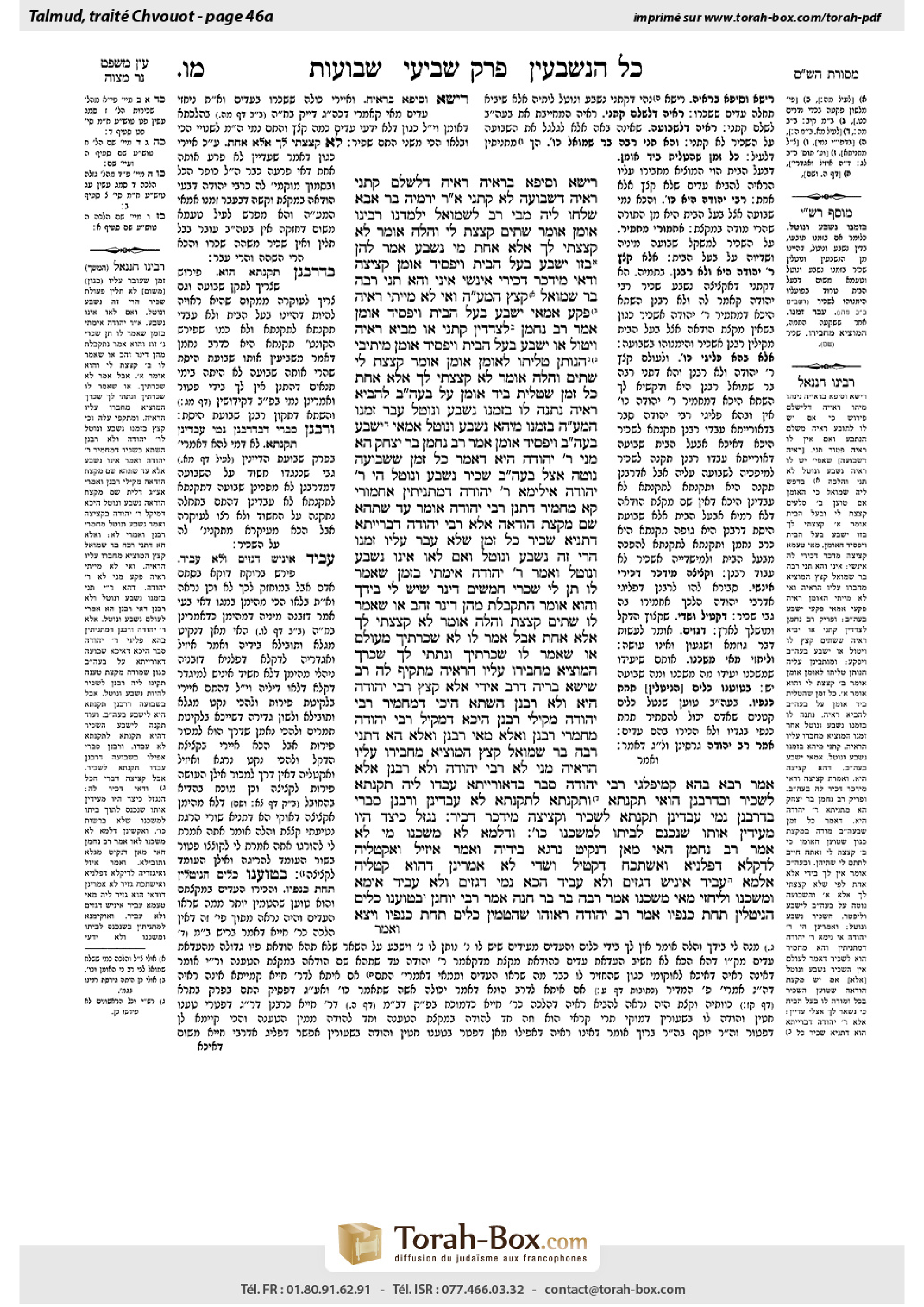
Shevuot 46a: Talmud study for Daf Yomi
Daf Yomi is the daily study of one Talmud folio. Explore 37 tractates with scans, Hebrew text, Sefaria English and AI-generated French translations where annotated.
Passage selection and English or AI-generated French translation are available where the scan has annotations. Daf Study is independent of Torah-Box and Sefaria.
Browse Shevuot · שבועות · All tractatesShevuot 46a text and translations
This page of Shevuot includes the Aramaic text, an English translation and an AI-generated French translation, alongside the scan above.
שבועות מ״ו א · Aramaic and Hebrew text
רֵישָׁא וְסֵיפָא בִּרְאָיָה; רְאָיָה דִּלְשַׁלֵּם קָתָנֵי, רְאָיָה דִּשְׁבוּעָה לָא קָתָנֵי.
אָמַר רַבִּי יִרְמְיָה בַּר אַבָּא, שְׁלַחוּ לֵיהּ מִבֵּי רַב לִשְׁמוּאֵל: יְלַמְּדֵנוּ רַבֵּינוּ, אוּמָּן אוֹמֵר: ״שְׁתַּיִם קָצַצְתָּ לִי״, וְהַלָּה אוֹמֵר: ״לֹא קָצַצְתִּי לְךָ אֶלָּא אֶחָת״ – מִי נִשְׁבָּע? אָמַר לָהֶן: בְּזוֹ יִשָּׁבַע בַּעַל הַבַּיִת, וְיַפְסִיד אוּמָּן; קְצִיצָה וַדַּאי מִידְכָּר דְּכִירִי אִינָשֵׁי.
אִינִי?! וְהָא תָּנֵי רַבָּה בַּר שְׁמוּאֵל: קָצַץ – הַמּוֹצִיא מֵחֲבֵרוֹ עָלָיו הָרְאָיָה, וְאִי לָא מַיְיתֵי רְאָיָה – פָּקַע. אַמַּאי? יִשָּׁבַע בַּעַל הַבַּיִת, וְיַפְסִיד אוּמָּן! אָמַר רַב נַחְמָן: לִצְדָדִין קָתָנֵי – אוֹ מֵבִיא רְאָיָה וְיִטּוֹל, אוֹ יִשָּׁבַע בַּעַל הַבַּיִת וְיַפְסִיד אוּמָּן.
מֵיתִיבִי: הַנּוֹתֵן טַלִּיתוֹ לְאוּמָּן, אוּמָּן אוֹמֵר: ״קָצַצְתָּ לִי שְׁתַּיִם״, וְהַלָּה אוֹמֵר: ״לֹא קָצַצְתִּי לְךָ אֶלָּא אֶחָת״; כׇּל זְמַן שֶׁטַּלִּית בְּיַד אוּמָּן – עַל בַּעַל הַבַּיִת לְהָבִיא רְאָיָה. נְתָנָהּ לוֹ בִּזְמַנּוֹ – נִשְׁבָּע וְנוֹטֵל. עָבַר זְמַנּוֹ – הַמּוֹצִיא מֵחֲבֵרוֹ עָלָיו הָרְאָיָה.
בִּזְמַנּוֹ מִיהָא נִשְׁבָּע וְנוֹטֵל; אַמַּאי? יִשָּׁבַע בַּעַל הַבַּיִת וְיַפְסִיד אוּמָּן!
אָמַר רַב נַחְמָן בַּר יִצְחָק: הָא מַנִּי – רַבִּי יְהוּדָה הִיא, דְּאָמַר: כׇּל זְמַן שֶׁשְּׁבוּעָה נוֹטָה אֵצֶל בַּעַל הַבַּיִת – שָׂכִיר נִשְׁבָּע וְנוֹטֵל.
הֵי רַבִּי יְהוּדָה? אִילֵימָא רַבִּי יְהוּדָה דְּמַתְנִיתִין, אַחְמוֹרֵי קָא מַחְמַר – דִּתְנַן: רַבִּי יְהוּדָה אוֹמֵר: עַד שֶׁתְּהֵא שָׁם מִקְצָת הוֹדָאָה!
אֶלָּא רַבִּי יְהוּדָה דְּבָרַיְיתָא – דְּתַנְיָא: שָׂכִיר, כׇּל זְמַן שֶׁלֹּא עָבַר עָלָיו זְמַנּוֹ – הֲרֵי זֶה נִשְׁבָּע וְנוֹטֵל, וְאִם לָאו – אֵינוֹ נִשְׁבָּע וְנוֹטֵל. וְאָמַר רַבִּי יְהוּדָה: אֵימָתַי – בִּזְמַן שֶׁאָמַר לוֹ: ״תֵּן לִי שְׂכָרִי חֲמִשִּׁים דִּינָר שֶׁיֵּשׁ לִי בְּיָדֶךָ״; וְהוּא אוֹמֵר: ״הִתְקַבַּלְתְּ מֵהֶן דִּינַר זָהָב״, אוֹ שֶׁאָמַר לוֹ: ״שְׁתַּיִם קָצַצְתָּ״, וְהַלָּה אוֹמֵר: ״לֹא קָצַצְתִּי לְךָ אֶלָּא אֶחָת״;
אֲבָל אָמַר לוֹ: ״לֹא שְׂכַרְתִּיךָ מֵעוֹלָם״, אוֹ שֶׁאָמַר לוֹ: ״שְׂכַרְתִּיךָ וְנָתַתִּי לְךָ שְׂכָרֶךָ״ – הַמּוֹצִיא מֵחֲבֵירוֹ עָלָיו הָרְאָיָה.
מַתְקֵיף לַהּ רַב שִׁישָׁא בְּרֵיהּ דְּרַב אִידִי: אֶלָּא קָצַץ – רַבִּי יְהוּדָה הִיא וְלָא רַבָּנַן?! הַשְׁתָּא הֵיכִי דְּמַחְמִיר רַבִּי יְהוּדָה – מְקִילִּי רַבָּנַן, הֵיכָא דְּמֵקֵיל רַבִּי יְהוּדָה – מַחְמְרִי רַבָּנַן?!
וְאֶלָּא מַאי – רַבָּנַן? וְאֶלָּא הָא דְּתָנֵי רַבָּה בַּר שְׁמוּאֵל: קָצַץ – הַמּוֹצִיא מֵחֲבֵירוֹ עָלָיו הָרְאָיָה, מַנִּי? לָא רַבִּי יְהוּדָה וְלָא רַבָּנַן!
אֶלָּא אָמַר רָבָא: בְּהָא קָמִיפַּלְגִי – רַבִּי יְהוּדָה סָבַר: בִּדְאוֹרָיְיתָא – עֲבַדוּ לֵיהּ תַּקַּנְתָּא לְשָׂכִיר; וּבִדְרַבָּנַן – הֲוַאי תַּקַּנְתָּא, וְתַקַּנְתָּא לְתַקַּנְתָּא לָא עָבְדִינַן.
וְרַבָּנַן סָבְרִי: בִּדְרַבָּנַן נָמֵי עָבְדִינַן תַּקַּנְתָּא לְשָׂכִיר, וּקְצִיצָה מִידְכָּר דְּכִיר.
נִגְזָל כֵּיצַד? הָיוּ מְעִידִין אוֹתוֹ שֶׁנִּכְנַס לְבֵיתוֹ לְמַשְׁכְּנוֹ כּוּ׳. וְדִלְמָא לֹא מִשְׁכְּנוֹ? מִי לָא אָמַר רַב נַחְמָן: הַאי מַאן דִּנְקִיט נַרְגָּא בִּידֵיהּ, וְאָמַר: ״אֵיזִיל וְאֶקְטְלֵיהּ לְדִקְלָא דִּפְלָנְיָא״, וְאִשְׁתְּכַח דִּקְטִיל וּשְׁדֵי – לָא אָמְרִינַן דְּהוּא קַטְלֵיהּ?
אַלְמָא עֲבִיד אִינִישׁ דְּגָזֵים וְלָא עָבֵיד, הָכָא נָמֵי – דְּגָזֵים וְלָא עָבֵיד! אֵימָא ״וּמִשְׁכְּנוֹ״. וְלִיחְזֵי מַאי מִשְׁכְּנוֹ? אָמַר רַבָּה בַּר בַּר חָנָה, אָמַר רַבִּי יוֹחָנָן: בְּטוֹעֲנוֹ כֵּלִים הַנִּיטָּלִין תַּחַת כְּנָפָיו.
אָמַר רַב יְהוּדָה: רָאוּהוּ שֶׁהִטְמִין כֵּלִים תַּחַת כְּנָפָיו וְיָצָא,
Shevuot 46a · English translation
Both the first clause and the latter clause address cases in which proof is required, as even in the first clause the worker must have witnesses testifying that he was actually hired. The baraita does not mention it because it teaches only with regard to proof that requires the employer to pay, but it does not teach with regard to proof that makes it possible for the worker to take an oath and receive payment.
§ Rabbi Yirmeya bar Abba said: After Rav’s death the Sages sent the following message to Shmuel from the study hall of Rav: Our teacher, instruct us with regard to the case where the craftsman says: You fixed two coins as my payment; and the other, the employer, says: I fixed only one coin as your payment. Who takes an oath? Shmuel told them: In that case, the employer shall take an oath to support his claim and the craftsman shall lose the difference. With regard to the fixing of wages, people certainly remember. The Sages instituted the oath taken by the worker where he claims he has not been paid in a situation where it is reasonable to presume that the employer is distracted and apt to forget.
The Gemara asks: Is that so? But doesn’t Rabba bar Shmuel teach in a baraita: If there is a dispute with regard to the sum fixed as wages, the burden of proof rests upon the claimant, i.e., the craftsman, and if he does not bring proof, his claim is dismissed. The Gemara clarifies the difficulty: Why? Have the employer take an oath, and only then shall the craftsman lose the difference, in accordance with Shmuel’s ruling. Rav Naḥman said: Shmuel teaches the baraita disjunctively: Either the craftsman brings proof and receives the amount he claims, or the employer takes an oath, and the craftsman loses the difference.
The Gemara raises an objection to Shmuel’s ruling from a baraita: With regard to one who gives his cloak to a craftsman for mending, and then the craftsman says: You fixed two dinars as my payment, and that one, the owner, says: I fixed only one dinar as your payment, then so long as it is so that the cloak is in the possession of the craftsman, it is incumbent upon the owner to bring proof that the fee was one dinar. If the craftsman gave the cloak back to him, then there are two scenarios: If the claim is lodged in its proper time, i.e., on the day of the cloak’s return, then the craftsman takes an oath and receives the two dinars. But if its proper time passed, then the burden of proof rests upon the claimant, and the craftsman would need to bring proof that the fee was two dinars.
The Gemara states the objection: In any event, the baraita states that if the claim is lodged in its proper time, the craftsman takes an oath and receives his payment. According to Shmuel’s ruling why should this be so? The employer should take an oath, and the craftsman should lose the difference.
Rav Naḥman bar Yitzḥak said in response: In accordance with whose opinion is this baraita? It is in accordance with the opinion of Rabbi Yehuda, who says: Any time that the basic obligation to take an oath is directed at the employer, as in this case, as he admits to part of the claim, the Sages instituted that the obligation to take the oath is transferred, and the hired worker takes an oath and receives his payment. But according to the opinion of the Rabbis, the employer takes an oath and is exempted, as Shmuel ruled.
The Gemara asks: To which statement of Rabbi Yehuda is Rav Naḥman bar Yitzḥak referring? If we say he is referring to the opinion of Rabbi Yehuda in the mishna (44b), how can that be? There, he is being stringent, and restricts the cases where the worker takes an oath and receives payment, more so than the Rabbis, as we learned in the mishna: Rabbi Yehuda says: The worker does not take an oath and receive payment without any other proof unless there is partial admission on the part of the employer with regard to payment of the wages.
Rather, he is referring to the opinion of Rabbi Yehuda in a baraita; as it is taught: A hired worker, as long as the time allotted for him to receive his wages has not passed, takes an oath and receives payment of his claim, and if not, i.e., the time has passed, he does not take an oath and receive payment. And Rabbi Yehuda said: When does the worker take such an oath? It is in a situation when he said to his employer: Give me my wages of fifty silver dinars, which are still in your possession. And the employer says: You have already received a golden dinar, equal to twenty-five silver dinars, from them. Alternatively, the worker said to him: You fixed two coins as my payment; and the other, the employer, says: I fixed only one coin as your payment.
The baraita continues: But if the employer said to him: I never hired you, or he said to him: I hired you but gave you your wages, the burden of proof rests upon the claimant, i.e., the worker. Rabbi Yehuda rules that it is only when they disagree about the amount of the wages owed to the worker that the worker takes an oath and is paid his claim by his employer.
Rav Sheisha, son of Rav Idi, objects to this: But is this baraita, which says that the craftsman can take an oath about the sum fixed as the price, the opinion of only Rabbi Yehuda, and not that of the Rabbis? Now, where Rabbi Yehuda is stringent and restricts the opportunities of the worker to take an oath and receive payment in the mishna, the Rabbis are lenient, granting the worker the right to take an oath as proof that he has not been paid, then in a case where Rabbi Yehuda is lenient in the dispute described in the baraita concerning the amount fixed as wages, granting the worker the right to take an oath as proof of his claim, would the Rabbis be stringent with regard to the worker and grant the employer the right to take an oath and be exempt?
The Gemara wonders: Rather, what can be said, that the baraita is in accordance with the opinion of the Rabbis? But if so, then with regard to that baraita that Rabba bar Shmuel teaches, that in a dispute about the sum fixed for the craftsman’s wages the burden of proof rests upon the claimant, whose opinion is it? It is not the opinion of Rabbi Yehuda, and not that of the Rabbis. According to Rabbi Yehuda the craftsman takes an oath to prove his claim about the wage, and according to the Rabbis, it is the employer who must take an oath to exempt himself from paying the higher wage.
Rather, Rava said that they disagree about this: Rabbi Yehuda holds that only in the case of an oath mandated by Torah law did the Sages institute an ordinance for the benefit of the hired worker that he can take an oath to support his claim. When the employer’s claim contains an admission to part of the claim of the worker, the employer is required by Torah law to take an oath to support his claim. But with regard to an oath mandated by rabbinic law, such as where the employer denies owing any money, where according to Shmuel he still must take an oath, the original oath is already an ordinance, and we do not institute an ordinance to adjust an already-instituted ordinance.
And the Rabbis hold that with regard to an oath mandated by rabbinic law, we also institute an ordinance for the benefit of the hired worker; but with regard to a dispute about the amount fixed as wages, they maintain that the employer will remember the amount, and therefore he takes the oath and is exempt, as Shmuel ruled. According to Rabbi Yehuda, the worker takes the oath in that case, as the employer admits to part of the claim, and the Sages transferred the oath to the worker as the means by which he can prove his claim. Rav Sheisha’s objection is therefore not valid. The difference between Rabbi Yehuda and the Rabbis is not that Rabbi Yehuda is more stringent; rather, it relates to the circumstances under which they see fit to have the worker take the oath.
§ The mishna teaches: How does the halakha of the worker taking an oath and receiving payment apply to one who was robbed? The case is where witnesses testified about the defendant that he entered the claimant’s house to seize collateral from him without the authority to do so. The claimant said: You took items that belong to me; and the defendant said: I did not take them. The claimant takes an oath and receives payment of his claim. The Gemara challenges: Perhaps he did not seize anything as collateral from him? The witnesses testify only to the fact that he entered the house for that purpose. Doesn’t Rav Naḥman say: With regard to one who takes an ax in his hand and says: I will go and chop down so-and-so’s palm tree, and the palm tree is found chopped down and tossed on the ground, we do not say that he chopped it down, but rather we search for evidence?
Evidently, a person is prone to bluster without acting on his threat. Here, also, it could be that he was blustering about seizing collateral, but did not act on it. The Gemara answers: Say that the case in the mishna is where the witnesses testify that he entered the house and seized collateral from him. The Gemara asks: If so, let us ask the witnesses and see what items he seized as collateral from him, and there will be no need for an oath. Rabba bar bar Ḥana said that Rabbi Yoḥanan said: This is a case where one claims that the defendant took items that can be carried beneath his garments, and the witnesses could not see what they were.
§ Rav Yehuda says, concerning a similar topic: If witnesses saw a person who entered another’s house, concealed items beneath his garments, and left,
Shevuot 46a · Traduction française (IA)
La première clause comme la dernière portent sur des cas où une preuve est requise, car même dans la première clause, l’ouvrier doit produire des témoins attestant qu’il a effectivement été embauché. La baraïta ne le mentionne pas, car elle traite uniquement des preuves qui obligent l’employeur à payer, et non de celles qui permettent à l’ouvrier de prêter serment et de recevoir son dû.
§ Rabbi Yirmeya bar Abba a dit : Après la mort de Rav, les Sages envoyèrent le message suivant à Shmuel depuis la maison d’étude de Rav : « Notre maître, enseigne-nous au sujet du cas où l’artisan dit : “Tu as fixé mon salaire à deux pièces”, tandis que l’autre, l’employeur, dit : “Je n’ai fixé ton salaire qu’à une pièce.” Qui prête serment ? » Shmuel leur répondit : « Dans ce cas, l’employeur prêtera serment à l’appui de sa déclaration, et l’artisan perdra la différence. » Pour ce qui est de la fixation du salaire, les gens s’en souviennent certainement. Les Sages ont institué le serment de l’ouvrier qui affirme ne pas avoir été payé dans une situation où il est raisonnable de supposer que l’employeur est distrait et risque d’oublier.
La Guemara demande : En est-il ainsi ? Rabba bar Shmuel n’enseigne-t-il pas dans une baraïta : En cas de litige sur le montant du salaire fixé, la charge de la preuve incombe au demandeur, c’est-à-dire à l’artisan, et s’il n’apporte pas de preuve, sa demande est rejetée. La Guemara précise la difficulté : Pourquoi ? Que l’employeur prête serment, et alors seulement l’artisan perdra la différence, conformément à la décision de Shmuel. Rav Naḥman a dit : Shmuel enseigne la baraïta de manière disjonctive : soit l’artisan apporte une preuve et reçoit le montant qu’il réclame, soit l’employeur prête serment et l’artisan perd la différence.
La Guemara oppose à la décision de Shmuel une baraïta : À propos de celui qui remet son manteau à un artisan pour le faire réparer, puis l’artisan dit : « Tu as fixé mon salaire à deux dinars », tandis que l’autre, le propriétaire, dit : « Je n’ai fixé ton salaire qu’à un dinar », tant que le manteau se trouve en possession de l’artisan, il incombe au propriétaire de prouver que le prix convenu était d’un dinar. Si l’artisan lui a rendu le manteau, deux situations se présentent : si la réclamation est présentée au moment approprié, c’est-à-dire le jour où le manteau a été rendu, l’artisan prête serment et reçoit les deux dinars. Mais si le délai approprié est passé, la charge de la preuve incombe au demandeur, et l’artisan doit prouver que le prix convenu était de deux dinars.
La Guemara formule l’objection : Quoi qu’il en soit, la baraïta dit que si la réclamation est présentée au moment approprié, l’artisan prête serment et reçoit son salaire. Selon la décision de Shmuel, pourquoi en serait-il ainsi ? L’employeur devrait prêter serment, et l’artisan devrait perdre la différence.
Rav Naḥman bar Yitzḥak répondit : Selon l’opinion de qui cette baraïta a-t-elle été enseignée ? Selon l’opinion de Rabbi Yehuda, qui dit : Chaque fois que l’obligation fondamentale de prêter serment incombe à l’employeur, comme dans ce cas où il reconnaît une partie de la réclamation, les Sages ont institué le transfert de l’obligation de prêter serment : c’est l’ouvrier embauché qui prête serment et reçoit son salaire. Mais selon l’opinion des Rabbins, l’employeur prête serment et est quitte, comme l’a décidé Shmuel.
La Guemara demande : À quelle déclaration de Rabbi Yehuda Rav Naḥman bar Yitzḥak fait-il référence ? Si l’on dit qu’il fait référence à l’opinion de Rabbi Yehuda dans la Michna (44b), comment cela serait-il possible ? Là, il se montre plus strict et restreint davantage que les Rabbins les cas où l’ouvrier prête serment et reçoit son salaire, comme nous l’avons appris dans la Michna : Rabbi Yehuda dit : L’ouvrier ne prête pas serment et ne reçoit pas son salaire sans autre preuve, à moins que l’employeur ne reconnaisse une partie de la réclamation relative au paiement du salaire.
Il fait plutôt référence à l’opinion de Rabbi Yehuda dans une baraïta, car il est enseigné : Un ouvrier embauché, tant que le délai qui lui est accordé pour recevoir son salaire n’est pas écoulé, prête serment et reçoit le montant qu’il réclame ; sinon, c’est-à-dire si le délai est passé, il ne prête pas serment et ne reçoit pas le paiement. Et Rabbi Yehuda a dit : Dans quel cas l’ouvrier prête-t-il un tel serment ? Lorsque l’ouvrier a dit à son employeur : « Verse-moi mon salaire de cinquante dinars d’argent, qui se trouve encore en ta possession », et que l’employeur dit : « Tu en as déjà reçu un dinar d’or, équivalant à vingt-cinq dinars d’argent. » Ou bien lorsque l’ouvrier lui a dit : « Tu as fixé mon salaire à deux pièces », tandis que l’autre, l’employeur, dit : « Je n’ai fixé ton salaire qu’à une pièce. »
La baraïta poursuit : Mais si l’employeur lui dit : « Je ne t’ai jamais embauché », ou s’il lui dit : « Je t’ai embauché, mais je t’ai versé ton salaire », la charge de la preuve incombe au demandeur, c’est-à-dire à l’ouvrier. Rabbi Yehuda décide que l’ouvrier ne prête serment et ne reçoit de son employeur le montant qu’il réclame que lorsque les deux parties sont en désaccord sur le montant du salaire qui lui est dû.
Rav Sheisha, fils de Rav Idi, objecte : Cette baraïta, qui dit que l’artisan peut prêter serment au sujet du montant du prix convenu, exprime-t-elle uniquement l’opinion de Rabbi Yehuda, et non celle des Rabbins ? Or, dans la Michna, là où Rabbi Yehuda se montre strict et restreint les possibilités pour l’ouvrier de prêter serment et de recevoir son salaire, les Rabbins sont indulgents et accordent à l’ouvrier le droit de prêter serment pour prouver qu’il n’a pas été payé. Alors, dans un cas où Rabbi Yehuda se montre indulgent dans le litige décrit par la baraïta, concernant le montant du salaire convenu, en accordant à l’ouvrier le droit de prêter serment à l’appui de sa réclamation, les Rabbins se montreraient-ils stricts envers l’ouvrier en accordant à l’employeur le droit de prêter serment et d’être quitte ?
La Guemara s’étonne : Que peut-on donc dire ? Que la baraïta est conforme à l’opinion des Rabbins ? Mais alors, au sujet de la baraïta enseignée par Rabba bar Shmuel, selon laquelle, en cas de litige sur le montant du salaire fixé pour l’artisan, la charge de la preuve incombe au demandeur, de quelle opinion s’agit-il ? Elle ne correspond ni à celle de Rabbi Yehuda ni à celle des Rabbins. Selon Rabbi Yehuda, l’artisan prête serment pour prouver sa réclamation concernant le salaire ; selon les Rabbins, c’est l’employeur qui doit prêter serment pour être quitte du paiement du salaire supérieur.
Rava a plutôt dit qu’ils sont en désaccord sur ce point : Rabbi Yehuda estime que les Sages n’ont institué, en faveur de l’ouvrier embauché, le droit de prêter serment à l’appui de sa réclamation que dans le cas d’un serment imposé par la Torah. Lorsque la déclaration de l’employeur comporte la reconnaissance d’une partie de la réclamation de l’ouvrier, la Torah impose à l’employeur de prêter serment à l’appui de sa déclaration. Mais pour un serment imposé par les rabbins, par exemple lorsque l’employeur nie devoir quoi que ce soit et doit néanmoins prêter serment selon Shmuel, le serment initial constitue déjà une institution ; nous n’instituons pas une nouvelle disposition pour modifier une disposition déjà instituée.
Les Rabbins, quant à eux, estiment que même pour un serment imposé par les rabbins, nous instituons une disposition en faveur de l’ouvrier embauché. Mais en cas de litige sur le montant du salaire fixé, ils considèrent que l’employeur se souviendra du montant ; c’est donc lui qui prête serment et est quitte, comme l’a décidé Shmuel. Selon Rabbi Yehuda, dans ce cas, c’est l’ouvrier qui prête serment, puisque l’employeur reconnaît une partie de la réclamation, et les Sages ont transféré le serment à l’ouvrier afin qu’il puisse prouver sa réclamation. L’objection de Rav Sheisha n’est donc pas valable. La différence entre Rabbi Yehuda et les Rabbins ne tient pas à ce que Rabbi Yehuda se montre plus strict ; elle concerne plutôt les circonstances dans lesquelles ils jugent approprié que l’ouvrier prête serment.
§ La Michna enseigne : Comment la halakha selon laquelle l’ouvrier prête serment et reçoit son salaire s’applique-t-elle à celui qui a été volé ? Il s’agit d’un cas où des témoins ont attesté que l’accusé était entré dans la maison du demandeur pour lui prendre un gage sans y être autorisé. Le demandeur a dit : « Tu as pris des objets qui m’appartiennent », et l’accusé a dit : « Je ne les ai pas pris. » Le demandeur prête serment et reçoit le montant qu’il réclame. La Guemara objecte : Peut-être n’a-t-il rien pris comme gage ? Les témoins attestent seulement qu’il est entré dans la maison dans ce but. Rav Naḥman ne dit-il pas : À propos de celui qui prend une hache en main et dit : « Je vais abattre le palmier d’untel », puis dont on trouve le palmier abattu et gisant à terre, on ne dit pas qu’il l’a abattu ; on recherche plutôt des preuves ?
Il apparaît qu’une personne est portée à fanfaronner sans donner suite à ses menaces. Ici aussi, il se peut qu’il se soit vanté de prendre un gage sans passer à l’acte. La Guemara répond : Disons que, dans le cas de la Michna, les témoins attestent qu’il est entré dans la maison et qu’il y a pris un gage. La Guemara demande : Dans ce cas, pourquoi ne pas interroger les témoins pour savoir quels objets il a pris comme gage, afin qu’il n’y ait pas besoin d’un serment ? Rabba bar bar Ḥana a dit au nom de Rabbi Yoḥanan : Il s’agit d’un cas où l’on affirme que l’accusé a pris des objets pouvant être dissimulés sous ses vêtements, et les témoins n’ont pas pu voir ce qu’ils étaient.
§ Rav Yehuda dit, à propos d’un sujet similaire : Si des témoins ont vu une personne entrer dans la maison d’autrui, dissimuler des objets sous ses vêtements et sortir,
Traduction française générée par IA à partir de l’édition anglaise de Sefaria. Vérifie toujours un passage avec le texte source.
Text from Sefaria: William Davidson Edition - Vocalized Aramaic (CC BY NC); William Davidson Edition - English (CC BY NC).