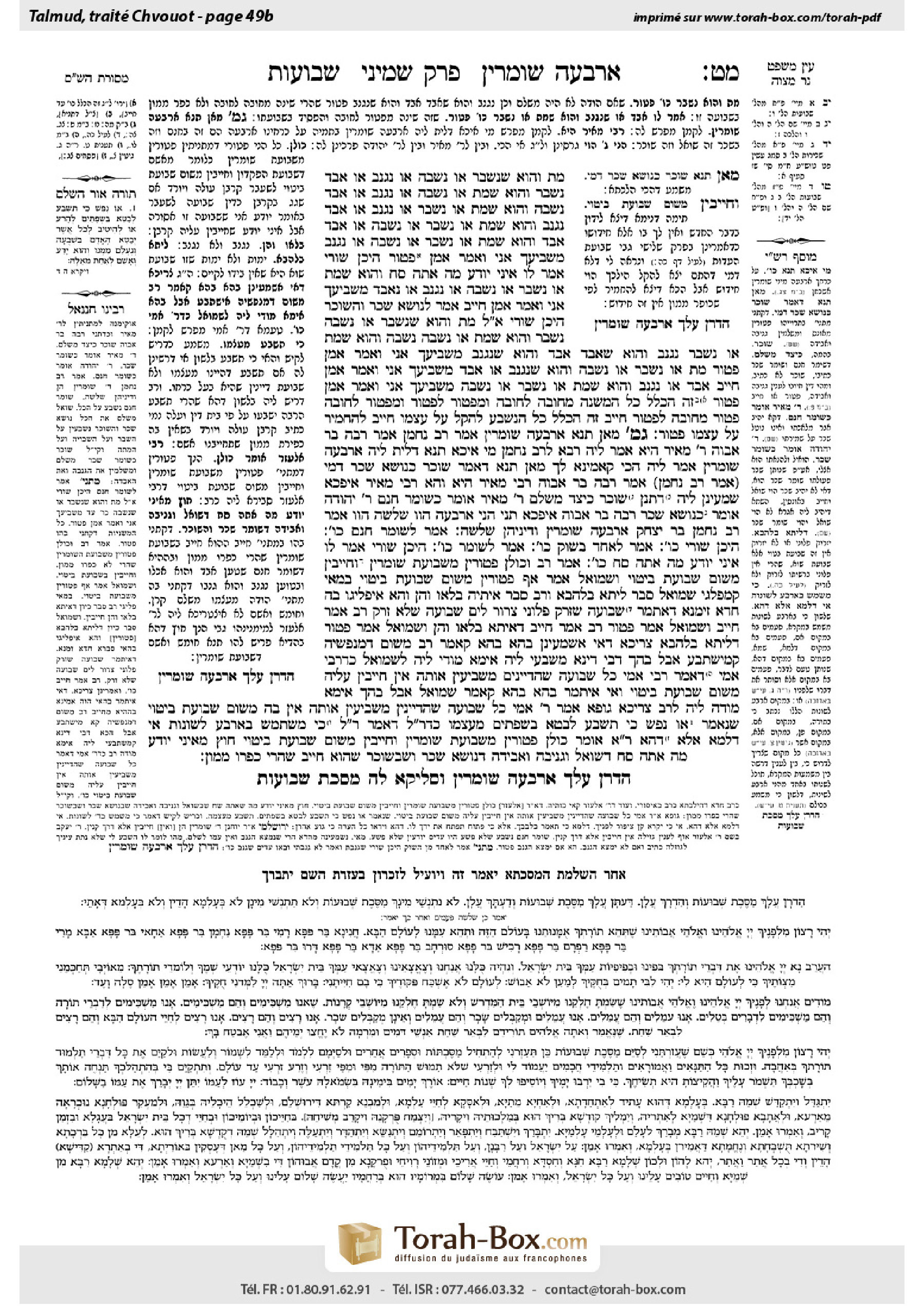
Shevuot 49b: Talmud study for Daf Yomi
Daf Yomi is the daily study of one Talmud folio. Explore 37 tractates with scans, Hebrew text, Sefaria English and AI-generated French translations where annotated.
Passage selection and English or AI-generated French translation are available where the scan has annotations. Daf Study is independent of Torah-Box and Sefaria.
Browse Shevuot · שבועות · All tractatesShevuot 49b text and translations
This page of Shevuot includes the Aramaic text, an English translation and an AI-generated French translation, alongside the scan above.
שבועות מ״ט ב · Aramaic and Hebrew text
״מֵת״ – וְהוּא שֶׁנִּשְׁבַּר אוֹ נִשְׁבָּה אוֹ נִגְנַב אוֹ אָבַד; ״נִשְׁבַּר״ – וְהוּא שֶׁמֵּת אוֹ נִשְׁבָּה אוֹ נִגְנַב אוֹ אָבַד; ״נִשְׁבָּה״ – וְהוּא שֶׁמֵּת אוֹ נִשְׁבַּר אוֹ נִגְנַב אוֹ אָבַד; ״נִגְנַב״ – וְהוּא שֶׁמֵּת אוֹ נִשְׁבַּר אוֹ נִשְׁבָּה אוֹ אָבַד; ״אָבַד״ – וְהוּא שֶׁמֵּת אוֹ נִשְׁבַּר אוֹ נִשְׁבָּה אוֹ נִגְנַב; ״מַשְׁבִּיעֲךָ אֲנִי״, וְאָמַר ״אָמֵן״ – פָּטוּר.
״הֵיכָן שׁוֹרִי?״ אָמַר לוֹ: ״אֵינִי יוֹדֵעַ מָה אַתָּה סָח״ – וְהוּא שֶׁמֵּת אוֹ נִשְׁבַּר אוֹ נִשְׁבָּה אוֹ נִגְנַב אוֹ נֶאֱבָד; ״מַשְׁבִּיעֲךָ אֲנִי״, וְאָמַר ״אָמֵן״ – חַיָּיב.
אָמַר לְנוֹשֵׂא שָׂכָר וְהַשּׂוֹכֵר: ״הֵיכָן שׁוֹרִי?״ אָמַר לוֹ: ״מֵת״ – וְהוּא שֶׁנִּשְׁבַּר אוֹ נִשְׁבָּה; ״נִשְׁבַּר״ – וְהוּא שֶׁמֵּת אוֹ נִשְׁבָּה; ״נִשְׁבָּה״ – וְהוּא שֶׁמֵּת אוֹ נִשְׁבַּר; ״נִגְנַב״ – וְהוּא שֶׁאָבַד; ״אָבַד״ – וְהוּא שֶׁנִּגְנַב; ״מַשְׁבִּיעֲךָ אֲנִי״, וְאָמַר ״אָמֵן״ – פָּטוּר.
״מֵת״ אוֹ ״נִשְׁבַּר״ אוֹ ״נִשְׁבָּה״ – וְהוּא שֶׁנִּגְנַב אוֹ אָבַד; ״מַשְׁבִּיעֲךָ אֲנִי״, וְאָמַר ״אָמֵן״ – חַיָּיב. ״אָבַד״ אוֹ ״נִגְנַב״ – וְהוּא שֶׁמֵּת אוֹ נִשְׁבַּר אוֹ נִשְׁבָּה; ״מַשְׁבִּיעֲךָ אֲנִי״, וְאָמַר ״אָמֵן״ – פָּטוּר.
זֶה הַכְּלָל: כׇּל הַמְשַׁנֶּה מֵחוֹבָה לְחוֹבָה, וּמִפְּטוּר לִפְטוּר, וּמִפְּטוּר לְחוֹבָה – פָּטוּר. מֵחוֹבָה לִפְטוּר – חַיָּיב. זֶה הַכְּלָל: כׇּל הַנִּשְׁבָּע לְהָקֵל עַל עַצְמוֹ – חַיָּיב. לְהַחְמִיר עַל עַצְמוֹ – פָּטוּר.
גְּמָ׳ מַאן תְּנָא אַרְבָּעָה שׁוֹמְרִין? אָמַר רַב נַחְמָן אָמַר רַבָּה בַּר אֲבוּהּ: רַבִּי מֵאִיר הִיא. אֲמַר לֵיהּ רָבָא לְרַב נַחְמָן: מִי אִיכָּא תַּנָּא דְּלֵית לֵיהּ אַרְבָּעָה שׁוֹמְרִין?! אֲמַר לֵיהּ, הָכִי קָאָמֵינָא לָךְ: מַאן תַּנָּא דְּאָמַר שׂוֹכֵר כְּנוֹשֵׂא שָׂכָר דָּמֵי? אָמַר רַב נַחְמָן אָמַר רַבָּה בַּר אֲבוּהּ: רַבִּי מֵאִיר הִיא.
וְהָא רַבִּי מֵאִיר אִיפְּכָא שָׁמְעִינַן לֵיהּ – דִּתְנַן: שׂוֹכֵר כֵּיצַד מְשַׁלֵּם? רַבִּי מֵאִיר אוֹמֵר: כְּשׁוֹמֵר חִנָּם, רַבִּי יְהוּדָה אוֹמֵר: כְּנוֹשֵׂא שָׂכָר! רַבָּה בַּר אֲבוּהּ אִיפְּכָא תָּנֵי.
הָנֵי אַרְבָּעָה הָווּ?! שְׁלֹשָׁה הָווּ! אָמַר רַב נַחְמָן בַּר יִצְחָק: אַרְבָּעָה שׁוֹמְרִין, וְדִינֵיהֶן שְׁלֹשָׁה.
אָמַר לְשׁוֹמֵר חִנָּם כּוּ׳, ״הֵיכָן שׁוֹרִי״ כּוּ׳, אָמַר לְאֶחָד בַּשּׁוּק כּוּ׳, אָמַר לְשׁוֹמֵר כּוּ׳, ״הֵיכָן שׁוֹרִי?״ אָמַר לוֹ: ״אֵינִי יוֹדֵעַ מָה אַתָּה סָח״ כּוּ׳. אָמַר רַב: וְכוּלָּן פְּטוּרִין מִשְּׁבוּעַת שׁוֹמְרִין, וְחַיָּיבִין מִשּׁוּם שְׁבוּעַת בִּיטּוּי. וּשְׁמוּאֵל אָמַר: אַף פְּטוּרִין מִשּׁוּם שְׁבוּעַת בִּיטּוּי.
בְּמַאי קָמִפַּלְגִי? שְׁמוּאֵל סָבַר: לֵיתַהּ בִּלְהַבָּא. וְרַב סָבַר: אִיתֵיהּ בְּלָאו וָהֵן.
וְהָא אִיפְּלִיגוּ בַהּ חֲדָא זִימְנָא – דְּאִתְּמַר: ״שְׁבוּעָה שֶׁזָּרַק פְּלוֹנִי צְרוֹר לַיָּם״, ״שְׁבוּעָה שֶׁלֹּא זָרַק״ – רַב אָמַר: חַיָּיב, וּשְׁמוּאֵל אָמַר: פָּטוּר. רַב אָמַר חַיָּיב – דְּאִיתַהּ בְּלָאו וְהֵן, וּשְׁמוּאֵל אָמַר פָּטוּר – דְּלֵיתַהּ בִּלְהַבָּא!
צְרִיכָא; דְּאִי אַשְׁמְעִינַן בְּהָא – בְּהָא קָאָמַר רַב, מִשּׁוּם דְּמִנַּפְשֵׁיהּ קָמִישְׁתְּבַע; אֲבָל בְּהָךְ, דְּבֵי דִינָא מַשְׁבְּעִי לֵיהּ – אֵימָא מוֹדֵי לֵיהּ לִשְׁמוּאֵל, כִּדְרַבִּי אַמֵּי; דְּאָמַר רַבִּי אַמֵּי: כׇּל שְׁבוּעָה שֶׁהַדַּיָּינִים מַשְׁבִּיעִין אוֹתָהּ – אֵין חַיָּיבִין עָלֶיהָ מִשּׁוּם שְׁבוּעַת בִּיטּוּי.
וְאִי אִיתְּמַר בְּהָא – בְּהָא קָאָמַר שְׁמוּאֵל, אֲבָל בְּהָךְ אֵימָא מוֹדֶה לֵיהּ לְרַב; צְרִיכָא.
גּוּפָא – אָמַר רַבִּי אַמֵּי: כׇּל שְׁבוּעָה שֶׁהַדַּיָּינִין מַשְׁבִּיעִין אוֹתָהּ, אֵין בָּהּ מִשּׁוּם שְׁבוּעַת בִּיטּוּי; שֶׁנֶּאֱמַר: ״אוֹ נֶפֶשׁ כִּי תִשָּׁבַע לְבַטֵּא בִשְׂפָתַיִם״ – מֵעַצְמוֹ. כִּדְרֵישׁ לָקִישׁ – דְּאָמַר רֵישׁ לָקִישׁ: ״כִּי״ מִשְׁתַּמֵּשׁ בְּאַרְבַּע לְשׁוֹנוֹת: אִי, דִּלְמָא, אֶלָּא, דְּהָא.
רַבִּי אֶלְעָזָר אוֹמֵר: כּוּלָּן פְּטוּרִין מִשְּׁבוּעַת שׁוֹמְרִין וְחַיָּיבִין מִשּׁוּם שְׁבוּעַת בִּיטּוּי; חוּץ מֵ״אֵינִי יוֹדֵעַ מָה אַתָּה סָח״ דְּשׁוֹאֵל, וּגְנֵיבָה וַאֲבֵידָה דְּנוֹשֵׂא שָׂכָר וְשֶׁבְּשׂוֹכֵר – שֶׁהוּא חַיָּיב, שֶׁהֲרֵי כְּפָרוֹ מָמוֹן.
הֲדַרַן עֲלָךְ אַרְבָּעָה שׁוֹמְרִין, וּסְלִיקָא לַהּ מַסֶּכֶת שְׁבוּעוֹת
Shevuot 49b · English translation
It died, but the truth was that it was injured or captured or stolen or lost; or if he responded: It was injured, but the truth was that it died or was captured or stolen or lost; or if he responded: It was captured, but the truth was that it died or was injured or stolen or lost; or if he responded: It was stolen, but the truth was that it died or was injured or captured or lost; or if he responded: It was lost, but the truth was that it died or was injured or captured or stolen, in any of the above cases, if the owner of the ox said: I administer an oath to you concerning your claim, and the borrower said: Amen, he is exempt from bringing an offering for his false oath, since the oath did not render him exempt from liability to pay. He would have been liable to pay in any case.
But if the owner said to the borrower: Where is my ox? And the borrower said to him: I do not know what you are talking about, but the truth was that it died or was injured or captured or stolen or lost, and the owner said: I administer an oath to you concerning your claim, and the borrower said: Amen, the borrower is liable to bring a guilt-offering, as he took an oath that would render him exempt from liability to pay.
If an owner said to a paid bailee or a renter: Where is my ox? And the latter said to him: It died, but the truth was that it was injured or captured; or if he said: It was injured, but the truth was that it died or was captured; or if he said: It was captured, but the truth was that it died or was injured; or if he said: It was stolen, but the truth was that it was lost; or if he said: It was lost, but the truth was that it was stolen, and the owner said: I administer an oath to you concerning your claim, and he said: Amen, the paid bailee or renter is exempt from bringing a guilt-offering.
If the paid bailee or renter said: It died or was injured or captured, but the truth was that it was stolen or lost, and the owner said: I administer an oath to you concerning your claim, and he said: Amen, the paid bailee or renter is liable to bring a guilt-offering. If the paid bailee or renter said: It was lost or stolen, but the truth was that it died or was injured or captured, and the owner said: I administer an oath to you concerning your claim, and he said: Amen, he is exempt from bringing a guilt-offering.
This is the principle: Anyone who changes from one claim of liability to another claim of liability or from one claim of exemption to another claim of exemption or from a claim of exemption to a claim of liability is exempt from bringing a guilt-offering. If he changes from a claim of liability to a claim of exemption, he is liable. This is the principle: Anyone who takes an oath to be lenient with himself is liable; if he takes an oath to be stringent with himself, he is exempt.
GEMARA: The Gemara asks: Who is the tanna who taught that there are four types of bailees? Rav Naḥman said that Rabba bar Avuh said: It is Rabbi Meir. Rava said to Rav Naḥman: And is there a tanna who does not accept that there are four types of bailees, as the question and your answer indicate? Rav Naḥman said to him: This is what I am saying to you: Who is the tanna who says that a renter has the same halakhic status as a paid bailee? With regard to this question, Rav Naḥman said that Rabba bar Avuh said: It is Rabbi Meir.
The Gemara challenges: But we have heard that Rabbi Meir said the opposite, as it is taught in a baraita: How does a renter pay? Rabbi Meir says: He pays like an unpaid bailee. Rabbi Yehuda says: He pays like a paid bailee. The Gemara explains: Rabba bar Avuh taught this baraita while reversing the opinions, stating that Rabbi Meir is of the opinion that a renter is like a paid bailee; therefore, he said that the mishna is in accordance with the opinion of Rabbi Meir.
The Gemara asks: Are these in fact four types of bailees? There are actually only three, as the halakhot relating to a paid bailee and a renter are identical. Rav Naḥman bar Yitzḥak said: There are indeed four types of bailees with regard to the manner in which they accepted the deposit, but only three halakhot that apply to them.
§ The following cases were stated in the mishna: If the owner of an ox said to an unpaid bailee: Where is my ox; or if the owner of an ox said to someone in the marketplace: Where is my ox that you stole; or if he said to a bailee: Where is my ox, and the other person said to him: I do not know what you are talking about. With regard to all of these situations referred to in the mishna, Rav says: All of them are exempt from bringing a guilt-offering for falsely taking an oath of the bailees, but they are liable to bring a sin-offering for falsely taking an oath on an utterance. And Shmuel says: They are exempt from bringing a sin-offering for falsely taking an oath on an utterance as well.
With regard to what principle do they disagree? Shmuel holds that he is exempt from bringing an offering because there is no possibility of taking that oath with regard to an event that may occur in the future, i.e., that the deposited animal will die or be stolen or be lost, and Shmuel holds that one is not liable for taking an oath on an utterance in the case of any oath that one cannot take with reference to the future. And Rav holds that there is an obligation to bring a sin-offering because it is possible to take both a negative oath and a positive one. One of the conditions necessary in order for one to incur liability for an oath on an utterance is that the oath can be formulated as both a negative and a positive statement. This oath meets that criterion as one can formulate the oath in the negative, e.g., the deposit was not stolen, as well as in the positive, e.g., it was stolen.
The Gemara challenges: But they already disputed this question on another occasion (see 25a), as it was stated: With regard to one who says: On my oath so-and-so threw a stone into the sea, or: On my oath he did not throw it, Rav says: If it was later discovered that his statement was false, he is liable to bring an offering for his oath. And Shmuel says: He is exempt. Rav says that he is liable, as the oath can be positive or negative. And Shmuel says he is exempt because this oath cannot be stated with regard to the future, since he cannot control what so-and-so does.
The Gemara explains: It was necessary to state the dispute in the case of a bailee as well, as if they would teach it to us only in the case where one took an oath that so-and-so threw a stone, it may have been understood that it is only in this case that Rav says that the person taking the oath is exempt, since he is taking a false oath of his own accord, but in the case in the mishna here, where it is the court that is administering the oath to him, say that Rav concedes to Shmuel that he is exempt, in accordance with the statement of Rabbi Ami. As Rabbi Ami says: In the case of any oath that is administered by the judges, one is not liable to bring a sin-offering for falsely taking an oath on an utterance.
And conversely, if the dispute had been stated only in this case, i.e., the case of the bailee to whom the court administers the oath, one might have said: It is in this case that Shmuel says that he is exempt, in accordance with Rabbi Ami’s statement, but in a case where one took an oath that so-and-so threw a stone, say that Shmuel concedes to Rav that he is liable. Therefore, it is necessary for the dispute to be stated in both cases.
Having mentioned Rabbi Ami’s ruling, the Gemara discusses the matter itself: Rabbi Ami says: In the case of any oath that is administered by the judges, one is not liable for falsely taking an oath on an utterance, as it is stated in the verse: “Or if [ki] anyone swears clearly with his lips to do evil or to do good, whatever it is that a man shall utter clearly with an oath, and it is hidden from him…and the priest shall make atonement for him concerning his sin” (Leviticus 5:4–6). Only if one takes the oath of his own accord is he liable, as the verse can be understood in accordance with the statement of Reish Lakish. As Reish Lakish says: The term ki has four distinct meanings: If, perhaps, rather, and as. According to Rabbi Ami, its meaning in the above verse is: If, indicating that only if one takes the oath of his own accord is he liable.
Rabbi Elazar says: All of them, i.e., all those listed in the mishna as exempt, are exempt from bringing a guilt-offering for taking an oath of the bailees, but they are liable to bring a sin-offering for taking an oath on an utterance, except for a borrower who says: I do not know what you are talking about, and a paid bailee or a renter who claims that the deposit was stolen or lost. In these cases, the bailee is liable for taking an oath of the bailees, as he denied a monetary claim, meaning that he wanted to render himself exempt from liability to pay. This halakha is in accordance with the opinion of Rav.
This chapter explained that a bailee who makes a false claim and takes an oath to that effect is not always liable for falsely taking an oath of the bailees. The principle with regard to this matter was stated at the end of the mishna: Any bailee who makes a false claim that would in any case not render him exempt from liability to pay, and takes an oath to that effect, is not liable for falsely taking an oath of the bailees.
Shevuot 49b · Traduction française (IA)
Il est mort, alors qu’en réalité il avait été blessé, capturé, volé ou perdu ; ou s’il répondit : « Il a été blessé », alors qu’en réalité il était mort, avait été capturé, volé ou perdu ; ou s’il répondit : « Il a été capturé », alors qu’en réalité il était mort, avait été blessé, volé ou perdu ; ou s’il répondit : « Il a été volé », alors qu’en réalité il était mort, avait été blessé, capturé ou perdu ; ou s’il répondit : « Il a été perdu », alors qu’en réalité il était mort, avait été blessé, capturé ou volé. Dans tous ces cas, si le propriétaire du bœuf lui dit : « Je t’adjure au sujet de ta déclaration », et que l’emprunteur répondit : « Amen », celui-ci est dispensé d’apporter un sacrifice de culpabilité pour son faux serment, puisque le serment ne l’a pas dispensé de son obligation de payer. Il aurait de toute façon été tenu de payer.
Mais si le propriétaire dit à l’emprunteur : « Où est mon bœuf ? », et que l’emprunteur lui répond : « Je ne sais pas de quoi tu parles », alors qu’en réalité le bœuf était mort, avait été blessé, capturé, volé ou perdu, et que le propriétaire lui dit : « Je t’adjure au sujet de ta déclaration », et que l’emprunteur répondit : « Amen », celui-ci est tenu d’apporter un sacrifice de culpabilité, car il a prêté un serment qui devait le dispenser de son obligation de payer.
Si un propriétaire dit à un gardien rémunéré ou à un locataire : « Où est mon bœuf ? », et que celui-ci lui répond : « Il est mort », alors qu’en réalité il avait été blessé ou capturé ; ou s’il répond : « Il a été blessé », alors qu’en réalité il était mort ou avait été capturé ; ou s’il répond : « Il a été capturé », alors qu’en réalité il était mort ou avait été blessé ; ou s’il répond : « Il a été volé », alors qu’en réalité il avait été perdu ; ou s’il répond : « Il a été perdu », alors qu’en réalité il avait été volé, et que le propriétaire lui dit : « Je t’adjure au sujet de ta déclaration », et qu’il répond : « Amen », le gardien rémunéré ou le locataire est dispensé d’apporter un sacrifice de culpabilité.
Si le gardien rémunéré ou le locataire dit : « Il est mort, a été blessé ou capturé », alors qu’en réalité il avait été volé ou perdu, et que le propriétaire lui dit : « Je t’adjure au sujet de ta déclaration », et qu’il répond : « Amen », le gardien rémunéré ou le locataire est tenu d’apporter un sacrifice de culpabilité. Si le gardien rémunéré ou le locataire dit : « Il a été perdu ou volé », alors qu’en réalité il était mort, avait été blessé ou capturé, et que le propriétaire lui dit : « Je t’adjure au sujet de ta déclaration », et qu’il répond : « Amen », il est dispensé d’apporter un sacrifice de culpabilité.
Voici le principe : quiconque passe d’une déclaration impliquant une obligation de payer à une autre déclaration impliquant une obligation de payer, ou d’une déclaration impliquant une exemption à une autre déclaration impliquant une exemption, ou d’une déclaration impliquant une exemption à une déclaration impliquant une obligation de payer, est dispensé d’apporter un sacrifice de culpabilité. S’il passe d’une déclaration impliquant une obligation de payer à une déclaration impliquant une exemption, il est tenu d’en apporter un. Voici le principe : quiconque prête serment pour s’accorder une indulgence est tenu d’apporter un sacrifice ; s’il prête serment pour s’imposer une rigueur, il en est dispensé.
GUEMARA : La Guemara demande : Qui est le tanna qui a enseigné qu’il existe quatre catégories de gardiens ? Rav Naḥman dit au nom de Rabba bar Avuh : C’est Rabbi Meïr. Rava dit à Rav Naḥman : Y a-t-il un tanna qui ne reconnaît pas l’existence de quatre catégories de gardiens, comme le laissent entendre ta question et ta réponse ? Rav Naḥman lui dit : Voici ce que je te demande : qui est le tanna qui considère que le statut halakhique d’un locataire est celui d’un gardien rémunéré ? À cette question, Rav Naḥman dit au nom de Rabba bar Avuh : C’est Rabbi Meïr.
La Guemara objecte : Mais nous avons entendu Rabbi Meïr dire le contraire, car il est enseigné dans une baraïta : Comment un locataire paie-t-il ? Rabbi Meïr dit : Il paie comme un gardien non rémunéré. Rabbi Yehouda dit : Il paie comme un gardien rémunéré. La Guemara explique : Rabba bar Avuh enseignait cette baraïta en inversant les opinions et affirmait que, selon Rabbi Meïr, un locataire est assimilé à un gardien rémunéré. C’est pourquoi il disait que la Michna suit l’opinion de Rabbi Meïr.
La Guemara demande : S’agit-il réellement de quatre catégories de gardiens ? En réalité, il n’y en a que trois, puisque les lois qui s’appliquent au gardien rémunéré et au locataire sont identiques. Rav Naḥman bar Yitzḥak dit : Il existe bien quatre catégories de gardiens quant à la manière dont ils ont accepté le dépôt, mais seules trois séries de lois leur sont applicables.
§ Les cas suivants ont été énoncés dans la Michna : si le propriétaire d’un bœuf dit à un gardien non rémunéré : « Où est mon bœuf ? » ; ou si le propriétaire d’un bœuf dit à quelqu’un sur la place du marché : « Où est mon bœuf que tu as volé ? » ; ou s’il dit à un gardien : « Où est mon bœuf ? », et que l’autre lui répond : « Je ne sais pas de quoi tu parles. » Au sujet de toutes ces situations mentionnées dans la Michna, Rav dit qu’ils sont tous dispensés d’apporter un sacrifice de culpabilité pour avoir prêté un faux serment de gardien, mais qu’ils sont tenus d’apporter un sacrifice expiatoire pour avoir prêté un faux serment portant sur une déclaration. Shmuel dit qu’ils sont également dispensés d’apporter un sacrifice expiatoire pour avoir prêté un faux serment portant sur une déclaration.
Sur quel principe sont-ils en désaccord ? Shmuel estime qu’il est dispensé d’apporter un sacrifice, car il est impossible de prêter un tel serment au sujet d’un événement susceptible de se produire dans l’avenir, c’est-à-dire que l’animal déposé mourra, sera volé ou sera perdu ; et Shmuel estime qu’on n’est pas passible d’un sacrifice pour un serment portant sur une déclaration si l’on ne peut pas prêter ce serment au sujet de l’avenir. Rav estime qu’il est tenu d’apporter un sacrifice expiatoire, car il est possible de prêter à la fois un serment négatif et un serment positif. L’une des conditions requises pour être passible d’un sacrifice expiatoire en raison d’un serment portant sur une déclaration est que le serment puisse être formulé à la fois sous la forme négative et sous la forme positive. Ce serment satisfait à ce critère, puisqu’on peut le formuler à la négative, par exemple : « Le dépôt n’a pas été volé », aussi bien qu’à la positive, par exemple : « Il a été volé. »
La Guemara objecte : Mais ils ont déjà été en désaccord sur cette question en une autre occasion (voir 25a), comme il a été rapporté : au sujet de quelqu’un qui dit : « Je jure qu’untel a jeté une pierre dans la mer », ou : « Je jure qu’il ne l’a pas jetée », Rav dit que, s’il est ensuite établi que sa déclaration était fausse, il est tenu d’apporter un sacrifice pour son serment. Shmuel dit qu’il en est dispensé. Rav estime qu’il en est passible, car le serment peut être positif ou négatif. Shmuel dit qu’il en est dispensé, car ce serment ne peut pas porter sur l’avenir, puisqu’il ne peut pas contrôler ce que fera untel.
La Guemara explique : Il était nécessaire d’énoncer également leur désaccord dans le cas d’un gardien. En effet, si l’on nous avait enseigné leur désaccord uniquement dans le cas de celui qui a prêté serment qu’untel avait jeté une pierre, on aurait pu comprendre que Rav estime que la personne qui prête serment est dispensée uniquement dans ce cas, puisqu’elle prête un faux serment de son propre chef ; mais dans le cas de la Michna ici, où c’est le tribunal qui lui fait prêter serment, on aurait pu dire que Rav reconnaît l’opinion de Shmuel et qu’elle en est dispensée, conformément à l’enseignement de Rabbi Ami. Car Rabbi Ami dit : pour tout serment que les juges font prêter, on n’est pas tenu d’apporter un sacrifice expiatoire pour avoir prêté un faux serment portant sur une déclaration.
Inversement, si leur désaccord n’avait été énoncé que dans ce cas, c’est-à-dire celui du gardien à qui le tribunal fait prêter serment, on aurait pu dire que c’est dans ce cas que Shmuel estime qu’il en est dispensé, conformément à l’enseignement de Rabbi Ami ; mais que, dans le cas où quelqu’un a prêté serment qu’untel avait jeté une pierre, Shmuel reconnaît l’opinion de Rav et estime qu’il est passible. C’est pourquoi il est nécessaire d’énoncer leur désaccord dans les deux cas.
Après avoir mentionné la décision de Rabbi Ami, la Guemara examine le sujet lui-même : Rabbi Ami dit que, pour tout serment que les juges font prêter, on n’est pas passible d’un sacrifice expiatoire pour avoir prêté un faux serment portant sur une déclaration, comme il est dit dans le verset : « Ou si quelqu’un, [ki], jure clairement de ses lèvres de faire le mal ou le bien, quoi que ce soit qu’un homme exprime clairement sous serment, et que cela lui ait été caché… le prêtre fera pour lui l’expiation de son péché » (Lévitique 5:4–6). On n’est passible que si l’on prête serment de son propre chef, car le verset peut être compris conformément à l’enseignement de Reish Lakish. En effet, Reish Lakish dit que le terme ki a quatre significations distinctes : si, peut-être, mais et comme. Selon Rabbi Ami, dans le verset cité, il signifie « si », ce qui indique qu’on n’est passible que si l’on prête serment de son propre chef.
Rabbi Elazar dit : Tous ceux qui sont mentionnés dans la Michna comme étant dispensés sont dispensés d’apporter un sacrifice de culpabilité pour avoir prêté un serment de gardien, mais ils sont tenus d’apporter un sacrifice expiatoire pour avoir prêté un serment portant sur une déclaration, à l’exception d’un emprunteur qui dit : « Je ne sais pas de quoi tu parles », et d’un gardien rémunéré ou d’un locataire qui affirme que le dépôt a été volé ou perdu. Dans ces cas, le gardien est passible pour avoir prêté un serment de gardien, car il a nié une réclamation portant sur une somme d’argent, c’est-à-dire qu’il voulait se dispenser de son obligation de payer. Cette halakha est conforme à l’opinion de Rav. Ce chapitre a expliqué qu’un gardien qui fait une fausse déclaration et prête serment en conséquence n’est pas toujours passible pour avoir prêté un serment de gardien. Le principe en la matière a été énoncé à la fin de la Michna : tout gardien qui fait une fausse déclaration qui, de toute façon, ne le dispenserait pas de son obligation de payer, et qui prête serment en conséquence, n’est pas passible pour avoir prêté un serment de gardien.
Traduction française générée par IA à partir de l’édition anglaise de Sefaria. Vérifie toujours un passage avec le texte source.
Text from Sefaria: William Davidson Edition - Vocalized Aramaic (CC BY NC); William Davidson Edition - English (CC BY NC).