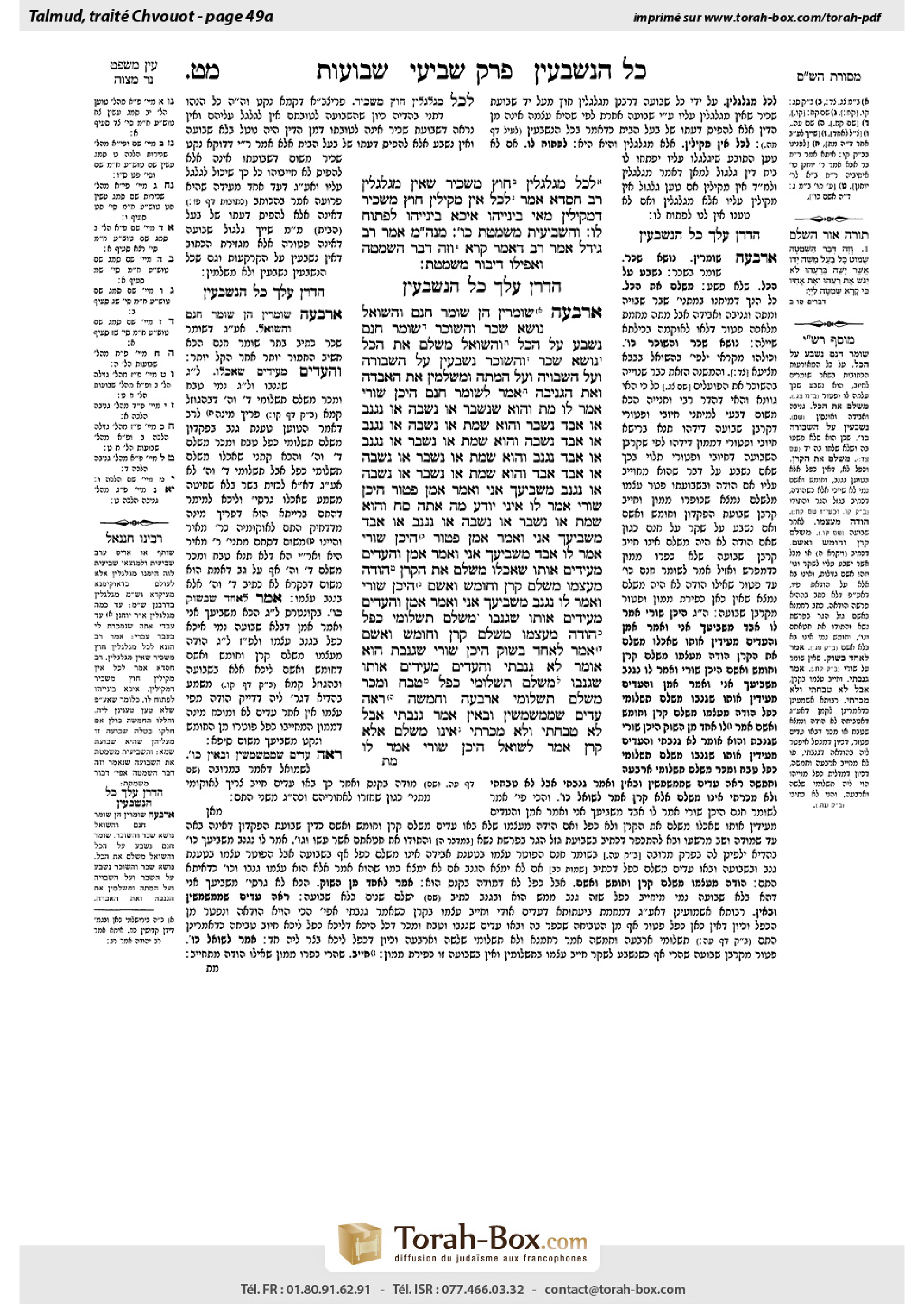
Shevuot 49a: Talmud study for Daf Yomi
Daf Yomi is the daily study of one Talmud folio. Explore 37 tractates with scans, Hebrew text, Sefaria English and AI-generated French translations where annotated.
Passage selection and English or AI-generated French translation are available where the scan has annotations. Daf Study is independent of Torah-Box and Sefaria.
Browse Shevuot · שבועות · All tractatesShevuot 49a text and translations
This page of Shevuot includes the Aramaic text, an English translation and an AI-generated French translation, alongside the scan above.
שבועות מ״ט א · Aramaic and Hebrew text
לַכֹּל מְגַלְגְּלִין, חוּץ מִשָּׂכִיר – שֶׁאֵין מְגַלְגְּלִין. רַב חִסְדָּא אָמַר: לַכֹּל אֵין מְקִילִּין, חוּץ מִשָּׂכִיר – דִּמְקִילִּין. מַאי בֵּינַיְיהוּ? אִיכָּא בֵּינַיְיהוּ לִפְתּוֹחַ לוֹ.
וְהַשְּׁבִיעִית מְשַׁמֶּטֶת כּוּ׳. מְנָא הָנֵי מִילֵּי? אָמַר רַב גִּידֵּל אָמַר רַב, דְּאָמַר קְרָא: ״וְזֶה דְּבַר הַשְּׁמִטָּה״ – וַאֲפִילּוּ דִּיבּוּר מְשַׁמֶּטֶת.
הֲדַרַן עֲלָךְ כׇּל הַנִּשְׁבָּעִין
מַתְנִי׳ אַרְבָּעָה שׁוֹמְרִין הֵן: שׁוֹמֵר חִנָּם וְהַשּׁוֹאֵל, נוֹשֵׂא שָׂכָר וְהַשּׂוֹכֵר.
שׁוֹמֵר חִנָּם נִשְׁבָּע עַל הַכֹּל, וְהַשּׁוֹאֵל מְשַׁלֵּם אֶת הַכֹּל.
נוֹשֵׂא שָׂכָר וְהַשּׂוֹכֵר – נִשְׁבָּעִין עַל הַשְּׁבוּרָה וְעַל הַשְּׁבוּיָה וְעַל הַמֵּתָה, וּמְשַׁלְּמִין אֶת הָאֲבֵדָה וְאֶת הַגְּנֵיבָה.
אָמַר לְשׁוֹמֵר חִנָּם: ״הֵיכָן שׁוֹרִי?״ אָמַר לוֹ: ״מֵת״ – וְהוּא שֶׁנִּשְׁבַּר אוֹ נִשְׁבָּה אוֹ נִגְנַב אוֹ אָבַד; ״נִשְׁבַּר״ – וְהוּא שֶׁמֵּת אוֹ נִשְׁבָּה אוֹ נִגְנַב אוֹ אָבַד. ״נִשְׁבָּה״ – וְהוּא שֶׁמֵּת אוֹ נִשְׁבַּר אוֹ נִגְנַב אוֹ אָבַד; ״נִגְנַב״ – וְהוּא שֶׁמֵּת אוֹ נִשְׁבַּר אוֹ נִשְׁבָּה אוֹ אָבַד; ״אָבַד״ – וְהוּא שֶׁמֵּת אוֹ נִשְׁבַּר אוֹ נִשְׁבָּה אוֹ נִגְנַב; ״מַשְׁבִּיעֲךָ אֲנִי״, וְאָמַר ״אָמֵן״ – פָּטוּר.
״הֵיכָן שׁוֹרִי?״ אָמַר לוֹ: ״אֵינִי יוֹדֵעַ מָה אַתָּה סָח״ – וְהוּא שֶׁמֵּת אוֹ נִשְׁבַּר אוֹ נִשְׁבָּה אוֹ נִגְנַב אוֹ אָבַד; ״מַשְׁבִּיעֲךָ אֲנִי״, וְאָמַר ״אָמֵן״ – פָּטוּר.
״הֵיכָן שׁוֹרִי?״ אָמַר לוֹ: ״אָבַד״; ״מַשְׁבִּיעֲךָ אֲנִי״, וְאָמַר ״אָמֵן״; וְהָעֵדִים מְעִידִים אוֹתוֹ שֶׁאֲכָלוֹ – מְשַׁלֵּם אֶת הַקֶּרֶן. הוֹדָה מֵעַצְמוֹ – מְשַׁלֵּם קֶרֶן וָחוֹמֶשׁ וְאָשָׁם.
״הֵיכָן שׁוֹרִי?״ וְאָמַר לוֹ: ״נִגְנַב״; ״מַשְׁבִּיעֲךָ אֲנִי״, וְאָמַר ״אָמֵן״; וְהָעֵדִים מְעִידִים אוֹתוֹ שֶׁגְּנָבוֹ – מְשַׁלֵּם תַּשְׁלוּמֵי כֶפֶל. הוֹדָה מֵעַצְמוֹ – מְשַׁלֵּם קֶרֶן וָחוֹמֶשׁ וְאָשָׁם.
אָמַר לְאֶחָד בַּשּׁוּק: ״הֵיכָן שׁוֹרִי שֶׁגָּנַבְתָּ?״ הוּא אוֹמֵר: ״לֹא גָּנַבְתִּי״, וְהָעֵדִים מְעִידִים אוֹתוֹ שֶׁגְּנָבוֹ – מְשַׁלֵּם תַּשְׁלוּמֵי כֶפֶל. טָבַח וּמָכַר – מְשַׁלֵּם תַּשְׁלוּמֵי אַרְבָּעָה וַחֲמִשָּׁה. רָאָה עֵדִים שֶׁמְּמַשְׁמְשִׁין וּבָאִין, אָמַר: ״גָּנַבְתִּי, אֲבָל לֹא טָבַחְתִּי וְלֹא מָכַרְתִּי״ – אֵינוֹ מְשַׁלֵּם אֶלָּא קֶרֶן.
אָמַר לְשׁוֹאֵל: ״הֵיכָן שׁוֹרִי?״ אָמַר לוֹ:
Shevuot 49a · English translation
Any oath, including one incurred by rabbinic law, may be extended to render the person who takes it liable to take an additional oath, except for the oath of a hired worker, which may not be extended, since the hired worker’s oath was instituted only to alleviate the concerns of the employer. Rav Ḥisda says: For everyone, the Sages are not lenient, in that they extend any oath they incur to impose upon them additional oaths, except for a hired worker, for whom they are lenient. The Gemara asks: What is the difference between the rulings of Rav Huna and Rav Ḥisda? The Gemara answers: There is a practical difference between them as to whether the court initiates extending an oath for him, i.e., even when the other litigant has not suggested it, the court extends the original oath to include an oath about other claims.
§ The mishna teaches: The Sabbatical Year abrogates the obligation to take an oath about a debt, just like it abrogates a debt. The Gemara asks: From where is this matter derived? Rav Giddel says that Rav says: It is derived from the fact that the verse states: “And this is the matter [devar] of the release: Every creditor shall release that which he has lent to his neighbor; he shall not exact it of his neighbor and his brother, because the Lord’s release has been proclaimed” (Deuteronomy 15:2). Since the word devar also means statement, this teaches that the Sabbatical Year releases, i.e., abrogates, even a statement, i.e., an oath.
MISHNA: There are four types of bailees, to whom different halakhot apply. They are as follows: An unpaid bailee, who receives no compensation for safeguarding the item in his care; and a borrower, who receives an item on loan for his own use without paying a rental fee; a paid bailee, who is paid a salary for safeguarding the deposited item; and a renter, i.e., one who pays a fee for the use of an item or animal.
In the event that one of these bailees is unable to return the deposited item to its owner, the halakha with regard to liability is dependent upon what happened to the item, and upon the type of bailee: An unpaid bailee takes an oath attesting to the fact that he was not negligent with the care of the item and is then exempt from liability for everything, meaning for all types of damage, whether the item was lost, stolen, damaged, or if the animal died. Conversely, a borrower does not have the option of taking an oath, and pays for everything, whether the item was stolen, lost, damaged, or the animal died, even if it was by unavoidable accident.
The halakhot of a paid bailee and a renter are the same: They take an oath concerning an injured animal, and concerning a captured one, and concerning a dead animal, attesting to the fact that these mishaps were not caused by negligence, but rather by unavoidable accident, and then are exempt from liability. But they must pay if the deposit cannot be returned due to loss or theft, even if these were not caused by negligence.
The mishna clarifies: If the owner of an ox said to an unpaid bailee: Where is my ox? And the unpaid bailee said to him: It died, but the truth was that it was injured or captured or stolen or lost; or if the bailee responded: It was injured, but the truth was that it died or was captured or stolen or lost; or if he responded: It was captured, but the truth was that it died or was injured or stolen or lost; or if he responded: It was stolen, but the truth was that it died or was injured or captured or lost; or if he responded: It was lost, but the truth was that it died or was injured or captured or stolen, in any of the above cases, if the owner of the ox then said: I administer an oath to you concerning your claim, and the unpaid bailee said: Amen, he is exempt from bringing a guilt-offering, despite the fact that he took a false oath. The reason is that his false oath did not render him exempt from liability to pay.
If the owner says to an unpaid bailee: Where is my ox? And the unpaid bailee said to him: I do not know what you are talking about, but the truth was that it died or was injured or captured or stolen or lost, and the owner said: I administer an oath to you concerning your claim, and the unpaid bailee said: Amen, he is exempt from bringing a guilt-offering, since he would not have been liable to pay in any of these cases.
But if the owner said to the unpaid bailee: Where is my ox? And the unpaid bailee said to him: It is lost, and the owner said: I administer an oath to you concerning your claim, and the unpaid bailee said: Amen, and then witnesses testify that the bailee consumed it, he pays the owner the principal, since he took the ox for himself. But if there were no witnesses, but after he took the oath he admitted of his own accord that he stole the ox and took a false oath, then he pays the owner the principal and the additional one-fifth payment, and he brings a guilt-offering to achieve atonement, as in any other case where one takes a false oath with regard to a deposit.
Similarly, if the owner said to the unpaid bailee: Where is my ox? And the unpaid bailee said to him: It was stolen, and the owner said: I administer an oath to you concerning your claim, and the unpaid bailee said: Amen, and then witnesses testify that the bailee stole it, he pays double the principal. If he admitted of his own accord that he stole it, then he is exempt from double payment for theft, but pays the principal and the additional one-fifth payment, and brings a guilt-offering to achieve atonement.
If the owner of an ox said to someone in the marketplace, i.e., a stranger who was not a bailee: Where is my ox that you stole? And the accused says: I did not steal it, and then witnesses testify that the accused did steal it, he pays the double payment. If he slaughtered or sold it, he pays the fourfold or fivefold payment. If the accused saw witnesses that were approaching to testify against him, and at that point he said: I admit that I stole the animal but I did not slaughter or sell it, he pays only the principal.
If the owner said to a borrower: Where is my ox? And the borrower said to him:
Shevuot 49a · Traduction française (IA)
Tout serment, y compris un serment imposé par la loi rabbinique, peut être étendu afin que celui qui le prête soit tenu de prêter un serment supplémentaire, à l’exception du serment d’un salarié, qui ne peut être étendu, car il n’a été institué que pour apaiser les inquiétudes de l’employeur. Rav Ḥisda dit : Pour tous les autres, les Sages ne se montrent pas indulgents : ils étendent tout serment auquel ils sont soumis et leur imposent des serments supplémentaires ; mais pour un salarié, ils se montrent indulgents. La Guemara demande : Quelle est la différence entre les décisions de Rav Houna et de Rav Ḥisda ? La Guemara répond : La différence pratique entre elles concerne la question de savoir si le tribunal prend l’initiative d’étendre le serment pour lui, c’est-à-dire si, même lorsque l’autre plaideur ne l’a pas proposé, le tribunal étend le serment initial afin d’y inclure un serment portant sur d’autres prétentions.
§ La Michna enseigne : L’année sabbatique annule l’obligation de prêter serment au sujet d’une dette, tout comme elle annule la dette. La Guemara demande : D’où cette règle est-elle déduite ? Rav Giddel dit au nom de Rav : Elle est déduite du verset qui dit : « Et voici la parole [devar] de la remise : Tout créancier remettra ce qu’il a prêté à son prochain ; il ne l’exigera pas de son prochain ni de son frère, car la remise de l’Éternel a été proclamée » (Deutéronome 15, 2). Puisque le mot devar signifie aussi « parole », cela enseigne que l’année sabbatique remet, c’est-à-dire annule, même une parole, à savoir un serment.
MICHNA : Il existe quatre catégories de gardiens, auxquelles s’appliquent différentes halakhot. Les voici : le gardien bénévole, qui ne reçoit aucune rémunération pour garder l’objet confié à ses soins ; l’emprunteur, qui reçoit un objet en prêt pour son usage personnel sans payer de loyer ; le gardien rémunéré, qui reçoit un salaire pour garder l’objet déposé ; et le locataire, c’est-à-dire celui qui paie une somme pour utiliser un objet ou un animal.
Si l’un de ces gardiens est incapable de rendre l’objet déposé à son propriétaire, la halakha concernant sa responsabilité dépend de ce qui est arrivé à l’objet et du type de gardien : le gardien bénévole prête serment pour attester qu’il n’a pas fait preuve de négligence dans la garde de l’objet, puis il est exempt de toute responsabilité, c’est-à-dire pour tous les types de dommages, que l’objet ait été perdu, volé ou endommagé, ou que l’animal soit mort. À l’inverse, l’emprunteur ne peut pas se libérer par un serment et doit payer dans tous les cas, que l’objet ait été volé, perdu ou endommagé, ou que l’animal soit mort, même à la suite d’un accident inévitable.
Les halakhot applicables au gardien rémunéré et au locataire sont identiques : ils prêtent serment au sujet d’un animal blessé, capturé ou mort, attestant que ces événements n’ont pas été causés par leur négligence, mais par un accident inévitable ; ils sont alors exempts de responsabilité. Toutefois, ils doivent payer si le dépôt ne peut être rendu en raison d’une perte ou d’un vol, même si ceux-ci ne sont pas dus à leur négligence.
La Michna précise : Si le propriétaire d’un bœuf dit à un gardien bénévole : « Où est mon bœuf ? », et que le gardien bénévole lui répond : « Il est mort », alors qu’en réalité il avait été blessé, capturé, volé ou perdu ; ou s’il répond : « Il a été blessé », alors qu’en réalité il était mort, capturé, volé ou perdu ; ou s’il répond : « Il a été capturé », alors qu’en réalité il était mort, blessé, volé ou perdu ; ou s’il répond : « Il a été volé », alors qu’en réalité il était mort, blessé, capturé ou perdu ; ou s’il répond : « Il a été perdu », alors qu’en réalité il était mort, blessé, capturé ou volé ; dans chacun de ces cas, si le propriétaire du bœuf lui dit ensuite : « Je t’adjure au sujet de ta déclaration », et que le gardien bénévole répond : « Amen », il est exempt d’apporter un sacrifice de culpabilité, bien qu’il ait prêté un faux serment. En effet, son faux serment ne l’a pas exempté de l’obligation de payer.
Si le propriétaire dit à un gardien bénévole : « Où est mon bœuf ? », et que le gardien bénévole lui répond : « Je ne sais pas de quoi tu parles », alors qu’en réalité le bœuf était mort, blessé, capturé, volé ou perdu, et que le propriétaire lui dit : « Je t’adjure au sujet de ta déclaration », et que le gardien bénévole répond : « Amen », il est exempt d’apporter un sacrifice de culpabilité, puisqu’il n’aurait été tenu de payer dans aucun de ces cas.
Mais si le propriétaire dit au gardien bénévole : « Où est mon bœuf ? », que le gardien bénévole lui répond : « Il a été perdu », que le propriétaire lui dit : « Je t’adjure au sujet de ta déclaration », et que le gardien bénévole répond : « Amen », puis que des témoins attestent que le gardien l’a consommé, celui-ci paie au propriétaire le principal, puisqu’il s’est approprié le bœuf. Mais s’il n’y a pas de témoins et qu’après avoir prêté serment, il reconnaît spontanément avoir volé le bœuf et prêté un faux serment, il paie au propriétaire le principal ainsi que le supplément d’un cinquième, et apporte un sacrifice de culpabilité pour obtenir le pardon, comme dans tout autre cas où quelqu’un prête un faux serment au sujet d’un dépôt.
De même, si le propriétaire dit au gardien bénévole : « Où est mon bœuf ? », que le gardien bénévole lui répond : « Il a été volé », que le propriétaire lui dit : « Je t’adjure au sujet de ta déclaration », et que le gardien bénévole répond : « Amen », puis que des témoins attestent que le gardien l’a volé, celui-ci paie le double du principal. S’il reconnaît spontanément l’avoir volé, il est exempt du paiement double pour le vol, mais paie le principal et le supplément d’un cinquième, et apporte un sacrifice de culpabilité pour obtenir le pardon.
Si le propriétaire d’un bœuf dit à quelqu’un sur la place du marché, c’est-à-dire à un inconnu qui n’était pas gardien : « Où est mon bœuf que tu as volé ? », que l’accusé répond : « Je ne l’ai pas volé », puis que des témoins attestent que l’accusé l’a bel et bien volé, celui-ci paie le double. S’il l’a abattu ou vendu, il paie le quadruple ou le quintuple. Si l’accusé voit des témoins qui s’approchent pour témoigner contre lui et qu’à ce moment-là il dit : « Je reconnais avoir volé l’animal, mais je ne l’ai ni abattu ni vendu », il ne paie que le principal.
Si le propriétaire dit à un emprunteur : « Où est mon bœuf ? », et que l’emprunteur lui répond :
Traduction française générée par IA à partir de l’édition anglaise de Sefaria. Vérifie toujours un passage avec le texte source.
Text from Sefaria: William Davidson Edition - Vocalized Aramaic (CC BY NC); William Davidson Edition - English (CC BY NC).