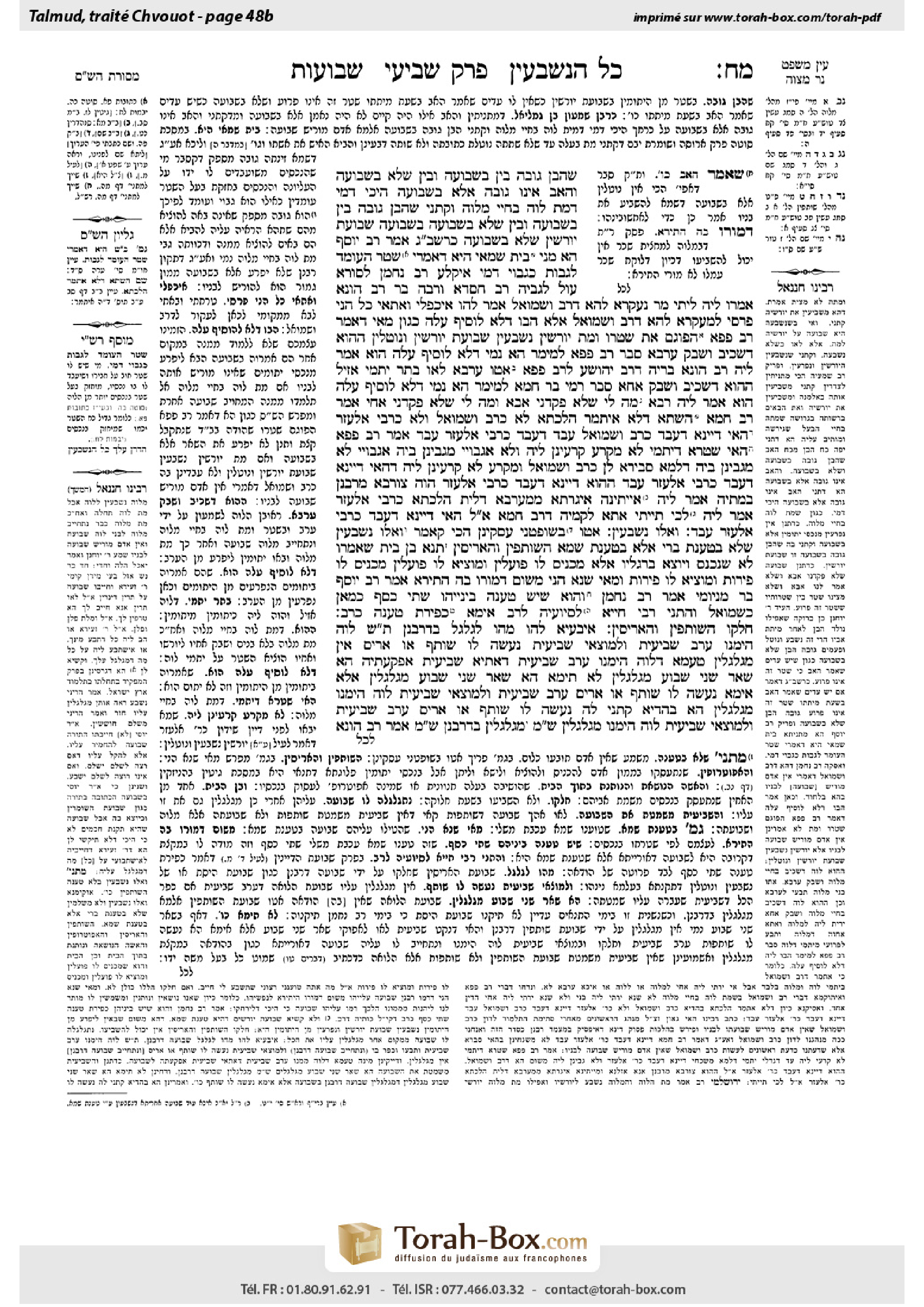
Shevuot 48b: Talmud study for Daf Yomi
Daf Yomi is the daily study of one Talmud folio. Explore 37 tractates with scans, Hebrew text, Sefaria English and AI-generated French translations where annotated.
Passage selection and English or AI-generated French translation are available where the scan has annotations. Daf Study is independent of Torah-Box and Sefaria.
Browse Shevuot · שבועות · All tractatesShevuot 48b text and translations
This page of Shevuot includes the Aramaic text, an English translation and an AI-generated French translation, alongside the scan above.
שבועות מ״ח ב · Aramaic and Hebrew text
שֶׁהַבֵּן גּוֹבֶה בֵּין בִּשְׁבוּעָה וּבֵין שֶׁלֹּא בִּשְׁבוּעָה, וְהָאָב אֵינוֹ גּוֹבֶה אֶלָּא בִּשְׁבוּעָה. הֵיכִי דָּמֵי – דְּמֵת לֹוֶה בְּחַיֵּי מַלְוֶה;
וְקָתָנֵי: שֶׁהַבֵּן גּוֹבֶה בֵּין בִּשְׁבוּעָה וּבֵין שֶׁלֹּא בִּשְׁבוּעָה; בִּשְׁבוּעָה – שְׁבוּעַת יוֹרְשִׁין, שֶׁלֹּא בִּשְׁבוּעָה – כְּרַבָּן שִׁמְעוֹן בֶּן גַּמְלִיאֵל!
אָמַר רַב יוֹסֵף: הָא מַנִּי – בֵּית שַׁמַּאי הִיא, דְּאָמְרִי: שְׁטָר הָעוֹמֵד לִגְבּוֹת – כְּגָבוּי דָּמֵי.
אִיקְּלַע רַב נַחְמָן לְסוּרָא; עוּל לְגַבֵּיהּ רַב חִסְדָּא וְרַבָּה בַּר רַב הוּנָא, אֲמַרוּ לֵיהּ: לֵיתֵי מָר נֶעְקְרַהּ לְהָא דְּרַב וּשְׁמוּאֵל. אֲמַר לְהוּ: אִיכַּפְלִי וַאֲתַאי כֹּל הָנֵי פַּרְסֵי, לְמֶעְקְרַהּ לְהָא דְּרַב וּשְׁמוּאֵל?! אֶלָּא הַבוּ דְלָא לוֹסֵיף עֲלַהּ; כְּגוֹן מַאי דְּאָמַר רַב פָּפָּא: הַפּוֹגֵם אֶת שְׁטָרוֹ וָמֵת – יוֹרְשִׁין נִשְׁבָּעִין שְׁבוּעַת יוֹרְשִׁין, וְנוֹטְלִין.
הָהוּא דִּשְׁכֵיב, וּשְׁבַק עָרְבָא. סְבַר רַב פָּפָּא לְמֵימָר: הָא נָמֵי – דְּלָא לוֹסֵיף עֲלַהּ הוּא. אֲמַר לֵיהּ רַב הוּנָא בְּרֵיהּ דְּרַב יְהוֹשֻׁעַ לְרַב פָּפָּא: אַטּוּ עָרְבָא לָאו בָּתַר יַתְמֵי אָזֵיל?!
הָהוּא דִּשְׁכֵיב, וּשְׁבַק אַחָא. סָבַר רָמֵי בַּר חָמָא לְמֵימַר: הָא נָמֵי – דְּלָא לוֹסֵיף עֲלַהּ הוּא. אֲמַר לֵיהּ רָבָא: מָה לִי ״שֶׁלֹּא פְּקָדַנִי אַבָּא״, וּמָה לִי ״שֶׁלֹּא פְּקָדַנִי אָחִי״.
אָמַר רַב חָמָא: הַשְׁתָּא דְּלָא אִיתְּמַר הִלְכְתָא לָא כְּרַב וּשְׁמוּאֵל וְלָא כְּרַבִּי אֶלְעָזָר; הַאי דַּיָּינָא דַּעֲבַד כְּרַב וּשְׁמוּאֵל – עֲבַד, דַּעֲבַד כְּרַבִּי אֶלְעָזָר – עֲבַד.
אָמַר רַב פָּפָּא: הַאי שְׁטָרָא דְּיַתְמֵי – לָא מִקְרָע קָרְעִינַן לֵיהּ, וְלָא אַגְבּוֹיֵי מַגְבִּינַן בֵּיהּ. אַגְבּוֹיֵי לָא מַגְבִּינַן בֵּיהּ – דִּלְמָא סְבִירָא לַן כְּרַב וּשְׁמוּאֵל, וּמִקְרָע לָא קָרְעִינַן לֵיהּ – דְּהַאי דַּיָּינָא דַּעֲבַד כְּרַבִּי אֶלְעָזָר, עֲבַד.
הָהוּא דַּיָּינָא דַּעֲבַד כְּרַבִּי אֶלְעָזָר. הֲוָה צוּרְבָּא מֵרַבָּנַן בְּמָתֵיהּ, אֲמַר לֵיהּ: אַיְיתִינָא אִיגַּרְתָּא מִמַּעְרְבָא, דְּלֵית הִלְכְתָא כְּרַבִּי אֶלְעָזָר. אֲמַר לֵיהּ: לְכִי תַּיְיתֵי. אֲתָא לְקַמֵּיהּ דְּרַב חָמָא, אֲמַר לֵיהּ: הַאי דַּיָּינָא דַּעֲבַד כְּרַבִּי אֶלְעָזָר – עֲבַד.
וְאֵלּוּ נִשְׁבָּעִין. אַטּוּ בְּשׁוּפְטָנֵי עָסְקִינַן?! הָכִי קָאָמַר: וְאֵלּוּ נִשְׁבָּעִין שֶׁלֹּא בְּטַעֲנַת בָּרִי אֶלָּא בְּטַעֲנַת שֶׁמָּא – הַשּׁוּתָּפִין וְהָאֲרִיסִין.
תָּנָא: בֶּן בַּיִת שֶׁאָמְרוּ – לֹא שֶׁנִּכְנָס וְיוֹצֵא בְּרַגְלָיו; אֶלָּא מַכְנִיס לוֹ פּוֹעֲלִין וּמוֹצִיא לוֹ פּוֹעֲלִין, מַכְנִיס לוֹ פֵּירוֹת וּמוֹצִיא לוֹ פֵּירוֹת.
וּמַאי שְׁנָא הָנֵי? מִשּׁוּם דְּמוֹרוּ בֵּהּ הֶתֵּירָא.
אָמַר רַב יוֹסֵף בַּר מִנְיוֹמֵי, אָמַר רַב נַחְמָן: וְהוּא שֶׁיֵּשׁ טַעֲנָה בֵּינַיְיהוּ שְׁתֵּי כֶּסֶף.
כְּמַאן – כִּשְׁמוּאֵל?! וְהָתָנֵי רַבִּי חִיָּיא לְסַיּוֹעֵיהּ לְרַב! אֵימָא כְּפִירַת טַעֲנָה, כְּרַב.
חָלְקוּ הַשּׁוּתָּפִין וְהָאֲרִיסִין. אִיבַּעְיָא לְהוּ: מַהוּ לְגַלְגֵּל בִּדְרַבָּנַן?
תָּא שְׁמַע: לָוָה הֵימֶנּוּ עֶרֶב שְׁבִיעִית, וּלְמוֹצָאֵי שְׁבִיעִית נַעֲשָׂה לוֹ שׁוּתָּף אוֹ אָרִיס – אֵין מְגַלְגְּלִין. טַעְמָא דְּלָוָה הֵימֶנּוּ עֶרֶב שְׁבִיעִית – דַּאֲתַאי שְׁבִיעִית אַפְקַעְתֵּיהּ; הָא שְׁאָר שְׁנֵי שָׁבוּעַ – מְגַלְגְּלִין!
לָא תֵּימָא: הָא שְׁאָר שְׁנֵי שָׁבוּעַ – מְגַלְגְּלִין; אֶלָּא אֵימָא: נַעֲשָׂה לוֹ שׁוּתָּף אוֹ אָרִיס עֶרֶב שְׁבִיעִית, וּלְמוֹצָאֵי שְׁבִיעִית לָוָה הֵימֶנּוּ – מְגַלְגְּלִין.
הָא בְּהֶדְיָא קָתָנֵי לַהּ: נַעֲשָׂה לוֹ שׁוּתָּף אוֹ אָרִיס עֶרֶב שְׁבִיעִית, וּלְמוֹצָאֵי שְׁבִיעִית לָוָה הֵימֶנּוּ – מְגַלְגְּלִין! שְׁמַע מִינַּהּ: מְגַלְגְּלִין בִּדְרַבָּנַן! שְׁמַע מִינַּהּ.
אָמַר רַב הוּנָא:
Shevuot 48b · English translation
as the son can collect both by taking an oath and without taking an oath, while the father can collect only by taking an oath. What are the circumstances in which this occurs? It is when the borrower died during the life of the lender. The father who is the lender can collect from the borrower’s heirs only if he takes an oath.
And it is taught: As the son can collect both by taking an oath and without taking an oath. He collects by taking an oath when he takes the heirs’ oath, that he has no knowledge that his father’s debt was paid, and he collects without taking an oath in accordance with the opinion of Rabban Shimon ben Gamliel in the mishna, that when there are witnesses that the father said at the time of his death that a certain promissory note had not been paid, the son collects the debt without taking an oath. In any case, absent testimony to that effect, the father bequeaths the oath to his children and the son can collect by taking an oath, contrary to the ruling of Rav and Shmuel.
Rav Yosef said in response: In accordance with whose opinion is this baraita? It is in accordance with the opinion of Beit Shammai, who say that a debt recorded in a promissory note that stands to be collected is considered as if it is already collected. Therefore, the father is considered to be already in possession of the loan and bequeaths it to his son. Even though the Sages instituted that the son take an oath to the heirs of the borrower, this is not a case of the son inheriting an oath.
§ It is related that Rav Naḥman arrived in the city of Sura. Rav Ḥisda and Rabba bar Rav Huna came to see him. They said to him: Let our Master come, and together we will overturn that ruling of Rav and Shmuel. Rav Naḥman said to them: Did I exert myself and come all these parasangs to uproot that ruling of Rav and Shmuel? Rather, let us not extend their ruling by applying it to other situations outside the specific context of when the borrower died during the lifetime of the lender. The Gemara offers an example: This is like what Rav Pappa says: If a creditor vitiates his promissory note, by acknowledging that he has received partial payment and thereby rendering himself liable to take an oath in order to receive the rest, and then he dies, his heirs take the heirs’ oath and collect from the debtor.
The Gemara relates: There was a certain debtor who died and left a guarantor of his debt, and the orphans of the creditor came to collect from the guarantor. Rav Pappa thought to say: This, too, is a case to which one should not extend Rav and Shmuel’s ruling, as they said only that orphans do not inherit an oath to collect from other orphans, and this should not apply to collecting from a guarantor. Rav Huna, son of Rav Yehoshua, said to Rav Pappa: Is that to say that the guarantor will not pursue the orphans and collect from them? Ultimately, collecting from the guarantor is tantamount to collecting from the orphans, and no distinction should be made.
The Gemara relates: There was a certain creditor who died and left a brother as his heir, who wanted to collect from the orphans of the debtor. Rami bar Ḥama thought to say that this, too, is a case to which one should not extend Rav and Shmuel’s ruling, since Rav and Shmuel ruled that one does not bequeath an oath to one’s children, and they did not mention a case where the heir is a brother. Rava said to him: What difference does it make to me if the oath taken by the heir is: My father did not inform me that this debt has been paid, and what difference does it make to me if the oath taken is: My brother did not inform me?
Rav Ḥama says: Now that the halakha was not stated either in accordance with the opinion of Rav and Shmuel or in accordance with the opinion of Rabbi Elazar, a judge who rules in accordance with the opinion of Rav and Shmuel has ruled, and his ruling is accepted, and a judge who rules in accordance with the opinion of Rabbi Elazar has ruled, and his ruling is accepted.
Rav Pappa says: When that promissory note of orphans comes before our court, we do not tear it up, but we also do not collect the debt with it. We do not collect the debt with it, since perhaps we should hold in accordance with the opinion of Rav and Shmuel that orphans cannot collect debts in a case where their father was required to take an oath to collect, as they cannot take the appropriate oath; but we do not tear it up, since a judge who rules in accordance with the opinion of Rabbi Elazar has ruled.
The Gemara relates: There was a certain judge who ruled in accordance with the opinion of Rabbi Elazar. There was a Torah scholar in his city. He said to the judge: I will bring a letter from the West, Eretz Yisrael, stating that the halakha is not in accordance with the opinion of Rabbi Elazar. The judge said to him: When you bring such a letter, I will consider it, but for now I stand by my ruling. That Torah scholar came before Rav Ḥama, and Rav Ḥama said to him: A judge who rules in accordance with the opinion of Rabbi Elazar has ruled, and his ruling cannot be voided.
§ The mishna teaches: And these people are sometimes required to take an oath that they do not owe anything even when there is no explicit claim against them: Partners, sharecroppers, stewards, a woman who does business from home, where she manages the property of orphans, and the member of the household appointed to manage the household’s affairs. The Gemara asks: Is that to say that we are dealing with fools who take an oath even though no claim has been brought against them? The Gemara explains: This is what the mishna is saying: And these people take an oath without it being in response to a definite claim but only to an uncertain claim, i.e., the claimant cannot know with certainty that he is owed money: Partners, sharecroppers, and the others listed in the mishna.
The Sages taught in a baraita (Tosefta, Ketubot 9:3): With regard to the member of the household whom they mentioned in the mishna, this is not referring to one who enters and exits the house on foot as a family friend, but rather to one who engages laborers, and dismisses laborers, gathers produce, and sends out produce in managing the household.
The Gemara asks: And what is different about these people listed in the mishna, e.g., partners, such that they are liable to take an oath in response to an uncertain claim? It is because they tend to grant themselves permission to take for themselves from the property for which they are responsible, using as an excuse the effort they invest in their duties.
Rav Yosef bar Minyumi said that Rav Naḥman said: One takes an oath in response to an uncertain claim only when there is a claim between them worth at least two silver ma’a.
The Gemara asks: In accordance with whose opinion is this ruling? Is it in accordance with that of Shmuel? Shmuel holds that one becomes liable to take an oath after admitting to part of a claim when the value of the entire claim is at least two silver ma’a. Rav holds that the portion one denies he owes must be at least two ma’a (see 39b). But didn’t Rabbi Ḥiyya teach a baraita in support of Rav? The Gemara answers: Say that Rav Naḥman means that the value of the denial of a claim is at least two silver ma’a, in accordance with the opinion of Rav.
§ The mishna teaches: Once the partners or the sharecroppers have divided the common property, and each has taken his share, then one side may not require an oath of the other absent a definite claim. A question was raised before the Sages: What is the halakha about extending an oath to an additional situation, in a case where the original oath is by rabbinic law?
The Gemara suggests: Come and hear a baraita: If one borrowed from another on the eve of, i.e., before, the Sabbatical Year, and upon the conclusion of the Sabbatical Year became his partner or sharecropper, the lender may not extend the partner’s or sharecropper’s oath to an oath about the loan. The Gemara infers: The reason he may not extend the oath is that he borrowed from him on the eve of the Sabbatical Year, so that the Sabbatical Year came and abrogated the loan, rendering the oath irrelevant. Therefore, if he borrowed during the other years of the seven-year Sabbatical cycle, an oath may be extended from the partner’s oath or sharecropper’s oath, which are rabbinic ordinances, to an oath about the loan.
The Gemara rejects that inference: Do not say: Therefore, if he borrowed during the other years of the Sabbatical cycle, an oath may be extended. Rather, say that one should infer from the baraita that if he became his partner or sharecropper on the eve of the Sabbatical Year, and upon the conclusion of the Sabbatical Year he borrowed from him and incurred an oath by Torah law, that oath may be extended.
The Gemara asks: Isn’t that taught explicitly in a baraita? It teaches: If he became his partner or sharecropper on the eve of the Sabbatical Year, and upon the conclusion of the Sabbatical Year he borrowed from him, the oath may be extended. Therefore, the initial inference must be correct. Conclude from it that an oath incurred by rabbinic law may be extended. The Gemara affirms: Conclude from it that this is so.
Rav Huna says:
Shevuot 48b · Traduction française (IA)
car le fils peut recouvrer la créance aussi bien en prêtant serment que sans prêter serment, tandis que le père ne peut la recouvrer qu’en prêtant serment. Dans quelles circonstances cela se produit-il ? Lorsque l’emprunteur est mort du vivant du prêteur. Le père, qui est le prêteur, ne peut recouvrer la créance auprès des héritiers de l’emprunteur qu’en prêtant serment.
Et il est enseigné : « Le fils peut recouvrer la créance aussi bien en prêtant serment que sans prêter serment. » Il la recouvre en prêtant serment lorsqu’il prête le serment des héritiers, à savoir qu’il n’a pas connaissance que la dette de son père ait été payée ; il la recouvre sans prêter serment conformément à l’avis de Rabban Shimon ben Gamliel dans la Michna : lorsqu’il y a des témoins attestant que le père a déclaré, au moment de sa mort, qu’un billet à ordre déterminé n’avait pas été payé, le fils recouvre la créance sans prêter serment. En tout état de cause, en l’absence d’un tel témoignage, le père transmet le serment à ses enfants, et le fils peut recouvrer la créance en prêtant serment, contrairement à la décision de Rav et Shmuel.
Rav Yosef répondit : De l’avis de qui cette baraïta est-elle ? Elle est conforme à l’avis de Beit Shammaï, qui disent qu’une dette inscrite dans un billet à ordre et destinée à être recouvrée est considérée comme déjà recouvrée. Le père est donc considéré comme ayant déjà la possession du prêt et le transmet à son fils. Bien que les Sages aient institué que le fils prête serment aux héritiers de l’emprunteur, il ne s’agit pas d’un cas où le fils hérite d’un serment.
§ On rapporte que Rav Naḥman arriva dans la ville de Soura. Rav Ḥisda et Rabba bar Rav Huna vinrent lui rendre visite. Ils lui dirent : « Que notre Maître vienne, et ensemble nous renverserons cette décision de Rav et Shmuel. » Rav Naḥman leur dit : « Me suis-je donné tant de peine et ai-je parcouru toutes ces parasanges pour abolir cette décision de Rav et Shmuel ? » Au contraire, n’étendons pas leur décision à d’autres situations que celle, précise, où l’emprunteur est mort du vivant du prêteur. La Guemara donne un exemple : c’est comme ce que dit Rav Pappa : si un créancier rend son billet à ordre contestable en reconnaissant avoir reçu un paiement partiel, se rendant ainsi tenu de prêter serment pour recevoir le reste, puis qu’il meurt, ses héritiers prêtent le serment des héritiers et recouvrent la créance auprès du débiteur.
La Guemara rapporte : Un débiteur mourut en laissant un garant de sa dette, et les orphelins du créancier vinrent recouvrer la créance auprès du garant. Rav Pappa pensa dire que, là encore, il ne fallait pas étendre la décision de Rav et Shmuel : ils avaient seulement dit que des orphelins n’héritent pas d’un serment leur permettant de recouvrer une créance auprès d’autres orphelins, et cela ne devrait pas s’appliquer au recouvrement auprès d’un garant. Rav Huna, fils de Rav Yehoshua, dit à Rav Pappa : « Veux-tu dire que le garant ne se retournera pas contre les orphelins et ne recouvrera pas la créance auprès d’eux ? » En définitive, recouvrer la créance auprès du garant équivaut à la recouvrer auprès des orphelins ; il ne faut donc faire aucune distinction.
La Guemara rapporte : Un créancier mourut en laissant un frère pour héritier, lequel voulut recouvrer la créance auprès des orphelins du débiteur. Rami bar Ḥama pensa dire que, là encore, il ne fallait pas étendre la décision de Rav et Shmuel, car Rav et Shmuel avaient décidé qu’on ne transmet pas un serment à ses enfants et n’avaient pas mentionné le cas où l’héritier est un frère. Rava lui dit : « Quelle différence cela fait-il pour moi que l’héritier prête serment en disant : “Mon père ne m’a pas informé que cette dette avait été payée”, ou qu’il prête serment en disant : “Mon frère ne m’en a pas informé” ? »
Rav Ḥama dit : À présent que la halakha n’a été énoncée ni conformément à l’avis de Rav et Shmuel ni conformément à celui de Rabbi Elazar, un juge qui statue conformément à l’avis de Rav et Shmuel a rendu une décision qui est acceptée, et un juge qui statue conformément à l’avis de Rabbi Elazar a également rendu une décision qui est acceptée.
Rav Pappa dit : Lorsque le billet à ordre de ces orphelins est présenté devant notre tribunal, nous ne le déchirons pas, mais nous ne recouvrons pas non plus la créance sur cette base. Nous ne recouvrons pas la créance sur cette base, car peut-être devons-nous retenir l’avis de Rav et Shmuel, selon lequel des orphelins ne peuvent recouvrer des créances lorsque leur père devait prêter serment pour les recouvrer, puisqu’ils ne peuvent prêter le serment requis ; mais nous ne le déchirons pas, car un juge qui statue conformément à l’avis de Rabbi Elazar a rendu une décision qui est acceptée.
La Guemara rapporte : Un juge statua conformément à l’avis de Rabbi Elazar. Un érudit en Torah vivait dans sa ville. Il dit au juge : « Je vais apporter une lettre de l’Ouest, d’Eretz Israël, attestant que la halakha n’est pas conforme à l’avis de Rabbi Elazar. » Le juge lui dit : « Lorsque tu apporteras une telle lettre, je l’examinerai, mais pour l’instant, je maintiens ma décision. » Cet érudit en Torah se présenta devant Rav Ḥama, qui lui dit : « Un juge qui statue conformément à l’avis de Rabbi Elazar a rendu une décision qui ne peut être annulée. »
§ La Michna enseigne : « Et ces personnes sont parfois tenues de prêter serment qu’elles ne doivent rien, même lorsqu’aucune réclamation explicite n’a été formulée contre elles : les associés, les métayers, les intendants, une femme qui fait du commerce depuis son domicile en administrant les biens d’orphelins, ainsi que le membre du foyer chargé de gérer les affaires de la maison. » La Guemara demande : « Cela signifie-t-il que nous avons affaire à des sots qui prêtent serment alors qu’aucune réclamation n’a été formulée contre eux ? » La Guemara explique : « Voici ce que dit la Michna : ces personnes prêtent serment non pas en réponse à une réclamation certaine, mais seulement à une réclamation incertaine, c’est-à-dire lorsque le demandeur ne peut savoir avec certitude qu’une somme lui est due : les associés, les métayers et les autres personnes énumérées dans la Michna. »
Les Sages enseignent dans une baraïta (Tosefta, Ketoubot 9:3) : Le membre du foyer mentionné dans la Michna ne désigne pas quelqu’un qui entre et sort de la maison à pied en tant qu’ami de la famille, mais plutôt quelqu’un qui engage et renvoie des ouvriers, rassemble les produits et les expédie dans le cadre de la gestion de la maison.
La Guemara demande : Qu’ont donc de particulier les personnes énumérées dans la Michna, par exemple les associés, pour être tenues de prêter serment en réponse à une réclamation incertaine ? C’est parce qu’elles ont tendance à s’autoriser à prélever pour elles-mêmes sur les biens dont elles ont la charge, invoquant les efforts qu’elles consacrent à leurs fonctions.
Rav Yosef bar Minyumi dit au nom de Rav Naḥman : On ne prête serment en réponse à une réclamation incertaine que si l’enjeu entre eux vaut au moins deux ma’a d’argent.
La Guemara demande : De l’avis de qui cette décision est-elle ? Est-elle conforme à celui de Shmuel ? Shmuel estime qu’on devient tenu de prêter serment après avoir reconnu une partie d’une réclamation lorsque la valeur de la réclamation entière atteint au moins deux ma’a d’argent. Selon Rav, la partie dont on nie être redevable doit, elle, valoir au moins deux ma’a (voir 39b). Mais Rabbi Ḥiyya n’a-t-il pas enseigné une baraïta à l’appui de Rav ? La Guemara répond : Il faut comprendre que Rav Naḥman veut dire que la valeur de la partie contestée atteint au moins deux ma’a d’argent, conformément à l’avis de Rav.
§ La Michna enseigne : « Dès que les associés ou les métayers ont partagé les biens communs et que chacun a pris sa part, aucune des parties ne peut exiger de l’autre qu’elle prête serment en l’absence d’une réclamation certaine. » Une question fut posée aux Sages : quelle est la halakha quant à l’extension d’un serment à une situation supplémentaire lorsque le serment initial est d’ordre rabbinique ?
La Guemara propose : Viens et entends une baraïta : si quelqu’un a emprunté à un autre à la veille de l’année de la Chmita, c’est-à-dire avant celle-ci, et qu’à la fin de l’année de la Chmita il est devenu son associé ou son métayer, le prêteur ne peut pas étendre le serment de l’associé ou du métayer à un serment portant sur le prêt. La Guemara en déduit que la raison pour laquelle il ne peut pas étendre le serment est qu’il lui a emprunté à la veille de l’année de la Chmita : celle-ci est donc survenue et a annulé le prêt, rendant le serment sans objet. Par conséquent, s’il lui a emprunté au cours des autres années du cycle de sept ans de la Chmita, on peut étendre le serment de l’associé ou du métayer, qui relève d’une ordonnance rabbinique, à un serment portant sur le prêt.
La Guemara rejette cette déduction : Ne dis pas : « Par conséquent, s’il lui a emprunté au cours des autres années du cycle de la Chmita, on peut étendre le serment. » Il faut plutôt déduire de la baraïta que, s’il est devenu son associé ou son métayer à la veille de l’année de la Chmita, puis qu’à la fin de cette année il lui a emprunté et s’est trouvé tenu à un serment d’ordre toranique, ce serment peut être étendu.
La Guemara demande : Cela n’est-il pas enseigné explicitement dans une baraïta ? Elle enseigne : s’il est devenu son associé ou son métayer à la veille de l’année de la Chmita, puis qu’à la fin de cette année il lui a emprunté, le serment peut être étendu. Il faut donc conclure que la déduction initiale est juste : un serment imposé par le droit rabbinique peut être étendu. La Guemara confirme : Conclus-en que c’est bien le cas.
Rav Huna dit :
Traduction française générée par IA à partir de l’édition anglaise de Sefaria. Vérifie toujours un passage avec le texte source.
Text from Sefaria: William Davidson Edition - Vocalized Aramaic (CC BY NC); William Davidson Edition - English (CC BY NC).