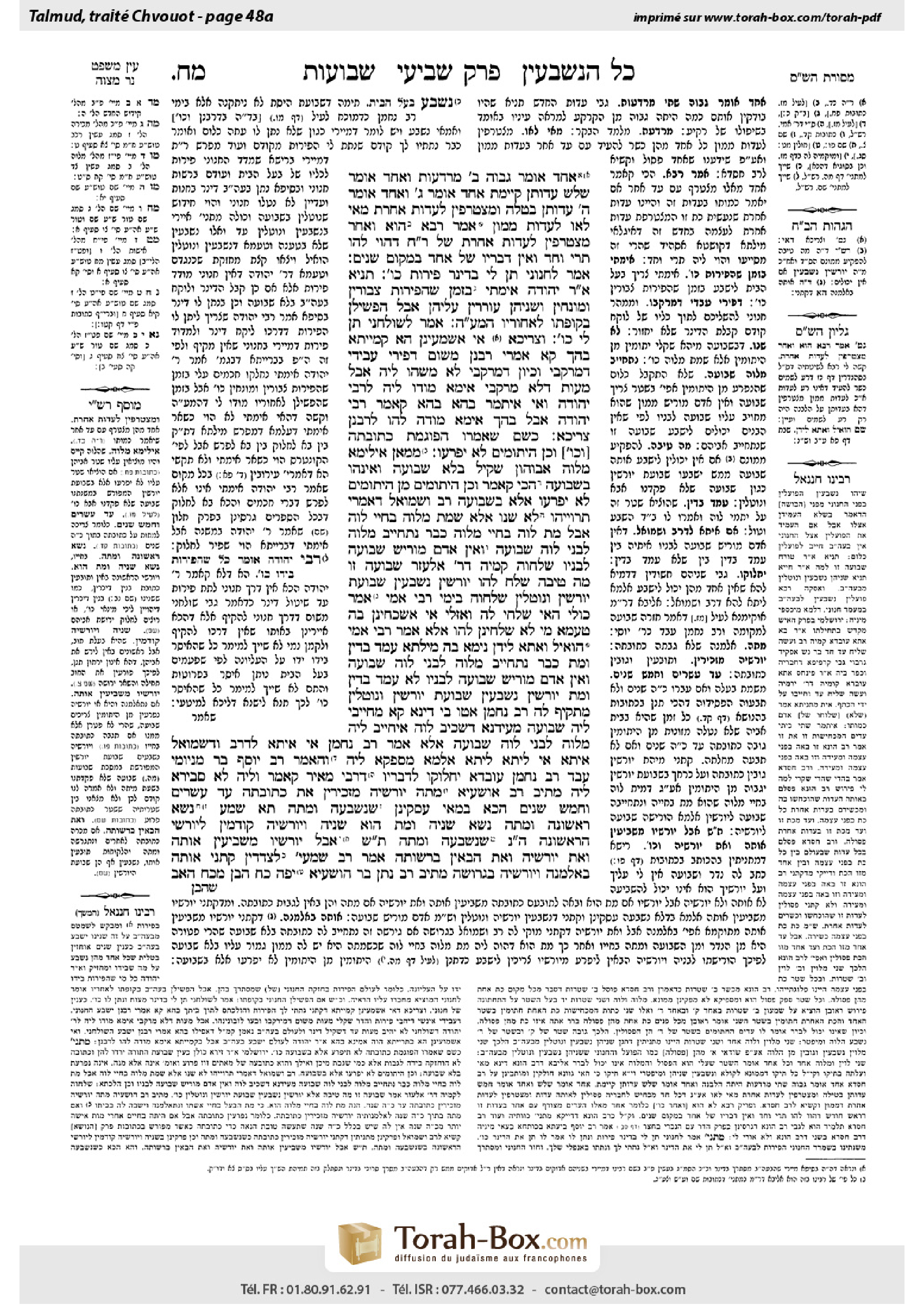
Shevuot 48a: Talmud study for Daf Yomi
Daf Yomi is the daily study of one Talmud folio. Explore 37 tractates with scans, Hebrew text, Sefaria English and AI-generated French translations where annotated.
Passage selection and English or AI-generated French translation are available where the scan has annotations. Daf Study is independent of Torah-Box and Sefaria.
Browse Shevuot · שבועות · All tractatesShevuot 48a text and translations
This page of Shevuot includes the Aramaic text, an English translation and an AI-generated French translation, alongside the scan above.
שבועות מ״ח א · Aramaic and Hebrew text
אֶחָד אוֹמֵר גָּבוֹהַּ שְׁתֵּי מַרְדְּעוֹת וְאֶחָד אוֹמֵר שָׁלֹשׁ – עֵדוּתָן קַיֶּימֶת. אֶחָד אוֹמֵר שָׁלֹשׁ וְאֶחָד אוֹמֵר חָמֵשׁ – עֵדוּתָן בְּטֵלָה, וּמִצְטָרְפִין לְעֵדוּת אַחֶרֶת.
מַאי, לָאו לְעֵדוּת מָמוֹן? אָמַר רָבָא: הוּא וְאַחֵר מִצְטָרְפִין לְעֵדוּת אַחֶרֶת שֶׁל רֹאשׁ חֹדֶשׁ; דְּהָוֵי לְהוּ תְּרֵי וְחַד, וְאֵין דְּבָרָיו שֶׁל אֶחָד בִּמְקוֹם שְׁנַיִם.
אָמַר לַחֶנְוָנִי ״תֵּן לִי בְּדִינָר פֵּירוֹת״ כּוּ׳. תַּנְיָא, אָמַר רַבִּי יְהוּדָה: אֵימָתַי – בִּזְמַן שֶׁהַפֵּירוֹת צְבוּרִין וּמוּנָּחִין, וּשְׁנֵיהֶן עוֹרְרִין עֲלֵיהֶן; אֲבָל הִפְשִׁילָן בְּקוּפָּתוֹ לַאֲחוֹרָיו – הַמּוֹצִיא מֵחֲבֵרוֹ עָלָיו הָרְאָיָה.
אָמַר לַשּׁוּלְחָנִי ״תֵּן לִי״ כּוּ׳. וּצְרִיכָא; דְּאִי אַשְׁמְעִינַן הָא קַמַּיְיתָא – בְּהָךְ קָא אָמְרִי רַבָּנַן, מִשּׁוּם דְּפֵירֵי עֲבִידִי דְּמַרְקְבִי, וְכֵיוָן דְּמַרְקְבִי לָא מְשַׁהוּ לֵיהּ; אֲבָל מָעוֹת דְּלָא מַרְקְבִי – אֵימָא מוֹדֵי לֵיהּ לְרַבִּי יְהוּדָה.
וְאִי אִיתְּמַר בְּהָא – בְּהָא קָאָמַר רַבִּי יְהוּדָה, אֲבָל בְּהָךְ אֵימָא מוֹדֶה לְהוּ לְרַבָּנַן; צְרִיכָא.
כְּשֵׁם שֶׁאָמְרוּ הַפּוֹגֶמֶת כְּתוּבָּתָהּ [וְכוּ׳], וְכֵן הַיְּתוֹמִין לֹא יִפָּרְעוּ. מִמַּאן? אִילֵימָא מִלֹּוֶה – אֲבוּהוֹן שָׁקֵיל בְּלָא שְׁבוּעָה, וְאִינְהוּ בִּשְׁבוּעָה?! הָכִי קָאָמַר: וְכֵן הַיְּתוֹמִים מִן הַיְּתוֹמִים, לֹא יִפָּרְעוּ אֶלָּא בִּשְׁבוּעָה.
רַב וּשְׁמוּאֵל דְּאָמְרִי תַּרְוַיְיהוּ: לֹא שָׁנוּ אֶלָּא שֶׁמֵּת מַלְוֶה בְּחַיֵּי לֹוֶה; אֲבָל מֵת לֹוֶה בְּחַיֵּי מַלְוֶה – כְּבָר נִתְחַיֵּיב מַלְוֶה לִבְנֵי לֹוֶה שְׁבוּעָה, וְאֵין אָדָם מוֹרִישׁ שְׁבוּעָה לְבָנָיו.
שַׁלְחוּהָ קַמֵּיהּ דְּרַבִּי אֶלְעָזָר: שְׁבוּעָה זוֹ – מָה טִיבָהּ? שְׁלַח לְהוּ: יוֹרְשִׁין נִשְׁבָּעִין שְׁבוּעַת יוֹרְשִׁין, וְנוֹטְלִין. שַׁלְחוּהָ בִּימֵי רַבִּי אַמֵּי, אָמַר: כּוּלֵּי הַאי שָׁלְחִי לַהּ וְאָזְלִי? אִי אַשְׁכְּחִינַן בַּהּ טַעְמָא, מִי לָא שָׁלְחִינַן לְהוּ?! אֶלָּא אָמַר רַבִּי אַמֵּי: הוֹאִיל וַאֲתָא לְיָדָן, נֵימָא בַּהּ מִילְּתָא:
עָמַד בַּדִּין וָמֵת – כְּבָר נִתְחַיֵּיב מַלְוֶה לִבְנֵי לֹוֶה שְׁבוּעָה, וְאֵין אָדָם מוֹרִישׁ שְׁבוּעָה לְבָנָיו. לֹא עָמַד בַּדִּין וָמֵת – יוֹרְשִׁין נִשְׁבָּעִין שְׁבוּעַת יוֹרְשִׁין, וְנוֹטְלִין.
מַתְקֵיף לַהּ רַב נַחְמָן: אַטּוּ בֵּי דִינָא קָא מְחַיְּיבִי לֵיהּ שְׁבוּעָה?! מֵעִידָּנָא דִּשְׁכֵיב לֹוֶה, אִיחַיַּיב לֵיהּ מַלְוֶה לִבְנֵי לֹוֶה שְׁבוּעָה!
אֶלָּא אָמַר רַב נַחְמָן: אִי אִיתַהּ לִדְרַב וְדִשְׁמוּאֵל, אִיתַהּ; אִי לֵיתַהּ, לֵיתַהּ. אַלְמָא מְסַפְּקָא לֵיהּ; וְהָאָמַר רַב יוֹסֵף בַּר מִנְיוֹמֵי: עֲבַד רַב נַחְמָן עוֹבָדָא – יַחְלוֹקוּ! לִדְבָרָיו דְּרַבִּי מֵאִיר קָאָמַר, וְלֵיהּ לָא סְבִירָא לֵיהּ.
מֵתִיב רַב אוֹשַׁעְיָא: מֵתָה – יוֹרְשֶׁיהָ מַזְכִּירִין אֶת כְּתוּבָּתָהּ עַד עֶשְׂרִים וְחָמֵשׁ שָׁנִים! הָכָא בְּמַאי עָסְקִינַן – שֶׁנִּשְׁבְּעָה וּמֵתָה.
תָּא שְׁמַע: נָשָׂא רִאשׁוֹנָה וָמֵתָה, נָשָׂא שְׁנִיָּה וּמֵת הוּא – שְׁנִיָּה וְיוֹרְשֶׁיהָ קוֹדְמִין לְיוֹרְשֵׁי הָרִאשׁוֹנָה! הָכָא נָמֵי, שֶׁנִּשְׁבְּעָה וּמֵתָה.
תָּא שְׁמַע: אֲבָל יוֹרְשָׁיו מַשְׁבִּיעִין אוֹתָהּ, וְאֶת יוֹרְשֶׁיהָ, וְאֶת הַבָּאִין בִּרְשׁוּתָהּ!
אָמַר רַב שְׁמַעְיָה, לִצְדָדִין קָתָנֵי: אוֹתָהּ – בְּאַלְמָנָה, וְיוֹרְשֶׁיהָ – בִּגְרוּשָׁה.
מֵתִיב רַב נָתָן בַּר הוֹשַׁעְיָא: יָפֶה כֹּחַ הַבֵּן מִכֹּחַ הָאָב –
Shevuot 48a · English translation
If one witness who came to testify about the new moon says that he saw it two oxgoads high above the horizon, and the other one says it was three oxgoads high, their testimony is valid, as a discrepancy of this type is reasonable. But if one says that he saw the moon three oxgoads above the horizon, and the other one says it was five, their testimony is voided. But despite this, they are not disqualified as witnesses, and either of them may join in another testimony.
What, is it not teaching that they each can join with another witness for testimony about monetary matters, even though each of them is suspected of giving false testimony? This contradicts Rav Ḥisda’s opinion. Rava said, explaining how Rav Ḥisda understands this baraita: He, one of the contradictory witnesses, and another witness may combine for another testimony about the new moon, as in doing so, they become two witnesses against one testifying differently; and the statement of one witness has no standing in a place where it is contradicted by two witnesses.
§ The mishna teaches: If one said to a storekeeper: Give me produce valued at a dinar, and he gave him the produce, and subsequently the storekeeper and the customer dispute whether the customer ever paid the storekeeper, the mishna rules that the customer takes an oath that he paid. It is taught in a baraita: Rabbi Yehuda says: When does the customer take this oath? He takes it when the produce is collected and situated in front of them, and the two of them are quarreling about it. But if the customer has it bundled in his basket on his back, the burden of proof rests upon the claimant, i.e., the storekeeper.
The mishna continues with a similar case: If one said to a money changer: Give me small coins valued at a dinar, and he gave him the coins, and subsequently they dispute whether the customer gave the money changer the dinar, the customer takes an oath that he paid already. The Gemara notes: It is necessary to teach both the case involving the storekeeper and the case involving the money changer, as had it taught us only this first case, one might say that only in that case do the Rabbis say that the customer may take an oath to avoid payment, because produce is prone to spoiling, and since it spoils storekeepers do not retain it but give it to the customer immediately. But with regard to money, which does not spoil, say that they concede to Rabbi Yehuda that a money changer does not give coins to the customer until he has received payment, and the customer does not need to take an oath.
And had the ruling been stated only about that case involving the money changer, one might say that only in that case does Rabbi Yehuda say that the customer need not take an oath to avoid payment, but in this case, involving the storekeeper, say he concedes to the Rabbis. Therefore it is necessary to teach this dispute for both cases.
§ The mishna teaches (see 45a): Just like other cases where the Sages said that one takes an oath and receives payment, the mishna teaches: A woman who vitiates her marriage contract, etc. And likewise, orphans may not collect with a promissory note inherited from their father except by taking an oath. The Gemara asks: From whom do they collect a debt by taking an oath? If we say that they collect this way from the borrower, i.e., those who borrowed from their father, that would not make sense. Their father would take payment with the promissory note without taking an oath, and they collect only by means of taking an oath? Don’t orphans have privileged status? Rather, this is what the mishna is saying: And even orphans do not collect with their father’s promissory note from the borrower’s orphans except by means of an oath.
Rav and Shmuel both say that the Sages taught that the lender’s orphans need to take an oath in order to be paid by the borrower’s orphans only when the lender died during the lifetime of the borrower, and the lender’s children had an opportunity to collect directly from the borrower without taking an oath. But if the borrower died during the lifetime of the lender, the lender has already become liable to take an oath to the children of the borrower, since one can collect from orphans only by means of an oath, and a person cannot bequeath an oath, i.e., a debt that requires the taking of an oath in order to be collected, to his children, and no payment is made. The lender’s children cannot take the oath that their father would have taken, that the promissory note has not been paid. The only oath they can take is that their father never told them that it had been paid, and that is insufficient once the father became liable to take an oath.
The Sages sent a question to Rabbi Elazar in Eretz Yisrael: What is the nature of this oath to the orphans of the borrower that it has the capacity to prevent the lender’s children from collecting their father’s debt? Rabbi Elazar sent a reply to them: That is not the correct ruling; rather, the heirs take the heirs’ oath, that they have no knowledge that this promissory note was paid, and collect payment of their claim. They sent the same question again to Eretz Yisrael in the days of Rabbi Ami. He said: They continue to send this question to this extent? If we had found a different explanation, wouldn’t we have sent it to them? Nevertheless, Rabbi Ami said: Since this question came to us, let us say something about it.
If the litigants stood trial and then the lender died before taking an oath, the lender has already become liable to take an oath to the children of the borrower in accordance with the court’s ruling, and a person cannot bequeath an oath to his children, in accordance with the opinion of Rav and Shmuel. If the litigants did not yet stand trial, and the lender died, the lender’s heirs take the heirs’ oath, and collect payment of their claim, as Rabbi Elazar said.
Rav Naḥman objects to this: Is that to say that it is the court that renders the lender liable to take an oath? At the moment the borrower died, the lender was liable to take an oath to the children of the borrower.
Rather, Rav Naḥman said: If the ruling of Rav and Shmuel is accepted, it is accepted; and if it is not accepted, it is not. The Gemara asks: Evidently, Rav Naḥman is uncertain whether the ruling of Rav and Shmuel is accepted. But didn’t Rav Yosef bar Minyumi say that Rav Naḥman ruled in an actual case against Rav and Shmuel, ruling that where both litigants are suspect about oaths they divide the disputed amount? The Gemara answers: Rav Naḥman stated his uncertainty with regard to the ruling of Rav and Shmuel, who rule in accordance with the statement of Rabbi Meir that the oath returns to its place, but he himself does not hold accordingly, but rather rules in accordance with the statement of Rabbi Yosei, who says that they divide the claim.
Rav Oshaya raises an objection from a mishna (Ketubot 104a): If a widow died without having received payment of her marriage contract, her heirs, e.g., sons from a previous marriage, may invoke her marriage contract in order to demand payment of it for up to twenty-five years later. Her heirs, who are orphans, can take an oath and collect their claim, even though they are collecting from other orphans, in contradiction to the ruling of Rav and Shmuel. The Gemara answers: Here we are dealing with a situation where the widow took an oath but died before she could collect the payment. When her heirs come to collect, an oath is no longer required.
The Gemara suggests: Come and hear a mishna (Ketubot 90a): In a case where he married his first wife and she died, and by the terms of the marriage contract, her sons inherit the sum promised in her marriage contract after the husband dies, if he subsequently married his second wife, and then he died, the second wife and her heirs take precedence over the heirs of the first wife, in collecting payment of her marriage contract. The heirs of the second wife can collect the marriage contract by taking an oath to the heirs of the first wife, stating that they have no knowledge of their mother having received her marriage contract, even though this is an oath bequeathed to them by their mother. This mishna therefore contradicts the ruling of Rav and Shmuel. The Gemara answers: This does not contradict their ruling, because they understand it to also be a situation where the second wife took an oath but died before she collected the payment.
The Gemara suggests: Come and hear another mishna (Ketubot 86b): If a husband stipulated that when his wife collects payment of her marriage contract he will not impose an oath on her or on her heirs or representatives, he may not impose an oath, but his heirs can administer an oath to her, to her heirs, and to those who come on her authority as representatives. Her heirs take an oath to collect from the husband’s heirs, though they are all orphans. This is contrary to the ruling of Rav and Shmuel, and here it is clear that the wife did not take an oath before she died.
Rav Shemaya said: The mishna is in accordance with Rav and Shmuel’s ruling because it teaches the administration of an oath disjunctively. The heirs can administer an oath to her when she is receiving payment of her marriage contract as a widow, or they can administer an oath to her heirs when she is a divorcée who died after the divorce and before her husband died. Since she died first, her heirs were not bequeathed an oath to her husband’s heirs.
Rav Natan bar Hoshaya raises an objection from a baraita: Sometimes the power of the son is greater than the power of the father,
Shevuot 48a · Traduction française (IA)
Si l’un des témoins venus témoigner au sujet de la nouvelle lune dit qu’il l’a vue à deux aiguillons de bœuf au-dessus de l’horizon, et que l’autre dit qu’il l’a vue à trois aiguillons de bœuf, leur témoignage est valide, car un tel écart est raisonnable. Mais si l’un dit qu’il a vu la lune à trois aiguillons au-dessus de l’horizon et que l’autre dit à cinq aiguillons, leur témoignage est invalidé. Malgré cela, ils ne sont pas disqualifiés comme témoins, et l’un ou l’autre peut s’associer à un autre témoin pour un autre témoignage.
N’enseigne-t-on pas qu’ils peuvent chacun s’associer à un autre témoin pour témoigner dans une affaire pécuniaire, alors même que chacun d’eux est soupçonné d’avoir fait un faux témoignage ? Cela contredit l’avis de Rav Ḥisda. Rava explique comment Rav Ḥisda comprend cette baraïta : l’un des témoins dont les témoignages se contredisent peut s’associer à un autre témoin pour un autre témoignage au sujet de la nouvelle lune ; ainsi, ils seront deux témoins contre un témoin qui affirme le contraire, et le témoignage d’un seul n’a pas de valeur lorsqu’il est contredit par deux témoins.
§ La Michna enseigne : si quelqu’un dit à un épicier : « Donne-moi des produits pour une valeur d’un dinar », et que celui-ci les lui donne, puis que l’épicier et le client se disputent pour savoir si le client a payé l’épicier, la Michna décide que le client prête serment qu’il a payé. Il est enseigné dans une baraïta : Rabbi Yehuda dit : dans quel cas le client prête-t-il ce serment ? Il le prête lorsque les produits sont réunis et se trouvent devant eux, et qu’ils se querellent à leur sujet. Mais si le client les a dans un panier attaché sur son dos, la charge de la preuve incombe au demandeur, c’est-à-dire à l’épicier.
La Michna poursuit avec un cas semblable : si quelqu’un dit à un changeur : « Donne-moi de la petite monnaie pour une valeur d’un dinar », et que celui-ci lui donne les pièces, puis qu’ils se disputent pour savoir si le client a donné le dinar au changeur, le client prête serment qu’il a déjà payé. La Guemara relève qu’il est nécessaire d’enseigner à la fois le cas de l’épicier et celui du changeur. En effet, si elle nous avait enseigné seulement le premier cas, on aurait pu dire que les Sages permettent au client de prêter serment pour se libérer de son obligation de payer uniquement dans ce cas, parce que les produits risquent de se gâter et que, puisqu’ils se gâtent, les épiciers ne les gardent pas, mais les donnent immédiatement au client. En revanche, concernant l’argent, qui ne se gâte pas, on aurait pu dire que les Sages reconnaissent l’avis de Rabbi Yehuda : le changeur ne donne pas de pièces au client avant d’avoir reçu le paiement, et le client n’a donc pas besoin de prêter serment.
Et si la décision n’avait été énoncée qu’à propos du cas du changeur, on aurait pu dire que Rabbi Yehuda affirme que le client n’a pas besoin de prêter serment pour se libérer de son obligation de payer uniquement dans ce cas, mais qu’en ce qui concerne le cas de l’épicier, il reconnaît l’avis des Sages. C’est pourquoi il est nécessaire d’enseigner cette controverse dans les deux cas.
§ La Michna enseigne (voir 45a) : parmi les autres cas où les Sages ont dit qu’une personne prête serment et reçoit son dû, la Michna enseigne celui d’une femme qui conteste son contrat de mariage, etc. De même, des orphelins ne peuvent recouvrer une créance au moyen d’un billet à ordre hérité de leur père qu’en prêtant serment. La Guemara demande : À qui recouvrent-ils une dette en prêtant serment ? Si l’on dit qu’ils la recouvrent auprès de l’emprunteur, c’est-à-dire de ceux qui ont emprunté à leur père, cela n’a pas de sens. Leur père aurait recouvré son dû au moyen du billet à ordre sans prêter serment, tandis qu’eux ne peuvent le recouvrer qu’en prêtant serment ? Les orphelins ne bénéficient-ils pas d’un statut privilégié ? Il faut plutôt comprendre que voici ce qu’enseigne la Michna : même des orphelins ne peuvent recouvrer une créance au moyen du billet à ordre de leur père auprès des orphelins de l’emprunteur qu’en prêtant serment.
Rav et Shmuel disent tous deux que les Sages ont enseigné que les orphelins du prêteur doivent prêter serment pour être payés par les orphelins de l’emprunteur uniquement lorsque le prêteur est mort du vivant de l’emprunteur, et que les enfants du prêteur ont eu la possibilité de recouvrer directement leur créance auprès de l’emprunteur sans prêter serment. Mais si l’emprunteur est mort du vivant du prêteur, le prêteur était déjà tenu de prêter serment aux enfants de l’emprunteur, car on ne peut recouvrer une créance auprès d’orphelins qu’en prêtant serment ; or une personne ne peut léguer à ses enfants un serment, c’est-à-dire une dette qui ne peut être recouvrée qu’en prêtant serment, et aucun paiement n’est effectué. Les enfants du prêteur ne peuvent pas prêter le serment que leur père aurait prêté, à savoir que le billet à ordre n’a pas été payé. Le seul serment qu’ils peuvent prêter est que leur père ne leur a jamais dit qu’il avait été payé, ce qui ne suffit pas dès lors que leur père était tenu de prêter serment.
Les Sages envoyèrent une question à Rabbi Elazar, en Eretz Israël : quelle est la nature de ce serment exigé des orphelins de l’emprunteur, qui peut empêcher les enfants du prêteur de recouvrer la dette de leur père ? Rabbi Elazar leur répondit : telle n’est pas la décision correcte ; les héritiers prêtent plutôt le serment des héritiers, à savoir qu’ils ignorent si ce billet à ordre a été payé, et recouvrent leur créance. Ils envoyèrent de nouveau la même question en Eretz Israël, à l’époque de Rabbi Ami. Celui-ci dit : vont-ils continuer à nous envoyer cette question ainsi ? Si nous avions trouvé une autre explication, ne la leur aurions-nous pas envoyée ? Néanmoins, Rabbi Ami dit : puisque cette question nous est parvenue, disons quelque chose à son sujet.
Si les parties ont comparu en justice, puis que le prêteur est mort avant d’avoir prêté serment, il était déjà tenu, conformément à la décision du tribunal, de prêter serment aux enfants de l’emprunteur ; or une personne ne peut léguer un serment à ses enfants, conformément à l’avis de Rav et Shmuel. Si les parties n’ont pas encore comparu en justice et que le prêteur est mort, les héritiers du prêteur prêtent le serment des héritiers et recouvrent leur créance, comme l’a dit Rabbi Elazar.
Rav Naḥman objecte : faut-il donc dire que c’est le tribunal qui rend le prêteur tenu de prêter serment ? Dès la mort de l’emprunteur, le prêteur était tenu de prêter serment aux enfants de l’emprunteur.
Rav Naḥman dit plutôt : si la décision de Rav et Shmuel est acceptée, elle l’est ; et si elle ne l’est pas, elle ne l’est pas. La Guemara demande : Rav Naḥman est donc incertain quant à savoir si la décision de Rav et Shmuel est acceptée. Mais Rav Yosef bar Minyumi n’a-t-il pas dit que Rav Naḥman avait tranché, dans un cas concret, contre Rav et Shmuel, en décidant que lorsque les deux parties sont suspectes en matière de serments, elles se partagent la somme contestée ? La Guemara répond : Rav Naḥman exprimait son incertitude au sujet de la décision de Rav et Shmuel, qui suivent l’avis de Rabbi Meir selon lequel le serment revient à son point de départ ; mais lui-même ne suit pas cet avis et tranche plutôt conformément à l’avis de Rabbi Yosei, qui dit qu’ils se partagent la créance.
Rav Oshaya soulève une objection à partir d’une Michna (Ketoubot 104a) : si une veuve meurt sans avoir reçu le paiement de son contrat de mariage, ses héritiers, par exemple ses fils issus d’un mariage précédent, peuvent invoquer son contrat de mariage pour en réclamer le paiement jusqu’à vingt-cinq ans plus tard. Ses héritiers, qui sont des orphelins, peuvent prêter serment et recouvrer leur créance, même s’ils la recouvrent auprès d’autres orphelins, ce qui contredit la décision de Rav et Shmuel. La Guemara répond : il s’agit ici d’une situation où la veuve a prêté serment, mais est morte avant de pouvoir recouvrer le paiement. Lorsque ses héritiers viennent recouvrer leur créance, il n’est plus nécessaire de prêter serment.
La Guemara suggère : viens et entends une Michna (Ketoubot 90a) : dans le cas où un homme a épousé sa première femme et qu’elle est morte, les fils de celle-ci héritent, selon les termes du contrat de mariage, de la somme qui y était promise après la mort du mari. S’il épouse ensuite une deuxième femme puis meurt, la deuxième femme et ses héritiers ont priorité sur les héritiers de la première femme pour recouvrer le paiement de son contrat de mariage. Les héritiers de la deuxième femme peuvent recouvrer ce contrat en prêtant serment aux héritiers de la première femme qu’ils ignorent si leur mère a reçu le paiement de son contrat de mariage, même si ce serment leur a été transmis en héritage par leur mère. Cette Michna contredit donc la décision de Rav et Shmuel. La Guemara répond : cela ne contredit pas leur décision, car ils comprennent également qu’il s’agit d’un cas où la deuxième femme a prêté serment, mais est morte avant d’avoir recouvré le paiement.
La Guemara suggère : viens et entends une autre Michna (Ketoubot 86b) : si un mari a stipulé que, lorsque sa femme recouvrerait le paiement de son contrat de mariage, il ne lui imposerait pas de serment, ni à ses héritiers ni à ses représentants, il ne peut pas lui imposer de serment ; mais ses héritiers peuvent imposer un serment à la femme, à ses héritiers et à ceux qui agissent en son nom comme représentants. Ses héritiers prêtent serment pour recouvrer leur dû auprès des héritiers du mari, alors que tous sont des orphelins. Cela va à l’encontre de la décision de Rav et Shmuel, et il est clair ici que la femme n’a pas prêté serment avant sa mort.
Rav Shemaya dit : la Michna est conforme à la décision de Rav et Shmuel, car elle énonce de manière disjonctive les personnes auxquelles un serment peut être imposé. Les héritiers peuvent imposer un serment à la femme lorsqu’elle recouvre le paiement de son contrat de mariage en tant que veuve, ou ils peuvent imposer un serment à ses héritiers lorsqu’elle est divorcée et qu’elle est morte après le divorce, mais avant la mort de son mari. Puisqu’elle est morte la première, ses héritiers n’ont pas hérité d’un serment à prêter aux héritiers de son mari.
Rav Natan bar Hoshaya soulève une objection à partir d’une baraïta : parfois, le fils a plus de pouvoir que le père,
Traduction française générée par IA à partir de l’édition anglaise de Sefaria. Vérifie toujours un passage avec le texte source.
Text from Sefaria: William Davidson Edition - Vocalized Aramaic (CC BY NC); William Davidson Edition - English (CC BY NC).